v. 47 – no.2 – abr./jun. 2010 Arq Gastroenterol
170
AR
TIGO ORIGINAL / ORIGINAL AR
TICLE
ARQGA/1483
EVALUATION OF THE NONALCOHOLIC FAT
LIVER DISEASE FIBROSIS SCORE FOR
PATIENTS UNDERGOING
BARIATRIC SURGERY
Silvania Klug
PIMENTEL
1, 5, Rodrigo
STROBEL
2, Carolina Gomes
GONÇALVES
3,
Danielle Giacometti
SAKAMOTO
4, Flávio Heuta
IVANO
5and Júlio Cezar Uili
COELHO
6ABSTRACT– Context - Morbidly obese patients have an increased risk for nonalcoholic fat liver disease. Its severe form, nonalcoholic steatohepatitis may cause liver ibrosis. The diagnosis of advanced ibrosis has great value during the pre operative evaluation for bariatric surgery. Currently, liver biopsy is the gold standard for diagnosis of liver ibrosis. Objective- To evaluate the nonalcoholic fat liver disease ibrosis score in morbidly obese patients undergoing Roux-en-Y gastric bypass in our population. Methods - One hundred ifty-eight morbidly obese patients that had undergone bariatric surgery were included. Age, body mass index, hyperglycemia, platelet count, albumin and AST/ALT ratio were applied to the score formula. Scores above 0.676 were indicative of advanced liver ibrosis and scores under –1,455 absence of advanced liver ibrosis. These scores were compared to liver biopsy indings. Results
- The presence of advanced ibrosis could be diagnosed with good accuracy, with a positive predictive value of 83.7%. The score had a higher accuracy to exclude advanced ibrosis with a negative predictive value of 97%. Twenty-ive patients (16%) had scores between the cutoffs points and were identiied as indeterminate. The score sensibility and speciicity was 83% and 97% respectively.
Conclusions - The nonalcoholic fat liver disease ibrosis score has high accuracy to identify and exclude advanced liver ibrosis in morbidly obese patients subjected to bariatric surgery.
HEADINGS - Liver cirrhosis. Fatty liver. Obesity, morbid. Bariatric surgery.
INTRODUCTION
The increasing prevalence of obesity, diabetes and metabolic syndrome promoted nonalcoholic fat liver disease (NAFLD) to the most common cause of chronic liver disease worldwide(4, 7, 18, 29). In the United
States, the incidence of obesity (class II and III) has increased from 23% to 30%, and in Brazil, 40.6% of the population are overweight, and 10% are obese(11, 25). The
prevalence of NAFLD in the USA population is 30% and in patients undergoing bariatric surgery is 90%(5, 17, 21, 28). The incidence of nonalcoholic steatohepatitis in
morbidly obese patients approaches 70%, and 4% of them may have cirrhosis(5, 20, 24, 36). Mild steatosis, in the
majority of cases, remains stable without any further complication(15, 38). However, patients with ibrosis
have a higher risk for cirrhosis, portal hypertension, hepatocarcinoma and death(1, 2, 9, 10, 32, 34, 38). Therefore,
identifying the presence and severity of liver ibrosis in patients with NAFLD is crucial in the guidance of subsequent management. Most of the patients with
ibrosis do not have symptoms and there are no speciic laboratory tests to detect liver ibrosis to date. Liver biopsy remains the only way to determine ibrosis’ grade and prognosis, but this is an invasive procedure and can be associated with a number of complications(23, 30). A noninvasive score, the NAFLD ibrosis score,
was recently created and it is in the validation process. This score is based on routinely measured clinical and laboratory variables and was initially used in a population of obese patients and was able to separate patients with and without signiicant NAFLD.
The purpose of this study was to evaluate de NAFLD ibrosis score in a group of morbidly obese patients undergoing bariatric surgery.
METHODS
One hundred and ifty-eight patients with morbid obesity that had undergone bariatric surgery were retrospectively evaluated. The indication for the bariatric surgery followed the Brazilian “Conselho Federal de
Post Graduation Course on Surgery of the Federal University of Paraná and Gastrovida Bariatric Surgery Service, Curitiba, PR, Brasil.
1 Post Graduation Course on Surgery, Federal University of Paraná, Curitiba, PR; 2 Bariatric Surgery Service, Clinica GastroVida, Curitiba, PR; 3 General Surgery Department, Positivo University; 4 Pathology Department, Evangelic Medical School, Curitiba, PR; 5 Bariatric Surgery Service, Sugisawa Medical Center, Curitiba, PR; 6 Division of Gastrointestinal Surgery, Hospital de Clínicas, Federal University of Paraná, Curitiba, PR, Brazil..
Pimentel SK, Strobel R, Gonçalves CG, Sakamoto DG, Ivano FH, Coelho JCU. Evaluation of the nonalcoholic fat liver disease ibrosis score for patients undergoing bariatric surgery
Arq Gastroenterol 171
v. 47 – no.2 – abr./jun. 2010
Medicina’s” criteria: body mass index (BMI) over 40 kg/m2 or
over 35 kg/m2 with complications due to the obesity, such as
diabetes, sleep apnea, high blood pressure, coronary disease and others(6).
During the pre operative evaluation, a complete history and physical examination was undertaken to exclude other causes of liver disease other than obesity. Laboratory evaluation included routine liver biochemistry (AST and ALT levels, total bilirubin, albumin, alkaline phosphatase and gamma-glutamyl transpeptidase), complete blood count, total cholesterol, HDL cholesterol and total triglycerides, fasting glucose, viral serology for hepatitis B and C, and anti mitochondrial antibody.
At the time of Roux-em-Y gastric bypass, patients routinely underwent wedge liver biopsy at the end of the bariatric procedure. Liver biopsies were routinely stained with hematoxylin and eosin and Gomori’s trichrome. A single liver pathologist, who did not have access to the clinical history nor to the ibrosis score, read the biopsies. The histological ibrosis stage was scored based on the 5- point scale proposed by Brunt(8), and modiied by Kleiner et al.(26) (Table 1).
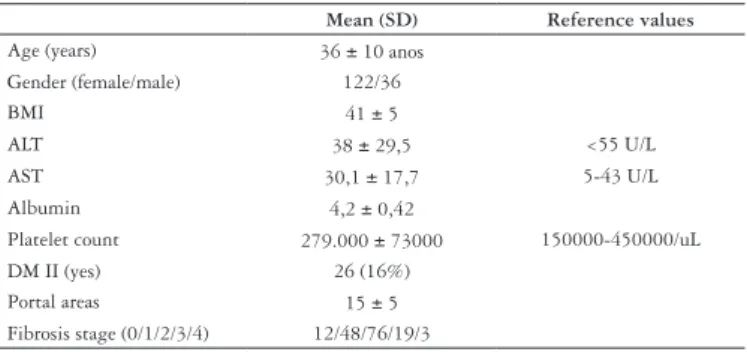
Histological analysis: all biopsies were 10 mm in length and the number of portal areas were 15 ± 6. The samples were from the liver wedge and to avoid ibrosis overestimation, the subcapsular ibrosis was not considered in the evaluation process. The criteria for the diagnosis of NAFLD was found in all biopsies samples and only 12 (8%) did not have ibrosis. From 146 (92%) with ibrosis, stage 2 was the most frequent and it was present in 76 patients (48%), followed by ibrosis stage 1 present in 48 patients (30%), and advanced liver ibrosis (stage 3 and 4) in 22 patients (14%).
NAFLD score application: 2 cutoff points previously validated were selected to identify the presence (score greater than 0.676) and absence (score lower than -1.455) of signiicant ibrosis(3).The accuracy calculation took into consideration
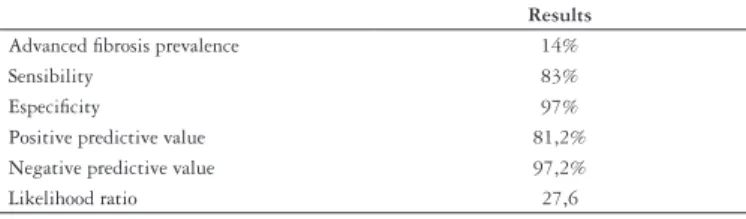
the prevalence of advanced ibrosis of 14%. The absence and the presence of advanced ibrosis were predicted in 133 (84%) of the patients and in 129 (97%) it was correct. Only 4 (2,5%) were incorrectly graded. In 25 (16%) the score was between the cutoff points and were considered indeterminate, in this group only 1 patient had advanced ibrosis. By applying the low cutoff point (score below – 1.455) 109 (80.1%) of the 136 patients without advanced ibrosis were correctly staged. Only 1 patient (0.9%) of the 110 patients with the score below the low cutoff point was incorrectly staged. Thus, the advanced ibrosis was excluded with high accuracy (negative predictive value of 97.2%). By applying a high cutoff point (score above 0.676), 20 (87%) of the 22 patients with advanced ibrosis were correctly staged and only 3 (13%) with scores higher than the high cutoff point were incorrectly staged. The presence of advanced ibrosis was diagnosed with good accuracy (positive predictive value of 81.8%). The score sensibility and speciicity was 83% and 97% respectively. The positive likelihood ratio was 27.6, thus the probability of a patient with a score higher than 0.676 to have advanced ibrosis is 27.6 times higher than for a patient with no score for advanced ibrosis. Table 3 and 4 summarizes these indings.
TABLE 2. Characteristics of the patient population
Mean (SD) Reference values
Age (years) 36 ± 10 anos Gender (female/male) 122/36
BMI 41 ± 5
ALT 38 ± 29,5 <55 U/L
AST 30,1 ± 17,7 5-43 U/L
Albumin 4,2 ± 0,42
Platelet count 279.000 ± 73000 150000-450000/uL DM II (yes) 26 (16%)
Portal areas 15 ± 5 Fibrosis stage (0/1/2/3/4) 12/48/76/19/3
SD = standard deviation; BMI = body mass index; ALT = alanine aminotransferase; AST = aspartate aminotransferase; DM II= diabetes mellitus II
TABLE 1. Histological ibrosis stage by Brunt(8), and modiied by Kleiner
et al.(26)
Fibrosis stage
Absence of ibrosis 0
Portal/perisinusoidal 1
Perisinusoidal and portal/periportal 2 Septal or bridging ibrosis 3
Cirrhosis 4
The NAFLD ibrosis score was calculated using the Angulo’s et al.(3) formula based on six variables: NAFLD
score: 1,675 + 0,037 x age (years) + 0,094 x BMI (kg/m2)
+ 1,13 x IFG/diabetes (yes = 1, no = 0) + 0,99 x AST/ALT ratio -0,013 x platelet (109/L) -0,66 x albumin (g/dL). Two cutoff points previously validated were used: values lower than –1.455 exclude advanced ibrosis (grade III and IV), and values above 0,676 indicate the presence of advanced ibrosis.
Continuous variables were expressed by mean and standard deviation and categorical variables by percentage. The NAFLD ibrosis score accuracy was determined by calculating sensitivity, speciicity, positive predictive value, negative predictive value and likelihood ratios taking into consideration the prevalence of advanced liver ibrosis in the studied group. All analysis were carried out using the statistical analysis software Prism 5 (Graphpad, San Diego, CA).
RESULTS
Patient population: 158 patients were analyzed and the mean age was 36 years (± 10 years), and 77% were females. All patients had a BMI greater than 35 kg/m2, the mean BMI
was 41 kg/m2 (± 5 kg/m2). Type II diabetes or fasting glucose
level greater than 110 mg/dL was present in 16% of the patients. Table 2 summarizes demographic and clinical data.
TABLE 3. Fibrosis score and histological ibrosis score
Histology/score <-1.455 <-1.455 and 0.676 >0.676 Total
Mild ibrosis FO, F1, F2
109 24 3 136
Advanced ibrosis F3 and F4
Pimentel SK, Strobel R, Gonçalves CG, Sakamoto DG, Ivano FH, Coelho JCU. Evaluation of the nonalcoholic fat liver disease ibrosis score for patients undergoing bariatric surgery
Arq Gastroenterol
172 v. 47 – no.2 – abr./jun. 2010
Pimentel SK, Strobel R, Gonçalves CG, Sakamoto DG, Ivano FH, Coelho JCU. Avaliação do escore de ibrose hepática para doença hepática gordurosa não-alcoólica em pacientes submetidos a cirurgia bariátrica. Arq Gastroenterol. 2010;47(2):170-3.
RESUMO - Contexto - Pacientes com obesidade mórbida apresentam risco signiicativo para doença hepática gordurosa não-alcoólica e para suas formas mais graves, a esteatohepatite e a cirrose hepática. O diagnóstico de tais alterações é importante, principalmente na avaliação pré-operatória de cirurgia bariátrica. Até o momento, a biopsia hepática é o procedimento com maior precisão para tal diagnóstico. Objetivo - Avaliar o escore de ibrose hepática em doença hepática gordurosa não-alcoólica em pacientes com obesidade mórbida na população brasileira. Métodos - Foram incluídos 158 pacientes com obesidade mórbida submetidos a cirurgia bariátrica. Idade, índice de massa corporal, hiperglicemia, albumina, contagem de plaquetas e razão AST/ALT foram aplicados à fórmula do escore de ibrose. Valores acima de 0,676 indicavam ibrose avançada e abaixo de – 1,455 indicavam ausência de ibrose. Estes valores foram comparados com os achados de biopsia hepática realizados no intra-operatório. Resultados - A presença de ibrose avançada foi diagnosticada com boa precisão, valor preditivo positivo de 83,7%. O escore teve melhor precisão para excluir ibrose avançada, com valor preditivo negativo de 97,2%. Em 25 pacientes (16%) o escore resultou indeterminado entre os pontos de corte. A sensibilidade e a especiicidade do escore foram de 83% e 97%, respectivamente. Conclusão - O escore de ibrose para doença hepática gordurosa não-alcoólica apresenta elevada precisão para reconhecer e excluir ibrose avançada em pacientes com obesidade mórbida submetidos a cirurgia bariátrica.
DESCRITORES - Cirrose hepática. Fígado gorduroso. Obesidade mórbida. Cirurgia bariátrica.
DISCUSSION
With the increasing prevalence of obesity worldwide, NAFLD has became the most common cause of liver disease in developed countries(11). The majority of patients with morbid
obesity, presents NAFLD complicated by ibrosis(20, 24, 36).Our
results showed a rate of 92% of ibrosis in morbidly obese patients subjected to Roux-en-Y gastric bypass. Brazilian data from patients undergoing bariatric surgery showed a wide range of ibrosis rate from 25% up to 89,5% in wedge biopsies(14, 16, 17, 19). This variation is probably due to different
diagnostic histological criteria(17).
The identiication of ibrosis is essential for the prognosis of liver disease and can be done using a panel of markers or scores instead of liver biopsy. These scores have became more accurate than liver biopsy which sometimes is not representative of the real ibrosis grade due to sample error or inadequate amount of tissue(13, 35). Scores based on serum
markers give a better estimation of the disease in the hepatic tissue(33).
Many ibrosis scores had already been evaluated mostly for hepatitis C patients(12, 31, 39). For NAFLD patients, the
Original European Liver Fibrosis test, which consist of age, tissue inhibitor of matrix metalloproteinase 1, hyaluronic acid and aminoterminal peptide of pro-collagen III, and its variant the Enhanced Liver Fibrosis panel, which uses the same variants except the age, had a good performance in distinguishing patients with ibrosis, moderate ibrosis and
severe ibrosis(22). The limitation for the routine use of these
scores is the cost and availability of these speciic markers. This study demonstrated the application of the NAFLD score, based on simple clinical and biochemical parameters, in the morbid obese patient group. The absence and the presence of advanced ibrosis were predicted in 133 (84%) of the patients and in 129 (97%) it was correct. Only 4 (2,5%) were incorrectly graded. In 25 (16%) the score was between the cutoff points and were considered indeterminate, in this group only 1 patient had advanced ibrosis. This implies that by applying the NAFLD ibrosis score the liver biopsy could have been avoided in 84% of patients.
The majority of patients undergoing bariatric surgery did not present advanced ibrosis, 136 or 86%, so the low cutoff point of -1.455 was very accurate to exclude this form of ibrosis with a good negative predictive value of 97.2%. However, the positive predictive value of the high cutoff point of 0.676 was 83.7%, probably due to the low prevalence of advanced ibrosis, only 14% of the patients.
The NAFLD ibrosis score can be used in pre operative evaluation of patients undergoing bariatric surgery. The great advantage this score is the use of easily obtained variables.
This score is particularly accurate in ruling out the presence of advanced ibrosis. Advanced ibrosis may not reduce in more than 60% of patients after bariatric surgery, and these patients will have higher risks for cirrhosis and hepatocarcinoma, and they must be followed in the postoperative period(27, 37).Also, this group of patients must
be informed about the grade of ibrosis and the chance of no regression. The presence of advanced ibrosis do not change the surgical plan, indeed, it is and additional indication for bariatric surgery. However, the surgical procedure must carry out a slow and progressive weight loss since more aggressive bariatric surgery with dramatic weight loss and malnutrition may worse their liver disease.
We conclude that the NAFLD ibrosis score could accurately predict the presence or absence of advanced liver ibrosis in the group of patients undergoing bariatric surgery.
TABLE 4. Predictive value of the scoring system, taking in consideration the advanced ibrosis prevalence
Results
Advanced ibrosis prevalence 14%
Sensibility 83%
Especiicity 97%
Positive predictive value 81,2% Negative predictive value 97,2%
Pimentel SK, Strobel R, Gonçalves CG, Sakamoto DG, Ivano FH, Coelho JCU. Evaluation of the nonalcoholic fat liver disease ibrosis score for patients undergoing bariatric surgery
Arq Gastroenterol 173
v. 47 – no.2 – abr./jun. 2010
REFERENCES
1. Adams LA, Lymp JF, St Sauver J, Sanderson SO, Lindor KD, Feldstein A, Angulo P. The natural history of nonalcoholic fatty liver disease: a population-based cohort study. Gastroenterology. 2005;129:113-21.
2. Angulo P. Nonalcoholic fatty liver disease. N Engl J Med. 2002;346:1221-31. 3. Angulo P, Hui JM, Marchesini G, Bugianesi E, George J, Farrell GC, Enders F,
Saksena S, Burt AD, Bida JP, Lindor K, Sanderson SO, Lenzi M, Adams LA, Kench J, Therneau TM, Day CP. The NAFLD ibrosis score: a noninvasive system that identiies liver ibrosis in patients with NAFLD. Hepatology. 2007;45:846-54. 4. Bedogni G, Miglioli L, Masutti F, Tiribelli C, Marchesini G, Bellentani S. Prevalence of and risk factors for nonalcoholic fatty liver disease: the Dionysos nutrition and liver study. Hepatology. 2005;42:44-52.
5. Beymer C, Kowdley KV, Larson A, Edmonson P, Dellinger EP, Flum DR. Prevalence and predictors of asymptomatic liver disease in patients undergoing gastric bypass surgery. Arch Surg. 2003;138:1240-4.
6. Brasil. Conselho Federal de Medicina. 1766/05 Normas seguras para o tratamento cirúrgico da obesidade mórbida, deinindo indicações, procedimentos aceitos e equipe. Brasília, 2005.
7. Browning JD, Szczepaniak LS, Dobbins R, Nuremberg P, Horton JD, Cohen JC, Grundy SM, Hobbs HH. Prevalence of hepatic steatosis in an urban population in the United States: impact of ethnicity. Hepatology. 2004;40:1387-95. 8. Brunt EM. Grading and staging the histopathological lesions of chronic hepatitis:
the Knodell histology activity index and beyond. Hepatology. 2000;31:241-6. 9. Bugianesi E, Leone N, Vanni E, Marchesini G, Brunello F, Carucci P, Musso
A, De Paolis P, Capussotti L, Salizzoni M, Rizzetto M. Expanding the natural history of nonalcoholic steatohepatitis: from cryptogenic cirrhosis to hepatocellular carcinoma. Gastroenterology. 2002;123:134-40.
10. Charlton M. Nonalcoholic fatty liver disease: a review of current understanding and future impact. Clin Gastroenterol Hepatol. 2004;2:1048-58.
11. Clark JM, Brancati FL, Diehl AM. Nonalcoholic fatty liver disease. Gastroenterology. 2002;122:1649-57.
12. Coco B, Oliveri F, Maina AM, Ciccorossi P, Sacco R, Colombatto P, Bonino F, Brunetto MR. Transient elastography: a new surrogate marker of liver ibrosis inluenced by major changes of transaminases. J Viral Hepat. 2007;14:360-9. 13. Colloredo G, Guido M, Sonzogni A, Leandro G. Impact of liver biopsy size
on histological evaluation of chronic viral hepatitis: the smaller the sample, the milder the disease. J. Hepatol. 2003;39:239-44.
14. Cotrim HP, Freitas LA, Alves E, Almeida A, May DS, Caldwell S. Effects of light-to-moderate alcohol consumption on steatosis and steatohepatitis in severely obese patients. Eur J Gastroenterol Hepatol. 2009;21:969-72.
15. Dam-Larsen S, Franzmann M, Andersen IB, Christoffersen P, Jensen LB, Sørensen TIA, Becker U, Bendtsen F. Long term prognosis of fatty liver: risk of chronic liver disease and death. Gut. 2004;53:750-5.
16. de Andrade AR, Cotrim HP, Alves E, Soares D, Rocha R, Almeida A, Almeida CG, de Freitas LA. Nonalcoholic fatty liver disease in severely obese individuals: the inluence of bariatric surgery. Ann Hepatol. 2008;7:364-8.
17. de Oliveira CP, de Mello ES, Alves VA, Saviero SM, Strauss E. Changes in histological criteria lead to different prevalences of nonalcoholic steatohepatitis in severe obesity. Ann Hepatol. 2007;6:255-61.
18. Fan J, Zhu J, Li X, Chen L, Li L, Dai F, Li F, Chen S. Prevalence of and risk factors for fatty liver in a general population of Shanghai, China. J Hepatol. 2005;43:508-14.
19. Furuya CK Jr, de Oliveira CP, de Mello ES, Faintuch J, Raskovski A, Matsuda M, Vezozzo DC, Halpern A, Garrido AB Jr, Alves VA, Carrilho FJ. Effects of bariatric surgery on nonalcoholic fatty liver disease: preliminary indings after 2 years. J Gastroenterol Hepatol. 2007;22:510-4.
20. Garcia-Monzon C, Martin-Perez E, Iacono OL, Fernandez-Bermejo M, Majano PL, Apolinario A, Larranaga E, Moreno-Otero R. Characterization of pathogenic
and prognostic factors of nonalcoholic steatohepatitis associated with obesity. J Hepatol. 2000;33:716-24.
21. Gholam PM, Flancbaum L, Machan JT, Charney DA, Kotler DP. Nonalcoholic fatty liver disease in severely obese subjects. Am J Gastroenterol. 2007;102:399-408.
22. Guha IN, Parkes J, Roderick P, Chattopadhyay D, Cross R, Harris S, Kaye P, BurtAD, Ryder SD, Aithal GP, Day CP, Rosenberg WM. Noninvasive markers of ibrosis in nonalcoholic fatty liver disease: validating the European Liver Fibrosis Panel and exploring simple markers. Hepatology. 2008;47:455-60.
23. Gunneson TJ, Menon KVN, Wiesner RH, Daniels JA, Hay JE, Charlton MR, Brandhagen DJ, Rosen CB, Porayko MK. Ultrasound-assisted percutaneous liver biopsy performed by a physician assistant. Am J Gastroenterol. 2002;97:1472-5. 24. Haynes P, Liangpunsakul S, Chalasani N. Nonalcoholic fatty liver disease in
individuals with severe obesity. Clin Liver Dis. 2004;8:535-47.
25. Instituto Brasileiro de Geograia e Estatística IBGE. Pesquisa de Orçamentos Familiares- POF 2002-2003. Disponível em: http://www.ibge.gov.br/home/estatistica/ populacao/condicaodevida/pof/2002aquisicao/default.shtm. Updated:2007. 26. Kleiner DE, Brunt EM, Van Natta M, Behling C, Contos MJ, Cummings OW,
Ferrell LD, Liu YC, Torbenson MS, Unalp-Arida A, Yeh M, McCullough AJ, Sanyal AJ. Design and validation of a histological scoring system for nonalcoholic fatty liver disease. Hepatology. 2005;41:1313-21.
27. Liu X, Lazenby AJ, Clements RH, Jhala N, Abrams GA. Resolution of nonalcoholic steatohepatits after gastric bypass surgery. Obes Surg. 2007;17:486-92. 28. Machado M, Marques-Vidal P, Cortez-Pinto H. Hepatic histology in obese
patients undergoing bariatric surgery. J Hepatol. 2006;45:600-6.
29. Nomura H, Kashiwagi S, Hayashi J, Kajiyama W, Tani S, Goto M. Prevalence of fatty liver in a general population of Okinawa, Japan. Jpn J Med. 1988;27:142-9. 30. Perrault J, McGill DB, Ott BJ, Taylor WF. Liver biopsy: complications in 1000
inpatients and outpatients. Gastroenterology. 1978;74:103-6.
31. Poynard T, McHutchison J, Manns M, Myers RP, Albrecht J. Biochemical surrogate markers of liver ibrosis and activity in a randomized trial of peginterferon alfa-2b and ribavirin. Hepatology. 2003;38:481-92.
32. Ratziu V, Giral P, Charlotte F, Bruckert E, Thibault V, Theodorou I, Khalil L, Turpin G, Opolon P, Poynard T. Liver ibrosis in overweight patients. Gastroenterology. 2000;118:1117-23.
33. Ratziu V, Massard J, Charlotte F, Messous D, Imbert-Bismut F, Bonyhay L, Tahiri M, Munteanu M, Thabut D, Cadranel JF, Le Bail B, de Ledinghen V, Poynard T. Diagnostic value of biochemical markers (FibroTest-FibroSURE) for the prediction of liver ibrosis in patients with non-alcoholic fatty liver disease. BMC Gastroenterol. 2006;14:6.
34. Sanyal AJ. AGA technical review on nonalcoholic fatty liver disease. Gastroenterology. 2002;123:1705-25.
35. Sanyal AJ, Banas C, Sargeant C, Luketic VA, Sterling RK, Stravitz RT, Shiffman ML, Heuman D, Coterrell A, Fisher RA, Contos MJ, Mills AS. Similarities and differences in outcomes of cirrhosis due to nonalcoholic steatohepatitis and hepatitis C. Hepatology. 2006;43:682-9.
36. Spaulding L, Trainer T, Janiec D. Prevalence of non-alcoholic steatohepatitis in morbidly obese subjects undergoing gastric bypass. Obes Surg. 2003;13:347-9. 37. Stratopoulos C, Papakonstantinou A, Terzis I, Spiliadi C, Dimitriades G,
Komesidou V, Kitsanta P, Argyrakos T, Hadjiyannakis E. Changes in liver histology accompanying massive weight loss after gastroplasty for morbid obesity. Obes Surg. 2005;15:1154-60.
38. Teli MR, James OF, Burt AD, Bennett MK, Day CP. The natural history of nonalcoholic fatty liver: a follow-up study. Hepatology. 1995;22:1714-9. 39. Wai C, Greenson JK, Fontana RJ, Kalbleisch JD, Marrero JA, Conjeevaram
HS, Lok AS. A simple noninvasive index can predict both signiicant ibrosis and cirrhosis in patients with chronic hepatitis C. Hepatology. 2003;38:518-26.