RESUmo
O objeivo deste estudo foi avaliar o estres
-se oxidaivo e as aividades metabólicas das enfermeiras em turnos diurnos e noturnos. Enfermeiras da Unidade de Tratamento In
-tensivo (UTI) (n=70) e do serviço comum (SC) (n=70) pariciparam do estudo. Logo no início e ao inal dos turnos, amostras de sangue foram obidas para medir parâmetros de estresse oxidaivo. Aividades metabólicas também foram analisadas com o uso da bra
-çadeira SenseWear. Parâmetros de estresse oxidaivo aumentaram no im dos turnos de todas as enfermeiras SC e UTI quando com
-parados ao início dos turnos. Com-parados às enfermeiras SC, os níveis de TAS, TOS e OSI das enfermeiras de UTI não eram signi
-icaivamente diferentes no inal dos turnos diurnos e noturnos. Além disso, as aividades metabólicas das enfermeiras de SC e UTI se revelaram como sendo similares. Assim, os parâmetros de estresse oxidaivo e as aivi
-dades metabólicas das enfermeiras SC e UTI não eram diferentes, e todas as enfermeiras sofrem efeitos semelhantes dos turnos, tanto no dia quanto na noite.
dEScRitoRES Enfermeiras Carga de trabalho Terapia intensiva Estresse oxidaivo Biotransformação
Evaluation of oxidative stress parameters
and metabolic activities of nurses
working day and night shifts
A
r
ti
g
o
o
r
i
g
i
n
A
l
AbStRAct
The aim of this study was to evaluate the oxidaive stress and metabolic aciviies of nurses working day and night shits. In
-tensive care unit (ICU) (n=70) and ordinary service (OS) nurses (n=70) were enrolled in the study. Just before and the end of the shits, blood samples were obtained to measure the paricipants’ oxidaive stress parameters. Metabolic aciviies were ana
-lyzed using the SenseWear Armband. Oxi
-daive stress parameters were increased at the end of the shits for all OS and ICU nurses compared to the beginning of the shits. Compared to the OS nurses, the ICU nurses’ TAS, TOS, and OSI levels were not signiicantly diferent at the end of the day and night shits. The metabolic aciviies of the OS and ICU nurses were found to be similar. As a result, the OS and ICU nurses’ oxidaive stress parameters and metabolic aciviies were not diferent, and all of the nurses experienced similar efects from both the day and night shits.
dEScRiPtoRS Nurses
Workload Intensive care Oxidaive stress Biotransformaion
RESUmEn
Se objeivó evaluar estrés oxidaivo y ac
-ividades metabólicas de enfermeras en turnos diurnos y nocturnos. Pariciparon enfermeras de Unidad de Terapia Inten
-siva (UTI, n=70) y del servicio común (SC, n=70). Se obtuvieron muestras sanguíneas al inicio y al inal de los turnos para medir parámetros de estrés oxidaivo. Las aci
-vidades metabólicas también fueron ana
-lizadas uilizando brazaletes SenseWear. Los parámetros de estrés oxidaivo aumen
-taron hacia el inal de los turnos de todas las enfermeras SC y UTI, comparados con la medida de inicio. Los niveles de TAS, TOS y OSI no eran signiicaivamente diferentes entre enfermeras SC y UTI al cierre de los turnos diurnos y nocturnos. Las acivida
-des metabólicas de enfermeras SC y UTI se mostraron similares. Consecuentemente, los parámetros de estrés oxidaivo y las acividades metabólicas de enfermeras SC y UTI no resultaron diferentes, y todas las enfermeras sufren efectos semejantes en sus turnos, tanto diurnos como nocturnos.
dEScRiPtoRES Enfermeras Carga de trabajo Cuidados intensivos Estrés oxidaivo Biotransformación
turgay Ulas1, Hakan buyukhatipoglu2, idris Kirhan3, mehmet Sinan dal4, Sevilay Ulas5, mehmet Emin
demir6, mehmet Ali Eren7, mehmet Ucar8, Abdussamet Hazar9, İbrahim Can Kurkcuoglu10, nurten Aksoy11
AvAliAção de pArâmetros de estresse oxidAtivo e As AtividAdes metAbólicAs dAs enfermeirAs trAbAlhAndo em turnos diurnos e noturnos
evAluAción de pArámetros de estrés oxidAtivo y ActividAdes metAbólicAs de enfermerAs trAbAjAndo en turnos diurnos y nocturnos
1 Assistant Prof., Faculty, Department of Internal Medicine, Harran University, Şanlıurfa,Turkey. [email protected] 2 Associate prof., faculty, department of
Internal Medicine, Harran University, Şanlıurfa, Turkey. [email protected] 3 specialist dr., faculty, department of internal medicine, harran university,
Şanlıurfa, Turkey. [email protected] 4 Specialist Dr., Faculty, Department of Internal Medicine, Dicle University, Diyarbakır, Turkey. dr.sinandal@gmail. com 5 Harran University, College of Social Sciences, Department of Public Relations and Publicity, Şanlıurfa, Turkey. [email protected] 6 specialist
Dr., Faculty, Department of Internal Medicine, Harran University, Şanlıurfa, Turkey. [email protected] 7 specialist dr., faculty, department
of Internal Medicine, Harran University, Şanlıurfa, Turkey. [email protected] 8 Specialist Dr., Department of Physical Therapy and Rehabilitation,
Sanliurfa Training and Research Hospital, Sanliurfa, Turkey. [email protected] 9 Asistant Prof., Faculty, Department of Thoracic and Cardiovascular
Surgery, Harran University, Sanliurfa, Turkey. [email protected] 10 Associate Prof., Ibrahim Can Kurkcuoglu, Faculty, Department of Chest Surgery,
intRodUction
The number of shit workers has rapidly increased world -wide over the last few decades.Nurses work long hours un -der highly stressful condiions, and they oten sufer from excessive workloads and minimal social support. Nurses working long-term night and shit work become more cyni -cal and less empatheic as their training progresses and might develop many health-related problems, such as fa -igue, sleep problems, anxiety and diiculies in maintaining regular lifestyles.Reduced rest and recovery imes lead to physiologic depleion or exhausion that coninues into the next workday.Consequently, shit workers have an increased prevalence of being unhealthy.However, whether prolonged physical and extreme workload and mental stress induce rel -evant metabolic changes remains poorly understood(1-5).Oxi -daive stress is believed to have a role in the development of chronic diseases. Ater the balance between reacive oxygen species producion and anioxidaive defense acivity is dis -rupted, oxidaive stress can occur, which may
result in cell injury or death, subsequent issue damage, and, inally, chronic disease(6-7). Addi -ionally, increased oxidaive stress associated with diferent jobs has been demonstrated by isolated studies. However, exhausive and prolonged working also has been shown to in -crease oxidaive stress in shit workers(8-11).
Despite the factors menioned above, unil now, no clinical research has been performed to evaluate the oxidaive stress parameters by comparing the metabolic aciviies of the nurs -es. In this study, we evaluated and compared metabolic aciviies using the SWA and oxida -ive stress parameters of the nurses working in the ordinary services (OS) and intensive care units (ICU) on day and night shits. The present study was undertaken to demonstrate whether oxidaive stress and metabolic aciviies of the nurses increased in prolonged and shit work.
mEtHod
Study design and nurses
This prospecive study was conducted at the Harran University School of Medicine, Sanliurfa, Turkey. Prior to subject recruitment, the study protocol was reviewed and approved by the local ethics commitee (ethical approval number; 28.01.2010: B.10.IEGO.0.11.00.01/021) in accor -dance with the ethical principles for human invesigaions, as outlined by the Second Declaraion of Helsinki. Writen informed consent was obtained from all the nurses. From October 2010 to September 2011, 140 nurses working in the ICUs (medical, surgical, coronary, general, neona -tal) and OSs (internal medicine, neurology, orthopedics, general surgery, pediatrics, obstetrics and gynecology, cardiology,Thoracic and Cardiovascular Surgery, Pediatric
Surgery) at Harran University Hospital were consecuively enrolled in the study.
The study subjects were divided into 2 groups: 1) the day shit group (n=70) consisted of nurses working from 8 a.m. to 4 p.m. (8 hours), and 2) the night shit group (n=70) con -sisted of nurses working from 4 p.m. to 8 a.m. (16 hours). Both groups were further divided: day shit ICU group and night shit ICU group (both n=35) and day shit OS group and night shit OS group (both n=35). The exclusion criteria were as follows: recent acute infecious illness, such as respiratory or gastrointesinal infecions, any inlammatory or iniltraive disorders, any evidence of liver, kidney, or respiratory disease, diabetes mellitus, malignancy, the use of any systemic drug that could afect the SWA, thermoregulatory process, body -weight or metabolism, regular alcohol use, smoking, pregnan -cy, depression and psychiatric or neurological disorders. Just before the shit began, blood samples were obtained to mea -sure the total anioxidant status (TAS) and total oxidant status
(TOS). Ater the shit, blood samples were ob -tained again to measure the TAS and TOS. To -tal EE, metabolic equivalents of a task (METs), number of steps, acive EE and physical acivity duraion were analyzed from all subjects at the end of the shit using SWA.
Baseline deiniions and measurements
Weight and height were measured ac -cording to standardized protocols. Body mass index was calculated as the weight in kilograms divided by the height in meters
squared (kg/m2). Blood pressure was mea
-sured by using a sphygmomanometer.
Biochemical analysis
All blood samples were drawn from a large antecubital vein without interruping venous low and using a 19-gauge buterly needle connected to a plasic syringe. Twenty milliliters of blood was drawn, with the irst few milliliters discarded. The residual content of the sy -ringe was transferred immediately to polypropylene tubes, which were then centrifuged at 3000 rpm for 10 minutes at 10 to 18oC. Supernatant plasma samples were stored in
plasic tubes at –80oC unil assayed. For the serum mark
-ers of oxidant stress, TOS was measured and the oxidaive stress index (OSI) calculated. TAS was measured as an indi -cator of anioxidant status.
Measurement of total oxidant status
Serum TOS was measured using a novel automated method developed by Erel(12). Oxidants present in the sam -ple oxidize the ferrous ion-o-dianisidine com-plex to ferric ion. The oxidaion reacion is enhanced by glycerol mole -cules, which are abundant in the reacion medium. The fer -ric ion generates a colored complex with Xylenol orange in an acidic medium. Color intensity, which can be measured oxidative stress is
believed to have a role in the development of chronic diseases. After
the balance between reactive oxygen
species production and antioxidative defense
activity is disrupted, oxidative stress can
occur, which may
result in cell injury or
spectrophotometrically (V-530; Jasco®, Tokyo, Japan), is re
-lated to the quanity of oxidant molecules present in the sample. The assay is calibrated with hydrogen peroxide, and the results are expressed in terms of micro-molar hy -drogen peroxide equivalents per liter (μmol H2O2 equiv./l).
Measurement of total anioxidant status
Serum TAS was measured using a novel automated method developed by Erel (12). In this method, hydroxyl radical, the most potent biological radical, is produced. In the assay, ferrous ion soluion in reagent 1 is mixed with hydrogen peroxide present in reagent 2. Sequenially produced radicals, such as the brown-colored dianisidine radical caion produced by the hydroxyl radical, are also potent radicals. This method allows measurement of the anioxidaive efect of the sample against the potent free-radical reacions that are iniiated by the hydroxyl radi -cal. The assay has excellent precision values of more than 97%. The results are expressed as mmol Trolox equiv./l.
Oxidaive stress index
The OSI was deined as the raio of the TOS to TAS levels. For the calculaion, TAS units were changed to mmol/l and the OSI value calculated according to the fol -lowing formula(12): OSI (arbitrary unit) = TOS (μmol H2O2 equiv./l)//TAS (mmol Trolox equiv./l).
Analyzing metabolic acivity parameters by SWA
The SenseWear Pro Armband™ Version 6.1 (BodyMe -dia, Inc., Pitsburgh, PA, USA) is a portable device measuring 8.8x5.6x2.1 cm in size and 82 g in weight; the armband, which was the most recent version, was provided by the manufac -turer for this study. The SWA uilizes a muli-sensor array including a 2-axis accelerometer, heat lux sensor, galvanic skin response sensor, skin temperature sensor, and a near-body ambient temperature sensor and has been validated in clinical paients. The SWA was placed on the dominant arm over the triceps at the midpoint between the acromion and olecranon processes. The subject’s age, gender, weight and height were programmed into the SWA. The total EE, METs, number of step counts, acive EE and physical acivity dura -ion were analyzed with InnerView Research Sotware (ver -sion 6.1), which was provided by BodyMedia, Inc. METs de -ine the EE related to body weight. One MET is equivalent to a metabolic rate consuming 1 kilo calorie per kilogram of body weight per hour (1 kcal/kg body weight/hour).Acive EE and physical acivity duraion were deined as requiring at least two consecuive minutes at 3.0 METs or higher(13-14).
Staisical analysis
All of the staisical analyses were performed using SPSS for Windows version 17.0 (SPSS, Chicago, IL, USA). Ater the shit and baseline diferences of TAS and TOS levels were calculated, Kolmogorov-Smirnov tests were used to test the normality of data distribuion. The data were expressed as arithmeic means and standard deviaions. Independent sample T-test and Mann-Whitney U-tests were used in nor
-mally and non-nor-mally distributed coninuous variables between groups, respecively. Paired t-tests and Wilcoxon signed-rank tests were used to analyze the changes within each group. Pearson’s correlaion analysis was used to ex -amine the associaion of oxidaive stress parameters and metabolic aciviies in all groups. A two-sided p value <0.05 was considered staisically signiicant.
RESULtS
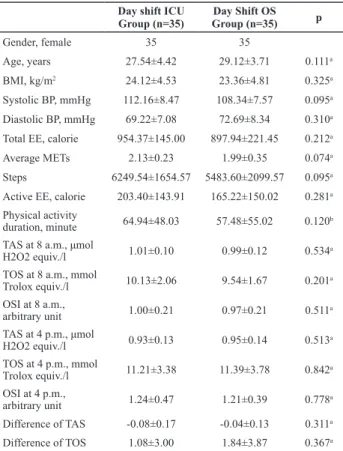
Day shit group results: The clinical, biochemical and demographic characterisics of the study subjects are shown in Table 1. There were no staisical diferences in the biochemical and demographic characterisics among the subgroups (p>0.05 for all). Compared to the day shit OS group, the day shit ICU group was not signiicantly dif -ferent regarding the TAS, TOS, and OSI levels at baseline and the end of the shit (p>0.05 for all). Similarly, the to -tal EE, METs, number of steps, acive EE, physical aciv -ity duraions, diference of TAS and TOS levels were not signiicantly diferent in the day shit OS and day shit ICU groups (p>0.05 for all). In addiion, compared to baseline, the TAS levels were signiicantly decreased at the end of the shit, and the TOS and OSI levels were both signiicant -ly increased in the two groups (p<0.05 for all) (Table 1, 2).
Table 1 - Comparison of demographic, laboratory and clinical characteristics of the day shift nurses – Sanliurfa, 2011
Day shift ICU Group (n=35)
Day Shift OS
Group (n=35) p
Gender, female 35 35
Age, years 27.54±4.42 29.12±3.71 0.111a
BMI, kg/m2 24.12±4.53 23.36±4.81 0.325a
Systolic BP, mmHg 112.16±8.47 108.34±7.57 0.095a
Diastolic BP, mmHg 69.22±7.08 72.69±8.34 0.310a
Total EE, calorie 954.37±145.00 897.94±221.45 0.212a
Average METs 2.13±0.23 1.99±0.35 0.074a
Steps 6249.54±1654.57 5483.60±2099.57 0.095a
Active EE, calorie 203.40±143.91 165.22±150.02 0.281a
Physical activity
duration, minute 64.94±48.03 57.48±55.02 0.120
b
TAS at 8 a.m., μmol
H2O2 equiv./l 1.01±0.10 0.99±0.12 0.534a
TOS at 8 a.m., mmol
Trolox equiv./l 10.13±2.06 9.54±1.67 0.201a
OSI at 8 a.m.,
arbitrary unit 1.00±0.21 0.97±0.21 0.511
a
TAS at 4 p.m., μmol
H2O2 equiv./l 0.93±0.13 0.95±0.14 0.513
a
TOS at 4 p.m., mmol
Trolox equiv./l 11.21±3.38 11.39±3.78 0.842a
OSI at 4 p.m.,
arbitrary unit 1.24±0.47 1.21±0.39 0.778a
Difference of TAS -0.08±0.17 -0.04±0.13 0.311a
Difference of TOS 1.08±3.00 1.84±3.87 0.367a
Table 2 - Comparison ofbaseline and at the end of the day shift oxidative stress parameters –Sanliurfa, 2011
Day shift ICU Group (n=35) Day Shift OS Group (n=35)
At 8 a.m At 4 p.m. p At 8 a.m. At 4 p.m. p
TAS, μmol H2O2 equiv./l 1.01±0.10 0.93±0.13 0.006a 0.99±0.12 0.95±0.14 0.047a
TOS, mmol Trolox equiv./l 10.13±2.06 11.21±3.38 0.040a 9.54±1.67 11.39±3.78 0.008a
OSI, arbitrary unit 1.00±0.21 1.24±0.47 0.003a 0.97±0.21 1.21±0.39 0.001a
All of the measurable values are provided with mean ± standard deviation. ICU: intensive care unit, OS: ordinary service, TOS: total oxidant status, TAS: total antioxidant status, OSI: oxidative stress index. By paired sample Ta test
Night shit group results: The clinical, biochemical and demographic characterisics of the study subjects are shown in Table 3. There were no staisical difer -ences in the biochemical and demographic characteris -ics among the subgroups (p>0.05 for all). Compared to the night shit OS group, the night shit ICU group was not signiicantly diferent regarding the TAS, TOS, and OSI levels at baseline and the end of the shit (p>0.05 for
all). Similarly, the total EE, METs, number of steps, acive EE, physical acivity duraions, diference of TAS and TOS levels were not signiicantly diferent in the night shit OS and night shit ICU groups (p>0.05 for all). In addiion, at the end of the shit, the TAS levels were signiicantly de -creased compared to baseline, and the TOS and OSI lev -els were both signiicantly increased in the two groups (p<0.05 for all) (Table 3, 4).
Table 3 - Comparison of demographic, laboratory and clinical characteristics of the night shift nurses – Sanliurfa, 2011
Night shift ICU Group (n=35) Night Shift OS Group (n=35) p
Gender, female 35 35
Age, years 28.14±4.46 26.88±3.92 0.168a
BMI, kg/m2 23.54±3.41 22.87±3.43 0.357a
Systolic BP, mmHg 116.14±12.51 119.41±9.33 0.173a
Diastolic BP, mmHg 71.26±8.12 73.55±7.08 0.326a
Total EE, calorie 1719.85±242.56 1683.11±301.71 0.576a
Average METs 1.96±0.33 1.83±0.28 0.067a
Steps 10302.40±2646.67 9398.94±3561.46 0.233a
Active EE, calorie 318.14±285.17 247.85±185.49 0.196a
Physical activity duration, minute 93.00±71.48 75.82±59.99 0.452b
TAS at 4 p.m., μmol H2O2 equiv./l 1.03±0.12 1.06±0.21 0.486a
TOS at 4 p.m., mmol Trolox equiv./l 11.18±3.31 10.85±2.67 0.648a
OSI at 4 p.m., arbitrary unit 1.09±0.34 1.05±0.34 0.658a
TAS at 8 a.m., μmol H2O2 equiv./l 0.91±0.14 0.91±0.09 0.793a
TOS at 8 a.m., mmol Trolox equiv./l 12.92±3.35 13.35±5.12 0.681a
OSI at 8 a.m., arbitrary unit 1.39±0.51 1.47±0.53 0.522a
Difference of TAS 0.11±0.17 0.15±0.23 0.464a
Difference of TOS -1.09±3.96 -2.49±5.85 0.246a
All of the measurable values are provided with mean ± standard deviation. ICU: intensive care unit, OS: ordinary service, NS: non-signiicant, BP: blood pressure, BMI: body mass index, TOS: total oxidant status, TAS: total antioxidant status, OSI: oxidative stress index. By Independent sample T-testa and Mann-Whitney Ub-tests
Table 4 - Comparison of oxidative stress parameters atbaseline and the end of the night shift– Sanliurfa, 2011
Night shift ICU Group (n=35) Night Shift OS Group (n=35)
At 8 a.m At 4 p.m. p At 8 a.m. At 4 p.m. p
TAS, μmol H2O2 equiv./l 1.03±0.12 0.91±0.14 0.001a 1.06±0.21 0.91±0.09 0.001a
TOS, mmol Trolox equiv./l 11.18±3.31 12.92±3.35 0.004a 10.85±2.67 13.35±5.12 0.016a
OSI, arbitrary unit 1.09±0.34 1.39±0.51 0.006a 1.05±0.34 1.47±0.53 0.001a
All of the measurable values are provided with mean ± standard deviation. ICU: intensive care unit, OS: ordinary service, TOS: total oxidant status, TAS: total antioxidant status, OSI: oxidative stress index. A paired sample Ta-test was used
In the bivariate analysis, no correlaions were found between oxidaive stress parameters and metabolic acivi -ies in all the groups (p>0.05 for all).
diScUSSion
The main indings of this study were as follows: (i) the oxidaive stress parameters were increased at the end of the shits in all OS and ICU nurses compared to the begin
-ning of the shits; (ii) compared to the OS nurses, the ICU nurses’ TAS, TOS, and OSI levels were not signiicantly dif -ferent at the end of the day and night shits; and (iii) the metabolic aciviies of the OS and ICU nurses were found to be similar.
where nursing personnel generally work(15-18). Some studies have concluded that inadequate work planning and a poor -ly organized work schedule may impact health. In paricular, this impact may result in a reduced quanity and quality of sleep, a decline in cogniive and physical performance and an associated increased risk for errors, and interference with family and social engagements. Addiionally, previous research studies on night shit working have also observed the risks or factors associated with the pathophysiology, lifestyle behavior and job-related condiions and impaired circadian rhythm(19-21). In the literature, limited numbers of research studies have been performed to evaluate the oxidaive stress parameters of the shit nurses; however, no research study has been performed to invesigate the metabolic aciviies of the nurses on their shits. Studies that have been previously performed have shown an in -creased oxidaive stress in nurses working on their shits(4, 9-11). Beyond the previous published studies, we found an increased oxidaive stress at the end of shits in all nurses compared to baseline parameters. Furthermore, we com -pared OS and ICU nurses’ oxidaive stress parameters and metabolic aciviies using the SWA device on their shits and found no diferences among them. In other words, the indings of the present study demonstrated that although oxidaive stress was increased, we observed no diference in the metabolic aciviies in the nurses, and most likely, the job stress and prolonged and incessant working hours were the main reasons for the increased oxidaive stress. This study is unique regarding this point.
Measuring diferent oxidant and anioxidant molecules is impracical, and their oxidant and anioxidant efects are addiive. Because there are numerous oxidants and ani -oxidants in the body, measuring total oxidant-anioxidant status is more valid and reliable(12). If only a few param -eters are measured, their levels may be unchanged or de -creased, even when the actual oxidant status is in-creased, or vice versa(22). There is considerable interest in the ha -bitual physical acivity levels and total EE of contemporary humans given the burden of inacivity-related disorders. Therefore, a requirement for accurate, nonintrusive, reli -able and valid methods for the measurement of physical acivity and predicing EE is warranted to tackle important health issues(13-14). The doubly labeled water method, indi -rect calorimetry and metabolic carts are considered to be
the gold standard techniques for EE assessment.However, these techniques cannot easily assess free-living subjects in everyday life because of their methodological complex -ity, limited pracical-ity, and/or high cost. SWA is a valid, re -liable, portable, pracical and easily accessible device that reports physical aciviies and predicts EE(13-14). For these reasons, we used TOS and TAS levels in our study along with the SWA device to determine the metabolic aciviies of the nurses in our study.
The resing imes, workloads, occupaional roles, ac -iviies of the nurses between the diferent ICUs and Oss, and the number and illness severiies of the paients in these units may not have been comparable among the shits. However, our study conirmed that all of the day and night shit nurses both in the ICUs and OSs had similar metabolic aciviies, which were standardized by the SWA device. Although we did not ind any correlaion between the oxidaive stress parameters and the metabolic acivi -ies of the nurses, presumably other factors, such as job stress and long shits, may have played a role in the in -creased oxidaive stress levels. Moreover, although all of the nurses were healthy, we hypothesized that increased workload without suicient ime to rest, along with high-level job stress, might disrupt oxidaive and anioxidaive balance, thereby causing oxidaive stress in on-duty nurs -es. However, the mechanisms of these efects are poorly understood and contenious.
concLUSion
The results of this study raise concerns regarding the long-term inluences of oxidaive stress on the health of nurses because oxidaive stress has been implicated in the pathophysiology of a large number of diseases. Note that the sample size of this study was relaively small, and it involved a single center. Moreover, analyzing stressing condiions with oxidaive stress parameters and metabolic aciviies of the nurses working in the ICUs and OSs might add to the value of our manuscript. Therefore, these re -sults should be veriied with large-scale, mulicenter pro -specive studies that are conducted using modern tech -nologies and methods. Clearly, further research into this area is warranted.
REFEREncES
1. Corradi-Webster CM, Carvalho AM. Dialogues in psychology and nursing in a ime of shiting paradigms. Rev Esc Enferm USP [In
-ternet]. 2011 [cited 2012 Mar 16];45(4):974-80. Available from: htp://www.scielo.br/pdf/reeusp/v45n4/en_v45n4a26.pdf
2. Pafaro RC, De Marino MM. Study on stress among nurses working in two shits at a pediatric oncology hospital in Campinas. Rev Esc Enferm USP. 2004;38(2):152-60.
3. De Marino MM, Misko MD. Emoional states of nurses in pro
-fessional performance at Intensive Care Units. Rev Esc Enferm USP. 2004;38(2):161-7.
4. Buyukhaipoglu H, Kirhan I, Vural M, Taskin A, Sezen Y, Dag OF, et al. Oxidaive stress increased in healthcare workers work
5. Nasrabadi AN, Seif H, Laii M, Rasoolzadeh N, Emami A. Night shit work experiences among Iranian nurses: a qualitaive study. Int Nurs Rev. 2009;56(4):498-503.
6. Fitzmaurice SD, Sivamani RK, Isserof RR. Anioxidant therapies for wound healing: a clinical guide to currently commercially available products. Skin Pharmacol Physiol. 2011;24(3):113-26.
7. Halliwell B, Guteridge JM, Cross CE. Free radicals, anioxi
-dants, and human disease: where are we now? J Lab Clin Med. 1992;119(6):598-620.
8. Tsuboi H, Tatsumi A, Yamamoto K, Kobayashi F, Shimoi K, Kinae N. Possible connecions among job stress, depressive symptoms, lipid modulaion and anioxidants. J Afect Disord. 2006;91(1):63-70.
9. Flore R, Gerardino L, Santoliquido A, Catanani C, Pola P, Tondi P. Reducion of oxidaive stress by compression stockings in standing workers. Occup Med (Lond). 2007;57(5):337-41.
10. Ishihara I, Nakano M, Ikushima M, Hara Y, Yoshimine T, Ha
-raga M, et al. Efect of work condiions and work environ
-ments on the formaion of 8-OH-dG in nurses and non-nurse female workers. J UOEH. 2008;30(3):293-308.
11. Shariian A, Farahani S, Pasalar P, Gharavi M, Aminian O. Shit work as an oxidaive stressor. J Circadian Rhythms. 2005;3:15.
12. Buyukhaipoglu H, Sezen Y, Yildiz A, Bas M, Kirhan I, Ulas T, et al. N-acetylcysteine fails to prevent renal dysfuncion and oxidaive stress ater noniodine contrast media administra
-ion during percutaneous coronary interven-ions. Pol Arch Med Wewn. 2010;120(10):383-9.
13. Berntsen S, Hageberg R, Aandstad A, Mowinckel P, Anders
-sen SA, Carl-sen KH, et al. Validity of physical acivity moni
-tors in adults paricipaing in free-living aciviies. Br J Sports Med. 2010;44(9):657-64.
14. Almeida GJ, Wasko MC, Jeong K, Moore CG, Piva SR. Physi
-cal acivity measured by the SenseWear Armband in women with rheumatoid arthriis. Phys Ther. 2011;91(9): 1367-76.
15. Borges FN, Fischer FM. Twelve-hour night shits of health
-care workers: a risk to the paients? Chronobiol Int. 2003;20(2):351-60.
16. Trinkof A, Geiger-Brown J, Brady B, Lipscomb J, Muntaner C. How long and how much are nurses now working? Am J Nurs. 2006;106(4):60-71.
17. Clissold G, Smith P, Acut B. The impact of unwaged domes
-ic work on the duraion and iming of sleep of female nurs
-es working full-ime on rotaing 3-shit rosters. J Hum Ergol (Tokyo). 2001;30(1-2):345-9.
18. Portela LF, Rotenberg L, Waissmann W. Self-reported health and sleep complaints among nursing personnel working under 12 h night and day shits. Chronobiol Int. 2004;21(6):859-70.
19. Dorrian J, Lamond N, van den Heuvel C, Pincombe J, Rog
-ers AE, Dawson D. A pilot study of the safety implicaions of Australian nurses’ sleep and work hours. Chronobiol Int. 2006;23(6):1149-63.
20. Fischer FM, Borges FN, Rotenberg L, Latorre Mdo R, Soares NS, Rosa PL, et al. Work ability of health care shit workers: what maters? Chronobiol Int. 2006;23(6): 1165-79.
21. Camerino D, Conway PM, Sartori S, Campanini P, Estryn-Béhar M, van der Heijden BI, et al. Factors afecing work ability in day and shit-working nurses. Chronobiol Int. 2008;25(2):425-42.
22. Erel O. A new automated colorimetric method for measur