Hypothermia in the intraoperative
period: can it be avoided?
*HIPOTERMIA NO PERÍODO INTRA-OPERATÓRIO: É POSSÍVEL EVITÁ-LA?
HIPOTERMIA EN EL PERÍODO INTRAOPERATORIO: ¿ES POSIBLE EVITARLA?
* Taken from the dissertation “Hipotermia no período intra-operatório”, University of São Paulo at Ribeirão Preto College of Nursing, 2008. 1 RN. Ph.D. in Nursing.
Faculty at Faculdades Integradas Teresa D’Ávila. Lorena, SP, Brazil. [email protected] 2 RN. Associate Professor, University of São Paulo at Ribeirão
O
RIGINAL
A
R
TICLE
RESUMO
O estudo teve como objetivo identificar as medidas adotadas para a prevenção de hipotermia no período intra-operatório. Trata-se de um estudo com delineamento de pesquisa não experimental, tipo descri-tivo-exploratório, prospectivo. Para tal ela-borou-se um instrumento de coleta de da-dos, o qual foi submetido à validação apa-rente e de conteúdo. A amostra foi consti-tuída de 70 pacientes. A medida mais em-pregada na sala de operação foi o método passivo de aquecimento cutâneo como o uso de lençol de algodão (11,4%) e o enfai-xamento dos membros inferiores (14,3%). A utilização de um método ativo de aque-cimento cutâneo ocorreu uma única vez (1,4%). Os resultados evidenciados de-monstraram a necessidade de implemen-tação de intervenções eficazes para a pre-venção da hipotermia e o enfermeiro tem papel importante neste contexto, uma vez que a segurança do paciente e a redução de complicações decorrentes do procedi-mento anestésico cirúrgico são metas do cuidado de enfermagem.
DESCRITORES Hipotermia
Enfermagem perioperatória Pesquisa em enfermagem
Vanessa de Brito Poveda1, Cristina Maria Galvão2
ABSTRACT
The objective of this study was to identify what measures are taken to prevent hypo-thermia in the intraoperative period. This is a non-experimental, descriptive-exploratory prospective study. To do this, a data collec-tion instrument was developed, which was submitted to appearance and content vali-dations. The sample consisted of 70 patients. The measure that was most commonly used in the operation room was the passive skin heating, such as using cotton sheets (11.4%) and bandaging the patient's lower limbs (14.3%). There was only one occurrence of active skin heating (1.4%). Results show there is a need to implement effective inter-ventions to prevent hypothermia, and nurses play an important role in this context, as pa-tient safety and avoiding complications due to the surgical anesthetic procedure are nursing care goals.
DESCRIPTORS Hypothermia Perioperative nursing Nursing research
RESUMEN
El estudio objetivó identificar las medidas adoptadas para prevención de hipotermia en periodo intraoperatorio. Estudio deli-neado como no experimental, descriptivo-exploratorio, prospectivo. Se elaboró ins-trumento de recolección de datos, someti-do a validación aparente y de contenisometi-do. Muestra constituida por 70 pacientes. La medida más empleada en quirófano fue el método pasivo de calentamiento cutáneo, como uso de sábana de algodón (11,4%) y fajado de miembros inferiores (14,3%). La utilización de un método activo de calen-tamiento cutáneo sucedió apenas una vez (1,4%). Los resultados evidenciados demos-traron la necesidad de implementación de intervenciones eficaces para la prevención de la hipotermia. El enfermero tiene impor-tante papel en este contexto, toda vez que la seguridad del paciente y la reducción de complicaciones derivadas del proceso anes-tésico quirúrgico son metas del cuidado de enfermería.
DESCRIPTORES Hipotermia
INTRODUCTION
Hypothermia is defined as core body temperature be-low 36°C and represents a common event for surgical pa-tients. During surgical anesthesia, hypothermia is mainly due to the alterations anesthetic agents induce in ther-moregulatory physiology, reduced metabolism and patients’ exposure to the cold surgery room. Literature indicates that hypothermia entails noxious effects for patients’ different physiological systems and functions(1-2).
Among hypothermia-related complications, the follow-ing stand out: cardiac arrhythmias, increased mortality, in-creased incidence of surgical site infection, intraoperative bleeding and, consequently, postoperative blood transfu-sions, extended stay of patients at the post-anesthesia re-covery room (PARR) and increased thermal discomfort(3-5).
These complications entail not only noxious effects for pa-tients, but also increased final costs of their hospital stay, whether due to professional health care delivery or medi-cation, transfusions, laboratory exams, among others(6).
In view of the above, it is crucial to put in practice methods to maintain patients’ nor-mothermia in the intraoperative period. In this context, nurses should provide effective interventions to prevent or treat hypother-mia and, consequently, decrease complica-tions associated with this event.
In 2007, the Association of periOperative Registered Nurses(AORN)(1) updated and
pub-lished recommended practices to prevent and treat perioperative hypothermia, indicating the need to assess patients’ body temperature dur-ing all phases of this period, that is, pre-, intra-and postoperatively, as well as the importance of passive and active warming methods.
Passive warming is achieved through the used of cot-ton blankets, either warmed or not, and other covers, such as surgical drapes. Although single layer can reduce heat loss by up to 30%, the use of an active cutaneous warming system has been proven more effective to maintain patients’ normothermia during the perioperative period(5).
Based on professional practice, it can be inferred that little investment is directed at the maintenance of patients’ normothermia during the perioperative period, mainly in the development of effective intraoperative hypothermia prevention measures; perhaps because it is such a com-mon event, health professionals frequently consider hypo-thermia something inherent in surgical anesthesia, or due to lack of knowledge on the complications associated with this event, or to the health institution’s lack of technical and financial investment in the purchasing of effective sys-tems. This reality is also discussed in international nursing(2).
In sum, it represents a challenge of nurses should lead perioperative professionals in the search for solutions to
This research was conducted to seek data on this prob-lem in the Brazilian reality and to offer support to improve perioperative nursing care.
OBJECTIVE
This study aimed to identify measures adopted in the surgery room to prevent hypothermia during the intraop-erative period.
METHOD
This is a non-experimental, descriptive and exploratory prospective research. This research design is adopted when researchers want to draw a picture of a phenomenon; ex-plore events, people or situations as they naturally occur or test relations and differences among variables(7).
Approval for the research project was obtained from the Institutional Review Board at the University of São Paulo at Ribeirão Preto College of Nursing, in com-pliance with National Health Council Resolu-tion 196/96 (process number 0623/2005) on research involving human beings. All research participants signed the Free and Informed Consent Term (FICT) after the researcher had provided general information about the study.
The study was accomplished at a philan-thropic hospital located in the interior of São Paulo State. The following criteria were set to constitute the sample: patients aged 18 years or older; submitted to elective surgery, with anesthesia taking at least one hour. To achieve the proposed aim, an instrument was elabo-rated, which three expert nurses (two involved in surgical unit care and one undergraduate perioperative nursing fac-ulty) submitted to face and content validation. The experts analyzed the presentation and contents of the instrument, relating these elements with its ability to reach the intended goal. They suggested some modifications, most of which were accepted.
The instrument contains data about the patient, surgi-cal anesthesia and intraoperative hypothermia prevention measures.
Data were collected between August 2006 and June 2007, totaling a 70-patient sample.
After double data entry to construct the database, the collected data were analyzed in Statistical Package for the Social Sciences (SPSS 10.0).
Data were analyzed descriptively, using statistical mea-sures like arithmetic means, standard deviation, median, minimum and maximum values.
...nurses should provide effective interventions to prevent or treat hypothermia and,
consequently, decrease complications associated with this
RESULTS
Characteristics of sample and surgical anesthetic procedure
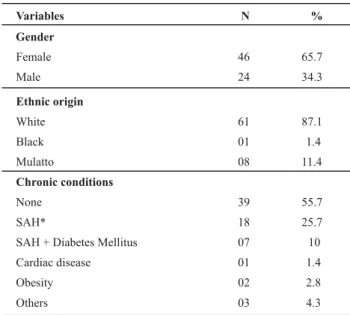
According to Table 1, out of 70 study participants, 65.7% were female and 34.3% male. Regarding ethnic origin, most were white. Arterial hypertension stood out as a chronic condition, with 18 cases (25.7%).
Table 1 - Distribution of categorical variables of 70 patients under
analysis
Variables N %
Gender
Female
Male
46
24
65.7
34.3
Ethnic origin
White
Black
Mulatto
61
01
08
87.1
1.4
11.4
39 55.7
18 25.7
07 10
01 1.4
Chronic conditions
None
SAH*
SAH + Diabetes Mellitus
Cardiac disease
Obesity 02 2.8
Others 03 4.3
*Systemic Arterial Hypertension
The investigated patients’ mean age was 53.6 years, with a standard deviation (SD) of 15.4 years, maximum 90.5 years and minimum 27.7 years.
The mean duration of surgery was 111 minutes, me-dian 100 (SD 48.1 minutes), minimum 40 minutes and maxi-mum 230 minutes. In Table 2, the types of procedures are described, among which laparoscopic cholecystectomy was the most frequent (25.7%). The category others includes different gastrointestinal, plastic, gynecological and urologi-cal procedures, totaling 19 surgeries.
Table 2 - Distribution of surgical procedures of patients under analysis
Surgical Procedure
Laparoscopic cholecystectomy 18 25.7
Laparoscopic hiatal hernia repair 07 10
Prostatectomy 06 8.6
Radical mastectomy 05 7.1
Abdominoperineal amputation 05 7.1
Abdominal hysterectomy 04 5.7
Rectosigmoidectomy 03 4.3
Femoral fracture repair
Others
03
19
4.3
27.1
Total 70 100
N %
The mean duration of anesthesia was 158.2 minutes, median 150 (SD= 53.7 minutes). In the sample, 77.1% (n=54) was submitted to general anesthesia, while combined an-esthesia (general + spinal) was administered in 12.9% (n=9) and regional in 10% (n=7).
Hypothermia prevention measures adopted in the intraoperative period
Upon arrival at the Surgical Unit, all patients were cov-ered with a cotton sheet and woolen blanket.
In the intraoperative phase, the cotton blanked was adopted as the passive cutaneous warming method in only eight patients (11.4%). The forced air-warming system was used as the active cutaneous warming method only once (1.4%).
Bandaging lower limbs with orthopedic cotton and stick-ing tape was done in 10 patients (14.3%).
Intravenous warmed fluid administration was applied in 12 patients (17.1%). In the study sample, the mean fluid quantity infused (saline solution, glucose solution and Ringer lactate) was 2,346 ml, median 2,000 ml.
DISCUSSION
The results evidenced that only 27.1% (n=19) of the study subjects used some intraoperative cutaneous warm-ing measure.
Active warming methods can be divided into passive and external or central active methods. The passive warming method can be general, through the use of cotton blan-kets, or local, such as the use of gloves, caps, among oth-ers. The external active warming method, on the other hand, can be classified as systemic, including contact (e.g. circulating water mattress and forced air-warming system) and radiant warming, through the use of devices with lights, or local, with the use of radiant heat clothing(3).
Another active warming form is called central warm-ing, which can be endogenous, such as the infusion of amino acids, and exogenous, through the administration of heated fluids and gases for example(3).
To prevent intraoperative hypothermia, as appointed in this study, the passive cutaneous warming method was used (use of cotton blankets and lower limb bandaging), which according to literature is not the most effective to maintain patients’ normothermia, while a proven effective active cutaneous warming method was used only once (forced air warming system).
of warmed cotton blankets, the forced air warming system has been associated with increased patient comfort, greater oxygen saturation in the blood and decreased appearance of shivers(8).
The forced air-warming system is an effective method to prevent or treat hypothermia in surgical patients(1,5).
In some patients, such as elderly or very ill people for example, this system can be insufficient to maintain pa-tients’ normothermia during certain procedures, such as liver transplantation or cardiac surgery. Thus, new systems are emerging and, today, in literature, studies compare this system with others that use new technologies(5,9).
Among new active cutaneous warming methods, two systems include a warmed water generator, which circu-lates through tubes for single-use devices. In the circulat-ing water garment, the devices can be used in different body parts, such as the chest and/or upper and lower limbs. In the energy transfer pads, the devices are flexible hydro-philic gel adhesives, which can cover the patient’s abdo-men, back and thighs and entail a close interface with the skin, which permits excellent energy transfer from the wa-ter generator to the patient. The consequence of this close contact is that a smaller part of the patient’s body needs to be covered to achieve effective thermal control(5,9).
Carbon fiber resistive heating blankets include non-dis-posable devices that can be used in different body seg-ments. The devices are made of resistant and washable material and can be sterilized or disinfected(10).
In a recent study that involved seven male volunteers in different phases, participants were randomly allocated in three groups of people who received warming through the circulating water garment system, through the energy trans-fer pads system and volunteers who used the forced air warm-ing system. All volunteers tested the three systems(11).
These subjects were initially submitted to general anes-thesia and their temperature was cooled down to approxi-mately 34°C, maintained for 45 to 60 minutes, after which they received active warming through the systems tested in this study. The energy transfer pads system was 25% faster than the circulating water garment system in recov-ering patients’ temperature, and twice as fast as the forced air warming system(11).
In a randomized controlled clinical trial, involving 53 patients submitted to open abdominal surgeries and gen-eral anesthesia, subjects were distributed in two groups, which were: 25 were warmed with the circulating water garment system, while the control group (n=28) used the forced air-warming system on upper limbs, while the oper-ating room temperature was kept constant at approximately 20°C. The patient’s body temperature was measured dur-ing the skin incision, one hour later, upon the closdur-ing of the incision and in the immediate postoperative phase, with significantly higher temperatures in the experimental than in the control group(12).
The authors concluded that the circulating water gar-ment system can distribute heat across a greater body sur-face percentage in comparison with the forced air-warm-ing system used on upper limbs, thus resultair-warm-ing in better intraoperative normothermia maintenance(12).
With a view to developing a care protocol based on evi-dence-based practice for surgical patients in the postop-erative phase at an intensive care unit (ICU), the research authors formulated the following guiding question: what is the best warming method to deliver excellent patient care? To answer this question, they investigated 60 adult patients admitted with a core temperature below 35.4°C, randomly selected and allocated in three groups: G1 forced air-warm-ing system (n=20); G2 circulatair-warm-ing water garment system (n=20) and G3 cotton blanket (n=20). The effects of the three methods on patients’ core temperature and total rewarm-ing time were investigated and data showed no statistically significant difference between the circulating water gar-ment system and the forced air warming system for the rewarming of ICU patients; these two systems, however, did show statistically significant results regarding rewarm-ing speed in comparison with cotton blanket use(13).
Although those results support literature, the authors in-dicate the research limitations due to the small number of patients, as the sample was restricted to hypothermic patients at a postoperative ICU, which impedes any generalization(13).
In another randomized controlled clinical trial, the au-thors tested the use of the forced air-warming system placed on the lower limbs (CG=control group, n=30). In experimen-tal group 1 (EG1, n=30), the carbon fiber resistive heating blanket was used, whose devices covered the upper limbs, neck, chest and partially covered the lower limbs and, in EG2 (n=30), circulating water garment system. Patients were submitted to coronary artery bypass graft surgery with gen-eral anesthesia(10).
During the intraoperative phase, the results evidenced a statistically significant difference among the groups. At the end of the surgery, only EG2 patients were normother-mic, while EG1 patients presented mild hypothermia and patients in CG severe hypothermia(10).
Intravenous warmed fluid administration was a mea-sure adopted for the research participants in only 12 cases (17.1%). This measure is generally indicated when large fluid volumes need to be replaced, that is, more than two liters per hour in adult patients. It is considered adjuvant, can-not replace the use of an active cutaneous warming sys-tem and by itself cannot maintain surgical patients’ nor-mothermia(1,5).
To test the hypothesis that the use of warmed fluids in combination with the forced air-warming system results in lesser intraoperative hypothermia in comparison with the use of the active warming method alone, experts conduced a study involving 61 patients (ASA 1 to 3), submitted to sur-geries that took at least 90 minutes. All subjects used the forced air-warming system and were randomly divided in two groups. Group 1 (n=31) also received warmed fluids, while group 2 (n=30) received fluids at room temperature. Thus, at the end of the research, group 1 displayed higher temperatures in comparison with group 2(15).
In another study, the authors investigated the effect of warmed fluid infusion on hemodynamic conditions, post-operative shivers and recovery in orthopedic surgery pa-tients. Therefore, two patient groups were randomly di-vided, with 30 patients receiving fluids at room tempera-ture (hypothermic group) and the other 30 warmed fluids (normothermic group). The results appointed a significant temperature decrease in both groups; this drop, however, was more enhanced in the hypothermic groups, which also presented more shivers, increased blood pressure and de-layed post-anesthesia recovery in comparison with the nor-mothermic group(16).
The use of warmed solutions to irrigate cavities like the abdomen, pelvis or thorax is another adjuvant measure to prevent hypothermia(1).
Thus, the effect of infusion and irrigation with fluids at room temperature (G1) was compared with irrigation with fluids warmed at 38°C and intravenous fluid infusion at room temperature (G2) and irrigation and intravenous warmed fluid infusion at 38°C in 120 patients submitted to transurethral resection of the prostate. Patients in groups 1 and 2 who complained of feeling cold were externally warmed with warmed cotton blankets and warmed fluid infusion was started. It was verified that body temperature at the end of the procedure was higher in G1 than in G2,
although patients in group 1 presented more shivers: G3, however, showed no important temperature changes and reported no feelings of coldness or shivers. None of the assessed data showed statistical significance(17).
Hypothermia generates not only thermal discomfort for patients, but also relevant complications, as appointed ear-lier. Therefore, nurses need to put in practice effective mea-sures to prevent or treat it during the perioperative period. Surgical nursing professionals’ practice, however, is still marked by attitudes based on experience, with nursing care actions solely oriented by a previously established routine at the service, to the extent that the feelings of patients experiencing hypothermia are sometimes ignored(18).
Intraoperative hypothermia prevention costs are lower than the cost to treat negative outcomes, such as the need for blood transfusion, that patients are affected due to their hypothermic condition. A meta-analysis demonstrated that, on average, a body temperature drop of more than 1.5°C below normal entailed accumulated negative outcomes, adding between $2.500 and $7.000 of hospital costs per surgical patient(19).
Health professionals and particularly nurses should act with commitment to patients’ wellbeing, combining scien-tific knowledge, based on the most recent evidence avail-able and exercising their professional autonomy to develop care protocols aimed at intraoperative hypothermia pre-vention or treatment(20).
CONCLUSION
Based on this research, it could be identified that the passive cutaneous warming method, involving cotton blan-kets and lower limb bandaging, was the most used mea-sure in the research sample, and that an active cutaneous warming method, i.e. the forced air-warming system, was used only once.
These results demonstrated the need to put in practice a care protocol aimed at effective hypothermia prevention interventions. The reality demonstrated here is expected to be the same or similar to that of many Brazilian hospi-tals and, in this context, nurses play an important role, as patient safety and the reduction of complications due to surgical anesthesia are nursing care targets.
REFERENCES
1. Association of periOperative Registered Nurses (AORN). Recommended practices for the prevention of unplanned perioperative hypothermia. AORN J. 2007;85(5):972-88.
2. Weirich TL. Hypothermia/warming protocols: why are they not widely used in the OR? AORN J. 2008;87(2):333-44.
3. Kumar S, Wong PF, Melling AC, Leaper DJ. Effects of perioper-ative hypothermia and warming in surgical practice. Int Wound J. 2005;2(3):193-204.
5. Kurz A. Thermal care in the perioperative period. Best Pract Res Clin Anaesthesiol. 2008;22(1):39-62.
6. Panagiotis K, Maria P, Argiri P, Panagiotis S. Is postanesthesia care unit length of stay increased in hypothermic patient. AORN J. 2005;81(2):379-92.
7. Lobiondo-Wood G, Harber J. Nonexperimental designs. In: Lobiondo-Wood G, Harber J. Nursing research: methods and critical appraisal for evidence-based practice. 6ª ed. St. Louis: Mosby; 2006. p. 238-59.
8. Good KK, Verble JA, Secrest J, Norwood BR. Postoperative hypo-thermia: the chilling consequences. AORN J. 2006;83(5): 1054-68.
9. Taguchi A, Kurz A. Thermal management of the patient: where does the patient lose and/or gain temperature? Curr Opin Anaesthesiol. 2005;18 (6):632-9.
10. Hofer CK, Worn M, Tavakoli R, Sander L, Maloigne M, Klaghofer R, et al. Influence of body core temperature on blood loss and transfusion requirements during off-pump coronary artery bypass grafting: a comparison of 3 warming systems. J Thorac Cardiovasc Surg. 2005;129(4):838-43.
11. Wadhwa A, Komatsu R, Orhan-Sungur M, Barnes P, In J, Sessler DI, et al. New circulating-water devices warm more quickly than forced air in volunteers. Anesth Analg. 2007;105(6):1681-7.
12. Janicki PK, Higgins MS, Janssen J, Johnson RF, Beattie C. Compari-son of two different temperature maintenance strategies during open abdominal surgery. Anesthesiology. 2001;95(4):868-74.
13. Grossman S, Bautista C, Sullivan L. Using evidence-based prac-tice to develop a protocol for postoperative surgical intensive care unit patients. Dimens Crit Care Nurs. 2002;21(5):206-13.
14. Grocott HP, Mathew JP, Carver EH, Phillips-Bute B, Landolfo KP, Newman MF. A randomized controlled trial of the Artic Sun temperature management system versus conventional methods for preventing hypothermia during off-pump cardiac surgery. Anesth Analg. 2004;98(2):298-302.
15. Smith CE, Gerdes E, Sweda S, Myles C, Punjabi A, Pinchaki AC, et al. Preventing hypothermia: convective and intravenous fluid warming versus convective warming alone. J Clin Anesth. 1998;10(5):380-5.
16. Hasankhani H, Mohammadi E, Moazzami F, Mokhtari M, Naghgizadh MM. The effects of intravenous fluids tempera-ture on perioperative hemodynamic situation, post-operative shivering, and recovery in orthopaedic surgery. Can Oper Room Nurs J. 2007;25(1):20-4.
17. Okeke LI. Effect of warm intravenous and irrigating fluids on body temperature during transurethral resection of the prostate gland. BMC Urol. 2007;7(15):1-3.
18. Christóforo BEB, Carvalho DS. Nursing care applied to surgical patient in the pre-surgical period. Rev Esc Enferm USP [Internet]. 2009 [cited 2010 Mar 15];43(1):14-22. Available from: http://www.scielo.br/pdf/reeusp/v43n1/en_02.pdf
19. Mahoney CB, Odom J. Maintaining intraoperative normoth-ermia: a meta-analysis of outcomes with costs. AANA J. 1999;67(2):155-63.