Evaluation of pain intensity and vital
signs in the cardiac surgery
postoperative period
*AVALIAÇÃO DA INTENSIDADE DE DOR E SINAIS VITAIS NO PÓS-OPERATÓRIO DE CIRURGIA CARDÍACA
EVALUACIÓN DE LA INTENSIDAD DEL DOLOR Y SIGNOS VITALES EN EL POST OPERATORIO DE CIRUGÍA CARDÍACA
* Taken from the thesis “Assessment of pain intensity and vital signs: reactions to a nursing procedure”, Universidade Estadual do Ceará, 2009. 1 RN. M.Sc. in
Clinical Care and Health, Universidade Estadual do Ceará. Fortaleza, CE, Brazil. [email protected] 2 RN. Ph.D. in Nursing. Faculty at
Universida-de Estadual do Ceará. Nurse at Hospital Universida-de Messejana Dr. Carlos Alberto Studart Gomes. Fortaleza, CE, Brazil. luciaUniversida-defá[email protected] 3 RN. Ph.D. in
Nursing. Faculty at Universidade Federal do Ceará. [email protected] 4 RN. Ph.D. in Nursing. Faculty at Universidade Estadual do Ceará. Fortaleza, CE, Brazil.
O
RIGINAL
A
R
TICLE
RESUMO
O objetivo do estudo é analisar as altera-ções nos sinais vitais de pacientes em pós-operatório de cirurgias cardíacas, mediante intensidade de dor referida. Trata-se de estudo descritivo-exploratório, que utilizou o método de análise quantitativa na inves-tigação de 38 pacientes submetidos à pri-meira renovação de curativos. A análise dos dados, mensurados antes e após a realiza-ção do procedimento de enfermagem, indi-caram que a manifestação da dor ocorreu em diferentes classificações. As principais alterações nos sinais vitais ocorreram na pressão arterial. Concluiu-se que a intensi-dade dolorosa mantém relações com os resultados dos sinais vitais e o cuidado prestado é imprescindível ao restabeleci-mento do estado de saúde do paciente no pós-operatório.
DESCRITORES Dor
Cirurgia torácica Medição da dor Sinais vitais
Cuidados de enfermagem
Adriana de Fátima Alencar Miranda1, Lúcia de Fátima da Silva2, Joselany Áfio Caetano3, Ana Cláudia
de Sousa4, Paulo César Almeida5
ABSTRACT
The objective of this study is to analyze the changes in vital signs of postoperative car-diac surgery patients, according to the re-ferred pain intensity. This descriptive-ex-ploratory study was performed using quan-titative analysis to investigate 38 patients submitted to a first dressing change. The analysis of the data, measured before and after performing the nursing procedure, in-dicated that the manifestation of pain oc-curred at different levels. The main changes in vital signs referred to blood pressure. In conclusion, there is a relationship between pain intensity and vital signs, and the care that is delivered is indispensible to reestab-lishing the health state of the postopera-tive patient.
DESCRIPTORS Pain
Thoracic surgery Pain measurement Vital signs Nursing care
RESUMEN
El objetivo del estudio es analizar las alte-raciones en signos vitales de pacientes en post operatorio de cirugías cardíacas, me-diante intensidad de dolor referida. Se tra-ta de un estudio descriptivo-exploratorio, que utilizó el método de análisis cuantita-tivo en la investigación de 38 pacientes so-metidos al primer cambio de curativos. El análisis de los datos, medidos antes y des-pués del procedimiento de enfermería, in-dicó que la manifestación de dolor ocurrió en diferentes clasificaciones. Las principa-les alteraciones en los signos vitaprincipa-les ocu-rrieron en la presión arterial. Se concluyó en que la intensidad dolorosa mantiene re-lación con los resultados de los signos vita-les y el cuidado prestado es imprescindible para el restablecimiento del estado de sa-lud del paciente en el post operatorio.
DESCRIPTORES Dolor
Cirugía torácia Dimensión del dolor Signos vitales
INTRODUCTION
In the postoperative (PO) period, different organic al-terations affect patients, due to their exposure to the ef-fects of the surgery on tissue. Pain is one of these main manifestations, and is considered a determinant of the clini-cal condition imposed by the surgiclini-cal procedure.
Pain is an unpleasant sensory and emotional experience, associated with actual or potential tissue damage and de-scribed in terms of this damage(1). This definition is used by
different studies in the area and also in this research.
Acute postoperative pain, due to acute tissue lesions, entails modifications in quality of life, which can impair health and cause physiological alterations that, if not solved, result in organic and psychological problems that will nega-tively influence lifestyles and associated comorbidities(2).
Pain symptoms negatively affect patients’ postopera-tive pain evolution, causing functional and organic dam-age and reflecting in difficulties for patients to reestablish their adequate vital parameters, such as
breathing, thermal and cardio-circulatory ca-pacity, to the detriment of surgical problems.
The main causes of postoperative pain include the surgical incision, tissue traumas, tracheal and chest tubes, besides different invasive procedures that are part of the adopted therapeutics(3).
Clients’ complaints should be assessed to identify the repercussions of PO pain and a physical assessment should be made to iden-tify biological alterations. The obtained re-sults provide clinical analysis data that, when
measured and observed, provide an assessment of the symptom.
In combination with these manifestations, vital signs are important to direct pain sensitivity as, in case of pain, blood pressure, respiratory and cardiac frequencies are modified, and significant influences on body temperature can occur(4).
Thus, patients’ postoperative exposure to pain provokes alterations in parametric biological data, demanding fur-ther research on the associations between pain intensity and its effects on modifications in vital signs.
Hence, in case of pain, manifestations in vital signs should be investigated, with a view to minimizing discrep-ancies between those resulting from pain or from post-sur-gical complications.
OBJECTIVE
To analyze alterations in patients’ vital signs in the post-operative phase of cardiac surgery, through referred pain intensity.
METHOD
A descriptive and exploratory study was carried out at an Intensive Care Unit (ICU) in the postoperative phase of cardiac surgeries at a state hospital in Fortaleza-CE, Brazil. Data were collected in August and September 2008 and quantitative analysis was used to examine patients aged 18 years or older, submitted to the first PO dressing change. Authorization for the research was obtained from the In-stitutional Review Board of Hospital Dr. Carlos Alberto
Studart Gomes (protocol CEP/ HM 519/08), in Fortaleza- CE,
2008.
Initially, 65 patients in the preoperative phase of elec-tive surgeries were contacted, find out about the study objectives and were trained about pain classification, ac-cording to the numerical-verbal scale, which scores pain from zero to 10, so as to classify its intensity as absent (zero), mild (1 to 3), moderate (4 to 6), intense (7 to 9) and un-bearable (10)(1).
When they agreed to participate, patients signed the informed consent term. Thirty-eight of these patients were part of data collection as they complied with the established inclusion cri-teria: they should be conscious, oriented and able to verbally express themselves during postoperative pain and vital signs assessment, going through a first postoperative cardiac surgery experience and with surgical access through median sternotomy.
Male and female patients participated, with a mean age of 49.5 years, submitted to heart surgeries, grouped as coronary artery bypass graft, correction of cardiac myxoma, valve correction and correction of congenital defects, with or without extracorporeal circulation (ECC).
Patients were assessed in the immediate PO period (un-til 48 hours after the end of the surgical procedure) at two times: before and after the first surgical dressing change, performed by nurses from the hospital unit where the re-search took place.
Before changing the dressings, pain was classified, us-ing criteria from the numerical-verbal pain assessment scale, and the following vital signs were checked: systolic blood pressure (SBP), diastolic blood pressure (DBP), cardiac fre-quency (CF), respiratory frefre-quency (RF) and body tempera-ture (T). At the end of the nursing procedure, the same evaluation steps were repeated and registered on a form developed for the study.
The collected data were processed in SPSS version 14.0, and later analyzed with the Fisher-Freeman-Halton and Maximum likelihood tests. Statistical significance was set at p < 0.05. The findings were organized in tables, in addi-tion to descriptive and inferential analysis.
...in case of pain, manifestations in vital
signs should be investigated, with a
view to minimizing discrepancies between
RESULTS
Thirty-eight patients participated in the study, 60.5% of whom were men. The most prevalent age group (47.4%) was 60 years or older. Half of the population suffered from Diabetes mellitus (DM) and/or systemic arterial
hyperten-sion (SAH) and the paramount surgical diagnosis was coro-nary artery bypass graft (68.4%). The most frequent dura-tion of surgery ranged between two and less than four hours in 63.1% of cases and most patients (92.1%) were in the first 24 hours after surgery.
Table 1 - Patient distribution according to characteristics, clinical-surgical data and pain intensity - Fortaleza - 2008
f %
CHARACTERISTICS
Gender Male Female
Age
18–|45
45–|60
>60
CLINICAL-SURGICAL DATA
Associated comorbidities None
DM and/or SAH
Surgical diagnosis Coronary artery bypass graft Others
Duration of surgery (in hours)
2–|4
>4
Postoperative time (in hours)
13–|24
> 24
23 15
8 12 18
19 19
26 12
24 14
35 3
60.5 39.5
21.0 31.6 47.4
50.0 50.0
68.4 31.6
63.1 36.9
92.1 7.9
PAIN INTENSITY f
BEFORE AFTER
%
BEFORE AFTER
Zero (absent) 1 to 3 (mild)
4 to 6 (moderate)
7 to 9 (intense) 10 (unbearable)
9 8
15 17
9 10
4 3
1
-23.7 21.0
39.5 44.8
23.7 26.3
10.5 7.9
2.6
-TOTAL 38 100.0
(n=38)
Regarding pain intensity, the assessment of this phe-nomenon before dressing change resulted in a different clas-sification at both times, particularly for the perception of unbearable pain, which one single participant reported before the procedure, but was not observed after nursing care delivery.
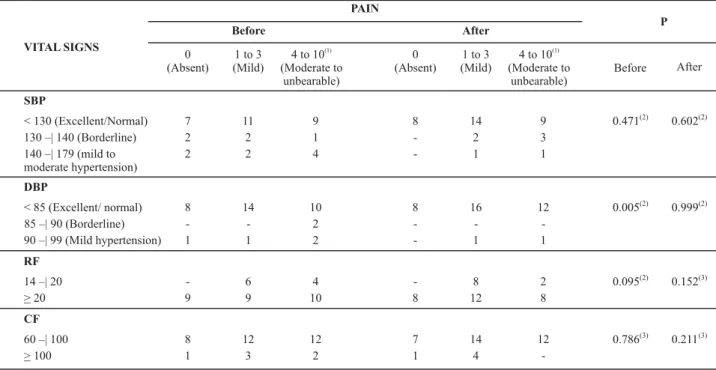
When relating pain intensity reactions with vital sign measurements, it is observed that, before the dressing changes, among 27 patients with SBP below 130 mmHg, 11 perceived mild and nine moderate to unbearable pain in-tensity. Out of eight people with SBP levels considered as mild to moderate systolic arterial hypertension, the stron-gest pain intensity was found in the moderate to
unbear-able pain classification (p= 0.471). After the dressing changes, SBP values demonstrated that levels below 130 mmHg were associated with mild pain manifestations in 14 patients and moderate to unbearable manifestations in nine people. The most suggestive variations occurred in SBP values between 130 and 140 mmHg, where three patients mentioned moderate to unbearable pain intensity (p= 0.602) after the dressing change.
Table 2 - Distribution of patient numbers according to association between vital signs and pain variables before and after dressing change - Fortaleza - 2008
PAIN
Before After P
VITAL SIGNS
0 (Absent)
1 3
(Mild)
to 4 10(1)
(Moderate to unbearable)
to 0
(Absent)
1 3
(Mild)
to 4 to 10(1)
(Moderate to unbearable)
Before After
SBP
< 130 (Excellent/Normal)
130–|140 (Borderline)
140 179 (mild to
moderate hypertension
–|
)
DBP
< 85 (Excellent/ normal)
85–|90 (Borderline)
90–|99 (Mild hypertension)
RF
14–|20
> 20
CF
60–|100
> 100
7 2 2
8 -1
-9
8 1
11 2 2
14 -1
6 9
12 3
9 1 4
10 2 2
4 10
12 2
8
-8
-8
7 1
14 2 1
16 -1
8 12
14 4
9 3 1
12 -1
2 8
12
-0.471(2)
0.005(2)
0.095(2)
0.786(3)
0.602(2)
0.999(2)
0.152(3)
0.211(3)
After the end of the nursing procedure, excellent/nor-mal DBP levels were found in 16 patients with mild pain. Eight patients with DBP below 85mmHg denied any pain (p=0.999).
Respiratory frequency (RF) before the nursing proce-dure highlighted that, out of 28 patients with tachypnea, 10 felt moderate to unbearable pain, while nine patients in the same group did not mention any pain (p = 0.095).
At the end of the dressing change, respiratory frequen-cies showed that most participants’ levels increased by 20 respiratory movements in 1 minute or more, that 12 pa-tients experienced mild pain and that eight classified the symptom as moderate to unbearable. Among eupneic sub-jects, eight mentioned mild pain and two more intense pain. No absence of pain was found among the research sub-jects with physiological RF (p=0.152).
Before the dressing change, cardiac frequency was kept at physiological levels in 32 patients. Twelve of them af-firmed mild pain, 12 others moderate to intense pain and 8 did not complain of this symptom. Three (p= 0.786) out of six patients who experienced increased pulse rate pre-sented mild pain complaints.
At the end of the dressing change, in most patients, car-diac frequencies remained at physiological levels (between 60 and 100 beats per minute). Fourteen of these patients classified their pain as mild and 12 as moderate to intense. In the same group, seven patients did not report pain. None of the five patients with increased pulse rate reported
in-tense pain. No association was found between CF and pain after the dressing change (p= 0.211).
Body temperature was classified as physiological when results varied between 35.8°C and 37.4°C (armpit measure), observed in all participants, without any modifications in these levels when the nursing intervention was accomplished.
DISCUSSION
This research reveals that some clinical-surgical variables can affect the proposed associations between pain inten-sity and blood pressure, cardiac and respiratory frequency and body temperature.
Findings for these variables are in line with other re-lated studies which, in a study of Diabetes Mellitus (DM) patients and the cardiovascular and neurological conditions of this comorbidity, reveal that they can cause autonomous cardiac alterations, leading to a reduction or even absence of pain in case of ischemic cardiac events(5). The frequent
association between Diabetes mellitus and arterial hyper-tension entails a great increase in cardiovascular risks(6).
These comorbidities collaborate in the prevalence of car-diac events with surgical repercussions, particularly coronary artery bypass graft surgery. A recent study identified that 35% of patients submitted to this procedure had DM, making it dif-ficult to reach a diagnosis based on the absence of pain mani-festations indicating heart problems, which can interference in pain assessment responses in the postoperative period(7).
(n=38)
The prevalence of coronary artery bypass graft surger-ies was important for a better approximation with pain classifications. Other pain assessment studies also high-lighted this type of surgery and found no significant dif-ferences in reactions to pain in terms of different surgical diagnoses(3). Pain intensity can also influence pulmonary
function alterations in the postoperative period(8). It can
be affirmed that, when establishing physiological respira-tory conditions, the chances that patients will feel more intense pain are minimized.
Pain results in respiratory, hemodynamic and metabolic changes, predisposing patients to probable unforeseen ho-meostatic events, causing greater energy and protein sumption and a decrease in ventilation volume. This con-tributed to the development of consequent relations be-tween pain and vital signs, observed in this research(9).
In pain interpretation, it should be emphasized that the subjective and multidimensional nature of pain entails dif-ficulties regarding the determination and quality of the symptom in the postoperative period. Its assessment needs to be based on multidimensional considerations, facilitat-ing its measurement and, thus, the indication of adequate treatment, with a view to validating the phenomenon’s role in the patient’s clinical situation(10). Pain classification
be-fore and after dressing change showed little variation in these study results. It is noteworthy that patients who re-ported intense (10.5%) and unbearable pain (2.6%) before the dressing change had their pain intensity reduced through the procedure. Despite the small sample size, these variations served to identify the benefits of nursing care.
About the relations between pain intensity and vital signs in the postoperative period, few studies were found on the same theme as the present research, among which a study of patients submitted to cardiac surgery is high-lighted(11), which was important to conduct discussions on
the findings regarding pain and vital signs.
When relating SBP with pain, the results were insuffi-cient to confirm a significant association between the vari-ables, although they demonstrated important modifications in pressure values depending on pain intensity, due to a significant reduction in pain classification after the dress-ing change (from six to two events), thus decreasdress-ing the number of people with SBP considered mild to moderate hypertension. It could be clarified that pain intensity inter-feres exactly in pressure levels, as pain was reduced and, consequently, SBP levels.
The relations between pain and BDP, analyzed before and after dressing changes, demonstrate that the non-as-sociation between diastolic pressure and pain classification after the procedure shows the relevance of accompanying both variables, so that the decrease in pain can satisfacto-rily affect the reduction of diastolic blood pressure levels.
These results are similar to the abovementioned study of patients submitted to cardiac surgery(11). In that research,
it was observed that, in patients with pain complaints at the moment of the assessment, the mean rise in SBP was 14.2 mmHg. In patients who had felt pain within 24 hours before the assessment and those who had not felt pain in the last 24 hours, a discrete drop occurred (0.7 and 2.0 mmHg, respectively). The tests applied to the pain-related pressure levels, in the same study, did not confirm a signifi-cant difference in the comparison between the research groups.
In the same research(11), diastolic BP levels in patients
feeling pain showed a mean rise of 9.1 mmHg, against an increase by 3.4 mmHg in patients who had experienced pain in the last 24 hours and 2.3 mmHg in patients who did not mention pain.
The verification of RF after the dressing change demon-strated a significant decrease in pain intensity, which was more considerable in people with eupnoea criteria (RF 14 ¦ 20), but showed suggestive alterations in patients with tachyp-nea. The number of patients who did not feel pain after nursing care decreased (although by one only), emphasiz-ing that pain intensity was a determinemphasiz-ing factor to indicate RF alterations.
Frequency changes in respiratory patterns were also observed in a comparative analysis, identifying that the number of respiratory movements increased in all patients who felt pain. Patients in pain showed an average increase of 6 respiratory movements/minute, against a mean in-crease by 3 movements/minute among patients who felt pain in the last 24 hours. Among patients who did not feel pain in the interval of up to 24 hours, the mean RF increased by 4 respiratory movements/minute(11).
When associated with pain intensity, statistical test re-sults did not confirm the association of cardiac frequency. In a comparative analysis, however, when confronting the levels of both variables before and after dressing changes, it is identified that, after the nursing procedure, the cross-ing between pain and CF approximate significance levels more closely than before the care delivery.
It is important to take into account that pain influences neuro-vegetative reactions and that, in combination with anxiety, pulse frequency, oxygen consumption and cardiac overload increase. Sinus tachycardia, with CF above 100 beats/minute, is a frequent complication in the postopera-tive period(12-13).
In a study involving patients in the postoperative pe-riod of heart surgery(11), research results were similar to the
present research, with an increase by up to 17 beats/minute in patients who experienced pain within 24 hours after heart surgery, showing a significant relation with cardiac fre-quency in the three research groups when compared with the preoperative situation. This may suggest that CF is not a defining characteristic of pain.
an intervention proposal, improved pulse frequency lev-els, collaborating in the maintenance and re-establishment of cardiovascular balance in the postoperative period of cardiac surgery.
Body temperature seemed to be the most resistant vari-able to modifications in pain intensity and to the execution of dressing changes in the immediate postoperative period, as no temperature modifications were perceived during the research. Thus, no parallels could be drawn between the increased painful reaction and consequent repercussions on body temperature, differing from other authors’ asser-tions(4). Nevertheless, the changes in the other vital signs
were important to determine the pain dimension and its influences in the postoperative phase.
CONCLUSION
Based on the associations between pain intensity and blood pressure, cardiac frequency, respiratory frequency and temperature levels, it could be identified that the non-association between the crossing of reactions was not de-terminant to confirm that pain intensity is related with changes in vital parameters. It was also observed that per-ceived alterations in vital signs, obtained through the nurs-ing procedure, took forms that differed from pain classifi-cation patterns, turning pain manifestations into subjec-tive experiences, based on the occurrence of the event in each patient under analysis. The dressing changes confirm the quality of nursing care to grant comfort to patients in the postoperative phase of cardiac surgery.
REFERENCES
1. Sociedade Brasileira para o Estudo da Dor (SBED). Hospital sem Dor: diretrizes para implantação da dor como 5º sinal vital [Internet]. São Paulo; 2009 [citado 2009 fev. 25] Disponível em: http:// www.dor.org.br/profissionais/5_sinal_vital.asp
2. Peón AH, Diccini S. Dor pós-operatória em craniotomia. Rev Lat Am Enferm. 2005;13(4): 489-95.
3. Mueller XM, Tinguely F, Tevaearai HT, Revelly J, Chioléro R, Segesser LK. Pain location, distribution, and intensity after cardiac surgery. Chest. 2000;118(2):391-6.
4. Chaves LD, Leão ER. Dor: 5º sinal vital – reflexões e interven-ções de enfermagem. Curitiba: Ed. Maio; 2004.
5. Gondim LGP, Oliveira WA, Grossi SAA. A diferenciação da dor do infarto agudo do miocárdio entre pacientes diabéticos e não-dia-béticos. Rev Lat Am Enferm. 2003;11(6): 720-6.
6. Sociedade Brasileira de Cardiologia, Sociedade Brasileira de Hipertensão, Sociedade Brasileira de Nefrologia. V Diretrizes Brasileiras de Hipertensão Arterial. São Paulo; 2006.
7. Jatene FB, Nicolau JC, Hueb AC, Atik FA, Barafiole LM, Murta CB, et al. Fatores prognósticos da revascularização na fase agu-da do infarto agudo do miocárdio. Rev Bras Cirurg Cardiovasc. 2001;16(3):195-202 .
8. Giacomazzi CM, Lagni VB, Monteiro MB. A dor pós-operatória como contribuinte do prejuízo na função pulmonar em paci-entes submetidos à cirurgia cardíaca. Rev Bras Cirurg Cardiovasc. 2006;21(4):386-92.
9. Pimenta CAM, Santos EMM, Chaves LD, Martins LM, Gutierrez BAO. Controle da dor no pós-operatório.Rev Esc Enferm USP. 2001;35(2):180-3.
10. Sousa FAEF. Dor: o quinto sinal vital. Rev Lat Am Enferm. 2002;10(3):446-7.
11. Corrêa CG. Dor: validação clínica no pós-operatório de cirur-gia cardíaca[dissertação]. São Paulo: Escola de Enfermagem, Universidade de São Paulo; 1997.
12. Smeltzer SC, Bare BG. Brunner & Suddarth: tratado de enfer-magem médico-cirúrgica.10ª ed. Rio de Janeiro: Guanabara Koogan; 2005.