Epidemiological profile of
haemophilus
influenzae
b meningitis in regional health
board of Piracicaba - São Paulo - Brazil
*SITUAÇÃO EPIDEMIOLÓGICA DAS MENINGITES POR HAEMOPHILUS INFLUENZAE B NA DIREÇÃO REGIONAL DE PIRACICABA - SÃO PAULO
SITUACIÓN EPIDEMIOLÓGICA DE LAS MENINGITIS POR HAEMOPHILUS INFLUENZAE B EN LA DIRECCIÓN REGIONAL DE PIRACICABA - SÃO PAULO - BRASIL
* Extracted from the thesis “Impacto da introdução da vacina contra Haemophilus influenzae b (Hib)”, University of São Paulo School of Nursing, 2002. 1 Nurse. Master in Nursing. Technical Director of the Epidemiological Surveillance Service of the Regional Health Department of Piracicaba. Piracicaba, SP, Brazil. [email protected] Specialist Nurse of the Teaching Hospital at University of São Paulo. Santo André, SP, Brazil. [email protected] Associate
O
RIGINAL
A
R
TICLE
RESUMO
O presente estudo objetivou caracterizar a população acometida por meningites por Hib em relação às variáveis demográficas e relativas ao processo saúde-doença, no período de 1992 a 2001, na DIR de Pira-cicaba, SP, Brasil. Os dados foram coletados a partir de fichas de notificação compulsó-ria, sendo sistematizados através do Progra-ma SINAN. Observou-se que ocorreu um pico de incidência da doença em 1994, e um pico de óbitos em 1999, anteriores à introdução da vacina. Os mais acometidos foram crianças menores de 5 anos, do sexo masculino, confirmando dados de literatu-ra. A maioria dos pacientes foi atendida em unidades hospitalares públicas de Piraci-caba e Limeira, referências para as comuni-dades desses municípios, concretizando um dos princípios do Sistema Único de Saúde (SUS): a regionalização. A introdução da vacina promoveu redução dos casos em cerca de 73%, o que corrobora a sua impor-tância e impele à necessidade de estimular a adesão à vacinação.
DESCRITORES
Meningite.
Meningite bacteriana. Vacinas.
Glaucia Elisa Cruz Perecin1, Claudia Maria de Freitas Garcia2, Maria Rita Bertolozzi3
ABSTRACT
The objective of the present study was to characterize the population affected by Hib meningitis from 1992 to 2001, in the Re-gional Health Board of Piracicaba (São Paulo-Brazil) in terms of variables regard-ing demographics and the health-disease process. Data were collected from disease notification reports, and arranged using the SINAN Data Program . It was observed there was a peak in the incidence of meningitis in 1994 and a peak of deaths in 1999, be-fore the vaccine had been introduced. The most affected group were male children under the age of 5 years, which is in agree-ment with literature. Most patients re-ceived care at public hospitals in the mu-nicipalities of Piracicaba and Limeira, which are references for the community of the entire region, which puts into effect one of the axes of the Health System of Brazil (SUS): regionalization. The introduction of the vaccine reduced incidence in about 73%, which corroborates its importance and shows that is necessary to encourage adherence to vaccination.
KEY WORDS
Meningitis.
Meningitis, bacterial. Vaccines.
RESUMEN
El presente estudio objetivó caracterizar la población afectada por meningitis causada por Hib en relación a las variables demográ-ficas y relativas al proceso salud-enfermedad, en el período de 1992 a 2001 en la DIR de Piracicaba, SP, Brasil. Los datos fueron reco-lectados a partir de fichas de notificación obli-gatorias, las cuales fueron sistematizadas a través del programa SINAN. Se observó que ocurrió un pico de incidencia de la enferme-dad en 1994 y un pico de fallecimientos en 1999, con antelación a la introducción de la vacuna. Los más afectados fueron niños me-nores de 5 años, de sexo masculino, confir-mando datos de la bibliografía. La mayoría de los pacientes fue atendida en unidades hospitalarias públicas de Piracicaba y Limeira, referenciales para las comunidades de tales municipios, concretando uno de los princi-pios del Sistema Único de Salud (SUS): su regionalización. La introducción de la vacu-na promovió la reducción de casos en cerca del 73%, lo que corrobora su importancia e impulsa la necesidad de estimular la adhe-sión a la vacunación.
DESCRIPTORES
Meningitis.
INTRODUCTION
Acute meningitis may be caused by different etiologic agents or due to the manifestation of a non-infectious dis-ease. The three pathogens that are most frequently involved in the etiology of acute bacterial meningitis, being respon-sible for more than 80% of the cases, are Haemophilus influenzae, Neisseria meningitidis and Streptococcus pneumoniae(1).
Most of the meningitis’ cases caused by Haemophilus influenzae result from capsulated strains of type b, and this microorganism is responsible for causing between 3 and 6% of the deaths. It is the prevailing agent in the cases of menin-gitis that strike children between 6 and 12 months old, fre-quently occurring between the first 30 days and the 6 years of life. The bacterial colonization initially takes place in the upper airways or in otological location, and the previous pres-ence of otitis media is frequent found. Despite of the fact that only 4% of the cases are due to Haemophilus influenzae, about 15% of the otitis media caused by this agent evolve to secondary meningitis. Adults and children older than 6 years old may become agent carriers states of the
agent when in intimate contact with ill chil-dren, which may explain the prevalence of meningitis among children(1-2).
The United States of America (USA) were the first to introduce the vaccine against Haemophilus influenzae b, in 1985, for chil-dren older than 18 months. In Brazil, this vac-cine was only introduced in the second se-mester of 1999, with 3 doses for children between 2 and 11 months and 1 dose for children between 12 and 24 months. Several studies, mainly in the international scope,
demonstrate a significant decrease in the incidence of the disease, especially in the group of more vulnerable chil-dren, after the introduction of the vaccine against Haemophilus influenza b(3-8).
In order to evaluate, even though generically, the epi-demiological importance of meningitis, it is possible to search the data of the Brazilian Institute of Geography and Statistics (IBGE – Instituto Brasileiro de Geografia e Estatística), published in the Statistical Yearbook of 1998. According to this source, the total number of cases of men-ingitis registered in Brazil was 28,271 cases in 1996 and 6,423 cases in 1997, considering only the state of São Paulo, there were 10,874 cases in 1996 and 2,121 cases in the fol-lowing year. The numbers concerning meningitis due to various etiologies, except for the meningococcal and the tuberculous meningitis, named as “other etiologies”, which would include, thus, the Haemophilus influenzae b, repre-sented 17,335 cases in the country in 1996, 9,344 of them in the state of São Paulo(5).
The surveillance system of the state of São Paulo has a historical series of meningitis caused by
influenzae b. From 1980 to 1997, there were 5,792 cases confirmed in this state, 3,086 of them in the capital region and 2,700 in the interior of the state. The age distribution, observed in this historical series, shows that most cases occurred with children under 5 years old(7).
In 1997, the deaths caused by meningitis, among chil-dren between 0 and 4 years old, at the same place, regis-tered a total number of 246 cases (8 deaths per 100,000 children), 152 among boys and 95 among girls. In the city of São Paulo there were 86 deaths (1 death per 10,000 chil-dren) caused by meningitis, in the same age group, 57 among boys and 29 among girls. In the interior of the state, the total number of deaths was 161 (7 deaths per 100,000 children), 95 boys and 66 girls. Considering all age groups, the total number of deaths was 516 (1.5 deaths per 100,000 people), 318 of them among men and 198 among women, in the state of São Paulo. In the city of São Paulo there were records of 201 deaths (2 deaths per 100,000 people), 134 men and 67 women and, in the interior of the state, there were 315 deaths (1.3 deaths per 100,000 people), around 184 men and 131 women(9).
In the Institute of Infectious Diseases Emílio Ribas, in São Paulo, the lethality rate was 16% in 2,700 assisted cases, from 1990 to 1992, which evidenced the importance of the establishment of an efficient treatment and protective measures(7).
The Regional Health Department XV (RHB XV), which corresponds to the Regional Health of Piracicaba, the location where this study was developed, represents a geographi-cal area of 8,486 km2,comprising 25 cities:
Águas de São Pedro, Analândia, Araras, Capivari, Charqueada, Conchal, Cordeirópolis, Corumbataí, Elias Fausto, Ipeúna, Iracemópolis, Itirapina, Leme, Limeira, Mombuca, Piracicaba, Pirassununga, Rafard, Rio Claro, Rio das Pedras, Saltinho, Santa Cruz da Conceição, Santa Gertrudes, Santa Maria da Serra and São Pedro. In 1999, these cities were the home of 1,222,550 inhabitants, according to the IBGE, which placed the RHB XV in the fifth position among the Regional Health Departments in the interior of the state in terms of population density. The greatest concentrations of population were found in Piracicaba, Limeira, Rio Claro, Araras and Leme. This RHB confirmed, in 1998, 1999 and 2000, respectively, 250, 337 and 266 cases of meningitis, being 17, 16 and 5 (6.8%, 4.8% and 1.9%, respectively) caused by Haemophilus influenzae b, which confirms its relevance among all cases of meningi-tis caused by various etiological agents(7).
Considering the magnitude of this disease, this study aimed to do an epidemiological characterization of the meningitis cases in the RHB XV of Piracicaba and, particu-larly, those caused by Haemophilus influenzae b, in the period from 1992 to 2001, in order to improve actions to strengthen the disease control.
Most of the meningitis’ cases caused by
Haemophilus influenzae
result from capsulated strains of type b, and this microorganism is responsible for causing
OBJECTIVES
•
Describing some epidemiological characteristics re-lated to the meningitis in general and that caused by the Haemophilus influenzae b in the RHB of Piracicaba, in the period from 1992 to 2001;•
Describing the characteristics of patients with menin-gitis, as well as the aspects related to the hospitalization in this region and the period of time.METHOD
This is a retrospective descriptive study that, initially, quantified and classified the cases, according to the iden-tification of the etiological agent, presented symptoms and signs, deaths and data related to the characteristics of pa-tients such as: age, gender, race, hometown, city of noti-fication, home zone, and cities of hospitals that hospital-ized the 2,971 cases of meningitis notified at the RHB of Piracicaba, in the study period from 1992 to 2001. The information necessary for the construction of the data-base was extracted from the compulsory notification forms, issued by the RHB of Piracicaba, and this database was then integrated to the SINAN software, of the Minis-try of Health.
The second step consisted on the systematization of the cases of meningitis caused by Haemophilus influenzae b, which were selected and analyzed, configuring the epidemi-ology of the meningitis caused by this etiological agent, ac-cording to the period of occurrence, incidence rate, presented symptoms and signs, deaths, age of the patients, gender, hometown, city of notification, home zone of the patients, city of hospitalization and respective hospitals, resulting in 132 cases (4.4% of the total number of meningitis’ cases).
All data were obtained after the approval of the autho-rization request to use the compulsory notification forms, which was sent to the RHB of Piracicaba. In addition, the project was submitted to evaluation and approved by the Committee of Ethics in Research of the Nursing School of the University of São Paulo (2006/2001CEP-EEUSP).
RESULTS AND DISCUSSION
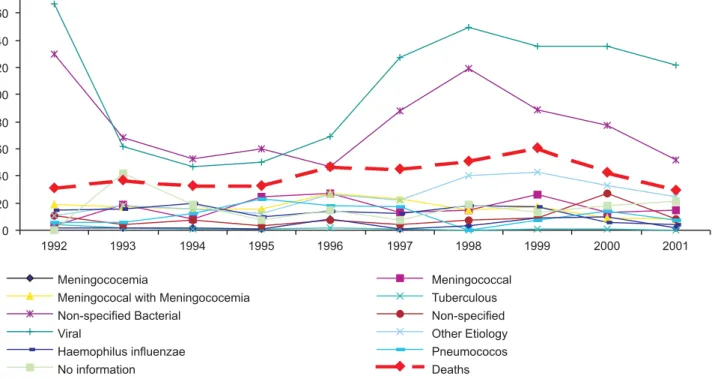
Regarding the results found for the meningitis cases of various etiological agents in the RHB of Piracicaba, it was observed that the highest incidence occurred for the viral types (variation between 23.4% in 1994 and 46% in 2001 -Figure 1). These were then followed by the cases due to non-specified bacteria (variation between 18.1% in 1996 and 35.3% in 1992). The meningitis cases due to Haemophilus influenzae b held the 6th position.
0 20 40 60 80 100 120 140 160 180
1992 1993 1994 1995 1996 1997 1998 1999 2000 2001
Meningococemia Meningococcal
Meningococal with Meningococemia Tuberculous
Non-specified Bacterial Non-specified
Viral Other Etiology
Haemophilus influenzae Pneumococos
No information Deaths
Figure 1 - Distribution of the meningitis cases in the RHB of Piracicaba according to type and deaths from 1992 to 2001.
The bacterial meningitis is the most important in terms of morbimortality, but it presentspresent’s lower incidence than viral meningitis, which is responsible for 90% of the cases. The literature also shows that the three most
The most frequent signs and symptoms observed in the patients were fever (80.8%), vomit (65.7%),headache (62.9%) and rigidity of the neck (44.4%). These data con-firm that the capital signs and symptoms in the diagnosis of meningitis include fever, vomit, rigidity of the neck and functional changes in the central nervous system. This syn-drome may vary, with the absence of some signs and symp-toms or the addition of other clinical manifestations(2).
The deaths occurred mainly in 1999. The year of 1992 presented the lowest rate (8.4%), followed by the year of 2000 (12.5%) and 2001 (11.3%), and the vaccine had al-ready been introduced in these last two years. The highest number of deaths occurred in patients with meningitis clas-sified as “other etiology”, followed by viral and non-spe-cific bacterial.
The information regarding the meningitis cases of “other etiology” may be resulting from the difficulty to quickly detect the etiological cause, due to the delay in the admis-sion of the patient into the care unit, or due to the lack of laboratorial resources for such identification, in certain health units. This may be true because some of the cities from the RHB of Piracicaba presented only small hospitals, which did not have the necessary infrastructure to respond properly to the previous mentioned needs.
On the other hand, there were records of 233 deaths among the 1,409 cases of bacterial meningitis (16.5%), and 75.5% of these deaths occurred to children under 5 years old and 42.9% to children under 1 year old. It is fundamen-tally important to state that, for those under 5 years old, the main cause of death was located in the meningitis due to Haemophilus influenzae b, to other etiologies, meningo-coccal with meningococcemia and non-specified bacterial. Regarding the groups of children under 1 year old, the deaths occurred due to meningitis caused by “other etiolo-gies”, by Haemophilus influenzae b, non-specified bacte-rial and pneumococcal. It is also important to highlight that all deaths caused by meningitis due to Haemophilus influenzae b occurred to children under 5 years old.
The importance of this variable must be emphasized because the literature shows that deaths and sequelae due to bacterial meningitis mostly happen to children under 5 years old, and they could be prevented with vaccination and a fast diagnosis, besides the early establishment of an appropriate treatment(10-11).
In terms of age, a higher incidence of cases (2.3%) was observed before the first month of life, mainly of meningi-tis classified as due to other etiology, followed by non-speci-fied bacterial meningitis. In the group of children between 1 month and 1 year of life, the highest number of cases occurred to 6-month-old children. After the first year, there was a decrease in the incidence of the disease that followed them until the age of 9 years old, and the viral meningitis was the most frequent type. An important incidence of the disease was also observed in the age groups between 10 and 14 years and from 45 to 64 years, with the first group
suffering from viral meningitis and the other from non-specified bacteria meningitis.
The findings of studies developed in Brazil and in Chile were similar as for the age groups of children under 5 years old and adults between 45 and 64 years old. Focaccia indi-cates that, after the age of 6 years up to the old age, there is a strong prevalence of meningococcus and pneumococcus in the cerebrospinal fluid. In older patients, the pneumococ-cus has a significant participation, due to the pulmonary in-fections caused by this agent. The old patient, who is debili-tated both organically and immunologically, is vulnerable to infections caused by opportunistic agents(2,10,12).
Regarding the gender, a higher number of cases was (não seria were) found among men (60.2%). A study devel-oped in Belo Horizonte – MG, in 2001, which evaluated 154 patients, found 64.9% (100) of the children were also male. In Campinas – SP, it was observed that 58.4% (160) of the cases of bacterial meningitis had also occurred to men, with no evidences in the literature to explain such fact(12).
As for their race, 98.2% of the compulsory notification forms did not provide this information. Among the forms that had this information, 1.6% was light-skinned and 0.07% was dark-skinned. These results must be analyzed carefully, given the way this variable generally takes. In addition, the study of this variable is important because the literature indicates that there are differences in the incidence among light and dark-skinned people, with the latter being the most vulnerable group(13).
The most frequent hometowns were Rio Claro, Piracicaba, Araras and Limeira, but mainly the first one (In-cidence Rates – per 1,000 inhabitants: 3.3; 3.0; 2.4 and 2.2, respectively). The most populated cities in the region, at the time, were Piracicaba (with 334,403 inhabitants in 2001), Limeira (253,651), Rio Claro (171,750) and Araras (106,258), which explains the greater concentration of cases in these cities, besides the fact that they integrate the larg-est network of health services(11).
The confrontation of the data regarding the hometowns and the cities where the notifications took place indicated that the cities with more notifications of cases (Piracicaba, Limeira, Rio Claro and Araras) corresponded to the home-towns of the registered cases, thus evidencing that the prin-ciple of regionalization, one of the Unified Health System, seems to be effective in this region.
As for the home zones, the urban area was the most frequent.Particularly in the last decades, there has been an important rural exodus to the urban zone, caused mainly by the depreciation of the agricultural work, by the grow-ing implementation of automated processes for the har-vests and by the lack of incentive to stay in these locations. As a result, the cities suffer a constant expansion, generally dislocating the least favored population to the suburbs.
The highest number of hospitalizations also happened in Piracicaba (720), followed by Limeira (618) and Rio Claro (527), representing 27.8%, 23.8% and 20.2%, respectively, of the total number of hospitalizations. It is also important
to highlight the cities of Araras and Leme, which respec-tively represented 11% (287) and 5.4% (140) of the hospi-talizations. The health care units that received the highest number of hospitalizations were the Santa Casa from Limeira (422), the Santa Casa from Piracicaba (399), the Santa Casa from Rio Claro (379) and the Hospital Fornecedor de Cana from Piracicaba (208), representing 16.2%, 15.3%, 14.5% and 7.9%, respectively, of the hospitalizations. There-fore, it was observed that the place where the notification emerged was not always the one to perform the hospital-ization. It is also interesting to observe that most of the health services were philanthropic and associated to the Unified Health System (UHS), which confirms the evidence that the public health system is the one that concentrates the treatment of infecto-contagious diseases.
Regarding the meningitis cases specifically caused by Haemophilus influenzae b, the highest incidence was ob-served in the years of 1994, 1998 and 1999, with a signifi-cant decrease in the immediate following years, 1995, 2000 and 2001 (Figure 2).
0 10 20 30
1992 1993 1994 1995 1996 1997 1998 1999 2000 2001
Cases
Deaths vaccine
Figure 2 - Distribution of cases and deaths caused by meningitis due to Haemophilus influenzae b in the RHB of Piracicaba - 1992 to 2001
The vaccine against Haemophilus influenzae b was in-troduced in the RHB of Piracicaba in the second semester of 1999, following the recommendations of the Health De-partment of the State of São Paulo. Regarding this matter, it is possible to observe the important reduction of cases, at around 73%, which evidenced an important epidemio-logical impact, mainly in face of the analysis of the immune potential developed in the long term, allowing other chil-dren to benefit from the prevention of the disease, as well as concerning the decrease in the number of incapacitat-ing sequelae, or even deaths. It is important to emphasize that the literature confirms Haemophilus influenzae b is the main agent among the types of bacterial meningitis, in the world context of the childhood, being its incidence currently controlled by the application of vaccines. In the present study, it was observed that the incidence of meningitis cases caused by Haemophilus influenzae b, before the introduc-tion of the vaccine and particularly in the city of Piracicaba, which presented the highest number of cases, varied from 3.8% to 10% of the total number of cases in each year. How-ever, after the introduction of the vaccine, this incidence decreased to 1.5% of the total number of cases in the year
of 2001, which reduced at least half of the number of cases (Figure 2)(2,7-8,13-15).
As for the signs and symptoms presented by people suf-fering from meningitis due to Haemophilus influenzae, the most prevalent were fever (84.8%), vomit (69.7%), rigidity of the neck (41.7%) and seizure (29.5%). The first two signs and symptoms were also found among the total cases of meningitis. In the cases of meningitis due to Haemophilus influenza b, the most prevalent signs and symptoms accord-ing to the literature are fever, vomit, lethargy, rigidity of the neck and fontanel bulging, mainly in infants, with the seizure being a sign of complication(2).
Regarding the deaths caused by meningitis due to Haemophilus influenzae, it was observed that these
In the analysis of the age, most of the meningitis cases due to Haemophilus influenzae b occurred to children under 1 year old, representing almost half (42.3%) of the cases. The most affected children were those aging 3, 6 and 7 months old. Between 1 and 5-year-old children there was a decrease in the incidence of cases, but it is important to indi-cate the high rate among children from 1 to 3 years old, rep-resenting 35.9% of the cases. Therefore, it was observed that the highest incidence of meningitis due to Haemophilus influenzae b occurred among children under 5 years old, rep-resenting 81.2% of the cases of meningitis due to this agent. The findings in the literature are similar to those found in this study. Reports indicate that the infections caused by the Haemophilus influenza b occur more often to children be-tween 2 months and 5 years, and it is estimated that around 80% of those happen before 2 years. This distribution is ex-plained by the fact that the immunity attributed by this agent is directly related to the development of specific antibodies. Therefore, at birth, the child presents a small quantity of maternal antibodies, with approximate survival of 3 months. After this stage, there is a progressive increase of these in-fections, reaching a maximum peak between 6 and 12 months, with a gradual decrease until 2 or 3 years, period when the production of antibodies start(2, 11,15-16).
In most of the years, there was a higher incidence of cases in male children. In 1997, 2000 and 2001, the pro-portion among the genders was the same and, in 1998, the female gender was more affected. The literature presents similar findings to those in this study, but without an ex-planation for this fact(7).
As for the hometowns, it was observed that only Piracicaba and Limeira presented, every year of the histori-cal series, patients with meningitis due to Haemophilus influenzae b, especially Limeira.
The cities that presented more notifications of menin-gitis cases due to Haemophilus influenzae b were Piracicaba, Limeira and Rio Claro. Analyzing the set of data, it was ob-served that Limeira prevails in terms of notifications caused by Haemophilus influenzae b and Piracicaba, by meningitis in general.
Regarding the hospitalization, the prevalence was found in Piracicaba (30), Limeira (30) and Rio Claro (25), represent-ing 25.6%, 25.6 and 21.4% respectively, of the total number of hospitalizations due to meningitis caused by Haemophilus influenzae b. In fact, the health services that hospitalized more patients with meningitis due to this agent were the Santa Casa of Piracicaba (20), Rio Claro (20) and Limeira (19), represent-ing 17.1% and 16.2% respectively, of the hospitalizations due to meningitis caused by Haemophilus influenzae b.
Similarly, it was observed that among the total number of meningitis cases, the urban zone was the most preva-lent to present cases of meningitis due to Haemophilus influenzae b, and in 2000 and 2001, there were no cases of meningitis caused by this agent in the rural zone.
CONCLUSION
The results presented showed that among all cases of meningitis, the viral type prevailed, and the patients pre-sented the same signs and symptoms evidenced by the lit-erature, which were fever, vomit and rigidity of the neck. Men were the most affected, the most vulnerable age was the first month of life, and data regarding the race are lim-ited because they are generally not provided by the com-pulsory notification forms. Most part of the cases took place in the urban zone of the cities Piracicaba, Rio Claro, Limeira and Araras. Piracicaba presented the highest number of inhabitants and it was the location with the greatest con-centration of notifications and hospitalizations, which is positive in the analysis of data under the perspective of the organization of the Unified Health System, since it shows the effectiveness of the principle of health care regionalization. Most of the deaths occurred in 1999.
Considering the cases of meningitis caused specifically by Haemophilus influenzae b, there was a higher incidence of the disease and a higher number of deaths in 1994, fol-lowed by an important decrease in 1995, 2000 and 2001. The reduction in the last two years may be explained by the introduction of the vaccine in 1999. Most of the cases occurred in the group of children under 1 year old and the findings regarding the signs and symptoms are similar to the cases of meningitis caused by all other etiologies. The compatibility of the findings may be also observed regard-ing the home zone, the hometowns, and the city where the notification and the hospitalization of the cases took place. Finally, the reduction of the cases of meningitis caused by Haemophilus influenzae b was observed after the introduction of the vaccine in 1999.
The findings show the need for nursing actions that en-courage the vaccine, mainly in children under 1 year old, starting at the age of 2 months, and the exclusive breast-feeding at least until the first 6 months of life, since the literature shows this practice gives protection to the new-borns against meningitis, and there would be a decrease in the incidence of the disease in general, not only for that caused by Haemophilus influenzae b. There is also a need for health policies to prioritize the information to the popu-lation, regarding the way the disease is transmitted, so that the compliance to the vaccine increases. Furthermore, the information concerning the main signs and symptoms would allow the index case to be quickly sent to the hospi-tals nearby, avoiding deaths and sequelae.
REFERENCES
1. Barone AA. Meningites bacterianas agudas: etiologia - epide-miologia - patogenia. In: Machado LR, Livramento JA, Spina-França Netto A, Nóbrega JPS. Neuroinfecção. São Paulo: Clíni-ca NeurológiClíni-ca HC/FMUSP; 1996. p. 141-7.
2. Focaccia R. Meningites. In: Veronesi R. Tratado de infectologia. São Paulo: Atheneu; 2002. p. 827-53.
3. Forleo Neto E, Oliveira CF, Maluf EM, Bataglin C, Araujo JM, Kunz LF Jr, et al. Decreased point prevalence of Haemophilus influenzae type b (Hib) oropharyngeal colonization by mass immunization of Brazilian children less than 5 years old with Hib polyribosylribitol phosphate polysaccharide-tetanus toxoid conjugate vaccine in combination with diphtheria-tetanus toxoid-pertussis vaccine. J Infect Dis. 1999;180(4):1153-8.
4. Singleton R, Hammitt L, Hennessy T, Bulkow L, DeByle C, Parkinson A, et al. The Alaska Haemophilus influenzae type b experience: lessons in controlling a vaccine-preventable disease. Pediatrics. 2006;118(2):e421-9.
5. Instituto Brasileiro de Geografia e Estatística (IBGE). Anuário Estatístico do Brasil. Rio de Janeiro; 1998.
6. Jafari HS. Efficacy of Haemophilus influenzae type b conjugate vaccines and persistence of disease in disadvantaged populations. Am J Public Health. 1999;89(3):364-8.
7. Perecin GEC. Comportamento epidemiológico das meningites na Regional de Piracicaba – SP, 1992 a 2001; impacto da intro-dução da vacina contra Haemophilus influenzae b (Hib) [dis-sertação]. São Paulo: Escola de Enfermagem, Universidade de São Paulo; 2002.
8. Gessner BD, Sutanto A, Linehan M, Djelantik IG, Fletcher T, Gerudug IK, et al. Incidences of vaccine-preventable Haemo-philus influenzae type b pneumonia and meningitis in Indo-nesian children: hamlet-randomised vaccine-probe trial. Lancet. 2005;365(9453):43-52.
9. Fundação Sistema Estadual de Análise de Dados (SEADE). Anu-ário Estatístico do Estado de São Paulo. São Paulo; 1997.
10. Cruces RP, Donoso FA, Camacho AJ, Llorente HM. Invasive infections caused by Haemophilus influenzae type b after the institution of the conjugated vaccine on the Expanded Programm on Immunization in Chile. Rev Chil Infectol. 2006;23(1):50-4.
11. Brasil. Ministério da Saúde. DATASUS. População Residente – São Paulo [texto na Internet]. Brasília; 2008. [citado 2008 set. 9]. Disponível em: http://tabnet.datasus.gov.br/cgi/ tabcgi.exe?idb2007/a01.def
12. Weiss DPL, Coplan P, Guess H. Epidemiology of bacterial meningitis among children in Brazil, 1997-1998. Rev Saúde Pública. 2001;35(3):249-55.
13. Bigham M, Hoefer M. Comparing benefits and risks of immunization. Can J Public Health. 2001;92(3):173-7.
14. Renner LA, Newman MJ, Ahadzie L, Antwi-Agyei KO, Eshetu M. Introduction of Haemophilus influenzae type B conjugate vaccine into routine immunization in Ghana and its impact on bacterial meningitis in children younger than five years. Pediatr Infect Dis J. 2007; 26(4):356-8
15. Peltola H, Aavitsland P, Hansen KG, Jonsdottir KE, Nokleby H, Romanus V. Perspective: a five – county Analysis of the impact of four different Haemophilus influenzae Type b conjugates and vaccination strategies in Scandinavia. J Infect Dis. 1999;179(1):223-9.