826
LETTERS
Juvenile myoclonic epilepsy mimicking
focal epilepsy
Epilepsia mioclônica juvenil imitando epilepsia focal
Rubia Rasseli Sfalsini1, Elida Bassetti1, José Furtado Alves Junior1, Valmir Passarelli2
1Neurology Resident at Santa Marcelina Hospital, São Paulo SP, Brazil; 2Neurologist at Santa Marcelina Hospital, São Paulo SP, Brazil.
Correspondence: Valmir Passarelli; Rua Oscar Freire 1.380 / apto. 51; 05409-010 São Paulo SP - Brasil; E-mail: [email protected]
Conflict of interest: There is no conflict of interest to declare.
Received 15 January 2012; Received in final form 27 April 2012; Accepted 07 May 2012
hree cases of juvenile myoclonic epilepsy (JME) mimick-ing focal epilepsy are here presented.
CASE 1
A 16-year-old male began to have sudden shaking epi-sodes in his right upper limb, when he was 14 years-old. Such episodes were referred to as scares and occurred pre-dominantly in the mornings. After a few months, he had a generalized tonic-clonic seizure (GTCS). An electroen-cephalogram (EEG), performed after sleep deprivation, was unremarkable. Phenobarbital (PB) was administered, which resulted in partial control of the seizures. He was re-ferred to our clinic with the hypothesis of partial epilepsy. After replacing PB with valproic acid (VPA), for a year he had no further seizures.
CASE 2
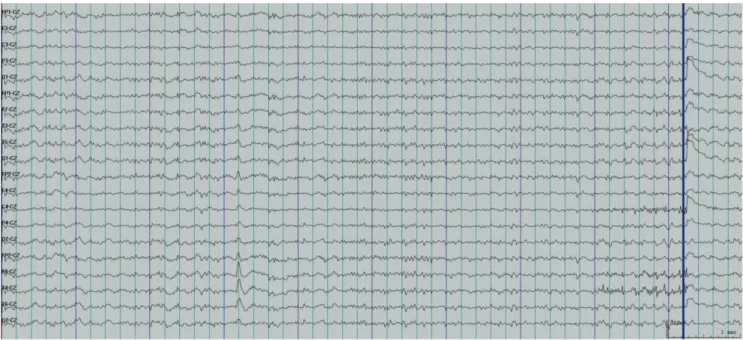
A 33-year-old woman started having GTCS at the age of 11 years, during her waking hours, predominantly in the mornings. After a few months of similar episodes, an EEG was performed, which showed generalized epileptiform dis-charges, predominantly in the anterior regions. Treatment consisting of PB and carbamazepine (CBZ) was adminis-tered, resulting in partial control of the GTCS (three to four months without seizures). However, sudden jerks of the limbs started to occur, predominantly in the right upper limb. hese events occurred daily, especially on awakening. Another EEG was performed (Fig 1), and she was referred to our clinic with refractory focal epilepsy. After clinical evalu-ation, CBZ and PB were replaced with VPA, resulting in sei-zure control ( for three years).
827 Arq Neuropsiquiatr 2012;70(10):826-830
CASE 3
A 36-year-old woman started, at the age of 18, to have episodes of sudden loss of consciousness, right cephalic ver-sion, and tremors in all four limbs, which lasted from two to three minutes. CBZ was administered, resulting in increased seizure frequency and new seizure patterns: sudden short jerks of the upper limbs, which happened daily at no speciic time. An EEG showed generalized epileptiform discharges. CBZ was then replaced with VPA, and no further seizures oc-curred over a three-year period.
DISCUSSION
JME is an idiopathic generalized epilepsy syndrome, which usually begins at puberty. It is characterized by pre-dominance of myoclonic seizures, often associated with GTCS and/or absence of seizures. he excellent response to valproic acid is well-known, however topiramate, lamotrig-ine, and levetiracetam are also efective. Lack of knowledge of focal clinical and/or electrographic manifestations favors erroneous diagnoses of focal epilepsy, thereby leading to inefective treatments, particularly use of carbamazepine,
oxcarbazepine and phenytoin, which may even worsen the
seizure frequency and should be avoided when treating JME1.
Myoclonic seizures are brief muscle contractions, similar to shocks or scares. In JME cases, they are generally bilater-al and symmetricbilater-al. Misinterpretation of myoclonic seizures and focal motor clonic seizure symptoms is common, and the main reason for this is the widespread lack of knowledge about the fact that myoclonic seizures in JME cases may be
focal or asymmetrical2,3.
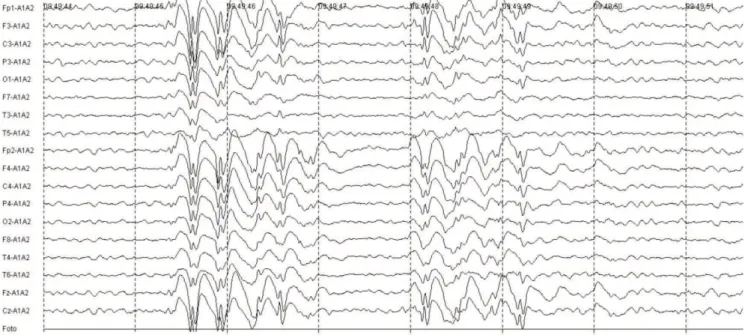
he idea that generalized epilepsy is associated with gen-eralized electroencephalographic abnormalities is, at least, im-perfect. Recent studies have suggested that focal EEG abnor-malities are common in JME ( from 20 to 50% of the cases). Focal indings in JME cases include: outbreaks of focal slow waves that are independent of generalized epileptiform discharges (GED); independent focal epileptiform discharges, or preceding
GED; and asymmetries or focal accents of GED (Fig 2)2,3.
Cephalic version as the initial ictal event is considered to be an indication of focal seizure. In 1984, Ochs et al. report-ed cases of idiopathic generalizreport-ed epilepsy (IGE) that had seizures with ictal cephalic version as the initial manifesta-tion. Subsequently, several other studies have strengthened the possibility that versive seizures may be a manifestation of
IGE, including JME3,4.
1. Alfradique I, Vasconcelos MM. Juvenile myoclonic epilepsy. Arq Neuropsiquiatr 2007;65:1266-1271.
2. Ferrie CD. Idiopathic generalized epilepsies imitating focal epilepsies. Epilepsia 2005;46:S91-S95.
3. Montalenti E, Imperiale D, Rovera A, Bergamasco B, Benna P. Clinical
features, EEG findings and diagnostic pitfalls in juvenile myoclonic epilepsy: a series of 63 patients. J Neurol Sci 2001;184:65-70.
4. Ochs R, Gloor P, Quesney F, et al. Does head-turning during a seizure have lateralizing or localizing significance? Neurology 1984;34: 884-890.
References