0103 - 5053 $6.00+0.00
A
r
ti
c
le
* e-mail: [email protected]
Elucidation of the Stereochemistry of Diterpene Derivatives Obtained by Palladium
Catalyzed Oxidative Coupling-Oxidation of Camphene
Elena V. Gusevskaya* and Marcio J. da Silva
Departamento de Química, ICEx, Universidade Federal de Minas Gerais, CP 702, 31270-901 Belo Horizonte - MG, Brazil
As estruturas dos derivados diterpénicos resultantes do acoplamento oxidativo - oxidação do canfeno catalisados por paládio, ou seja, bis(2,2-dimetil-biciclo[2.2.1]hepto-3-ilideno)etano e (4,4-dimetilbiciclo[3.2.1]octo-2-on-3-il)(2,2-dimetilbiciclo[2.2.1]hepto-3-ilideno)metano, foram estudadas utilizando-se as técnicas de RMN de 1H e de 13C uni e bidimensionais. Sua estereoquímica foi
determinada utilizando-se NOESY.
The structures of diterpene derivatives resulting from the palladium catalyzed tandem oxidative coupling-oxidation of camphene, i.e., bis(2,2-dimethyl-bicyclo[2.2.1]hept-3-ylidene)ethane and (4,4-dimethylbicyclo[3.2.1]oct-2-on-3-yl)(2,2-dimethylbicyclo[2.2.1]hept-3-ylidene)methane, were elucidated using one- and two-dimensional 1H and 13C NMR techniques. Their stereochemistry was
determined unambiguously by NOESY experiments.
Keywords: camphene oxidation, palladium catalyst, diterpene derivatives, NMR spectroscopy, NOESY
Introduction
Functionalization of inexpensive naturally occurring monoterpenes using transition metal homogeneous catalysis can provide various derivatives of interest to perfumery, flavor and pharmaceutical industries as well as
useful synthetic intermediates and chiral building blocks.1,2
We have recently reported that allylic acetates, alcohols, aldehydes and esters can be obtained in good yields and in some cases with high stereoselectivity by catalytic oxidation or carbonylation of some monoterpenes, such
as limonene, β-pinene, and camphene.3
The reactions of olefin oxidation by palladium salts may be incorporated into catalytic processes by use of
reversible reoxidants, such as CuCl2 (the Wacker type
catalyst). Although these processes have been developed into commercially important methods for the oxidation of olefins by dioxygen, the most abundant and cheapest oxidant, their applications to natural product synthesis
are rather scarce. We previously reported a selective PdCl2/
CuCl2 catalyzed oxidation of limonene, however in the
case of bicyclic monoterpenes, such as β-pinene and
camphene, CuCl2 promoted the extensive skeletal
rearrangements of the substrates.3 Then, we developed a
CuCl2-free system for selective oxidation of β-pinene and
camphene into allylic and glycol derivatives, respectively, using H2O2 as the final oxidant and Pd(OAc)2 as catalyst.3
In a further study, we applied a Pd(II)/NO3- catalytic
system, a valuable alternative to the Wacker catalyst,4 to
the oxidation of camphene (1) by dioxygen. We found a
new process consisting in oxidative coupling of camphene (C10) giving diene 2 (C20) and its further oxidation to β, γ -unsaturated ketone 3 (C20) (Figure 1).
In order to fully characterize compounds 2 and 3,we
used one- and two-dimensional 1H and 13C NMR
techniques as well as gas chromatography-mass spectros-copy (GC-MS) and IR spectrosspectros-copy. In this paper, we report the results of the elucidation of the stereochemistry of these diterpene derivatives, mainly by nuclear Overhauser enhancement spectroscopy (NOESY).
Experimental
General
determined on a Mettler FP82HT melting point apparatus.
1H and 13C NMR spectra were obtained using a Bruker
DRX-400 AVANCE spectrometer with a magnetic field
induction of 9.4 T. in CDCl3 solutions (concentration of
30 mg mL-1). Analyses were performed at 298 K. Chemical
shifts are referenced to tetramethylsilane as internal standard. Standard Bruker pulse sequences (given in parentheses) were used for NMR experiences and
experimental conditions were as follows. For 1H NMR
spectra (zg30): dwell time (DW) 146.400 µs, acquisition
time (AQ) 4.131 s, number of transients (NS) 16, recycle
delay (D1) 1.000 s. For 13C NMR spectra (zgpg30): DW
31.400 µs, AQ 2.058 s, NS 1024, D1 2.000 s, decoupling
multiple resonance method Waltz-16. For DEPT 135
(dept135): DW 15.700 µs, AQ 1.029 s, NS 512, D1 2.000 s.
For g-COSY (cosy45): DW 227.200 µs, AQ 0.233 s, NS 8,
D1 2.000 s, data points (TD) 1024 (F2) and 256 (F1). For
HMQC (inv4tp): DW 249.600 µs, AQ 0.233 s, NS 8, D1
2.000 s, TD 1024 (F2) and 512 (F1). For HMBC (inv4lplrnd):
DW 62.400 µs, AQ 0.256 s, NS 16, D1 2.000 s, TD 2048 (F2)
and 1024 (F1), delay for long-range coupling (D6) 0.07 s. For
2D NOESY (noesytp): DW 222.400 ms, AQ 0.446 s, NS 32,
D1 2.000 s, mixing time 550 ms, time evolution 6.50 µs,
TD 2048 (F2) and 512 (F1).
The data were processed before Fourier transformation
as follows. For 1H NMR spectra: using Gaussian
multiplication (line broadening -0.3 Hz, Gaussian
broadening 0.2). For 13C NMR spectra: using exponential
multiplication (line broadening 1.0 Hz). For DEPT 135: using exponential multiplication (line broadening 1.0 Hz). For g-COSY: using a sine-bell function in both dimensions.
For HMQC: using a sine-bell function in the F1 dimension
and a sine-bell squared window function in the F2
dimension. For HMBC: using a sine-bell squared window function in both dimensions. For 2D NOESY: using a sine-bell function in both dimensions.
Oxidation of camphene: general procedure
Reactions were carried out in a stirred glass reactor connected to a gas burette to monitor a dioxygen uptake
and followed by GC using a Shimadzu 14B instrument fitted with a Carbowax 20 M capillary column and a flame ionization detector. The typical run conditions for the
synthesis of compound 2 were as follows: Pd(OAc) (0.1
mmol), benzoquinone (0.5 mmol), camphene (5 mmol),
acetic acid (10 mL), 60 oC, 1 bar of dioxygen, 6 h. Diene 2
was formed in stoichiometric amounts based on benzoquinone (96% selectivity at 22% conversion, which corresponded to a 21% GC yield, isolated yield was 14%). The typical run conditions for the synthesis of compound
3 were as follows: Pd(OAc) (0.1 mmol), LiNO3 (1.8 mmol),
camphene (5 mmol), acetic acid (5 ml), 60 oC, 1 bar of
dioxygen, 8.5 h. Enone 3 was formed with a 92%
selectivity at 80% conversion of camphene (74% GC yield,
51% isolated yield). Compounds 2 and 3 were isolated
from the reaction solutions as isomeric mixtures 2a/2b
(ca. 40/60) and 3a/3b (60/40-30/70) by column
chromatography (silica) using mixtures of hexane, CH2Cl2
and methanol as eluents.
Bis(2,2-dimethyl-bicyclo[2.2.1]hept-3-ylidene)ethane
(2a/2b). White solid, mp 182-184 oC (Lit5 183-184 oC); IR
(KBr) νmax/cm-1: 3020 [n (=C-H)], 2950, 2875, 1625 [n
(C=C)], 1460, 1375, 1360, 1250, 1120, 890, 870, 810 [δ
(=C-H)]; MS m/z (rel. int.): 2a (shorter GC retention time):
270 (M+,70), 255 [(M-CH
3)
+, 100], 227 (27), 202 (20), 161
(27), 133 (44), 121 (30), 119 (73), 117 (30), 109 (44), 107 (58), 105 (71), 95 (73), 93 (71), 91 (89), 81 (58), 79 (67), 77
(53), 69 (56), 67 (95), 55 (58); 2b: 270 (M+, 79), 255
[(M-CH3)+, 100], 227 (30), 202 (19), 161 (19), 133 (41), 121
(25), 119 (62), 117 (30), 109 (36), 107 (50), 105 (65), 95 (69), 93 (62), 91 (71), 81 (52), 79 (57), 77 (50), 69 (51), 67
(95), 55 (56); Anal. Calcd. for C20H30: C, 88.82; H, 11.18.
Found: C, 88.36; H, 11.12. For 1H and 13C NMR data see
Table 1.
(4,4-Dimethylbicyclo[3.2.1]oct-2-on-3-yl)(2,2-dimethylbicyclo[2.2.1]hept-3-ylidene)methane (3a/3b). Light yellow oil, IR (film) νmax/cm-1: 3025 [n (=C-H)], 2975,
2875, 1700 [n (C=O)], 1630 [n (C=C)], 1465, 1380, 1365,
1250, 1090, 1025, 800 [δ (=C-H)]; MS m/z (rel. int.): 3a
(exo, shorter GC retention time): 286 (M+, 70), 271
[(M-CH3)+, 35], 202 (46), 175 (51), 133 (35), 119 (44), 109
Figure 1. Synthesis of bis(2,2-dimethyl-bicyclo[2.2.1]hept-3-ylidene)ethane (2) and
(95), 108 (44), 107 (67), 105 (49), 95 (44), 93 (58), 91 (67), 81 (84), 79 (50), 69 (50), 67 (100), 55 (79), 43 (38), 41
(97); 3b (endo): 286 (M+, 100), 271[(M-CH
3)
+, 44], 217
(35), 202 (60), 175 (67), 133 (44), 119 (46), 117 (40), 109 (98), 108 (46), 107 (70), 105 (56), 95 (44), 93 (58), 91 (67), 81 (86), 79 (53), 69 (51), 67 (98), 55 (73), 43 (35), 41 (86);
Anal. Calcd. for C20H30O: C, 83.92; H, 10.49. Found: C,
83.50; H, 10.38. For 1H and 13C NMR data see Table 2.
Results and Discussion
The application of the Pd(II)/NO3- catalytic system to
the oxidation of camphene (1) by dioxygen resulted in
oxidative coupling of camphene (C10) giving diene 2 (C20)
and its further oxidation to β, γ-unsaturated ketone 3 (C20) (Figure 1).
Reactions were carried out in acetic acid solutions at
60 oC and 1 bar of dioxygen with catalytic amounts of
Pd(OAc)2 and LiNO3. Under these conditions, camphene
was converted in a 74% chromatographic yield to product
3 (80% conversion, 92% selectivity). It has been shown
that the reaction proceeds via the intermediate formation
of compound 2, which can be obtained, in the absence of
LiNO3, as the only product in stoichiometric amounts based
on palladium. Oxidative coupling of 1 into diene 2 was
also realized using catalytic amounts of Pd(OAc)2 and
benzoquinone as reoxidant under similar conditions. The
primarily formed 2 can be rapidly and selectively converted
into 3 by the addition of LiNO3 to the reaction solutions
containing Pd(II) ions. This clearly shows the consecutive
character of the reactions. Compounds 2 and 3 were isolated
from the reaction solutions as isomeric mixtures 2a/2b
and 3a/3b.
The chemical nature of new compounds resultingfrom
the oxidation of camphene has been firstly elucidated by GC-MS and IR and then by NMR spectroscopy. Mass
spectra of 2a and 2b show the same molecular ion peak of
270 mass units and are very similar, indicating that these compounds seem to be closely related isomers. The
observed molecular weightcorresponds to the products of
the dimerization of camphene with the abstraction of two
hydrogen atoms, i.e., oxidative coupling. The IR spectrum
of mixture 2a/2b exhibits absorptions due to C=CH
fragments: at 3020 [ν (=C-H)], 1625 [ν (C=C)] and 810 cm-1
[δ (=C-H)].6,7 Mass spectra of 3a and 3b are also very similar.
The molecular ions observed give molecular weights of 286 corresponding to the products of the addition of one
oxygen atom to compound 2.The IR spectrum of mixture
3a/3b shows a strong absorption at 1700 cm-1, which can
be assigned to the stretching vibration of the carbonyl group, and adsorptions due to the C=CH fragment: at 3025
[ν (=C-H)], 1630 [ν (C=C)] and 800 cm-1 [δ(=C-H)].6,7 Based
on the analysis of GC-MS, IR, 1H and 13C-NMR
spectroscopy data we suggested structures 2 and 3 for the
products (Figures 2 and 3). The assignment of hydrogen and carbon resonances (Tables 1 and 2) was helped by COSY (1H, 1H), HMQC (1H, 13C), HMBC (1H, 13C) and DEPT
NMR experiments. The study of the HMBC spectra of 3
has delivered decisive arguments for building its molecular skeleton. The oxidative ring expansion of one
of the isocamphane (bicycloheptane) fragment of 2 to a
bicyclooctane one has been unambiguously proved by the analysis of long-range cross signals in HMBC spectra (Table 2). Carbonyl carbon C-3 correlates with both H-7a and H-8, while olefinic carbon C-3' correlates with H-8 via
3J
CH. Thus, compound 3 has a structure of β,γ-unsaturated
ketone with the carbonyl group being endo cyclic. The
9.6 Hz vicinal coupling between H-8' and H-8, which show a strong correlation signal in COSY spectra, the multiplicity of the H-8 signal (doublet) and no vicinal coupling between
H-8 and H-4, expected for isocamphane systems,6 provide
additional evidences for the ring expansion and the C=O incorporation between C-4 and C-8. Formally, the
formation of this new skeleton from diene 2 can be
rationalized as the cleavage of the C-2-C-3 bond and the formation of a new C-2-C-8 bond. To facilitate the discussion and signal comparison, carbon numbering used for 2 is maintained for 3.
Figure 2. Structure and numbering of (E,E)
bis(2,2-dimethyl-bicyclo[2.2.1]hept-3-ylidene)ethane (2). Newman projections for two possible skew conformations of 2 (C-8 - C-8' view).
Figure 3. Structure and numbering of (4,4-dimethylbicyclo
Table 2. Chemical shifts (δ, ppm), coupling constants (J, Hz, in parenthesis) and HMBC correlations for compounds 3a and 3b
Atoma 3 a 3b
δ (1H)b δ (13C) HMBC δ (1H)b δ (13C) HMBC
1 1.93 (bd, 4.0, H-6eq) 47.48 H-9, H-10 1.93 (bd, 4.0, H-6eq) 47.18 H-9, H-10
2 43.48 H-8, H-9, H-10 43.07 H-8, H-9, H-10
3 214.73 H-8, H-7a 214.68 H-8, H-7a
4 2.69 (s, b) 50.80 H-7a 2.69 (s, b) 50.80 H-7a
5ax 1.23-1.29 (m) 27.43 H-1, H-7b 1.23-1.29 (m) 27.50 H-1, H-7b
5eq 1.70-1.85 (m) 1.70-1.85 (m)
6ax 2.03-2.07 (m) 24.94 H-4, H-7b 2.03-2.07 (m) 24.91 H-4, H-7b
6eq 1.70-1.85 (m) 1.70-1.85 (m)
7a 1.61-1.71 (m) 35.16 H-6 1.61-1.71 (m) 35.00 H-6
7 b 2.11 (d, 12.0, H-7b) 2.11 (d, 12.0, H-7b)
8 2.99 (d, 9.6, H-8') 53.81 H-9, H-10 2.95 (d, 9.6, H-8') 53.38 H-9, H-10
9 0.84 (s) 23.13 H-8, H-10 0.95 (s) 26.15 H-8, H-10
1 0 0.96 (s) 27.33 H-8, H-9 0.80 (s) 22.85 H-8, H-9
1' 1.89 (bd, 2.4, H-6'eq) 47.89 H-9', H-10' 1.89 (bd, 2.4, H-6'eq) 47.81 H-9', H-10'
2' 42.08 H-7'a, H-8', H-9', H-10' 42.00 H-7'a, H-8', H-9', H-10'
3' 158.87 H-8, H-7'a, H-9', H-10' 158.81 H-8, H-7'a, H-9', H-10'
4' 2.70 (bd, 4.4, H-7'b) 41.35 H-8' 2.76 (bd, 4.4, H-7'b) 41.39 H-8'
5'ax 1.23-1.29 (m) 27.54 H-1', H-7'b 1.23-1.29 (m) 27.87 H-1', H-7'b
5'eq 1.70-1.85 (m) 1.70-1.85 (m)
6'ax 1.70-1.85 (m) 23.87 1.70-1.85 (m) 23.84
6'eq 1.34-1.40 (m) 1.34-1.40 (m)
7'a 1.20 (d, 9.6, H-7'b) 37.80 1.20 (d, 9.6, H-7'b) 37.20
7'b 1.58-1.67 (m) 1.58-1.67 (m)
8' 4.97 (d, 9.6, H-8) 109.25 H-8 4.97 (d, 9.6, H-8) 109.00 H-8
9' 1.09(s) 29.59 H-10' 1.01 (s) 29.68 H-10'
10' 1.04 (s) 26.34 H-9' 1.11 (s) 25.82 H-9'
a Carbon numbering used for compound 2 is maintained for 3 to facilitate a discussion.
b Resonance multiplicities, coupling constants and coupled partners in parentheses: (s) singlet, (d) doublet), (t) triplet, (m) multiplet, (b) broad.
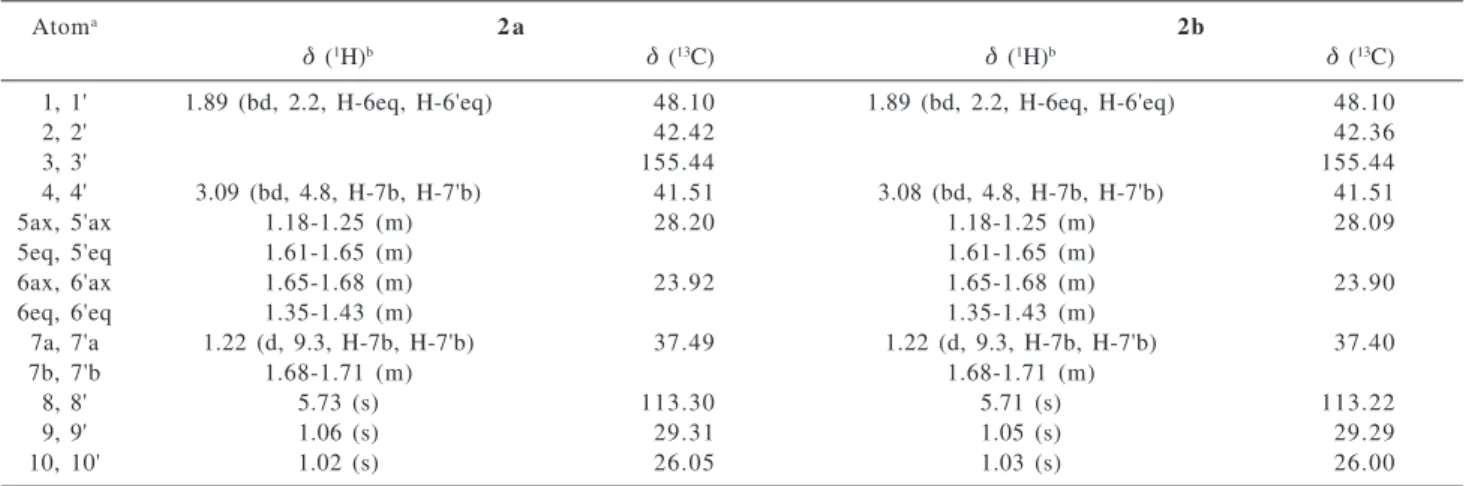
Table 1. Chemical shifts (δ, ppm) and coupling constants (J, Hz, in parentheses) for compounds 2a and 2b
Atoma 2 a 2b
δ (1H)b δ (13C) δ (1H)b δ (13C)
1, 1' 1.89 (bd, 2.2, H-6eq, H-6'eq) 48.10 1.89 (bd, 2.2, H-6eq, H-6'eq) 48.10
2, 2' 42.42 42.36
3, 3' 155.44 155.44
4, 4' 3.09 (bd, 4.8, H-7b, H-7'b) 41.51 3.08 (bd, 4.8, H-7b, H-7'b) 41.51
5ax, 5'ax 1.18-1.25 (m) 28.20 1.18-1.25 (m) 28.09
5eq, 5'eq 1.61-1.65 (m) 1.61-1.65 (m)
6ax, 6'ax 1.65-1.68 (m) 23.92 1.65-1.68 (m) 23.90
6eq, 6'eq 1.35-1.43 (m) 1.35-1.43 (m)
7a, 7'a 1.22 (d, 9.3, H-7b, H-7'b) 37.49 1.22 (d, 9.3, H-7b, H-7'b) 37.40
7b, 7'b 1.68-1.71 (m) 1.68-1.71 (m)
8, 8' 5.73 (s) 113.30 5.71 (s) 113.22
9, 9' 1.06 (s) 29.31 1.05 (s) 29.29
10, 10' 1.02 (s) 26.05 1.03 (s) 26.00
a Usual numbering for terpenes.
b Resonance multiplicities, coupling constants and coupled partners in parentheses: (s) singlet, (d) doublet), (t) triplet, (m) multiplet, (b) broad.
Isomers 3a and 3b could differ from each other on the
position of the substituents on the (i) carbon atom C-8:
exo and endo isomers, and (ii) olefinic carbon atoms C-3'
and C-8': Z (cis) and E (trans) isomers with respect to
dimethyl-substituted carbon atom C-2' and the bicyclooctane fragment. So, we considered four possible
arrangements for compound 3, i.e., (Z)-endo, (Z)-exo,(E
)-endo and (E)-exo, and three for compound 2, i.e., (ZZ), (EZ)
and (EE). The stereochemistry of products 2a, 2b, 3a and
3b can be elucidated by NOESY experiments.
The most relevant regions of the NOESY spectrum of
correlations are presented in Table 3. In both isomers,
proton H-8' gives NOE with H-9'and H-10' and no NOE
with H-4' (Figura 4). Proton H-8gives a strong correlation
signal with H-4' in 3a and 3b showing their spatial
proximity in both isomers,whereas no NOE correlation is
observed between H-8 and methyl protons H-9' and H-10'
(Figura 5). This clearly indicates the E-configuration for
both isomers as shown in Figure 3. For Z-configuration,
opposite NOE correlation signals could be expected. This
is a sufficient proof to reject the (Z)-endo and (Z)-exo
structures.
The further analysis of NOESY spectra allowed us to distinguish endoand exoisomers of ketone 3. In 3a, proton H-8 gives a correlation signal with the protons of the axial methyl group (H-10) and no correlation with the protons
of the equatorial one (H-9), whereas in 3b theeffects are
opposite: H-8 gives NOE to H-9and no NOE to H-10
(Figure 5). Based on these observations, we have attributed
Table 3. 2D 1H NOESY NMR correlations in the compounds 2a, 2b, 3a and 3b (for the selected atoms)
NOESY correlation of H- NOESY correlation with
H-isomer a isomer b
compound 2
4, 4' 8, 8'; 5ax, 5'ax; 5eq, 5'eq; 7a, 7'a; 7b, 7'b 8, 8'; 5ax, 5'ax; 5eq, 5'eq; 7a, 7'a; 7b, 7'b
8, 8' 4, 4'; 9, 9'; 10, 10' 4, 4'; 9, 9'; 10, 10'
9, 9' 1, 1'; 8, 8'; 7b, 7'b 1, 1'; 8, 8'; 7b, 7'b
10, 10' 1, 1'; 8, 8'; 6ax, 6'ax 1, 1'; 8, 8'; 6ax, 6'ax
compound 3
8 4', 8', 10 4', 8', 9,
4' 8, 7'a 8, 9, 7'a
8' 8, 9, 9', 10' 8, 9', 10, 10'
9 1, 8', 7b 1, 8
1 0 1, 8 1, 8', 7b
9' 7'b, 8' 7'b, 8'
10' 8' 7'b, 8'
exo configuration for isomer 3a (shorter GC retention time)
and endo for isomer 3b. The following additional evidence
confirms this assignment. The NOESY spectra show a strong correlation signal between olefinic proton H-8' in
3a and the protons of the equatorial methyl group (H-9)
but not the axial one (H-10). On the other hand, in 3b a
correlation is observed between H-8' and H-10 but not
between H-8' and H-9 (Figure 4). Molecular modeling of 3
shows that olefinic proton H-8' is spatially proximate to only one of the methyl groups of the bicyclooctane system:
the equatorial (H-9) in the exo isomer and the axial (H-10)
in the endo isomer. This proximity has been clearly revealed
in NOESY spectra.
It is important to note the significant shielding observed for the resonances of the protons as well as the
carbon atoms of the equatorial methyl group (C-9) in exo
isomer 3a (0.84 ppm and 23.13 ppm for H-9 and C-9 vs.
0.96 ppm and 27.33 ppm for H-10 and C-10), and of the
axial methyl group (C-10) in endo isomer 3b (0.95 ppm and
26.15 ppm for H-9 and C-9 vs. 0.80 ppm and 22.85 ppm for
H-10 and C-10) (Table 2, Figure 4). The proximity of the bulk bicyclooctane group and the steric hindrance lead to a higher electron density on the equatorial methyl group in
3a and axial one in 3b resulting in these shielding effects.
In addition to the anisotropic effect of the double bond, the
steric interactions between atoms of the more hindered endo
isomer should be more important so that most signals in the spectra of this isomer expectedly appear more shielded
compared to those of the exo isomer (Table 2).
Thus, the two detected isomers of ketone 3 are the (E
)-exo (3a) and (E)-endo (3b) forms (Figura 3).
The stereochemistry of diene 2 was also studied. We
observed the formation of two predominant isomers, which could be (Z,Z), (E,E), or (Z,E)-forms. Corresponding carbon and hydrogen atoms of both ring systems in each isomer
show the same resonances in 1H and 13C NMR spectra,
while most of the 13C signals and some 1H signals (vinyl
and methyl protons) for two isomers are slightly different.
13C NMR spectroscopy is a particularly valuable tool for
the configurational assignment of trisubstituted alkenes
(RR1C=CHR2). The principle involved is that the carbon
nucleus cis to the R2 group will be shielded (5-7 ppm),
through a “γ compression effect”, relative to the same
carbon nucleus positioned cis to hydrogen.8 Resonances
for carbons C-2 and C-2' as well as C-4 and C-4' attached to olefinic carbons C-3 and C-3', respectively, are very
close for both isomers(cf. 42.42 ppm for C-2 and C-2' in
2avs. 42.36 ppm in 2b; and 41.51 ppm for C-4 and C-4' in
both isomers) (Table 1). Therefore, all double bonds in two isomers have the same configuration and both compounds 2a and 2b should be either (E,E) or (Z,Z)-forms.
Unfortunately, the results of NOESY experiments can not
provide the necessary information to distinguish (Z,Z) and
(E,E)-forms, since, as mentioned above, the corresponding
protons of both ring systems in each isomer of 2 show the
same resonances. Stereochemistry of 2a and 2b was clarified
by the comparative analysis of the 13C NMR spectra of 2a/
2b and 3a/3b. The chemical shifts of the carbon signals in
the intact isocamphane systems of 3a and 3b are very close
to those of 2a and 2b. In particular, the chemical shifts of
carbons C-2' and C-4' attached to olefinic carbon C-3' do not deviate more than 0.4 ppm (cf. 42.42/42.36 ppm for
C-2' in 2a/2b vs. 42.08/42.00 ppm in 3a/3b; and 41.51 ppm
for C-4' in 2a/2b vs. 41.35/41.39 ppm in 3a/3b) (Tables 1 and 2). This clearly shows that trisubstituted double bonds in all four compounds have the same configuration.
Considering that for both 3a and 3b theNOESY study
unambiguously proved the (E)-configuration, it is
reasonable to propose (E,E)-configuration for both original
isomers 2a and 2b. This conclusion is also supported by
mechanistic considerations: at the oxidation of diene 2
into ketone 3,the configuration of the intact double bond
most likely remains unchanged, while the other undergoes palladation followed by the expansion of the isocamphane skeleton.
The further analysis of the NMR data helped us to
elucidate some structural peculiarities of 2. Conjugated
dienes would be expected to adopt conformations in which double bonds are coplanar, so as to permit effective orbital overlap and electron delocalization. The two alternative
planar conformations are referred to as s-cis and s-trans,
with the latter being usually more stable.9 The analysis of
molecular model structures shows that s-cis conformation
for diene 2 is extremely unfavorable due to a steric
hindrance of two bulky bicyclic fragments. A simulation of this structure, performed with the Chem3D program, shows that in a lowest-energy form the conjugated double bonds are not coplanar. Such a conformation is referred to
as skew9 in which the repulsion between the two
isocamphane substituents is relieved. This hypothesis has
been clearly proved by 1H NMR spectroscopy. For both
isomers 2a and 2b, vinyl protons H-8 and H-8' appear as
singlets at 5.73 and 5.71 ppm, respectively, showing that there is no vicinal coupling between them. So, in the preferred conformations of both isomers two adjacent C-H
bonds are orthogonal (3J
HH ≅ 0) and conjugated double
bonds are not coplanar. In Figure 2 the Newman projections
along the C-8 - C-8' bond for two possible skew
conformations of 2 resulting from right- or left-hand
rotations about the C-8 – C-8' bond are presented. Thus,
compounds 2a and 2b formed by the oxidative coupling
stereoisomers of the dimeric (EE)-diene existing
preferentially in skew conformations (Figure 2).
Conclusions
The geometry of compounds 2 and 3 can now be
discussed from a mechanistic point of view. The palladium catalyzed oxidative coupling of camphene seems to occur
via the formation of the π-olefin palladium complex
followed by the insertion of the coordinated camphene into
the Pd-O bond resulting in a σ-organopalladium C10
-intermediate. The later then reacts with another molecule of camphene, which inserts into the Pd-C bond in an
anti-Markovnikov fashion, giving a C20-intermediate which
contains the following fragment: [>C(X)-CH2-CH2-C(Pd)<] (X= NO3– or OAc–). The stereochemistry of the final diene 2
[>C=CH-CH=C<] is determined in the step of the
decomposition of this palladium alkyl C20-intermediate via
a β-hydrogen abstraction. Usually either cis- or the trans -alkene can be formed in such a step. However, for camphene derivative, both the PdH and HX eliminations are highly stereoselective, probably due to the large steric hindrance of two bulky isocamphane systems, and result mainly in
(E,E)-isomer of diene 2. On the other hand, the further
oxidation of diene seems to involve a palladation step, i.e.,
a nucleophilic attack on the face of the C-C double bond π
-coordinated to palladium, followed by the heterolysis of the palladium-C-8 bond and the rearrangement of the resulting carbonium ion with a cleavage of the C-2-C-3 bond and the formation of a new C-2-C-8 bond.
Stereochemistry of final ketone 3 at C-8is determined in
the carbonium ion rearrangement step, which is not expected to be stereoselective. An alternative mechanism of the
oxidative rearrangement of 2 via a π-allyl palladium
complex and further C-2-C-3 bond cleavage does not appear also to be stereoselective. Consequently, the two isomers of ketone 3, i.e., (E)-exo (3a) and (E)-endo (3b) are formed in approximately equal amounts.
Acknowledgments
Financial support from CNPq (Conselho Nacional de Desenvolvimento Científico e Tecnológico) and FAPEMIG (Fundação de Amparo à Pesquisa do Estado de Minas
Gerais) is gratefully acknowledged. The authors wish to thank Prof. D. Piló-Veloso (Universidade Federal de Minas Gerais) and Prof. O. W. Howarth (Centre for NMR, University of Warwick, UK) for valuable discussions and Ms. Ivana Silva Lula for technical assistance in NMR experiements.
References
1. Erman, W. E.; Chemistry of the Monoterpenes. An Encyclope-dic Handbook, Marcel Dekker: New York, 1985.
2. Chalk, A. J. In Catalysis of Organic Reactions; Rylander, P. N.; Greenfield H.; Augustine, R. L., eds.; Marcel Dekker: New York, vol. 22, 1988, p. 43.
3. Gusevskaya, E. V.; dos Santos, E. N.; Augusti, R.; Dias, A. O.; Robles-Dutenhefner, P. A.; Foca, C. M.; Barros, H. J. V.; Stud. Surf. Sci. Catal. 2000, 130, 563; Gusevskaya, E.; Gonçalves, J. A.; J. Mol. Catal. 1997, 121 131; Gusevskaya, E.; Robles-Dutenhefner, P. A.; Ferreira, V. M. S.; Appl. Catal. 1998, 174, 177; Dias, A. O.; Augusti, R.; dos Santos, E. N.; Gusevskaya, E. V.; Tetrahedron Lett.1997, 38,41; Gusevskaya, E. V.; dos Santos, E. N.; Augusti, R.; Dias, A. O.; Foca, C. M.; J. Mol. Catal.2000, 152, 15; da Rocha, L. L.; Dias, A. O.; Augusti, R.; dos Santos, E. N.; Gusevskaya, E.; J. Mol. Catal. 1998, 132, 213.
4. Andrews, M. A.; Chang, T. C.-T.; Cheng, C.-W. F.; Kelly, K. P.; Organometallics1984, 3, 1777;Kiers, N. H.; Feringa, B. L.; Tetrahedron Lett.1992, 33, 2403; Wenzel, T. T.; J. Chem. Soc., Chem. Commun.1989,932; Beck, I. E.; Gusevskaya, E. V.; Stepanov, A. G.; Likholobov, V. A.; J. Mol. Catal. 1992, 73, 115.
5. Mehta G., Indian J. Chem. 1973, 11, 843.
6. Gordon, A. J; Ford, R. A.; The Chemist’s Companion, Wiley: New York, 1972.
7. Roeges, N. P. G.; A Guide to the Complete Interpretation of Infrared Spectra of Organic Structures, Wiley: Wiltshire, 1995. 8. Eliel, E. L.; Wilen, S. H.; Mander, L. N.; Stereochemistry of
Organic Compounds, Wiley: New York, 1994.
9. Carey, F. A.; Sundberg, R. J.; Advanced Organic Chemistry, Plenium Press: New York, Part A., 1990.
Received: March 14, 2002
![Figure 1. Synthesis of bis(2,2-dimethyl-bicyclo[2.2.1]hept-3-ylidene)ethane (2) and (4,4-dimethylbicyclo[3.2.1]oct-2-on-3-yl)(2,2- (4,4-dimethylbicyclo[3.2.1]oct-2-on-3-yl)(2,2-dimethylbicyclo[2.2.1]hept-3-ylidene)methane (3) by the palladium catalyzed tan](https://thumb-eu.123doks.com/thumbv2/123dok_br/18989720.460187/2.892.191.674.103.217/figure-synthesis-dimethyl-dimethylbicyclo-dimethylbicyclo-dimethylbicyclo-palladium-catalyzed.webp)
![Figure 2. Structure and numbering of (E,E) bis(2,2-dimethyl- bis(2,2-dimethyl-bicyclo[2.2.1]hept-3-ylidene)ethane (2)](https://thumb-eu.123doks.com/thumbv2/123dok_br/18989720.460187/3.892.482.820.644.790/figure-structure-numbering-dimethyl-dimethyl-bicyclo-ylidene-ethane.webp)