The reproductive performance of the Red-Algae shrimp
Leander paulensis
(Ortmann, 1897) (Decapoda, Palaemonidae) and the effect of post-spawning
female weight gain on weight-dependent parameters
Decapod species have evolved with a variety of
reproductive strategies. In this study reproductive
features of the palaemonid shrimp
Leander paulensis
were investigated. Individuals were collected in the
coastal region of Ubatuba, São Paulo, Brazil. In
all, 46 ovigerous females were examined in terms
of the following reproductive traits: fecundity,
reproductive output, brood loss and egg volume.
Leander paulensis
produces a large number of
small eggs with an average fecundity of 635 ± 246
eggs. Egg volume increased signiicantly from early
(0.034 ± 0.008 mm
3) to late development stage
(0.05 ± 0.012 mm
3). The reproductive output did not
correlate with female size. The weight of females
bearing stage 2 eggs was signiicantly higher than
that of females carrying stage 1 eggs. We assume
that the reason for this weight gain is the recovery
of female reserves that have been depleted for
egg production. Moreover, we emphasize that this
weight gain must be considered when evaluating
weight-dependent variables such as reproductive
output or brood loss in relation to female weight.
Otherwise, an overestimation of these variables
might lead to inaccurate results.
A
bstrAct
Uwe Zimmermann
1,2, Fabrício Lopes Carvalho
2,3, Fernando L. Mantelatto
2,*
1 Eberhard Karls-University Tübingen, Faculty of Science, Department of Biology
(Auf der Morgenstelle 28, 72076 Tübingen, Germany)
2 Universidade de São Paulo (USP), Faculdade de Filosoia, Ciências e Letras de Ribeirão Preto (FFCLRP), Departamento de Biologia,
Laboratório de Bioecologia e Sistemática de Crustáceos (LBSC) (Av. Bandeirantes, 3900, Ribeirão Preto, 14040-901, São Paulo, Brazil)
3 Universidade Federal do Sul da Bahia (UFSB), Instituto de Humanidades, Artes e Ciências Jorge Amado (IHAC-JA)
(Rod. Ilhéus-Vitória da Conquista, km 39, BR 415, 45613-204, Ferradas, Itabuna, Bahia, Brazil)
*Corresponding author: [email protected]
Financial Support: FAPESP (Temático Biota 2010/50188-8) CAPES (Ciências do Mar II Proc. 2005/2014 - 23038.004308/201414) CNPq (DR 140199/2011-0 and PQ 302748/2010-5; 304968/2014-5)
Descriptors:
Brood loss, Caridea, Egg volume,
Fecundity, Reproductive output.
Decápodes desenvolveram uma ampla variedade de estratégias reprodutivas. Neste estudo foram investigadas características reprodutivas da espécie de
Palaemonidae Leanderpaulensis. Os indivíduos foram coletados na região costeira de Ubatuba, São Paulo,
Brasil. Foram examinadas 46 fêmeas ovígeras quanto
aos seguintes aspectos reprodutivos: fecundidade, investimento reprodutivo, perda de ovos e volume dos ovos. Leander paulensis produz uma grande quantidade de pequenos ovos, com fecundidade média de 635 ± 246 ovos. O volume dos ovos aumentou signiicativamente quando comparado o estágio inicial (0.034 ± 0.008
mm3) com o estágio inal de desenvolvimento (0.05 ± 0.012 mm3). O investimento reprodutivo não apresentou
correlação com o tamanho das fêmeas. Fêmeas com ovos no estágio 2 apresentaram massa corpórea seca signiicativamente maior que aquelas carregando ovos no estágio inicial. Esse aumento de massa parece ser decorrente da recuperação de reservas energéticas das fêmeas, que teriam sido utilizadas durante a produção de ovos. Além disso, deve-se considerar neste tipo de avaliação o aumento da massa corpórea em relação
ao investimento reprodutivo, assim como da perda de
ovos relacionada à massa das fêmeas ou qualquer outra variável dependente do peso.
r
esumo
Descritores:
Fecundidade, Caridea, Perda de ovos,
Volume de ovos, Investimento reprodutivo.
http://dx.doi.org/10.1590/S1679-87592015085806303
BJOCE
INTRODUCTION
There are many reproductive strategies among decapods, and these manifest as differences in parameters such as fecundity and breeding frequency, which are directly related to the species’ life strategy (OH; HARTNOLL, 2004). Caridean shrimps are not an exception to this scenario, with some species, such as Macrobrachium potiuna (NAZARI
et al., 2003) and Synalpheus pectiniger (COREY; REID,
1991), producing few but larger eggs, and others, such as
Macrobrachium olfersii and Pontonia margarita, carrying a great number of relatively small eggs (COREY; REID, 1991). Differences in reproductive strategies can also occur intraspeciically, depending on environmental factors such as salinity (JANAS; MAŃKUCKA, 2010) or temperature and season (BODDEKE, 1982; OH; HARTNOLL, 2004). Other examples and variations among these genera and congeners are discussed in PAVANELLI et al. (2008) and TAMBURUS et al. (2012).
The genus Leander DESMAREST, 1849, is composed
of ive species distributed in different regions (DE GRAVE; FRANSEN, 2011). Leander paulensis ORTMANN, 1897,
is a small shrimp that occurs in shallow marine waters of the western Atlantic from Florida, USA to Paraná, Brazil (CARVALHO et al., 2014). It inhabits sand and rock bottoms with algae up to a depth of 16 m (RAMOS-PORTO, 1986). Studies regarding L. paulensis have focused on the composition of crustacean fauna of certain areas (COSTA et al., 2000; COELHO et al., 2006; ALMEIDA et al., 2006, 2007a, b; MCCARTHY et al., 2012), taxonomy and geographical distribution (MANNING, 1961; RAMOS-PORTO, 1986; ABELE; KIM, 1989; RAMOS-PORTO; COELHO, 1998; CARVALHO et al., 2014). Some ecological features, such as reproductive period, fecundity, egg volume and brood volume (BAUER, 1989, 1991; COREY; REID, 1991), have been addressed in the congeneric species
Leander tenuicornis. However, Leander paulensis remains completely unknown in terms of its reproductive strategy. Considering that fecundity is an expressive measure of reproductive potential and contributes to the understanding of reproductive performance, the aim of the present paper is to analyze female weight gain during egg incubation, fecundity and investment per reproductive event in Leander paulensis.
MATERIAL AND METHODS
All specimens were collected in April 2013 at Lamberto beach (23º29′56″S, 45º07′04″W), a protected area that lies in the sheltered Flamengo bay, south of
Ubatuba, São Paulo State, Brazil (Figure 1). In total, 46 ovigerous females were captured using a hand push net at a depth of 0.5 to 1 m and were identiied according to Ramos-Porto (1986). All specimens were kept in 80% ethanol for the duration of the study.
Figure 1. Location of the sampling site in the Flamengo Bay in the
southern region of Ubatuba, State of São Paulo, Brazil.
Eggs of all females were gently removed, using ine forceps under a Leica® stereomicroscope M205C.
The measurement of eggs and females, and the counting and classiication of eggs, were performed under the stereomicroscope with the aid of the Leica Application Suite® (v 3.8.0). Female carapace length was measured
from the post-orbital margin to the posterior border of the carapace. Eggs were counted and classiied into two stages: stage 1 (early development) without eyespots and stage 2 (late development) with visible eyespots (COREY; REID, 1991). Ten eggs from each female were randomly chosen for measurement of their major and minor axis and the volume of each egg was quantiied using the volume formula of oblate spheroids (cf. TURNER; LAWRENCE, 1979): EV = 4/3 * π * EL/2 * (EW/2)2, where EV = egg
volume, EL = egg length and EW = egg width. For fecundity estimation, an ANCOVA was performed to check whether there is a loss of eggs from stage 1 to stage 2. As the results showed no signiicant difference (see results section), eggs of all 46 females were considered, regardless of their stage. Fecundity was thus determined as the total number of eggs attached to the abdomen of each female.
therefore deined herein as investment per reproductive event. To determine the reproductive output of each female, brood dry weight was divided by the females’ dry weight. An ANCOVA was performed to check whether reproductive output differed between females of stage 1 and females of stage 2 eggs. As the reproductive output was signiicantly lower for females carrying stage 2 eggs (see results section), only females carrying stage 1 eggs were used to determine the reproductive investment. Additionally, differences in female weight between individuals of stage 1 and 2 were tested by performing ANCOVA.
The Akaike Information Criterion (AIC) was used to choose the simplest model of ANCOVA that could be used (with or without interaction). All ANCOVA were performed with sum of squares type III, having carapace length as the covariate. The variables were linearized (ln) for all ANCOVA. A Student’st-test was performed to verify whether there is any difference between the volume of eggs in stage 1 and stage 2. A linear regression analysis was conducted to check for a relationship between the reproductive output and carapace length of females. Power regression and the coeficient of determination were obtained and displayed whenever a signiicant correlation was observed.
The signiicance level of 0.05 was adopted for all analyses. The results are displayed as the mean ± standard deviation. All statistical analyses were performed using the R program version 3.0.1 (car package) (FOX; WEISBERG, 2011).
RESULTS
F
emalesizeandweightCarapace length varied from 4.27 mm to 6.92 mm (mean 5.50 ± 0.63 mm). Female weight varied from 16.3 mg to 67.6 mg (39.55 ± 13.06 mg) for stage 1 and from 21.3 mg to 81.8 mg (50.99 ± 18.70 mg) for stage 2. The mean female weight of both stages combined was 42.96 mg (± 15.66). Females of stage 2 eggs were signiicantly heavier than females of stage 1 eggs (F = 36.4, d.f. = 1, 43, p < 0.01). The carapace length vs. weight relationship was described by a power function (Figure 2). The equation for stage 1 was FW = 0.2178 * CL3.0407 (R2 = 0.859) and FW = 0.3986 * CL2.8062
(R2 = 0.945) for stage 2, where FW = female weight and
CL = carapace length.
Figure 2. Power function of female weight and carapace length. The
weight of females with stage 2 eggs is signiicantly higher than the weight of females with stage 1 eggs (F = 36.4, d.f. = 1, 43, p < 0.01).
Female weight does not include egg weight. FW = female weight; CL = carapace length.
F
ecundityOf the 46 females examined, 32 females carried eggs of stage 1 and 14 carried eggs of stage 2. Fecundity showed a strong correlation with carapace length which could be described by a power function (Figure 3). There was no signiicant difference in the number of eggs between stages 1 and 2 (F = 0.32, d.f. = 1, 43, p = 0.58).
The number of eggs ranged from 227 (smallest female, CL = 4.27 mm) to 1360 (largest female, CL = 6.92 mm) averaging 635 ± 246 eggs. The power regression equation representing the data of both egg stages is FW = 2.5857 * CL3.1997 (R2 = 0.8922), where F = fecundity (number of
eggs) and CL = carapace length (mm).
Figure 3. Fecundity in relation to carapace length. A power regression is applied to the individuals of both egg stages combined. The number
of eggs does not vary signiicantly from stage 1 to 2 (F = 0.32, d.f. = 1, 43, p = 0.58). F = fecundity; CL = carapace length.
e
ggvOlumeThe mean egg volumes of stages 1 and 2 were 0.034 mm3 (± 0.008) and 0.050 mm3 (± 0.012), respectively,
stage 1 and from 0.018 to 0.076 mm3 for stage 2. There
was a signiicant increase in egg volume from stage 1 to stage 2 (t = 16.3, d.f. = 458, p < 0.01) (Figure 4). The outlier in stage 2 is from a female whose eggs were poorly developed and small, although eyespots were visible.
Figure 4. Boxplot of egg volume at stage 1 and 2. The egg volume of
stage 2 eggs is signiicantly higher than that of stage 1 eggs (t = 16.3, d.f. = 458, p < 0.01).
r
eprOductiveOutputAs the reproductive output was signiicantly lower for females bearing stage 2 eggs (F = 7.28, d.f. = 1, 43,
p < 0.01), only females carrying stage 1 eggs were used to calculate the reproductive investment. The values of reproductive output per reproductive event ranged from 4.8% (CL = 4.94 mm) to 28.5% (CL = 4.86 mm) of egg weight relative to female weight (Figure 5). The mean value was 14.2 ± 5.4%. A linear regression test showed no signiicant relationship between the reproductive output and carapace length (F = 1.75, d.f = 44, p = 0.19), which
indicates that the reproductive output does not depend on female size in this species.
DISCUSSION
F
emaleweightgainduringincubatiOnFemales carrying stage 2 eggs exhibit a signiicantly higher weight than those carrying stage 1 eggs. To the best of our knowledge, this aspect has never been shown in caridean species. In terms of energy (i.e. nutritional resources), spawning is very costly and uses up accumulated reserves. At the beginning of the incubation
Figure 5. Reproductive output and carapace length of females
carrying eggs at stage 1. No signiicant relationship could be detected (F = 1.75, d.f. = 44, p = 0.19).
were invested into egg production. During egg incubation and maturation weight is regained as food intake is used to build up new reserves. Moreover, females may rebuild their gonads after spawning, which additionally increases female weight. However, gonad recovery has not been analyzed in this study.
The weight gain of females during egg incubation must be considered when evaluating weight-speciic variables, such as the reproductive output or egg loss. According to ANGER; MOREIRA (1998), egg loss can be estimated measuring both size and weight-speciic fecundity. However, our data reveal that a weight-speciic estimation of fecundity might give inaccurate results. An increase in female weight might lead to an overestimation of brood loss when regressing fecundity on female weight. Female size is less likely to change during the incubation period. Therefore, our recommendation is to analyze brood loss rather by size-speciic than weight-speciic fecundity.
Brood loss is a life-history parameter playing an important role when determining fecundity per spawning event (ANGER; MOREIRA, 1998). In this study, no signiicant loss of eggs was observed during the spawning period examined. Similar results were found for Macrobrachium acanthurus and Palaemon carinicauda (former Exopalaemon carinicauda) (OH;
KIM, 2008; TAMBURUS et al., 2012). Tamburus et al. (2012) conjectured an eficient parental care strategy to reduce the most common causes of egg loss. Contrary to these indings, many other studies have found a signiicant reduction of fecundity in other palaemonid species. ANGER and MOREIRA (1998) calculated a maximum loss of eggs of 23% in Palaemon pandaliformis and
Macrobrachium acanthurus. A brood loss of 38% was
estimated for Palaemon serratus by REEVE (1969) and
15-33% for Palaemon modestus (former Exopalaemon modestus) by OH et al. (2002). NAZARI et al. (2003) studied two freshwater prawns, Macrobrachium potiuna
and M. olfersii, and stated that the egg loss could result in a better accommodation of the eggs in the brood pouch and, therefore, a greater circulation and better supply of oxygen. Other factors causing this loss may be mechanical stress, increase in egg volume during incubation, abrasion by the ventilatory movements of the pleopods or any intrinsic or extrinsic change during incubation period (BALASUNDARAM; PANDIAN, 1982; KURIS, 1991). Parasites can also affect brood mortality as shown by KURIS and WICKHAM (1987) for some brachyuran crabs. It is possible that disturbances such as mechanical stress are lower for the area or time period where
L. paulensis females were collected since the sampling site was inside a sheltered bay. However, mechanical stress could not be controlled for in this study since collecting took place at one single sampling site and during one single spawning event. Likewise, the absence of egg loss in this study could be explained by more intensive brood care as was suggested for Macrobrachium acanthurus by TAMBURUS et al. (2012).
e
ggvOlumeEgg volume increases signiicantly during egg development from stage 1 to stage 2. An increase in size during egg development is a common feature among crustaceans (DAVIS, 1965, 1966; PANDIAN, 1970; WEAR, 1974; MORAIS et al., 2002; NAZARI et al., 2003; ZHAO et al., 2007). Most authors relate this increase mainly to osmotic water uptake through the in the extent of feeding during egg incubation. If a female
weight increase cannot be ruled out, we suggest quantifying exclusively the reproductive output of females with eggs of early developmental stages. To our knowledge, no further information on the effect of post-spawning female weight gain is available in the literature. Therefore, we strongly recommend this approach in future studies with other members of this group.
F
ecundityFecundity and carapace length show a strong positive correlation as has been recorded for many decapod crustacean species (REID; COREY, 1991a, b). The same relationship is found in the congener Leander tenuicornis
(COREY; REID, 1991) and other palaemonid shrimps (ALBERTONI et al., 2002; DA SILVA et al., 2004; BILGIN; SAMSUN, 2006; TAMBURUS et al., 2012). Although female size is likely to be the principal factor determining the fecundity of a species, other factors, such as latitudinal distribution, adaptation to habitat and season may inluence fecundity as well (BODDEKE, 1982; MANTELATTO; FRANSOZO, 1997). Additionally, various biological variables, such as pleopod size in relation to body size, the number of spawns in a single reproductive period, egg mortality, and food availability may also affect fecundity (ANNALA, 1991; OH et al., 2002).
Fecundity data on a member of the genus Leander has been published by BAUER (1991) and COREY and REID (1991) for Leander tenuicornis. The mean fecundity of L.
tenuicornis found by COREY and REID (1991) in East
Florida/USA (28º31’N, 80º45’W) amounts to 452 eggs per female, ranging from 181 to 640 eggs. BAUER (1991) obtained a somewhat higher fecundity on the north coast of Puerto Rico (18º29’N, 66º15’W) averaging 593 ± 311 eggs. Compared to these results, Leander paulensis from Ubatuba (23º29′S, 45º07′W) achieves a slightly higher fecundity than its congener (635 ± 246 eggs ranging from 227 to 1360). Carapace length by both authors is very similar (BAUER, 1991: 6.7 mm; COREY; REID, 1991: 6.42 mm) and is therefore slightly higher than the mean carapace length of L. paulensis in this study (5.50 ± 0.63 mm, ranging from 4.27 to 6.92 mm), which still permits a fecundity comparison of both species. Other palaemonids of similar size, such as Palaemonetes pugio (110 eggs ranging from 53 to 189) and Palaemon mundusnovus
(former Palaemonetes intermedius) (105 eggs ranging from 52 to 168) also laid fewer eggs than L. paulensis
egg membrane (DAVIS, 1965; 1966; PANDIAN, 1970; WEHRTMANN; KATTNER, 1998; NAZARI et al., 2003; ZHAO et al., 2007). Moreover, AMSLER and GEORGE (1984) discussed metabolic water as a by-product of respiration as an additional factor.
Data on egg size of a species of the genus Leander
has been published by COREY and REID (1991) and BAUER (1991) for Leander tenuicornis. For calculation of egg volume, Corey and Reid (1991) applied the formula EV = EL * π * (EW/2)2 differing from the formula of
oblate spheroids used by BAUER (1991) and in this study: EV = 4/3 * π * EL/2 * (EW/2)2 with EV = egg volume,
EL = egg length and EW = egg width. The results of the two formulas differ by the factor 1.5. To compare the egg volume data of the present study to both studies on
Leander tenuicornis, egg volume values of L. tenuicornis
published by COREY and REID (1991) were transformed by dividing them by 1.5.
Results on Leander tenuicornis by BAUER (1991)
and COREY and REID (1991) differ to some extent. The mean egg volume obtained by Bauer (1991) (0.028 and 0.033 mm3 for irst and second egg stage, respectively;
both stages without visible eyespots) on the north coast of Puerto Rico (18º29’N, 66º15’W) is about a third of that found by COREY and REID (1991) (0.109 mm3)
in East Florida/USA (28º31’N, 80º45’W). An overview of egg volume, fecundity and carapace length of L. tenuicornis and L. paulensis is given in Table 1. Eggs of
Leander paulensis (0.034 mm3) are much smaller than
those of L. tenuicornis from a mangrove ecosystem in Florida. However, they are about the same size as eggs of L. tenuicornis from seagrass meadows in Puerto Rico.
This not only implicates ecological and latitudinal factors accounting for differences between the species, but also reveals strong intraspeciic variation in egg size of L. tenuicornis, changing with latitude and habitat. Fecundity of L. paulensis also resembles that of L. tenuicornis from Puerto Rico, however it differs from that found in Florida.
These results indicate that Leander tenuicornis may pursue different reproductive strategies in different localities. Moreover, L. paulensis and L. tenuicornis from Florida differ strongly in their reproductive traits. L. paulensis produces more but smaller eggs, whereas fecundity of L. tenuicornis
is lower but egg volume is comparatively high. However, compared to L. tenuicornis from Puerto Rico, reproductive
traits are very similar, implying a similar reproductive strategy, i.e. many small instead of few larger eggs.
Studies comparing different species of marine invertebrates have revealed that egg size represents an energy investment on the part of females, as larger eggs contain a higher amount of yolk (SHAKUNTALA; REDDY, 1982; MCCLINTOCK; PEARSE, 1986; CLARKE; GORE, 1993; MCEDWARD; MORGAN, 2001). This model is strongly conirmed and accounts for interspeciic variation in egg size (CLARKE, 1993a). Egg size strongly inluences the developing rate and the hatching size of larvae or juveniles. Larger eggs generally produce larger offspring, which may be better prepared for competition (SASTRY, 1983). Egg size is an adaptive factor for different habitat conditions, such as temperature, salinity, food supply or predation (SASTRY, 1983; MASHIKO, 1990; CLARKE, 1993b). In this context, latitudinal differences also play an important role. Several of the mentioned features presumably account for differences in fecundity and egg size of L. tenuicornis
from Florida and L. paulensis. The little data available on the fecundity of the genus, however, do not permit a consistent evaluation of this trait for this taxon; populations of these species in other areas should be studied to construct a more comprehensive scenario regarding reproductive performance.
r
eprOductiveOutputThe reproductive output of Leanderpaulensis shows no signiicant correlation with female carapace length. The absence of a signiicant relationship between size and reproductive output has been reported for other species of palaemonids
Table 1. Comparison of fecundity, egg volume (mm³) and female size (carapace length in mm) of Leander tenuicornis
and L. paulensis. The values of egg volume by Bauer (1991) are means of irst and second egg stage, both without visible
eyespot. The egg volume data of Corey and Reid (1991) was adjusted by the factor 1.5 to the volume formula applied by Bauer (1991) and in this study. For the egg volume of L. paulensis only stage 1 eggs were used in this comparison.
Species Mean fecundity ± SD (min. - max.)
Mean egg volume (mm³) ± SD (min. - max.)
Carapace length (mm)
± SD (min. - max.) Reference
L. tenuicornis 452 (181-640) 0.109 6.42 (5.20-7.52) Corey and Reid (1991)
593 ± 311 0.028 - 0.033 6.7 ± 1.0 Bauer (1991)
(ANGER; MOREIRA, 1998; MANTEL; DUDGEON, 2005; LARA; WEHRTMANN, 2009), which suggests that this feature may be common in the family. CLARKE et al. (1991) found site-to-site variation for Pandalus borealis showing no signiicant relationships of reproductive output to female body size in four of six sample localities. Another intraspeciic study of two populations of Macrobrachium amazonicum, depicted a higher reproductive output in an inland compared to a coastal population (MEIRELES et al., 2013).
Seasonal variation of reproductive output was shown for Crangon crangon by OH and HARTNOLL
(2004) and two amphipods, Gammarus oceanicus and
Echinogammarus marinus, by CLARKE et al. (1985).
In the latter study, egg size of both species decreased, whereas overall investment increased as the breeding season proceeded. These results point to a great variety of factors inluencing the reproductive output of caridean species. For species with a reproductive output independent of female size we suggest other variables, such as the nutritional condition of a female, the number of broods per reproductive station, population structure and density, temperature or mortality to modulate the energetic investment and thus the reproductive output of a female (SASTRY, 1983; CLARKE et al., 1991).
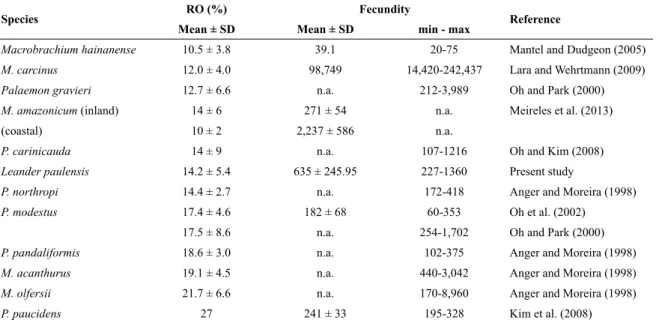
Brood weight of L. paulensis averages 14.2 ± 5.4%
of female body weight. This value lies at the low end of the range of previously published data of palaemonids (10.5 - 26.9%, Table 2) and within the range of other pandalid, crangonid and alpheid shrimp species (9 - 24%)
(see OH et al., 2002 for references). The reproductive output of L. paulensis is very similar to that of Palaemon northropi (14.4 ± 2.7%), a sympatric tropical marine
shrimp species also abundant in Brazilian shallow waters (ANGER; MOREIRA, 1998).
Reproductive output underlies a trade-off with growth. This tradeoff has been suggested for some sympatric congeneric species of brachyuran crabs (CARVALHO et al., 2010). However, the lack of comparative studies for many ecological traits and for many groups makes a general statement for Palaemonidae unfeasible. Since brood weight is a combined measure of fecundity and single egg weight (i.e. egg volume) the reproductive output (a measure of brood weight relative to female weight) underlies the ecological factors determining fecundity and egg volume. Over evolutionary time-scales, selection acts on egg size through factors such as food availability or predation risk, whereas overall reproductive investment is determined by feeding conditions for the adult females as ovaries mature (CLARKE et al., 1985). In any given situation, proximate local factors may modulate the extent to which the optimal level of reproductive investment is realized (CLARKE et al., 1991). This makes it very dificult to identify rules and relationships of speciic factors. Although necessary to analyze different reproductive strategies and their ecological and phylogenetic relationships, comparative studies of marine, estuarine and freshwater palaemonid species will be challenging since there is strong biological variation among reproductive traits.
Table 2. Comparison of reproductive output (RO) and fecundity in different species of Palaemonidae.
RO values are dry weight estimates; n.a.: no information available.
Species RO (%) Fecundity Reference Mean ± SD Mean ± SD min - max
Macrobrachium hainanense 10.5 ± 3.8 39.1 20-75 Mantel and Dudgeon (2005)
M. carcinus 12.0 ± 4.0 98,749 14,420-242,437 Lara and Wehrtmann (2009)
Palaemon gravieri 12.7 ± 6.6 n.a. 212-3,989 Oh and Park (2000)
M. amazonicum (inland) 14 ± 6 271 ± 54 n.a. Meireles et al. (2013)
(coastal) 10 ± 2 2,237 ± 586 n.a.
P. carinicauda 14 ± 9 n.a. 107-1216 Oh and Kim (2008)
Leander paulensis 14.2 ± 5.4 635 ± 245.95 227-1360 Present study
P. northropi 14.4 ± 2.7 n.a. 172-418 Anger and Moreira (1998)
P. modestus 17.4 ± 4.6 182 ± 68 60-353 Oh et al. (2002)
17.5 ± 8.6 n.a. 254-1,702 Oh and Park (2000)
P. pandaliformis 18.6 ± 3.0 n.a. 102-375 Anger and Moreira (1998)
M. acanthurus 19.1 ± 4.5 n.a. 440-3,042 Anger and Moreira (1998)
M. olfersii 21.7 ± 6.6 n.a. 170-8,960 Anger and Moreira (1998)
CONCLUSION
Comparison of fecundity and egg size of Leander paulensis with other palaemonids reveals that this species produces a large number of relatively small eggs, with no correlation of investment per reproductive event to female body size. We suggest several extrinsic and intrinsic variables to modulate the reproductive output, such as nutritional condition, temperature or the number of broods per reproductive station. Size and number of eggs of
L. paulensis may suggest an extended larval development, as found in many species of Palaemonidae. We showed that females gain weight during egg incubation, which may be a result of a restoration of depleted energy reserves after reproduction. This weight gain must be taken into account when estimating the reproductive output, brood loss in relation to female weight or any other weight-dependent variables of reproduction. The evaluation of several reproductive traits of marine, estuarine and freshwater palaemonids is necessary to generate a comparative analysis of strategies as well as their ecological and phylogenetic relationships.
ACKNOWLEDGEMENTS
The authors express their deep gratitude to the Faculty of Philosophy, Science and Letters at Ribeirão Preto (FFCLRP), University of São Paulo (USP), to FAPESP (Temático Biota 2010/50188-8) and CAPES (Ciências do Mar II Proc. 2005/2014 - 23038.004308/2014-14) for grant support enabling us to travel to the northern coast of São Paulo and for facilities during the development of the course: Methodologies on Fauna Studies - Invertebrates. We express our thanks to all participants for their help during ield activities. FLC and FLM were supported by PhD and Research fellowships from CNPq (140199/2011-0 and 302748/2010-5; 304968/2014-5, respectively). The collection of specimens conducted in this study complied with current applicable state and federal laws of Brazil (DIFAP/IBAMA/126/05; permanent license to FLM for collection of Zoological Material Nº 11777-1 MMA/IBAMA/SISBIO).
REFERENCES
ABELE, L. G.; KIM, W. The decapod crustaceans of the Panama Canal. Smithson. Contrib. Zool., v. 482, p. 1-50, 1989. ALBERTONI, E. F.; PALMA-SILVA, C.; ESTEVES, F. A.
Fecundity of Macrobrachium acanthurus Wiegmann, 1836 (Decapoda: Palaemonidae) in a tropical coastal lagoon subject to human impact (Macaé, Brazil). Acta Limnol. Bras.,
ALMEIDA, A. O.; COELHO, P. A.; SANTOS, J. T. A.; FERRAZ, N. R. Crustáceos decápodos estuarinos de Ilhéus, Bahia, Brasil. Biota Neotrop., v. 6, n. 2, p. 1-24, 2006.
ALMEIDA, A. O.; COELHO, P. A.; SANTOS, J. T. A.; FERRAZ, N. R. Crustáceos estomatópodos e decápodos da costa de Ilhéus, Bahia, Brasil. Atlântica, v. 29, n. 1, p. 5-20, 2007a. ALMEIDA, A. O.; GUERRAZZI, M. C.; COELHO, P. A.
Stomatopod and decapod crustaceans from Camamu Bay, state of Bahia, Brazil. Zootaxa, v. 1553, p. 1-45. 2007b. AMSLER, M. O.; GEORGE, R. Y. Seasonal variation in the
biochemical composition of the embryos of Callinectes sapidus Rathbun. J. Crustac. Biol., v. 4, n. 4, p. 546-553, 1984.
ANGER, K.; MOREIRA, G. S. Morphometric and reproductive traits of tropical caridean shrimps. J. Crustac. Biol., v. 18, n 4, p. 823-838, 1998.
ANNALA, J. H. Factors inluencing fecundity and population egg production of Jasus species. In: WENNER, A.; KURIS,
A. (Eds.). Crustacean egg production. Rotterdam: A. A. Balkema, 1991. p. 301-315.
BALASUNDARAM, C.; PANDIAN, T. J. Egg loss during incubation in Macrobrachium nobilii (Henderson & Mathai). J. Exp. Mar. Biol. Ecol. v. 59, n. 2/3, p. 289-299, 1982. BAUER, R. T. Continuous reproduction and episodic recruit
-ment in nine shrimp species inhabiting a tropical seagrass meadow. J. Exp. Mar. Biol. Ecol., v. 127, n. 2, p. 175-187, 1989.
BAUER, R. T. Analysis of embryo production in a caridean shrimp guild from a tropical seagrass meadow. In: Wenner, A.; Kuris, A. (Eds.). Crustacean egg production. Rotterdam: A. A. Balkema, 1991. p.181-191.
BILGIN, S.; SAMSUN, O. Fecundity and egg size of three shrimp species, Crangon crangon, Palaemon adspersus, and
Palaemon elegans (Crustacea: Decapoda: Caridea), off Sinop
Peninsula (Turkey) in the Black Sea. Turk. J. Zool., v. 30, n. 4, p. 413-421, 2006.
BODDEKE, R. The occurrence of winter and summer eggs in the brown shrimp (Crangon crangon) and the pattern of recruitment. Neth. J. Sea Res., v. 16, p. 151-162, 1982. CARVALHO, F. L.; SOUZA-CARVALHO, E. A.; COUTO, E. C.
G. Comparative analysis of the distribution and morphological sexual maturity of Persephona lichtensteinii and P. punctata
(Brachyura, Leucosiidae) in Ilhéus, BA, Brazil. Nauplius, v. 18, n. 2, p. 109-115, 2010.
CARVALHO, F. L.; DE GRAVE, S.; MANTELATTO, F. L.
Palaemonetes karukera Carvacho, 1979, a junior synonym of Leander paulensis Ortmann, 1897 (Decapoda, Palaemonidae). Crustaceana, v. 87, n. 13, p. 1586-1590, 2014.
CLARKE, A.; SKADSHEIM, A.; HOLMES, L. J. Lipid bio -chemistry and reproductive biology in two species of Gam-maridae (Crustacea: Amphipoda). Mar. Biol., v. 88, n. 3, p. 247-263, 1985.
CLARKE, A.; HOPKINS, C. C. E.; NILSSEN, E. M. Egg size and reproductive output in the deep-water prawn Pandalus borealis Kroyer, 1838. Funct. Ecol., v. 5, n. 6, p. 724-730, 1991.
CLARKE, A. Egg size and egg composition in polar shrimps (Caridea; Decapoda). J. Exp. Mar. Biol. Ecol., v. 168, n. 2, p. 189-203, 1993a.
CLARKE, A.; GORE, D. J. Egg size and composition in Ceratoserolis (Crustacea: Isopoda) from the Weddell Sea. In: Hempel, G. (Ed.). Weddell Sea Ecology. Berlin: Heidelberg: Springer-Verlag, 1993. p. 129-134.
COELHO, P. A.; ALMEIDA, A. O.; SOUZA-FILHO, J. F.; BEZERRA, L. E. A.; GIRALDES, B. W. Diversity and dis -tribution of the marine and estuarine shrimps (Dendrobran-chiata, Stenopodidea and Caridea) from North and Northeast Brazil. Zootaxa, v. 1221, p. 41-62, 2006.
COREY, S.; REID, D. M. Comparative fecundity of decapod crustaceans: I. The fecundity of thirty-three species of nine families of caridean shrimp. Crustaceana, v. 60, n. 3, p. 270-294, 1991.
COSTA, R. C.; FRANSOZO, A.; MANTELATTO, F. L.; CASTRO, R. H. Occurrence of shrimp species (Crustacea: Decapoda: Natantia: Penaeidea and Caridea) in Ubatuba Bay, Ubatuba, SP, Brazil. Proc. Biol. Soc. Washington, v. 113, n 3, p. 776-781, 2000.
DA SILVA, R. R.; SAMPAIO, C. M. S.; SANTOS, J. A. Fecundity and fertility of Macrobrachium amazonicum (Crustacea,
Palaemonidae). Braz. J. Biol., v. 64, n. 3a, p. 489-500, 2004. DAVIS, C. C. A study of the hatching process in aquatic inver
-tebrates. XIV. An examination of hatching in Palaemonetes vulgaris (Say). Crustaceana, v. 8, n. 3, p. 233-238, 1965.
DAVIS, C. C. A Study of the Hatching Process in Aquatic Invertebrates. XXIII. Eclosion in Petrolisthes armatus
(GIBBES) (Anomura, Porcellanidae). Int. Rev. Gesamten Hydrobiol. Hydrogr., v. 51, n. 5, p. 791-796, 1966.
DE GRAVE, S.; FRANSEN, C. H. J. M. Carideorum catalogus: the recent species of the dendrobranchiate, stenopodidean, procarididean and caridean shrimps (Crustacea: Decapoda). Zool. Meded., v. 85, n. 9, p. 195-589, 2011.
FOX, J.; WEISBERG, S. An R Companion to Applied Regression, Second Edition. Thousand Oaks: Sage, 2011.
JANAS, U.; MAŃKUCKA, A. Body size and reproductive traits of Palaemon elegans Rathke, 1837 (Crustacea, Decapoda), a
recent colonizer of the Baltic Sea. Oceanol. Hydrobiol. St., v. 39, n. 2, p. 3-24, 2010.
KIM, J. C.; MA, C. W.; OH, C. W.; PAIK, S. G. Reproduction and growth of the freshwater prawn, Palaemon paucidens
(Decapoda: Palaemonidae) in a lake of Korea. J. Environ. Biol., v. 29, n. 2, p. 163-168, 2008.
KURIS, A. M. A review of patterns and causes of crustacean brood mortality. In: Wenner, A.; Kuris, A. (Eds.). Crustacean egg production. Rotterdam: A. A. Balkema, 1991. p. 117-141. KURIS, A. M.; WICKHAM, D. E. Effect of nemertean egg
predators on crustaceans. B. Mar. Sci., v. 41, n. 2, p. 151-164, 1987.
LARA, L. R.; WEHRTMANN, I. S. Reproductive biology of the freshwater shrimp Macrobrachium carcinus (L.) (Decapoda:
Palaemonidae) from Costa Rica, Central America. J. Crustac. Biol., v. 29, n. 3, p. 343-349, 2009.
MANNING, R. B. A redescription of the palaemonid shrimp,
Leander paulensis Ortmann, based on material from Florida. Bull. Mar. Sci. Gulf Caribb., v. 11, n. 4, p. 525-536, 1961. MANTEL, S. K.; DUDGEON, D. Reproduction and sexual
dimorphism of the palaemonid shrimp Macrobrachium hainanense in Hong Kong streams. J. Crustac. Biol., v. 25, n.
3, p. 450-459, 2005.
MANTELATTO, F. L.; FRANSOZO, A. Fecundity of the crab
Callinectes ornatus Ordway, 1863 (Decapoda, Brachyura, Portunidae) from the Ubatuba region, São Paulo, Brazil. Crustaceana, v. 70, n. 2, p. 214-226, 1997.
MASHIKO, K. Diversiied egg and clutch sizes among local populations of the fresh-water prawn Macrobrachium nipponense (de Haan). J. Crustac. Biol., v. 10, n. 2, p.
306-314, 1990.
MCCARTHY, L. C.; LOFTUS, W. F.; REHAGE, J. S. Segregation of Palaemonid shrimp along an everglades estuarine gradient: Do multiple species have similar trophic function? Bull. Mar. Sci., v. 88, n. 4, p. 843-861, 2012.
MCCLINTOCK, J. B.; PEARSE, J. S. Organic and energetic content of eggs and juveniles of antarctic echinoids and asterids with lecithotrophic development. Comp. Biochem. Physiol. A: Physiol., v. 85, n. 2, p. 341-345, 1986.
MCEDWARD, L. R.; MORGAN, K. H. Interspeciic relationships between egg size and the level of parental investment per offspring in echinoderms. Biol. Bull., v. 200, n. 1, p. 33-50, 2001.
MEIRELES, A. L.; VALENTI, W. C.; MANTELATTO, F. L. Reproductive variability of the Amazon River Prawn, Macro-brachium amazonicum (Caridea, Palaemonidae): inluence of
life cycle on egg production. Lat. Am. J. Aquat. Res., v, 41, n 4, p. 718-731, 2013.
MORAIS, S.; NARCISO, L.; CALADO, R.; NUNES, M. L.; ROSA, R. Lipid dynamics during the embryonic develop -ment of Plesionika martia martia (Decapoda; Pandalidae), Palaemon serratus and P. elegans (Decapoda; Palaemoni -dae): relation to metabolic consumption. Mar. Ecol. Prog. Ser., v. 242, p. 195-204, 2002.
NAZARI, E. M.; SIMÕES-COSTA, M. S.; MÜLLER, Y. M. R.; AMMAR, D.; DIAS, M. Comparisons of fecundity, egg size, and egg mass volume of the freshwater prawns Macrobra-chium potiuna and Macrobrachium olfersi (Decapoda, Palae-monidae). J. Crustac. Biol., v. 23, n. 4, p. 862-868, 2003. OH, C. W.; PARK, K. Y. Comparative study on reproductive
effort and spawning frequency of the two palaemonid prawns (Exopalaemon modestus and Palaemon gravieri) with different habitats. J. Fish. Sci. Techn., v. 3, n. 3/4, p. 180-187, 2000.
OH, C. W.; SUH, H. L.; PARK, K. Y.; MA, C. W.; LIM, H. S. Growth and reproductive biology of the freshwater shrimp
Exopalaemon modestus (Decapoda: Palaemonidae) in a lake
of Korea. J. Crustac. Biol., v. 22, n. 2, p. 357-366, 2002. OH, C. W.; HARTNOLL, R. Reproductive biology of the com
-mon shrimp Crangon crangon (Decapoda: Crangonidae) in
the central Irish Sea. Mar. Biol., v. 144, n. 2, p. 303-316, 2004. OH, C. W.; KIM, J. N. Reproductive biology of Exopalaemon
carinicauda (Decapoda, Palaemonidae) in the Hampyong Bay of Korea. Crustaceana, v. 81, n.8, p. 949-962, 2008. PANDIAN, T. J. Ecophysiological studies on the developing eggs
and embryos of the European lobster Homarus gammarus. Mar. Biol., v. 5, n. 2, p. 154-167, 1970.
RAMOS-PORTO, M. Revisão das espécies do gênero Leander E. Desmarest que ocorrem no litoral brasileiro. Trab. Oceanogr. Univ. Fed. PE., v. 19, p. 7-26, 1986.
RAMOS-PORTO, M.; COELHO, P. A. Malacostraca - Eucarida. Caridea (Alpheoidea excluded). In: Young, P. S. (Eds.). Catalogue of Crustacea of Brazil. Rio de Janeiro: Museu Nacional, 1998. p. 325-350.
REEVE, M. R. The laboratory culture of the prawn Palaemon serratus. Fish. Invest., v. 26, n. 1, p. 1-38, 1969.
REID, D. M.; COREY, S. Comparative fecundity of decapod crus -taceans, II. The fecundity of ifteen species of anomuran and brachyuran crabs. Crustaceana, v. 61, n. 2, p. 175-189, 1991a. REID, D. M.; COREY, S. Comparative fecundity of decapod
crustaceans, III. The fecundity of ifty-three species of De -capoda from tropical, subtropical, and boreal waters. Crusta -ceana, v. 61, n. 3, p. 308-316, 1991b.
SASTRY, A. N. Ecological aspects of reproduction. In: Vernberg, F. J.; Vernberg, W. B. (Eds.). The biology of Crustacea. Environmental adaptations. New York: Academic Press, 1983. p. 179-270.
SHAKUNTALA, K.; REDDY, S. R. Crustacean egg size as an indicator of egg fat/protein reserves. Int. J. Invert. Rep. Dev., v. 4, n. 6, p. 381-384, 1982.
TAMBURUS, A. F.; MOSSOLIN, E. C.; MANTELATTO, F. L. Populational and reproductive aspects of Macrobrachium acanthurus (Wiegmann, 1836) (Crustacea: Palaemonidae)
from Southern, Brazil. Braz. J. Aquat. Sci. Technol., v. 16, n. 1, p. 9-18, 2012.
TURNER, R. L.; LAWRENCE, J. M. Volume and composition of echinoderm eggs: implications for the use of egg size in life-history models. In: Stancky, S. E. (Ed.). Reproductive ecology of marine invertebrates. Columbia: University of South Caroline Press, 1979. p. 25-40.
WEAR, R. G. Incubation in British decapod Crustacea, and the effects of temperature on the rate and success of embryonic development. J. Mar. Biol. Assoc. U. K., v. 54, n. 3, p. 745-762, 1974.
WEHRTMANN, I. S.; KATTNER, G. Changes in volume, biomass, and fatty acids of developing eggs in Nauticaris magellanica (Decapoda: Caridea): a latitudinal comparison.
J. Crustac. Biol., v. 18, n. 3, p. 413-422, 1998.