Comparative Study of Catalytic Oxidation of Ethanol to
Acetaldehyde Using Fe(III) Dispersed on Sb
2O
5Grafted on SiO
2and on Untreated SiO
2Surfaces
Edilson V. Benvenutti*a, and Yoshitaka Gushikemb
aLSS, Laboratório de Superfícies Sólidas, Instituto de Química, UFRGS, C.P. 15003,
91501-970 Porto Alegre - RS, Brazil
b
Instituto de Química, UNICAMP, C.P. 6154, 13081-970 Campinas - SP, Brazil
Received: August 13, 1997
O Fe(III) foi suportado sobre o óxido de Sb(V) enxertado na superfície de sílica gel e diretamente sobre a superfície da sílica gel, respectivamente por um processo de troca iônica e de impregnação. A conversão catalítica do etanol a acetaldeído foi muito mais eficiente usando Fe/Sb/SiO2 do que
Fe/SiO2, como catalisador. Esta maior eficiência do primeiro em relação ao segundo, leva em conta
dois aspectos: a) a nova fase FeSbO4 que se forma quando Fe/Sb/SiO2 é submetido ao aquecimento
e, b) é mais dispersa na superfície da matriz.
Fe(III) was supported on Sb(V) oxide grafted on the silica gel surface and directly on the silica gel surface using ion-exchange and impregnation processes producing Fe/Sb/SiO2 and Fe/SiO2,
respectively. The catalytic conversion of ethanol to acetaldehyde was much more efficient using Fe/Sb/SiO2 than Fe/SiO2 as catalyst. This higher efficiency of the former catalyst takes into account
two aspects: a) the new phase FeSbO4 formed when Fe/Sb/SiO2 is heat treated and, b) it is higher
dispersion on the matrix.
Keywords: modified silica, silica supported iron antimony, phase ethanol oxidation
Introduction
Studies of metallic oxides highly dispersed on the sur-face of inorganic supports have received special attention in recent years1-9. In general this kind of material presents different properties in relation to unsupported forms. In some cases, catalytic activity5,6 and adsorption properties7,8 improve. Another advantageous aspect is that physical properties like porosity, surface area and particle size are not substantially changed and can be monitored from the selected support.
There are several methods of synthesis to obtain dis-persed metal oxides on the support surfaces: a) Impregna-tion9,10 is a common process where the metal oxide is deposited over the support surface. However, this synthesis could result in a low dispersion because the metal is not bonded to the support. b) Grafting method8,11,12 usually results in a highly dispersed form on the surface, but it can only be used when the metal (alkoxide or halide) is
suffi-ciently acidic to react with the -OH groups present on the support surface. c) Ion-Exchange method13,14 is a very important procedure to obtain supported materials, the metal fixed on the surface by this process is always highly dispersed, because it is attracted to the surface by coulom-bic force at specific sites. However, it can only be used if the surface of the support shows ion-exchange properties.
In this work the iron (III) ion is fixed at the silica gel surface by two procedures: a) Impregnation and b) Ion-ex-change. For the ion-exchange process, the silica gel surface was modified with antimony (V) oxide. It is known12, that antimony (V) oxide dispersed at the silica surface presents Lewis acid sites and when hydrated, Brönsted acid sites. The Brönsted acid sites can be used to bind the iron (III) ion by ion-exchange process.
The dispersion of Fe(III) was compared for the two synthetic processes using the catalytic activity for the
oxi-Article
J. Braz. Chem. Soc., Vol. 9, No. 5, 469-472, 1998. © 1998 Soc. Bras. Química
dation of alcohol to acetaldehyde. The ethanol oxidation by iron (III) has already been reported15,16.
Experimental
Antimony (V) dispersed on silica gel, Sb/SiO2
Silica gel 60 (Merck) was activated at 150 °C under vacuum (10-1 Pa). The SbCl5 (Carlo Erba) (6 cm3),
pre-viously distilled in a Schlenk apparatus, was dissolved in CCl4 (Merck) (150 cm3) dried above 0.4 nm molecular
sieves. The activated silica (30 g) was then added. The mixture was stirred for 20 h under dry nitrogen atmosphere at solvent-reflux temperature. The resulting modified silica was filtered in a Schlenk apparatus, washed with CCl4 to
eliminate unreacted SbCl5 and trapped HCl, and finally
degassed at 150 °C for 5 h. The hydrolysis of the grafted SbCl5 was carried out under a flux of wet air for 48 h, then
washed with bidistilled water and finally, dried for 5 h under vacuum (10-1 Pa) at 150 °C.
Iron(III) oxide dispersed on silica modified with antimony (V) oxide, Fe/Sb/SiO2 (ion-exchange process)
About 30 g of Sb/SiO2 was immersed in 100 cm3 of
FeCl3 0.05 mol dm-3 aqueous solution (pH 1) and allowed
to stand for 24 h at room temperature. The solid was filtered off, washed with bidistilled water and degassed for 5 h at 150 °C.
Iron oxide dispersed on silica gel surface, Fe/SiO2
(impregnation process)
Silica gel 60 Merck (20 g), was immersed in an aqueous solution containing 2.8 mmol of FeCl3. After drying in air
at room temperature the material was degassed for 5 h at 150 °C.
Chemical analyses
The antimony and iron analyses were carried out on a Perkin Elmer 500 Atomic Absorption Spectrometer after leaching the metals from the surface with boiling concen-trated hydrochloric acid. The amount of Sb and Fe, deter-mined by atomic absorption spectrometry, were (in wt %) Fe/Sb/SiO2 : Sb = 4.5, Fe = 0.60; Fe/SiO2: Fe = 0.72.
Specific surface area
The BET surface area of materials heated at 150 °C and 700 °C were obtained using the multipoint technique, using a Micromeritics Flowsorb 2300 instrument.
Catalytic oxidation of ethanol
The catalytic experiment was carried out under steady state. Self supporting disks of materials having an area of 5 cm2 and ca. 50 mg were prepared. The cell was connected to a greaseless vacuum line and the system pumped for 1 h at 200 °C (10-2 Pa). After this treatment the catalysts were
submitted to 2.7 kPa of ethanol (Merck) dried over 0.4 nm molecular sieves and 2.7 kPa of oxygen. FT-IR spectra of gas phase were obtained after heating the catalysts for 20 min. at different temperatures. The catalytic conversion was obtained from the area under the carbonyl stretching band of the acetaldehyde at ca. 1750 cm-1. The FT-IR equipment used was a Perkin Elmer Model 1600, with 4 cm-1 of resolution and a maximum of 256 scans.
Results and Discussion
The catalytic conversion was carried out in the tempera-ture range between 200 °C and 300 °C. The spectra ob-tained for Fe/SiO2 and Fe/Sb/SiO2 are shown on Figs. 1 and
2, respectively. It can be observed in Figs. 1 and 2 that the CO stretching band increases with temperature. The main final product of catalysis was acetaldheyde, but a weak band of carbon monoxide can be observed at temperatures
470 Benvenutti & Gushikem J. Braz. Chem. Soc.
Figure 2. FT-IR gas phase spectra of the products formed in the presence of Fe/SbSiO2, obtained at different temperatures: a) 200 °C; b) 250 °C; c) 300 °C.
more elevated than 250 °C. The pure silica gel and the Sb/SiO2 (silica gel modified with antimony oxide) did not
show any catalytic activity.
The catalytic activity of the materials was obtained applying the equation:
a = A 100
m x (1)
where A is the area under CO stretching band, m is the mass of the catalyst and x is the percent fraction of iron on the catalyst.
The catalytic activities of materials obtained from Eq. 1 at different temperatures are given on Table 1. It can be observed that Fe/Sb/SiO2, obtained by ion-exchange
pro-cess, converts ethanol to acetaldehyde at a temperature of 200 °C, while Fe/SiO2 obtained by the impregnation
method shows catalytic activity at a temperature of 250 °C. In Table 2, the ratios of catalytic activities for all tempera-tures is presented. It can be observed that the Fe/Sb/SiO2
presents 5 times more activity than Fe/SiO2.
The catalytic activity of the Fe/SiO2 is lower because
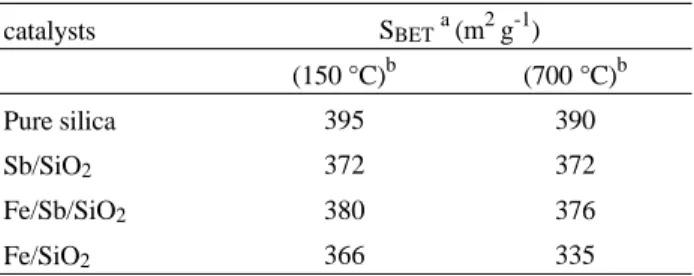
the iron oxide particles are agglomerated, taking into ac-count the method of preparation and the decrease of surface area obtained before and after the thermal treatment (see Table 3). The impregnation of Fe(III) results in a decrease of the surface area even before the thermal treatment (see Table 3), and after the calcination this effect was more pronounced. It is known that the Fe(III) ions are very mobile on the silica surface17,18 and then, the thermal
treatment produces Fe2O3 agglomeration as larger
parti-cles, decreasing its degree of dispersion.
However, in the Fe/Sb/SiO2 case, obtained by the
ion-exchange process, the Fe(III) ions are fixed at specific positions of the support surface, in a highly dispersed form, since no change on the surface area was observed after the thermal treatment (see Table 3). The dispersion of the iron (III) catalyst on the silica surface considerably enhanced the catalytic activity.
The equation which describes the impregnation process is:
SiO2 + mFe(OH2)x3+→ SiO2/FemOmx + mxH+ (2)
and the equations which describe the Fe/Sb/SiO2 synthesis
can be written as:
n≡SiOH + SbCl5→ (≡SiO)nSbCl5-n + nHCl (3)
(≡SiO)nSbCl5-n + (5-n)H2O →
(≡SiO)nSb(OH)5-n + (5-n)HCl (4)
If (≡SiO)nSb(OH)5-n is represented by ♦SbOH, the
reaction with the Fe(III) ion can be written as:
m♦SbOH + Fe(OH2)n3+→
(♦SbO)m[Fe(OH2)n-m](3-m)+ + m H3O+ (5)
Vol. 9, No. 5, 1998 Catalytic Oxidation of Ethanol to Acetaldehyde 471
Table 1. Catalytic activity on ethanol conversion to acetaldehyde.
Catalyst xa (wt %) mb (mg) Tc (oC) Ad (abs cm-1) ae
Fe/SiO2 0.72 50.1 200 -
-250 1.58 4.4
300 6.24 17.3
Fe/SbSiO2 0.60 46.6 200 1.22 4.4
250 7.20 26.4
300 25.98 92.8
a = percent fraction of iron on material; b = mass of material;
c = temperature of reaction;
d = stretching C-O band area of acetaldehyde.
Table 2. Catalytic activity ratios.
Ta (°C) a2 / a1
200
-250 6.0
300 5.3
a = Temperature of reaction; a1= Activity of Fe/SiO2; a2 = Activity of Fe/SbSiO2.
Table 3. Specific surface area.
catalysts SBETa (m2g-1)
(150 °C)b (700 °C)b
Pure silica 395 390
Sb/SiO2 372 372
Fe/Sb/SiO2 380 376
Fe/SiO2 366 335
It can be observed from Eqs. 3 and 4 that Sb(V) ion is grafted on the silica surface forming a submonolayer be-cause this ion is covalently bonded to the silica surface through the silanol group ≡SiOH, forming the ≡Si-O-Sb bonding. Thus, in the ion-exchange process the Fe(III) is maintained in a highly dispersed form (see Eq. 5). There is also evidence that Fe(III) in Fe/Sb/SiO2 can not form Fe2O3
agglomerates because there is a strong interaction between iron(III) and the grafted antimony(V) on the silica surface, resulting in a new FeSbO4 phase19,20.This last phase is
presumably more effective than Fe2O3 in the catalytic
conversion of ethanol to acetaldehyde.
Conclusions
The catalytic conversion of ethanol to acetaldehyde using Fe(III) as catalyst is more efficient when the reaction is carried out by using Fe/Sb/SiO2 than Fe/SiO2. This
higher efficiency takes into account two aspects: a) the new phase FeSbO4 formed when Fe/Sb/SiO2 is heat treated and,
b) The Fe(III) is better dispersed on the Fe/Sb/SiO2 catalyst.
References
1. Bond, G.C.; Flamerz, S.; Shukri, R. Faraday Discuss.
Chem. Soc. 1989, 87, 65.
2. Vuurman, M.A.; Wachs, I.E. J. Phys. Chem. 1992, 96, 5008.
3. Thomas, C.; Vivier, L.; Lemberton, J.L.; Kasztelan, S.; Pérot, G. J. Catal. 1997, 167, 1.
4. Iwasawa, Y.; Gates, B.C. Chemtech 1989, 173. 5. Bond, G.C.; Bruckman, K. Faraday Dissc. Chem.
Soc. 1981, 72, 235.
6. Shirai, M.; Asakura, K.; Iwasawa, Y. J. Phys. Chem.
1991, 95, 9999.
7. Peixoto, C.R.M.; Gushikem, Y.; Baccan, N. Analyst
1992, 117, 1029.
8. Denofre, S.; Gushikem, Y.; Davanzo, C.U. Eur. J.
Solid State Inorg. Chem. 1991, 28, 1295.
9. Datta, A.K.; Ha, J.-W.; Ragalbuto, J.R. J. Catal. 1992,
133, 55.
10. Lopez, T.; Bosch, P.; Asomoza, M.; Gomez, R. J.
Catal. 1992, 133, 243.
11. Drago, R.S.; Getty, E.E. J. Am. Chem. Soc. 1988, 110, 3311.
12. Benvenutti, E.V.; Gushikem, Y.; Davanzo, C.U.; Cas-tro, S.C.; Torriani, I. J. Chem. Soc. Faraday Trans.
1992, 88, 3193.
13. Fujitani, F.; Echigoya, E. Chem. Lett. 1991, 827. 14. Bonivardi, A.L.; Baltanás, M.A. J. Catal. 1990, 125,
243.
15. Hino, H.; Arata, K. J. Chem. Soc. Chem. Comm. 1988,
17, 1168.
16. Wang, L.; Egushi, K.; Aray, H.; Seiyama, T. Chem.
Letters 1986, 1173.
17. Lee, Jyh-Fu; Lee, Min-Dar Appl. Catal. 1989, 52, 193. 18. Cagnoli, M.V.; Marchetti, S.G.; Gallegos, N.G.; Al-varez, A.M.; Mercader, R.C.; Yeramian, A.A. J.
Catal. 1990, 123, 21.
19. Davanzo, C.U.; Gushikem, Y.; Castro, S.C.; Ben-venutti, E.V.; Vasquez, A. J. Chem. Soc. Faraday
Trans. 1996, 92, 1569.
20. Benvenutti, E.V.; Zavislak, L. Polyhedron 1998, 17, 1627.
FAPESP helped in meeting the publication costs of this article