BRAZILIAN JOURNAL OF OCEANOGRAPHY, 55(4):265-279, 2007
ANTHROPOGENIC NUTRIENT POLLUTION OF CORAL REEFS IN
SOUTHERN BAHIA, BRAZIL
Ozeas S. Costa Jr.
The Ohio State University at Mansfield, School of Earth Sciences (1680 University Drive, Mansfield, OH 44906, USA)
A
B S T R A C TSpatial, temporal and anthropogenic controls on nutrient distribution were evaluated for nearshore and offshore reefs at Porto Seguro Bay, Southern Bahia. Water samples were analysed for total oxidised nitrogen (TON), soluble reactive phosphorus (SRP), reactive silica (DSi), and chlorophyll a (Chl). The results indicate that rainfall promotes a significant (F=19.873, p<0.001) increase in the load of nutrients to nearshore (average 12% increase) and offshore reefs (average 31% increase). Nutrient concentrations at the urbanized reef (TON=1.93-3.21µM; SRP=0.57-0.89µM; DSi=8.48-11.15µM) are on average 25% higher than at non-urban reefs and over 200% higher than the offshore reef. The urbanized reef also presented the highest rates of increase in nutrient input between dry and rainy seasons (TON=+0.36µM; SRP=+0.08µM; DSi=+0.70µM). Differences in nutrient concentration between nearshore and offshore reefs are more pronounced during dry season, when the bulk of land-based nutrient contribution is confined to the nearshore reefs. SRP values in the study area ranked among the highest in the world for coral reef areas and phytoplankton growth appears to be nitrogen-limited.
R
E S U M OEste artigo discute os fatores espaço, tempo e atividade antrópica na distribuição de nutrientes em amostras dos recifes costeiros da Baía de Porto Seguro, sul do Estado da Bahia. Análises realizadas nas amostras d’água incluem a porção reativa de nitrogênio (TON), fósforo (SRP) e silicato (DSi) dissolvidos, e clorofila (Chl). Resultados indicam um aumento significante (F=19.873, p<0.001) na descarga de nutrientes durante a estação chuvosa para os recifes costeiros (média de 12%) e para o recife oceânico (média de 31%). O recife urbano (TON=1.93-3.21µM; SRP=0.57-0.89µM; DSi=8.48-11.15µM) apresentou concentrações 25% mais altas que o outro recife costeiro, e mais de 200% acima do recife oceânico. Aquele recife também apresentou as mais altas taxas de aumento na descarga de nutrientes entre as estações seca e chuvosa (TON=+0.36µM; SRP=+0.08µM; DSi=+0.70µM). A diferença nas concentrações de nutrientes entre os recifes costeiros e oceânico é maior durante a estação seca, quando a contribuição continental de nutrientes está confinada a áreas próximo à costa. As concentrações de fósforo inorgânico na área de estudo estão entre as mais altas do mundo para áreas coralinas, e o fitoplâncton parece ser limitado pela disponibilidade de nitrogênio.
Descriptors: Coastal eutrophication; Nitrogen; Phosphorus; Submarine groundwater discharge; Coral reef; Nutrients; Seasonality; Coastal urbanization.
Descritores: Eutrofização costeira; Nitrogênio; Fósforo; Descarga de água subterrânea marinha; Recife de coral; Nutrientes; Sazonalidade; Urbanização costeira.
I
NTRODUCTIONFlowing down from the Equator, waters from the oceanic Brazil Current induce oligotrophic and near to homogeneous conditions of the chemical constituents along the inner shelf in the Brazilian coast (KOENING; DE MACEDO, 1999). Mesotrophic or eutrophic conditions are mainly local, depending on either land-based sources (DITTMAR; LARA, 2001) or upwelling processes (CARBONEL; VALENTIN, 1999). Estuarine and coastal areas near to major urban
(COSTA et al., 2000). Widespread use of cesspits and septic tanks in urban settlements along the coast also increases the nutrient concentrations of groundwater by infiltration through highly porous sandstone and beach rocks (COSTA et al., 2000). This study evaluates the spatial, temporal and anthropogenic controls on nutrient distribution of nearshore and offshore reefs in Southern Bahia, Brazil. Seawater, porewater and sediment samples were collected along different transects during dry and rainy seasons, for two years, in three reefs with distinct nutrient inputs (two nearshore reefs, one being close to an urban settlement, and an offshore marine park). We also discuss the importance of submarine groundwater discharge (SGD) as a potential pathway for nutrient fluxes to coastal coral reefs in the study area.
SGD is a relatively common phenomenon and has been recently recognized as an important source of nutrients to coastal waters (see the review from Slomp; Van Cappellen, 2004). Estimates of freshwater groundwater flux indicate that the ratio of groundwater discharge to stream flow is 20 to 50%, and that the magnitudes of both the total dissolved nitrogen and PO4
3− loads due to fresh SGD are 40 to
100% of loads carried by streams (KROEGER et al., 2007). In some areas, SGD can have greater ecological significance than surface runoff as virtually all freshwater entering the sea is in the form of submarine discharge (KAY et al., 1977; HANSHAW; BACK, 1980). Likewise, SGD can be one of the primary pathways for nutrients and contaminants to interact with overlying surface waters (RUTKOWSKI et al., 1999), and a key factor initiating phytoplankton blooms (LAPOINTE et al., 1990).
Reports of SGD in Brazil are scarce, but the research carried out so far have indicated that it is a quantitatively important component of the nutrient and water budget to coastal areas, especially near urban settlements. The first observation was made in the early 1990’s, on a coastal lagoon near Rio de Janeiro City. Salinity and temperature profiles revealed an intrusion of seawater to the lagoon through the porous sediments of a sand barrier (COSTA, O.S., unpubl.). Subsequent topographic profiles also revealed that, during high tides, the lagoon level occurred at more than 1 m below the sea level, thus allowing the inflow of seawater to the choked lagoon. Windom and Niencheski (2003), studying the freshwater-seawater mixing zone in southern Brazil, also found that freshwater discharged to the ocean through permeable sediments may have a significantly different composition than that discharged at the surface. Oliveira et al. (2003, 2006) used a natural tracer (222Rn) to estimate groundwater fluxes in four embayments at Ubatuba coastal area in southern Brazil. They observed significant flow of subsurface water at rates of 23 ± 22 cm day-1. They also compared
222
Rn data to seepage measurements, finding flux rates between 1.4 and 21.6 cm day-1.
Further studies of SGD were also performed in the north coast of Bahia (COSTA et al., 2000). In this study, groundwater nutrient concentration in the urbanized site was many times higher than those detected in the underdeveloped area, due mainly to the widespread use of septic tanks and cesspits. Groundwater flux was predominantly seaward due to the fact that the lagoon-level could be as high as 5.9 m above sea-level (at low tides), generating a groundwater flux of approximately 45 L m-2 day-1 towards the coastal reefs. Studies of SGD fluxes performed elsewhere revealed discharge rates ranging from 2.2 to 14.5 L m-2 day-1 (SWARZENSKI et al., 2007).
Although the direction of the groundwater flow is assumed to oscillate as the fluctuating tides create a differential head between sea level and the water table, the study of COSTA et al. (2000) has shown that this may not always be the case, and an unidirectional flow may be established. Such a permanent supply of nutrients via groundwater seepage may pose an ecological problem, leading to algal blooms and the steady deterioration of the water quality.
Seasonality is also an important factor affecting the degree to which groundwater nutrients influence coastal communities, and the flux of the SGD has been shown to increase substantially during rainy seasons. Seasonal differences in nutrient concentration presented by Costa et al. (2000) in the northern coast of the state reflect the role of rainfall in nutrient dilution and transport. Lower levels of ammonia and higher nitrate found during the rainy season indicate that a recharge of the permeable aquifer by oxygenated rainfall infiltration allow an increasing oxidation of ammonia to nitrite and then to nitrate.
M
ATERIAL ANDM
ETHODS Study AreaFig. 1. Map of the Brazilian Discovery Coast, Southern Bahia, Brazil, and location of the studied reefs.
Sampling Design
In order to account for seasonal variability, sampling occurred during both dry (July-August) and rainy (February-March) seasons in 1999 and 2000. Water, porewater, and sediment sampling were performed in the last two weeks of the sampling period in both August (dry season) and March (rainy season). During the preceding 45 days of each sampling period, a benthic ecological assessment was performed on each reef, aiming to identify any spatial or temporal patterns of community structure variation within and between reefs. As phytoplankton activity can quickly deplete the dissolved nutrients from the water column, chlorophyll measurements were also performed as an additional indicator of nutrient enrichment (also on the last two weeks of each sampling period).
Seawater Sampling
Samples in the water column were collected 1 m below the surface and 1 m above the bottom in all sites where depth was higher than 3 m. In sites with depths of less than 3 m, only one sample was taken at
mid-depth. Samples were collected with 5 L polyethylene bottles deployed by SCUBA diving. Samples were filtered immediately, using a Nalgene® filtration unit connected to a hand-pump, and then frozen (-20ºC). A series of measures were taken to minimize the effects of storage on analyte concentration, including: 1) the use of HDPE bottles with leak-proof screws; 2) careful cleaning and decontamination of bottles, flasks and containers that came in contact with the sample by using an overnight bath with Neutracon® (a phosphate-free, totally rinsable, surface active agent), followed by a HCl 10% acid bath; and 3) comprehensive sub-sampling procedure to detect any background contamination. A storage trial was also performed (prior to sampling) to assess the stability of TON, SRP and DSi under different storage methods and with different water matrices. A site specific protocol for sample storage (-20ºC freezing) was used, and all samples were analyzed within two weeks. A detailed description of the storage trial procedure and results can be found in Gardolinski et al. (2001). Two types of filters were used: Cellulose acetate membranes (Whatman® 0.45
analysis, and glass fiber filters (Whatman® GF/F), for concentration of pigments for chlorophyll analysis. Procedural blanks (distilled, double deionised, UV irradiated Milli-Q water, filtered as sample) were used throughout the sampling to assure that no analyte was added during the processing of the sample. Control solutions were also used to monitor the effects of the storage period on the nutrient concentration of the water samples. At each station, a solution containing 7.14 µmol L-1 of N, 3.23 µmol L-1 of P, and 3.56 µmol L-1 of Si was filtered and stored as sample. Variations in the concentration of controls stayed within 6%.
Sediment and Porewater Sampling
Analysis of sediment and porewater samples aimed to identify the contribution of nutrients regenerated from the sediment. Sediment cores were collected from the same stations used for water sampling (along the reef transects described previously) using aluminum tubes (7.5 cm internal diameter). Both ends of the core were closed with PVC caps after core retrieval. Each core was divided into 10 cm-long sections. Porewater was extracted from each section using a system based on the "whole-core squeezer" porewater sampler developed by Bender et al. (1987). The porewater collected was then filtered as described for seawater samples. Sediment samples were collected from each core-section, placed in zip-lock bags, identified and frozen (-20ºC). Sediment samples were used for textural analysis (dry sieving technique – FOLK; WARD, 1957; LARSON et al., 1997) and organic matter content (loss on ignition method – HEIRI et al., 2001).
Benthic Ecological Assessment
Due to the high complexity of the reef ecosystem, and considering the time constraints of the study, only the following benthic organisms were targeted in the survey: cnidarians (including stony corals, hydrocorals, gorgonians and zoanthids) and macroalgae (including fleshy, turf and crustose coralline algae). These organisms comprised more than 3/4 of the reef cover in the study area. A detailed description of methods used and the results of statistical analysis of the distribution and ecology of macroalgae species and other benthic groups in the study area can be found in Costa et al. (2002).
Analytical Measurements
Samples were analyzed for total oxidized nitrogen (TON), soluble reactive phosphorus (SRP), and reactive silica (DSi). Nutrient concentrations were determined using a segmented continuous flow analyser (Skalar SANplus) incorporating a chemistry
unit (SA 4000). For absorbance reading, a matrix photometer 6250 detector with automatic background correction was used. The automated method for determination of TON was based on the cadmium reduction method adapted for autoanalyzers (BREWER; RILEY, 1965). Detection limit was 0.07
µmol L-1. The efficiency of nitrate reduction in the cadmium column was validated regularly to be over 95% by running a nitrite standard with the same concentration as the highest nitrate standard. SRP was determined by the molybdenum blue complex method (BENSON et al., 1996). Detection limit was 0.04
µmol L-1. The automated method for DSi determination was based on the reduction of silicomolybdic acid with ascorbic acid, producing a blue dye, which was then measured at 810 nm (BREWER; RILEY, 1966). Detection limit was 0.03
µmol L-1. For analysis of chlorophyll pigments, the visible spectrophotometry method described by ARAR (1997) was used. The detection limit for this method was 0.1 µg L-1 using a 2-cm glass cell. Salinity was measured using a portable Yellow Springs' salinometer model YSI 30/10FT (range between 0-80 PSU and resolution of 0.1 PSU).
Statistical Analysis
Multifactorial ANOVA was used to analyse simultaneously the effects of season, reef sites and sample locations, and their interactions, on each nutrient analyte (TON, SRP or DSi). Post hoc tests (Student Newman Keuls - SNK and Tukey's pairwise comparisons) were performed to further investigate the interactions between these effects. For porewater data, values were averaged for each core in order to ascertain differences in nutrient concentrations between reefs and sampling sites. The Friedman's test was then performed to evaluate the effects of season, reef and sample location. This test is a nonparametric analogue of a two-way ANOVA and makes no assumptions about the distribution of the data. It is appropriate to the situation faced by the porewater data, where in some cases there is a single observation for each location. All multivariate analyses were completed using the PRIMER software package.
R
ESULTSNutrient Concentrations in Surface and Bottom Samples
µmol L-1, during the dry season, and from 0.52 to 1.16
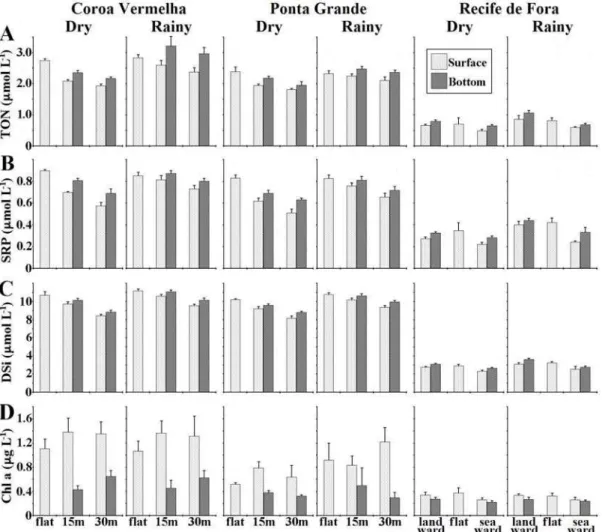
µmol L-1 during the rainy season (Fig. 2A). Bottom samples (collected 1 m above the sediment) exhibited consistently higher TON concentrations than those collected near the surface at the same locations in all seasons on both nearshore and offshore reefs (Fig. 2A).
SRP concentrations on the nearshore reefs (Fig. 2B) varied from 0.46 to 0.91 µmol L-1, during the dry season, and from 0.61 to 0.91 µmol L-1, during the rainy season. Values at Ponta Grande were again lower than on Coroa Vermelha at all but one sampling site (the reef flat). At the offshore reef (Fig. 2B), concentrations varied from 0.20 to 0.43 µmol L-1, during the dry season, and from 0.23 to 0.46 µmol L-1 during the rainy season, the lowest SRP values always occurring at the seaward side, in both seasons.
Samples collected near the bottom exhibited higher SRP concentration than those sampled near the surface in all reefs and seasons (Fig. 2B).
DSi concentrations at the nearshore reefs (Fig. 2C) varied from 7.96 to 11.05 µmol L-1, during the dry season, and from 9.05 to 11.47 µmol L-1, during the rainy season. At the offshore reef, DSi concentrations (Fig. 2C) varied from 2.13 to 3.14
µmol L-1, during the dry season, and from 2.15 to 3.88
µmol L-1 during the rainy season. Concentrations near the bottom again exhibited persistently higher concentrations than those observed in the surface samples, with higher values being recorded during the rainy season (Fig. 2C). From all three parameters, DSi was the most stable, presenting lowest spatial and temporal variability.
Fig. 2. Comparison of (A) TON, (B) SRP, (C) DSi, and (D) chlorophyll a concentrations (mean ±SE) between surface and
bottom samples during dry and rainy seasons in all studied reefs (n = 8). flat = reef flat, 15m and 30 m = distance from the reef crest.
Patterns of TON Distribution
Surface TON concentrations are highly variable both within and between reefs. The nearshore reefs, although having similar geology and being exposed to the same climatic and hydrologic conditions, presented significantly different TON distribution, with Coroa Vermelha presenting results 9% higher than Ponta Grande during the dry season, and 14% higher during the rainy season. The reef flat exhibited the highest TON concentration of all sample locations, but did not vary significantly between seasons. Results of the ANOVA significance test for nearshore reefs indicates that, although all factors presented significant results, only one interaction (season x reef) revealed a significant effect. On the offshore reef, however, the season effect is highly significant, mainly because of the observed variation in landward TON concentrations. Peak values during the rainy season were found on the landward side of the reef, but the lowest values, as expected, always occurred at the seaward side, in both surface and bottom samples.
Patterns of SRP Distribution
Contrary to the trend observed for TON, there was not a significant increase in SRP concentrations at Coroa Vermelha during the rainy season, and no season x reef interaction term was evident, according to the results of ANOVA tests. The only significant first-order interaction was that between season and sample location, due mainly to the behaviour of reef flat concentrations, which did not vary significantly either between reefs or seasons. At the offshore reef, lowest SRP values always occurred at the seaward side, in both seasons. However, unlike that observed for TON, highest SRP values always occurred on the reef flat. Distinct seasonal responses from landward and seaward sides resulted in a significant first-order interaction between season and location for surface samples. The same was not observed for bottom samples (F = 7.065, p = 0.013), which, although presenting consistently higher concentrations than those collected near the surface, did not vary seasonally in the same pattern as for TON concentrations.
Patterns of DSi Distribution
As for TON and SRP, higher DSi concentrations were recorded during the rainy season. However, differences between surface and bottom samples were not as significant as those for TON concentrations. A significant first-order interaction between season and location was found (F = 14.408, p = <0.001), and is due mainly to variations in reef flat
DSi concentrations between seasons. Differences in DSi concentrations between Coroa Vermelha and Ponta Grande were smaller than TON or SRP, although still statistically significant, with the latter reef presenting higher variation among seasons than Coroa Vermelha. On the offshore reef, the highest DSi values were found mostly on the reef flat, but never on the seaward side. A significant season effect was observed, with concentrations during rainy season being significantly higher than dry season.
Nutrient Concentrations in Porewater
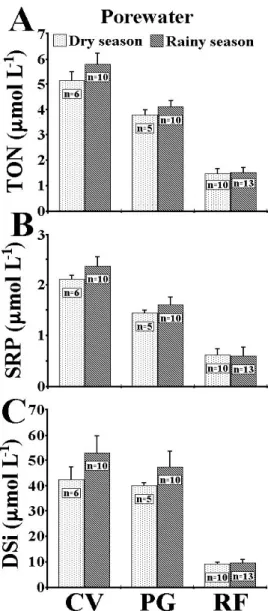
Nutrient concentrations in porewater from the studied reefs are about twice the concentration for the overlying water column. TON concentrations (Fig. 3A) in Coroa Vermelha varied from 4.73 to 5.48 µmol L-1, during the dry season, and from 5.16 to 6.22 µmol L-1, during the rainy season. In Ponta Grande, concentrations ranged from 3.70 to 3.94 µmol L-1, during the dry season, and from 3.81 to 4.28 µmol L-1, during the rainy season. Porewater TON concentrations at the offshore reef varied between 1.26 and 1.72 µmol L-1, during the dry season, and from 1.01 to 1.96 µmol L-1, during the rainy season (Fig. 3A). The results of the Friedman's test for porewater TON concentrations showed a significant statistical difference between seasons (χ2 = 6.000; p = 0.014), with the rainy season presenting higher concentrations than the dry season. TON values at Coroa Vermelha are also significantly higher than those at Ponta Grande. The significance test also showed that concentrations in the sampling site located 15 m from the reef are higher than concentrations at 30 m. On the offshore reef, no significant difference between seasons was observed (χ2 = 0.333; p = 0.564). Additionally, no significant difference was found between sampling locations, although landward samples always presented the highest porewater TON concentrations and seaward samples the lowest values.
those at Ponta Grande. As observed for TON, the significance test also showed that 15 m porewater SRP concentrations are higher than the 30 m sampling location. On the offshore reef, no significant statistical difference was found between seasons or sampling locations. The significance test also showed that landward samples presented the highest SRP concentrations, while no statistical difference was found between seaward and reef flat samples.
Porewater DSi concentrations (Fig. 3C) in Coroa Vermelha ranged from 34.01 to 46.92 µmol L-1, during the dry season, and from 39.69 to 60.77 µmol L-1, during the rainy season. Values at Ponta Grande varied between 37.73 and 41.40 µmol L-1, during the dry season, and from 37.92 to 57.83 µmol L-1, during the rainy season. Concentrations at Recife de Fora varied from 8.15 to 9.78 µmol L-1, during the dry season, and from 8.06 to 11.46 µmol L-1, during the rainy season (Fig. 3C). Porewater DSi concentrations are more than four times the concentration in the overlying water column. A significant statistical difference was found between seasons (χ2 = 6.000; p = 0.014), with DSi concentrations during rainy season being higher. No significant difference was found between the two reefs, although porewater DSi concentration at Coroa Vermelha was generally higher than those at Ponta Grande. All sampling locations (flat, 15m and 30m) are different from each other. On the offshore reef, porewater DSi concentrations represent about three times the concentration of the water column near the bottom. Results of the Friedman's test showed no significant difference between seasons (χ2 = 0.333; p = 0.564) or between sampling locations, with landward samples presenting the highest porewater DSi concentrations and the reef flat presenting the lowest values.
Chlorophyll a Concentrations
At the nearshore reefs, mean chlorophyll a concentration in surface waters ranged from 0.51 to 1.38 µg L-1 (Fig. 2D). Bottom samples showed little variation between reefs or seasons, with chlorophyll a concentrations ranging from 0.29 to 0.64 µg L-1. At the offshore reef, chlorophyll a concentrations were extremely low, especially at the seaward reef (Fig. 2D). In surface waters, concentrations ranged from 0.26 to 0.38 µg L-1. In bottom samples, concentrations varied between 0.22 and 0.28 µg L-1. Although statistical tests on chlorophyll a data from surface samples have shown significant seasonal and spatial variation, post hoc tests revealed that such variation is due mainly to Ponta Grande values, in which seasonality represents a highly significant effect. Evaluation of the Coroa Vermelha dataset alone further confirmed this with no seasonal effect on
chlorophyll a concentration being observed. Bottom samples showed little variation between reefs or seasons. At the offshore reef, Chlorophyll a concentrations were extremely low, especially at the seaward reef. There was a significant statistical difference between dry and rainy season in surface samples (F = 5.105, p = 0.010), but none was observed in bottom samples (F = 3.192, p = 0.085). The interaction between the effects of season and sample location is significant only for surface samples, and post hoc tests revealed that this is caused mainly by reef flat variation between seasons.
Sediment Organic Matter Content
Organic matter (OM) content (values given in percent of dry weight) in nearshore sediments (Fig. 4A) varied between 5 and 39%, during the dry season, and between 8 and 43% during the rainy season. Ponta Grande had both the highest and the lowest values, presenting the most significant difference between sampling locations. At the offshore reef (Fig. 4B), sediment OM concentrations showed a distinct
gradient from landward to seaward. At the landward side, OM content in the sediment varied around 45% in both transects and both seasons. In Ponta Grande, analysis of all OM data combined yielded no statistically significant seasonal effect (F = 2.226, p = 0.146). This may be due to the fact that OM values in Ponta Grande presented a higher degree of variability between replicates (Fig. 5).
Fig. 4. Distribution of sediment organic matter at (A) nearshore and (B) offshore reefs. Columns represent mean of replicates (n = 9) with 95% confidence intervals. CV = Coroa Vermelha, PG = Ponta Grande, RF = Recife de Fora, flat = reef flat, 15 m and 30 m = distance from the reef crest.
D
ISCUSSIONEvidence for SGD in the Study Area
As shown in Costa et al. (2000), volumes of SGD can be calculated using the hydraulic conductivity of the aquifer and the hydraulic head on flow equations based on the Darcy Law. Other studies have used similar approach (ZEKTSER, 2002; ZEKTSER; LOAICIGA, 1993; VALIELA et al., 1978). In the study area, the hydraulic head can reach 2 m at low tides, and calculations considering the mean sea level for the years of study yielded a groundwater flow rate of 27 L m-2 d-1 (for Coroa Vermelha) and 21 L m-2 day-1 (for Ponta Grande). Although these rates are not as high as the ones found in the northern coast of Bahia (COSTA et al., 2000) they are comparable to other areas with highly permeable sediments (SCHLUTER et al., 2004; CHARETTE et al., 2003; HEMOND; FIFIELD, 1982; VALIELA et al., 1978; SWARZENSKI et al., 2007). In addition, seeps along the beach face were distinguished visually. Such springs discharged in a narrow strip along the beach, mainly during low tide, with no visible difference in the flux between dry and rainy seasons. Similar springs have been observed elsewhere (STIEGLITZ, 2005; COSTA et al., 2000; CORBETT et al., 1999).
Salinity is also a good indicator of SGD. In the study area, lowest salinity values at the nearshore reefs were always found in the pools on the reef flat and in the shallow lagoon between the reef and the beach. This dilution of seawater is certainly due to SGD as there is no river or streams draining to these particular sites (the closest stream is 6 km away and the two largest rivers in the area are both located at 11 km, respectively north and south from the study sites – see Fig. 1). This pattern was observed in both dry and rainy season (Table 1). At the offshore reef, however, the shallow pools in the reef flat always presented the highest salinity values (as expected due to higher rates of evaporation), the lowest values being in the landward side of the reef. The relationship between salinity and DSi concentrations at the water-sediment interface has also been used previously as a tracer of
groundwater discharge (MONTAGGIONI et al., 1993) as DSi is generally higher in groundwater relatively to the surrounding seawater (NAIM et al., 1997). In the study sites, the corresponding low salinities with high silicate levels at the discharge areas indicates that this low-salinity water is either river or groundwater derived (and not simply rainfall), which is in accordance with findings from previous studies (CUET et al., 1988; BELL, 1992).
Finally, the marked seasonal increase (from dry to rainy season) in nutrient concentrations near the bottom (for all nutrient species analyzed) is a further indicator that SGD represents an important source of nutrients to the reefs in addition to ongoing (all season) nutrient remineralization as a result of high sediment organic matter content (see Fig. 4 and the next paragraph). This difference in bottom nutrients from dry to rainy season also cannot be explained by simple seasonal stratification as the area around the reefs presents extremely high wave energy and high levels of vertical mixing.
Nutrient Supply from Sediment Regeneration Benthic regeneration is an essential process within biogeochemical cycles of nutrients in many marine environments as well as an important source of nutrients to support coastal productivity. The quantity of organic material and nutrients in sediments will reflect the longer-term nutrient supply and productivity of an area (KLUMP; MARTENS, 1983). Remineralization rates have been found to vary significantly with season (JAHNKE et al., 2005) and this seasonal variation is probably linked to variations in organic matter inputs. In our study sites, spatial variations in the sedimentary organic matter (OM) content are more important than temporal (seasonal) patterns, particularly in Ponta Grande. This may be due to the fact that OM values in Ponta Grande presented a higher degree of variability between replicates. Nevertheless, the fact that OM accumulation near the bottom is high all through the year at both nearshore locations indicates that remineralization from the sediment is an important,
Table 1. Summary of salinity values (in PSU) for sampling sites at the nearshore reefs in both dry and rainy seasons (n = 12). CV = Coroa Vermelha, PG = Ponta Grande, flat = reef flat, 15 m and 30 m = distance from the reef crest.
flat 15 m 30 m
Max Min Mean ± SE Max Min Mean ± SE Max Min Mean ± SE
CV 33.5 31.0 32.2 ± 1.7 32.7 31.7 32.3 ± 1.1 34.3 33.8 34.0 ± 0.5 Dry
Season PG 33.5 32.1 32.8 ± 0.8 33.9 33.2 33.7 ± 0.4 34.8 33.8 34.1 ± 0.3
CV 33.1 30.7 32.0 ± 1.4 32.3 31.5 32.0 ± 0.9 33.9 33.0 33.5 ± 0.6 Rainy
Season
PG 32.8 31.9 32.4 ± 0.5 33.5 33.0 33.2 ± 0.4 34.4 33.3 33.8 ± 0.5
permanent source of nutrients to the water column at both nearshore reefs. This, however, still does not explain the seasonal increase in nutrient concentrations both in bottom samples and porewater. Changes in the water temperature have been shown to induce seasonal patterns of OM remineralization but that is not the case in the study area, where daily variations in water temperature (related to insolation and cloud cover) were far more important than seasonal patterns (COSTA, 2002).
Nitrogen Limitation of Phytoplankton Growth
Phytoplankton biomass (as estimated from Chlorophyll a concentrations) present a strong positive correlation with both TON and SRP concentrations (see Fig. 2D). Nevertheless, we can safely discard phosphorus as the limiting nutrient, given the fact that reactive phosphorus is present in quantities well above those for algal growth requirements, as shown by the extremely low TON:SRP ratios observed. Such TON:SRP ratios are considerably lower than the Redfield ratio (widely used to evaluate the nutrient limitation status of many marine ecosystems worldwide) and thus the study area is likely to be consistently N limited. Such finding is consistent with the majority of empirical nitrogen-based models for phytoplankton biomass and productivity that are reported in the recent literature (KELLY, 2001; NIELSEN et al., 2002; HOYER et al., 2002; SMITH, 2006).
Comparison With Other Reef Areas
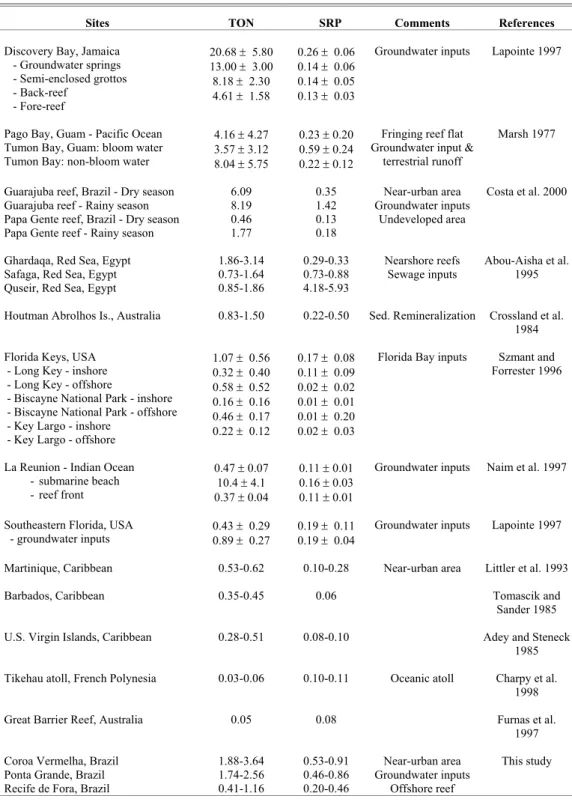
TON concentrations in Coroa Vermelha and Ponta Grande are similar to those at the nearshore fringing reefs of Ghardaqa, in the Red Sea (Table 2), an arid zone with no river inflow and whose major nutrient sources are sewage outfalls. Higher TON concentrations are found only in heavy-impacted fringing reefs of the Caribbean (Jamaica), the Pacific Ocean (Guam) or in the north coast of Brazil (Guarajuba Reef), where groundwater discharge, untreated sewage from urban areas, and terrestrial run-off are causing nutrient enrichment of the coastal reefs (Table 2). Nevertheless, TON concentrations in Coroa Vermelha and Ponta Grande are considerably higher than most near-pristine Caribbean reefs. Even the Recife de Fora, whose TON concentrations varied between 0.41 and 1.16 µmol L-1, presented values above those coral reef locations. In general, values of TON above 1 µmol L-1 are found only in waters enriched by sewage effluents (SMITH et al., 1981), groundwater springs (LAPOINTE, 1997), reef lagoons with high rates of remineralization (CROSSLAND et al., 1984) or areas close to marinas and canals (SZMANT; FORRESTER, 1996).
Most offshore reefs in the literature present considerably lower TON concentrations. The Great Barrier Reef in Australia (TON: 0.05 µmol L-1) and the atolls of the Indian Ocean (TON: 0.03-0.06 µmol L-1), receive nutrient supply mainly from sediment resuspension and from water column/benthic microbial regeneration (80-90% of total nutrient demand), according to Furnas et al. (1997). Upwelling is also a major nutrient contributor to offshore reef areas (SZMANT; FORRESTER, 1996) with only 10% of the total nutrient demand to come from external sources. The offshore reef in this study, however, presented nutrient levels that are similar to nearshore reefs in Florida (Table 2), which receive inputs from Florida Bay (SZMANT; FORRESTER, 1996) or submarine groundwater discharge (LAPOINTE, 1997).
If the comparison is based on SRP concentrations, the studied reefs present the highest values of nearly all sites depicted in Table 2, the only exception being the nearshore reefs of Safaga and Quseir, in the Red Sea (ABOU-AISHA et al., 1995), which receive large phosphorus loading from phosphate factories near the coast. Results from a 20-year study in Florida have shown that phosphorus is a key factor controlling the growth of reef building corals (HBOI, 2006). The high level of phosphorus in the study area also contributed to the extremely low TON:SRP ratios observed. Such low TON:SRP ratio in both nearshore and offshore reefs either suggests that there is a strong source of P to the area or that N is rapidly metabolized (as described in Szmant; Forrester, 1996). Both possibilities seem likely, although the data does not provide evidence of the latter. Either way, such TON:SRP ratios also reflect the importance of SGD as a significant pathway for nutrients and other dissolved solutes into Porto Seguro Bay, especially to the nearshore reefs where wastewater disposal practices are likely to be adding large amounts of nitrogen and phosphorus to the subsurface each year.
BRAZILIAN JOURNAL OF OCEANOGRAPHY, 55(4):265-279, 2007
Table 2. Typical N and P concentrations (in µmol L-1) for coral reefs around the world.
Sites TON SRP Comments References
Discovery Bay, Jamaica - Groundwater springs - Semi-enclosed grottos - Back-reef
- Fore-reef
20.68 ± 5.80 13.00 ± 3.00 8.18 ± 2.30 4.61 ± 1.58
0.26 ± 0.06 0.14 ± 0.06 0.14 ± 0.05 0.13 ± 0.03
Groundwater inputs Lapointe 1997
Pago Bay, Guam - Pacific Ocean Tumon Bay, Guam: bloom water Tumon Bay: non-bloom water
4.16 ± 4.27 3.57 ± 3.12 8.04 ± 5.75
0.23 ± 0.20 0.59 ± 0.24 0.22 ± 0.12
Fringing reef flat Groundwater input &
terrestrial runoff
Marsh 1977
Guarajuba reef, Brazil - Dry season Guarajuba reef - Rainy season Papa Gente reef, Brazil - Dry season Papa Gente reef - Rainy season
6.09 8.19 0.46 1.77
0.35 1.42 0.13 0.18
Near-urban area Groundwater inputs
Undeveloped area
Costa et al. 2000
Ghardaqa, Red Sea, Egypt Safaga, Red Sea, Egypt Quseir, Red Sea, Egypt
1.86-3.14 0.73-1.64 0.85-1.86
0.29-0.33 0.73-0.88 4.18-5.93
Nearshore reefs Sewage inputs
Abou-Aisha et al. 1995
Houtman Abrolhos Is., Australia 0.83-1.50 0.22-0.50 Sed. Remineralization Crossland et al. 1984
Florida Keys, USA - Long Key - inshore - Long Key - offshore
- Biscayne National Park - inshore - Biscayne National Park - offshore - Key Largo - inshore
- Key Largo - offshore
1.07 ± 0.56 0.32 ± 0.40 0.58 ± 0.52 0.16 ± 0.16 0.46 ± 0.17 0.22 ± 0.12
0.17 ± 0.08 0.11 ± 0.09 0.02 ± 0.02 0.01 ± 0.01 0.01 ± 0.20 0.02 ± 0.03
Florida Bay inputs Szmant and Forrester 1996
La Reunion - Indian Ocean - submarine beach - reef front
0.47 ± 0.07 10.4 ± 4.1 0.37 ± 0.04
0.11 ± 0.01 0.16 ± 0.03 0.11 ± 0.01
Groundwater inputs Naim et al. 1997
Southeastern Florida, USA - groundwater inputs
0.43 ± 0.29
0.89 ± 0.27 0.19 ± 0.11 0.19 ± 0.04
Groundwater inputs Lapointe 1997
Martinique, Caribbean 0.53-0.62 0.10-0.28 Near-urban area Littler et al. 1993
Barbados, Caribbean 0.35-0.45 0.06 Tomascik and
Sander 1985 U.S. Virgin Islands, Caribbean 0.28-0.51 0.08-0.10 Adey and Steneck
1985
Tikehau atoll, French Polynesia 0.03-0.06 0.10-0.11 Oceanic atoll Charpy et al. 1998
Great Barrier Reef, Australia 0.05 0.08 Furnas et al.
1997 Coroa Vermelha, Brazil
Ponta Grande, Brazil Recife de Fora, Brazil
1.88-3.64 1.74-2.56 0.41-1.16
0.53-0.91 0.46-0.86 0.20-0.46
Near-urban area Groundwater inputs
Offshore reef
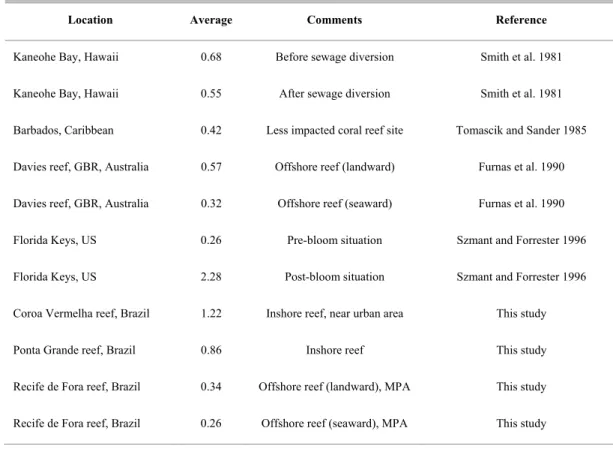
Table 3. A comparison of chlorophyll a concentrations (µg L-1) taken from the literature and from this study.
Location Average Comments Reference
Kaneohe Bay, Hawaii 0.68 Before sewage diversion Smith et al. 1981
Kaneohe Bay, Hawaii 0.55 After sewage diversion Smith et al. 1981
Barbados, Caribbean 0.42 Less impacted coral reef site Tomascik and Sander 1985
Davies reef, GBR, Australia 0.57 Offshore reef (landward) Furnas et al. 1990
Davies reef, GBR, Australia 0.32 Offshore reef (seaward) Furnas et al. 1990
Florida Keys, US 0.26 Pre-bloom situation Szmant and Forrester 1996
Florida Keys, US 2.28 Post-bloom situation Szmant and Forrester 1996
Coroa Vermelha reef, Brazil 1.22 Inshore reef, near urban area This study
Ponta Grande reef, Brazil 0.86 Inshore reef This study
Recife de Fora reef, Brazil 0.34 Offshore reef (landward), MPA This study
Recife de Fora reef, Brazil 0.26 Offshore reef (seaward), MPA This study
C
ONCLUSIONSThe results of both water column and porewater nutrient measurements revealed the occurrence of consistent spatial and temporal patterns. Nutrient concentrations decrease with increasing distance from the shore, reflecting terrestrial and nearshore sources of nutrients. Nutrient concentrations at the offshore reef were about threefold lower (for TON and DSi) and twofold lower (for SRP) than nearshore reefs. In general, these differences between nearshore and offshore reefs were higher during the dry season, when land-based nutrient fluxes (groundwater seepage and surface run-off) were more localized at the nearshore reefs. This pattern is consistent with observations in the field where, during the rainy season, large quantities of litter were found floating around the offshore reef (e.g. plastic bags and flasks, bottles, cans, pieces of furniture wood, etc), just after the low tide, even though the reef is located 8 km away from the coast. Such litter was not observed at the offshore reef during the dry season. In addition, there is a consistent difference within the nearshore
reefs, with Coroa Vermelha showing the most elevated nutrient concentrations, due mainly to anthropogenic sources such as untreated sewage and wastewater contributions from the nearby urban area (no sewage treatment is available and the use of cesspits and septic tanks is widespread). Lower levels of nutrients in Ponta Grande reflect, in general, the lack of a continuous, permanent source, in addition to biological and chemical removal processes.
of N for waters around the nearshore reefs, particularly in urbanized areas where wastewater disposal is adding contaminants to the subsurface environment.
A
CKNOWLEDGEMENTSThis contribution results from my PhD thesis which had the financial support from CNPq (Brazilian Scientific Research Council) and the University of Plymouth, U.K. I gratefully acknowledge the support, discussions and comments from my supervisors, Drs. Martin Attrill (School of Biological Sciences, University of Plymouth), Malcolm Nimmo (School of Earth, Ocean & Environmental Sciences, University of Plymouth), and Axel Miller (Dunstaffnage Marine Laboratory, Scotland). I also acknowledge the help with field sampling provided by park rangers Leo and Valter, and the logistical support from Paolo Botticelli, of Pousada Bahia Tropical, and Milene and Luciano, of the Environment Secretary of Porto Seguro City.
R
EFERENCESABOU-AISHA, K. M.; KOBBIA, I. A.; EL ABYAD, M. S.; SHABANA, E. F.; SCHANZ, F. Impact of phosphorus loadings on macro-algal communities in the Red Sea coast of Egypt. Wat. Air Soil Poll., v. 83, p. 285-297, 1995.
ADEY, W. H.; STENECK, R. S. Highly productive eastern Caribbean reefs: synergistic effects of biological, chemical, physical, and geological factors. In: REAKA, M. L. (Ed.). The ecologyof coral reefs. Symposium Series of Undersea Research. NOAA Undersea Research Program, Rockville, Maryland, 1985. v. 3, p. 163-187. AGUIAR, V. M.; BRAGA, E. S. Seasonal and tidal
variability of phosphorus along a salinity gradient in the heavily polluted estuarine system of Santos/São Vicente - São Paulo, Brazil. Mar. Poll. Bull., v. 54, p. 464-488, 2007.
ARAR, E. J. In vitro determination of chlorophylls a, b, c1 + c2 and pheopigments in marine and freshwater algae by visible spectrophotometry. USEPA Method 446-0. Cincinnati, Ohio: U.S. Environmental Protection Agency, 1997.
BELL, P. R. F. Eutrophication and coral reefs: some examples in the Great Barrier Reef lagoon. Wat. Res., v. 26, p. 553-568, 1992.
BENDER, M.; MARTIN, W.; HESS, J.; SAYLES, F.; BALL, L.; LAMBERT, C. A whole-core squeezer for interfacial pore-water sampling. Limnol. Oceanogr., v. 32, p.1214-1225, 1987.
BENSON, R. L.; TRUONG, Y. B.; MCKELVIE, I. D.; HART, B. T. Monitoring of dissolved reactive phosphorus in wastewater by flow injection analysis. Part 1. Method development and validation. Wat. Res., v. 30, p. 1959-1964, 1996.
BREWER, P. G.; RILEY, J. P. The automatic determination of nitrate in seawater. Deep-Sea Res., v. 12, p. 765-772, 1965.
BREWER, P. G.; RILEY, J. P. The automatic determination of silicate-silicon in natural waters with special reference to seawaters. Anal. Chim. Acta, v. 35, p. 514-519, 1966. CARBONEL, C.A.A.; VALENTIN, J.L. Numerical
modelling of phytoplankton bloom in the upwelling ecosystem of Cabo Frio (Brazil). Ecol. Modell., v. 116, p. 135-148, 1999.
CHARETTE, M.A.; SPLIVALLO, R.; HERBOLD, C.; BOLLINGER, M.S.; MOORE, W.S. Salt marsh submarine groundwater discharge as traced by radium isotopes. Mar. Chem., v. 84, p. 113-121, 2003. CHARPY, L.; CHARPY-ROUBAUD, C.; BUAT, P. Excess
primary production, calcification and nutrient fluxes of a patch reef (Tikehau atoll, French Polynesia). Mar. Ecol.- Prog. Ser., v. 173, p. 139-147, 1998.
CONTADOR, L.; PARANHOS, R. Water quality trends in Urca inlet (Guanabara bay, Brazil) from 1986 to 1992. Arq. Biol. Tecnol., v. 39, p. 735-744, 1996.
CORBETT, D. R.; CHANTON, J.; BURNETT, W.; DILLON, K.; RUTKOWSKI, C.; FOURQUREAN, J.W. 1999. Patterns of groundwater discharge into Florida Bay. Limnol. Oceanogr., v. 44, p. 1045-1055, 1999. COSTA, O. S., JR. Nutrification and its effects on coral
reefs from Southern Bahia, Brazil. PhD Thesis, University of Plymouth, Plymouth, U.K., March 2002. 297 p.
COSTA, O. S. JR.; ATTRILL, M.; PEDRINI, A. G.; DE-PAULA, J. C. Spatial and seasonal distribution of seaweeds on coral reefs from Southern Bahia, Brazil. Bot. Mar., v. 45, p. 346-355, 2002.
COSTA, O. S. JR.; LEÃO, Z.M.A.N.; NIMMO, M.; ATTRILL, M. Nutrification impacts on coral reefs from northern Bahia, Brazil. Hydrobiologia, v. 440, p. 307-315, 2000.
CROSSLAND, C. J.; HATCHER, B. G.; ATKINSON, M. J.; SMITH, S. V. Dissolved nutrients of a high-latitude coral reef, Houtman Abrolhos Islands, Western Australia. Mar. Ecol.- Prog. Ser., v. 14, p. 159-163, 1984. CUET, P.; NAIM, O.; FAURE, G.; CONAN, J. Y.
Nutrient-rich groundwater impact on benthic communities of La Saline fringing reef (Reunion Island, Indian Ocean): Preliminary results In: INTERNATIONAL CORAL REEF SYMPOSIUM, 6. James Cook University, Townsville, Australia. Proceedings, v. 2, p. 207-212, 1988.
DITTMAR, T.; LARA, R. J. Do mangroves rather than rivers provide nutrients to coastal environments south of the Amazon River? Evidence from long-term flux measurements. Mar. Ecol.- Prog. Ser., v. 213, p. 67-77, 2001.
FOLK, R. L.; WARD, W. C. Brazos River bar: a study in the significance of grain size parameters. J. Sediment. Petrol., v. 27, p. 3-26, 1957.
FURNAS, M. J.; MITCHELL, A. W.; GILMARTIN, M.; REVELANTE, N. Phytoplankton biomass and primary production in semi-enclosed reef lagoons of the central Great Barrier Reef, Australia. Coral Reefs , v. 9, p. 1-10, 1990.
FURNAS, M. J.; MITCHELL, A. W.; SKUZA, M. Shelf-scale nitrogen and phosphorus budget for the central Great Barrier Reef (16-19ºS). In: INTERNATIONAL CORAL REEF SYMPOSIUM, 8. Smithsonian Tropical Research Institute, Balboa, Panama. Proceedings, v. 1, p. 809-814, 1997.
GARDOLINSKI, P. C. F. C.; HANRAHAN, G.; ACHTERBERG, E. P.; GLEDHILL, M.; TAPPIN, A. T.; HOUSE, W. A.; WORSFOLD, P. J. Comparison of sample storage protocols for the determination of nutrients in natural waters. Wat. Res., v. 35, p. 3670-3678, 2001.
H.B.O.I – Harbour Branch Ocenographic Institution. Nutrients may be the root cause of coral decline. Mar. Poll. Bull., v.52, p. 361-361, 2006.
HANSHAW, B. B.; BACK, W. Chemical mass-wasting on the north Yucatan Peninsula by groundwater dissolution. Geology , v. 8, p. 222-224, 1980.
HEIRI, O.; LOTTER, A. F.; LEMCKE, G. Loss on ignition as a method for estimating organic and carbonate content in sediments: Reproducibility and comparability of results. J. Paleolim., v. 25, p. 101–110, 2001. HEMOND, H. F.; FIFIELD, J. L. Subsurface flow in a salt
marsh peat: a model and field study. Limnol. Oceanogr., v. 27, p. 126–136, 1982.
HOYER, M. V.; FRAZER, T. K.; NOTESTEIN, S. K.; CANFIELD, D.E. Nutrient, chlorophyll, and water clarity relationships in Florida’s nearshore coastal waters with comparisons to freshwater lakes. Can. J. Fish. Aquat. Sci., v. 59, p. 1024–1031, 2002.
JAHNKE, R.; RICHARDS, M.; NELSON, J.; ROBERTSON, C.; RAO, A.; JAHNKE, D. Organic matter remineralization and porewater exchange rates in permeable South Atlantic Bight continental shelf sediments. Cont. Shelf Res., v. 25, p. 1433–1452, 2005. KAY, A. E.; LAU, L. S.; STROUP, E. D.; DOLLAR, S. J.; FELLOWS, D. P.; YOUNG, R.W.F. Hydrological and ecological inventories of the coastal waters of West Hawaii. Water Resources Research Center, Techn. Rept. #105, University of Hawaii, Honolulu, Hawaii.1977. KELLY, J. Nitrogen effects on coastal marine ecosystems.
In: FOLETT, R.F.; J.L. HATFIELD (Eds.), Nitrogen in the environment: Sources, problems, and management. London: Elsevier, 2001. p. 207-253.
KJERFVE, B.; RIBEIRO, C. H. A.; DIAS, G. T. M.; FILIPPO, A. M.; QUARESMA, V. D. Oceanographic characteristics of an impacted coastal bay: Baia de Guanabara, Rio de Janeiro, Brazil. Cont. Shelf Res., v. 17, p. 1609-1617, 1997.
KLUMP, J. V.; MARTENS, C. S. Benthic nitrogen regeneration. In: CARPENTER, E.J.; CAPONE, D.G. (Eds.). Nitrogen in the marine environment. New York: Academic Press, 1983. p. 411-457.
KNOPPERS, B.; MEYERHOFER, M.; MARONE, E.; DUTZ, J.; LOPES, R.; LEIPE, T.; DE CAMARGO, R. Compartments of the pelagic system and material exchange at the Abrolhos Bank coral reefs, Brazil. Arch. Fish. Mar. Res., v. 47, p. 285-306, 1999.
KOENING, M.L.; DE MACEDO, S.J. Hydrology and phytoplankton community structure at Itamaraca, Pernambuco (Northeast Brazil). Braz. Arch. Biol. Technol., v. 42, p. 381-392, 1999.
KROEGER, K. D.; SWARZENSKI, P. W.; GREENWOOD, W. J.; REICH, C. Submarine groundwater discharge to Tampa Bay: Nutrient fluxes and biogeochemistry of the coastal aquifer. Mar. Chem., v. 104, p. 85-97, 2007. LAPOINTE, B .E.; O’CONNELL, J. D.; GARRETT, G. S.
Nutrient couplings between On-Site sewage disposal systems, groundwaters, and nearshore surface waters of
the Florida Keys. Biogeochemistry, v. 10, p. 289-307, 1990.
LAPOINTE, B.E. Nutrient thresholds for bottom-up control of macroalgal blooms on coral reefs in Jamaica and southeast Florida. Limnol. Oceanogr., v. 42, p. 1119-1131, 1997.
LARSON, R.; MORANG, A.; GORMAN, L. Monitoring the coastal environment: Part II. Sediment sampling and geotechnical methods. J. Coast. Res., v. 13, p. 308–330, 1997.
LEÃO, Z.M.A.N. The coral reefs of Bahia: morphology, distribution and the major environmental impacts. An. Acad. Bras. Ci., v. 68, p. 439-452, 1996.
LITTLER, M. M.; LITTLER, D. S.; LAPOINTE, B. E. Modification of tropical reef community structure due to cultural eutrophication: the southwest coast of Martinique. In: INTERNATIONAL CORAL REEF SYMPOSIUM, 7. University of Guam Press, UOG Station, Guam. Proceedings, v. 1, p. 335-343, 1993. MARSH JR., J. A. Terrestrial inputs of nitrogen and
phosphorus on fringing reefs of Guam. In: TAYLOR, D.L. (Ed.). INTERNATIONAL CORAL REEF SYMPOSIUM, 3. RSMAS, University of Miami, Florida, U.S.A.. Proceedings. v. 1, p. 331-336. 1977. MONTAGGIONI, L. F.; CUET, P.; NAIM, O. Effect of
nutrient excess on a modern fringing reef (Reunion Islands, Western Indian Ocean): Geological implications. In: COLLOQUIUM ON GLOBAL ASPECTS OF CORAL REEFS: Health, Hazards and History. RSMAS, University of Miami, Florida, U.S.A. Proceedings, p. 397-403, 1993.
NAIM, O.; CUET, P.; LETORNEUR, Y. Experimental shift in benthic community structure. In: INTERNATIONAL CORAL REEF SYMPOSIUM, 8. Smithsonian Tropical Research Institute, Balboa, Panama. Proceedings, v. 2, p. 1873-1878, 1997.
NIELSEN, S. L.; SAND-JENSEN, K.; BORUM, J.; GEERTZ-HANSEN, O. Phytoplankton, nutrients, and transparency in Danish coastal waters. Estuaries, v. 25, p.:930–937, 2002.
OLIVEIRA, J.; BURNETT, W. C.; MAZZILLI, B. P.; BRAGA, E. S.; FARIAS, L. A.; CHRISTOFF, J.; FURTADO, V. V. Reconnaissance of submarine groundwater discharge at Ubatuba coast, Brazil, using Rn-222 as a natural tracer. J. environ. Radioactivity , v. 69, p. 37-52, 2003.
OLIVEIRA, J.; COSTA, P.; BRAGA, E. S. Seasonal variations of Rn-222 and SGD fluxes to Ubatuba embayments, São Paulo. J. Radioanalytical Nuc. Chem., v. 269, p. 689-695, 2006.
RUTKOWSKI, C. M.; BURNETT, W. C.; IVERSON, R. L.; CHANTON, J. P. The effect of groundwater seepage on nutrient delivery and seagrass distribution in the North-eastern Gulf of Mexico. Estuaries, v. 22, p. 1033-1040, 1999.
SCHLUTER, M.; SAUTER, E. J.; ANDERSEN, C. E.; DAHLGAARD, H.; DANDO, P. R. Spatial distribution and budget for submarine groundwater discharge in Eckernforde Bay (Western Baltic Sea). Limnol. Oceanogr., v. 49, p. 157-167, 2004.
SMITH, S. V.; KIMMERER, W. J.; LAWS, E. A.; BROCK, R. E.; WALSH, T. E. Kaneohe bay sewage diversion experiment: perspectives on ecosystem responses to nutritional perturbation. Pac. Sci., v. 35, p. 279-395, 1981.
SMITH, V. H. Responses of estuarine and coastal marine phytoplankton to nitrogen and phosphorus enrichment. Limnol. Oceanogr., v. 51, p. 377-384, 2006.
STIEGLITZ, T. Submarine groundwater discharge into the near-shore zone of the Great Barrier Reef, Australia. Mar. Poll. Bull., v. 51, p. 51-59, 2005.
SWARZENSKI, P. W.; REICH, C.; KROEGER, K. D.; BASKARAN, M. Ra and Rn isotopes as natural tracers of submarine groundwater discharge in Tampa Bay, Florida. Mar. Chem., v. 104, p. 69-84, 2007.
SZMANT, A. M.; FORRESTER, A. Water column and sediment nitrogen and phosphorus distribution patterns in the Florida Keys, USA. Coral Reefs, v. 15, p. 21-41, 1996.
TOMASCIK, T.; SANDER, F. Effects of eutrophication on reef-building corals. I. Growth rate of the reef-building coral Montastrea annularis. Mar. Biol., v. 87, p. 143-155, 1985.
VALIELA, I.; TEAL, J.M.; VOLKMANN, S.; SHAFER, D.; CARPENTER, E.J. Nutrient and particulate fluxes in a salt marsh ecosystem: tidal exchanges and inputs by precipitation and groundwater. Limnol. Oceanogr., v. 23, p. 798-812, 1978.
WINDOM, H.; NIENCHESKI, F. Biogeochemical processes in a freshwater-seawater mixing zone in permeable sediments along the coast of Southern Brazil. Mar. Chem., v. 83, p. 121-130, 2003.
ZEKTSER, I. S. Principles of regional assessment and mapping of natural groundwater resources. Environ. Geol., v. 42, p. 270-274, 2002.
ZEKTSER, I. S.; LOAICIGA, H. A. Groundwater fluxes in the global hydrologic cycle – past, present and future. J. Hydrol., v. 144, p. 405-427, 1993.
(Manuscript received 06 July 2006; revised 14 July 2007; accepted 30 September 2007)