What is “public” in public journalism?
Laura Ahva
University of Tampere, Finland E-mail: [email protected]
T
HE PUBLIC SPHEREis an important frame of reference for understandingthe role of journalism in society. Public sphere is a system of communi-cation between the state and civil society (Habermas 1998; 2006) and there-fore it is the ultimate context in which journalism operates. Journalism is one of the many institutions or agents that function in the public sphere. Journal-ism’s public position, however, is quite central because it creates, maintains and shapes the public sphere, so that civil society and institutions of the state can interact and democracy function in an open manner. This significant pub-lic position of journalism brings along responsibilities: Habermas argues that journalism should be self-regulating and there should be a proper feedback loop between journalism and citizens (Habermas 2006, 420–423). Habermas thus challenges journalism to be more accessible, transparent and connective in relation to the public sphere.
In this article, the notion of the public sphere is taken as a starting point in discussing the role of journalism in society from a specific angle, namely that of public journalism (Rosen 1999; Glasser 1999). Public journalism (or civic journalism) is an American-based journalistic reform movement and an idea which aims at connecting the media more closely with its readers, and readers with public life (Haas 2007). It is a normative idea that aspires – very much in line with Habermas’s claims – for a more diverse, deliberative, active and connective journalism (Ahva 2010, 48–54). In this article, it is suggested that public journalism can benefit from deepening its understanding of the public sphere, because the conceptualization of “the public” in public journalism literature has not been consistent. The aim of this article is to offer an elaborated public sphere theory for public journalism.
This aim has been chosen because of various reasons. Firstly, public jour-nalism has previously been mostly defined by its practice and not by theoreti-cal formulations. This is due to the fact that public journalism was concretely invented through a series of practical experiments (e.g. Friedland 2003). For
example Glasser and Lee (2002, 206) argue that public journalism’s propo-sitions have been organized around general themes: it has not been part of a logically developed, historically formed, and internally coherent theory or philosophy of journalism.
Secondly, a deepened understanding of the public sphere is needed be-cause existing theorizations about public journalism have been framed by conventional journalism and its professional norms. Public journalism has been foremost defined by perceived flaws in conventional journalism (Haas 2007, 46). Therefore “journalism” in the concept of public journalism has been more defining than the aspect of “public”. Pubic journalism literature has been shaped by the wave of professional criticism that has centred on the journalistic norms of autonomy, democracy and objectivity (Ahva 2010, 89–94). Naturally, public journalism as a reform movement is tied to the al-ready existing norms; it has sprung from the perceived shortcomings in those standards. But in theoretical sense, it would be beneficial to take a step away from the professional-centred way of conceiving public journalism.
Thirdly, this article is inspired by the “public philosophy” by Tanni Haas, the latest attempt to actually address the public nature of public journalism with theoretical analysis. Haas (2007, Chapter 2) suggests that public journal-ism should aim at brining about an open, deliberating public sphere in which journalists share their authority with citizens in setting the public agenda. Moreover, journalists should help nurture a public sphere composed of mul-tiple discursive domains and that broadly based problem solving should be taken as a key aim in public journalism. Haas has taken Habermas’s (1989) notion of “the deliberating public” and Frasers’ (1992) criticism thereof as starting points of his theoretical discussion.
However, in this article, I wish to broaden Haas’s theoretical scope and discuss the ways in which the public sphere has been theorized by Habermas particularly in his later writings (Habermas 1998; Habermas 2006) in which he explicitly addresses the role of journalism in the public sphere. Addition-ally, I will discuss the work of other relevant public sphere scholars in order to be able to address the open questions of public journalism theory more broadly. I will thus continue Haas’s work by concentrating on the founda-tional and theoretically based principles that would clearly explicate what the “publicness” of public journalism is. The main question of this article thus is: What does the public sphere stand for or could stand for in public journalism?
I will offer a theoretical analysis of five open questions regarding the pub-lic sphere to which pubpub-lic journalism needs to relate itself more clearly. I will discuss (1) the structure of the public sphere; (2) the role of citizens in the public sphere; (3) the idea and aim of deliberation; (4) the function of the public sphere as a site for public opinion formation; and (5) the relationship between the public sphere and democratic frameworks.1
Structure of the public sphere: Single sphere or
multi-ple publics?
The first question deals with how to consider the structure of the public sphere: as a single sphere or as multiple public spheres? Public journalism does not usually clearly advocate for either of the conceptions even if there are some authors (e.g. Haas & Steiner 2001, Haas 2007) who argue for un-derstanding the public sphere in terms of counter-publics.
In Structural Transformation Habermas suggests that the public sphere as a concept can be regarded in singular, since smaller publics are always aware of being part of the larger public sphere (Habermas 1989, 37). But he also points to the idea that the public sphere is not unitary by identifying the literary public sphere as well as the political public sphere (Habermas 1989, Chapter 7). In any case, Habermas has been largely interpreted as theorist who argues for a single and unitary public sphere – and a significant debate has resulted. Habermas has been criticized for seeing the public sphere as something unified, singular and therefore exclusive (e.g. Fraser 1992, also Mouffe in Carpentier & Cammaerts 2006). Even if this debate was based on a misreading of early Habermas, this discussion is important to take into account, since it may help us to understand the various aspects from which the public sphere is viewed at.
The debate is further affected by translation: the original German cept of Öffentlichkeit does not suggest as strong a spatial and singular con-notation as the English translation of the “public sphere”. Splichal (2006, 507) notes that translating Öffentlichkeit “the public sphere” surpassed the traditional conceptualizations of “the public” (or the French “le public”) and
1. This article is based on my PhD research. For an extended version of this theoretical discussion as well as empirical study on public journalism in Finland, see Ahva 2010.
thus also the work of theorists such as Jeremy Bentham, Gabriel Tarde, Wal-ter Lippmann and John Dewey who had conceptualized “the public” before Habermas. To make things more complicated, Habermas and his critics are not consistent in their use of the terms “the public sphere” and “the public”.
However, in his later work Habermas is more explicit. According to him, the public sphere is conceptually fruitful term, but he express explicitly that in practice the public sphere is differentiated into several publics. In Between Facts and Norms, Habermas writes that the public sphere has become differ-entiated into several publics, either according to issues or themes, or accord-ing to the way in which publics are organized (Habermas 1998, 373–374). In his 2006 article, he furthermore explicitly points out that the public sphere is composed of different layers and issue-based publics (Habermas 2006, 25).
Friedland et al (2006, 6; 23–24) have reworked Habermas’s theory. They introduce an idea that the public sphere is assuming an increasingly networked structure. Like Habermas, the authors underline the coexistence of the strong, political public sphere and the weaker, informal public sphere that are inter-connected via networks. The informal public sphere is an important sphere for communicative action because it draws from the everyday life and can be related to the larger structures of public discourse through the networked structures and networked communication.
Fraser (1992), one of the most prominent of Habermas’s critics, has un-derlined the need to recognize the existence of several publics. Fraser argues that Habermas’s whole narrative is informed by an underlying assumption that confinement to a single public sphere is a positive and desirable state of affairs (Fraser 1992, 116; 122). Therefore subordinate groups may become absorbed into a false “we” that merely reflects the more powerful and ex-cludes the plurality provided by minorities (Fraser 1992, 123). Marx Ferree et al (2002, 309) point out that according to constructivist critics such as Fraser, the dialogue in the unitary public sphere is not as desirable as the dialogue in autonomous and separate cultural domains or “free spaces” in which individu-als may speak together supportively and develop their identities free from the conformity pressures of the mainstream.
Indeed, the whole debate points to the question of whether we should talk about “publicness” instead of “the public sphere”, since the latter term seems to lead us to disputes that might even hinder further theorizing. Taylor (2004, 83) argues that the public sphere should be seen as one of the “social
imag-inaries” of modern society. He means that the public sphere is a collective construct, an imagination that has become so evident for us that it is hard to conceive a society without it (Taylor 2004, 99). So, despite the spatial and singular metaphor of the public sphere, it remains a fruitful concept if we consider it as a mode of collective understanding about our social existence; an imaginary that is carried in everyday practices, not merely in social theory (Taylor 2004, 23-24; Heikkilä & Kunelius 2006, 66-67). If we conceptual-ize the public sphere as a social imaginary, it also enables us to realconceptual-ize that we simply cannot escape the concept of the public sphere, in singular. The concept allows us firstly to conceive publicness and secondly to consider it as being constituted of smaller “actualized” publics.
Splichal (2006) maintains that we need to see the idea of “public/ness” as the basis and the principle on which the concept of the public sphere is founded. In addition, Heikkilä and Kunelius (2006, 65) point out that the “lan-guage of space” that the term public sphere connotes often directs our imagi-nation by suggesting that questions regarding the public sphere are connected to the question of where. They suggest that one way out of this dilemma is to see the public sphere as action, much like pragmatist philosophers such as Dewey, whose theorizations have indeed acted as an initial theoretical spark for the early public journalism scholars (e.g. Rosen 1999). Dewey sees that the public (sphere) is always a social formation defined by interaction between people (Kunelius 2004, 99). It is also useful to remember Habermas’s notion that the public sphere is formed and reproduced through communication; it is a communication structure and not an institution (Habermas 1998, 360). Understanding the public sphere as communication allows us to see that the diversity of communication in society may lead to diversity of publics.
Therefore, I suggest that for public journalism the best way to understand the structure of the public sphere is to consider publicness as the defining prin-ciple and consider the public sphere as being comprised of multiple publics that may emerge, dissolve or linger and that are interconnected via networks. Thus, in public journalism theory, we need a conception of an overarching public sphere in order to have a relevant discussion about the possibilities and limitations of public journalism to bring forth diversity of citizen opinions from sub-publics into the public sphere, and ultimately have an impact on the policy making processes. However, we also need to recognize the plurality
of publics within the public sphere in order to be able to evaluate how well public journalism succeeds in connecting the sub-publics with each other.
Citizens’ role in the public sphere: Agents or
represen-tatives?
Public journalism takes citizens into the journalistic focus by reporting about citizens’ issues and taking them along into the news making process. But should citizens be seen as representatives of the citizenry or as active agents? This question has been somewhat unclear in public journalism lit-erature, since some of the practices, such as citizen surveys, have relied on representative citizen conception and others, such as deliberative discussions on active agent conception. The representative framework implies that the ultimate authority in society rests with the citizenry, but that their public ac-tivity is not central for the function of the public sphere and therefore they are seen in a more abstract frame (Marx Ferree et al 2002, 290-291). The agency framework, in turn, suggests that citizens are the most important communica-tors in the public sphere.
Habermas’s view on citizens as active agents is linked to his idea that it is the citizens who produce the public sphere with their communication. The role of citizens as active agents is thus fundamental because without citizens there would be no public sphere to begin with: communicative freedom allows citizens to take part in deliberation (Habermas 1998, 364). However, Haber-mas consistently views that even if civic activity takes place in the public sphere, the decision making ultimately takes place in the parliamentary or-gans (see Habermas 1994). One can say that Habermas’s view of civic agency has a dual orientation (Habermas 1994, 6–7): on the one hand, civic activ-ity is required in order to construct the public sphere, and on the other hand, civic activity in the form of deliberation is needed in order to produce public opinion and thus affect the political system with that opinion.
In his 2006 article, Habermas briefly touches a third point, namely that of civic agency as a process of learning or empowerment: civic agency can also strengthen citizens’ identities and their capabilities to act (Habermas 2006, 414). Thus, he moves closer to Fraser (1992, 125) who points out that the public spheres are not just arenas for the formation of public opinion; they are
also arenas for the formation and enactment of social identities. However, for Habermas, civic activity without democratic representation is not effective. For him the public is recruited from the entire citizenry. It is the idea of be-longing to a larger representative group that acts as a guarantee of the public sphere’s ability to work properly: to signal the state about current problems of civil society at large. Even so, Habermas cannot be entirely situated among advocates of representative liberal democratic theory, such as Walter Lipp-mann (1965 [1922]; 1925), who consider that the public sphere should rather include citizens through their representatives than through participation (Marx Ferree et al 2002, 291-292).
The agency aspect of public sphere theory is prominently explicated for example by John Dewey and Hannah Arendt: they consider the relationship of civic agency and the public sphere to be central. For them, communication and interaction ultimately define the possibility for social and political life. For example, according to Dewey (cited in Kunelius 2004, 103), it is only through interaction with others that the individual becomes a conscious agent. Arendt’s theory of publicness relies on the fact that people “can experience meaningfulness only because they can talk with and make sense to each other and to themselves” (Arendt 1958, 4). For Arendt, being truly public means to be able to act and start something new, to be able to use one’s public freedom. For her, civic action
has a rather precise and demanding meaning; action always causes ex-ceptions to the routine behaviour people so easily conform to (Rosen 1991, 274-275).
The idea of active citizen engagement in the public sphere is sometimes criticized by empirical findings that indicate citizens’ disinterest and increas-ing passiveness in political and public life. However, accordincreas-ing to Hermes (2006), for example, the cultural studies perspective suggests that we should widen the concept of the public sphere in order to recognize the importance of popular culture as a platform of the lifeworld – as it is the lifeworld to which the public sphere is rooted in. Therefore, we do not have to consider citizens’ passiveness in the “serious” platforms of the public sphere so alarming: cit-izenship is also nurtured in the broader domain of media culture, especially now that the media landscape is changing so rapidly (Hermes 2006; Living-stone 2005). Thus, the everyday talk (and other forms of “weak” deliberation) that takes place for instance in the context of popular culture could indeed be
seen as a basis of public discourse that has relevance for the political public sphere.
An in-between position between the two viewpoints represented here can be exemplified by Michael Schudosn’s (1998) term “monitorial citizenship”. He suggests that citizens engage in environmental surveillance rather than ac-tive information gathering and enactment. The state of citizenship may be seemingly inactive, but since citizens constantly monitor and scan their in-formational environment they have the potential to become alerted to action when faced with public issues that are meaningful for them. Citizens may form floating or temporary coalitions to deal with the issues, and then after a while the coalitions may dissolve. (See Shudson 1998, 294–314; Merrit & McCombs 2004, 30–32.)
How should public journalism theory relate to this debate? Public journal-ism cannot bypass the role of citizens as representatives of a larger population and the framework of the representative democratic system in which it oper-ates. Moreover, representation lends citizens’ views legitimacy and authority in the public sphere (Blumer 1948). But at the same time public journalism theory is deeply rooted in the framework of citizen activity here represented by theorists such as Dewey and Arendt. Citizens’ interaction and capability for creating something new with their action form the basis of public journalism’s underlying experimental-normative assumptions: public journalism ought to take part in maintaining the public sphere by recognizing the potential activity that citizens have, by addressing the public in a way that initiates and encour-ages citizen activity. In terms of political and everyday citizen activity, public journalism should link the formal with the informal, so that the political pub-lic sphere would be connected with the experiences rooted in the lifeworld. In addition, public journalism should encourage citizen activity in relation to the news organization, but the motivation of this encouragement should not merely focus on the aim of getting citizens to contact the newsroom, but in getting citizens involved in public life.
Goal of deliberation: Problem-solving or issue
recogni-tion?
Public journalism theory takes deliberation as a key element of public life. However, it is somewhat unclear as to what the aim of deliberation is that public journalists advocate. It has not been clearly articulated whether public journalism builds itself on an idea of the public sphere where delib-eration strives for solutions; or is delibdelib-eration rather a process during which certain issues are recognized (for similar argument see Haas 2007). The latter view means that sometimes the process of public opinion formation through deliberation is seen more important than solutions because the deliberative process brings forth issues and reveals viewpoints of the public and therefore also creates a public that is concerned about this common issue (Dewey 1954; Kunelius 2004, 98).
Habermas places his theory into the frame of deliberative democracy. In this framework, however, the public in itself does not have to come up with solutions. Public deliberation is seen as a process that produces public opin-ion, but this opinion is not a solutopin-ion, it merely acts as a method of control and guidance. Public deliberation does not have to – and in fact, the public sphere as a rather weak formation cannot – end up with solutions. Instead, it produces considered public opinions (Habermas 2006, 414). Moreover, it is significant that these opinions, concerns or questions are detected, thematized and problematized in public deliberation and in the media, and that – ideally -everyone who is affected by the issues is included in this process (Habermas 1998, 365). Hence, the public sphere is part of the process of social problem-solving, but it cannot be the primary site of finding solutions.
Recent public sphere theorists tightly connected to deliberative democratic theory, have highlighted problem-solving as the key result of the deliberative process. For example, Benhabib (in an interview with Karin Wahl-Jorgensen) notes that we should not forget that deliberation is a decision-making process; it is not just a conversation. Hence there is always the urgency of coming to some kind of conclusion (Wahl-Jorgensen 2008, 966). for pragmatist theorists like John Dewey, the essence of deliberation is its result in the formation of the public itself. Dewey (1954) sees that a public consists of all those who are directly and indirectly affected by the consequences of a given action. The
realization that these consequences need to be jointly controlled ends up in the formation of a public. According to this understanding, the idea that people recognize certain “symptoms” and detect problems is the key factor that binds people together into a public. In a Deweyan sense, issue recognition refers to the process in which publics become aware of themselves. The goal of public deliberation is to phrase or thematize the issues from the perspective and in the language of civil society and everyday life so that the public can recognize itself in public discourse (Kunelius 2004, 100-101).
In terms of public journalism theory, the dilemma between problem-sol-ving and issue recognition remains interesting. It is obvious that public jour-nalism theory owes greatly to the Deweyan tradition by considering that the task of public journalism is to aid citizens in recognizing issues and coming together as publics. Based on this background, some public journalism schol-ars have taken a step forward towards deliberative theory and suggested that public problem-solving should be taken as the key aim of the idea (Rosen 1999, Sirianni & Friedland 2001, Haas 2007). Haas (2007, 41–46) argues that the problem-solving model suggests that the public sphere should be consid-ered in more expansive and inclusive terms than before, to consider the public sphere as an inclusive terrain in which some problems may be resolvable by citizens but other problems may require collaboration between citizens, ex-perts and government officials.
However, I consider problem-solving a demanding task and there-fore would not over-emphasized it as the core outcome of deliberation with regard to public journalism. The solution-oriented idea of public deliberation suggested by scholars is supportable, but could be toned down by the fact that issue recognition is a valuable outcome in itself. For example, feminist scholars point out that the process of public discussion is significant in its em-powering ability, and its public nature may bring forth new understandings and recognition of distinctive standpoints of participants (Marx Ferree et al 2002, 307-308). In this question I would thus incline to Habermas’s view that journalism should foster social problem-solving in a broad sense. It is enough for public journalism to encourage deliberation and use deliberative methods without the burden of having to bring about solutions. Solutions and suggestions may result from public journalism practices, but a too intense solution-orientation may even paralyze the process.
Function of the public sphere: Finding consensus or
highlighting conflict?
The next juxtaposition deals with consensus-oriented deliberation and open-ended, even conflicting communication as a function of the public sphere. Public journalism literature has not explicitly addressed the question of whe-ther journalism should strive for a process of public opinion formation, which ends in a consensus (collective unanimous opinion of a number of people), or rather, should it act as an open arena and take care of the fact that all the relevant viewpoints appear in the public sphere. According to the first view, consensus is seen as a frame that defines the nature of interaction in the public sphere. The latter view appreciates the fact that varying, even conflicting and passionate views get to be presented in the public sphere.
Habermas’s early views were based on the historically defined idea of the bourgeois public sphere and highlighted the importance of reaching a con-sensus in rational-critical debate. The task of the public sphere was to set-tle “conflicts of interest” (Habermas 1989, 198). However, in his later writ-ings, he shifts the focus to modern forms and the political public sphere and ceases to emphasize the idea of consensus. Instead, he refers to “approval” or “agreement” as necessary elements in producing truly public opinions (Haber-mas 1998, 362). Haber(Haber-mas argues that preferences and attitudes – which are always sources of conflict – cannot be separated from opinion formation, but participants can be separated from putting these dispositions into action (Habermas 1998, 361–362). By this, he refers to the fact that the deliber-ative process ought to be embedded in a shared understanding of the rules and practices of public communication, which emphasize rationality. In other words, Habermas seems to loosen his emphasis on consensus as a product of deliberation, but he does not loosen his position on rationality as a shared un-derstanding of the nature of public communication. A certain degree of ratio-nality is always apparent in language-based human communication that aims at achieving understanding (Habermas 1984 [1981], 75), and understanding is always needed for reciprocal communication in society. The function of the public sphere is to produce “plurality of considered public opinions” (Haber-mas 2006, 13), but these opinions are indeed plural, and therefore, they need not to be consensual.
However, opinion formation is still more important for Habermas than the mere appearance of ideas. This is naturally linked to the central element of deliberation in his thinking. Deliberation is always a reasoning process, and therefore, it always produces more than a set of individual ideas. Ethough Habermas admits that consensus is rarely reached, he continues to insist that we must go on assuming that consensus is in principle possible, or otherwise, political disputes would degenerate into purely strategic struggles for power (Baumeister 2007, 488; Karppinen et al 2008, 7).
A substantial theory of publicness that emphasizes appearance rather than consensus is brought forward by Hannah Arendt (1958). For her, the public realm is composed of the “space of appearance” and the “common world”. The space of appearance is needed so that a reality becomes comprehensible: something that appears (is being seen or heard) constitutes reality. The public realm provides this possibility for appearance, which is necessary also for the establishment of our public identities and for the assessment of the actions of others. This space of appearance comes into existence in interaction, in speech and persuasion. The common world is the other aspect of the public realm. This is the world of human artefacts and institutions that we have common ex-perience and knowledge of; and this commonality also holds people and pub-licness together. (See Arendt 1958, 50–58; d’Entreves 1994, 140–143.) The role of the common world is important since mere appearance without context guarantees no understanding and thus no meaningful public life (Silverstone 2007, 26). The concepts stress the importance of appearance over reaching a consensus, but even if Arendt does not underscore consensus, she suggests that political life cannot be solely based on differences and separations. This is due to the fact that difference without acknowledging a shareable identity leads to isolation, which then might lead to political impotence (Silverstone 2007, 36).
Some theorists do not follow the route provided by Ardent or Habermas, but they maintain that the aim of achieving consensus in the public sphere is problematic to begin with because human society is unequal and conflicting. For them, the deliberative process masks underlying power relations. Subor-dinate groups may not be able to take part in public discourse due to the lack of cultural competence. For example, Fraser (1992, 119–120; 125) notes that if we consider the public sphere to be composed of multiple publics, the in-teraction is as likely to become conflicting, as it is likely to be deliberative. In
addition, Blumer sees that functioning public interaction is always character-ized by oppositions, not by single-mindedness (Blumer 1999, 22-23; Blumer 1948, 545).
Discordant communication is seen as a goal in itself. This argument is brought forward by a recent prominent critic of deliberation, Chantal Mouffe (1999, 2005). She argues that the idea of deliberation and especially the aim of consensus wipe out the dimensions of power and antagonism that are al-ways present in the social and thus in the public sphere (Mouffe 2005, 24). Mouffe does not see the elements of conflict and disagreement as barriers to public discussion, but as elements that indeed make public discussion and ex-change of opinions possible. Antagonism emerges in all forms of social life, especially in politics and the public sphere. Therefore, Mouffe thinks that it is simply impossible to find a rationally based consensus in the public sphere without walling out anyone, i.e. without starting to reduce the very degree of publicness (Mouffe 1999; 2005). Therefore, the public sphere should be considered a site for the expression of dissensus and passions and an arena in which the political nature of society is made explicit (Mouffe 2005, 24; Carpentier & Cammaerts 2006, 973).
Is there any way of finding common ground between consensus-oriented and conflict-oriented theorists? In a way Mouffe addresses similar issues as Habermas, who points out that the validity claims in public discourse ought to be tested, questioned and contested. Karppinen et al (2008) out that contrary to some readings, neither Habermas nor Mouffe would embrace fullconsensus or unlimitedpluralism. Therefore, both theorists could be used as perspectives that reveal problems and shortcomings in political and social reality. These in-sights may help us to study deliberation between people as a form of commu-nication in which people accept each other’s colliding positions as legitimate. (See Karppinen et al, 2008, 6-11.)
Public journalism aims to foster public deliberation, and therefore, it is closely connected to the Habermasian framework. Additionally, following Arendt, it agrees that the possibility for public appearance in itself can be sig-nificant for marginalized groups. Therefore, public journalism theory should aim at what Habermas calls the “plurality of considered public opinions”, thus not adhering to the notion of consensus as a collective and unanimous closure, but allowing citizens to express their considered opinions. Moreover, as in the case of problem-solving, a too tight theoretical adherence to consensus might
work against the practice of public journalism. What public journalism theory may learn from critics of Habermas, then, is that that moral disagreements, conflicts and unequal power relations are inherent in human life and should not be treated as obstacles, but as points of departure for public discussion – however, not as the essential focus of journalistic coverage.
Democratic orientation: Ideal or practical?
The final question deals with the concept of democracy. The theory of public journalism certainly fits in to the models of participatory and delib-erative democracy. Should this link be made more explicit, or would public journalism benefit from remaining outside of ideal democratic models and ac-cept the fact that most often journalism functions in a democratic system that is institutional, representational and based on competitive elections?
In Habermas’s public sphere theory the driving force behind democracy is twofold: on the one hand, Habermas emphasizes civic participation and de-liberation, and on the other hand, he trusts the experts in the parliamentary systems to take care of the “burden” of decision making. In my view, Haber-mas’s theory gradually drifts closer to an of democracy, but he holds on to the idea that in practice this deliberative model is situated a representative system of democracy, in which public opinion may “point the use of administrative power in specific directions” (Habermas 1994, 9).
As a ideal, Habermas’s public sphere theory is participatory and delib-erative, but as he tries to fit his normative view into the practical-empirical setting of the modern political public sphere, he also acknowledges the role of the elite actors, especially in his later writings. He summarizes that in the political public sphere experts give advice, lobbyists and advocates represent interest groups and marginalized voices, moral entrepreneurs generate atten-tion to neglected issues, and intellectuals promote general interests (Haber-mas 2006, 416). Their role, however, should not overpower that of citizens. His later theory is thus directed towards agents who are already well situated within the political public sphere, but it is less clear how his ideas might serve such agents in the public sphere that are excluded from the centres of power but desire a participatory entry (Huspek 2007, 332).
The question of ideal vs. practical democratic framework can be further discussed by referring to the classic Lippmann vs. Dewey debate (cf. Schud-son 2008; Malmberg 2009) on the nature of democracy. Lippmann advo-cates administrative democracy by stating that “it is on the men inside, under conditions that are sound, that the daily administrations of society must rest” (Lippmann 1965, 251). This means that there is a clear distinction between the public who observes, and experts and politicians who act. For Schud-son (2008) Lippmann appears as a theorist who wishes to seek a way to har-ness experts to a legitimately democratic function as the advisers of politically elected decision-makers. Dewey, in turn, regarded that public opinion is for-mulated in discussion and embedded in lived experience. Dewey argued that people’s experiential knowledge should be utilized in a democratic way, via public discussion and participation. His dialogical and experience-centred view was thus fundamentally different from Lippmann’s individualistic and knowledge-centred view of democracy. (See Dewey 1954, 217–219; Malm-berg 2009; Carey 1989, 79.)
Mouffe (2005) makes a distinction between “the political” as the inherent and experiential conflict-driven nature of society and “politics” as the insti-tutional handling of current issues by experts and politicians. By bearing in mind this distinction – and especially the fact that we need to have some kind of interplay between the two terrains (Mouffe 2005, 970) – we can see more clearly why it may be problematic to consider experts or technocracy as the driving force of a democratically functioning public sphere. If we consider that our society is embedded in “the political”, as Mouffe suggests, we cannot ignore the active role that people inherently have as citizens in their right to “politicize” issues. This means that citizens can make explicit the power rela-tions in seemingly non-political issues and make connecrela-tions to larger societal problems, and thus bring them up as topics of discussion in the public sphere. Cultural studies scholars argue that parts of society that are not tradition-ally seen as political or public also possess democratic potential (Dahlgren 2006). For instance, Hermes (2006, 40) argues that varying forms of popular culture and the “hidden debates” that take place in everyday settings should be taken seriously by public sphere theorists. Livingstone (2005, 19) suggests that it is important to see beyond the formal political system because citizen participation is increasingly a matter of identity, belonging and lifestyle, not merely a matter of formal and politically defined citizen status. Indeed, Marx
Ferree et al (2002, 310) define “the political” as the societal dimension and power relations that are woven into lifestyles, cultural activities and family life. Thus the task of the media would be to actively seek out the political in everyday life. These perspectives suggest that we should not adhere to the existing practices and ways of seeing democracy merely in line with the rep-resentative framework and formal politics. However, they do not embrace the idea of deliberative democracy, either. More importantly, these perspectives seem to transgress the lines between the public and private, so that everyday life issues could be handled in public, in order to reveal the political dimension of these issues.
A recent contribution to understanding the current state of democracy -that can be placed between the participatory and representative frames - is introduced by John Keane (2009) who suggests that democracy ought to be understood in terms of monitoring, i.e. public scrutiny and control of state and non-state institutions. Keane argues that the basic institutions and legit-imating spirit of representative democracy have undergone major permuta-tions after the Second World War. Representative form of democracy that used to be dominant has now been mixed and combined with new extra-parliamentary ways of public monitoring: citizens’ juries, advisory boards, consumer councils, social forums, blogs etc. In monitory democracy, the cen-trality of elections, political parties and parliaments is weakening, though not lost altogether. The rules of democratic accountability, representation and public participation are applied to a much wider range of settings and in much more complex manner than before. The new monitory institutions are defined by a commitment to strengthen the diversity and influence of citizens’ voices and to supplement the outcome of elections. (See Keane 2009, xxii-xxix; 686-747; Schudson 1998.)
What does the debate about ideal vs. realist democracy mean for public journalism? I consider that public journalism should adhere to the notion of deliberation, and thus to the theories of deliberative and participatory democ-racies as normative and ideal visions. These visions act as frames within which public journalism is able to justify its aim to assist publics to realize themselves. However, for public journalism as a movement that is also prac-tical, it should be fruitful to state more concretely how public journalism can make a difference in the actually existing societal context that is still largely election based, representative and expert-oriented. Here, the notion of
moni-tory democracy can be useful: public journalism can itself be seen as a form of public monitoring. It could act as a force that politicizes topics in a citizen-oriented manner. Public journalism should thus position itself more clearly as a connective agent that aims to build a link between citizens’ participation and the formal political system in a way that does not neglect the experiences of the subaltern publics that are often ruled out of the formal political system.
The “public” in public journalism
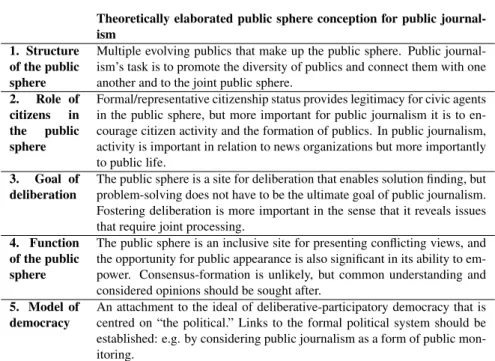
The five questions considered here can help us produce a theoretical ba-sis for public journalism that is more deeply rooted in public sphere theories. Based on the public sphere theories reviewed above, I conclude that public journalism would benefit from developing its practices on a wide theoretical basis that draws broadly form Habermas but also from his critics and earlier theorists. I suggest that if public journalism considers itself truly public it needs to recognize that the public sphere constitutes multiple publics, which are actively formed by citizens, but in which finding solutions is not always easy, since the nature of the public sphere is political and conflicting. In addi-tion, the public sphere is kept alive by providing possibilities for appearance, participation and deliberation. In Table 1, I have summarized the suggested elaborated conception of the public sphere in public journalism.
Firstly, it is fruitful to maintain the idea of a singular public sphere, but to stress that it is a varying, non-spatial and actively formed terrain that features various sub-publics. For public journalism this means that it is journalism’s task to identify the multiple emerging “seeds” of publics in civil society. Jour-nalism should take care of the fact that plurality provided by the issue-based publics is recognized; i.e. they need to be encouraged in order to make the public sphere more multifaceted. Moreover, it means that journalism could facilitate the formation of these publics and take them into journalistic fo-cus when relevant. Through this kind of activity, the already recognized sub-publics could become more aware of themselves and indeed more active, and the less recognized counter-publics could become seen as legitimate parts of the public sphere. In addition, public journalism in every platform should rec-ognize the networked (and technologically aided) way in which individuals communicate with each other and come together as publics.
Theoretically elaborated public sphere conception for public journal-ism
1. Structure of the public sphere
Multiple evolving publics that make up the public sphere. Public journal-ism’s task is to promote the diversity of publics and connect them with one another and to the joint public sphere.
2. Role of citizens in the public sphere
Formal/representative citizenship status provides legitimacy for civic agents in the public sphere, but more important for public journalism it is to en-courage citizen activity and the formation of publics. In public journalism, activity is important in relation to news organizations but more importantly to public life.
3. Goal of
deliberation The public sphere is a site for deliberation that enables solution finding, butproblem-solving does not have to be the ultimate goal of public journalism. Fostering deliberation is more important in the sense that it reveals issues that require joint processing.
4. Function of the public sphere
The public sphere is an inclusive site for presenting conflicting views, and the opportunity for public appearance is also significant in its ability to em-power. Consensus-formation is unlikely, but common understanding and considered opinions should be sought after.
5. Model of
democracy An attachment to the ideal of deliberative-participatory democracy that iscentred on “the political.” Links to the formal political system should be established: e.g. by considering public journalism as a form of public mon-itoring.
Table 1:Summary of the concept of the public sphere for public journalism theory.
Secondly, it needs to be stressed that citizens indeed are the agents who construct the public sphere. A central challenge for public journalism is there-fore to consider how journalism can be part of producing content and news stories that would launch the potential in individuals to become citizens, to become active firstly by recognizing themselves as a public and secondly, en-gaging in public life. These themes have already been broadly discussed by public journalism scholars, but it needs to be underlined that various forms of thinking, speaking, listening and acting should be widely recognized as pub-licly relevant. This requires sensitivity from public journalists in seeing the social and political (or the lifeworld), and not just politics (the system) as le-gitimate areas of coverage. Understanding the role of citizens in these terms means considering civic activity firstly in relation to public life at large and only secondly in relation to the needs of news organizations.
Thirdly, it is most fruitful to consider the public sphere as a social entity in which issue recognition is as important as solution-orientation. As such, it is important to notice the potential nature of citizens as problem-solvers. Citizen-based problem-solving can indeed be maintained as a valid public journalism practice where appropriate. It may empower the public to see the possibility of proposing solutions, not just reacting to the solutions that are offered to them by the elite. But it needs to be considered where and how far does the ability of the public extend in terms of executing the solutions that it comes up with. These considerations have to be taken into account in order to avoid the disillusionment of citizens who take part in public journal-ism projects (Haas 2007). Therefore, in public journaljournal-ism, problem-solving does not have to be the ultimate goal; it is more important to engage people in public life and aid publics in the realization of themselves.
The fourth question dealt with consensus and conflict. Public journalism does not have to identify itself with an understanding of deliberation that em-phasizes consensus, as it is an unlikely outcome. However, it does not have to take conflict as the new buzzword either. Concentrating only on conflict and ignoring connectedness might lead to a kind of journalism that promotes civic activity only in isolated and populist terms, or take a step back towards classical news values that endorse conflict. Public journalism could aim at politicizing seemingly apolitical issues, and thus make an intervention to and provide input for the routinely functioning system of politics. Moreover, if public journalism wishes to empower citizens, it needs to take the question of appearance seriously. It needs to actively produce the kind of accessible public sphere in which identity formation and interaction become possible for the public.
Finally, in the context of public journalism, it is fruitful to consider democ-racy in terms of participation and deliberation as Dewey and Habermas have suggested. This view builds on Rosen’s (1999, 299) idea that democracy is something that we , and not something that is done to us. Civic participation should thus be promoted also in its “weakest” sense, to encourage people to see “the political” nature of the everyday. However, it is useful to take into account that public journalism often functions in representative and admin-istrative framework. I do not suggest that public journalism should give up its basis as seeing democracy in a participatory manner, but public journalism should openly recognize the contradiction – and difference in logics – between
the ideal and the realist democracy, so that it could more clearly identify itself as a form of public monitoring and promote civic participation in an effec-tive manner. Indeed, this is the way in which public journalism can remain democratic and “political” without fearing to lose its credibility by getting too involved in the “politics”.
This elaborated understanding of public sphere theory challenges and takes a step away from previously dominant professional and journalism-centred view of public journalism. The above discussed understanding of the public sphere is also a normative-theoretical construct. In order to consider how this challenge takes place and how it is interpreted in practice, future studies need to turn to empirical evidence. Malmberg (2004, 58) summarizes Habermas by pointing out that he sees that mass communication can be both; a means to repress and a means to emancipate, and therefore, it is an empirical question to study when and where the media is repressive or emancipatory. Therefore, this normative-theoretical basis can act as a mirror against which public jour-nalism practices may be analyzed, in order to evaluate what kind of publicness those practices actually promote.
Literature
AHVA, Laura, Making News with Citizens: Public Journalism and Profes-sional Reflexivity in Finnish Newspapers, Tampere, Tampere University Press, 2010.
ARENDT, Hannah, The Human Condition, Second Edition, Chicago, The University of Chicago Pres, 1958.
BAUMEISTER, Andrea T., Diversity and Unity: The Problem with ‘Consti-tutional Patriotism’, European Journal of Political Theory : 4, 483–503, 2007.
BLUMER, Herbert, Public Opinion and Public Opinion Polling, American Sociological Review 13: 542–549, 1948.
BLUMER, Herbert, Joukko, massa ja julkiso, Tiedotustutkimus 22: 3, 14–26, 1999 [1946].
CAREY, James W., Communication As Culture: Essays on Media and Soci-ety, New York, Routledge, 1989.
CARPENTIER, Nico & Cammaerts, Bart, Hegemony, Democracy, Agonism and Journalism: An Interview with Chantal Mouffe, Journalism Studies 7: 6, 964–975, 2006.
DAHLGREN, Peter, Doing Citizenship: The Cultural Origins of Civic Agency in the Public Sphere, European Journal of Cultural Studies 9: 3, 267–286, 2006.
D’ENTREVES, Maurizio Passerin, The Political Philosophy of Hannah Arendt. New York, Routledge, 1994.
DEWEY, John, The Public and Its Problems. Swallow Press/Ohio University Press, 1954 [1927].
FRASER, Nancy, Rethinking the Public Sphere: A Contribution to the Cri-tique of Actually Existing Democracy, in Calhoun Craig (ed.), Haber-mas and the Public Sphere, Campridge, MA: MIT Press, 109–142, 1992.
Friedland, Lewis A., Public Journalism: Past and Future, Dayton, Kettering Foundation Press, 2003.
FRIEDLAND, Lewis A.; Hove, Thomas & Rojas, Hernando, The Networked Public Sphere, Javnost–The Public 13: 4, 5–26, 2006.
GALSSER, Theodore L. (ed.), The Idea of Public Journalism, New York, The Guilford Press, 1999.
GALSSER, Theodore L., The Politics of Public Journalism, in an article Debate: Public Journalism, Journalism Studies 1: 4, 679–694, 2000. GLASSER, Theodor L. & Lee, Francis L. F., Repositioning the Newsroom:
The American Experience with ‘Public Journalism’, in Kuhn, Raymond & Neveu, Eric (eds.), Political Journalism: New Challenges, New Prac-tices, London and New York, Routledge, 2002.
HAAS, Tanni & Steiner, Linda, Public Journalism As a Journalism of Publics: Implications of the Habermas–Fraser Debate for Public Journalism, Jour-nalism 2: 2, 123–147, 2001.
HAAS, Tanni, The Pursuit of Public Journalism: Theory, Practice and Crit-icism, New York, Routledge, 2007.
HABERMAS, Jürgen, The Theory of Communicative Action Vol1: Rea-son and the Rationalization of Society, Cambridge, Polity Press, 1984 [1981].
HABERMAS, Jürgen, The Structural Transformation of the Public Sphere, Cambridge, MIT Press, 1989 [1962].
HABERMAS, Jürgen, Three Normative Models of Democracy, Constella-tions 1: 1, 1–10, 1994.
HABERMAS, Jürgen, Between Facts and Norms, Cambridge, MIT Press, 1998 [1992].
HABERMAS, Jürgen, Political Communication in Media Society: Does Democracy Still Enjoy an Epistemic Dimension? The Impact of Nor-mative Theory on Empirical Research, Communication Theory : 4, 411–426, 2006.
HEIKKILÄ, Heikki & Kunelius, Risto, Journalists Imagining the European Public Sphere: Professional Discourses about the EU News Practices in Ten Countries, Javnost–The Public 13: 4, 63–80, 2006
HERMES, Joke, Hidden Debates: Rethinking the Relationship between Pop-ular Culture and the Public Sphere, Javnost–The Public 13: 4, 27–44, 2006.
HUSPEK, Michael, Symposium: Habermas and Deliberative Democracy: Introductory Remarks, Communication Theory 17: 4, 329–332, 2007. KARPPINEN, Kari; Moe, Hallvard & Svensson, Jakob, Habermas, Mouffe
and Political Communiation: A Case for Theoretical Eclecticism, Javnost-The Public 15: 3, 5-22, 2008.
KEANE, John, The Life and Death of Democarcy, London, Simon & Schus-ter, 2009.
KUNELIUS, Risto, Kokemuksesta julkiseen tietoon: John Deweyn pragma-tismia viestinnän tutkijoille, in Mörä, Tuomo; Salovaara-Moring, Inka & Valtonen, Sanna (eds.), Mediatutkimuksen vaeltava teoria, Helsinki, Gaudeamus, 90–118, 2004.
LIPPMANN, Walter, Public Opinion, New York, The Free Press, 1965 [1922]. LIPPMANN, Walter, The Phantom Public, New York, Harcourt, Brace and
Company, 1925.
LIVINGSTONE, Sonia, On the Relation Between Audiences and Publics, in Livingstone, Sonia (ed.), Audiences and Publics: When Cultural En-gagement Matters for the Public Sphere, Bristol, Intellect, 17-41, 2005.
MALMBERG, Tarmo, Porvarillisen julkisuuden keskeneräinen projekti: Jür-gen Habermas ja kriittinen mediatutkimus, in Mörä, Tuomo; Salovaara-Moring, Inka & Valtonen, Sanna (eds.) Mediatutkimuksen vaeltava teo-ria, Helsinki, Gaudeamus, 38-74, 2004.
MALMBERG, Tarmo, Lippmann vai Dewey? Demokratia, poliittinen kult-tuuri ja julkisuus, Media & viestintä 32: 3, 54-72, 2009.
MARX FERREE, Myra; Gamson, William A.; Gerhards, Jürgen & Rucht, Dieter, Four Models of the Public Sphere in Modern Democracies, The-ory and Society 31: 3, 289–324, 2002.
MERRIT, Davis & McCombs, Maxwell, The Two W's of Journalism: The Why and What of Public Affairs Reporting, Mahwah, New Jersey, Law-rence Erlbaum Associates, 2004.
MOUFFE, Chantal, Deliberative Democracy or Agonistic Pluralism? Social Research 66: 3, 745–758, 1999.
MOUFFE, Chantal, On the Political, London, Routledge, 2005.
ROSEN, Jay, Making Journalism More Public, Communication 12, 267-284, 1991.
ROSEN, Jay, What Are Journalists For? New Haven and London, Yale Uni-versity Pres, 1999.
SCHUDSON, Michael, The Good Citizen: A History of American Civic Life, New York, The Free Press, 1998.
SCHUDSON, Michael, The “Lippmann-Dewey Debate” and the Invention of Walter Lippman as an Anti-Democrat 1986-1996, International Jour-nal of Communication 2, 1031-1042, 2008.
SILVERSTONE, Roger, Media and Morality: On the Rise of the Mediapolis, Cambridge, Polity Press, 2007.
SIRIANNI, Carmen & Friedland, Lewis, Civic Innovation in America: Com-munity Empowerment, Public Policy and the Movement for Civic Re-newal, Berkeley and Los Angeles, University of California Press, 2001. SPLICHAL, Slavko, In Search of a Strong European Public Sphere: Some Critical Observations on Conceptualizations of Publicness and the (Eu-ropean) Public Sphere, Media, Culture & Society 28: 5, 695–714, 2006.
TAYLOR, Charles, Modern Social Imaginaries, Durham, Duke University Press, 2004.
WAHL-JORGENSEN, Karin, On the Public Sphere, Deliberation, Journal-ism and Dignity: An Interview with Seyla Benhabib, JournalJournal-ism Stud-ies 9: 6, 962-970, 2008.