Gamma-ray Tracking with Segmented HPGe Detectors
O. Wieland
a, Th. Kr¨oll
b, D. Bazzacco
c, R. Venturelli
c, F. Camera
a, B. Million
a, E. Musso
a,
B. Quintana
d, C. A. Ur
e, M. Bellato
c, R. Isocrate
c, Ch. Manea
c, R. Menegazzo
c, P. Pavan
c,
C. Rossi Alvarez
c, E.Farnea
c, A. Gadea
e, D. Rosso
e, P. Spolaore
e, A. Pullia
a, G. Casati
f,
A. Geraci
f, G. Ripamonti
f, and M. Descovich
gaINFN, Sezione di Milano, and Dipartimento di Fisica, Via Celoria 16, 20133 Milano, Italy bPhysik-Department E12, Technische Universit¨at M¨unchen, James Franck Strae, 85748 Garching, Germany c
INFN, Sezione di Padova, and Dipartimento di Fisica ”Galileo Galilei”, Via Marzolo 8, 35131 Padova, Italy
d
Universidad de Salamanca, Pl. La Merced s/n, 37008 Salamanca, Spain
e
INFN - Laboratori Nazionali di Legnaro, Via Romea 4, 35020 Legnaro, Italy
f
Politecnico di Milano and INFN, Sezione di Milano, Piazza Leonardo da Vinci 32, 20133 Milano, Italy
g
Oliver Lodge Laboratory, University of Liverpool, Liverpool, L69 7ZE, United Kingdom
Received on 30 October, 2002
This paper gives a brief overview of the technical progress that can be achieved with the newly available seg-mented HPGe detectors. Gamma-ray tracking detectors are a new generation of HPGe detectors which are currently being developed to improve significantly the efficiency and resolving power of the 4πgermanium detectors arrays for high-precisionγ-ray spectroscopy. They consist of highly segmented HPGe detectors as-sociated with fast digital front-end electronics. Through the pulse-shape analysis of the signals it is possible to extract the energy, timing and spatial information on the few interactions aγ-ray undergoes in the HPGe detector. The tracks of theγ-rays in the HPGe detector can then be reconstructed in three dimensions based on the Compton scattering formula. Such a detector has been used for the first time during an in-beam experiment. Theγ-decay of the Coulomb excitation of a56Fe nucleus was measured with the highly segmented MARS prototype positioned at 135 degree. The energy resolution has been improved by a factor of 3 as compared to standard HPGe detectors due to very precise Doppler correction based on knowledge of theγ-ray track.
I
Introduction
The future facilities for radioactive beams will allow, for the first time, the exploration of a new large area of the nuclear landscape. In connection with the study of theγ-radiation, it is important to point out that the intensity of such radioac-tive beams is expected to be much smaller than that of stable beams, Doppler Effects in many experiments are expected to be much stronger and an intense background of X-rays could be present. Consequently, a new generation of power-ful HPGe arrays with segmented detectors is being designed. Both in USA and in Europe several projects, based on seg-mented HPGe detectors, have already started and are in an advanced status of realization. The objective of the more recent R&D efforts is to improve the total efficiency by re-moving the BGO shields without affecting the P/T ratio with the use of the tracking technique, namely the reconstruction of theγ-ray path to identify theγ-incident direction (for the Doppler correction), the removal of the background and to check whether or not the γ was fully absorbed in the ar-ray. Such development implies unprecedented R&D efforts where completely new technology has to be applied, tested
II
Segmented HPGe detectors and
tracking
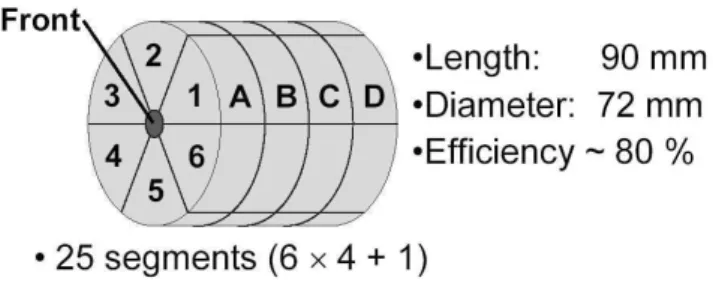
Before building tracking arrays like AGATA [2] or GRETA [3], the design and performance of single segmented detec-tors has to be tested and evaluated. It is a crucial point to decide the design of the single modules which will be in-serted into the 4πtracking arrays. It is of great importance to study the behaviour of these detectors under real exper-imental conditions, as well as the properties like eventual cross talk, transient signals, superposition of signals in one segment, long time performance, heat flux etc. The perfor-mance of the arrays built out of these segmented detector modules will be much higher than that of present arrays (Eu-roball, Gammasphere, GASP...) with an total efficiency of about 50% and a P/T better than 60% for single gammas of 1 MeV. The total efficiency is calculated to be about 30% for high multiplicityγ-events, this means one order of mag-nitude better than the actual arrays. Both in USA and in Europe several projects, based on segmented HPGe detec-tors, have already started and are in an advanced status of realization. In Germany the Miniball [4] project is based on encapsulated HPGe crystals which are six fold segmented. The EXOGAM [5] and the VEGA [6] arrays are composed by several segmented clovers. At the NSCL (MSU) [7] an array consisting of HPGe crystals, each segmented into 32 sections (4 segments in its surface base and 8 segments in its depth) will be installed. Some prototypes of compact and cylindrical 24-36 segmented HPGe detectors are already available and under study. For example, the TIGRE detector at the university of Liverpool is a 24-fold detector (6x4). The GRETA detector at the Lawrence Berkeley National Labo-ratory is a 36-fold prototype segmented six ways in depth and six ways longitudinally. The 37 FET’s are located and cooled in the same vacuum as the crystal. Cold FET’s pro-vide low noise, which is important for optimising the energy and position resolution. The MARS prototype detector (Fig. 1) is a highly segmented HPGe detector manufactured by Eurisys with K¨oln type preamplifiers. It consists of a cylin-drical crystal with 90 mm length and 72 mm diameter. It has a closed-end geometry with an inner hole of 10 mm di-ameter and 75 mm length. The outer contact of the detector is divided electrically in 25 segments: six angular sections and four transversal in depth. Cold FET’s are used. The res-olution obtained with standard analogue electronics at 1.33 MeV is about 2.2 keV. With the newly developed Milano type preamplifiers, the resolution is much better about 1.7 keV, together with a larger bandwidth and giving less noisy signal shapes [8]. With all these segmented detectors wide ranges of tests and source-experiments have been done. A complete scan inside one segment usingγsources and a col-limated Compton coincidence setup [9] has been done and shows the pulse shapes as a function of the Compton interac-tion posiinterac-tion. Crystal orientainterac-tion effects on the drift velocity of the electrons and their influence on the pulse shape have been thoroughly studied with the GRETA and MARS proto-type [10] [11] [13]. Precise simulations of pulse shapes with
the weighting field method have been made for the MARS [11] and GRETA detectors. The influence of the crystallo-graphic orientation on the drift velocity of the electrons and holes (and therefore also on the pulse shape) is remarkable, especially in the front cap of the detector. Geant [14] sim-ulations of single and multipleγ-interactions were done to get information about signal distribution [12] and mainly to develop tracking algorithms based on the Compton scatter-ing formula [13] to reconstruct the path of the interactscatter-ing γ-rays inside the detector. Two main types of algorithm are used, the cluster tracking algorithm [14] and the backtrack-ing algorithm [16]. A major part of these R&D projects is to develop newly digital electronics for signal processing and amplification. Pulse shapes have been simulated [17] and algorithms have been developed to disentangle multiple in-teractions [18] in the single segments. For tests and experi-ments with the MARS prototype the pulse shapes are mea-sured with a DAQ system made by an array of seven dig-ital oscilloscopes. The signals from the preamplifiers were stored with a sampling rate of 200 MSamples/s and a resolu-tion of 8 bit. The oscilloscopes are triggered by the pream-plifier signal of the central contact of the detector. All pos-sible proof of principle tests have been made with different types of segmented detectors. It is of great interest to test their performance and the feasibility under in beam exper-imental conditions. The analysis of data from segmented HPGe detectors have been widely studied. First, the sig-nals from the FET’s have to be preamplified and then digi-tally stored. These pulses have to be analysed to disentangle the three dimensional position of each interaction which has produced the pattern of pulses. Then a tracking algorithm has to reconstruct the most probable track theγ-ray may has followed inside the detector. Two pieces of basic informa-tion have to be determined. One is the first interacinforma-tion point of theγ impinging the detector, which is necessary to es-timate theγ-ray emission angle for the Doppler correction. The second is to determine the nature of the track, whether or not theγhas released all its energy within the germanium array and therefore useful to reject background events.
Figure 1. Schematic view of the 6x4+1 segmented HPGe MARS prototype detector.
III
In beam experiment
A measurement of theγ-rays emitted from the Coulomb ex-citation of the56
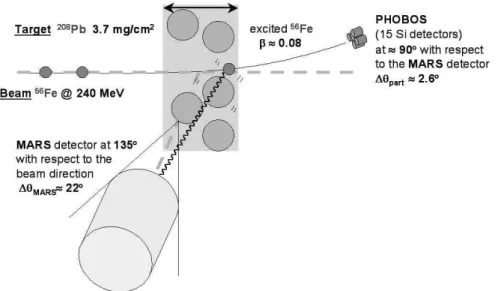
pro-totype detector. The setup and the reaction has been sim-ulated using GEANT libraries in order to reduce as much as possible the Doppler broadening effect by determining the first point of interaction. The scattered particles were measured in coincidence with the PHOBOS Si pin-diodes to control the whole kinematics of the reaction (Fig. 2). The MARS detector was mounted under 135 degree (in the labo-ratory frame) in backward direction in the GASP setup. The PHOBOS Si-diodes (with an opening angle of 2.6 degree) were mounted at approximately 90 degree with respect to the MARS detector, to maximize the Doppler broadening for the scattered56
Fe nuclei (Fig. 2). The FWHM of the measured peak is determined mainly by the Doppler broad-ening which is dominant over the other major contributions to the energy resolution as the finite opening angle of the individual si-detectors, the energy straggling due to the en-ergy loss of the projectiles in the target before and after the scattering, and the finite size of the beam spot (about 4 mm diameter). The 56
Fe beam at an energy of 240 MeV has been delivered by the XTU Tandem Accelerator at Legnaro
and impinged on a 3.7 mg/cm2
lead target. The scattering angle was 60 degrees in the laboratory system and the cor-responding velocity was 8% of the light velocity. The cross section for excitation of the first 2+-state in56
Fe at this scat-tering angle is about 250 mb/sr. The 847.8 keV peak of the first transition of the56
Fe Beam was measured with a FWHM of 15.5 keV. Using the information of the central angle of the segment which undergoes the first interaction (highest deposited energy for energies higher than 500 keV) the peak width can be reduced by a factor of better than two. Assuming a ”perfect” tracking, position determination and correct reconstruction of the scattering path,one expects an energy resolution of 2.7 keV (FWHM) as deduced from sim-ulations. If a realistic position error of 5mm will be assumed for the simulation, the FWHM of the 848 peak will be 3.4 keV (FWHM). These values have to be folded with the in-trinsic energy-resolution of the detector of 2.2 keV. There-fore, the present resolution for tracking was expected to be 4.2 keV.
Figure 2. Setup of the in-beam experiment done at LNL with the MARS detector. A56Fe beam of 240 MeV is impinging on a 3.7 mg/cm2 lead target. The velocity of the scattered nuclei corresponds to 8% of the light velocity. The excited56Fe is detected in the PHOBOS Si-detector array which consists of 15 single Si-detectors with 2.6 degree opening angle. Theγ-rays are detected in the MARS prototype which has an opening angle of 22 degree. The complete kinematics of the reaction is defined experimentally by detecting theγ-rays in coincidence with the excited56Fe ions.
IV
Results
To retrieve the energy information of the digitally stored pulses of the described MARS experiment at the LNL (Italy) the moving windows deconvolution algorithm [19] was used. The decomposition of the signals (giving the po-sition information of the gamma interaction) was done by the approach developed by Th. Kr¨oll based on a genetic al-gorithm [1]. Weighting field calculations of different pulse shapes with a spatial resolution of some mm have been made to build a matrix for the genetic algorithm. This method was
stop-criteria ends the evolution, the fittest event pattern found is taken as the result of the decomposition. The genetic algo-rithm and the cluster tracking algoalgo-rithm could determine the first interaction point of the impingingγ-rays with a position resolution of 5mm. This is enough to improve the FWHM of the measured 847.8 keVγ-transition from 15 keV to 4.5 - 5.0 keV (Fig. 3).
Figure 3. Measured (FWHM = 14.8 keV) and Doppler corrected spectra of the 848 keV peak. If the segment information (opening angle 9 degree instead of 22 degree of the whole MARS detector) is used for the Doppler correction, the peak can be corrected to a FWHM of 6-6.5 keV. If pulse shape analysis with genetic algo-rithm and tracking is applied for Doppler correction, the FWHM of the peak will be reduced to 4.5 keV.
V
Conclusion
Worldwide efforts in developing simulation algorithms, tracking codes, pulse processing and analysing tools, dig-ital data treatment and signal processing units have shown that trackingγ-rays is possible. In the first in beam experi-ment the feasibility of the major steps of theγ-tracking pro-cess have been sucpro-cessfully demonstrated. A preliminary analysis of the MARS experiment shows that the FWHM of the Doppler broadened 845 keV peak can be reduced by a factor of 3 namely from 15.5 keV down to 4.5 keV. This is in good agreement with the simulation predictions for a 5mm position resolution corresponding to a FWHM of 4.2 keV (see also Th. Kr¨oll et al. [17]). This experiment is very promising for the design of future tracking arrays like Agata [2] or Greta [3]. The achieved performance of the Doppler correction outranges classical non-segmented ger-manium detectors by a factor of more than 3. Further work and R&D has still to be done to disentangle multiple inter-actions in single segments. In particular the whole digital electronic setup has to be built, signal shape analysis and
tracking should be made possible ”on-line”, before the final geometry of the single capsules for a big array is chosen for a large 4πarray based on tracking.
Acknowledgments
This work is supported by the INFN and the European Commission under TMR contract No. ERBFMRXCT97-0123. Th. Kr¨oll. acknowledges support by the Technis-che Universitt MnTechnis-chen. The authors would like to thank K. Vetter and I.Y. Lee (LBNL) for fruitful discussions and R. Kr¨ucken (Technische Universit¨at M¨unchen) for providing the PIN diodes silicon detectors.
References
[1] Th. Kr¨oll, D. Bazzacco, to be published
[2] Web site: ftp.gsi.de/pub/agata/agata.pdf
[3] Web site: greta.lbl.gov
[4] J. Eberth, G. Pascovici, H.G. Thomas, N. Warr, D. Weis-shaar, D. Habs, P. Reiter, P. Thirolf, D. Schwalm, C. Gund, H. Scheit, M. Lauer, P. Van Duppen, S. Franchoo, M. Huyse, R.M. Lieder, W. Gast, J. Gerl, K.P. Lieb Prog. in Part. and Nuc. Phys. 4
¯6, 389 (2001) [5] Web site www.ganil.fr/exogam
F. Azaiez, W. Korten, Nucl. Phys. News7, 21 (1997)
[6] Web site:
www-gsi-vms.gsi.de/eb/html/eb welcome.html
[7] W.F. Mueller, J.A. Church, T. Glasmacher, D. Gutknecht, G. ackman, P.G. Hansen, Z. Hu, K.L. Miller, P. Quirin Nucl. Inst. and Meth. A466, 492 (2001)
[8] A. Pullia private communication 09/2002
[9] K. Vetter, A. Kuhn, M.A. Deleplanque, I.Y. Lee, F.S. Stephens, G.J. Schmid, D. Beckedahl, J.J. Blair, R.M. Clark, M. Cromaz, R.M. Diamond, P. Fallon, G.J. ane, J.E. Kam-meraad, A.O. Macchiavelli, C.E. Svensson Nucl. Instr. and Meth. A452, 223 (2000)
[10] K. Vetter, A. Kuhn, L.Y. Lee, R.M. Clark, M. Cromaz, M.A. Deleplanque, R.M. Diamond, P. Fallon, G.J. Lane, A.O. Mac-chiavelli, M.R. Maier, F.S. Stephens, C.E. Vensson, H. Yaver Nucl. Instr. and Meth. A452, 105 (2000)
[11] Web site:
axpd30.pd.infn.it/MARS/index.html
[11] L. Mihailescu, W. Gast, R.M. Lieder, H. Brands, H. Jager Nucl. Instr. and Meth. A447, 350 (2000)
[12] O. Wieland, F. Camera, B. Million, A. Bracco, J. van der Marel, IEEE Trans. Nucl. Sci.48, 3 (2001); Nucl. Instr. and Meth. A487, 441 (2002)
[13] Web site: ikp193.ikp.kfa-juelich.de/tmr98
Boston A., Cullen D., Descovich M., Enqvist T., Cederwall B., Ideguch E., van der Marel J., Nyberg J., Herskind B., Slet-ten G., Wilson J., Redouin B., Henck R., Gutknect D., and Jaaskelainen K. Nucl.Phys. A682, 279c (2001); Prog. Part. Nucl. Phys.46, 399 (2001); Acta Physica Polonica, B32, 2395 (2001)
[14] GEANT 3.12 Detector Simulation Tool, CERN (1994) [14] G.J. Schmid, M.A. Deleplanque, I.Y. Lee, F.S. Stephens, K.
Vetter, R.M. Clark, R.M. Diamond, P. Fallon, A.O. Macchi-avelli, R.W. MacLeod Nucl. Instr. and Meth. A430, 69 (1999) [16] J. van der Marel, B. Cederwall Nucl. Instr. and Meth. A437,
538 (1999)
[17] D. Bazzacco, R. Venturelli, E. Farnea, R. Isocrate, C. A. Ur, Ch. Manea, M. Bellato, C. Rossi Alvarez, Th. Kroell, D. Rosso, P. Spolaore, F. Camera, O. Wieland, B. Million, E. Musso, A. Pullia, G. Ripamonti, A. Geraci, B. Quintana, M. Descovich FSN Proceeding 2002 Berkeley
[18] G. Ripamonti, A. Geraci, E. Gatti, G. Casati, F. Camera, B. Million, A. Bracco, M. Pignanelli, O. Wieland IEEE Trans. Nucl. Sci.48, 20 (2001)