1204 Brazilian Journal of Physics, vol. 34, no. 3B, September, 2004
Irreversible Processes and the Accelerated-Decelerated
Phases of the Universe
G. M. Kremer and M. C. N. Teixeira da Silva
Departamento de F´ısica, Universidade Federal do Paran´a,Caixa Postal 19044, 81531-990 Curitiba, Brazil
Received on 16 December, 2003
A model for the Universe is proposed where it is considered as a mixture of scalar and matter fields. The particle production is due to an irreversible transfer of energy from the gravitational field to the matter field and represented by a non-equilibrium pressure. This model can simulate three distinct periods of the Universe: (a) an accelerated epoch where the energy density of the scalar field prevails over that of the matter field, (b) a past decelerated period where the energy density of the matter field becomes larger than the scalar field energy density, and (c) a present acceleration phase where the scalar field energy density overcomes the energy density of the matter field.
1
Introduction
In order to take into account the irreversible processes dur-ing the evolution of the Universe, cosmological models were proposed where the Einstein field equations are combined with the field equations of the thermodynamic theory of ir-reversible processes. For a homogeneous and isotropic Uni-verse, represented by the Robertson-Walker metric, there exists only one term related to the irreversible processes, namely the non-equilibrium pressure. In Eckart (or first-order) thermodynamic theory the non-equilibrium pressure is considered as a constitutive quantity which is propor-tional to the Hubble parameter and whose proporpropor-tionality factor is the coefficient bulk viscosity (see e.g. the works [1-3]), whereas in extended (second-order or causal) thermo-dynamic theory the non-equilibrium pressure is supposed to obey an evolution equation (see e.g. the works [4-12]). These theories are known in the literature as viscous cosmo-logical models.
According to cosmological observations one can distin-guish three different periods of the Universe with respect to its acceleration field, namely, (a) an early accelerated epoch, (b) a past decelerated period, and (c) a present accelerated phase.
The early acceleration of the Universe, which refers to the inflationary period, can be modeled as a mixture of a scalar field – the so-called inflaton – and a matter field while the non-equilibrium pressure is identified with the particle production due to an irreversible transfer of energy from the gravitational field to the matter field [9, 13, 14]. The inflaton is supposed to have a negative pressure which is the respon-sible for the acceleration of the early Universe.
The present acceleration of the Universe is also due to a scalar field with a negative pressure, since it has been observed that the energy density of the present Universe is not due to matter or radiation but to an extraordinary non-baryonic matter and energy. Hence, the present
Uni-verse can be modeled as a mixture of a matter field with a scalar field which is identified with the dark energy den-sity. If the irreversible processes are taken into account the non-equilibrium pressure, in this case, is the responsible for the transfer of energy between the matter and gravitational fields. There exist at least two candidates in the literature for the dark energy density, namely the quintessence [15-18,10] and the Chaplygin gas (see e.g. [11] and the refer-ences therein).
The objective of this work is to present a model of the Universe which could describe the distinct periods of the Universe, beginning with an early accelerated epoch, pass-ing through a decelerated period and leadpass-ing back to an ac-celerated phase. For that end we model a homogeneous and isotropic Universe as a mixture of two constituents, namely: (a) a scalar field that plays the role of the inflaton at the early accelerated period and of the dark energy at the present ac-celerated phase; (b) a matter field that represents the parti-cles classically and which are created from the irreversible transfer of energy from the gravitational field to the matter field. Here we show, among other results, that this model can simulate the three distinct periods: the early acceler-ated, the past decelerated and the present accelerated peri-ods. Units have been chosen so thatc=~=k= 1.
2
Field Equations
The equations of state that relate the pressures of the scalar fieldpφand of the matter fieldpmto their energy densities
ρφandρmare given by
½
pφ=wφρφ, with −1≤wφ≤0,
pm=wmρm, with 0≤wm≤1.
(1) While the equation of state of the matter is the well-known barotropic equation with wm = 0; 1/3; 2/3 representing a
G. M. Kremer and M. C. N. Teixeira da Silva 1205
scalar field can be found e.g. in the works [19, 20] and in the references therein.
If we consider the irreversible processes of particle pro-duction in the Universe, the energy-momentum tensorTµν
is written as
Tµν = (ρ+p+̟)UµUν−(p+̟)gµν. (2) In the above equationUµ(such thatUµU
µ= 1) is the
four-velocity and̟denotes the non-equilibrium pressure which is the quantity responsible for particle production [9, 13, 14] during the evolution of the Universe. Moreover, the pressure
pand the energy densityρof the mixture are given by
ρ=ρφ+ρm, p=pφ+pm. (3)
From the conservation law of the energy-momentum tensor Tµν
;ν = 0it follows the balance equation for the
energy density of the mixture that – in a comoving frame and by considering the Robertson-Walker metric – reads
˙
ρ+ 3H(ρ+p+̟) = 0. (4) The quantityH = ˙a(t)/a(t)is the Hubble parameter while
a(t)denotes the cosmic scale factor and the over-dot refers to a differentiation with respect to time.
The cosmic scale factor is connected with the energy density of the mixture by the Friedmann equation
H2+ k
a2 =
8πG
3 ρ, (5)
whereGis the gravitational constant andkassumes the val-ues +1,0,−1 for closed, flat and open Universes, respec-tively.
We assume that the scalar field interacts only with it-self and is minimally coupled to the gravitational field. In this case, the balance equation for the energy density of the scalar field decouple from the energy density of the mixture (4) and can be written as
˙
ρφ+ 3H(ρφ+pφ) = 0. (6)
Equation (6) is used to get from (4) the balance equation for the energy density of the matter field
˙
ρm+ 3H(ρm+pm) =−3H̟. (7)
From the above equation it is possible to interpret the term −3H̟ as the energy density production rate of the matter field (see e.g. [10, 11]).
The relationship between the cosmic scale factor and the energy density of the scalar field can be obtained from the integration of (6) by considering the equation of state given in (1), yielding
ρφ=ρ0φ
³a0
a
´3(wφ+1)
. (8)
In the above equationρ0
φis the value of the energy density
of the scalar field att= 0(by adjusting clocks) whilea0is the corresponding value of the cosmic scale factor.
Now we differentiate the Friedmann equation (5) with respect to time and get the following equation for the time evolution of the cosmic scale factor
˙
H+3
2(wm+ 1)
µ
H2+ k
a2 ¶ = k a2 +4πG ·
(wm−wφ)ρ0φ
³a0
a
´3(wφ+1) −̟
¸
. (9) In order to find a solution of (9) for the cosmic scale fac-tor one has to specify how the non-equilibrium pressure̟
is connected witha(t). Here we assume that ̟ is a vari-able within the framework of extended (causal or second-order) thermodynamic theory and write the linearized evo-lution equation for the non-equilibrium pressure as
̟+τ̟˙ =−3ηH. (10) For the derivation of this equation within the framework of the Boltzmann equation one is referred to [21]. Moreover, the coefficient of bulk viscosityηand the characteristic time
τare assumed to be related to the energy density of the mix-tureρby
η=αρ, with τ=η/ρ, (11) whereαis a constant (see e.g. [4, 9, 10, 11]).
For the solution of the system of differential equations (9) and (10) we introduce the dimensionless quantities
H≡ H
H0
, t≡tH0, a≡
a a0
, ̟≡ 8πG̟
3H2 0
, (12) and the dimensionless coefficients
α≡αH0, χ=H02a20, (13) where the index zero denotes the value of the quantity at
t= 0(by adjusting clocks).
Now the system of differential equations (9) and (10) can be written in terms of the dimensionless quantities (12) and (13) as
˙
H+3
2(wm+ 1)
µ
H2+ k
χa2 ¶ = k χa2 +3 2 "
(wm−wφ)
1 +k/χ
1 +ρ0
m/ρ0φ
µ1
a
¶3(wφ+1) −̟
#
, (14)
̟+α̟˙ =−3αH
µ
H2+ k
χa2 
. (15) With respect to the above dimensionless quantities the energy densities of the scalar and matter fields, can be deter-mined from (8) and (5) and read
ρφ ρ0 φ = µ 1 a
¶3(wφ+1)
, (16)
ρm
ρ0
φ
=1 +ρ
0
m/ρ0φ
1 +k/χ
µ
H2+ k
χa2 ¶ − µ 1 a
¶3(wφ+1)
1206 Brazilian Journal of Physics, vol. 34, no. 3B, September, 2004
By specifying initial conditions fora(t),a˙(t)and̟(t)
at timet= 0and values for the parameterswφ,wm,ρ0m/ρ0φ,
k,χandαone can determine from the system of differen-tial equations (14) and (15) the time evolution of the cosmic scale factora(t)and of the non-equilibrium pressure̟(t). Oncea(t)is a known function of time the energy densities are obtained from (16) and (17). The parameterswφ,wm,
ρ0
m/ρ0φ,k,χandαhave the following interpretation: (a)wφ
andwmrepresent the ratios between the pressures and the
energy densities of the scalar field and matter fields, respec-tively; (b)ρ0m/ρ0φgives the ratio between the initial amount
of the energy density of the matter field with respect to that of the scalar field; (c) kandχare related with the space-time geometry; and (d)αis connected with the relevancy of the irreversible processes that correspond to the particle production.
3
Results and Discussions
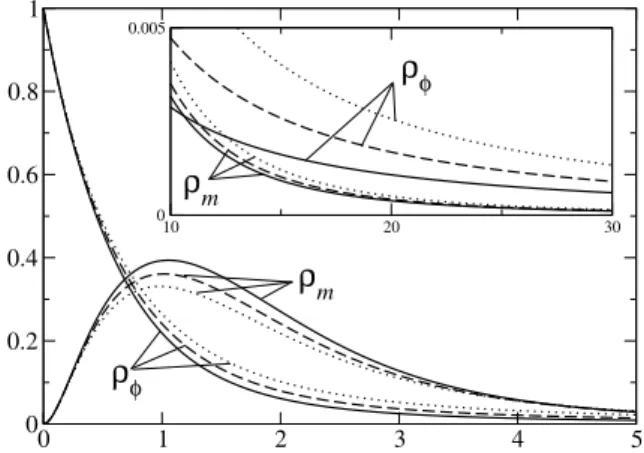
We have solved the system of differential equations (14) and (15) numerically by considering the following initial condi-tions: a(0) = 1for the cosmic scale factor, H(0) = 1for the Hubble parameter and̟(0) = 0for the non-equilibrium pressure. There still remains much freedom to find the so-lution of the two systems of differential equations, since they do depend on the parameters wφ, wm, ρ0m/ρ0φ, k, χ
andα. The Figs. 1 and 2 were obtained by choosing: (a)
wφ=−0.45andwm= 1/3for the ratios between the
pres-sures and the energy densities of the scalar field and of the matter fields, respectively; (b)ρ0m/ρ0φ = 0, i.e., a vanishing
initial amount of the energy density of matter field since the particles are created through the irreversible process of en-ergy transfer from the gravitational field to the matter field; (c)χ = 3 andk = 0,+1,−1 for the importance of the space-time geometry and (d)α = 0.3for the influence of the irreversible processes in the particle production. We call attention to the fact that wm = 1/3 refers to a radiation
field and the conditionwφ =−0.45satisfies the restriction
for the quintessencewφ <−1/3(see e.g. [20]). Below we
shall comment how the change of these parameters affect the solution of the system of differential equations.
We have plotted in Fig. 1 the time evolution of the ac-celeration field whereas in Fig. 2 it is shown the time evo-lution of the energy densities for the scalar and matter fields in the cases of closed (straight line), flat (dashed line) and open (dotted line) Universes. These figures follow from the numerical solution of the system of differential equations (14) and (15) for the cosmic scale factor and for the non-equilibrium pressure and from the equations (16) and (17) for the energy densities. One can infer from Figs. 1 and 2 that there exist three distinct periods: (a) an accelerated epoch where the energy density of the scalar field prevails over the matter field, (b) a past decelerated period where the energy density of the matter field becomes more predomi-nant than that of the scalar field, and (c) a present accelerated phase where the scalar field energy density overcomes the
0 2 4 6 8 10
t
0 0.5 1 1.5
a..
10 20 30
-0.1 0.02
0
Figure 1. Accelerationa¨vs timetfor closed (straight line), flat (dashed line) and open (dotted line) Universes.
0 1 2 3 4 5
0 0.2 0.4 0.6 0.8 1
10 20 30
0 0.005
ρ
mρ
φρ
mρ
φFigure 2. Energy densities of scalarρφ and matterρmfields vs timetfor closed (straight lines), flat (dashed lines) and open (dot-ted lines) Universes.
energy density of the matter field. Hence, the transition from the early accelerated period to the decelerated epoch is con-nected with the transition from a scalar field to a matter field dominated Universe, whereas the transition from the decel-erated phase to the present acceldecel-erated epoch is connected with the transition from a matter field to a scalar field dom-inated Universe. In the first accelerated period the closed Universe has the largest value for the acceleration field fol-lowed by the flat and the open Universes. One can under-stand this behavior by recognizing from the equation for the non-equilibrium pressure (15) that̟ has the largest nega-tive value for the closed Universe followed by the flat and the open Universes which implies that the acceleration, given by
¨
a a =−
4πG
3 (ρ+ 3p+ 3̟), (18)
G. M. Kremer and M. C. N. Teixeira da Silva 1207
and closed Universes since the energy density of the scalar field decays more slowly and lesser matter field is created in the case of the open Universe than the two others.
We have the following remarks concerning the change of the parameters: (a) by decreasing the values of the pa-rameter for the scalar field wφ the energy density of the
scalar field decays more slowly (see equation (16)) so that the initial accelerated period increases and the deceleration period decreases; (b) when the value of the parameter wm
for the matter field is increased in the interval between radi-ation and non-relativistic matter1/3 ≤ wm ≤ 2/3the
en-ergy density of the matter field decreases (see equation (7)) so that there exists a smaller decelerated period; (c) when
wmis decreased in the interval between dust and radiation
0 ≤ wm ≤ 1/3this behavior reverses; (d) by decreasing
the value of the parameter χ – which refers to the impor-tance of the space-time geometry – the period of past decel-eration becomes larger for the closed Universe and smaller for the open Universe, since for the former case the non-equilibrium pressure becomes more negative than that of the latter (see equation (15)) ; (e) by increasing the value of the parameter α– which is liable for the significance of irre-versible processes – the period of past deceleration becomes larger for the closed Universe and smaller for the open Uni-verse, which confirms that the irreversible processes are con-nected with the particle production and that the energy den-sity of the matter field answer for the decelerated period. From the above remarks we infer that the behavior of the solutions found here for the acceleration field and for the scalar and matter energy densities is also valid by changing the values of the parameters wφ,wm, ρm0 /ρ0φ,k, χandα
within specified ranges.
References
[1] G. L. Murphy, Phys. Rev. D8, 4231 (1973).
[2] Ø. Grøn, Astrophys. Space Sci.173, 191 (1990).
[3] G. M. Kremer and F. P. Devecchi, Phys. Rev. D65, 083515 (2002).
[4] V. A. Belinskiˇi, E. S. Nikomarov, and I. M. Khalatnikov, Sov. Phys. JETP50, 213 (1979).
[5] V. Romano and D. Pav´on, Phys. Rev. D47, 1396 (1993).
[6] L. P. Chimento and A. S. Jakubi, Class. Quant. Grav.10, 2047 (1993).
[7] A. A. Coley and R. J. van den Hoogen, Class. Quant. Grav. 12, 1977 (1995).
[8] W. Zimdahl, Phys. Rev. D61, 083511 (2000).
[9] G. M. Kremer and F. P. Devecchi, Phys. Rev. D66, 063503 (2002).
[10] G. M. Kremer and F. P. Devecchi, Phys. Rev. D67, 047301 (2003).
[11] G. M. Kremer, Gen. Relat. Grav.35, 1459 (2003).
[12] G. M. Kremer, Phys. Rev. D68, 123507 (2003).
[13] I. Prigogine, J. Geheniau, E. Gunzig, and P. Nardone, Gen. Relat. Grav.21, 767 (1989).
[14] W. Zimdahl, Phys. Rev. D57, 2245 (1998).
[15] R. R. Caldwell, R. Dave, and P. J. Steinhardt Phys. Rev. Lett 80, 1582 (1998).
[16] I. Zlatev, L. Wang, and P. J. Steinhardt Phys. Rev. Lett82, 896 (1999).
[17] W. Zimdahl, D. Pav´on, and L. P. Chimento, Phys. Lett. B 521, 133 (2001).
[18] W. Zimdahl, A. B. Balakin, D. J. Schwarz, and D. Pav´on, Grav. Cosmol.8, 158 (2002).
[19] B. Ratra and P. J. E. Peebles, Phys. Rev. D37, 3406 (1988).
[20] P. J. E. Peebles and B. Ratra, Rev. Mod. Phys.75, 559 (2003).