Gauge/String Duality and Hadronic Physics
Henrique Boschi-Filho and Nelson R. F. Braga
Instituto de F´ısica, Universidade Federal do Rio de Janeiro, Caixa Postal 68528, RJ, 21941-972, Brazil
Received on 24 March, 2006
We review some recent results on phenomenological approaches to strong interactions inspired in gauge/string duality. In particular, we discuss how such models lead to very good estimates for hadronic masses.
Keywords: AdS/CFT; String theory; QCD
I. INTRODUCTION
Let us start by briefly reviewing some early results on strong interactions which lead to the proposal of string the-ory. These results date back to the decade of 1960. The first is the experimental observation, in hadronic scattering, of an apparently infinite tower of resonances with mass and angular momenta related by
J ∼ m2α′ (1)
whereα′∼1(GeV)−2is the Regge slope.
Another important fact is that the properties of hadronic scattering in the so called Regge regime are nicely described by the amplitude postulated by Veneziano (in terms of Man-delstan variables (s,t,u))
A(s,t) = Γ(−α(s))Γ(−α(t))
Γ(−α(s)−α(t)) (2)
whereΓ(z) is the Euler gamma function andα(s) =α(0) +
α′s.
A strong motivation for relating hadrons to strings is the fact that these two results of eqs. (1) and (2) can be reproduced from a relativistic bosonic string[1, 2]. A relativistic bosonic string can be described by the action
S=− 1 4πα′
Z
dτdσ√−ggab∂aXµ∂bXµ. (3) After quantization, one finds that the spectrum of excitations shows up in representations satisfying eq. (1). The string scat-tering amplitudes also reproduce the Veneziano result eq. (2). On the other hand, some problems concerning a possible string description of hadronic physics have been a challenge for physicists for a long time. One of them is the behavior of the scattering amplitudes at high energy. If one considers the Regge limit, corresponding tos→∞, with fixed t : the Veneziano amplitude behaves as
A∼sα(t), (4)
whereα(t) =α(0) +α′t, in agreement with experimental re-sults. Actually this was one of the inputs for building up the
Veneziano amplitude. However considering high energy scat-tering at fixed angles that correspond to the limits→∞ with s/t fixed the amplitude behaves as (soft scattering)
AVen.∼exp{−α′s f(θ)} (5) while experimental results for hadrons show a hard scattering behavior
Aexp.∼s(4−∆)/2, (6) that is reproduced by QCD[3, 4].
As we will discuss later, this apparent obstacle to describing strong interactions using string theory was solved recently by Polchinski and Strassler[5].
In the mean time it was realized that string theory contains massless spin two excitations that can be associated with the graviton. This allows one to interpret string theory as a quan-tum theory for gravity. In fact the symmetry groups for the possible string theories are large enough to contain also all the fields of the standard model. So presently string theory is a candidate for a unified theory for all interactions.
In this review we are going to discuss recent results con-cerning the relation between string theory and QCD. QCD has been tested and confirmed with success in high energy exper-iments. But QCD is non perturbative at low energies. Lat-tice calculations give us very important results in this regime. However it seems that we are still far from a complete descrip-tion of the complexity of strong interacdescrip-tions. In particular, important aspects like confinement and mass generation still lack of a satisfactory description. Presently there are many in-dications that string theory can be useful in the description of strong interactions in the non perturbative regimes of QCD.
An early connection between SU(N) gauge theories (for large N) and string theory was realized long ago by ’t Hooft[6]. A few years ago a very important result was ob-tained by Maldacena[7] relating string theory in anti-de Sit-ter (AdS) space with gauge theories in Minkowski space. He established a correspondence between string theory in AdS5×S5 space-time and
N
=4 superconformal Yang Mills SU(N) theory for large N in its four dimensional boundary. This is known as AdS/CFT correspondence[7–9].many attempts to search for exact dualities involving gauge theories more similar to QCD[10–13].
Although it involves a conformal gauge theory, the AdS/CFT correspondence has been a very important source of inspiration for searching QCD results from string theory. The first idea of breaking conformal invariance in the AdS/CFT context, proposed by Witten, is to consider an AdS Schwarz-schild black hole as dual to a non-supersymmetric Yang Mills theory[14]. This approach was used to calculate glueball masses in [15–21].
II. QCD SCATTERING AND STRING THEORY
Recently Polchinski and Strassler[5] introduced an infrared cut off in the AdS space and reproduced the hard scattering behavior of strong interactions at fixed angles from string the-ory. Inspired in the AdS/CFT correspondence they assumed a duality between gauge theory glueballs and string theory dila-tons in an AdS slice and found the QCD scaling.
This scaling was also obtained in [22] from a mapping be-tween quantum states in AdS space and its boundary found in [23]. We considered an AdS slice as approximately dual to a confining gauge theory. The slice corresponds to the metric
ds2= R
2
(z)2 ³
dz2+ (d~x)2−dt2´, (7)
with 0≤z≤zmax ∼1/µwhereµis an energy scale chosen as the mass of the lightest glueball. We used a mapping between Fock spaces of a scalar field in AdS space and operators on the four dimensional boundary, defined in [23]. Considering a scattering of two particles inmparticles one finds a relation between bulk and boundary scattering amplitudes[22]
SBulk ∼SBound. ³√α′
µ ´m+2
K(m+2)(1+d) (8) whered is the scaling dimension of the boundary operators andK is the boundary momentum scale. This leads to the result for the amplitude
ABoundary ∼s(4−∆)/2, (9) where∆is the total scaling dimension of scattered particles. This reproduces the QCD scaling of eq. (6).
For some other results concerning QCD scattering proper-ties from string theory see also [24–30].
III. SCALAR GLUEBALL MASSES
Using the phenomenological approach of introducing an energy scale by considering an AdS slice we found estimates for scalar glueball mass ratios[31, 32]. In the AdS5bulk we
took dilaton fields satisfying Dirichlet boundary conditions at z=zmax
Φ(z,~x,t) = ∞
∑
p=1
Z d3k
(2π)3
z2J 2(upz) zmaxwp(~k)J3(upzmax)
× {ap(~k)e−iwp(
~k)t+i~k·~x +h.c.
},
wherewp(~k) = q
u2
p+~k2 and the functionsJνwithν=2,3 are Bessel functions of orderν. The momentum associated with thezdirection is
up = χ2,p zmax
, (10)
where χ2,p are the zeroes of the Bessel functions: J2(χ2,p) =0.
On the boundary (z = 0) we considered scalar glue-ball states JPC = 0++ and their excitations 0++∗,0++∗∗ with masses µp,p = 1,2, .... Assuming an approximate gauge/string duality the glueball masses are taken as propor-tional to the dilaton discrete modes:
up µp
=const.
So, the ratios of glueball masses are related to zeros of the Bessel functions
µp µ1
= χ2,p
χ2,1
.
Note that these ratios are independent of the size of the slice zmax. Our estimates compared withSU(3)lattice [33, 34] and AdS-Schwarzshild [15] (in GeV) are shown in Table I.
4d State lattice,N=3 AdS-BH AdS slice 0++ 1.61±0.15 1.61 1.61 0++∗ 2.8 2.38 2.64
0++∗∗ - 3.11 3.64
0++∗∗∗ - 3.82 4.64 0++∗∗∗∗ - 4.52 5.63
0++∗∗∗∗∗ - 5.21 6.62
TABLE I: Four dimensional glueball masses in GeV with Dirichlet boundary conditions. The value 1.61 of the third and fourth columns is an input taken from lattice results.
3d State lattice,N=3 lattice, N→∞ AdS-BH AdS slice 0++ 4.329±0.041 4.065±0.055 4.07 4.07 0++∗ 6.52±0.09 6.18±0.13 7.02 7.00 0++∗∗ 8.23±0.17 7.99±0.22 9.92 9.88
0++∗∗∗ - - 12.80 12.74
0++∗∗∗∗ - - 15.67 15.60
0++∗∗∗∗∗ - - 18.54 18.45
Dirichlet lightest 1stexcited 2ndexcited glueballs state state state
0++ 1.63 2.67 3.69 2++ 2.41 3.51 4.56 4++ 3.15 4.31 5.40 6++ 3.88 5.85 6.21 8++ 4.59 5.85 7.00 10++ 5.30 6.60 7.77
TABLE III: Higher spin glueball masses in GeV with Dirichlet boundary condition. The value 1.63 is an input from lattice.
A similar approach was used also for glueball masses in QCD3, taken as dual to scalar fields is AdS4. In this case the Bessel functions areJ3/2and the mass ratios take the form
µp µ1
= χ3/2,p
χ3/2,1 . (11)
Our results for QCD3are shown in Table II, again compared with lattice [33, 34] and AdS-Schwarzshild [15] results.
For some other results concerning glueball masses using gauge/string duality see for instance [35–38].
IV. HIGHER SPIN STATES AND REGGE TRAJECTORIES
Recently, very interesting results for the hadronic spec-trum were obtained by Teramond and Brodsky[39] consider-ing scalar, vector and fermionic fields in a slicedAdS5×S5 space. It was proposed that massive bulk states corresponding to fluctuations about theAdS5metric are dual to QCD states with angular momenta (spin) on the four dimensional bound-ary. This way the spectrum of light baryons and mesons has been reproduced from a holographic dual to QCD inspired in the AdS/CFT correspondence.
We used a similar approach to estimate masses of glueball states with different spins[40]. The motivation was to com-pare the glueball Regge trajectories with the pomeron trajec-tories. For soft pomerons [41] experimental results show that
J≈1.08+0.25M2 (GeV). (12) It is conjectured that the soft pomerons may be related to glueballs. Recent lattice results are consistent with this interpretation[42].
We assume that massive scalars in the AdS slice with mass µare dual to boundary gauge theory states with spinJrelated by:
(µR)2=J(J+4). (13) We consider both Dirichlet and Neumann boundary condi-tions and the results for the four dimensional glueball masses with even spin are shown in tables III and IV respectively.
We found non linear relations between spin and mass squared. We considered linear approximations representing Regge trajectories
J=α0+α′M2. (14)
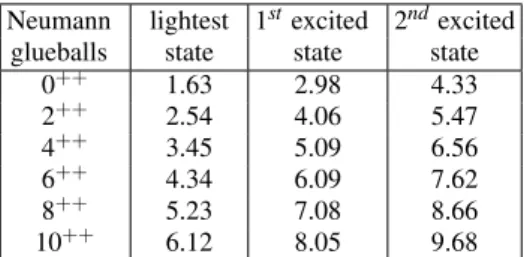
Neumann lightest 1stexcited 2ndexcited glueballs state state state
0++ 1.63 2.98 4.33 2++ 2.54 4.06 5.47 4++ 3.45 5.09 6.56 6++ 4.34 6.09 7.62 8++ 5.23 7.08 8.66 10++ 6.12 8.05 9.68
TABLE IV: Higher spin glueball masses in GeV with Neumann boundary condition. The value 1.63 is an input from lattice.
For Neumann boundary conditions for the statesJ++withJ=
2,4, ...,10 we found
α′= (0.26±0.02)GeV−2 ; α0 =0.80±0.40, (15) as shown in Figure 1.
5 10 15 20 25 30 35 40
2 4 6 8 10
M2 (GeV2)
J
FIG. 1: Spin versus mass squared for the lightest glueball states with Neumann boundary conditions from table IV. The line corresponds to the linear fit.
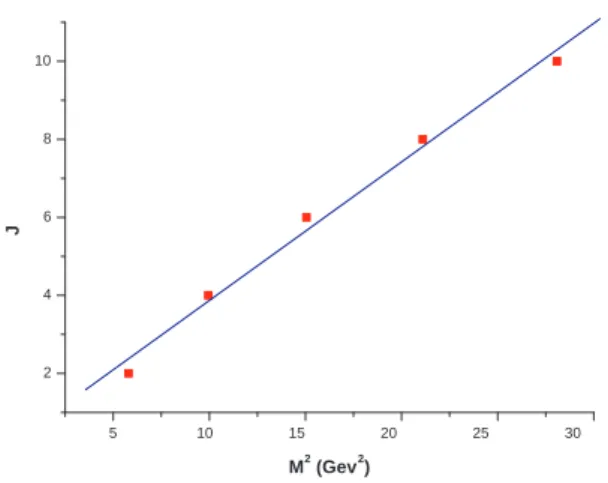
For Dirichlet boundary conditions, taking the statesJ++ with J=2,4, ...,10 we found a linear fit with
α′ = (0.36±0.02)GeV−2 ; α0=0.32±0.36, (16) as shown in Figure 2.
So, Neumann boundary conditions give a glueball trajec-tory consistent with that of pomerons, eq. (12). These kind of boundary conditions appear in the Randall Sundrum model[43] as a consequence of the orbifold condition.
V. WILSON LOOPS AND QUARK ANTI-QUARK POTENTIAL
5 10 15 20 25 30 2
4 6 8 10
J
M2 (Gev2)
FIG. 2: Spin versus mass squared for the lightest glueball states with Dirichlet boundary conditions from table III. The line corresponds to the linear fit.
ECornell(L) =− 4 3 a
L +σL+constant, (17) where ,a=0.39 andσ=0.182GeV2.
In the AdS/CFT correspondence Wilson loops for a heavy quark anti-quark pair in the conformal gauge theory can be calculated from a static string in the AdS space[44, 45]. The corresponding energy is a non confining Coulomb potential.
For an excellent review and extension to other metrics see [46].
We calculated Wilson loops for a quark anti-quark pair in D3-brane space finding different confining behaviors depend-ing on the quark position[47].
Recently we calculated[48] the energy of a static string in an AdS slice between two D3-branes with orbifold con-dition. The energy for configurations with endpoints on a brane grows linearly for large separation between these points. The derivative of the energy has a discontinuity at some crit-ical separation. Choosing a particular position for one of the branes we find configurations with smooth energy. In the limit where the other brane goes to infinity the energy has a Coulombian behaviour for short separations and can be iden-tified with the Cornell potential eq. (17). This identification leads to effective values for the string tension, the position of the infrared brane and the AdS radius
R =
r a 3σC2
1
=1.4 GeV−1, (18)
whereC1= √
2π3/2/[Γ(1/4)]2.
These results suggest an approximate duality between static strings in an AdS slice and a heavy quark anti-quark configu-ration in a confining gauge theory.
For other interesting results concerning gauge/string duality and QCD see for instance [49–59].
Acknowledgments
The authors are partially supported by CNPq and Faperj.
[1] M. B. Green, J. H. Schwarz, and E. Witten, “Superstring The-ory. Vol.1: Introduction,”, Cambridge, 1987.
[2] J. Polchinski, “String theory. Vol.1: An introduction to the bosonic string,” Cambridge 1998.
[3] V. A. Matveev, R. M. Muradian, and A. N. Tavkhelidze, Lett. Nuovo Cim.7, 719 (1973).
[4] S. J. Brodsky and G. R. Farrar, Phys. Rev. Lett 31 (1973) 1153; Phys. Rev. D11, 1309 (1975).
[5] J. Polchinski and M. J. Strassler, Phys. Rev. Lett.88, 031601 (2002).
[6] G. ’t Hooft, Nucl. Phys. B72, 461 (1974).
[7] J. Maldacena, Adv. Theor. Math. Phys.2, 231 (1998).
[8] S. S. Gubser , I.R. Klebanov, and A.M. Polyakov, Phys. Lett. B
428, 105 (1998).
[9] E. Witten, Adv. Theor. Math. Phys.2, 253 (1998).
[10] J. M. Maldacena and C. Nunez, Phys. Rev. Lett.86, 588 (2001). [11] I. R. Klebanov and A. A. Tseytlin, Nucl. Phys. B 578, 123
(2000).
[12] I. R. Klebanov and M. J. Strassler, JHEP0008, 052 (2000). [13] J. Polchinski and M. J. Strassler, “The string dual of a confining
four-dimensional gauge theory,” arXiv:hep-th/0003136. [14] E. Witten, Adv. Theor. Math. Phys.2, 505 (1998).
[15] C. Csaki, H. Ooguri, Y. Oz, and J. Terning, JHEP9901, 017 (1999).
[16] R. de Mello Koch, A. Jevicki, M. Mihailescu, and J. P. Nunes,
Phys. Rev. D58, 105009 (1998).
[17] A. Hashimoto, Y. Oz, Nucl. Phys. B548, 167 (1999).
[18] C. Csaki , Y. Oz, J. Russo, J. Terning, Phys. Rev. D59, 065012 (1999).
[19] J. A. Minahan, JHEP9901, 020 (1999).
[20] C. Csaki, J. Terning, AIP Conf. Proc.494, 321 (1999). [21] R. C. Brower, S. D. Mathur, C. I. Tan, Nucl. Phys. B587,249
(2000).
[22] H. Boschi-Filho and N. R. F. Braga, Phys. Lett. B560, 232 (2003).
[23] H. Boschi-Filho and N. R. F. Braga, Phys. Lett. B525, 164 (2002).
[24] S. B. Giddings, Phys. Rev. D67, 126001 (2003). [25] R. C. Brower, C. I. Tan, Nucl. Phys. B662, 393 (2003). [26] O. Andreev, Phys. Rev. D67, 046001 (2003).
[27] J. Polchinski and M. J. Strassler, JHEP0305, 012 (2003). [28] S. J. Brodsky and G. F. de Teramond, Phys. Lett. B582, 211
(2004).
[29] O. Andreev, Phys. Rev. D70, 027901 (2004). [30] O. Andreev, Phys. Rev. D71, 066006 (2005).
[31] H. Boschi-Filho and N. R. F. Braga, Eur. Phys. J. C32, 529 (2004).
[32] H. Boschi-Filho and N. R. F. Braga, JHEP0305, 009 (2003). [33] C. J. Morningstar and M. Peardon, Phys. Rev. D 56, 4043
[34] M.J. Teper, ”Physics from lattice: Glueballs in QCD; topology; SU(N) for all N ”, arXiv:hep-lat/9711011.
[35] E. Caceres and R. Hernandez, Phys. Lett. B504, 64 (2001). [36] R. Apreda, D. E. Crooks, N. Evans, and M. Petrini, JHEP0405,
065 (2004).
[37] X. Amador and E. Caceres, JHEP0411, 022 (2004). [38] E. Caceres and C. Nunez, JHEP0509, 027 (2005).
[39] G. F. de Teramond and S. J. Brodsky, Phys. Rev. Lett. 94, 201601 (2005).
[40] H. Boschi-Filho, N. R. F. Braga, and H. L. Carrion, Phys. Rev. D73, 047901 (2006).
[41] P. V. Landshoff, “Pomerons,”, published in “Elastic and Difrac-tive Scattering” Proceedings, Ed. V. Kundrat and P. Zavada, 2002, arXiv:hep-ph/0108156.
[42] H. B. Meyer and M. J. Teper, Phys. Lett. B605, 344 (2005). [43] L. Randall and R. Sundrum, Phys. Rev. Lett.83, 3370 (1999);
ibid.83, 4690 (1999).
[44] S. J. Rey and J. T. Yee, Eur. Phys. J. C22, 379 (2001). [45] J. Maldacena, Phys. Rev. Lett.80, 4859 (1998).
[46] Y. Kinar, E. Schreiber, and J. Sonnenschein, Nucl. Phys. B566, 103 (2000).
[47] H. Boschi-Filho and N. R. F. Braga, JHEP0503, 051 (2005). [48] H. Boschi-Filho, N. R. F. Braga, and C. N. Ferreira, Phys. Rev.
D73, 106006 (2006) [Erratum-ibid. D74, 089903 (2006)]. [49] R. A. Janik and R. Peschanski, Nucl. Phys. B565, 193 (2000). [50] R. A. Janik and R. Peschanski, Nucl. Phys. B586, 163 (2000). [51] R. A. Janik and R. Peschanski, Nucl. Phys. B625, 279 (2002). [52] L. A. Pando Zayas, J. Sonnenschein, and D. Vaman, Nucl. Phys.
B682, 3 (2004).
[53] O. Andreev and W. Siegel, Phys. Rev. D71, 086001 (2005). [54] F. Bigazzi, A. L. Cotrone, L. Martucci, and L. A. Pando Zayas,
Phys. Rev. D71, 066002 (2005).
[55] J. Erlich, E. Katz, D. T. Son, and M. A. Stephanov, Phys. Rev. Lett.95, 261602 (2005).
[56] L. Da Rold and A. Pomarol, Nucl. Phys. B721, 79 (2005). [57] N. Evans, J. P. Shock, and T. Waterson, Phys. Lett. B622, 165
(2005).
[58] S. J. Brodsky and G. F. de Teramond, AIP Conf. Proc.814, 108 (2006).