Article
Printed in Brazil - ©2012 Sociedade Brasileira de Química0103 - 5053 $6.00+0.00
A
*e-mail: [email protected]
Synthesis and Characterization of Polyesters from Glycerol by-Product of
Biodiesel Production
Carla V. Rodarte de Moura,* Antonia S. L. Nunes, Jose M. Moita Neto, Haroldo L. S. Neres, Lee M. G. de Carvalho and Edmilson M. de Moura
Departamento de Química, Universidade Federal do Piauí, 64049-550 Teresina-PI, Brazil
Glicerol, um sub-produto da produção de biodiesel, pode reagir com ácidos di-carboxílicos, resultando em poliésteres, e ser usado na composição de resinas do tipo uréia/formaldeído ou fenol/formaldeído para melhorar as qualidades de aderência e resistência à umidade dessas resinas. Neste trabalho, foram sintetizados seis tipos de resinas derivadas do glicerol, sendo nomeadas GAA (glicerol/ácido adípico), GAAU (glicerol/ácido adípico/uréia), GAF (glicerol/ácido ftálico), GU (glicerol/uréia), GUF (glicerol/uréia/formaldeído) e GF (glicerol/formaldeído). As resinas derivadas dos ácidos carboxílicos tiveram melhor estabilidade térmica (até 350 ºC) do que as resinas derivadas do formaldeído (até 200 ºC). As massas moleculares médias das resinas foram determinadas por espectrometria de massas por tempo de vôo acoplada à ionização dessortiva de matriz por laser (MALDI-TOF MS) e cromatografia de permeação em gel (GPC), e encontram-se na faixa de 1800-2800 Da, sendo portanto, oligômeros, e os índices de polidispersão no intervalo de 1,3 a 1,8. As técnicas de ressonância magnética nuclear (NMR) de 1H e 13C foram usadas para
identificar as estruturas das resinas.
Glycerol, a by-product from biodiesel production can react with di-carboxylic organic acids, resulting in polyesters, and can be used in the composition of urea/formaldehyde or phenol/ formaldehyde resins to improve the qualities of adhesion and moisture resistance of them. In this work, six kinds of resins derived from glycerol, named as GAA (glycerol/adipic acid), GAAU (glycerol/adipic acid/urea), GAF (glycerol/phtalic acid), GU (glycerol/urea), GUF (glycerol/ urea/formaldehyde) and GF (glycerol/formaldehyde), were synthesized. The resins derived from carboxylic acids had better thermal stability (up to 350 ºC) than those derived from formaldehyde (up to 200 ºC). The average molecular weights of the resins were determined by matrix assisted laser desorption ionization time-of-flight mass spectrometry (MALDI-TOF MS) and gel-permeation chromatography (GPC), and are in the range of 1800-2800 Da, being oligomers, and the polydispersity indexes are in the range of 1.3 to 1.8. The 1H and 13C nuclear magnetic resonance
(NMR) techniques were used to identify the structure of the resins.
Keywrods: glycerol, resins, biodiesel
Introduction
The prospect of shortages and the damage, which is causing the pretroleum to the environment, has contributed to the new emerging areas of interest and research opportunities, based on the use of biomass because of its renewable nature,
availability, biodegradability and low cost.1-3 Questions about
renewable resources, which may replace, at least in part, the fossil fuels, climate change and energy security coupled with sustainable development, have been discussed all over
the world to minimize the effects of global warming.4,5
Renewable fuels are very promising alternatives to replace the petroleum, especially biodiesel, which can be obtained by the transesterification of vegetable oils or animal fats. This reaction produces alkyl esters and glycerin, that is
the most important by-product of biodiesel production.6
Transesterification of vegetable oils generate about
10 m3 of glycerin for every 90 m3 of biodiesel produced,
and approximately 200,000 m3 per year are estimated
to be produced only in Brazil by 2013.4 According to
Gonçalves et al.7, these values are very high for consumption
in the Brazilian market of approximately 35,000 m3 per
year. According Zhou et al.,8 the market of glycerin is very
a sharp decline of over 60% of its value. The commercial viability of biodiesel is complicated because now the market has an absorption limit for growing supply of glycerin. It is
necessary to find new applications for this product,9-11 and
value added to glycerin generated, otherwise this by-product could undermine the economic viability of any production
process of biodiesel as renewable fuel.5,7
The utilization of glycerol as a chemical platform represents an opportunity to obtain value added products from a highly functionalized and cheap raw material, and much research has been recently dedicated to find new chemical pathway for the glycerol transformation to value added products.
Glycerol is a molecule used for production of polymers due to their polyfunctional reactivity. The glycerol polymers produced can have different applications, as polyols substitutes, polivinylic alcohol, lubricant, row materials to produce resins
and polyurethanes.12 Glycerol can be a plasticizer agent when
added to phenolic composite and can increase the elasticity and toughness of the phenolic materials. The presence of glycerol in the phenolic network reduces the characteristic brittleness of phenolic resins by decreasing to cross-link density of the
cure composites.13 The glycerol can react with di-carboxylic
organic acids, resulting in polyesters.
The esters derived from the phthalic acids have found many applications. For instance, poly(ethylene terephtalate) (PET) has excellent mechanical properties and is used for the manufacturing of plastic bottles for carbonated
beverages (soft drinks, etc.).13 Poly(butylene therephtalate)
(PBT) can be used for a wide range of applications, for example, for thin-walled injection-moulded parts in electrical engineering applications, for especially dimensionally stable components of high surface quality in the automotive industry, as a barrier layer in multilayer
fuel lines, and in the cable industry.14 PBT is also used in
plug-in connectors, connector strips, switching systems, housings for automatic cut-outs, capacitor pots, in coil formers, lamp parts, PC fans, power supply components, parts for electric drives, sheathing for waveguides and many other products and not least in vehicle electrical
systems (ignition coil housing).14 The preparation of
polyesters from multi-functional phenols and phthalic acid gave rise to production of gas separation membranes with
good selectivity coefficients.15 Therefore, the production
of polyesters from glycerol and phthalic acid should produce new materials for the preparation of desalination membranes and as modifiers for polyurethane foams.
Adhesives based on urea-formaldehyde (UF) are widely employed in the industries of wood panels. According to
Roffael and Schneider,16 90% of plates crowded around
the world are produced with the resin urea-formaldehyde.
However, this adhesive has very limited resistance to
moisture.16
The polyols such as glycerol can be used in the composition of urea/formaldehyde or phenol/formaldehyde resins to improve the qualities of adhesion and moisture resistance of them. Therefore, this work aimed to synthesize resins based on glycerin, phtalic acid, adipic acid, urea and formaldehyde with the possibility of their application on the composite factory, mainly in the furniture sector.
Experimental
Material and instrumentation
The glycerol, urea and formaldehyde were 99.5 and 38% of purity and purchased by Vetec (Duque de Caxias-RJ, Brazil). The adipic and phytalic acid were purchased by Riedel-de Haen AG (Seelze, Hannover, Germany) with 99.5% of purity. All the reagents were used without further purification.
Fourier transform infrared (FTIR) analysis of resins was performed using a confocal microscope equipment Raman/FTIR. The spectra were obtained with resolution of
4 cm-1 and wavenumber between 4000-400 cm-1. Nuclear
magnetic resonance (NMR) spectra were obtained using an INOVA-500 spectrometer at a resonance frequency of
500 MHz. DMSO-d6 was used as solvent as well internal
standard to run the spectra of resins. Thermogravimetric analysis (TGA) were obtained on TA Instruments equipment, model TGA 2050. The experiments were performed using a pan of aluminum, with mass ranging from 5.3 to 9.4 mg under a nitrogen atmosphere with flow
rate 150 mL min-1. The temperature range was 25-600 °C
using a heating rate of 10 °C min-1. Differential scanning
calorimetric (DSC) curves were obtained in equipment from TA Instruments, DSC 2920, the type of heat flow
conducted in an N2 atmosphere, under a flow rate of 80 mL
min-1. The range of temperature was 25-600 °C with a
heating rate of 10 °C min-1. The molecular weights of the
resins were measured by gel-permeation chromatography (GPC) on a HP-1090M, equipped with a UV-diode array detector and a Viscotek differential viscosimeter detector, model 200 (SEC-DV). PS standards were used for the universal calibration. The solvent/eluent was THF, the flow
rate was 1.0 mL min-1, and 4 PL-gel Mixed C columns
were applied by matrix assisted laser desorption ionization time-of-flight mass spectrometer (MALDI-TOF MS) using the equipment Voyager-DE STR (Applied Biosystems, Foster City, CA) under optimized conditions in reflectance mode. MALDI was made by irradiating the sample with
dissolved in methanol before injection in the equipment
with a concentration of 1×10⁻⁴ mmol mL-1.
Synthesis of resins
Six kinds of resins were synthesized based on glycerol (Table 1) according to methods adapted from the literature.14,17,18
The reagents with different molar ratios (Table 1) were added into a beaker, and heated to 160 °C under constant magnetic stirring. No substance was added as the function of catalyzing, initiating or terminating the reaction. After the reaction time, which ranged as shown in Table 1, the resins were collected and left in the oven for 2 h at 103 ± 2 °C for evaporation of volatile residuals, and then cooled at room temperature.
Results and Discussion
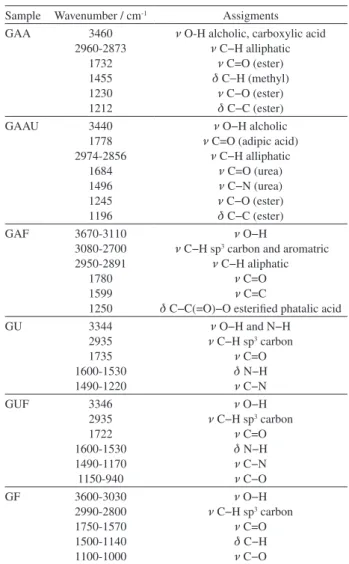
The main absorptions bands in the infrared region of the resins synthesized in this study are shown in Table 2.
The esterification of glycerol with phthalic and adipic acids was confirmed by the presence of the bands 1732,
1230, 1780 and1250 cm-1. The absence of absorption
at 1711 cm-1 (assigned to –COOH) evidenced that the
esterification reaction was almost complete for the poliesters derived from phtalic acid, adipic acid and urea.
Through the NMR spectra and the study described
by Stumbo and Bruchmann,19 it was possible to propose
structures of resins. Beside, the ChemBioDraw software
were used to simulate the spectra of 1H NMR. The simulate
and the real 1H NMR and 13C NMR spectra of the resin
GAF are shown in Figure 1.
1H NMR of GAF resin showed chemical shifts at
d 3.29-4.90 and 5.17, so they are attributed to displacement
of first and third hydrogen and central hydrogen of glycerol molecule, respectively. The chemical shift of central
hydrogen was observed in the spectrum of triacetin,20,21
and it was attributed to hydrogen connected to secondary carbon for glycerol carbonate. The same displacement was
observed in simulate structures.The displacements at d 7.65
and 7.74 were attributed to hydrogen from aromatic ring.
The 13C NMR spectrum of GAF presents signals at 63.5 and
72.9 that are attributed to carbons of glycerol. Besides that, the spectrum presents signals at 129.3, 130.1, 136.4 and 175.9, attributed to carbons of aromatic ring and carbonyl. The chemical shifts found to the others resins obtained in this study are showed in Table 3.
The analysis of data taken from the mass spectrum using the software Origin allowed the determination of the weight average molecular weight (Mw), number average molecular weight (Mn) and polydispersity (DPI). The results can be seen in Table 4. The values of Mw and PDI
were lower than those found by Stumbo and Bruchmann.19
MALDI-TOF spectrum of GAF and GUF resins are shown in Figure 2. It could make a size estimate of the resins chain from the Mw and GAF resin is approximately 15 monomers
whereas the monomer is 74 Da per unit, ant they may
correspond to a fragment from the glycerin. The GUF
resin is approximately 10 monomers, also with 74 Da per
Table 1. Molar ratio of resins and reaction time
Resin Molar ratio Reaction time / h
GAA 1:1 (glycerol/adipic acid 2.5
GAAU 3:2.5:0.5 (glycerol/adipic acid/urea) 2.5 GAF 1:1 (glycerol/phtalic acid) 2.5
GU 1:2 (glycerol/urea) 2.5
GUF 1:1:1.8 (glycerol/urea/formaldehyd) 3
GF 1:1.1 (glycerol/formaldehyd) 3
Table 2. Main absorption bands in the infrared region
Sample Wavenumber / cm-1 Assigments
GAA 3460 2960-2873 1732 1455 1230 1212
nO-H alcholic, carboxylic acid
nC−H alliphatic
n C=O (ester)
dC−H (methyl)
nC−O (ester)
d C−C (ester)
GAAU 3440 1778 2974-2856 1684 1496 1245 1196
n O−H alcholic
nC=O (adipic acid)
nC−H alliphatic
n C=O (urea)
n C−N (urea)
n C−O (ester)
d C−C (ester)
GAF 3670-3110 3080-2700 2950-2891 1780 1599 1250
n O−H
nC−H sp3 carbon and aromatric
n C−H aliphatic
nC=O
n C=C
dC−C(=O)−O esterified phatalic acid
GU 3344
2935 1735 1600-1530 1490-1220
n O−H and N−H
n C−H sp3 carbon
n C=O
d N−H
n C−N
GUF 3346 2935 1722 1600-1530 1490-1170 1150-940
n O−H
n C−H sp3 carbon
n C=O
d N−H
n C−N
nC−O GF 3600-3030 2990-2800 1750-1570 1500-1140 1100-1000
n O−H
n C−H sp3 carbon
n C=O
d C−H
Figure 1. The 1H NMR simulate spectrum (A), 1H NMR real spectrum (B), 13C NMR real spectrum (C) of the resin GAF.
Table 3. NMR results
sample d1H NMR d13C NMR Assigments
GAA 1.51(1), 2.30(2), 3.33(3), 4.21(4), 5.15(5)
33.5(1), 24.2(2), 63.5(3), 72.9(4), 174.2(5)
GAAU 1.51(1), 2.30(2), 3.33(3), 4.20(4), 5.17(5), 5.35(7), 6.69(7)
33.5(2), 24.2(1), 65.8(3), 67.4(4), 72.9(5), 161.9(8), 175.0(9)
GAF 7.64(1), 7.76(2), 3.40-5.64(4,5,6) 129.3(1), 132.1(2), 136.4(3), 63.5(4), 72.9(5), 175.0(7)
GU 2.95-4.77(1,2), 5.98(3), 6.27(4) 67.6(1), 71.2(2), 158.9(5)
GUF
3.31-3.60(3,8,9), 4.43-4.71(1,2,4,6,7), 5.65(12)
65.7(1,4), 69.9(2), 156.4(5), 70.9 (6), 65.8(7), 38.3(9), 155.9(10), 176.2(11)
GF 3.89(2), 3.75(3), 3.09(4), 3.54(5) 157.8 (1-6), 63.5 (2,5), 72.9(3)
unit. We observed that all the resins are oligomers, and
have an average molecular weight below 10,000 g mol-1.
It was possible through the results of analysis of spectra obtained by MALDI-TOF realize that the average lengths of chains synthesized resins are more regularly when they are formed from dicarboxylic acids.
differ by 0.05-0.15% from those determined by MALDI TOF experiments. Thus, these results are very near and showed that the method using results obtained by MALDI-TOF and calculated by Origin software could be used to calculate the molecular weights of resin. The results of TGA and DSC curves from resins can be divided into two classes, one comprising the resins GAA,
GAAU and GAF (1st class) and the other comprising the
resins GU, and GF GUF (2nd class). The first class present
a profile as showed in Figure 3, curves with one step of mass loss and the DSC curves present one step with an endothermic peak. The endothermic peak is correlated to the following temperatures and mass loss, GAA 380.61 ºC (96%), GAAU 425.71 ºC (95%), and GAF 377.63 ºC (97%).
Those results can be compared with Zorba et al.,22 in which
the decomposition of the resins occurred at 379, 385º and 412 ºC. A small peak below 100 ºC was attributed to small
molecules as water,23 this peak corresponds to about 1% of
loss mass. When the TGA curves from GAA and GAAU we can observe that temperature of resin degradation increases, being attributed to addition of urea to resin.
The second class of resins that comprehends glycerol, urea and formaldehyde showed two steps of degradation in TGA and DSC curves with endothermic peaks. An example of profile is showed in Figure 4. The first step is correlated to the following temperatures and mass loss:
Figure 2. MALDI-TOF spectra of resins (A) GAF and (B) GUF.
Table 4. Weight average molecular weight (Mw), number average molecular weight (Mn) and polydispersity index (DPI) of resins investigated in this work
Resin Mw / (g mol-1)a M
n / (g mol-1)a DPIa Mw / (g mol-1)b Mn / (g mol-1)b DPIb
GAA 4.966 3.378 1.47 5.143 3.127 1.64
GAAU 3.610 2.170 1.66 4.375 2.697 1.62
GAF 4.134 2.730 1.51 4.603 3.012 1.53
GU 2.183 1.734 1.26 2.303 1.964 1.17
GUF 2.234 1.709 1.31 2.080 1.302 1.59
GF 3.165 2.212 1.43 3.300 2.375 1.39
aMolecular weight determined from MALDI-TOF using Origin software; bmolecular weight determined from GPC.
Figure 3. TGA, DTA and DSC curves of GAA resin.
GU, 200-450 °C (34 and 58.7%); GUF, 200-400 °C (23 and
71.5%); GF, 180-280 oC (88 and 11%).
Conclusions
The polymerization between glycerol, bi-functional and mono-functional organic groups proved to be an efficient method for the production of new polymers. The NMR and MALDI-TOF techniques allowed to identify structures and molecular weights of the resins studied in this work. The resins are made all within the class of oligomers. TGA
and DSC results suggested that the 1st class of resins has
good thermal stability (up to 350 ºC) and the 2nd one has
an intermediate thermal stability (up to 200 ºC).
The use of these materials for the development of composites derived from natural fibers will be considered and is going to be a topic of research in our research group soon.
Acknowledgments
The authors would like to thank the Brazilian agencies, CAPES (Coordenação de Aperfeiçoamento de Pessoal de Nível Superior), CNPq (Conselho Nacional de Desenvolvimento Científico e Tecnológico), FINEP (Financiadora de Estudos e Projetos) and FAPEPI (Fundação de Amparo à Pesquisa do Estado do Piauí) for their financial suporte. We would like to thank Dr. Donald J. Darensbourg and Texas A&M University for the results from MALDI-TOF and GPC.
References
1. Chandra, R.; Rustgi, R.; Polym. Degrad. Stab. 1997, 56, 185. 2. Vichi, F. M.; Mansor, M. T. C.; Quím. Nova2009, 32, 757.
3. Galembeck, F.; Barbosa, C. A. S.; Sousa, R.; Quím. Nova 2009, 32, 571.
4. Mota, C. J. A.; Silva, C. X. A.; Gonçalves, V. L. C.; Quím. Nova 2009,32, 639.
5. Dabdoub, M. J.; Bronzel, J. L.; Rampim, M. A.; Quím. Nova 2009,32, 776.
6. Medeiros, M. A.; Araujo, M. H.; Augusti, R.; Oliveira, L. C. A.; Lago, R. M.; J. Braz. Chem. Soc. 2009,20, 1667. 7. Gonçalves, V. L. C.; Pinto, B. P.; Silva, J. C.; Mota, C. J. A.;
Catal. Today2008,133-135, 673.
8. Zhou, C.-H.; Beltramini, J. N.; Fan, Y.-X.; Lu, G. Q. M.; Chem. Soc. Rev.2008,37, 527.
9. Adhikari, S.; Fernando, S.; Haryanto, A.; Energy Fuels2007, 21, 2306.
10. Adhikari, S.; Fernando, S.; Haryanto, A.; Catal. Today2007, 129, 355.
11. Byrd, A. J.; Pant, K. K.; Gupta, R. B.; Fuel2008,87, 2956. 12. Medeiros, M. A.; Rezende, J. C.; Lago, M. R.; Polímeros2010,
20, 188.
13. Cardona, F.; Ku, H.; Chouzenoux L. J.; J. Reinf. Plast. Compos. 2010, 29, 3543.
14. Guimaraes, D. H.; Brioude, M. M.; Fiuza, R. P.; Prado, L. A. S. A.; Boaventura, J. S.; Jose, N. M.; Mater. Res.2007, 10, 257.
15. Bucio, E.; La-Estevez, J. C. I.; Ruiz-Trevino, F. A.; Acosta-Huerta, A.; Polym. Bull.2006, 56, 163.
16. Roffael, E.; Schneider, A.; Holz Roh-Werkst.1983, 1, 221. 17. Schneider, A.; Roffael, E.; May, H. A.; Holz Roh-Werkst.1982,
40, 339.
18. Eleotério, J. R.; Tomazello Filho, M.; Bortoletto Jr., G.; Ciência Florestal2000, 10, 75.
19. Stumble, J. F.; Bruchaman, B.; Macromol. Rapid Commun. 2004, 25, 921.
20. Garcia, E.; Laca, M.; Perez, E.; Garrido, A.; Peinado, J.; Energy Fuels2008, 22, 4274.
21. Rokicki, G.; Rakoczy, P.; Parzuchowski, P.; Sobiecki, M.; Green Chem. 2005, 7, 529.
22. Zorba, T.; Chrissafis, K.; Paraskevopoulos, K. M.; Bikiaris, D. N.; Polym. Degrad. Stab.2007, 92, 222.
23. Brioude, M. M.; Guimarães, D. H.; Fiuza, R. P.; Prado, L. A. S. A.; Boaventura, J. S.; Jose, N. M.; Mat. Res.2007, 10, 335.
Submitted: September 20, 2011