Printed in Brazil - ©2005 Sociedade Brasileira de Química 0103 - 5053 $6.00+0.00
Short Repport
* e-mail: [email protected]; [email protected]
Preparation of Phenazine
N
5,
N
10-Dioxides. Effects of Benzofuroxan Substituents in the
Outcome of their Expansion Reaction with Phenolates
Hugo Cerecetto*, Mercedes González*, M. Laura Lavaggi and Williams Porcal
Departamento de Química Orgánica, Facultad de Química-Facultad de Ciencias, Universidad de la República, Iguá 4225, 11400, Montevideo, Uruguay
Os efeitos mesoméricos do substituintebenzofuroxano, na preparação de N5,N10-dióxidos de
fenazina são descritos. As características eletrônicas do substituinte na posição 5 dos benzofuroxanos
determinam a proporção dos isômeros 7 e 8 dos N5,N10-dióxidos de fenazina, quando fenóis
substituídos são usados.
The mesomeric effects of the benzofuroxan substituent in the preparation of phenazine N5,N10
-dioxides are described. The electronic characteristics of the substituent in 5-substituted benzofuroxans determine the ratio of the 7- and 8-isomers of phenazine N5,N10-dioxides when substituted phenols
are used.
Keywords: phenazine N5,N10-dioxide, benzofuroxan tautomerism, mesomeric effect
Introduction
It is well known that phenolate anions react with
benzo[1,2-c]1,2,5-oxadiazole N-oxides (benzofuroxans) to
afford phenazine N5,N10-dioxide derivatives.1,2 These are
obtained through an heterocycle expansion process by reaction of the corresponding 1,2,5-oxadiazole system with the phenolate carbanion generated in basic medium attacking one of the heterocyclic nitrogen (Figure 1). When substituted benzofuroxans and phenolates are used, the reactions yield a
mixture of 6- and 9- or 7- and 8-isomers.3-5
The formation of the isomers is the result of the well
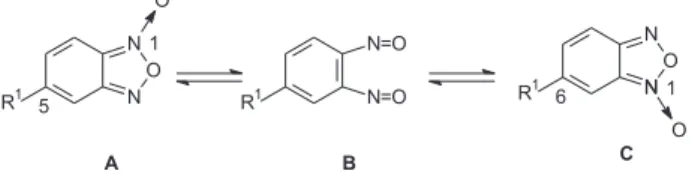
known tautomerism of the benzofuroxans6,7 (i.e. Figure 2),
thus the tautomeric forms can react with the carbanion in a
non-selective fashion and with similar probability. However, each tautomeric form has different stability and electrophilic capacity.
Recently, the synthetic procedure shown in Figure 1
was used to develop a series of phenazine N5,N10-dioxide
derivatives as new hypoxic selective cytotoxic agents.8 In
this synthetic approach, benzofuroxans with different 5-substituents, electron withdrawing and electron releasing moieties, were employed as the starting material. A mixture of the corresponding 7- and
8-substituted-2-amino-phenazine N5,N10-dioxide was obtained when p
-amino-phenol was used as the -amino-phenolate source and a mixture of
7- and 8-substituted-2-hydroxyphenazine N5,N10-dioxide
was obtained when p-hydroquinone was used (Table 1). It
was observed that the proportion of isomers was highly dependent on the substituents electronic characteristics.
The existence of benzofuroxan as a mixture of isomers at
room temperature (i.e.A, B and C tautomers in 5(6)-substituted
benzofuroxans, Figure 2) has been intensively studied by
different techniques.9-17 Thermodynamic equilibrium
Figure 1. General procedure for the phenazine N5,N10-dioxide
de-rivatives synthesis.
concentrations are dependent on a number of factors, such as solvent, temperature, nature and position of the substituents
on the ring.6,7,18-22 Under the same conditions (solvent and
temperature) in 5(6)-substituted benzofuroxans the presence of an electron withdrawing group generally favors the 6-tautomer over the 5-6-tautomer while the opposite occurs with
an electron releasing group.23-25 In our knowledge, studies
related to benzofuroxan tautomerism and reactivity have not been described. On the other hand, in the preparation of
phenazine N5,N10-dioxide derivatives from benzofuroxan,1-5
the effect of the benzofuroxan substituent on the isomeric
proportion of the products has not been studied.26
Herein, we present our results on the benzofuroxan tautomerism on the 1,2,5-oxadiazole-expansion process
to obtain phenazine N5,N10-dioxide derivatives. By
analysis of the reaction mixture products of 5(6)-nitro-benzofuroxan, it has also been demonstrated that the
1,2,5-oxadiazole heterocycle (tautomer A or C, Figure 2) is the
electrophilic species in this process. Theoretical calculation, using the density functional theory (DFT) approach, were performed in order to determine the electrophilic center in each tautomer. These were in agreement with the experimental results.
Results and Discussion
The expansion process was performed, as previously
reported,5 with sodium methoxide as the base, the mixture of
the benzofuroxan derivative27-30 and the corresponding
phenol in MeOH:THF as the solvent at low temperature. Under these conditions, the products were obtained in moderate yield, except for the highly reactive 5(6)-nitro-benzofuroxan, which produced a complex mixture of products and a low yield of the desired heterocycle (Table 1).
Although, it could be assumed that the carbanion phenolate reacted non regioselectively with each tautomeric form, clear isomeric preferences were observed
according to the stability of the tautomers A and C at the
reaction temperature. Under the reaction conditions, the
isomeric mixture of phenazine N5,N10-dioxides
precipitated as a mixture which could not be separated neither by crystallization nor by chromatographic methods.
The isomeric proportion, was established by 1H NMR
analysis of the precipitates (Table 2) analyzing the
integrations of 8-H, in 7-substituted phenazines, and 7-H,
in 8-substituted phenazines, for each isomer. As shown in
Figure 3, 7–H and 8-H in the 8-substituted isomers result
hardly affected, by 2-NH2 or 2-OH electron releasing
moieties. This fact together with the chemical shifts of 7-H
and 8-H (Figure 3b) allowed to analyze the isomeric
proportion in derivatives 1-12.
Clearly, the isomeric ratios in the expansion processes were dependent on the benzofuroxan substituent
electronic effect. When p-hydroquinone is used as the
phenolate, the effects resulted clearly important, i.e. an electron releasing group as the methoxy and an electron withdrawing group as the nitro generated only one compound, the 7- and the 8-isomers, respectively. Table 1. Yield and spectroscopic characteristics of precipitated phenazine N5,N10-dioxide
Ref. -X -R Yield δ of characteristic Ref. -X -R Yield δ of characteristic
(%)a protons b (%)a protons b
8-H or 7-H 1-H 8-H or 7-H 1-H
1 -NH2 -OCH3 45 7.48 (8-H)c 7.39 7 -OH -OCH
3 40 7.54 (8-H)
c 7.69
2 -NH2 -CH3 46 7.66 (8-H)c 7.38 8 -OH -CH
3 42 7.71 (8-H)
f 7.59
3 -NH2 85 7.75 (8-H)
c 7.40 9 OH 47 7.84 (7-H)f 7.74
4 -NH2 -Cl 40 7.83 (8-H)c 7.35-7.39 (1-H+3-H) 10 -OH -Cl 37 7.91 (8-H)c 7.72
5 -NH2 -Br 40 8.00 (8-H)d 7.42-7.47 (1-H+3-H) 11 -OH -Br 40 7.95 (8-H)f 7.70
6 -NH2 -NO2 7 8.44 (7-H)e 8.46 12 -OH -NO
2 5 8.42 (7-H)
e 8.44 a Yield of benzofuroxans to phenazines transformations according to it is described in the text. The yields correspond to precipitated phenazine; b For the main isomer; in ppm; c In DMSO-d
6; d In CD
3OD:D2O (1:1); e In CD
3OD.
f In DMSO-d
et al. J. Braz. Chem. Soc.
Therefore, the electronic effects of the substituent define, in the reaction medium, the position of the benzofuroxan tautomeric equilibria so they define the predominant electrophilic species. In these species the electrophilic atom is the nitrogen 1 in each tautomer (Figure 4a). These electrophilic preferences could be explained via a
substituent mesomeric process (i.e. Figure 4b). Thus,
electron releasing substituents decrease the electrophilic characteristic of the benzofuroxan nitrogen at position 3 in the favored 5-substituted tautomers. However, electron withdrawing substituents increase the electrophilic characteristic of benzofuroxan nitrogen at position 1 in
the mesomerism-stabilized 6-substituted tautomers.The
relevance of the electronic properties of the substituent in the isomeric ratio was tested studying the relationships between the proportion of 7-isomer in each reaction and the substituent inductive or mesomeric effect (expressed
as Hammett constants, σ, or Swain-Lupton constants, R
and F). Thus, phenazine N5,N10-dioxide isomeric
distribution, expressed as the proportion of the 7-isomer, was linearly related to the Hammett benzofuroxan
substituent σp (Table 2, Figure 5, inset graphics).
31-33 In
the amino-derivatives a better correlation was observed
between σp and the proportion of 7-isomer (r= -0.9032,
s= 0.1514, p=0.0136) than for hydroxy-derivatives (r=
-0.8254, s= 0.1990, p= 0.0431). Because
“through-conjugation” could be operative in the expansion
processes, the correlations between σp-and σp
+ substituent
constants and the proportion of the 7-isomer were
analyzed.34 For the amine derivatives the substituent
resonance-electron-withdrawing effects (expressed as σp
_)
did not correlate adequately to the proportion of the
7-isomers as did σp constants (r= -0.8463, s= 0.3300, p=
Figure 3. a)7- and 8-Proton chemical shifts in derivatives 6 and 8; b) Selected region of 1H NMR spectra of derivative 10 showing
7- and 8-proton in isomer 8- and 7- respectively.
Table 2. Isomeric proportion of phenazine N5,N10-dioxide derivatives and Hammett constants used in the correlations
Ref. -X -R Proportion σpR σ-pR σ
+
pR Ref. -X -R Proportion
07-isomer : 8-isomers 07-isomer : 8-isomer
1 -NH2 -OCH3 9.5 : 0.5 -0.27 -0.26 -0.78 7 -OH -OCH3 10.0 : 0.0
2 -NH2 -CH3 7.0 : 3.0 -0.24 -0.17 -0.31 8 -OH -CH3 7.6 : 2.4
3 -NH2 6.5 : 3.5 -0.02a -0.00b 0.00b 9 -OH 3.5 : 6.5
4 -NH2 -Cl 6.3 : 3.7 0.14 0.19 0.11 1 0 -OH -Cl 6.6 : 3.4
5 -NH2 -Br 5.4 : 4.6 0.22 0.25 0.15 1 1 -OH -Br 6.4 : 3.6
6 -NH2 -NO2 4.0 : 6.0 0.57 1.27 0.79 1 2 -OH -NO2 0.0 : 10.0
a Sigma inductive of CH(OEt) 2 ref. 32;
0.0336). For the hydroxyl-derivatives, improvements in the statistical parameters were obtained in the correlation
between σp- and the 7-isomer proportions (r= -0.8610,
s= 0.3151, p= 0.0276). However, the 7-isomer proportions
correlate better with the σp
+ parameters than with the σ
p
(see Figure 5). This could be indicative that the substituent resonance-electron-donating effect is operative in the benzofuroxan expansion processes.
The participation of tautomer B (Figure 2) as the
electrophilic species in the reactions was rejected according to the results obtained in the yield optimization studies of the reaction involving 5(6)-nitro-benzofuroxan. Attempts to improve the yield in the
preparation of derivative 6 were done using Et3N as base
under different conditions (Table 3). The use of Et3N at
room temperature was optimal for the preparation of 6. In
all cases a complex mixture of products was obtained.
Compound 13 and 4-amino-2-nitrophenol were also
isolated, together with compound 6 (Figure 6).
Compound 13 was the SNAr product of the reaction
between the hard electrophilic 6–carbon, due to the
presence of the nitro moiety, and the phenolate. The 4-amino-2-nitrophenol could be regarded as the product of the nucleophilic attack of the carbanion at the nitrogen in position 1 in the cyclic tautomer producing
intermediate (X) (Figure 6) followed by a fragmentation
process.
In order to corroborate the electrophilic capacity of the nitrogen atoms of the three tautomers of
5(6)-substi-tuted benzofuroxan (A, B, and C, Figure 2), atomic
charges (as natural charges) on oxadiazole’s nitrogen atoms were calculated for nitro and methoxy derivatives.
Figure 4. a)Proposed nucleophilic attack on different substituted benzofuroxans; b) Substituted benzofuroxan mesomeric processes.
Figure 5. a)Isomeric proportion vs substituent σp
+ constant (inset: isomeric
proportion vs substituent σp) for reaction between benzofuroxan
deriva-tives and p-aminophenol; b) Isomeric proportion vs substituent σp +
con-stant (inset: isomeric proportion vs substituent σp) for reaction between
et al. J. Braz. Chem. Soc.
The results, Figure 7, showed that the most positive
nitrogen was nitrogen 1 on tautomer A for nitro
derivative and nitrogen 1 on tautomer C for methoxy
derivative, being nitroso nitrogens marginal in their
electrophilic capacities (tautomers B).
In conclusion, the mesomeric effects of the 5-substituent of the benzofuroxan determine the 7:8
isomeric proportion of the isolated phenazine N5,N10
-dioxide when p-aminophenol or p-hydroquinone are used
as the nucleophilic agents.
Experimental
General
All starting materials were commercially available research-grade chemicals and were used without further purification. All solvents were dried and distilled prior to Table 3. Conditions for the preparation of derivative 6
Conditions Yield (%) Other products
derivative 6 (Yield / %) MeONa/MeOH/-10 ºC 7 4-amino-2-nitrophenol a
Et3N/0 ºC 9 4-amino-2-nitrophenol, 13
Et3N/room temperature 1 5 4-amino-2-nitrophenol (22),
13 b(13)
Et3N/0 ºC to 60 ºC Decomposition
a Characterized by NMR spectroscopy and X-ray crystallographic
studies; b According to 1H NMR and MS data (see Figure 6).
Figure 6. Proposed 4-amino-2-nitrophenol generation from 5-nitrobenzofuroxan and p-aminophenol.
use. All the reactions were carried out under a nitrogen atmosphere. The typical work-up included washing with brine and drying the organic layer with sodium sulfate. Infrared spectra were recorded on a Perkin Elmer 1310 apparatus, using potassium bromide tablets, the frequencies
are expressed in cm-1. Elemental analyses were obtained
from vacuum-dried samples (over phosphorus pentoxide at 3-4 mm Hg, 24 h at room temperature) and performed on a Fisons EA 1108 CHNS-O analyzer, and were within ± 0.4%
of theoretical values. 1H NMR and 13C NMR spectra were
recorded on a Bruker DPX-400 (at 400 MHz and 100 MHz) instrument, with tetramethylsilane as the internal reference and in the indicated solvent; the chemical shifts are reported
in ppm. The 1H and 13C NMR signals reported were obtained
at room temperature. Bruker software was used to perform HMQC, and HMBC experiments. Mass spectra were recorded on a Shimadzu GC-MS QP 1100 EX instrument (electronic impact, 70 eV).
General procedure for the synthesis of phenazine N5,N10
-dioxide derivatives
A suspension of sodium methoxide was prepared (Na, 89.7 mg, 3.9 mmol, in 25.0 mL of anhydrous methanol) at –5 ºC under nitrogen. Then a mixture of benzofuroxan
(20.0 mmol), the corresponding phenol (p-aminophenol
or p-hydroquinone)(20.0 mmol), anhydrous methanol (5.0
mL) and anhydrous THF (30.0 mL) was added at –5 ºC during 15 minutes. The mixture was stirred at room temperature for 24 h. It was left stay at –20 ºC for 24 h. The resulting precipitate was collected by filtration and washed with small portions of methanol.
2-Hydroxy-8-nitrophenazine N5,N10-dioxide, 12
Green solid; mp > 240 ºC; IR νmax / cm
-1:3400, 1525,
1340, 1330; MS, m/z (%): 273 (M+., 1), 256 (4), 239 (4),
223 (5); Anal. (C12H7N3O5) C, H, N. 1H NMR (CD
3OD,
400MHz) δ 9.27 (1H, d, H9, J 2.2 Hz), 8.78 (1H, d, H6, J 9.5
Hz), 8.46 (1H, d, H4, J 9.6 Hz), 8.44 (1H, s, H1), 8.42 (1H, dd,
H7,J1 9.6 Hz, J2 2.3 Hz), 7.34 (1H, d, H3, J 9.9 Hz), 6.63 (1H,
s, OH). 13C NMR (HMQC-HMBC) (CD
3OD, 100MHz) δ
121.19, 115.54 (two carbons), 169.10, 149.80, 135.66, 134.00, 133.50, 131.74, 130.90, 127.80, 122.60.
Computational methods35-37
Calculations were performed with the Spartan’04 suit of
programs, version 1.0.1.38 First, the compounds were built
with standard bond lengths and angles. Adetailed
conformational distribution study was performed, byusing
mechanics force field (MMFF).The geometry of each
minimum energy conformer was fully optimised by applying PM3 in gas phase. Then the tautomers were fully optimized using the gradient-corrected density functional methodology. Becke’s exchange functional (B) and Becke’s three-parameter adiabatic connection (B3) hybrid exchange functional were used in combination with the Lee-Yang-Parr correlation functional. The standard 6-31G* basis set of DZP quality was used for orbital expansion to solve the Kohn-Sham equations for first and second-row elements.
Acknowledgments
Our research was supported by a grant from PEDECIBA. M.L.L. and W.P. are PEDECIBA students.
References
1. Haddadin, M. J.; Issidorides, C. H.; Heterocycles 1976, 4, 769. 2. Haddadin, M. J.; Issidorides, C. H.; Heterocycles 1993, 35,
1503.
3. Issidorides, C. H.; Haddadin, M. J.; J. Org. Chem. 1966, 31, 4067.
4. Abu El-Haj, M. J.; Dominy, B. W.; Johnston, J. D.; J. Org. Chem. 1972, 37, 589.
5. Ludwig, G. -W.; Baumgartel, H.; Chem. Ber. 1982, 115, 2380. 6. Boulton, A. J.; Katritzky, A. R.; Sewell, M. J.; Wallis, B.; J.
Chem. Soc. B 1967, 9, 914.
7. Boulton, A. J.; Halls, P. J.; Katritzky, A. R.; J. Chem. Soc. B
1970, 636.
8. Cerecetto, H.; González, M.; Lavaggi, M. L.; Azqueta, A.; López de Ceráin, A.; Monge, A.; J Med Chem. 2005, 48, 21. 9. Ammon, H. L.; Bhattacharjee, S. K.; Acta Cryst. 1982, B38,
2498.
10. Saha, S.; Acta Cryst. 2002, C58, 174.
11. Boulton, A. J.; Middleton, D.; J. Org. Chem. 1974, 39, 2956. 12. Calvino, R.; Fruttero, R.; Gasco, A.; Mortarini, V.; Aime, S.; J.
Heterocyclic Chem. 1982, 19, 427.
13. Balasubrahmanyan, S. N.; Rajendran, N.; Indian J. Chem. Sect. B 1988, 27, 793.
14. Hacker, N. P.; J. Org. Chem. 1991, 56, 5216.
15. Dunkin, I. R.; Lynch, M. A.; Boulton, A. J.; Henderson, N.; J. Chem. Soc. Chem. Commun. 1991, 1178.
16. Murata, S.; Tomioka, H.; Chem. Lett. 1992, 57; Cmoch, P.; Schilf, W.; Magn. Reson. Chem. 1999,37, 758.
17. Cmoch, P.; Wiench, J. W.; Stefaniak, L.; Webb, G. A.; Spectrochim. Acta Part A 1999, 55, 2207.
18. Harris, R. K.; Katritzky, A. R.; Oksne, S.; Bailey, A. S.; Paterson, W. G.; J. Chem. Soc. 1963,197.
et al. J. Braz. Chem. Soc.
20. Friedrichsen, W.; J. Phys. Chem. 1994, 98, 12933.
21. Ponder, M.; Fowler, J. E.; Schaefer III, H. F.; J .Org. Chem.
1994, 59, 6431.
22. Rauhut, G.; J. Comput. Chem. 1996, 17, 1848; Rauhut, G.; Jarzecki, A. A.; Pulay, P.; J. Comput. Chem. 1997, 18, 489. 23. Gasco, A. M.; Ermondi, G.; Fruttero, R.; Gasco, A.; Eur. J.
Med. Chem. 1996, 31, 3.
24. Visentin, S.; Amiel, P.; Fruttero, R.; Boschi, D.; Roussel, C.; Giusta, L.; Carbone, E.; Gasco, A.; J. Med. Chem. 1999, 42, 1422.
25. Ermondi, G.; Visentin, S.; Boschi, D.; Fruttero, R.; Gasco, A.; J. Mol. Struct. 2000, 523, 149.
26. Laursen, J. B.; Nielsen, J.; Chem. Rev. 2004, 104, 1663. 27. Diel, P. J.; Schmid, W.; Ger. Offen. Patent 2,344,314 1974.
(CA 80: 146201)
28. Edwards, M. L.; Bambury, R. E.; J. Heterocyclic Chem. 1975, 12, 835.
29. Monge, A.; Palop, J. A.; Piñol, A.; Martínez-Crespo, F. J.; Narro; S.; González, M.; Sáinz, Y.; López de Ceráin, A.; J. Heterocyclic Chem. 1994, 31, 1135.
30. Monge, A.; Palop, J. A.; González, M.; Martínez-Crespo, F. J.; López de Ceráin, A.; Sáinz, Y.; Narro, S.; Barker, A. J.; Hamilton, E.; J. Heterocyclic. Chem. 1995, 32, 1213.
31. Hansch, C.; Leo, A.; Substituent Constants for Correlation Analysis in Chemistry and Biology, Wiley: New York, 1979. 32. Sheppard, W. A.; Tetrahedron 1971, 27, 945.
33. Katritzky, A. R.; Topsom, R. D.; Chem. Rev. 1977, 77, 639. 34. Ruff, F.; Csizmadia, I. G.; Organic Reactions. Equilibria,
Kinetics and Mechanism, Elsevier: Amsterdam, 1994. 35. Hehre, W. J.; Radom, L.; Schleyer, P. V. R.; Pople, J. A.; Ab
Initio Molecular Orbital Theory, Wiley: New York, 1986. 36. Hehre, W. J.; Shusterman, A. J.; Huang, W. W.; A Laboratory
Book of Computational Organic Chemistry, Wavefunction Inc.: California, 1996.
37. Hehre, W. J.; A Guide to Molecular Mechanics and Quantum Chemical Calculations, Wavefunction Inc.: California, 2003. 38.Spartan’04; Wavefunction, Inc.: Irvine, California.
Received: April 25, 2005