J. Braz. Chem. Soc., Vol. 16, No. 5, 899-902, 2005. Printed in Brazil - ©2005 Sociedade Brasileira de Química 0103 - 5053 $6.00+0.00
Communication
* e-mails: [email protected] ; [email protected]
High Surface Area Functionalized Carbon Briquettes: A Novel Adsorbent for Contaminants
from Water
Luiz C.M. Costaa, Maria Helena Araujoa, Karim Sapagb, Maria F. Sardellac, Hugo Silvac,
Ana C. Deiana*,c and Rochel M. Lago*,a
a
Departamento de Química, Universidade Federal de Minas Gerais, 31270-901 Belo Horizonte - MG, Brazil b
Departamento de Física, Universidad Nacional de San Luis, San Luis, Argentina
c
Instituto de Ingeniería Quimica, Universidad Nacional de San Juan, San Juan, Argentina
Neste trabalho, as vantagens de carbonos funcionalizados com alta área superficial e a forma especial de briquete foram combinadas para a produção de um novo adsorvente de metais. Análises BET, TG, IR, sítios ácidos e EDS sugerem que a funcionalização com HNO3 ocorre por todo o corpo do briquete. Foram estudadas também as isotermas e as cinéticas de adsorção de Cr3+, Zn2+ e do corante azul de metileno.
In this work, the advantages of special briquette shape and high surface area functionalized carbon were combined to produce a novel adsorbent for metals. BET, TG, IR, acid site and EDS analyses suggest that the functionalization with HNO3 and metal adsorption takes place throughout the briquette body. The adsorption isotherms and kinetics have been studied for Cr3+, Zn2+ and the dye methylene blue.
Keywords: briquettes, activated carbon, functionalization, adsorption
Introduction
Activated carbon shaped as briquettes offers several advantages over powder and granular carbons, especially in industrial and environmental applications where the manipulation and use of fine powders can be complicated.1-8 In this work it is investigated for the first
time the carbon surface modification by functionalization to produce special adsorbents based on activated carbon briquettes. This chemical modification can tailor the adsorbents by combining the advantages of a briquette shape with the presence of functional surface groups for special applications.
Herein, we show that carbon briquettes can be functionalized with concentrated HNO3 generating acidic groups, not only on the external surface of the briquette but also in the most internal layers of the carbon body. The functionalization strongly improves the adsorption of cationic species, such as Zn2+, Cr3+ and of the dye methylene
blue, from aqueous medium with the adsorbed species homogeneously distributed throughout the briquette.
Experimental
The briquettes (ca. 1 g, 10 mm diameter x 13 mm length) were prepared from Eucalyptus camaldulensis Dehn wood (ca. 1 wt% ash, 11 wt% moisture, 69 wt% volatiles and 19 wt% fixed carbon) and rice husk (ca. 17 wt% ash, 10 wt% moisture, 63 wt% volatiles and 10 wt% fixed carbon) pyrolyzed at 500 oC under N
2 atmosphere
for 4h. Concentrated grape must with density of 1.35 g mL-1 and sugar (fructose and glucose) content of 860 g
L-1 was used as binder to prepare the briquettes
(binder:char weight ratio of 1:4) in a mould held in a hydraulic press at 1,400 kg cm-2. The briquettes were
thermally treated at 15 oC min-1 up to 880 oC under N 2
flow and activated with steam (1.7 gH2O gcarbon-1 h-1) for
105 min. The briquettes showed high mechanical strength with impact resistance index (IRI)9 of 1503. The carbon
900 Costa et al. J. Braz. Chem. Soc.
been published elsewhere.8 The functionalization of the
carbon briquettes was carried out with HNO3 (conc) under reflux for 60 min. The adsorption isotherms were obtained after 24 h adsorption equilibrium of 20 mg carbon with solutions (20 mL, 28±2 oC) of the cationic species dye
methylene blue (measured spectrophotometrically at 533 nm), Cr3+ or Zn2+ (measured by AAS, Carls Zeiss Jena).
The adsorption kinetics were studied using one briquette (intact or ground) in 100 mL solution of methylene blue (140 mg L-1) or Cr3+ (200 mg L-1) at 28±2 oC under stirring.
The briquettes division in layers was carefully carried out with the aid of a blade to produce an outer (ca. 1 mm thick and 0.33 g), a middle (ca. 1.5 mm, 0.33 g) and an inner layer (ca. 2.5 mm, 0.33 g).
Results and Discussion
The high surface area briquettes for application as adsorbents have been prepared by a careful procedure involving steps of chars production, binder addition, press moulding and thermal activation carefully established in a previous work.8 Another important feature of these
briquettes is that they are produced from low cost agricultural by-products, i.e. eucalyptus waste, rice husks and grape most, available in different areas of Brazil and Argentine.
The carbon functionalization was carried out by the controlled oxidation with concentrated nitric acid.10,11 In
order to obtain an analytical depth profile the briquette bodies were separated into three layers, i.e. outer, middle and inner, as shown in Figure 1.
The different layers of the functionalized briquettes, were analyzed by IR, TG, BET and acid titration. The IR spectroscopic analyses of the different layers clearly showed the presence of strong bands at ca. 3440 and 1720
cm-1 characteristic of COOH groups formed by the
oxidation with HNO3, and bands located at ca. 1595 cm-1
likely related to NO2 groups produced by the nitration of the carbon. These results agree with a large number of studies which show that the functionalization of activated carbon with concentrated nitric acid produces mainly surface carboxylic acid groups, –COOH, and –OH and –NO2 in less extension.10,11 TG analysis of the original
briquette does not show any significant weight loss up to 400 oC. On the other hand, oxidized carbons showed from
ca. 4 up to 20% weight losses in the temperature range 120-400 oC due to the decomposition of the COOH and
–NO2 groups to produce CO2 and NO2. The acid site concentrations determined by titration12 in the different
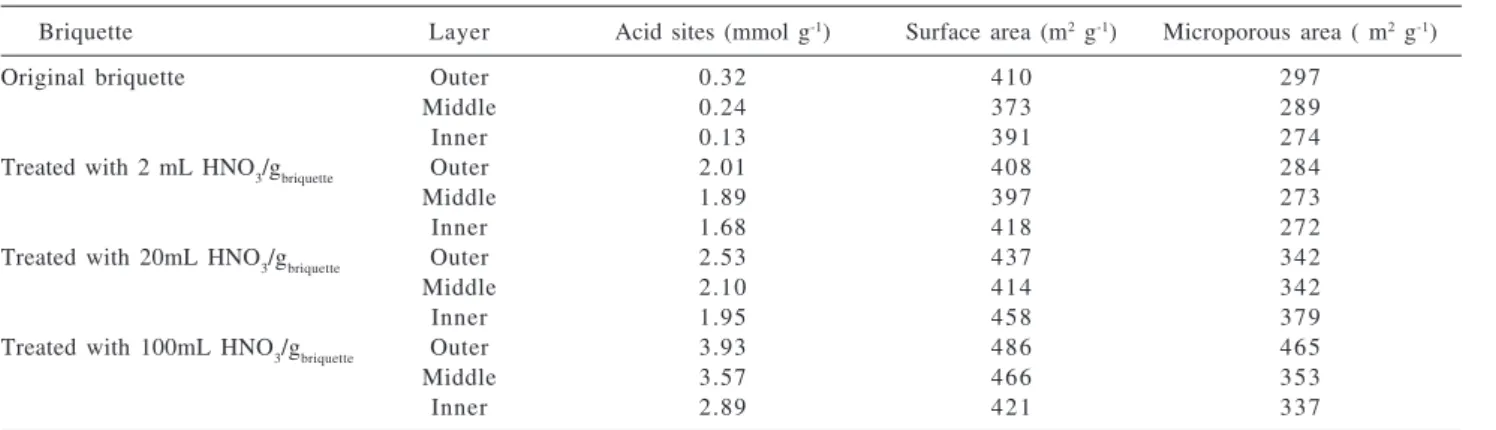
layers of the briquettes treated with concentrated HNO3 are shown in Figure 1 and Table 1.
It can be observed that the outer layer of the original briquette shows approximately 0.32 mmol g-1 acid sites
which decrease to 0.24 and 0.13 mmol g-1 for the middle
and inner layers, respectively. It is also observed for the
Table 1. Acid site concentration and BET surface areas for the different layers of briquettes treated with different volumes of HNO3 per gbriquette at 120 oC for 60 min
Briquette Layer Acid sites (mmol g-1) Surface area (m2 g-1) Microporous area ( m2 g-1)
Original briquette Outer 0.32 410 297
Middle 0.24 373 289
Inner 0.13 391 274
Treated with 2 mL HNO3/gbriquette Outer 2.01 408 284
Middle 1.89 397 273
Inner 1.68 418 272
Treated with 20mL HNO3/gbriquette Outer 2.53 437 342
Middle 2.10 414 342
Inner 1.95 458 379
Treated with 100mL HNO3/gbriquette Outer 3.93 486 465
Middle 3.57 466 353
Inner 2.89 421 337
901 High Surface Area Functionalized Carbon Briquettes
Vol. 16, No. 5, 2005
outer layer a slightly higher BET surface area of 410 m2 g-1
compared to the middle and inner layers. When the briquettes are treated with HNO3 at the ratio of 2 mL acid/
gbriquette a large increase in the acid sites to 2.01, 1.89 and
1.68 mmol g-1 is produced in the outer, middle and inner
layers, respectively. Under reflux with HNO3 at 20 mL acid/
gbriquette the acid sites further increased and a significant
increase in the surface area is observed. The data presented in Table 1 suggest that this increase in surface area is related to an increase in the microporosity of the material. If the reaction is carried out with 100 mL HNO3/gbriquette for 60 min under reflux, a strong increase in the acid site concentration to approximately 4 mmol g-1 is produced
(Figure 1). However, the briquette becomes very fragile with low mechanical resistance.
In order to investigate the effect of the functional groups on adsorption processes, experiments with Cr3+
(aq), Zn
2+ (aq)
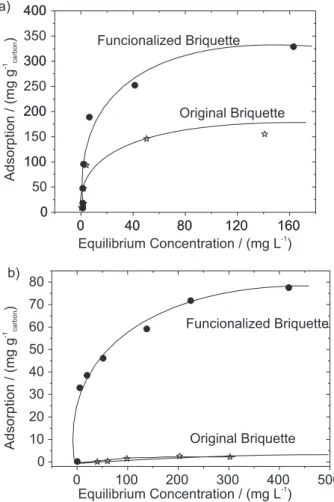
and the dye methylene blue(aq), a positively charged organic molecule, were carried out. The adsorption isotherms of the
dye methylene blue and Cr3+
(aq) for the original and
functionalized briquettes are shown in Figure 2.
It can be observed that the original briquette adsorbs a maximum of approximately 140 mg dye g-1 adsorbent. On
the other hand, upon functionalization, the adsorption capacity increases up to 330 mg g-1. A more significant
effect is observed for the adsorption of Cr3+ which increases
from approximately 1 mg g-1 for the original briquette up
to 78 mg g-1 for the functionalized carbon. These results
suggest that the presence of the surface carboxylic groups strongly improve the adsorption of the cationic species from the aqueous medium.
In order to investigate if a preferential adsorption on the more external part of the briquette occurs or if the metal can diffuse and adsorb into the briquette body, EDS analyses of Zn2+ adsorbed briquette were carried out. The
adsorption experiments with Zn2+
(aq) were carried out by
exposing the functionalized briquettes to the metal aqueous solution for 24 h at 28 ±2 oC. After drying, the
briquette was cut transversally and analyzed from the centre to the border by EDS/SEM with approximately 6 spectra mm-1. The EDS spectra showed signals related to the
elements Si, S, Ca, Al, K and Mg, all originated from the precursors used and two strong signals at 8.6 and 1.6 keV related to Zn. The relative areas of the Zn signal peak for the spectra obtained at different points of the briquette are shown in Figure 3.
It can be observed that the Zn EDS signals from the centre to the border of the briquette showed similar relative
intensities, suggesting that Zn2+ does not adsorb
preferentially on the more external surface of the briquette. These results suggest that the briquette possesses a porous structure large enough to allow facile diffusion of the hydrate Zn2+ species and its homogeneous adsorption
throughout the briquette body.
It was also investigated if the adsorption on the briquette was limited by diffusion of the adsorbate into the inner part of the briquette body. The adsorption kinetics
Figure 2. Adsorption isotherms of (a) methylene blue dye and (b) Cr3+on the original and functionalized briquettes.
902 Costa et al. J. Braz. Chem. Soc.
of methylene blue and Cr3+ on the functionalized carbon
as a briquette and as a powder were compared. The results are displayed in Figure 4.
It can be observed that the adsorption of the dye onto powder functionalized carbon takes place with a first order dependent rate constant kads of 1.5x10⁻¹ h-1 whereas the
adsorption onto the briquette is a much slower process with kads of 1.6x10⁻² h-1. On the other hand, for the
adsorption kinetics of Cr3+ on carbon powder a k
ads of
6.8x10⁻² h-1 was observed whereas the adsorption onto the
briquette was a slightly slower process with rate constant of 4.5x10⁻² h-1. This suggests that in the case of the relative
large organic molecule methylene blue the diffusion significantly affects the rate of the adsorption process whereas the adsorption of the smaller metal cation Cr3+ is
much less affected by diffusion processes.
In conclusion, the functionalization of activated carbon briquettes with HNO3 can be carried out homogeneously throughout the briquette body, suggesting that the HNO3 molecule can penetrate the porous structure to oxidize the carbon surface to produce mainly carboxylic groups in the most internal surface of the briquettes. The presence of these carboxylic groups strongly promote the adsorption of Zn2+,
Cr3+ and of the dye methylene blue, which are
homogeneously adsorbed throughout the briquette body. Adsorption kinetic measurements suggest that the adsorption of metallic cations onto the briquette is not seriously controlled by diffusion whereas for large organic molecules a significant diffusion limitation is observed.
Acknowledgements
The authors wish to thank FAPEMIG, CNPq, PRPq/ UFMG and CAPES-SECYT and the Laboratório de Microscopia Eletronica, UFMG.
References
1. MacDowall, J.; US pat. 5,162,2861992.
2. Yan, Z.Q.; McCue, J.; Tolles, E.; US pat. 5,538,9321996. 3. Yamada, T.; Tsumuki, K.; US pat. 5,685,9861997. 4. Rhys Jones, D.C.In Chemistry of Coal Utilization; Lowry
H.H., ed., John Wiley & Sons: New York ,1963, 2nd supplementary volume.
5. Schinzel, W. In Chemistry of Coal Utilization; Lowry H.H., ed., John Wiley & Sons: New York, 1981, 2nd supplementary volume.
6. Taylor, J.W.; Fuel1988, 67, 1945.
7. Clarke, D.E.; Marsh, H.; Fuel 1989, 68, 1031.
8. Deiana, A.C.; Granados, D.L.; Petkovic, L.M.; Sardella, M.F.; Silva, H.S.; Braz. J. Chem. Eng. 2004, 21, 585.
9. Rios, R.V.R.A.; Donnici, C.L.; Bento, J.S.; Pinto, D.; Lago, R.M.; Mat. Res. 2003, 6, 152.
10. Radovic, L.R.; Reinoso, F.R. In Chemistry and Physics of
Carbon; Thrower, P.A., ed., Marcel Dekker: New York, 1997, vol. 25.
11. Richards, S.R.; Fuel Proc. Technol. 1990, 25, 89. 12. Bohem, H.P.;Carbon 1994, 32, 759.
Received: April 22, 2005
Published on the web: July 27, 2005 Figure 4. Adsorption kinetics of (a) methylene blue and (b) Cr3+ on