A
r
t
ic
le
0103 - 5053 $6.00+0.00
*e-mail: [email protected]
Chemical Composition of Black-Watered Rivers in the Western Amazon Region (Brazil)
Adriana M. C. Horbe* and Ana G. da Silva Santos
Departamento de Geociências, Universidade Federal do Amazonas, 69077-000 Manaus-AM, Brazil
A maioria das investigações sobre a química da águas na Amazônia é focada nos rios Solimões, Amazonas e Negro e o conhecimento sobre a composição química dos pequenos tributários é restrita a dados pontuais. Esses pequenos rios que apresentam, na maior parte das vezes, apenas aportes de suas bacias de drenagem, são muito importantes para entender os mecanismos controladores da química dos grandes rios da região. Com esse objetivo foi determinada a composição química dos principais afluentes de águas pretas do rio Solimões na Amazônia Ocidental Brasileira durante o período de águas baixas. Os dados revelam que a química das águas pretas é altamente variável e fortemente influenciada pelo ambiente geológico local: a bacia do Badajós é quimicamente mais diluída; a bacia de Coari apresenta alto conteúdo de SiO2, enquanto os lagos menores têm maior pH, condutividade, Ca2+, Mg2+ e Sr, mas inferiores aos do rio Solimões. A composição química da água é compatível com a pouca erosão e com o ambiente altamente lixiviante da Amazônia onde os elementos mais solúveis são rapidamente removidos.
Most investigations addressing Amazonian water chemistry are focused on the Solimões, Amazonas and Negro rivers. Knowledge of the chemical composition of their smaller tributaries is restricted to some few, punctual data. The smaller rivers, that only present inputs from their catchments, are very important to understand the overall mechanisms controlling the chemistry of larger rivers of the region. With this objective the chemical composition of the principal Solimões river black-watered tributaries in the western Brazilian Amazon during the low water period were determined. The data reveal the black water chemical composition to be highly variable and strongly influenced by the local geological environment: the Badajós basin being chemically more diluted; the Coari basin presenting higher SiO2 contents, as well as smaller lakes having higher pH, conductivity, Ca2+, Mg2+ and Sr, yet not as much as those found in the Solimões river. The chemical composition of these waters is compatible with the low physical erosion and the region’s highly leached tropical environment from which most soluble elements were quickly removed.
Keywords: smaller-sized river basin, Solimões-Amazonas Basin, white water
Introduction
The western Brazilian Amazonian region shows two main fluvial structures: the larger white water rivers, whose headwaters are in the Andean Cordillera and Sub Andean region, and their many smaller black-watered tributaries. These rivers present extreme inter-seasonal variability in their discharges on account of the rainfall variability and miscellaneous mixtures of white and black-waters.
Each colored water river reflects distinct chemical characteristics. Fittkay et al.1 and Furch2 relate these
water color-types to geological, soil type and plant cover
characteristics of their basins. Black-waters, draining older rocks and being typical to the Negro river, result from dissolved fulvic and humic substances, present small amounts of suspended sediment, lower pH (4.0 to 6.0) and dissolved elements, yet higher SiO2 contents (Table 1). The white-waters, typical of larger rivers such as the Solimões, Amazon, Madeira and Purus, present large amounts of suspended material and dissolved salts coming from Andean and Sub Andean rocks and from riverbanks and floodplain erosion. High pH (pH ca. 8.0) and Ca and Mg contents are their main characteristics.3,5-7
Most investigations addressing Amazonian waters chemistry are focused on the Solimões-Amazonas and Negro river channels6-11 while knowledge about the
tributaries is restricted to very few and punctual data.5,12-15
Since smaller stream tributaries only present inputs from their catchments during the least rainfall, the chemical composition of the water is determined by geological weathering processes and forest characteristics. During the rainy season water comes in from the Solimões river. To provide a better picture of the geochemical environment and to help understand the mechanisms controlling the water
chemistry of the Amazon and Solimões rivers we need know the characteristics of these waters. Therefore, this paper reports chemical composition of the Solimões river black-watered tributaries in the Brazilian western Amazon during the low water period. We also discuss geological influences and suggest chemical reactions involved in their composition in order to help understand the interactions between the Amazon river catchments.
Table 1. Trace elements compositions in mg L-1 (except for Sr, µg L-1) in the waters studied. NA-not analysed
Sample pH Cond Ca2+ Na+ K+ Mg2+ Cl– SiO
2 Fe B Sr Pb Se
Badajós basin-black water
1 5.69 25.5 1.66 0.42 0.40 0.44 5.18 3.84 < 0.01 < 0.01 5.00 0.16 0.21
2 5.91 41.7 2.63 0.31 0.64 0.55 4.85 3.00 < 0.01 < 0.01 4.50 0.03 0.13
3 5.38 22.5 2.17 0.30 0.49 0.48 1.93 1.29 < 0.01 < 0.01 4.75 0.07 0.11
4 5.40 12.1 3.17 0.26 0.48 0.37 5.81 1.27 0.01 < 0.01 2.50 0.22 0.05
5 5.26 22.9 2.59 0.33 0.52 0.54 5.81 1.55 < 0.01 < 0.01 5.50 0.08 0.16
Average 24.94 2,44 0.32 0.51 0.48 4.72 2.19 0.01 < 0.01 4.45 0.11 0.13
Coari basin-black water
6 5.53 10.7 1.24 0.39 0.43 0.39 2.03 0.66 0.04 0.01 1.75 0.21 0.1
7 5.81 10.6 0.97 0.91 0.68 0.26 4.07 4.14 0.03 0.58 1.50 0.16 0.1
8 6.01 10.7 2.44 1.23 0.70 0.59 3.05 7.76 0.09 0.91 1.75 0.26 0.2
9 5.76 18.8 0.99 1.22 0.78 0.38 2.03 8.37 0.12 0.59 2.50 0.02 0.1
10 5.60 19.0 0.54 0.89 0.57 0.35 4.07 7.15 0.18 0.28 2.50 < 0.01 NA
11 6.07 34.2 0.98 0.88 0.84 0.55 4.07 11.36 0.16 0.02 2.75 0.12 < 0.1
12 5.33 22.3 0.84 0.62 0.51 0.28 4.95 9.37 0.02 0.04 2.50 0.13 0.1
13 5.42 22.7 1.70 0.67 0.43 0.54 4.95 9.95 0.13 < 0.01 2.00 < 0.01 NA
14 5.51 39.9 1.85 0.55 0.35 0.56 1.98 8.81 0.15 < 0.01 2.75 0.14 0.1
15 5.60 18.2 1.65 0.56 0.43 0.35 2.97 6.16 0.16 < 0.01 2.75 0.23 0.2
Average 20.71 1.32 0.79 0.57 0.43 3.42 7.37 0.11 0.24 2.28 0.13 0.12
Smaller lakes-black water
16 5.50 50.0 3.36 0.51 0.48 0.57 5.81 4.10 < 0.01 < 0.01 8.50 0.07 NA
17 6.90 52.9 3.86 0.55 0.58 0.67 1.94 3.82 0.02 < 0.01 9.50 0.17 0.13
18 6.20 55.5 3.86 0.66 0.87 1.21 3.87 3.70 < 0.01 < 0.01 9.75 0.07 0.14
19 6.12 70.3 3.05 0.76 0.34 1.46 3.96 4.46 0.14 < 0.01 3.25 0.18 0.12
20 7.22 70.0 3.05 0.74 0.08 1.46 2.97 3.81 0.03 < 0.01 2.25 0.15 0.14
21 6.04 71.3 3.05 0.86 0.27 1.67 2.97 3.47 < 0.01 < 0.01 13.25 0.15 0.13
Average 61.6 3.37 0.68 0.44 1.17 3.59 3.89 0.03 < 0.01 7.75 0.13 0.13
Solimões river-white water
22 7.34 99.4 3.05 1.68 0.23 1.15 7.93 3.76 0.18 < 0.01 12.50 0.08 0.10
23 6.90 71.2 3.04 1.07 0.65 1.12 8.15 4.24 0.06 0.01 11.75 0.08 0.21
24 6.01 69.0 3.86 0.97 0.67 0.75 1.94 3.93 0.08 0.01 12.00 0.11 0.21
Average 79.9 3.32 1.24 0.52 1.01 6,01 3.98 0.11 0.01 12.08 0.09 0.17
Black-water* < 4.5 0.1-2.9 0.1-2.1 < 0.70 0.4-3.5 4.2-6.9
White-water* 5.3-16.4 1.8-6.0 0.9-2.0 1.0-2.3 1.7-4.9 1.5-2.1
World river21 14.7 7.2 1.4 3.7 8.3 6.5
Geological context
Geological knowledge regarding the Amazon region is still quite scarce and restricted to studies on selected areas where only rock types and structures are available. Two main sedimentary rocks occur in the region, siltstones and locally ferruginizated sandstones (Solimões Formation) located on the right bank of the Solimões river.16,17
Overlaying this unit in the Solimões river and on the SW side of Acará Lake, discordant plio-pleistocene fluvial pink and whitish friable claystones and sandstones (Içá Formation) occur. Holocene clayey and sandy sediments occur on the floodplains and abandoned meanders forming the islands along the courses of this river. Quartz and kaolinite were identified in these rocks, sediments and weathering profiles as being the most abundant minerals followed by a small amount of illite, smectite, muscovite, feldspar, hematite, goethite, anatase and apatite.17,18 Further
on, the Holocene sediments also have small diatoms, Si-sponge spicules and siderite concretion contents.
Experimental
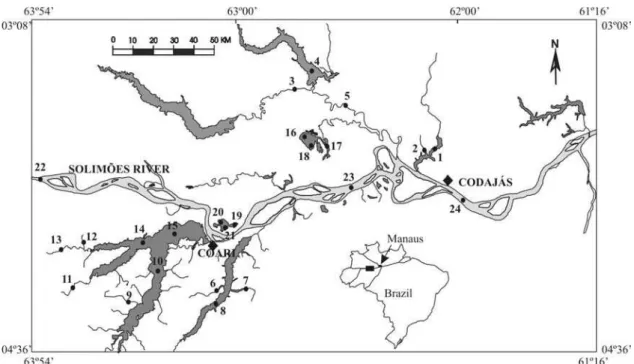
On account of their geographical and geological distribution, the drainages are grouped into basins. Figure 1 shows the sampling sites from these basins. They are named (i) Badajós, including samples from the left side of Solimões river, which are numbered from 1 to 5; (ii) Coari, a tributary on the right side of Solimões river, from 6 to 15; (iii) smaller lakes from 16 to 21; and (iv) the Solimões
river from 22 to 24. The Badajós and the Coari basins drain rocks from the Solimões and Içá Formations. These units and the Holocene sediments influence the smaller lakes (Acará Lake, samples 16 to 18 and Munguba and Jussara Lakes, samples 19 to 21).
Collections were performed in October 2002, a month that is representative of the period with the least rainfall in the region. This period reflects the geological environment better since it is less diluted by rainwater. The samples were stored in 2 L polyethylene containers rinsed with a 25% HNO3 solution and deionised water. At the time of the sampling the containers were washed several times with the water being collected. They were vacuum-filtered through a 0.45 µm cellulose membrane. The analytical methods used were: potentiometry (pH and electrical conductivity); titrimetry (chlorides) and ICP-OES spectrometry for Na, K, Mg, Ca, Al, Fe, B, Bi, Cr, Cu, Fe, Li, Mo, Ni, Pb, Sr, V, W and Zn, carried out at Lakefield Laboratory (Brazil). Standard procedures (APHA) and international standards for ICP-OES analysis were used. The pH and conductivity were analysed in locus, chlorides in less than 24 h and the remaining elements in up to 3 months following collection.
Results and Discussion
Calcium, magnesium, sodium and potassium chemistry
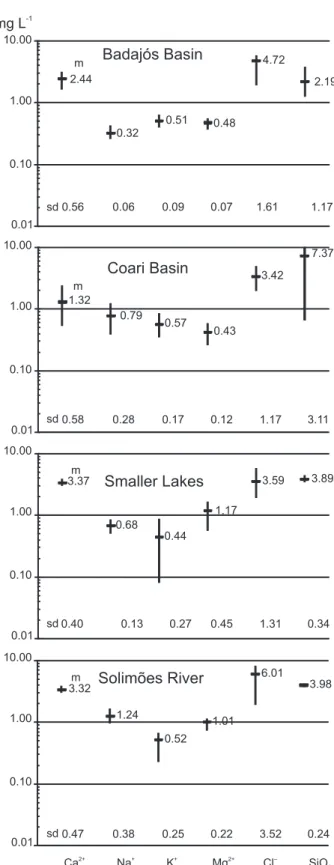
The contents of all alkali metals vary but were often lower in the Coari and Badajós black waters than in those of the smaller lakes and the Solimões river (Table 1). Ca2+
dominates in nearly all drainages, especially in the smaller lakes, which were developed on Quaternary floodplain sediments, and in the Solimões river. However its contents fluctuate more in the black waters (Figure 2). Mg2+ presents
almost the same behavior as that of Ca2+, yet, with lower
quantities. Na+ is higher in the Solimões river but there
are two samples from Coari basin with similar contents (Table 1). K+ is the only element that does not present
specific variation as a function of the river basin (Figure 2). These elements indicate a specific chemical pattern for each basin: Ca2+ > K+ ≈Mg2+ > Na+ in the Badajós, Ca2+ >
Na+ > K+ > Mg2+ in the Coari basins, Ca2+ > Mg2+ > Na+ >
K+ in the smaller lakes and Ca2+ > Na+ > Mg2+ > K+ in the
Solimões river. The Coari basin is the most dilute and the Solimões river the most concentrated.
Chloride and silicon composition
It is possible to identify the Badajós basin and Solimões rivers on the basis of their Cl– > SiO
2 composition, the
Coari basin by its SiO 2 > Cl– compositions and the smaller
lakes that present Cl–≈ SiO
2 (Table 1 and Figure 2). Cl –
shows large variability especially in the Badajós basin (Figure 2) indicating it not related to the water color. The Coari basin presents the highest and most varying SiO2 contents (Figure 2). They are similar to those found in those drainages by Santos and Ribeiro,5 while the Badajós
basin (0.4 to 3.8 mg L-1) is more similar to those of the
Negro river (2.00 mg L-1 ± 0.5)20 (Table 1). Smaller lakes
and the Solimões present SiO2 contents similar to each other (Figure 2).
Although SiO2 presents no variation downstream in the Solimões river, pH, Cl–, Na+ and Mg2+ decreased and Ca2+
and K+ increased (Table 1). On the other hand, the total sum
of alkali-metals is unaltered (between 6.1 mg L-1 upstream
and 6.3 mg L-1 downstream). Variations in the Solimões
river chemical compositions were also found by several other researchers.5,6,7,10 This trend can be related to water
discharge10 but the miscellaneous input from the tributaries
may also bring about these chemical changes.
pH and electrical conductivity
Although there are significant variations, the Badajós and Coari basins show lower pH (pH between 4.9 and 6.3) and electrical conductivity (between 11.6 and 41.7 mS cm-1)
while the smaller lakes, with larger amounts of macro-ions, are similar to the white water of the Solimões river (Table 1). The Solimões river showed decreased conductivity downstream (Table 1), similar to that found by Seyler and Boaventura10 and by Lopes.19 Although Ca and
Mg exhibit a correlation (r = 0.75), this does not happens with the pH (Figure 3). This indicates that it is the dissolved organic matter that controls the black water pH.
Trace-elements distribution
The element contents found in the waters studied are lower than river averages throughout the world.21 Of them
(Al, B, Ba, Bi, Cr, Cu, Fe, Li, Mo, Ni, Pb, Sr, V, W and Zn) only Fe, B, Sr, Pb and Se present consistent concentration variabilities to influence the chemistry of the waters (Table 1). Strontium was higher in the Solimões river (up to 12 µg L-1) than in Badajós and Coari basins (about 6 µg L-1)
(Table 1). Its content in the Solimões river is lower than that found by Gaillardetet al.7 in the same water; however, those
from the Badajós and Coari basins are consistent with what these authors7 found for the Negro river (ca. 3.6 µg L-1). Of
the other trace elements only the higher Fe and B in the Coari basin helps to differentiate this water from the other black waters (Table 1).
Multivariate statistical analysis of components with no rotation using the Statistic 5.0 software shows the chemical variation in the basins. This method identified pH, conductivity, Ca2+, Mg2+, Sr and SiO
2 as the principal
variables that best characterise the water basins (Table 2) by considering a 0.1 to 0.5% likelihood of error. With these variables and the scores of each sample, the chemically equivalent sample groups were obtained, as shown in Figure 4. Factor 1 (F1) represents the influence of the pH, conductivity, Ca2+, Mg2+ and Sr and factor two (F2) the
influence of SiO2. Factor 1 effectively separates the black waters of Badajós and Coari basins (highest negative score) from the smaller lakes and the Solimões river with higher pH, conductivity, Ca2+, Mg2+ and Sr. F2 distinguishes the
Coari basin with higher SiO2 content (highest negative score) from the Badajós basin. These characteristics establish that the Badajós basin is more chemically diluted than the others basins and more similar to rain water, as shown by the ratio Na/(Na+Ca) and by the macro-ion abundance22 (Figure 5). Coari Basin, although it presents
higher SiO2 contents, is also similar to rain water; the smaller lakes have higher pH, conductivity, Ca2+, Mg2+ and
Sr, yet not as much as the Solimões river that has the most concentrated water in the region, indicating the influence of silicate weathering. The chemical similarity between the waters of the smaller lakes and the Solimões river may indicate input by the white water of this river, especially during the rainy season. However this input is not observed in the other basins, which are also near to the Solimões river. This indicates that, at least in the dry season, the surrounding Holocene clayey and sandy sediments of the floodplains is the main influence in the water chemistry of the smaller lakes.
The higher Cl than Na concentrations and the absence of a correlation between them (r = 0.04), reveal that Na is
Figure 3. Correlation between Ca2+, Mg2+ and pH. Samples 1 to 7 are from Badajós basin, 8 to 21 are from Coari basin, 22 to 27 from smaller lakes and 28 to 30 from the Solimões River.
Figure 4. Factor score diagram. Badajós Basin, Coari Basin,
Smaller Lakes, Solimões River. F1 represents the influence of the pH and conductivity and the Ca2+, Mg2+ and Sr concentrations. F2 represents the SiO2 concentration. The arrows indicate trends from high load to more diluted ones.
Table 2. Factor loadings of physico-chemical parameters
F1 F2
pH 0.82 -0.30
Conductivity 0.92 0.14
Ca2+ 0.78 0.25
Na+ 0.40 -0.68
K+ 0.02 -0.30
Mg2+ 0.86 0.21
Cl- 0.17 0.03
SiO2 -0.13 -0.73
Fe 0.01 -0.67
B -0.12 -0.23
Sr 0.81 0.08
Pb -0.14 -0.17
Se 0.35 0.23
Figure 6. Stablility relationships between the minerals and the waters of the studied regions. Badajós Basin, Coari Basin, Smaller Lakes,
Solimões River.
derived from weathering of Na(K)-bearing silicate minerals such as feldspar, muscovite, illite and smectite that are found in the sedimentary rocks of the studied region. The Amazon region’s intense tropical weathering environment, which is subjected to high temperatures (26 ºC) and rainfall (2600 mm year-1), make those minerals unstable while
gibbsite may be neoformed23 and consequently the SiO 2
and alkali contents in the waters increase. In this conceptual model and considering the mineral composition of the main sedimentary rocks that occur in the region, the main possible chemical reactions involved in the weathering process for the basin water are:
KAl3Si3O10(OH)2 + H+ + 9H
2O ↔ 3Al(OH)3 + K + + 3H
4SiO4 (1)
Muscovite/illite Gibbsite
6[(Al2.00,Si3.67Al0.33)O10(OH)2](K0.33Mg1.67Na0.33) + 7H2O + 2H+↔
Smectite
6Al2Si2O5(OH)4 + 8SiO2 + Mg2+ + K+ + Na+ (2) kaolinite
Al2Si2O5(OH)4 + 5H2O ↔ 2Al(OH)
3(s) + H4SiO4(aq (3)
Kaolinite Gibbsite
Reactions 1, 2, 3 demonstrate the functions of H4SiO2, K+/H+ and Ca2+/H+ ion-activity diagram at 25 ºC shown
in Figure 6.24 All the samples are plotted in the
kaolinite-gibbsite-quartz range, the most abundant minerals in the region. In addition, it shows that there is a trend from the low concentration black waters of Badajós-Coari to the white water of the Solimões river that is in agreement
with the less weathered region from where the white water come (Figure 6). This indicates that the black waters come from highly leached tropical environments where most of the soluble elements are quickly removed by heavy rainfall. It also indicates a probable higher content of quartz in the sediments and soils of Coari that brings more SiO2 to the water of this basin. The
Figure 5. Na/(Na+Ca) versus total dissolved salts after Gibbs (1970).
biological inputs which can bring SiO2 to water seems less important as the content of this element is lower than 109 mg L-1 (Figure 6).23 Hence, the very low dissolution of
quartz, and the great amount of forest organic matter help kaolinite breakdown in a podzolization process producing solutions with high SiO2 contents and low pH. Another point to be considered is that the region is tectonically very stable and the basins are completely covered by rainforest that minimise physical erosion and although feldspar, muscovite, illite and smectite are present in the sediments, the dominance of kaolinite and quartz and the high-rainfall produce dilute chemical waters.
The smaller lakes and the Solimões river fall more near the anortite/laumontite range (Figure 6B) as a consequence of their higher Ca2+ contents (ca. 3 mg L-1). This mineral
and the easily weathered Quaternary sediments rich in diatoms, Si-sponge spicules, siderite concretion as well as muscovite, illite and esmectite17 that retain the
macro-ions in the exchange sites, increase the chemical load of the waters in the smaller lakes. In the Solimões river the higher macro-ion abundance in the dissolved phase can be also related to exchange with suspended matter. Inputs from the Solimões river in the smaller lakes, especially during the rainy season, also increase the amount of dissolved elements in this environment.
The chemical water composition indicates two weathering regimes in the region. The smaller lakes and the Solimões river are more compatible with the bi-siallitisation environment of weathering dominance processes in Quaternary sediments where clay minerals with 2:1 structures occur. The Badajós and Coari basins, less mineralised and in more leached conditions, are in mono-siallitisation environments rich in kaolinite and more similar to those of precipitation dominance21 and to the
weathering process in tropical rain forest regions.
Conclusions
This study presents the macro-ion abundance in the black watered tributaries of Solimões river in the western Amazon region in Brazil. The results show the black waters are highly chemically variable and are neither equivalent amongst each other nor equivalent to those from the Negro river, but sometimes can be similar to those in the white water rivers. The chemical load is a consequence of the physical and geological environments and silicate mineral dissolution in a highly weathering environment that appears to control the chemical concentration of these black waters. The characteristics of each basin are: the Badajós basin is chemically more dilute; the Coari basin presents higher contents of SiO2; the smaller lakes have higher pH and
conductivity and Ca2+, Mg2+ and Sr contents but still less
than the Solimões river. These chemical compositions indicate a mono-siallitisation environment for the black waters and a bi-siallitisation environment for the white ones.
Further research will be carried out in order to elucidate the importance of the geological environment on the chemical composition of black waters in the Amazon. This will help to understand the overall mechanisms involved in tropical environment exchanges.
Acknowledgments
This study was sponsored by a grant from CNPq/ CTPETRO fund of the Brazilian National Council for Scientific and Technological Development number 460223/01-1. We are indebted to CAPES for a grant to the first author and to the Departamento de Geociências of the Universidade Federal do Amazonas, Brazil.
References
1. Fittkau, E. J.; Irmler, U.; Junk, W. J.; Reiss, F.; Schmidt, G. W.; Tropical Ecological Systems-Trends in Terrestrial and Aquatic Research, Golley, F. B.; Medina, E., eds.; Springer: New York, 1975, ch. 8.
2. Furch, K.; The Amazon, Limnology and Landscape Ecology of the Mighty Tropical River and Its Basin, Sioly, H., ed.; Dr. W. Junk Publishers: Dordrecht, 1984, ch. 4.
3. Sioli, H.; Fundamentos da Ecologia da Maior Região de Florestas Tropicais, Ed. Vozes: Petrópolis, Brasil, 1983. 4. Santos, U. M.; Bringel, S. R. B.; Bergamin, F. H.; Ribeiro, M.
N. G.; Bananeira, M.; Acta Amaz. 1984, 14, 222.
5. Santos, U. M.; Ribeiro, M. N. G. A.; Acta Amaz.1988, 18, 145. 6. Konhauser, K. O.; Fyfe, W. S.; Kronberg, B. I.; Chem. Geol.
1994, 111, 155.
7. Gaillardet, J.; Dupré, B.; Allègre, C. J.; Négrel, P.; Chem. Geol. 1997, 142, 141.
8. Stallard, R. F.; Edmond, J. M.; J. Geophys. Res.1983, 88, 9671. 9. Mortatti, J.; Probst, J-L.; Chem. Geol.2003, 197, 177. 10. Seyler, P.; Boaventura, G. R.; Hydrolog. Process.2003, 17,
1345.
11. Tardy, Y.; Bustillo, V.; Roquin, C.; Mortatti, J.; Victoria, R.; Appl. Geochem.2005, 20, 1746.
12. Campos, Z. E. S.; MSc Dissertation, Instituto Nacional de Pesquisa da Amazônia, Manaus, Brazil, 1994.
13. Silva, M. S. R.; Ramos, J. P.; Pinto, A. G. N.; Acta Limnol. Bras. 1999, 11, 89.
14. Horbe, A. M. C.; Gomes, I. L. F.; Miranda, S. A. F.; Silva, M. S. R.; Acta Amaz.2005, 35, 119.
16. Nogueira, A. C. R.; Arai, M.; Horbe A. M. C.; Horbe, M. A.; Silveira, R. R.; Silva J. S., Motta, M. B. A.; Abstracts of the VIII Simpósio de Geologia da Amazônia, Manaus, Brazil, 2003. 17. Rossetti, D. F.; Toledo, P. M.; Moraes-Santos, H. M.; Santos,
A. E. A. Jr.; Quater Res.2004, 61, 289.
18. Horbe, A. M. C.; Paiva, M. R. P.; Motta, M. B.; Horbe, M. A.; Acta Amaz. 2007, 37, 81.
19. Lopes U. B.; PhD Thesis, Instituto Nacional de Pesquisa da Amazônia, Manaus, Brazil, 1992.
20. Henderson, P.; Comparison between White and Black Waters, http://www.amazonian-fish.co.uk/indexamaz.html, accessed in September, 2005.
21. Hem, J.D.; Study and Interpretation of the Chemical Characteristics of Natural Water, Alexandria, VA, U.S. Geological Survey, 1970.
22. Gibbs, R.; Science1970, 170, 1088.
23. Stallard, R. F.; Edmond, J. M.; J. Geophys. Res.1987, 92, 8293. 24. Drever, J. I.; The Geochemistry of Natural Waters, Prentice
Hall: Englewood Cliffs, NJ, 1997.