Characterization and expression analysis of WOX2 homeodomain
transcription factor in
Aegilops tauschii
Shan Zhao
1+, Qian-Tao Jiang
1+, Jian Ma
1, Ji-Rui Wang
1, Ya-Xi Liu
1, Guo-Yue Chen
1, Peng-Fei Qi
1,
Zhi-En Pu
1, Zhen-Xiang Lu
2, You-Liang Zheng
1,3and Yu-Ming Wei
11
Triticeae Research Institute, Sichuan Agricultural University, Chengdu, Sichua, China.
2
Lethbridge Research Centre, Agriculture and Agri-Food Canada, Lethbridge, Canada.
3
Key Laboratory of Southwestern Crop Germplasm Utilization, Ministry of Agriculture, Ya’an,
Sichuan, China.
Abstract
The WUSCHEL (WUS)-related homeobox (WOX) gene family coordinates transcription during the early phases of embryogenesis. In this study, a putativeWOX2 homolog was isolated and characterized from Aegilops tauschii, the donor of D genome ofTriticum aestivum. The sequence consisted of 2045 bp, and contained an open reading frame (ORF), encoded 322 amino acids. The predicted protein sequence contained a highly conserved homeodomain and the WUS-box domain, which is present in some members of the WOX protein family. The full-length ORF was subcloned into prokaryotic expression vector pET-30a, and an approximately 34-kDa protein was expressed in Escherichia coli BL21 (DE3) cells with IPTG induction. The molecular mass of the expressed protein was identical to that predicted by the cDNA sequence. Phylogenetic analysis suggested thatAe. tauschii WOX2 is closely related to the rice and maize orthologs. Quantitative PCR analysis showed thatWOX2 from Ae. tauschii was primarily ex-pressed in the seeds; transcription increased during seed development and declined after the embryos matured, suggesting thatWOX2 is associated with embryo development in Ae. tauschii.
Keywords:WOX2,Aegilops tauschii, phylogenetic analysis, real-time quantitative PCR.
Received: June 24, 2014; Accepted: October 30, 2014.
Introduction
WOXgenes comprise a large plant-specific gene
fam-ily that belongs to the homeodomain (HD) class of tran-scription factors. WUS HDs are critical for early-phase embryogenesis and lateral organ development (Haeckeret al., 2004). HD proteins typically contain a highly
con-served motif of 60 amino acids encoded by a characteristic DNA fragment called the homeobox and consisting of a he-lix-loop-helix-turn-helix structure (Kamiyaet al., 2003).
Phylogenetic analyses have divided theWOXgene family
into three major clades: the ancient clade with representa-tives from all lineages of land plants as well as green algae, and the intermediate and modern clades with representa-tives found only in ferns and seed plants (Nardmannet al.,
2009; van der Graaffet al., 2009). In addition to the HD, the
primary structures of WOX proteins in the modern clade also possess conserved structures called the WUS box and/or EAR-like motif (Kieffer et al., 2006; Lin et al.,
2013).
Previous studies have identified 15WOXgene family members inArabidopsis thaliana: theWUSgene is specifi-cally expressed in the shoot apical meristem (SAM) where it regulates stem cell fate (Mayeret al., 1998; Haeckeret al., 2004; Lianet al., 2014; Zhanget al., 2010) andWOX5
performs similar functions in the root apical meristem (RAM) (Sarkar et al., 2007). PRESSED FLOWER/AtWOX3is required for the development of lat-eral stipules in the leaves and the latlat-eral sepals and stamens of flowers (Matsumoto and Okada, 2001), whileAtWOX4
acts as a key regulator of cambium activity in the main stem of Arabidopsis (Suer et al., 2011). PRETTY FEW SEEDS2/AtWOX6 transcripts accumulate in developing primordia and differentiating organs and regulate ovule de-velopment (Parket al., 2005).STIMPY/AtWOX9maintains cell division and prevents premature differentiation in the center zone of the SAM (Wu et al., 2005). Moreover,
OsWOX11 mediates activation of crown root emergence and growth in rice (Zhao et al., 2009). AtWOX2 and AtWOX8are co-expressed in egg cells and zygotes and are involved in embryo formation and differentiation in
Arabidopsis(Haeckeret al., 2004). In maize,ZmWOX2A, a homolog ofAtWOX2, is expressed in the zygote, where it
DOI: http://dx.doi.org/10.1590/S1415-475738138120140192
Send correspondence to Yu-Ming Wei. Triticeae Research Insti-tute, Sichuan Agricultural University, No. 211 Huimin Road, Chengdu, 611130 Sichuan, China. E-mail: [email protected]. +These authors contributed equally to this work.
marks the apical cell fate and prepatterns the SAM position (Nardmann et al., 2007). PaWOX2, which is the Picea abies homolog of AtWOX2, is highly expressed during early growth of the zygote and somatic embryo (Palovaara
et al., 2010).
Although there have been several studies of theWOX
gene family in monocots, such as rice and maize (Kamiyaet al., 2003; Nardmann et al., 2007), little is known about
WOXgenes in Triticeae plants. In this study, we character-ized the WOX2 gene structure and its expression from
Aegilops tauschii, the D-genome progenitor species of hexaploid wheat. The objective of this study was to investi-gate the structural features ofWOX2, determine its expres-sion pattern at different tissues inAe. tauschii, and examine the evolutionary history of theWOXgenes.
Material and Methods
Plant material
Ae. tauschiiAS2407 (2n = 2x = 14, DD) was culti-vated in the field for sample collection. The seeds were pro-vided by the Triticeae Research Institute of Sichuan Agri-culture University, ChengDu, Sichuan, China. Genomic DNA was extracted from fresh leaves by using a CTAB procedure (Murray and Thompson, 1980). For gene expres-sion analysis, root tissue was harvested from 1-week old seedlings. Leaf and stem tissues were from 3-weeks old seedlings. Stamina and ovaries were harvested before anthesis. Developing seeds were harvested from between 2 and 24 days after flowering at 2-day intervals. Immature embryos were cultured on MS callus induction medium (Özgen et al., 1998) supplemented with 2 mg/L 2,4-dichlorophenoxyacetic acid. The cultures were maintained at 26 °C in the dark. Calli were collected after twelve days’ culture. All samples were immediately frozen in liquid ni-trogen and stored at -80 °C.
Database analysis and cloning ofWOX2fromAe. tauschii
We searched Arabidopsis, rice, and maize WOX2
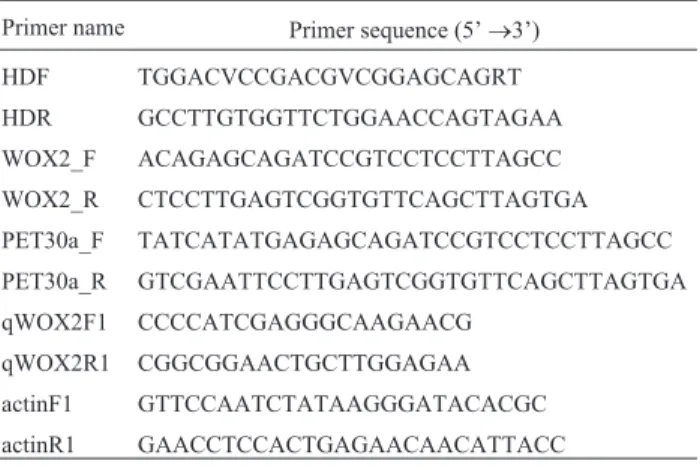
DNA sequences from the National Centre for Biotechnol-ogy Information. After alignment using the ClustalW pro-gram (version 1.83) (Thompsonet al., 1994), the conserved sequences were used to design a pair of degenerate primers (HDF/R) (Table 1) for amplifying part of theAe. tauschii WOX2gene. The amplified PCR product was purified and cloned into a pMD19-T vector (TaKaRa Biotechnology Co. Ltd. Dalian, China) for sequencing. BLAST searching of the GenBank database with the partial Ae. tauschii WOX2sequence identified oneWOX ortholog. Based on thisWOXortholog, a pair of primers (WOX2_F/R) (Table 1) was designed to amplify the full-length gene fromAe. tauschiiusing cDNA and gDNA templates. PCR was per-formed with the LA PCR Kit Ver. 2.1 (TaKaRa Biotechnol-ogy Co. Ltd. Dalian, China). Sequence alignment and
protein prediction were performed in DNAMAN software (Ver. 5.2.10; Lynnon Biosoft).
Phylogenetic analysis
To examine the evolutionary history of the WOX
genes and the evolutionary relationship of theAe. tauschii WOX2with other plants, we screened sequences homolo-gous toAtWUSandAtWOX2using TBLASTN in the NCBI database, with default parameters and the WUS/WOX2 homeodomain sequences as queries. We retrieved 76WOX
genes including 15 inArabidopsis, 10 in rice, 15 in maize, 17 inPopulus tomentosa, six inTheobroma cacao, and six inGinkgo biloba(GenBank accession numbers are listed in the Supplemental Table S1). OneWOX2gene was identi-fied in each of the following species:Glycine max,Vitis vinifera,Petunia x hybrida,Picea abies,Cicer arietinum,
Fragaria vesca, andSolanum tuberosum(Table S1). These sequences were used to construct a phylogenetic tree. Mul-tiple sequence alignment was performed in ClustalW (ver-sion 1.83) (Thompsonet al., 1994). MEGA 5.0 was used to construct a Maximum Likelihood (ML) tree by using the Jones-Taylor-Thornton (JTT) model and with 1000 boot-strap replicates (Joneset al., 1992; Tamuraet al., 2011).
Bacterial expression of clonedAe. tauschii WOX2
ORFs
To express the Ae. tauschii WOX2 open reading frame (ORF) in bacteria, the PET30a_F/R primer (Table 1) sets were designed to amplify an ORF from the cDNA se-quence. We modified theWOX2ORF using PCR mutagen-esis, which is almost the same as general PCR except the primer added two restriction sites forNdeI andEcoRI. PCR conditions were identical to those described above except the template was plasmid DNA purified from the respective clones. The ORFs were cloned into the pET-30a expression vector (Novagen) and then expressed in BL21Escherichia coli(DE3) cells. To induce bacterial expression, the cells were treated with 0.5 mM isopropylb -d-thiogalactopyra-noside (IPTG) for 3-5 h. The proteins were extracted with
Table 1- Primer sequences.
Primer name Primer sequence (5’®3’)
extraction buffer (1% SDS, 5% 2-mercaptoethanol, and 0.25 M Tris-HC1, pH 6.8) (Santambrogio et al., 1993), heated at 96 °C for 10 min, separated by 12% SDS-PAGE, and stained with Coomassie Blue R-250.
Expression analysis by real-time quantitative PCR (RT-qPCR)
Total RNA was extracted with Trizol reagent (Tian-gen Biotech Co. Ltd, Beijing, China) according to the man-ufacturer’s protocol. First-strand cDNA was synthesized with PrimeScript RT and gDNA Eraser (TaKaRa Biotech-nology Co. Ltd. Dalian, China). RT-qPCR was performed with diluted cDNA and the SYBRPremix Ex Taq II Kit
(TaKaRa Biotechnology Co. Ltd. Dalian, China). Reac-tions were performed in triplicate in a BioRad CFX96 thermocycler under the following cycling conditions: 5 min at 95 °C, followed by 40 cycles of 30 s at 95 °C, 30 s at 60 °C, 40 s at 72 °C, and a final extension of 10 min at 72 °C. Negative (distilled water) and no-template (total RNA) controls were included in each run. The data were analyzed with the BioRad CFX Manager software. Relative expression was calculated based on the standard curve method described by Pfaffl (2001). Gene-specific primers for WOX2 (qWOX2F1/R1) were used to detect WOX2
RNA levels normalized toactin(actinF1/R1; GenBank
ac-cession number, AY145451) (Liet al., 2010). Primer
se-quences are shown in Table 1.
Results
Isolation and sequence analysis ofWOX2fromAe. tauschii
Based on the multiple alignments of homologous genes fromArabidopsis, rice, and maize, we amplified the HD region ofAe. tauschii WOX2with degenerate primers. After blasting against the GenBank database, we found a cDNA clone from wheat (AK335177) in which the HD is the same as the partialWOX2sequence we cloned inAe. tauschiiand highly homologous toWOX2in other species. This clone contained the complete ORF. To determine the
coding sequence (CDS) of the putativeAe. tauschii WOX2
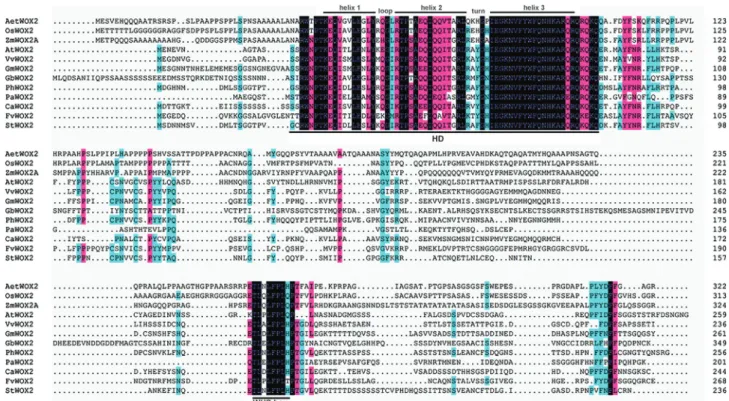
gene, we isolated the gDNA and cDNA sequences fromAe. tauschii. Sequence analysis revealed that theWOX2gene is 2,045 bp in length, with a 969 bp ORF, a 29 bp 5’ upstream sequence, and a 104 bp 3’ downstream sequence (GenBank accession numbers KJ459391). Two exons and one intron were identified forWOX2after alignment of gDNA with the respective ORF. The putative WOX2 gene in Ae. tauschii was predicted to encode a polypeptide of 322 amino acids. Our BlastP results against public databases in-dicated that the primary HD region ofAe. tauschiiWOX2 (amino acids 40-105) is conserved in all WOX family members. The WOX2 HD inAe. tauschiishared 89% and 85% similarity with OsWOX2 in rice and ZmWOX2A in maize, respectively. Its similarity toArabidopsisAtWOX2 was, however, only 69%. Domain prediction analysis re-vealed that the putative WOX2 protein ofAe. tauschiialso contains the WUS-box domain, which is present in the modern clade of the WOX protein family (Figure 1). We also compared the full protein sequences of Ae. tauschii
WOX2 with O. sativa, Z. mays, G. max, Arabidopsis,
V. vinifera, P. hybrida, G. biloba, S. tuberosum,
C. arietinum,F. vesca, andP. abies(Figure 2). Multiple alignments showed that the WOX2 HD was highly con-served across all 12 species whereas the flanking sequences varied.
Expression ofAe. tauschii WOX2inE. coli
We used the clone of theAe. tauschii WOX2ORF to analyze protein expression so as to verify whether the cloned gene expresses the corresponding protein product. Furthermore this also will allow the recombinant protein to be used as antigen to develop antibodies, which could be used to detect the expression of the transgenic progeny at the protein level in future studies. We ligated theWOX2
ORF fromAe. tauschiiinto pET-30a by using modified re-striction sites. The recombinant plasmid,
pET30a-AetWOX2, was then expressed inE. coliBL21 (DE3) and protein expression was induced with IPTG. SDS-PAGE re-vealed a single protein band of approximately 34 kDa in the
induced extract (Figure 3). The molecular mass of the ex-pressed protein was identical to that predicted by the
AetWOX2cDNA sequence, so the single protein band is ac-curate representation of theAetWOX2encoding protein.
Phylogenetic analysis ofAe. tauschiiWOX2
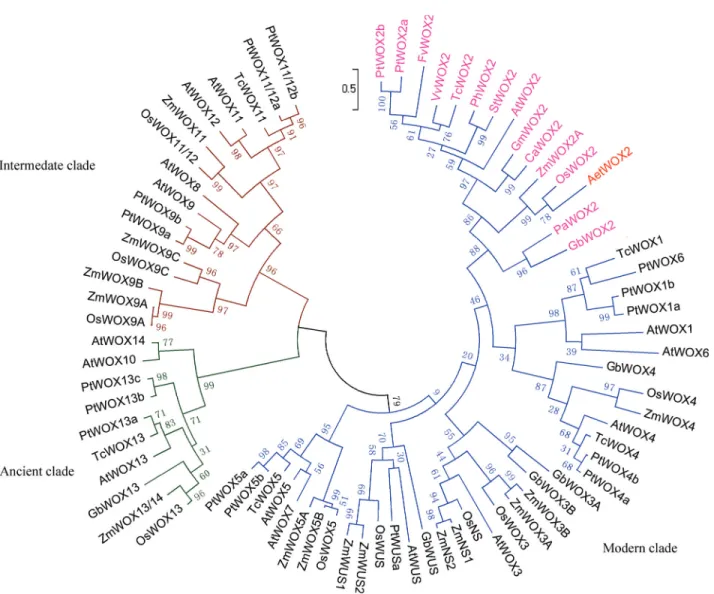
To confirm the classifications and analyze the phylo-genetic relationships of the WOX proteins, multiple align-ment analyses of the 77 WOX proteins were performed. The resulting ML tree divided the 77 WOX members into three clades: modern, intermediate, and ancient (Figure 4). There were 51 WOX proteins in the modern clade, which can be subdivided into five subgroups including WUS, WOX1/WOX4, WOX2, WOX3/NS, and WOX5; ten WOXs in the ancient clade of WOX10, WOX13, and WOX14 homologues; and sixteen WOXs in the intermedi-ate clade consisting of WOX8, WOX9, WOX11, and WOX12. The WOX2 subgroup in the modern clade con-tained one member from each of twelve species. AetWOX2 in the WOX2 subgroup clustered with OsWOX2 and ZmWOX2A. WOX2 fromAe. tauschiiis closely related to the rice and maize orthologs.
Expression pattern analysis
To understand the function of WOX2 from
Ae. tauschii, we investigated its expression in different tis-sues ofAe. tauschii,and in seeds at different stages of de-velopment. We set the expression level in roots as equal to 1, and calculated the expression in other tissues as relative
to roots. The qRT-PCR results revealed that WOX2 is primarily expressed in seeds, with lower levels transcript levels in the other tissues (Figure 5). Expression of Ae.
Figure 2- Multiple sequence alignment of WOX2. Abbreviations are G. biloba, Gb;G. max, Gm;V. vinifera, Vv;Petunia x hybrida, Ph;S. tuberosum, St; C. arietinum, Ca;F. vesca, Fv; andP. abies, Pa.
tauschii WOX2continuously increased from 12 day after flowering (DAF), peaked at 18 DAF, and then declined un-til 24 DAF. Around 18 DAF is the stage at which embryos become mature.
Discussion
The coding region ofAetWOX2shared 99% similar-ity with the clone AK335177 from wheat, a result agrees with the well-established fact thatAe. taushiiis the donor of the D genome to the hexaploid wheat,T. aestivum(Mc and Sears, 1946; Gillet al., 1996). AsAe. taushiiis one of most important gene resources for improving common wheat, exploiting theWOXgene inAe. tauschiimay contribute to understanding the differentiation and evolution of theWOX
gene in Triticeae species.
The WOX2 gene from Ae. tauschii encodes a WUS/WOX-like HD protein that is highly conserved. The
WOX2 HD consists of about 65 amino acids with one extra amino acid in the loop between helices 1 and 2, and four ex-tra amino acids in the turn between helices 2 and 3 (Fig-ure 2). The WUS-box, another domain in Ae. tauschii
WOX2, is located downstream of the HD and is found in most WOX proteins (Haeckeret al., 2004). We did not find an EAR-like motif in any the examined WOX2 sequences, but it is present in WUS/WOX5. The sequence similarity of AetWOX2 with OsWOX2 and ZmWOX2A is 89% and 85%, respectively. The orthology of AetWOX2 with OsWOX2 and ZmWOX2A in the modern clade (Figure 4) is well supported by the phylogenetic tree. Taken together, these results suggest that WOX2 is abona fidemember of the WOX family inAe. tauschii.
The close phylogenetic relationship among WOXs in
Arabidopsis, rice, maize, P. tomentosa,T. cacao, andG. bilobaorthologs (Figure 4) suggested that WOXs are evo-lutionarily conserved. It is interesting that no rice and maize
orthologs ofArabidopsisWOX1, 6, 7, 8, 10, and 14 were found in the phylogenetic tree.Arabidopsishas at least 15
WOXmembers, there are nine independent clones encoding WUS-type proteins from rice (Kamiyaet al., 2003), and re-search in maize indicated that orthologs of WOX1, 6, 7, 8, 10, and 14 are not present in grass genomes (Nardmannet al., 2007). Therefore, the WOX family and functions of its member are distinct in different species.
WOX2 is associated with embryo patterning in
Arabidopsis, maize, and spruce (Haecker et al., 2004; Nardmann et al., 2007; Palovaara et al., 2010). In Ae. tauschii, the process of embryonic growth is consistent with seed development, so it is possible that the expression ofWOX2in seeds corresponds to that in the embryo. Tran-script levels of Ae. tauschii WOX2 increased during the early process of seed development and declined after the embryo matured (Figure 5). Based on the function of mem-bers of theWOX2gene family already described in differ-ent plant species, and the expression pattern during seed development, the data suggest thatWOX2inAe. tauschii
may indeed be associated with embryo development.
Acknowledgments
This work was supported by the National Natural Sci-ence Foundation of China (31230053) and the China Trans-genic Research Program (2011ZX08002-005).
References
Gill KS, Gill BS, Endo TR and Boyko EV (1996) Identification and high-density mapping of gene-rich regions in chromo-some group 5 of wheat. Genetics 143:1001-1012.
Haecker A, Gross-Hardt R, Geiges B, Sarkar A, Breuninger H, Herrmann M and Laux T (2004) Expression dynamics of WOXgenes mark cell fate decisions during early embryonic patterning inArabidopsis thaliana. Development 131:657-668.
Jones DT, Taylor WR and Thornton JM (1992) The rapid genera-tion of mutagenera-tion data matrices from protein sequences. Comput Appl Biosci 8:275-282.
Kamiya N, Nagasaki H, Morikami A, Sato Y and Matsuoka M (2003) Isolation and characterization of a riceWUSCHEL
-type homeobox gene that is specifically expressed in the central cells of a quiescent center in the root apical meristem. Plant J 35:429-441.
Kieffer M, Stern Y, Cook H, Clerici E, Maulbetsch C, Laux T and Davies B (2006) Analysis of the transcription factor WUSCHEL and its functional homologue in Antirrhinum reveals a potential mechanism for their roles in meristem maintenance. Plant Cell 18:560-573.
Li QF, Sun SS, Yuan DY, Yu HX, Gu MH and Liu QQ (2010) Validation of candidate reference genes for the accurate nor-malization of real-time quantitative RT-PCR data in rice during seed development. Plant Mol Biol Rep 28:49-57. Lian G, Ding Z, Wang Q and Zhang D, Xu J (2014) Origins and
evolution of WUSCHEL-related homeobox protein family in plant kingdom. Sci World J 2014:e534140.
Lin H, Niu L, McHale NA, Ohme-Takagi M, Mysore KS and Tadege M (2013) Evolutionarily conserved repressive activ-ity of WOX proteins mediates leaf blade outgrowth and flo-ral organ development in plants. Proc Natl Acad Sci USA 110:366-371.
Matsumoto N and Okada K (2001) A homeobox gene,PRESSED FLOWER, regulates lateral axis-dependent development of Arabidopsisflowers. Genes Dev 15:3355-3364.
Mayer KF, Schoof H, Haecker A, Lenhard M, Jürgens G and Laux T (1998) Role of WUSCHEL in regulating stem cell fate in theArabidopsisshoot meristem. Cell 95:805-815.
McFadden ES and Sears ER (1946) The origin ofTriticum spelta and its free-threshing hexaploid relatives. J Hered 37:107-116.
Murray MG and Thompson WF (1980) Rapid isolation of high molecular weight plant DNA. Nucleic Acids Res 8:4321-4325.
Nardmann J, Zimmermann R, Durantini D, Kranz E and Werr W (2007)WOXgene phylogeny in Poaceae: A comparative ap-proach addressing leaf and embryo development. Mol Biol Evol 24:2474-2484.
Nardmann J, Reisewitz P and Werr W (2009) Discrete shoot and root stem cell-promotingWUS/WOX5functions are an evo-lutionary innovation of angiosperms. Mol Biol Evol 26:1745-1755.
Özgen M, Türet M, Altinok S and Sancak C (1998) Efficient cal-lus induction and plant regeneration from mature embryo culture of winter wheat (Triticum aestivumL.) genotypes. Plant Cell Rep 18:331-335.
Palovaara J, Hallberg H, Stasolla C and Hakman I (2010) Com-parative expression pattern analysis ofWUSCHEL-related homeobox 2 (WOX2) andWOX8/9in developing seeds and somatic embryos of the gymnosperm Picea abies. New Phytol 188:122-135.
Park SO, Zheng Z, Oppenheimer DG and Hauser BA (2005) The
PRETTY FEW SEEDS2 gene encodes an Arabidopsis
homeodomain protein that regulates ovule development. Development 132:841-849.
Pfaffl, MW (2001) A new mathematical model for relative quanti-fication in real-time RT-PCR. Nucleic Acids Res 29:45e. Santambrogio P, Levi S, Cozzi A, Rovida E, Albertini A and
Arosio P (1993) Production and characterization of recom-binant heteropolymers of human ferritin H and L chains. J Biol Chem 268:12744-12748.
Sarkar AK, Luijten M, Miyashima S, Lenhard M, Hashimoto T, Nakajima K, Scheres B, Heidstra R and Laux T (2007)
served factors regulate signaling in Arabidopsis thaliana shoot and root stem cell organizers. Nature 446:811-814. Suer S, Agusti J, Sanchez P, Schwarz M and Greb T (2011)WOX4
imparts auxin responsiveness to cambium cells in Arabidopsis. Plant Cell 23:3247-3259.
Tamura K, Peterson D, Peterson N, Stecher G, Nei M and Kumar S (2011) MEGA5: Molecular evolutionary genetics analysis using maximum likelihood, evolutionary distance, and max-imum parsimony methods. Mol Biol Evol 28:2731-2739. Thompson JD, Higgins DG and Gibson TJ (1994) CLUSTAL W:
Improving the sensitivity of progressive multiple sequence alignment through sequence weighting, position-specific gap penalties and weight matrix choice. Nucleic Acids Res 22:4673-4680.
van der Graaff E, Laux T and Rensing SA (2009) The WUS homeobox-containing (WOX) protein family. Genome Biol 10:e248.
Wu X, Dabi T and Weigel D (2005) Requirement of homeobox geneSTIMPY/WOX9forArabidopsismeristem growth and maintenance. Curr Biol 15:436-440.
Zhang X, Zong J, Liu J, Yin J and Zhang D (2010) Genome-wide analysis of WOX gene family in rice, sorghum, maize, Arabidopsis and poplar. J Integr Plant Biol 52:1016-1026. Zhao Y, Hu Y, Dai M, Huang L and Zhou DX (2009) The
WUSCHEL-related homeobox geneWOX11is required to activate shoot-borne crown root development in rice. Plant Cell 21:736-748.
Supplementary Material
The following online material is available for this article: Table S1 - Accession numbers of WOX proteins.
This material is available as part of the online article from http://www.scielo.br/gmb.
Associate Editor: Adriana S. Hemerly