Washington, D. C. September-0etober 1974
Provisional Agenda Item 19 CsPIg/DT/6 (Eng.)
CORRIGENDUM •
14 September 1974 ORIGINAL: PORTUGUESE
STUDIES AND STRATEGIES TO REDUCE MORBIDITY AND MORTALITY FROM ENTERIC INFECTIONS
THE PRESENT STATE OF ENTERIC INFECTIONS
by
Dr. Nelson Luiz de Araujo Moraes
Corrigendum
Page 5, paragraph i, line 4:
- Where text reads "yellow fever," it should read "typhoid fever."
Page 17_ paragraph i r line 2 and paragraph 2_ line I:
--
,
D
i
s
cus
s
io
n
s
Washington, D.C. September-October 1974
CSP19/DT/6 EN
ProvisionalAsendaItem 19 (
15 August 1974
ORIGINAL: PORTUGUESE
STUDIES AND STRATEGIES TO REDUCE MORBIDITY AND MORTALITY FROM ENTERIC INFECTION S
THE PRESENT STATE OF ENTERIC INFECTIONS
by
Dr. Nelson Luiz de Araujo Moraes
Professor of Preventive Medicine School of Medical Sciences
THE PRESENT STATE OF ENTERIC INFECTIONS
Enteric infections have differing epidemiologic characteristics which depend on the causative agent in each case, but they have one important point in common: transmission is caused by ingestion of feces.
The mechanisms by which human or animal feces reach the mouth of a human being are basically of two types: one in which the feces travel a
short distance in a small amount of time, through what might be termed an "anus-to-mouth short-circuit," and another in which the feces travel a long distance over a period of perhaps several days through a vehicle which is generally water or food.
With this basic epidemiologic information available it should be perfectly possible to control enteric infections.
However, because of the enormous problem that man encounters in prac-tice in disposing of his own fecal wastes, it may be said that the greater part of the human species is engaged today in an unsuccessful effort to
eliminate feces from his diet. Accordingly, enteric infections continue to pose a serious public health problem, actual or potential, for a consider-able part of the world's population, including that of the American Continent.
In arriving at a concise and systematic evaluation of the present
state of these diseases, it would seem advisable to examine them according to the following criteria: geographic distribution, population at risk, epidemic potential, morbidity, mortality_ lethality, socioeconomic conse-quences, availability of resources for prevention and treatment, and inter-national implications.
I. SALMONELLOSIS (including those caused by _. typhi)
i. Geographic Distribution
The etiologic agents of salmonellosis, which include a large number of pathogenic serotypes for humans and for animals, are present throughout the world. Salmonellae are commonly isolated from hens, turkeys, hogs,
and cattle, from animal feed, and from food for human consumption. Salmo-nella typhimurium appears to be the dominant serotype in both humans and
animals.
2. Population at Risk
CSPI9/DT/6 (Eng.)
Page 2
3. Epidemic Potential
Salmonellae show considerable capacity to cause outbreaks of gas
tro-enteritis in homes, hospitals, children's institutions, and restaurants, frequently produced by contaminated food or by dissemination from a carrier.
Salmonellae may at times enter the mouth of a person by means of very sophisticated processes.
An outbreak of salmonellosis in a hospital in Boston was caused by carmine capsules used by physicians in examining the intestinal tract of
children suffering from digestive disorders; the capsules of the dye were contaminated by S. cubana.
4. Morbidit_
Although thousands of people are infected each year by salmonella, lack of sufficient information makes it very difficult to calculate the rates of incidence. Investigation of outbreaks can at times reveal the severity of the infection. A severe epidemic of diarrhea caused by
_. typhimurium in Riverside, California, in 1966, caused by contamination of unehlorinated public water supplies, was marked by more than 15,000 cas es.
5. Mortality
It has not been possible thus far to determine the exact number of deaths associated with infections by salmonellae, partly because fatal
cases of salmonellosis often occur in patients afflicted with another serious disease, making it difficult to determine to what extent each dis-ease was responsible.
6. Lethality
In the absence of adequate information on salmonellosis morbidity and mortality rates it is very difficult to estimate the ratio of one to the other.
A study of outbreaks offers the best available measure of the rate
of lethality for clinical salmonellosis. In 49 outbreaks occurring in the United States of America in 1970, there were 45 deaths among 3,852 cases, representing a rate of lethality of 1.2 per cent; during the period 1962-1969 there were 53 deaths among 20,161 persons involved in 238 outbreaks, giving a rate of lethality of 0.3 per cent.
7. Socioeconomic Consequences
potential it presents. There are many examples of serious damage done by salmonellosis outbreaks in institutions such as hospitals, and the disease has at times brought about a disruption of international trade in food products.
8. Availability of Resources for Prevention and Treatment
Available epidemiologic information on the transmission of salmonel-losis offers a basis for taking a number of preventive measures.
If it is conceded that most cases of human salmonellosis are caused
by ingestion of contaminated food, then proper cooking of all products of animal origin, coupled with measures to prevent recontamination in the kit-chen and refrigeration of food already prepared, are two highly effective preventive measures.
But salmonellae can be transmitted directly from infected animals to man and it is increasingly suspected that transmission by person-to-person contact is not so unlikely as had been supposed. In these cases prevention becomes more difficult as it requires adequate feces disposal and habits of personal cleanliness, both of which require the availability of running wa-ter, preferably within the home.
Vaccines a_ainst salmonellae are not available to date.
As for therapeutic resources, no specific treatment for salmonellosis is available and, in fact, salmonellae have been found to be resistant to a large number of antibiotics.
Outbreaks of infections by salmonellae, especially S. t_phimurium but also such others as S. Saintpaul, have become a serious problem in child care units in South and Central America during the last three or four years. The outbreaks have been characterized by severe infection, commonly accom-panied by septicemia or meningitis. The lethality rate has at times ex-ceeded 20 per cent. The salmonellae involved in these outbreaks have
revealed the following characteristics: they attack mainly children; they are highly communicable, so that the rate of morbidity may go as high as 50 per cent; they cause severe infection; and they are resistant to ampicil-lin, neomycin, canamycin, streptomycin, tetracyclins, chloramphenicol, and nalidixic acid.
The emergence of resistant salmonellae is the result of protracted and imprudent use of drugs to which particular strains are resistant. In the case of epidemics caused by resistant strains one of the control mea-sures should be to refrain from using any of the antibiotics mentioned above.
9. International Implications
CSPI9/DT/6 (Eng.) Page 4
II. TYPHOID FEVER
I. Geosraphic Distribution
S. typhi is present throughout the world. It is a cause of sickness in countries of the Far East, the Middle East, Eastern Europe, Central and South America, and Africa.
2. Population at Risk
The susceptibility of the population is general, although many adults acquire immunity as a result of infections that go unnoticed.
3. Epidemic Potential
S_. typhi continues to present substantial epidemic potential because it can be disseminated in water and food or, on a lesser scale, by person-to-person contact.
A current epidemic in Mexico was the cause of more than i0,000 cases in 1972 and had not completely subsided at the start of 1974.
Even in developed countries, small outbreaks of isolated cases are
common, and transmission can be brought about through a common vehicle or by person-to-person contact.
In the United States of America, for example, an outbreak of typhoid
fever involving four persons was reported in Yakima, Washington. S. typhi was spread by contaminated water from the sewer of a house in which there was a carrier. In West Springfield, Massachusetts, there was a peculiar outbreak in 1972 involving three persons out of 13 exposed to the risk; here
transmission was caused by a carrier.
In Canada, 40 cases of typhoid fever were reported in Ontario during 1972, a continuation of the rising trend observed in 1971 when 30 cases were reported.
In 1968, 1969, and 1970, there were few cases of typhoid fever: 6, 8, and 7, respectively. The 40 cases in 1972 (18 males and 22 females) were reported in 12 health units. Age distribution ranged from nine months to
66 years, with most of the cases in children and young adults. Sixteen of the cases were imported from six countries: India, Israel, Italy, Mexico, Morocco, and Yugoslavia.
4. Morbidity
Typhoid fever morbidity remains high in developing countries, but lack of sufficient information makes it difficult to calculate the rate of
incidence. As already mentioned, its epidemic potential continues to be considerable: yellow fever is responsible for a large number of cases over a short span of time and can seriously disrupt the life of a community, as occurred with the 1954 epidemic in Itatiba, State of Sao Paulo, Brazil.
5. Mortality
Typhoid fever mortality varies widely from country to country as shown below:
TYPHOID FEVER MORTALITY IN YEARS CLOSE TO 1966
Rates per
Country i00,000 Inhabitants
The Netherlands Sweden
UnitedStates 0.0
Canada 0.0
Japan 0.0
France 0.I
Italy 0.1
Uruguay 0.2
Peru 2.9
Mexico 3.i
Chile 4.8
Guatemala 7.4
Source: Demographic Yearbook, 1968. United Nations.
6. Lethality
Typhoid fever lethality, generally i0 per cent, can he reduced to three per cent or less by adequate treatment of patients with antibiotics.
7. Socioeconomic Consequences
Typhoid fever, in addition to causing death and sickness can, be-cause of its high epidemic potential, cause serious harm to the life of communities and disrupt trade, particularly tourism.
Between January and June 1972, for example, typhoid fever outbreaks were reported in more than 200 urban and rural localities in Mexico, with
CSPI9/DT/6 (Eng.) Page 6
During the same period, 1,479 confirmed cases of typhoid fever were admitted to seven hospitals in the metropolitan area of Mexico City.
The social and economic damage suffered by a country stricken by an epidemic of this magnitude can readily be imagined.
On 14 March 1973, 213 persons were hospitalized as a result of an outbreak of water-borne typhoid fever in a migrant workers' camp in South Dade, Florida, with clear and serious disruption of the operation of that institution.
8. Availability of Resources for Prevention and Treatment
_. typhi, unlike other salmonellae, which are widely disseminated among animals of various species, is exclusively a disease of man. This
feature, along with available epidemiologic knowledge on the transmission of typhoid fever, makes it possible to apply highly effective preventive measures against the disease. Some of these measures are treatment and
chlorination of water for public supply, proper disposal of human feces, control of flies, boiling or pasturization of milk and its by-products, restrictions on fishing, the sale of oysters and seafood only to establish-ments approved by the health authorities, and habits of personal cleanliness.
In addition, vaccines of considerable efficacy, capable of providing protection on the order of 80 per cent, are available for use against
typhoid fever.
The most indicated treatment or drug for typhoid fever is
chloram-phenicol. However, chloramphenicol-resistant strains of S. typhi, preclud-ing treatment of the disease with this antibiotic, were reported in Mexico, India, and Vietnam in 1972. Ampicillin, which is not the preferred drug for typhoid fever, was used.
9. International Implications
Typhoid fever entails significant international implications. The records show that the disease has been spread by travelers returning from abroad and by aliens who may have contracted it in countries where it is endemic or epidemic.
III. SHIGELLOSIS
I. Geographic Distribution
Shigellosis is present throughout the world.
2. Population at Risk
The entire population is susceptible, but the disease is particularly common and more severe among children, especially during the first years of
life. J
3. Epidemic Potential
In addition to representing an important component of acute endemic gastroenteritis in the general population in the tropical regions, the dis-ease has a high epidemic potential, especially in prisons, children's ins-titutions, psychiatric hospitals, and at times in the community at large, affecting large areas of one or more countries. In 1969 a serious increase in the incidence of dysentery was reported in Guatemalan cities and towns.
Analysis of dysentery mortality for the two preceding years revealed that the country was undergoing an epidemic of considerable magnitude, with high death rates in many communities. Clinical, bacteriologic, serologic, and
autopsy data identified the causative agent as type i Shigella dysenteriae. A significant role of water in transmission was soundly documented in cer-tain communities, but person-to-person dissemination was probably respon-sible for introduction of new cases into communities and for the cases
occurring before and after the explosive outbreak and spread by common sources.
On the other hand, as already noted, shigellae are frequently respon-sible for outbreaks in "closed" institutions. Between September and
November 1969, a two-phase outbreak of febrile diarrhea occurred in two of the three pediatric wings of a school for retarded children in New Jersey. In Wing A, 62 of the i01 children (62 per cent) contracted diarrhea over a
period of 12 days. The 86 children between three and eight years of age in Wing B were not affected. Wing C was affected later, and 43 of these 63
children (68 per cent) contracted diarrhea over a period of 18 days.
_ sounei was isolated from the feces of 63 pediatric patients, of
four older interns employed as auxiliaries, and of three attendants hired in the community. Initially, the shigellae were found to be susceptible to tetracyclin, chloramphenicol, canamycin, and dihydrostreptomycin, and resis-tant to sulfas, ampicillin, and neomycin. Later they also showed resistance to tetracyclin and dihydrostreptomycin. Although the initial outbreak had
the characteristics of an epidemic with a common source of infection, it was not possible to incriminate either the water or any particular food.
CSPI9/DT/6 (Eng.) Page 8
the older interns assisting in feeding the children or changing diapers spread the infection to a large number of children in a short span of time. This hypothesis cannot be proved.
4. Morbidity
The incidence of shigellosis is very high in developing countries. The study of diarrheal diseases carried out in Venezuela jointly by the World Health Organization and the Venezuelan Ministry of Health over the
period from 7 September 1964 to 7 July 1965, and later continued in a
sec-ond phase from 14 June 1965 to 14 June 1966, showed that the mean annual incidence of diarrhea in children below seven years of age was rather high, as will be seen in the following table:
DISTRIBUTION OF DIARRHEA IN VENEZUELAN TOWNS:
MONTHLY AVERAGE OVER A YEAR, 1964-1966
Cases of Diarrhea
Age (In Years) Number ofInterviews
No. %
0 2,624 601 22.7
i 3,085 904 29.3
2 3,554 745 21.0
3 2,883 421 14.6
4 2,905 338 11.6
5 2,828 261 9.2
6 5,752 218 3.8
Total 20,417 3,524 17.3
These figures refer to diarrheal diseases of any etiology; however, since shigellae have a highly important role as causes of these diseases,
along with enteropathogenic Escherichia coli, whereas salmonellae play a very small part, the data in the above table can provide some idea of the high incidence of infection.
5. Mortality
6. Lethality
The lethality rate for shigellosis is difficult to estimate because of a lack of sufficient data. However, the rate may be said to be low, especially if the children receive adequate treatment.
7. Socioeconomic Consequences
Since shigellosis is an important component of diarrheal diseases, which are in turn a major cause of diseases and death in children below
five years of age in many developing countries, it may be readily assumed that this group of diseases imposes a heavy social and economic burden of human lives, medical care and hospital expenditures, and work lost.
8. Availability of Resources for Prevention and Treatment
Currently available epidemiologic knowledge of shigellosis, which points to dissemination from person to person and to ingestion of contami-nated water, milk, and other foods as the most common means of transmission, makes it possible to put a number of highly effective preventive measures into practice.
These include, notably, sanitary disposal of human feces, hygienic habits of personal cleanliness and feeding, the boiling of milk and water
for the feeding of infants, pasteurization of milk and its byproducts, and hygienic preparation and handling of food.
No satisfactory vaccine for mass-scale use is yet available.
The most important aspect of treatment is to correct dehydration through replacement of liquids and electrolytes. Antimicrobial drugs may also be used, provided the causative agents appear to be susceptible to
them.
Shigellae isolated from cases in Central America have been uniformly found to be resistant to tetracyclin, chloramphenicol, streptomycin, and sulfonomides. Ampicillin, administered at a rate of 50 mg per kg of weight, per day, in four doses, parenterally first and then by way of mouth, has been found to be effective.
Shigellae in Central America have shown in vitro sensitivity to gentamycin, canamycin, nitrofurantoin, cholistine, cefalotine, and nalidix acid.
9. International Implications
CSPI9/DT/6 (Eng.) Page i0
IV. CHOLERA
i. Geographic Distribution
Although cholera is endemic only in Asian countries, it should be stressed that half the world's population lives in or close to endemic areas and that modern transportation allows the disease to spread rapidly from endemic areas to other parts of the world.
2. Population at Risk
While the susceptibility to clinical manifestations of cholera is variable, the population potentially subject to the risk of contracting the disease is very large.
The seventh cholera pandemic, which began in Asia in 1961, reached Europe in 1970. Outbreaks of the disease occurred that year in Czechoslovakia, Turkey, and the Soviet Union, and isolated cases involving persons coming
from other countries were reported in France and the United Kingdom. In 1971, outbreaks occurred in Algeria, Morocco, Portugal, and Spain and there were again isolated cases involving persons coming from abroad, this time
in France, West Berlin, Sweden, and the United Kingdom.
Cholera may thus be considered a potential threat to all the people of the world and is therefore an international problem.
3. Epidemic Potential
Cholera has a high epidemic potential. In the explosive cholera epidemics, the disease spreads from a common source or through a common vehicle and results in a large number of cases over a short period of time (i to 5 days). Classic examples of epidemics with a common source of
in-fection were the Broad Street pump epidemic described by John Snow in 1854 in London, which was caused by contaminated water, and the explosive epi-demic in West Negros (Philippines) in 1962, caused by the ingestion of raw contaminated shrimp.
Cholera epidemics may also be slower spreading and result in only a few cases per day or per week over various weeks. The means of transmis-sion are not always clearly determined in epidemics such as these. In West Pakistan they have been considered water-borne. As a general rule,
4. Morbidity
Cholera may present high rates of incidence, particularly in
explo-sive epidemics. It is known today, however, that non-apparent and com-pletely asymptomatic infections are much more frequent than clinically recognized cases. The demonstration of the prevalence and important role of carriers was a tremendous advance in the knowledge of the epide_iology of the disease.
Actual cholera morbidity, however, is very difficult to calculate because of the wide variation of criteria and accuracy of reporting.
5. Mortality
Cholera can cause the death of a patient within a matter of hours after the onset of the disease. Thousands of people may die each year from the disease, but cholera mortality rates are also difficult to obtain be-cause of the lack of reliable data.
6. Lethality
In the absence of reliable morbidity and mortality information it is extremely hard to calculate the rate of lethality for cholera. In some
epidemics, however, it is admitted that the lethality of the disease may exceed 50 per cent among cases not treated.
7. Socioeconomic Consequences
A signal case of cholera may be sufficient to cause substantial
social and economic harm by disrupting trade and tourism, since even today the disease is highly feared and creates panic even among physicians.
8. Availability of Resources for Prevention and Treatment
The knowledge acquired about cholera in the past 15 years is so vast that the disease need no longer be seen as a terrible scourge. It is now known that the cordon sanitaire policy, based on vaccination and on restrictions on travel and on food in ports, does not prevent the entry of cholera into countries where levels of sanitation and personal hygiene are low.
The only truly effective barrier to the spread of cholera would
seem to be a high level of environmental sanitation and personal and food hygiene.
Adequate disposal of human wastes, purification and chlorination
CSPI9/DT/6 (Eng.)
Page 12
destruction of flies and their breeding places, and education of the public
in matters of personal hygiene, with special emphasis on the need for people to wash their hands before eating and after defecating, are highly effective
measures against cholera.
Apart from this, currently available vaccines against cholera, al-though varying in efficacy within a range of 30 to 90 per cent, afford some degree of protection for a period of two to six months.
The use of this resource in the event of a threatened epidemic is
therefore justified as a means of reducing the probable number of acute cases of cholera.
It should also be emphasized that with the present therapeutic meth-ods the lethality rate of cholera may be reduced to negligible proportions
by well-organized treatment centers.
Intravenous rehydration with appropriate saline solution and then by way of mouth, accompanied by administration of tetracyclin in doses of 250 mg at six hour intervals, prevents death in nearly all cases.
9. International Implications
Cholera is without a doubt a serious international problem, firstly because, although of immediate interest mainly for countries in which out-breaks occur, it nonetheless poses a potential threat to the entire world; secondly, because prompt control of cholera and its eradication from en-demic foci are impossible without international cooperation and assistance; and thirdly, because cholera has serious adverse effects on international tourism and trade.
V. DIARRHEAL DISEASES CAUSED BY ENTEROPATHOGENOUS ESCHERICHIA COLI
i. Geographic Distribution
Enteropathogenous Escherichia coli are present throughout the world.
2. Population at Risk
Enteropathogenous E. coli are an important component of endemic diarrheas in developing countries.
They mainly attack children in the early years.
In the study carried out in Venezuela during 1964-1966, they were isolated with some frequency in children with diarrhea. In a similar study
made in Sri Lanka from 26 February to 2 November 1962, pathogenous E. coli were isolated in 16.7 per cent of the infants below age two that were
3. Epidemic Potential
Enteropathogenous E. coli can very readily provoke epidemics in day nurseries, maternity homes, hospitals, and other "closed" institutions for
children.
Enteropathogenous E. coli, unlike staphylococci resistant to tetra-cyclin, are not hospital bacteria; the disease they cause may spread in the community at large and also at times in hospitals. The best way of prevent-ing epidemic dissemination of coliform infections in hospitals, therefore, is to prevent their entering. The studies carried out by Rogers and Koegler in 1961 in Birmingham, and by Stock and Schuman in 1956 in Pittsburgh,
clearly show how epidemic after epidemic could be sparked by the admittance of infected infants into infirmaries. In some cases the infants responsible
for the start of the outbreak had diarrheal symptoms and were obviously dan-gerous; in other cases the disease was in the incubation period or
convales-cence phase and could only be identified by means of routine bacteriologic examination of feces. Transfer of infants from the hospital already stricken by an epidemic was found to be particularly dangerous.
The way E. coli infections spread in a hospital was studied primarily in children's infirmaries, where it was found that isolation of bacteria from the feces frequently preceded the first symptoms by several days, and that some infants were infected without becoming sick. Examination of equipment and of dust from the floor and the air in the infirmaries revealed abundant
contamination by the specific type of E. coli responsible for the infection of infants in the institution. The hypothesis was advanced that germs from the feces, diapers, and perhaps vomit, were dispersed directly into the air and also transferred by means of the hands of nursing staff to the surround-ing area.
It is considered possible that bacteria infect new inmates by way of mouth and frequently by means of nursing bottles and food.
4. Morbidity
As already noted, enteropathogenous Escherichia coli are an important component of endemic diarrheas, particularly in areas without adequate
sani-tation resources and with low levels of personal hygiene. In addition, they are responsible for a large number of cases of disease in hospitals and ma-ternity homes, generally in epidemic form. However, it is very difficult to calculate the rates of incidence because of lack of reliable data.
5. Mortality
Enteropathogenous E. coli infection may lead to death, particularly in children below age two.
CSPI9/DT/6 (Eng.) Page 14
6. Lethality
The rate of lethality in epidemics in hospitals and maternity homes
may be 40 per cent or higher. However, lethality rates for this group of infections can be drastically reduced with the advances made in treatment, including rehydration procedures and the use of antibiotics.
7. Socioeconomic Consequences
Enteropathogenous E. coli infections may seriously disrupt the work of hospitals and maternity homes stricken by epidemics. Furthermore, as an endemic disease, pathogenous E. coli infections are a contributing fac-tor in keeping diarrheal diseases as the leading cause of morbidity and mortality in children in many developing countries.
8. Availability of Resources for Prevention and Treatment
Available epidemiologic knowledge of the transmission of enteropatho-genous E. coli infections, both in the community and in hospitals, maternity homes and other "closed" institutions, makes it possible to apply highly
effective preventive measures.
Proper disposal of human wastes, purification and chlorination of public water supplies, the installation of running water, preferably within the home, hygienic handling of foods, and the education of the people in matters of personal hygiene, are some of the ways of helping reduce the
in-cidence of enteropathogenous E. coli infections in communities.
In hospitals and maternity homes, the primary way of preventing the spread of enteropathogenous E. coli infections is to refrain from admitting infected children into infirmaries. In addition to this, absolute asepsia in the preparation of food, its preparation by personnel that has had no contact with infected children, and heat sterilization of food in the final
container, are other very effective ways of preventing hospital infection.
In regard to treatment, in addition to modern rehydration techniques, use may be made of antibiotics such as chloramphenicol and, particularly, neomycin, provided the bacteria are sensitive to those drugs. In the study in Venezuela, 25 per cent or more of the strains of enteropathogenous
E. coli were found to be resistant to ehloramphenicol and the tetracyclins, but not to cholestine.
9. International Implications
VII. TRAVELERS' DIARRHEA
The clinical syndrome known throughout the world as "travelers'
diarrhea," characterized by a sudden onset in the form of liquid evacuations accompanied by variable gastrointestinal symptoms in the upper and lower digestive tract and by malaise, continues to be a problem which has not been clarified.
The disease principally attacks adults, in sporadic form, but also occurs in the form of outbreaks in families or groups of travelers of all
ages, apparently provoked by a common source.
This syndrome is conceded to be infectious, but changes in diet and overeating probably play an important part.
VIII. ENTERIC INFECTIONS RESULTING FROM OTHER CAUSES
i. Gastroenteritis Caused by Vibrio Parahaemolyticus
Thirteen outbreaks of gastroenteritis with common sources of
infec-tion, attributed to Vibrio parahaemolyticus, were reported to the Disease Control Center for the Atlantic, Pacific, and Gulf States and Hawaii during the period 1969-1972. Eight of these outbreaks, in which vibrions were isolated from the feces of patients or their food, were classified as laboratory-confirmed.
The 13 outbreaks involved approximately 1,200 cases, the attack rate varying from 24 to 88 per cent. Most of the cases were adults, with no special susceptibility reported for particular age groups or by sex. There were no indications of secondary dissemination in the families of the cases
in any of the outbreaks. The incubation period ranged from 4 to 96 hours in individual cases, and the average in individual outbreaks from 15 to 24 hours.
Diarrhea, the dominant symptom, was reported in 80 to i00 per cent of the persons involved in all outbreaks.
The duration of the sickness ranged from a few hours to over i0 days in individual cases, with an average of 72 hours. In some outbreaks a small proportion of the patients were hospitalized, but there were no serious com-plications or deaths.
CSP 19/DT/6 (Eng.) Page 16
time at inadequate temperatures, following inadequate refrigeration, whereas the other nine were attributed to cross-contamination between raw and cooked seafood.
The identification of V. parahaemolyticus as the cause of outbreaks provoked by contaminated seafood in many coastal states, involving various seafoods such as oysters, shrimp, crabs, and lobsters, is entirely consis-tent with the ecology of these agents in the United States of America.
The documentation of these outbreaks was possible only because of the recently generalized use of agar-sucrose-bilecitrato-thiosulfare, an
excellent selective medium for _. parahaemolyticus, by the public health laboratories of the United States of America.
Outbreaks caused by raw or cooked seafood can be averted by adequate hygiene, cooking, and refrigeration procedures.
2. Diarrhea Caused b_ Pseudomonas aeruginosa
Pseudomonas aeruginosa has been isolated from a wide variety of hos-pital sources: distilled water, soaps, detergents and disinfectants,
breast pumps, faucets and sinks, and some foods.
More recently Zanon et al reported having isolated P. aeruginosa from milk formulas and from a powdered milk measuring receptacle at the Antonio Pedro University Hospital in Niteroi, Brazil.
During January 1973, 300 newborn infants were admitted to the nur-sery of that hospital, five of whom were suffering from severe intestinal
infection caused by _. aeruginosa, two of whom died.
Cultures prepared with leftover liquid in the nursing bottle of one of the infants and with all the milk formulas stored in the refrigerator of the nursing department revealed from i00,000 to 1,000,000 colonies of P. aeruginosa per ml of "seeded" material. The attempts to isolate the germ from sealed or opened cans of powdered milk and from water used in preparing the formulas were unavailing. However, the microorganism was isolated from the hands of one of the women preparing the formula and from
the instrument used to measure the milk.
The authors concluded that contamination of the milk formulas by P. aeruginosa could be held responsible for intestinal colonization in
the infants and that intestinal infection followed as a result of the
selective mechanism exercised by the treatment with antibiotics.
3. Gastroenteritis Caused by a Virus
Ruth Bishop et al, using electronic microscopy of negatively colored fecal extracts, were able to detect the presence of particles of arbovirus in ii of 14 infants afflicted with nonbacterial gastroenteritis. These particles were not observed in fecal extracts from nine infants used as controls.
CSPI9/DT/6 (Eng.) Page 18
TABLE 1
DEATHS FROM DIARRHEAL DISEASES IN CHILDREN UNDER FIVE YEARS
1968-1971
City Ratesper i00,000
San Salvador(El Salvador) 1,193.9
Recife(Brazil) 1,023.3
Resistencia (Argentina) 687.6
La Paz (Bolivia) 653.5
Call(Colombia) 504.9
SaoPaulo(Brazil) 492.4
Monterrey(Mexico) 487.7
Medellin(Colombia) 446.9
Cartagena(Colombia) 375.6
Ribeir_oPreto(Brazil) 283.8
Santiago(Chile) 253.6
SanJuan(Argentina) 253.6
Kingston(Jamaica) 220.9
San Francisco (United States of America) 20°9
Sherbrooke(Canada) 3.3
With extensive application of the knowledge and resources now
avail-able it is possible to reduce deaths from diarrheal diseases to very low levels. However, in areas where sanitary conditions and social, cultural and economic levels are still at low levels, the diarrheal diseases appear, with extremely high rates, as the principal cause of death in children
cal _ ,'_o_
)i
_-
,.Q 4..1111° ;
"_•
.
o_ ._
=_._
r._ 0 m 0
_°
i
°
°
o
_1
_
o
_1
_
.
: _
_
o
_
_uM
$.1 _ o ,1:1 ,=
_._
CSPI9/DT/6 (Eng.) Page 20
TABLE 3
TRANSMISSION
Person to Common
Person Source
Salmonella (Excluding _. typhi) + Ill
S. typhi + Ill
Shigella Ill +
E. coli + ;II
V. cholerae - 111
_. parahaemolyticus - III
Clostridium, Staphylococcus - If;
Virus ? ?
The basic mechanism for transmission varies according to the etiological agent concerned. Salmonella typhi, for example, can be readily transmitted from person to person or through a carrier or common source, while transmission of V. chOlerae is effected
TABLE 4
GEOGRAPHIC DISTRIBUTION OF THE ENDEMIC FORMS
Universal Regional
Salmonella Ill
S. typhi I11
Shigella :::
E. coli :::
V. cholerae III
_. parahaemolyticus II1"
Clostridium, Staphylococcus Ill
Virus ? ?
Enteric infections, of whatever etiology, are endemic on the basis of worldwide distribution. The only exception is cholera, which is endemic regionally in many countries of Southern Asia and
CSPI9/DT/6 (Eng.)
Page 22
TABLE 5
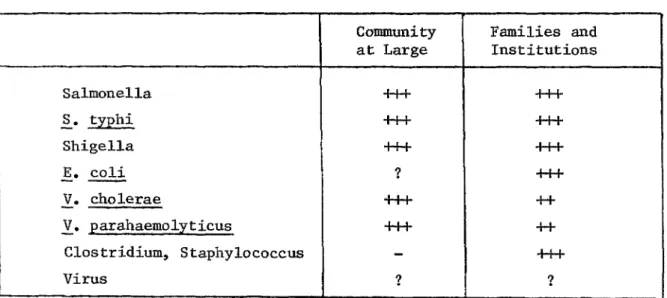
POTENTIAL EPIDEMIC
Community Families and
at Large Institutions
Salmonella '''
S• typhi ...si! if:
Shigella _:; I[I
E. coli ? Ill
V. cholerae +++ ++
V. parahaemolyticus _;: ++
Clostridium,Staphylococcus - III
Virus ? ?
Almost all etiological agents of the enteric infections
TABLE 6
INTERNATIONAL IMPLICATIONS
Threat to Impact on Impact on
Other Countries Tourism Commerce
Salmonella - + I, II
S.typhi + + + +
Shigella - -
-E.coli - + +
V. cho!erae I1,1, III III
_. _arahaemolyticus - - + +
Clostridium,Staphylococcus - - +
Virus ? ? ?
International implications of enteric infections vary widely depend-ing on the etiological agent involved.
From the aspect of the threat of invasion to other countries, _. cholerae is the only one of undeniable international importance, and causes equally significant injury to tourism and trade°
It should be pointed out that Salmonella andS. parahaemolyticus are equally important from the standpoint of injury to international trade.
CSPI9/DT/6 (Eng.) Page 24
"_
, + +I , +I , , ,
o_
4-I
_ ,--101:14
_._
_'_'_,,
o,_ O_P_
•
_
_
_o__
_
°°
_o co o
0 _ ¢) ::::l
o _ o
•H 0 .,q
_ o _
o
_
_._
o
o "0
_
,
_ _
_
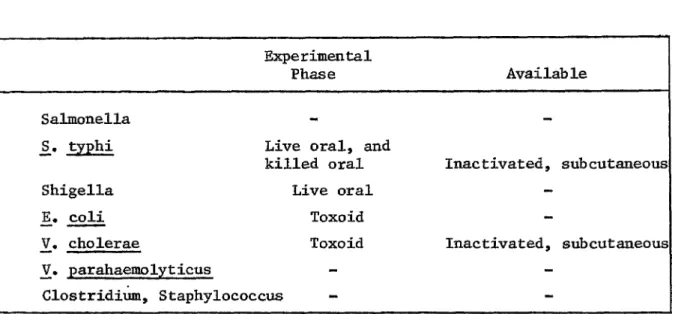
TABLE 8
VACCINES
Experimental
Phase Available
Salmonella -
-_. typhi Live oral, and
killed oral Inactivated, subcutaneous
Shigella Live oral
-E. coli Toxoid
-V. cholerae Toxoid Inactivated, subcutaneou_
_. parahaemolyticus -
-Clostridium,Staphylococcus
CSPI9/DT/6 (Eng.) Page 26
TABLE 9
I. STUDY TO EVALUATE THE USE OF THE KNOWLEDGE AND RESOURCES AVAILABLE
II. EPIDEMIOLOGICAL SURVEILLANCE
III. EXPERIMENTAL USE OF NEW RESOURCES (VACCINES, TREATMENT SCHEDULES, SIMPLE SANITATION MEASURES)
Studies designed to identify the factors and conditions that have prevented large-scale use of the knowledge and resources at present avail-able for combatting enteric infections will undoubtedly help to improve the efficiency of control programs.
Another aspect worthy of study is epidemiological surveillance of enteric infections because of the inadequate dissemination of information
about this group of diseases in the developing countries.