Carlos Pestana Barros & Nicolas Peypoch
A Comparative Analysis of Productivity Change in Italian and Portuguese Airports
WP 006/2007/DE _________________________________________________________
António Afonso, Michael G. Arghyrou and Alexandros Kontonikas
The determinants of sovereign bond yield spreads in the
EMU
WP 36/2012/DE/UECE _________________________________________________________
De p a rtm e nt o f Ec o no m ic s
W
ORKINGP
APERSISSN Nº 0874-4548
School of Economics and Management
The determinants of sovereign bond yield
spreads in the EMU
*António Afonso, $ Michael G. Arghyrou,± and Alexandros Kontonikas+
October 2012
Abstract
We use a panel of euro area countries to assess the determinants of long-term sovereign bond yield spreads over the period 1999.01-2010.12. We find that, unlike the period preceding the global financial crisis, European government bond yield spreads are well-explained by macro- and fiscal fundamentals over the crisis period. We also find that the menu of macro and fiscal risks priced by markets has been significantly enriched since March 2009, including the risk of the crisis’ transmission among EMU member states, international risk and liquidity risk. Finally, we find that sovereign credit ratings are statistically significant in explaining spreads, yet compared to macro- and fiscal fundamentals their role is limited.
JEL: C23, E62, H50.
Keywords: sovereign yields, government debt, panel analysis, credit ratings
*
We are grateful to Paul de Grauwe, Jean-Paul Renne, to participants at the 61th Congress of the French Economic Association (Paris), at theBanque de France and BETA, University of Strasbourg, conference on “Macroeconomic and Financial Vulnerability Indicators in Advanced Economies” (Strasbourg), at seminars at the Department of Applied Economics of the Universitat Autònoma de Barcelona, and at the Cardiff University. Michael G. Arghyrou and Alexandros Kontonikas would like to thank the Fiscal Policies Division of the ECB for its hospitality. The opinions expressed herein are those of the authors and do not necessarily reflect those of the ECB or the Eurosystem.
$
European Central Bank, Directorate General Economics, Kaiserstraße 29, D-60311 Frankfurt am Main, Germany. email: [email protected]. ISEG/TULisbon – Technical University of Lisbon, Department of Economics; UECE – Research Unit on Complexity and Economics, R. Miguel Lupi 20, 1249-078 Lisbon, Portugal, email: [email protected]. UECE is supported by FCT (Fundação para a Ciência e a Tecnologia, Portugal), financed by ERDF and Portuguese funds.
± Cardiff Business School, Economics Section, Cardiff University, Colum Drive, Cardiff CF10 3EU,
United Kingdom, email: [email protected].
+ University of Glasgow Business School, Economics Subject, Adam Smith Building, University of
Contents
Non-technical summary ... 3
1. Introduction ... 4
2. Related literature... 6
3. Analysis ... 9
3.1. Methodology ... 9
3.2. Data and stylised facts ... 14
3.3. Measuring transmission effects ... 16
3.4. Panel estimation results ... 19
3.5. Sovereign ratings and spreads ... 22
4. Conclusions ... 23
Non-technical summary
Following the 2008-2009 international financial crisis, and notably in the aftermath of the Lehman Brothers bankruptcy in autumn 2008, fiscal imbalances increased in most European economies and the euro area in particular, reflecting the high fiscal cost of the measures taken to contain the fallout from the credit crisis. These developments have been followed by a sovereign debt crisis, which started from Greece in autumn 2009 and gradually engulfed the whole of the European Economic and Monetary Union (EMU), particularly the so-called periphery EMU economies. Greece Ireland and Portugal were all forced in 2010-11 to resort to financial rescue schemes. These, however, failed to put a halt to the crisis. Not only all three countries remain, effectively, cut-off from international bond markets, but in the second half of 2011 Spanish and Italian government bonds came under significant market pressure.
In this paper we assess the determinants of long-term government bond yields in the euro area, paying particular emphasis in their changing composition over time. We employ a panel of ten euro area countries (Austria, Belgium, Finland, France, Greece, Ireland, Italy, Netherlands, Portugal and Spain) over the period 1999:01-2010:12 (monthly data). We assess the role of an extended set of potential spreads’ determinants, namely macroeconomic and expected fiscal fundamentals, international risk, crisis’ transmission risk, liquidity conditions, and sovereign credit ratings. We consider three distinct time periods: first, the period preceding the global credit crunch (1999.01 – 2007.07); second the period during which the global credit crunch had not yet mutated into a sovereign debt crisis (2007.08 – 2009.02); and third the period during which the global financial crisis mutated into a sovereign debt crisis (2009.03 – 2010.12).
Our findings can be summarised as follows: i) the second principal component of yield spreads, including Greece, Portugal, Spain, Ireland and Italy, captures the risk involved in investing to periphery relative to core countries’ bonds. Starting from early 2009, the two groups decoupled, with the risk of periphery countries relative to core ones increasing rapidly. The developing periphery crisis caused an increased risk of the crisis’ transmission among periphery countries, as well as from periphery to core countries since early 2010; ii) since August 2007 higher international risk is associated with higher spreads iii) since August 2007 yield spreads increase as a response to a slowdown in growth; iv) since March 2009 yield spreads are positively associated with real exchange rate appreciation and negatively associated with bond market liquidity; v) markets price fiscal risk, throughout the period under examination, through the fiscal balance. Since March 2009, however, they penalise fiscal imbalances more strongly, attaching an extra premium on the stock of projected public debt; vi) between summer 2007 and spring 2009, the decrease in long-term debt issuance in most euro area countries was associated with lower yield spreads, while since March 2009 the relationship between the two variables reverses; vii) credit ratings are statistically significant in explaining spreads but their role is not critical.
1. Introduction
Following the 2008-2009 international financial crisis, and notably in the aftermath of the Lehman Brothers bankruptcy in autumn 2008, fiscal imbalances increased in most European economies and the euro area in particular, reflecting the high fiscal cost of the measures taken to contain the fallout from the credit crisis. These developments have been followed by a sovereign debt crisis, which started from Greece in autumn 2009 and gradually engulfed the whole of the European Economic and Monetary Union (EMU), particularly the so-called periphery EMU economies. With their government bond yields soaring, and following a series of credit rating downgrades, Greece Ireland and Portugal were forced in 2010-11 to resort to financial rescue schemes organised by the European Union (EU), the European Central Bank (ECB) and the International Monetary Fund (IMF) in the context of the newly-created mechanism, the European Financial Stabilisation Facility (EFSF). These rescue packages, however, failed to put a halt to the crisis. Not only all three countries remain, effectively, cut-off from international bond markets, but in the second half of 2011 Spanish and Italian government bonds came under significant market pressure.
In response to the European sovereign debt crisis, a number of recent empirical studies have attempted to identify the factors affecting EMU government bonds yields spreads. This previous literature (see section two), has explained the crisis on the basis of a transfer of global financial risk to sovereign bonds through banking bailout schemes (Acharya et al., 2011); changing private expectations regarding the probability of default risk and/or a country’s exit from the euro (Arghyrou and Tsoukalas, 2011), leading to a marked shift in market pricing behaviour from a ‘convergence-trade’ model before August 2007 to one driven by macro-fundamentals and international risk thereafter (Arghyrou and Kontonikas, 2012); increased attention to fiscal developments. (Afonso, 2010); contagion effects (De Santis, 2012) and sovereign credit ratings events (Afonso et al., 2012).
crunch had not yet mutated into a sovereign debt crisis (2007.08 – 2009.02); and third the period during which the global financial crisis mutated into a sovereign debt crisis (2009.03 – 2010.12). Compared to existing studies, we use a widened set of fundamentals enabling us to capture further insights, some of which are unreported in the previous literature, relevant to the factors determining sovereign spreads in the euro area. These include macroeconomic and expected fiscal fundamentals, international risk, liquidity conditions and the risk of the crisis’ transmission among EMU member states, which we capture using principal components analysis as in Longstaff et al. (2011).
We employ a panel of ten euro area countries (Austria, Belgium, Finland, France, Greece, Ireland, Italy, Netherlands, Portugal and Spain) over the period 1999:01-2010:12 (monthly data). Our findings can be summarised as follows: i) the second principal component of yield spreads, including Greece, Portugal, Spain, Ireland and Italy, captures the risk involved in investing to periphery relative to core countries’ bonds. Starting from early 2009, the two groups decoupled, with the risk of periphery countries relative to core ones increasing rapidly. The developing periphery crisis caused an increased risk of the crisis’ transmission among periphery countries, as well as from periphery to core countries since early 2010; ii) since August 2007 higher international financial risk is associated with higher spreads iii) since August 2007 yield spreads increase as a response to a slowdown in growth; iv) since March 2009 yield spreads are positively associated with real exchange rate appreciation and negatively associated with bond market liquidity; v) markets price fiscal risk, throughout the period under examination, through the fiscal balance. Since March 2009, however, they penalise fiscal imbalances more strongly, attaching an extra premium on the stock of projected public debt; vi) between summer 2007 and spring 2009, the decrease in long-term debt issuance in most euro area countries was associated with lower yield spreads, while since March 2009 the relationship between the two variables reverses; vii) credit ratings are statistically significant in explaining spreads but their role is not critical.
2. Related literature
Existing studies on EMU government bond yields, or their spread against Germany, fall into two broad categories, respectively covering the period prior to and following the global financial crisis. Both groups of studies typically follow the general literature on government bond yields modelling the latter on three main variables (see e.g. Manganelli and Wolswijk, 2009): First, an international risk factor capturing the level of perceived financial risk and its unit price. Typically, this is empirically approximated using indexes of US stock market implied volatility or the spread between the yields of US corporate bonds against US treasury bills. Second, credit risk, reflecting the probability of default on behalf of a sovereign borrower, typically approximated using indicators of past or projections of future fiscal performance. Indeed, existing evidence suggests that markets attach additional risks to the loosening of observed fiscal positions (see e.g. Ardagna et al., 2004; Afonso and Rault, 2010) and shifts in fiscal policy expectations (see e.g. Elmendorf and Mankiw, 1999). Third, government bond yields are linked to liquidity risk. This source of risk refers to the size and depth of the sovereign bonds market and captures the possibility of capital losses due to early liquidation or significant price reductions resulting from a small number of transactions. Liquidity is a variable particularly difficult to measure empirically, usually approximated using bid-ask spreads, transaction volumes and the level of or the share of a country’s debt in global/EMU-wide sovereign debt (see e.g. Favero et al., 2010, Arghyrou and Kontonikas, 2012).
The literature on European government bonds for the period preceding the global credit crunch is not unanimous regarding the role of each of the three variables discussed above. Having said so, the balance of reported evidence leads to the following conclusions: First, prior to summer 2007 the international risk factor was an important determinant of bond yields and spreads, as suggested by studies including Codogno et al. (2003), Geyer et al. (2004), Barrios et al. (2009), Sgherri and Zoli (2009), Manganelli and Wolswijk (2009) and Favero et al. (2010). This effect was stronger during periods of tightening international financial conditions (see e.g. Haugh et al., 2009; Barrios et al., 2009) and more prominent in countries with high levels of public debt (see e.g. Codogno et al., 2003).
Wolff (2008) and Schuknecht et al. (2009) interpret this finding as evidence that the Stability and Growth Pact operated as credible mechanism enforcing fiscal discipline among EMU members. This interpretation, however, has been contested by Manganelli and Wolswijk (2009), who suggest that the penalties imposed by markets were not sufficiently high to prevent unsustainable national fiscal policies. Similarly, Afonso and Strauch (2007) report that the fiscal policy events in 2002 in the EU had only small effects on government bond yield spreads, while Hallerberg and Wolff (2008) find that the effect of fiscal performance on EMU sovereign bond yields has weakened following the euro’s introduction. Overall, default risk in the EMU context has been seen in the past, at least before the global financial crisis, to be present but rather subdued (see e.g. Bernoth et al., 2004).
Finally, the effect of liquidity risk for the period preceding the global financial crisis is disputed. Codogno et al. (2003), Bernoth et al. (2004), Pagano and Von Thadden (2004), and Jankowitsch et al. (2006) find a limited and declining liquidity effect on EMU spreads. On the other hand, Gomez-Puig (2006), Beber et al. (2009), and Manganelli and Wolswijk (2009) find that liquidity was an important determinant of yields spreads. Liquidity effects are found to be stronger during periods of tightening financial conditions and higher interest rates, during which market participants are willing to trade lower yields for higher sovereign debt liquidity.1
There is a growing literature on EMU sovereign bond during the current period of financial turmoil. More specifically, existing studies share two common findings. First, the observed widening in EMU spreads is largely driven by the increased international risk factor.2 In this process, the role of domestic banking sectors is crucial, as suggested by Candelon and Palm (2010), Gerlach et al. (2010) and Acharya et al. (2011).3 International banking risk appears to have been transformed into sovereign risk through
1
Favero et al. (2010), on the other hand, provide theoretical justification and empirical evidence according to which during the early EMU-years liquidity had a smaller effect on sovereign spreads in periods of high risk. This is explained by the fact that in crisis periods investors choose from a reduced set of alterative investment opportunities, limiting their willingness to move away from sovereign bonds. 2
Holló et al. (2012) develop a comprehensive indicator of financial stress for the EMU composed using information from numerous financial markets, covering the period 1987-2010. Their findings suggest an unprecendented increase in financial systemic risk in the euro area since mid-2007, whose peak coincides with the immediate aftermath of the Lehman Brothers crisis.
3
three channels. First, shortages in banking liquidity restricted credit to the private sector causing economic recession and increasing fiscal imbalances. Second, governments were obliged to recapitalise banks using public money increasing fiscal liabilities further. In relation to this, if bank bailouts are perceived to be (even partly) financed through future taxation, they reduce the non-financial sector’s incentives to invest, hurting growth and, implicitly, expected future public revenue. Finally, the announcement of a banking bailout itself lowers the price of government debt due to the anticipated dilution from newly issued debt. With national banking sectors having different degrees of exposure to international financial conditions the increase in the common international risk factor causes a heterogeneous impact on national spreads. Attinasi et al. (2009), Sgherri and Zoli (2009), Mody (2009), Barrios et al. (2009), Gerlach et al. (2010), Schuknecht et al. (2010), Caceres et al. (2010) and Acharya et al. (2011) have all established the importance of the international risk factor during the crisis period and its impact on the latter through the financial/banking sector.
The second point of consensus is that during the crisis period markets have been penalising fiscal and other macro-imbalances much more heavily than before. According to Arghyrou and Kontonikas (2012), unlike the pre-crisis period, when markets did not price macro-fundamentals (with the possible exception of expected budget deficits) and the international risk factor, during the crisis period markets have been pricing both factors, and several factors, notably fiscally related, have become relevant determinants of spreads. Similar findings are obtained by Bernoth and Erdogan (2010). Furthermore, markets not only attach a higher weight on fiscal imbalances, but they also price their interaction with the international risk factor (see e.g. Barrios et al., 2009; Haugh et al., 2009; Manganelli and Wolswijk, 2009; Schuknecht et al., 2010). Increased focus on heterogeneous fiscal performance/outlook and the latter’s interaction with the international risk factor is another major factor explaining the differential spread increases observed among EMU countries (see Favero and Missale, 2011).
role for country-specific liquidity risk (see e.g. Attinasi et al., 2009; Sgherri and Zoli, 2009; Barrios et al., 2009; Haugh et al., 2009; Arghyrou and Kontonikas, 2012; De Santis, 2012; Favero and Missale, 2011).
Finally, recent studies have investigated the impact of sovereign credit ratings on EMU sovereign bond yields. Afonso et al. (2012) find notably significant responses of government bond yield spreads to changes in rating notations and outlook (from Standard & Poor’s, Moody’s, Fitch), particularly in the case of negative announcements. In addition, rating announcements in so-called event countries affect more significantly sovereign yields in non-event countries when the sovereign rating of the event country is lower than those of non-event countries. Therefore, such spill-over effects run from lower rated countries to higher rated countries. Similar findings, confirming the significance of sovereign credit agencies in determining yields in the market for CDS on EMU sovereign bonds, as well as the existence of substantial spill-over effects both across countries and financial markets, are presented by Arezki et al. (2011) and De Santis (2012).
3. Analysis 3.1. Methodology
We use a unified framework of analysis capturing simultaneously and extending the insights of the studies by Arghyrou and Kontonikas (2012) and Afonso et al. (2012). In its simplest version the proposed specification to assess the potential determinants of the sovereign long-term bond yields can be written as:
sprit = a + β1sprit-1 +β2vixt + β3bait + β4balanceit + β5debtit + β6qit + β7gindit
+ β8pc2t+ γi + εit. (1)
Equation (1) models the 10-year government bond yield spread versus Germany,
sprit, on the international risk factor, bond market liquidity conditions, macroeconomic
and fiscal fundamentals, and contagion effects incorporating country-specific fixed effects (γi). To account for endogeneity between spreads and the explanatory variables
we estimate equation (1) using the Two-Stage Least Squares (2SLS) method with cross-section weights which account for cross-cross-sectional heteroskedasticity.4 Following
4
time-standard practice in the empirical literature on EMU Equation(1) includes lagged spreads to account for spreads persistence (see also Gerlach et al., 2010). As Hallerberg and Wolff (2008) explain, while the persistent nature of spreads implies that the exclusion of the lagged spread term from the model will generate omitted variable bias, inclusion of the lagged dependent variable as a regressor generates a different bias since the latter variable is correlated with the fixed effects (see Nickell, 1981). Nevertheless, as Hallerberg and Wolff (2008) point out, the latter bias declines as the time-series dimension of the panel (T) increases and becomes quite small once T reaches 20. As in our sample T = 144 we expect any bias introduced by the inclusion of the lagged dependent variable to be very small and in all likelihood smaller than the omitted variables bias that would arise by its exclusion. However, in the robustness tests that follow our estimations, we have also estimated the base line model excluding the lagged spread term. The results, as we shall see in section 3.4 below, remain qualitatively very similar.
vixt is the logarithm of the S&P 500 implied stock market volatility index (VIX),
our proxy for the international risk factor. The VIX, often called the ‘investor fear gauge’ since it tends to spike during market turmoil periods (Whaley, 2000), is a reasonable proxy for international financial risk (Mody, 2009) and has been extensively used in the literature on euro area government bond spreads (see e.g. Beber et al., 2009) and Gerlach et al., 2010).5 We expect a higher (lower) value for the international risk factor to cause an increase (reduction) in government bond spreads.
baitdenotes the 10 year government bond bid-ask spread. This is our measure of
bond market illiquidity, with a higher (lower) value of this spread indicating a fall (increase) in liquidity leading to an increase (reduction) in government bond yield spreads. Bid-ask spreads are used to capture liquidity effects in EMU sovereign bond markets by a number of previous studies including Barrios et al. (2009), Favero et al. (2010), Gerlach et al. (2010), and Bernoth and Erdogan (2010).
series observations, that is, the opposite case of the type of panel that we work with (see also Barrios et al., 2009). All reported models have also been estimated using the Feasible Generalised Least Squares (FGLS) method, with cross-section weights which accounting for cross-sectional heteroskedasticity (see also Attinasi et al., 2009). The FGLS results (available upon request) do not differ significantly from the 2SLS results.
5
balanceit and debtit denote the expected fiscal position variables, namely, the
expected (one-year ahead) government budget balance-to-GDP ratio and the expected government debt-to-GDP ratio, respectively, both measured as differentials versus Germany. The expected fiscal position provides a proxy for credit quality, with an expected fiscal deterioration implying higher risk. The utilisation of expected, as opposed to historical fiscal data, is in line with a number of recent studies on EMU government bond yield spreads including Attinasi et al. (2009), Sgherri and Zoli (2009), Gerlach et al. (2010) and Favero and Missale (2011). We expect a higher (lower) value for the expected government budget balance to reduce (increase) spreads; while higher (lower) expected public debt should cause an increase (reduction) in spreads.
qit is the log of the real effective exchange rate. This variable generally captures
credit risk originating from general macroeconomic disequilibrium although, and given the inclusion in equation (1) of variables specifically capturing fiscal fundamentals and growth conditions (see below), in our specification it may be mainly capturing external competitiveness. An increase (reduction) in q denotes real exchange rate appreciation (depreciation), which is expected to increase (reduce) spreads as theoretically justified by the analysis of Arghyrou and Tsoukalas (2011).6 The empirical significance of real exchange rates in explaining spreads in the EMU area has been confirmed by Arghyrou and Kontonikas (2012). In the empirical specification shown above, we use trade-weighted real exchange rates calculated against our sample countries’ main trading partners. As Germany is the main trading partner of all countries included in our panel, the level of the real effective exchange rate qit captures the effect of relative productivity
shocks against Germany, as well as the shocks relative to the remaining trading partners. However, in our robustness tests, we also estimate our baseline model using
6
the real exchange rate differential against Germany (qdit), given by the difference
between the log of a country’s real effective exchange rate and the log of the German real effective exchange rate. As we report in section 3.4 below, this does not affect our results.
gindit is the annual growth rate of industrial production (differential versus
Germany). This variable is used as a proxy for the effects of economic growth on spreads, capturing the argument by Alesina et al. (1992) according to which sovereign debt becomes riskier during periods of economic slowdown (see also Bernoth et al., 2004). Therefore, an increase (reduction) in growth performance is assumed to improve (deteriorate) credit worthiness reducing (increasing) government bond spreads.
Finally, pc2t denotes our proxy for the effects caused by the transmission of the
sovereign debt crisis within the group of periphery countries and from the periphery to core countries. This proxy is derived using principal components analysis on government bond yields spreads (see Longstaff et al., 2011) and is fully explained in Section 3.3 below. If such transmission effects are present, an increase (reduction) in
pc2t should increase (reduce) spread values.
After estimating the baseline model given by equation (1) we extend it by adding variables aiming to capture further insights relating to the movements of spreads within the EMU area. First, we consider the role of the share of long-term general government debt (defined as debt maturing at least after one year) in total general government debt. The rational for adding this variable (ltsdebtit) is that all else equal, a country with a
large stock of debt maturing in the near future might be considered less credit-worthy compared to a country whose debt repayment is scheduled in the more distant future. Second, we allow the expected debt to GDP ratio differential versus Germany to enter in the second power (debit2) to capture possible non-linear effects of expected fiscal
performance on government bond spreads, as suggested by Bernoth et al. (2004) and Bernoth and Erdogan (2010).
Third, we allow for the effect of a multiplicative term capturing the interaction between past spread movements and illiquidity conditions (see Llorente et al., 2002). Given that sovereign bond yield spreads and bid-ask spreads are highly positively correlated,7 the product of the two variables typically increases (declines) because both terms increase (decline). Therefore, the multiplicative term (sprit-1*bait-1) can be
7
interpreted as a stress indicator for bond markets, since a rise is associated with falling bond prices and higher illiquidity. Assuming, as it is the case in recent months for EMU countries, an increase in spreads and illiquidity, a positive coefficient for (sprit-1*bait-1)
would indicate the existence of market forces pushing bond prices below their equilibrium value, as this is determined by the remaining spreads’ determinants. This would be consistent with (though not definitely proving) speculation trading pushing bond prices below their fair value.
On the other hand, and assuming the same tightening market conditions, a negative coefficient for (sprit-1*bait-1) would indicate the existence of market forces
pushing bond prices above their equilibrium value, as this is determined by the remaining spreads’ determinants. This could be consistent with bond purchases originating from two possible sources: (a) purchases by private agents, speculating that the rest of market participants have underpriced the fair value of bonds, which they proceed to buy in anticipation of a future increase in their value. This movement would reduce market pressure on bonds; (b) bond purchases by institutional investors, in an effort to mitigate the effect of private sales and prevent a collapse of the bonds’ market. Whatever the source of such bond purchases, a negative sign for the multiplicative term (sprit-1*bait-1) would not be consistent with speculation of the former (detrimental) kind
that increases spreads beyond the level justified by their fundamentals.
Fourth, we account for the role of sovereign credit ratings/announcements on government bond spreads, denoted by averageratingit and averageoutlookit respectively.
This allows us to assess the effect of credit ratings/announcements on government bond spreads, which is above and beyond the information that markets have already priced through observation of the remaining determinants of spreads. In a fully efficient (strong-form) market, credit ratings and outlook announcements should not affect bonds’ prices, therefore their coefficients should equal zero. If, however, markets are efficient only in the semi-strong form, credit ratings and credit announcements may be treated by markets as revealing information, which was previously private to credit rating agencies. In other words, we test whether sovereign credit ratings announcements convey some kind of information that the market treats as news.
sprit = a + β1sprit-1 +β2vixt + β3bait + β4balanceit + β5debtit + β6qit + β7gindit
+ β8pc2t + β9ltsdebtit + β10debtit2 + β11sprit-1bait-1 + β12averageratingit
+ β13averageoutlookit + γi + εit . (2)
After estimating equations (1) and (2) which relate spreads to their underlying fundamentals under the assumption that these relationships have remained stable over time, we proceed by accounting for the possibility of structural change during the crisis period. In particular, we allow for two structural breaks in the relationship between spreads and their aforementioned potential determinants, using slope dummy variables. The first dummy variable (D2007.08t) aims to capture the effects of the global financial
crisis specified to begin in August 2007. This date is widely acknowledged in the literature to be the starting point of the global credit crunch given that the first large emergency loan that the ECB provided to European banks in response to increasing pressures in the interbank market took place on 9/8/2007 (see also Arghyrou and Kontonikas, 2012; Attinasi et al., 2009).
The second dummy variable (D2009.03t) intends to capture the point in time
when the global credit crisis started being transformed into the European sovereign debt crisis. We date this development back to March 2009 for two reasons. First, the most intense period of the credit crisis was over by the spring of 2009 with major stock market indices experiencing their lowest levels in early March 2009 and since then recording significant gains. Second, by spring 2009 the cost of fiscal activism and the bank bailout packages that were implemented during the credit crisis period became apparent. The very substantial revision of projected public debt in the spring of 2009, an increase of 19% on average across euro area members according to ECFIN data, defines a key point in the European debt crisis, as markets were made officially aware of these costs. As we explain in section 3.2 below, the effect of these events are strikingly apparent in expected fiscal balances and public debt to GDP ratios, with both series registering a sharp step-increase in March 2009. This renders the choice of March 2009 as marking the beginning of a new phase in the EMU sovereign debt a data-driven one.
3.2. Data and stylised facts
frequency, over the time period 1999:01-2010:12.8 The data sources and definition of the variables can be seen in Table A1 of the Appendix.
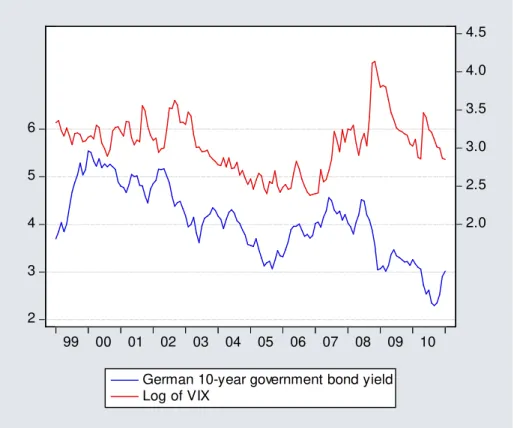
Figure 1 presents the 10-year euro area government bond yield spreads. Before the economic and financial crisis of 2007-8, spreads against Germany had stabilised at very low levels despite deteriorating macroeconomic fundamentals in many countries. During the credit crisis all euro area economies experienced a large increase in their spread versus Germany. German government bonds operated as a ‘flight-to-quality’ asset during the crisis putting an upward pressure in all euro area government bond yield spreads. This ‘flight-to-quality’ feature of German bonds is apparent in Figure 2, which plots the 10-year German yield together with the general indicator of common international risk, the VIX. Figure 2 shows that during the peak of the credit crisis in the autumn of 2008, following the collapse of Lehman Brothers, the VIX increased sharply while the 10-year German government bond yield plummeted as investors flock to the perceived safety of German bonds.
[Figures 1, 2]
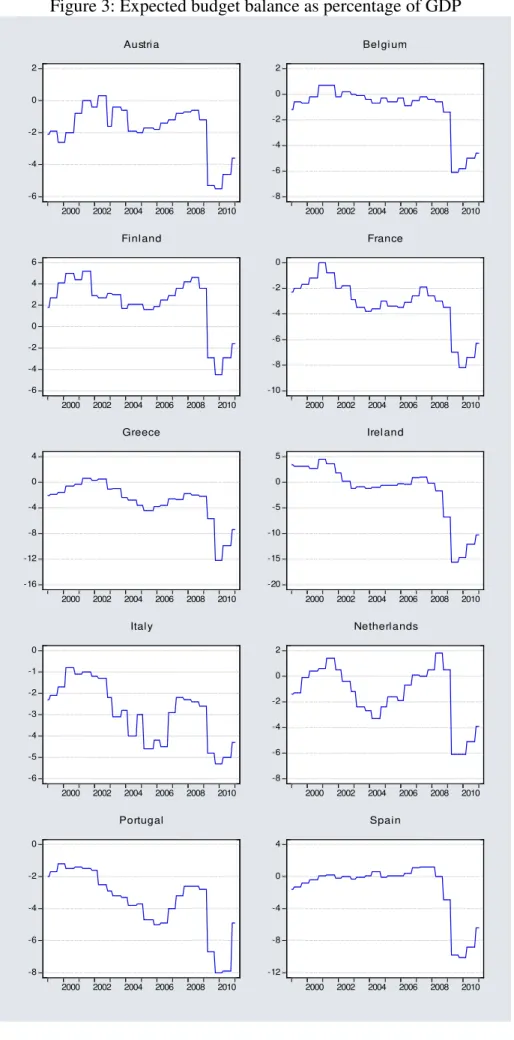
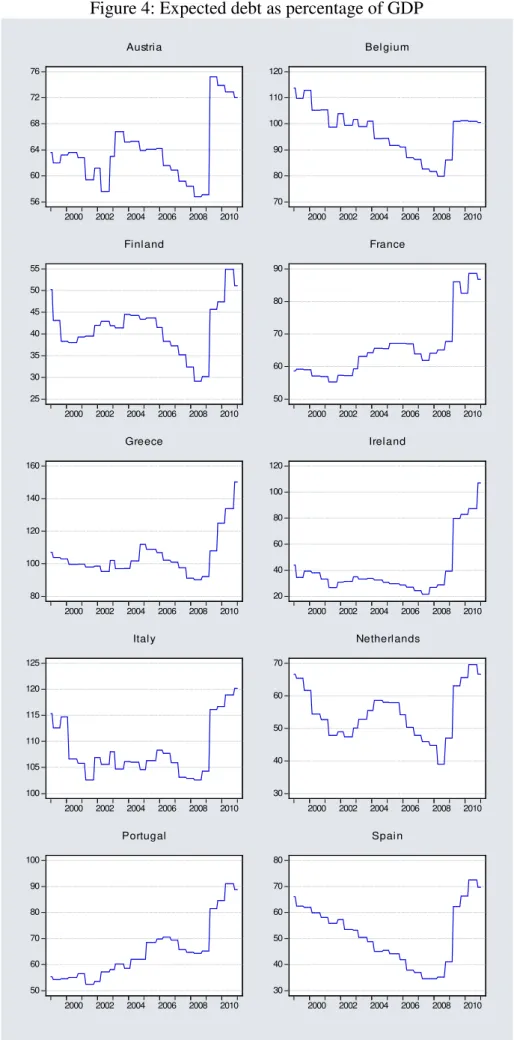
Figures 3 and 4 depict the transformation of the credit crisis into a sovereign debt crisis with euro area governments expected fiscal position deteriorating sharply in early 2009.9 The fiscal deterioration reflects lower tax revenues for the euro area governments, due to the economic contraction, as well to the fiscal stimulus packages that were implemented to prevent further deterioration. Furthermore, governments faced the additional major fiscal cost of having to support the financial sector, via significant capital injections in the euro area banks’ balance sheets, provision of guarantees, such as the Irish government bank guarantee scheme (29/09/2008), and outright purchases of assets from banks.10
[Figure 3, 4]
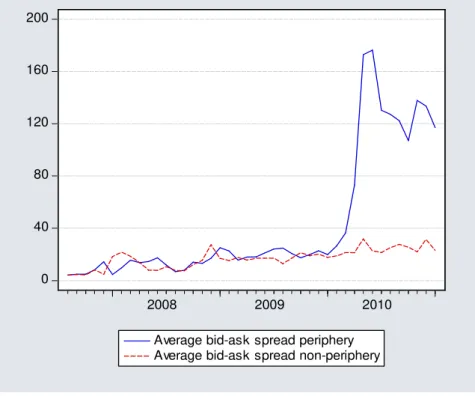
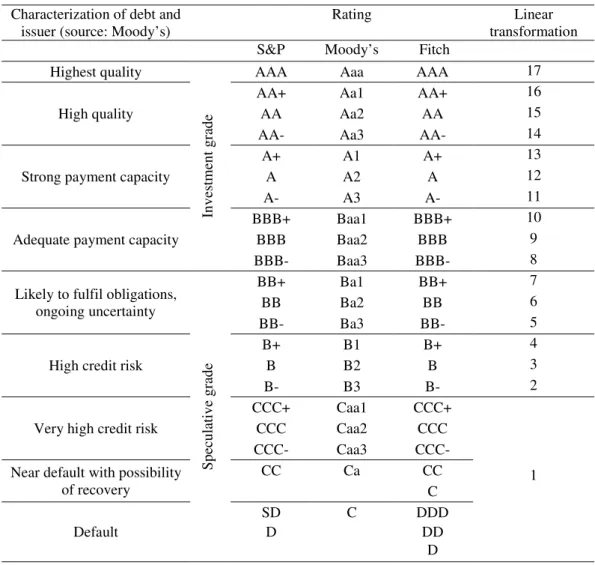
Finally, Figures 5 and 6 link present information on credit ratings and their link to the European sovereign debt crisis. We use data on euro area sovereign debt credit rating and credit outlook from each of the three main rating agencies, Standard and
8
We exclude Luxembourg, where the outstanding government debt and the associated market are very small, as well as the countries that joined the euro since 2008 (Cyprus, Malta, Slovakia and Slovenia). 9
These forecasts are produced by the European Comission’s DG ECFIN twice a year (spring and autumn).
10
Poor’s, Moody’s and Fitch, as well as for the simple average rating calculated using rating scores from all three agencies. Following existing literature (see e.g. Gande and Parsley, 2005; Afonso et al. 2012), we transform sovereign credit rating scores into the linear scale presented in Table A2 in the Appendix.11 A worse sovereign credit rating should be perceived by the markets as implying higher credit risk, therefore having an upward effect on the yield spread. Indeed, as Figures 5 and 6 indicate, the significant deterioration in the expected fiscal position in early 2009 was soon followed by downgrades of periphery euro area government debt and liquidity withdrawal, marking the escalation of the euro area debt crisis.
[Figure 5, 6]
3.3. Measuring transmission effects
An important feature of the recent movements of government bond yield spreads in the euro area is the dichotomy observed between core and periphery EMU countries. Following the spike in all countries’ spreads at the height of the global credit crunch, the spreads of the core group have been relatively stable albeit at levels higher compared to those of the pre-crisis period. At the same time, following a temporary reduction in the immediate aftermath of the Lehman Brothers crisis, the spreads of the periphery group have been on an ascending path. This core-periphery divergence raises the possibility of transmission of the sovereign debt crisis within the euro area members. We define transmission as the increase in the spread of any given EMU country due to the markets discounting worsened future fiscal and/or macro fundamentals for that country, after having observed an increased probability of default in another EMU country, reflected in higher spreads for that second country. Transmission can take place both from periphery to core countries, as well as within periphery countries and is ultimately linked to the periphery-core divergence through the following channels.
First, increasing core-periphery divergence, denoting increased probability of default and/or euro exit in one or more countries of the periphery group signals an increased probability of possible future sovereign rescues, ultimately to be funded by non-default countries. Given the superior state of their fiscal fundamentals, the latter are more likely to be members of the core group. Therefore, increasing core-periphery
11
divergence signals an increased probability of aggregating fiscal risks at the EU-level, and increased future borrowing requirements from the core group to cover the potential support efforts. Through this channel, increasing core-periphery divergence may cause transmission of the crisis from the periphery group to the core group.
Second, increased probability of default and/or euro exit in one periphery country, reflected in the widening of its spread versus the core group, may operate as a trigger for fears of subsequent default and/or euro exit in another periphery country (the so-called domino effect). Hence, increasing core-periphery divergence caused by increased spreads in a specific periphery country may cause precautionary capital flight in other periphery countries, leading to a tighter credit environment and deteriorating growth expectations. These, in turn, can cause deteriorating expectations about future fiscal performance increasing credit risk through the channels linking banking risk with sovereign risk discussed in the literature review section. Through this channel, increasing core-periphery divergence may cause transmission of the crisis from one periphery country to another.
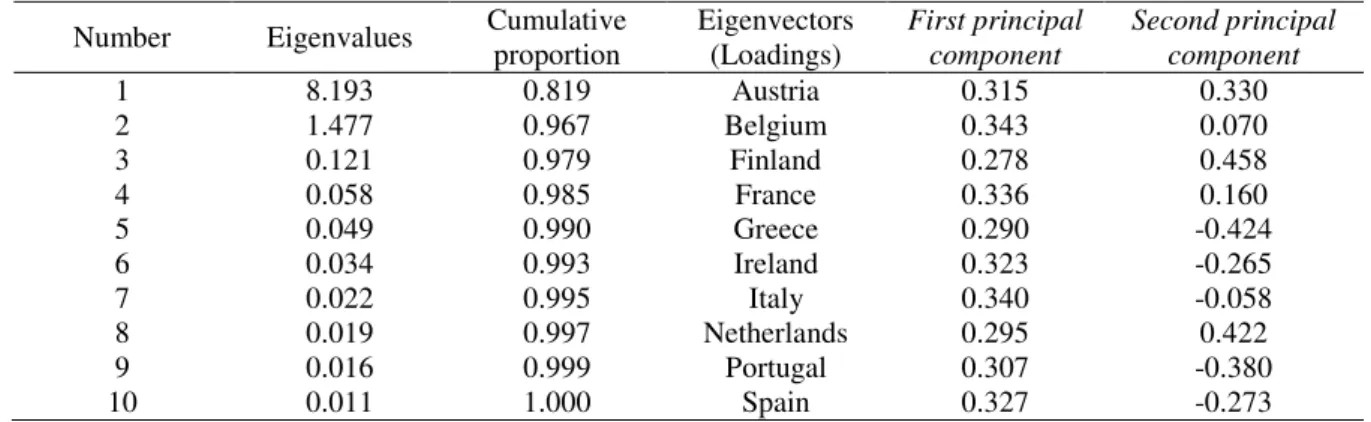
To test the transmission hypothesis we need a quantitative measure of transmission risk which we pursue through a principal components analysis, In a nutshell, the principal components are uncorrelated linear combinations of the original variables, which are then ranked by their variances in descending order. Principal components analysis on government bond spreads allows us to capture both the percentage of data variation due to global co-movement across all spreads, as well as the variation of data explained by the movement of one group of countries against another (see Longstaff et al., 2011).
The results from such analysis are presented in Table 1. Interestingly, the reported eigenvalues and the cumulative proportion figures suggest that the variance of the spreads is essentially captured by the first two principal components. Those two components explain around 97% of the variation of the full variable set. This also implies that we only take into account the components whose associated eigenvalues are above 0.7, a rule suggested by Jollife (1972).
[Table 1]
sign of the reported weights. Table 1 suggests that the first group (denoted by a positive sign) includes Finland, the Netherlands, Austria, France and, marginally, Belgium. The second group (denoted by a negative sign) includes Greece, Portugal, Spain, Ireland and Italy. The absolute size of the reported weights is indicative of the markets’ perception regarding the definitiveness of a country’s position within its group. The country composition of the two groups identified by the second principal component coincides with the core- and periphery-groups widely assumed to exist within the euro area.
The second principal component provides a measure of divergence between the core and periphery groups, roughly a kind of spread between the core and periphery countries (see Longstaff et al. 2011, p.81) As such, it can be interpreted as the risk involved in investing in core bonds relative to the risk of investing in periphery bonds. As explained earlier, an increasing divergence between the core and periphery groups indicates an increasing probability of a sovereign default and/or euro exit within the periphery group. From that point of view, the core-periphery divergence is directly linked to the concept of crisis’ transmission through the two channels (periphery-to-core and periphery-to-periphery transmission) described above.
Figure 7 plots the first two estimated principal components for the period 1999-2010. Focusing on the second principal component, we can infer that starting from early 2009 the two groups are decoupled, with the risk of periphery countries relative to the core ones increasing rapidly. Furthermore, it should be noted that the first principal component has also been rising since early 2010 indicating the possibility of transmission from the developing periphery crisis. Overall, the movements of the second principal component in Figure 7 provide clear evidence for core-periphery relative risk divergence since early 2009, which in association with the recent increase in the first principal component, and on the basis of our arguments above, renders the former variable an appropriate proxy for transmission effects. In our empirical models variable pc2t, which is defined as minus the second principal component, is used to
capture the transmission effects.12 If the latter are present then pc2t is expected to enter
the empirical models of spread determination with a significantly positive sign. [Figure 7]
12
3.4. Panel estimation results
We start our econometric investigation by estimating benchmark models for equation (1) and its extensions for the full sample period without allowing for possible structural breaks. The results from our 2SLS estimations are reported in Table 2. In all reported specifications spreads appear to be highly persistent. We also obtain statistically significant coefficients with the theoretically expected signs for the international risk factor and growth conditions. Liquidity conditions are significant with the appropriate sign in three out of four specifications. The multiplicative term involving past spreads and illiquidity is significant in the two specifications it has been used with a positive sign, suggesting the presence of market forces that increased spreads beyond their equilibrium value. On the other hand, the role of expected fiscal fundamentals appears limited. Specifically, public debt and the ratio of long-term debt to total debt are not significant; squared debt is significant but with the wrong sign; while the fiscal balance is significant with the right negative sign only in two out of four specifications. Finally, real exchange rates and the principal component capturing transmission effects are not significant. Overall, some of the findings reported in Table 2 are consistent with our a priori expectations while others are not.
[Table 2]
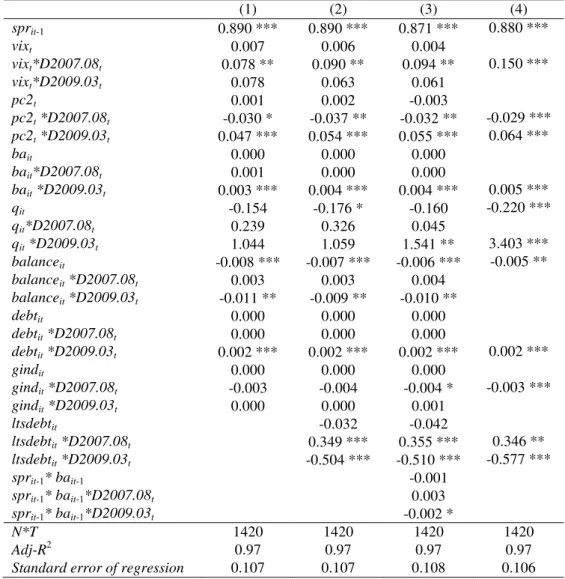
crisis. On the other hand, the coefficient associated with bond market liquidity conditions becomes statistically significant only since March 2009.
[Table 3]
Regarding the expected fiscal position, it appears that markets price the expected budget balance position throughout the entire sample period, with the (positive) reaction of spreads to budget deficits however becoming much stronger (relevant overall coefficient more than doubles) since March 2009. On the other hand, the expected debt ratio starts being positively reflected in spreads only since March 2009. Overall, expected fiscal deterioration is more heavily penalised by the markets during the latter part of the sample period, which captures the escalating sovereign debt crisis.
The March 2009 slope dummy associated with pc2t is positive and significant
indicating that during the debt crisis transmission effects have led to higher spreads. During to the credit crisis the coefficient of pc2t is negative and significant at the 10%
level, however the sum of the two slope-dummy coefficients is positive, indicating that transmission effects have overcompensated the mispricing of the early-crisis period. Finally, real exchange rates and economic growth are not significant in this specification.
Column (2) adds to our specification the share of long-term to total government debt. This becomes statistically significant during the crisis period. The two slope dummy variable coefficients exhibit opposite sign but their sum is negative indicating that overall, a higher long-term share of debt is associated with lower spreads.13 It appears then that the ability to successfully issue and place increasing amounts of term debt in the market is associated with lower borrowing costs, with the ratio of long-term to total debt thereby operating as a credibility indicator.
While the effect of the long-term share of debt on spreads is significantly negative since March 2009, as well as overall, the coefficient of the slope dummy variable associated with the August 2007 break is positive. This indicates that between the summer of 2007 and the spring of 2009, the decrease in the share of long-term debt to total debt was not penalised by the markets in the form of higher spreads.14 This finding can be interpreted within the ‘flight to safety’ trading that took place during the credit crisis and saw a massive rebalance of portfolios at global level, away from falling
13
The Wald test F-statistic indicates that the null hypothesis of zero sum of the two slope dummy variable coefficients can be rejected at the 10% level of significance.
14
equities and towards government debt securities. It is consistent with the theoretical prediction by Favero et al. (2010) according to which in crisis periods investors choose from a reduced set of alternative investment opportunities, limiting their willingness to move away from government debt securities. In the process of fleeing the stock market and given an environment of high uncertainty which did not favour long-term commitment of funds, investors increased their demand for liquid short term instruments, such as Treasury bills. At the same time, sovereign bond issuers had an incentive to increase short term debt issuance in order to avoid locking themselves into (the prevailing at the time) high long-term borrowing costs. Finally, compared to column (1), the findings relating to the rest of the variables in column (2) remain unchanged, with the exception of evidence (at the 10% level) of real exchange rate mispricing.
Column (3) adds into the empirical specification the product of the past bond yield spread and the past bid-ask spread. We find that this is statistically significant only since March 2009 with a negative sign, indicating that after the effect of all other determinants of spreads has been accounted for, spreads are lower as compared to what the increasingly stressed bond market conditions would imply. This finding is in contrast to the findings in Table 2 and suggests the existence of demand that helped bond prices from falling further. Compared to column (2) the rest of the findings remain unchanged, with two important exceptions. First, real exchange rates now appear to be statistically significant with the expected positive sign since March 2009. Second, growth conditions are significant at the 10% level with the expected negative sign since August 2007.
stock of public debt only since March 2009. Furthermore, since March 2009 a decrease in the long-term component of total public debt is associated with higher spreads. Growth conditions are also priced since summer 2007. Finally, none of the multiplicative terms involving past spreads and illiquidity is statistically significant.
All in all, the findings in Table 3 suggest that since the onset of the global financial crisis in summer 2007 markets have gradually moved to a pricing model that is much more compatible with theoretical expectations. Furthermore, the menu of macro/fiscal fundamentals priced by the markets has been becoming richer as the crisis evolves. Therefore, compared to the models reported in Table 2, which did not account for structural change, the models reported in Table 3 offer superior information regarding the determinants of sovereign bond spreads in the euro area, especially for the crisis period. This is also reflected in their superior model fit, as suggested by the notable reduction (by approximately 20%) in the standard error of the regressions compared to their (no-breaks) counterpart models reported in Table 2.
3.5. Sovereign ratings and spreads
One of the aspects of the European sovereign debt developments that have been extensively debated is the role of credit ratings in determining intra-EMU government bond yield spreads. In efficient markets, and as long as credit ratings/outlook announcements are determined on the basis of publicly available information, they should not be a statistically significant determinant of spreads. Nevertheless, a number of European policy makers have suggested that sovereign downgrades by the credit rating agencies have been a significant factor in the crisis’ initiation and escalation.15 Moreover, previous empirical evidence indicates that sovereign credit ratings and outlook announcements have had a statistically significant impact on spreads (see e.g. Afonso et al., 2012). Hence, to account for the role of credit rating agencies in the determination of spreads, in this section we repeat the panel estimations of section 3.4 adding to the set of explanatory variables the average credit rating and outlook scores. We measure credit ratings and outlook announcements by the simple average rating and
15
outlook score provided by each of the three main rating agencies, namely Standard and Poor’s, Moody’s and Fitch.
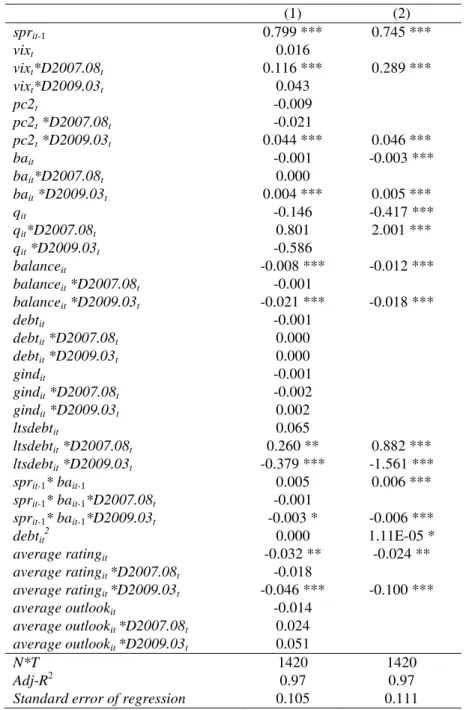
The results are reported in Table 4.16 Column (1) presents a general model, including all the variables used to explain spreads in section 3.4 plus average credit ratings and outlooks respectively. Average ratings are statistically significant during the pre-crisis period, with their significance increasing further during since March 2009. Credit outlook announcements, on the other hand, are not significant. International risk, transmission risk, fiscal fundamentals as well as liquidity conditions remain statistically significant, particularly during the crisis period.17 This pattern is more obvious in column (2), which reports the estimates of a parsimonious model obtained from applying a general-to-specific estimation approach to the general model reported in column (1). Note that compared to the latter, the set of significant variables includes the real exchange rate, confirming our previous finding of the latter’s mispricing during the pre-crisis period and its theory-consistent pricing during the crisis.
[Table 4]
Overall, our findings in Table 4 suggest that the role of credit rating agencies in spreads determination within the euro area is relevant. Nevertheless, the inclusion of ratings and outlook announcements into our models does not result in any significant improvement of the models’ fit and explanatory power, suggesting that even after controlling for the effect of ratings/outlook announcements, the main drivers of intra-EMU spreads continue to be macroeconomic and fiscal fundamentals, transmission risk, international risk and liquidity conditions. Hence, downgrades by the credit rating agencies have played a real yet mitigated role in explaining spread developments.
4. Conclusions
In this paper we studied the determinants of long-term government bond yields in the euro area. We employ a panel of ten euro area countries (Austria, Belgium, Finland, France, Greece, Ireland, Italy, Netherlands, Portugal and Spain) using monthly data over the period 1999:01-2010:12. We investigate the role of an extended set of potential spreads’ determinants, namely macroeconomic and expected fiscal fundamentals,
16
The results from models that use individual credit ratings and outlook scores are available upon request. The qualitative inference obtained using individual agency scores is identical to the one obtained using average scores, with the latter, however, resulting in higher adjusted R2 coefficients.
17
international risk, liquidity conditions, sovereign credit ratings, and the risk of the crisis’ transmission among the EMU members. After estimating benchmark models not accounting for structural change, we repeated our analysis allowing for differences in spreads determination between three distinct time periods: first, the period preceding the global credit crunch (1999.01 – 2007.07); second, the period during which the global credit crunch had not yet mutated into a sovereign debt crisis (2007.08 – 2009.02); and third, the period during which the global financial crisis mutated into a sovereign debt crisis (2009.03 – 2010.12).
Our empirical findings indicate that the determinants of government bond spreads in the euro area have changed significantly over time. This marked shift in market pricing behaviour is evident not only since the onset of the global financial crisis in summer 2007, but also within different stages of the crisis, namely before and after spring 2009. More specifically, we find that during the pre-crisis period macro- and fiscal-fundamentals are generally not significant in explaining spreads. By contrast, since summer 2007 the movements of macro and fiscal fundamentals explain spread movements well and in a way consistent with theoretical expectations. Furthermore, the menu of fundamentals which appear statistically significant in explaining spreads is enriched since spring 2009, suggesting that markets are now pricing risks which they did not consider previously, even well within the crisis period. These include the risk of crisis transmission among the countries of the European periphery, as well as from the periphery countries to the countries of the European core. We also find that in contrast to the pre-crisis period, the size, liquidity and maturity of debt issuances are now being priced by markets. Finally, we find that sovereign credit ratings are statistically significant in explaining spreads, yet relative to macro- and fiscal fundamentals, their role has been rather limited.
References
Acharya, V.V., Drechsler, I. and Schnabl, P. (2011). “A Pyrrhic victory? – Bank bailouts and sovereign credit risk”. NBER Working Paper 17136.
Afonso, A. (2010). “Long-term government bond yields and economic forecasts: evidence for the EU”. Applied Economics Letters, 17, 1437-1441.
Afonso, A., Furceri, D. and Gomes, P. (2012). “Sovereign credit ratings and financial markets linkages: application to European data”. Journal of International Money and Finance, 31, 606-638.
Afonso, A., Gomes, P. and Rother, P. (2011). “Short- and long-run determinants of sovereign debt ratings”. International Journal of Finance and Economics, 16, 1-15. Afonso, A. and Strauch, R. (2007). “Fiscal Policy Events and Interest Rate Swap
Spreads: some Evidence from the EU”. Journal of International Financial Markets, Institutions and Money, 17, 261-276.
Alesina, A., De Broeck, M., Prati, A. and Tabellini, G. (1992), “Default risk on government debt in OECD countries”. Economic Policy, 15, 427-451.
Ardagna, S., Caselli, F. and Lane, T. (2004). “Fiscal Discipline and the Cost of Public Debt Service: Some Estimates for OECD Countries”. EBC Working Paper 411. Arezki, R., Candelon, B. and Amadou, N.R.S. (2011). “Sovereign rating news and
financial market spillovers: Evidence from the European debt crisis”. IMF Working Paper 11/68.
Arghyrou, M.G. and Tsoukalas, J. (2011). “The Greek debt crisis: Likely causes, mechanics and outcomes”. The World Economy, 34, 173-191.
Arghyrou, M.G. and Kontonikas, A. (2012). “The EMU sovereign debt crisis: Fundamentals, expectations and contagion”. Journal of International Financial Markets, Institutions and Money, 22, 658-677.
Attinasi, M-G., Checherita, C., and Nickel, C. (2009). “What explains the surge in euro area sovereign spreads during the financial crisis of 2007-09?”. ECB Working Paper 1131.
Barrios, S., Iversen, P., Lewandowska, M., and Setzer, R. (2009). “Determinants of intra-euro-area government bond spreads during the financial crisis”. European Commission, Economic Papers 388.
Beber, A., Brandt, M. and Kavajecz, K. (2009). “Flight-to-quality or flight-to-liquidity? Evidence from the euro-area bond market”. Review of Financial Studies, 22, 925-957.
Bernoth, K., Wolff, G. (2008). “Fool the markets? Creative accounting, fiscal transparency and sovereign risk premia”. Scottish Journal of Political Economy, 55, 465-487.
Bernoth, K., von Hagen, J., Schuknecht, L. (2004). “Sovereign risk premia in the European government bond market”. ECB Working Paper 369.
Caceres, C., Guzzo, V., Segoviano, M. (2010). “Sovereign spreads: Global risk aversion, contagion or fundamentals?”. IMF Working Paper 10/120.
Candelon, B., Palm, F.C. (2010). “Banking and debt crises in Europe: The dangerous Liaisons?”. CESifo Working Paper 3001.
Codogno, L., Favero, C., Missale, A. (2003). “Yield spreads on EMU government bonds”. Economic Policy, 18, 211-235.
De Santis, R. (2012). “The euro area sovereign debt crisis: Safe haven, credit rating agencies and the spread of the fever from Greece, Ireland and Portugal”. ECB Working Paper 1419.
European Commission (2010). “Public consultation on credit rating agencies”. Directorate General Internal Market and Services.
Elmendorf, D. and Mankiw, N. (1999). “Government Debt”, in Taylor, J. and Woodford, M. (eds.), Handbook of Macroeconomics, vol. 1C, 1615-1669, North-Holland.
Faini, R. (2006). “Fiscal policy and interest rates in Europe”. Economic Policy, 21, 443-489.
Favero, C.A. and Missale, A. (2011). “Sovereign spreads in the euro area. Which prospects for a eurobond?”. CEPR Discussion Paper No. 8637.
Favero, C., Pagano, M., and von Thadden, E.-L. (2010). “How does liquidity affect government bond yields?”. Journal of Financial and Quantitative Analysis, 45, 107-134
Featherstone, K. (2011). “The Greek sovereign debt crisis and EMU: A failing state in a skewed regime”. Journal of Common Market Studies, 49, 193-217.
Gande, A. and Parsley, D. (2005). “News spillovers in the sovereign debt market”.
Journal of Financial Economics, 75, 691-734.
Gerlach, S., Schulz, A., Wolff, G. (2010). “Banking and sovereign risk in the euro-area”. CEPR Discussion Paper No. 7833.
Gomez-Puig, M. (2006). “Size matters for liquidity: Evidence from EMU sovereign yield spreads”. Economics Letters, 90, 156-162.
Hallerberg, M., Wolff, G.B. (2008). “Fiscal institutions, fiscal policy and sovereign risk premia in EMU”. Public Choice, 136, 379-396.
Haugh, D., Ollivaud, P., Turner, D. (2009). “What drives sovereign risk premiums? An analysis of recent evidence from the euro area”. OECD Economics Department Working Paper No. 718.
Holló, D., Kremer, M. and Lo Duca, M. (2012). “CISS – A composite indicator of systemic stress in the financial system”. ECB Working Paper 1426.
Hui, C.H., Chung T.K. (2011). “Crash risk of the euro in the sovereign debt crisis of 2009-2010”. Journal of Banking and Finance, 35, 2945-2955.
Jankowitsch, R., Mosenbacher, H., Pichler, S. (2006). “Measuring the liquidity impact on EMU government bond prices”. European Journal of Finance, 12, 153-169. Jollife, I. (1972). “Discarding variables in a principal component analysis I: Artificial
data”. Applied Statistics, 21, 160-173.
Krugman, P. (1998). “What happened to Asia?”. Available at: http://web.mit.edu/krugman/www/disinter.html
Llorente, G., Michaely, R., Saar, G. and Wang, J. (2002). “Dynamic volume – return relation of individual stocks”. Review of Financial Studies, 15, 1005-1047.
Longstaff, F., Pan, J., Pedersen, L., Singleton, K. (2011). “How Sovereign Is Sovereign Credit Risk?”. American Economic Journal: Macroeconomics, 3, 75-103.
Manganelli, S., Wolswijk, G. (2009). “What drives spreads in the euro-area government bond market?”. Economic Policy, 24, 191-240.
Mody, A. (2009). “From Bear Sterns to Anglo Irish: How Eurozone sovereign spreads related to financial sector vulnerability”. IMF Working Paper 09/108.
Nickell, S. (1981). “Biases in dynamic models with fixed effects”. Econometrica, 49, 1417-1426.
Obstfeld, M. (1996). “Models of currency crises with self-fulfilling features”.
European Economic Review, 40, 1037-1048.
Pagano, M., von Thadden, E.L. (2004). “The European bond markets under EMU”.
Oxford Review of Economic Policy,20, 531-554.
Schuknecht, L., von Hagen, J., Wolswijk, G. (2009). “Government risk premiums in the bond market: EMU and Canada”. European Journal of Political Economy”, 25, 371-384.
Schuknecht, L., von Hagen, J., Wolswijk, G. (2010). “Government bond risk premiums in the EU revisited: The Impact of the financial crisis”. ECB Working Paper 1152. Sgherri, S., Zoli, E. (2009). “Euro area sovereign risk during the crisis”. IMF Working
Paper 09/222.
Tables and Figures
Table 1: Principal component analysis of government bond yield spreads
Note: Principal component analysis is carried out over the time period 1999.01-2011.01 (T=143).
Table 2: Modelling bond yield spreads, 2SLS
Note: The regression models are estimated over the time period 1999.02-2010.11 (T=142). The panel members include Austria, Belgium, Finland, France, Greece, Ireland, Italy, Netherlands, Portugal and Spain (N=10). Two Stage Least Squares (2SLS) fixed effects panel estimates, which account for endogeneity, are reported. The instruments used in the 2SLS estimations are the second and third lag of the dependent variable and the first three lagged values of the independent variables. Colum 1 reports the estimates from the baseline model, while Column 3 reports the estimates from the fully specified model. Column 4 reports the estimates of the parsimonious model that results from applying the general-to-specific approach to the fully specified model. The asterisks ***, **, * indicate significance at the 1, 5, 10% level respectively.
Number Eigenvalues Cumulative proportion
Eigenvectors (Loadings)
First principal component
Second principal component
1 8.193 0.819 Austria 0.315 0.330
2 1.477 0.967 Belgium 0.343 0.070
3 0.121 0.979 Finland 0.278 0.458
4 0.058 0.985 France 0.336 0.160
5 0.049 0.990 Greece 0.290 -0.424
6 0.034 0.993 Ireland 0.323 -0.265
7 0.022 0.995 Italy 0.340 -0.058
8 0.019 0.997 Netherlands 0.295 0.422
9 0.016 0.999 Portugal 0.307 -0.380
10 0.011 1.000 Spain 0.327 -0.273
(1) (2) (3) (4)
sprit-1 0.990 *** 0.989 *** 0.944 *** 0.933 ***
vixt 0.026 *** 0.027 *** 0.042 *** 0.046 ***
pc2t 0.000 0.000 0.000
bait 0.001 *** 0.001 *** 0.000 0.001 *
qit 0.022 0.049 0.046
balanceit -0.001 -0.001 -0.005 ** -0.005 ***
debtit 0.000 0.000 0.000
gindit -0.005 *** -0.004 *** -0.004 *** -0.004 ***
ltsdebtit 0.070 0.030
sprit-1* bait-1 0.001 *** 0.001 ***
debtit2 -1.04E-05 *
N*T 1420 1420 1420 1420
Adj-R2 0.96 0.96 0.96 0.96
Table 3: Modelling bond yield spreads, accounting for structural change
Note: The regression models are estimated over the time period 1999.02-2010.11 (T=142). The panel members include Austria, Belgium, Finland, France, Greece, Ireland, Italy, Netherlands, Portugal and Spain (N=10). Two Stage Least Squares (2SLS) fixed effects panel estimates, which account for endogeneity, are reported. The instruments used in the 2SLS estimations are the second and third lag of the dependent variable and the first three lagged values of the independent variables. The dummy variables D2007.08 and D2009.03 which are equal to one from August 2007 and March 2009 onwards, respectively, and zero otherwise were also included as intercept dummies. Colum 1 reports the estimates from the baseline model, while Column 3 reports the estimates from the fully specified model. Column 4 reports the estimates of the parsimonious model that results from applying the general-to-specific approach to the fully specified model. The asterisks ***, **, * indicate significance at the 1, 5, 10% level respectively.
(1) (2) (3) (4)
sprit-1 0.890 *** 0.890 *** 0.871 *** 0.880 ***
vixt 0.007 0.006 0.004
vixt*D2007.08t 0.078 ** 0.090 ** 0.094 ** 0.150 ***
vixt*D2009.03t 0.078 0.063 0.061
pc2t 0.001 0.002 -0.003
pc2t *D2007.08t -0.030 * -0.037 ** -0.032 ** -0.029 ***
pc2t *D2009.03t 0.047 *** 0.054 *** 0.055 *** 0.064 ***
bait 0.000 0.000 0.000
bait*D2007.08t 0.001 0.000 0.000
bait *D2009.03t 0.003 *** 0.004 *** 0.004 *** 0.005 ***
qit -0.154 -0.176 * -0.160 -0.220 ***
qit*D2007.08t 0.239 0.326 0.045
qit *D2009.03t 1.044 1.059 1.541 ** 3.403 ***
balanceit -0.008 *** -0.007 *** -0.006 *** -0.005 **
balanceit *D2007.08t 0.003 0.003 0.004
balanceit *D2009.03t -0.011 ** -0.009 ** -0.010 **
debtit 0.000 0.000 0.000
debtit *D2007.08t 0.000 0.000 0.000
debtit *D2009.03t 0.002 *** 0.002 *** 0.002 *** 0.002 ***
gindit 0.000 0.000 0.000
gindit *D2007.08t -0.003 -0.004 -0.004 * -0.003 ***
gindit *D2009.03t 0.000 0.000 0.001
ltsdebtit -0.032 -0.042
ltsdebtit *D2007.08t 0.349 *** 0.355 *** 0.346 **
ltsdebtit *D2009.03t -0.504 *** -0.510 *** -0.577 ***
sprit-1* bait-1 -0.001
sprit-1* bait-1*D2007.08t 0.003
sprit-1* bait-1*D2009.03t -0.002 *
N*T 1420 1420 1420 1420
Adj-R2 0.97 0.97 0.97 0.97