Non-Destructive tests on normal and high strength concrete
S M R Lopes*, University of Coimbra, PortugalM
c
S Neponmuceno, University of Beira Interior, Portugal26thConference on OUR WORLD IN CONCRETE & STRUCTURES: 27 - 28 August 2001, Singapore
Article Online Id: 100026005
The online version of this article can be found at:
http://cipremier.com/100026005 This article is brought to you with the support of Singapore Concrete Institute www.scinst.org.sg All Rights reserved for CI‐Premier PTE LTD You are not Allowed to re‐distribute or re‐sale the article in any format without written approval of CI‐Premier PTE LTD Visit Our Website for more information www.cipremier.com
53
26th Conference on Our World in Concrete & Structures: 27 - 28 August 2001, Singapore
Non-Destructive tests on normal and high strength concrete
S M R Lopes*, University of Coimbra, Portugal
Me
S Neponmuceno, University of Beira Interior, PortugalAbstract
One of the most important concrete properties for structural concrete design or re-design is the compressive strength. Furthermore, other important concrete properties can be derived from the compressive strength. This property is typically obtained by standardised crushing tests on cast cubes or cylinders.
However, cast cubes or cylinders may not be available for testing and, therefore, alternative tests need to be considered. The most reliable alternative test is the core test, which needs specimens extracted from the structure. Obviously, this is a very destructive test and other less destructive tests have been developed and deserve some attention.
Some of non-destructive or partially destructive tests were carried out by the authors on normal and high strength concrete and compared with cube/cylinder common tests and also with core tests. This paper presents results from this study. Test procedures and reliability of non-destructive tests are analysed and discussed. Conclusions are presented.
Keywords: High Strength Concrete, Concrete Standards, Surfuce Hardness Tests, Ultrasonic Tests
1. Introduction
Many of the concrete properties can be predicted from its compressive strength. Moreover, this property is often the only one checked for a large amount of new common concrete structures. Compliance with specification is typically achieved by means of testing a set of concrete cubes or cylinders 28 years old in accordance with standards for sampling, curing and testing [8, 9, 10, 11, 18].
The compressive tests are of outmost importance for the quality control of the concrete produced in site. However, the values from the tests can only be accepted as indicating the "potential strength" of the concrete and may differ from the actual strength of the concrete structure. The differences at 28 days are noticeable if the environmental conditions of the structures are very different to those imposed to the cubes by following the standards procedures. This has been studied and confirmed by several investigators, such as Prince and Hynes [19]. The knowledge, as close as possible, of the in situ concrete strength is, in some situations, necessary in order to estimate, for instance: the time when precast concrete members can be moved and transported, the time of prestress, removal of moulds or propping, etc. The in situ strength of concrete may be evaluated by different test apparatus presenting differences, including: accuracy, destruction to the concrete structure, speed, immediacy of results and costs.
26th Conference on Our World in Concrete & Structures: 27 - 28 August 2001, Singapore
Non-Destructive tests on normal and high strength concrete
S M R Lopes*, University of Coimbra, Portugal M C S Neponmuceno, University of Beira Interior, Portugal
Abstract
One of the most important concrete properties for structural concrete design or re-design is the compressive strength. Furthermore, other important concrete properties can be derived from the compressive strength. This property is typically obtained by standardised crushing tests on cast cubes or cylinders.
However, cast cubes or cylinders may not be available for testing and, therefore, alternative tests need to be considered. The most reliable alternative test is the core test, which needs specimens extracted from the structure. Obviously, this is a very destructive test and other less destructive tests have been developed and deserve some attention.
Some of non-destructive or partially destructive tests were carried out by the authors on normal and high strength concrete and compared with cube/cylinder common tests and also with core tests. This paper presents results from this study. Test procedures and reliability of non-destructive tests are analysed and discussed. Conclusions are presented.
Keywords: High Strength Concrete, Concrete Standards, Surface Hardness Tests, Ultrasonic Tests
1. Introduction
Many of the concrete properties can be predicted from its compressive strength. Moreover, this property is often the only one checked for a large amount of new common concrete structures. Compliance with specification is typically achieved by means of testing a set of concrete cubes or cylinders 28 years old in accordance with standards for sampling, curing and testing [8, 9, 10, 11, 18].
The compressive tests are of outmost importance for the quality control of the concrete produced in site. However, the values from the tests can only be accepted as indicating the "potential strength" of the concrete and may differ from the actual strength of the concrete structure. The differences at 28 days are noticeable if the environmental conditions of the structures are very different to those imposed to the cubes by following the standards procedures. This has been studied and confirmed by several investigators, such as Prince and Hynes [19]. The knowledge, as close as possible, of the in situ concrete strength is, in some situations, necessary in order to estimate, for instance: the time when precast concrete members can be moved and transported, the time of prestress, removal of moulds or propping, etc. The in situ strength of concrete may be evaluated by different test apparatus presenting differences, including: accuracy, destruction to the concrete structure, speed, immediacy of results and costs.
54
The most destructive in situ concrete test, the compression testing of cores, is also the most reliable for the evaluation of the compressive strength of concrete. Being the most reliable method of assessing in situ strength, this method is limited in application by consideration of cost, damage and delays caused by laboratory sample preparation and testing. Sealed cylinders under temperature matched curing that reproduces the environmental conditions in the structure gives also results with similar reliability. The compressive strength can also be estimated by in situ non-destructive or partially destructive tests. However, these tests do not give direct readings of this property, and empirical correlations need to be used to estimate the concrete strength. The correlations add some uncertainties to the estimation of the concrete strength and this is a disadvantage when compared to core testing. However, this disadvantage can be overcome if proper correlations are used.
Non-destructive tests have some advantages, including: fast procedures, immediacy of results, lower costs, and low levels of damage to the structure. Interest on these tests has been growing since the sixties and this led to developments on test equipments and techniques. Test apparatus can be simple, economical and user friedly or complicate, expensive and highly specialised. They were first developed for application on normal strength concrete and recently, some of them were adapted for high strength concrete.
Some of the tests are not truly non-destructive and are designated by partially destructive. A general introduction on all destructive and partially destructive tests is presented in this paper and two of them, those truly non-destructive, are detailed explained. An experimental programme envolving these two kind of tests, Surface Hardness Tests and the Ultra Sonic Tests, is also presented. Ten sets of specimens corresponding to ten different concrete mixes were cast for this investigation. Concrete average strength varied from 17 MPa to 82 MPa. Each set consisted of a 550x500x170 mm normal strength concrete slab or a 750x500x170 mm high strength concrete slabs and several 150 mm cubes.
2. Remarks on NDT
Non-destructive tests are specially directed to hardened concrete [4] and they are a part of a bigger set of tests used in concrete technology. Three main test classes are generally identified, as suggested by Bungey and Millard [7] or as presented in European Standard ENV206 [9]:
1. Control tests, normally carried out by contractor or concrete producer in order to adjust mixes to ensure the quality of the produced concrete.
2. Conformity tests carried out by the inspection body to check the compliance with specifications III
accordance with a pre-defined plan of sampling and testing.
3. Secondary or extraordinary tests carried out on the hardened concrete of the structure or on specimens extracted from the structure. This class of tests may be required if the conformity tests are not conclusive or if they are not available for instance, when the concrete strength of an old structure needs to be known. The long term monitoring tests of the concrete structure also fall in this category.
As far as extraordinary tests are concerned, the European standard ENV206 states (see Cause C.2.2.2): "An extraordinary inspection is necessary:
if severe discrepancies are dectected during a routine inspection (re-inspection); when there has been no production for a period of more than six months; on request of the producer e.g. because of changes in the production conditions; if requested by the certification body, given due justification"
Secondary tests can be divided into two main groups [7]: a. Non-Destructive Tests, NDT
The most destructive in situ concrete test, the compression testing of cores, is also the most reliable for the evaluation of the compressive strength of concrete. Being the most reliable method of assessing in situ strength, this method is limited in application by consideration of cost, damage and delays caused by laboratory sample preparation and testing. Sealed cylinders under temperature matched curing that reproduces the environmental conditions in the structure gives also results with similar reliability. The compressive strength can also be estimated by in situ non-destructive or partially destructive tests. However, these tests do not give direct readings of this property, and empirical correlations need to be used to estimate the concrete strength. The correlations add some uncertainties to the estimation of the concrete strength and this is a disadvantage when compared to core testing. However, this disadvantage can be overcome ifproper correlations are used.
Non-destructive tests have some advantages, including: fast procedures, immediacy of results, lower costs, and low levels of damage to the structure. Interest on these tests has been growing since the sixties and this led to developments on test equipments and techniques. Test apparatus can be simple, economical and user friedly or complicate, expensive and highly specialised. They were first developed for application on normal strength concrete and recently, some of them were adapted for high strength concrete.
Some of the tests are not truly non-destructive and are designated by partially destructive. A general introduction on all destructive and partially destructive tests is presented in this paper and two of them, those truly non-destructive, are detailed explained. An experimental programme envolving these two kind of tests, Surface Hardness Tests and the Ultra Sonic Tests, is also presented. Ten sets of specimens corresponding to ten different concrete mixes were cast for this investigation. Concrete average strength varied from 17 MPa to 82 MPa. Each set consisted of a 550x500x170 mm normal strength concrete slab or a 750x500x170 mm high strength concrete slabs and several 150 mm cubes.
2. Remarks on NDT
Non-destructive tests are specially directed to hardened concrete [4] and they are a part of a bigger set of tests used in concrete technology. Three main test classes are generally identified, as suggested by Bungey and Millard [7] or as presented in European Standard ENV206 [9]:
1. Control tests, normally carried out by contractor or concrete producer in order to adjust mixes to ensure the quality of the produced concrete.
2. Conformity tests carried out by the inspection body to check the compliance with specifications m accordance with a pre-defined plan of sampling and testing.
3. Secondary or extraordinary tests carried out on the hardened concrete of the structure or on specimens extracted from the structure. This class of tests may be required if the conformity tests are not conclusive or if they are not available for instance, when the concrete strength of an old structure needs to be known. The long term monitoring tests of the concrete structure also fall in this category.
As far as extraordinary tests are concerned, the European standard ENV206 states (see Cause C.2.2.2): "An extraordinary inspection is necessary:
if severe discrepancies are dectected during a routine inspection (re-inspection); when there has been no production for a period of more than six months; on request of the producer e.g. because of changes in the production conditions; if requested by the certification body, given due justification"
Secondary tests can be divided into two main groups [7]: a. Non-Destructive Tests, NDT
55
The non-destructive tests are normally defined as not prejudicial to the performance of the tested member of the structure. This also includes the methods that cause some surface damages to chosen locations of the structure. These tests were designated ''Near to Surface Tests" by British Standards [6]. All NDT can be carried out on site with no need to extract specimens. However, the removal of finishing materials is probably necessary.
b. Tests on Specimens Extracted from the Structure
Specimens extracted from the structure are normally cores, which may be taken to the laboratory for crushing tests or for visual inspection or other physical, chemical or petrographic tests. For chemical tests, the size of the specimens is very small when compared to that required for crushing tests. Non-destructive tests can be applied to new or old structures. For new structures, the main applications are the quality control or as additional tests to confirm the quality of materials or work. For old structures, they are normally related with the assessment the integrity and the evaluation of structural safety for future use [4]. Table
1 (next two pages) presents a list of the most common non-destructive tests.
According to British Standard, BS 1881: Part 201 [4], some of non-destructive tests cause some surface damages and may be designated by partially destructive tests.
Other important fact is the growing use of high-strength concrete. Some of the tests were developed for normal strength concrete and some investigation on the applicability of the tests to HSC is still being studied. Furthermore, the definition of "High Strength Concrete" is not concensual and can even vary geographically [1, 19]. Also a few decades before, a concrete with a compressive strength of around 35-40 MPa was already considered as "High Strength Concrete". For the current investigation, the authors considered compressive strengths over 60 MPa as High Strength.
During the last years, a large amount of investigation has been carried out on High Strength Concrete and the applicability ofNDT to HSC is also being a topic under investigation. An investigation programme was carried out in both the Universities of Coimbra and Coviihll in order to study the aplicability of NDT to high strength concrete [13, 14, 15, 17]. Two of the studied tests, the Surface Hardness Tests and the Ultra Sonic Tests, are reported in this paper.
3. Surface Hardness Tests 3.1 Introduction
The surface hardness is a property that may be measured on the concrete surface and, typically, its value increases with time and with concrete strength. This observation led to the development of testing equipment and procedures to read this property and to the development of correlation curves in order to estimate the compressive strength of the concrete. However it was not possible to find a general relationship between surface hardness and compressive strength of concrete [5, 7, 16]. Despite of that, it is possible to find good correlations, if the calibrations are developed for a set of specific circumstances for a particular situation [16]. This is an interesting method not only for assessing the concrete strength but also for other applications, as explained later. The test methods developed to measure the surface hardness may fall into two categories, early methods based on the measurement of the size of identation caused by a steel ball, and later methods based on the measurement of the height of rebound of a mass from the surface.
The most common apparatus used to measure this property is the so called Schmidt type N hammer with an impact energy of2.2 Nm, because this is the most adequate for normal strength concrete (compressive strengths of20MPa to 60 MPa).
The non-destructive tests are normally defined as not prejudicial to the performance of the tested member of the structure. This also includes the methods that cause some surface damages to chosen locations of the structure. These tests were designated "Near to Surface Tests" by British Standards [6]. All NDT can be carried out on site with no need to extract specimens. However, the removal of finishing materials is probably necessary.
b. Tests on Specimens Extracted from the Structure
Specimens extracted from the structure are normally cores, which may be taken to the laboratory for crushing tests or for visual inspection or other physical, chemical or petrographic tests. For chemical tests, the size ofthe specimens is very small when compared to that required for crushing tests. Non-destructive tests can be applied to new or old structures. For new structures, the main applications are the quality control or as additional tests to confirm the quality of materials or work. For old structures, they are normally related with the assessment the integrity and the evaluation of structural safety for future use [4]. Table
1 (next two pages) presents a list of the most common non-destructive tests.
According to British Standard, BS 1881: Part 201 [4], some of non-destructive tests cause some surface damages and may be designated by partially destructive tests.
Other important fact is the growing use of high-strength concrete. Some of the tests were developed for normal strength concrete and some investigation on the applicability of the tests to HSC is still being studied. Furthermore, the defmition of "High Strength Concrete" is not concensual and can even vary geographically [1, 19]. Also a few decades before, a concrete with a compressive strength of around 35-40 MPa was already considered as "High Strength Concrete". For the current investigation, the authors considered compressive strengths over 60 MPa as High Strength.
During the last years, a large amount of investigation has been carried out on High Strength Concrete and the applicability ofNDT to HSC is also being a topic under investigation. An investigation programme was carried out in both the Universities of Coimbra and Covilha in order to study the aplicability of NDT to high strength concrete [13, 14, 15, 17]. Two of the studied tests, the Surface Hardness Tests and the Ultra Sonic Tests, are reported in this paper.
3. Surface Hardness Tests 3.1 Introduction
The surface hardness is a property that may be measured on the concrete surface and, typically, its value increases with time and with concrete strength. This observation led to the development of testing equipment and procedures to read this property and to the development of correlation curves in order to estimate the compressive strength of the concrete. However it was not possible to find a general relationship between surface hardness and compressive strength of concrete [5, 7, 16]. Despite of that, it is possible to find good correlations, if the calibrations are developed for a set of specific circumstances for a particular situation [16]. This is an interesting method not only for assessing the concrete strength but also for other applications, as explained later. The test methods developed to measure the surface hardness may fall into two categories, early methods based on the measurement of the size of identation caused by a steel ball, and later methods based on the measurement of the height of rebound of a mass from the surface.
The most common apparatus used to measure this property is the so called Schmidt type N hammer with an impact energy of 2.2 Nm, because this is the most adequate for normal strength concrete (compressive strengths of20MPa to 60 MPa).
56
Table 1- Quick description ofNDT [4]
General applications
Quality Investigation Mould and Comparison of Evaluation of Investigation of
Main property Main application control on the quality proping the concrete the potential damage Surface damage Type of
Method directly of work removal, quality of the durability imposed by equipment
measured by prestress or structure fire, ice,
test load application chemical atack
or similar cases
Related with Estimation of in
Pull-out test; Lok-test type strength situ concrete X X Moderate / Mechanical
strength small
Related with Estimation of in
Pull-out test; Capo-test type strength situ concrete X X X X Moderate / Mechanical
strength small
Related with Estimation of in
Internal fracture test strength situ concrete X X X X Moderate / Mechanical
strength small
Resistance to Estimation of in
Break-off test bending situ concrete X X Substancial/ Mechanical
strength moderate
Direct tension Estimation of in
Pull-off test strength situ concrete X X X Moderate / Mechanical
strength small
Related with Estimation of in
Penetration resistance test strength situ concrete X X X Moderate / Mechanical
strength small
Surface Comparative
Surfuce hardness hardness survey X X X X Very small Mechanical I
I
Screed test Surface depth Quality control small Mechanical
of mortars X X X I
Dynamic response Dynamic Integridade de none Mechanical /
response estacas e pilares X X X electronical
Ultrasonic pulse velocity Modulus of Comparative none electronical
elasticity survey X X X X X X
Internal Monitoriza91io
Acoustic emission cracking dos ensaios de X X none electronical
carga Layout of steel
Cover depth bars inside Location of steel X X X none Electromagnetic
concrete bars
Table
1- Quick description ofNDT [4]
General applications
Quality Investigation Mould and Comparison of Evaluation of Investigation of
Main property Main application control on the quality proping the concrete the potential damage Surface damage Type of
Method directly ofwork removal, quality of the durability imposed by equipment
measured by prestress or structure fire, ice,
test load application chemical atack
or similar cases
Related with Estimation of in
Pull-out test; Lok-test type strength situ concrete X X Moderate / Mechanical
strength small
Related with Estimation of in
Pull-out test; Capo-test type strength situ concrete X X X X Moderate / Mechanical
strength small
Related with Estimation of in
Internal fracture test strength situ concrete X X X X Moderate / Mechanical
strength small
Resistance to Estimation of in
Break -offtest bending situ concrete X X Substancial/ Mechanical
strength moderate
Direct tension Estimation of in
Pull-off test strength situ concrete X X X Moderate / Mechanical
strength small
Related with Estimation of in
Penetration resistance test strength situ concrete X X X Moderate / Mechanical
strength small
Surface Comparative
Surfuce hardness hardness survey X X X X Very small Mechanical
Screed test Surface depth Quality control small Mechanical
of mortars X X X
Dynamic response Dynamic Integridade de none Mechanical /
response estacas e pilares X X X electronical
Ultrasonic pulse velocity Modulus of Comparative none electronical
elasticity survey X X X X X X
Internal Monitoriza91io
Acoustic emission cracking dos ensaios de X X none electronical
carga Layout of steel
Cover depth bars inside Location of steel X X X none Electromagnetic
57
Table 1- Quick description ofNDT [4] (continued)
General applications
Quality Investigation Mould and Comparison of Evaluation of Investigation of
Main property Main application control on the quality proping the concrete the potential damage Surface Type of
Method directly of work removal, quality of the durability imposed by damages equipment
measured by prestress or structure fire, ice,
test load application chemical atack
or similar cases
Radar Internal Location of X X none Electronic
interfaces voids or bars
Radiography Relative Location of X X none Radioactive
density voids or bars
Radiometria Densidade Controle de X X X none Radioactive
qualidade
Neutron absorsion Moisture Comparation of none Nuclear
content moisture content X X
Carbonation depth Concrete Durability Moderate! Chemical
alcalinity survey X X X none
Surface initial absortion Surface Suface small
absortion permeability X X Hydraulic
Suface permeability Suface Suface small
permeability permeability X Hydraulic
Medi9ao da resistividade Resistividade Examede small Electrical
durabilidade X X
Potencial of bar Risc of
Half-cell potential electrod corrosion in bars X Very small Electrical
Strain or craking measurements Strains, crack Monitoring 6ptical,
width structural X X X X X small mechanic or
movements electronic
Temperature Structural
Termography radiation integrity and X X none Optical, infrared
maping location of voids
Maturity measurements Maturity Monitoring in chemical!
situ strenght X small electrical
Dynamical
Ressonance frequency Modulus of Quality control X none Electronic
Elasticity
Table 1- Quick description ofNDT [4] (continued)
General applications
Quality Investigation Mould and Comparison of Evaluation of Investigation of
Main property Main application control on the quality pro ping the concrete the potential damage Surface Type of
Method directly of work removal, quality of the durability imposed by damages equipment
measured by prestress or structure fire, ice,
test load application chemical atack
or similar cases
Radar Internal Location of X X none Electronic
interfaces voids or bars
Radiography Relative Location of X X none Radioactive
density voids or bars
Radiometria Densidade Controle de X X X none Radioactive
qualidade
Neutron absorsion Moisture Comparation of none Nuclear
content moisture content X X
Carbonation depth Concrete Durability Moderate / Chemical
alcalinity survey X X X none
Surface initial absortion Surface Suface small
absortion permeability X X Hydraulic
Sufuce permeability Suface Suface small
permeability permeability X Hydraulic
Medi9iio da resistividade Resistividade Exame de small Electrical
durabilidade X X
Potencial of bar Risc of
Half-cell potential electrod corrosion in bars X Very small Electrical
Strain or craking measurements Strains, crack Monitoring Optical,
width stmctural X X X X X small mechanic or
movements electronic
Temperature Stmctural
Termography radiation integrity and X X none Optical, infrared
maping location of voids
Maturity measurements Maturity Monitoring in chemical/
situ strenght X small electrical
Dynamical
Ressonance frequency Modulus of Quality control X none Electronic
58
3.2 Tests Results
Table 2 shows the results of surface hardness obtained on normal strength concrete by means of a Schmidt Type N hammer apparatus, with tests being made by holding the apparatus vertically or horizontally against the concrete surface.
Table 3 shows similar results to those of Table 2 but for high strength concrete.
Table 2 - Surface hardness tests on normal strength concrete
Surface hardness test (Rebound Number - R) Compressive strength of 150 mm cubes Apparatus hold vertically Apparatus hold horiwntally
Series (fem) (facing down)
No. Average Standard Coefficient Average Standard Coeff. of Average Standard Coeff. of value deviation of variation value deviation variation value deviation variation
[MPaJ [MPa] [%] [%] [%] N27 23.80 2.62 11.00 29.53 1.02 3,5 29.98 l.25 4.17 (3) (12) (13) N29 37.43 0.87 2.33 32.10 0.84 2.62 32.06 1.31 4.09 (4) (12) (14) N30 42.33 1.74 4.11 35.,37 1.54 4.35 3l.86 l.60 5.01 (4) (12) (14) N31 53.18 1.94 3.65 41.57 1.49 3.59 38.84 1.93 4.96 (4) (12) (14) N33 17.70 0.47 2.66 23.10 0.91 3.92 25.33 0.70 2.78 (4) (10) (12)
..
Note: the number m parenthesIs mdlcates the amount of readmg locatIOns and for each locatIOn an average of 5 indIVIdual readings was considered.
Table 3 - Surface hardness tests on high strength concrete
Surface hardness test (Rebound Number - R)
Compressi ve strength of 150 mm cubes Apparatus hold vertically Apparatus hold horiwntally Series (fern) (facing down)
No. Average
I
Standard Coefficient Average Standard Coeff. of Average Standard Coeff. of value deviation of variation value deviation variation value deviation variation
[MPa] [MPa] [%] [%] [%] N34 8l.94 1.12 1.37 50.82 0.84 l.64 53.52 1.16 2.18 (3) (10) (12) N35 78.35 2.17 2.77 50.80 0.66 1.29 52.92 1.05 1.98 (3) (9) (12) N36 49.12 1.02 2.08 42.28 0.78 l.84 40.47 1.19 2.94 (3) (10) (12) N37 58.27 0.82 1.41 44.42 1.20 2.71 46.10 0.71 1.54 (3) (9) (12) N38 67.77 1.56 2.30 48.60 1.01 2.09 49.00 0.93 1.91 (3) (9) (12)
Note: the number in parenthesis indicates the amount of reading locations and for each location an average of 5 individual readings was considered.
3.2 Tests Results
Table 2 shows the results of surface hardness obtained on nonnal strength concrete by means of a Schmidt Type N hammer apparatus, with tests being made by holding the apparatus vertically or horizontally against the concrete surface.
Table 3 shows similar results to those of Table 2 but for high strength concrete.
Table 2 - Surface hardness tests on nonnal strength concrete
Surface hardness test (Rebound Number - R)
Compressive strength of 150 mm cubes Apparatus hold vertically Apparatus hold horizontally Series (fern) (facing down)
No. Average Standard Coefficient Average Standard Coeff. of Average Standard Coeff. of value deviation of variation value deviation variation value deviation variation
[MPa] [MPa] [%] f%] [%] N27 23.80 2.62 11.00 29.53 1.02 3,5 29.98 1.25 4.17 (3) (12) (13) N29 37.43 0.87 2.33 32.10 0.84 2.62 32.06 1.31 4.09 (4) (12) (14) N30 42.33 1.74 4.11 35.,37 1.54 4.35 31.86 1.60 5.01 (4) (12) (14) N31 53.18 1.94 3.65 41.57 1.49 3.59 38.84 1.93 4.96 (4) (12) (14) N33 17.70 0.47 2.66 23.10 0.91 3.92 25.33 0.70 2.78 (4) (10) (12)
..
Note: the number m parenthesIs mdlcates the amount of readmg locatIOns and for each locatIOn an average of 5 mdlvldual readings was considered.
Table 3 - Surface hardness tests on high strength concrete
Surface hardness test (Rebound Number - R)
Compressive strength of 150 mm cubes Apparatus hold vertically Apparatus hold horizontally Series (fern) (facing down)
No. Average Standard Coefficient Average Standard Coeff. of Average Standard Coeff. of value deviation of variation value deviation variation value deviation variation
[MPa] [MPa] [%] [%] [%] N34 81.94 1.12 1.37 50.82 0.84 1.64 53.52 1.16 2.18 (3) (10) (12) N35 78.35 2.17 2.77 50.80 0.66 1.29 52.92 l.05 1.98 (3) (9) (12) N36 49.12 1.02 2.08 42.28 0.78 1.84 40.47 1.19 2.94 (3) (10) (12) N37 58.27 0.82 1.41 44.42 1.20 2.71 46.10 0.71 1.54 (3) (9) (12) N38 67.77 1.56 2.30 48.60 1.01 2.09 49.00 0.93 1.91 (3) (9) (12)
Note: the number in parenthesis indicates the amount of reading locations and for each location an average of 5 individual readings was considered.
59 4. Ultrasonic Tests
4.1 Introduction
The Ultrasonic test method is a truly non-destructive test and the first reports of the application of this method to concrete appeared in the mid forties. The method is based on the measurement of the velocity of mechanically generated pulses through concrete.
The test equipment must provide a means of generating pulses, transmitting these to the concrete, receiving and amplifYing the pulses and measuring and displaying the time taken. Normally, the fmal results are the velocity of propagation of ultrasonic pulses, in km/s.
In general, ultrasonic tests may be applied to: 1. Measurement of concrete uniformity; 2. Detection of cracking and honeycombing;
3. Measurement of changes of concrete properties with time; 4. Strength estimation
5. Measurement of elastic and dynamic modulus
4.2 Test Results
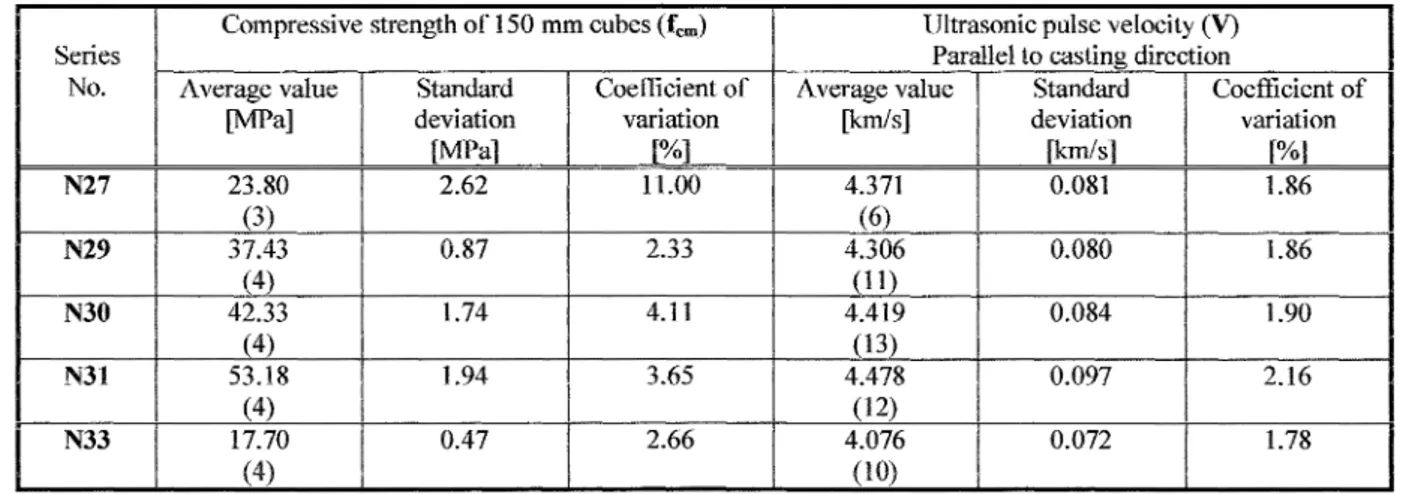
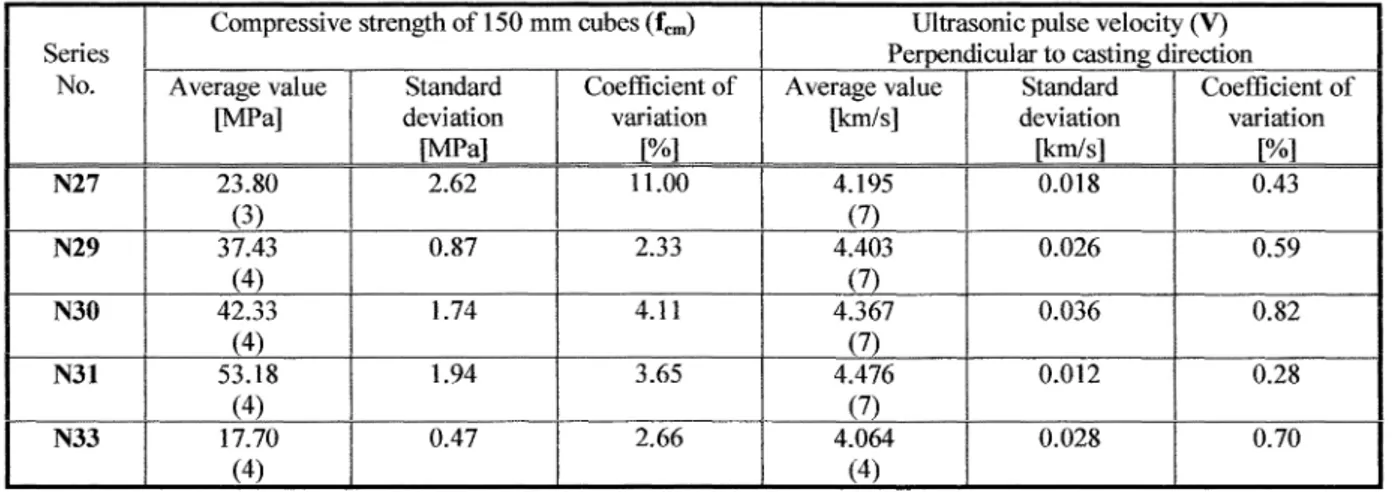
Tables 4 and 5 show the results of ultrasonic tests for normal strength concrete. Table 4 is for pulses traveling parallel to the casting direction while Table 5 is for pulses traveling perpendicular to the casting direction. Tables 6 and 7 show the results of ultrasonic tests for high strength concrete. Table 6 is for pulses traveling parallel to the casting direction while Table 7 is for pulses traveling perpendicular to the casting direction.
Table 4 - Ultrasonic tests on normal strength concrete (parallel to casting)
Compressive strength of ISO mm cubes (fem) Ultrasonic pulse velocity (V)
Series Parallel to casting direction
No. Average value Standard Coefficient of Avemge value Standard Coefficient of [MPa] deviation variation [km/s] deviation variation
[MPal [%] ~s] [%] N27 23.80 2.62 11.00 4.371 0.081 1.86 (3) (6) N29 37.43 0.87 2.33 4.306 0.080 1.86 (4) (11) N30 42.33 1.74 4.11 4.419 0.084 1.90 (4) (13) N31 53.18 1.94 3.65 4.478 0.097 2.16 (4) (12) N33 17.70 0.47 2.66 4.076 0.072 1.78 (4) (10)
Note: the number in parenthesis indicates the number of readings
4. Ultrasonic Tests 4.1 Introdnction
The Ultrasonic test method is a truly non-destructive test and the first reports of the application of this method to concrete appeared in the mid forties. The method is based on the measurement of the velocity of mechanically generated pulses through concrete.
The test equipment must provide a means of generating pulses, transmitting these to the concrete, receiving and amplifying the pulses and measuring and displaying the time taken. Normally, the [mal results are the velocity of propagation of ultrasonic pulses, in km/s.
In general, ultrasonic tests may be applied to: 1. Measurement of concrete uniformity; 2. Detection of cracking and honeycombing;
3. Measurement of changes of concrete properties with time; 4. Strength estimation
5. Measurement of elastic and dynamic modulus
4.2 Test Results
Tables 4 and 5 show the results of ultrasonic tests for normal strength concrete. Table 4 is for pulses traveling parallel to the casting direction while Table 5 is for pulses traveling perpendicular to the casting direction. Tables 6 and 7 show the results of ultrasonic tests for high strength concrete. Table 6 is for pulses traveling parallel to the casting direction while Table 7 is for pulses traveling perpendicular to the casting direction.
Table 4 - Ultrasonic tests on normal strength concrete (parallel to casting)
Compressive strength of 150 mm cubes (fem) Ultrasonic pulse velocity (V)
Series Parallel to casting direction
No. Average value Standard Coefficient of Average value Standard Coefficient of
[MPa] deviation variation [km/s] deviation variation
[MPa] [%] [km/s] [%] N27 23.80 2.62 11.00 4.371 0.081 1.86 (3) (6) N29 37.43 0.87 2.33 4.306 0.080 l.86 (4) (11) N30 42.33 1.74 4.11 4.419 0.084 1.90 (4) (13) N31 53.18 1.94 3.65 4.478 0.097 2.16 (4) (12) N33 17.70 0.47 2.66 4.076 0.072 1.78 (4) (10)
60
Table 5 - llitrasonic tests on normal strength concrete (perpendicular to casting)
Compressive strength of 150 mm cubes (f,oJ Ultrasonic pulse velocity (V)
Series Perpendicular to casting direction
No. Average value Standard Coefficient of Average value Standard Coefficient of [MPa] deviation variation [lan/s] deviation variation
[MPa] [%] [km/s] [%] N27 23.80 2.62 11.00 4.195 0.018 0.43 (3) (7) N29 37.43 0.87 2.33 4.403 0.026 0.59 (4) (7) N30 42.33 1.74 4.11 4.367 0.036 0.82 (4) (7) N31 53.18 1.94 3.65 4.476 0.012 0.28 (4) (7) N33 17.70 0.47 2.66 4.064 0.028 0.70 (4) (4)
Note: the number ill parenthesIs mdicates the number of readings
Table 6 - Ultrasonic tests on high strength concrete (parallel to casting)
Compressive strength of 150 mm cubes (t...) Ultrasonic pulse velocity (V)
Series Parallel to casting direction
No. Average value Standard Coefficient of Average value Standard Coefficient of [MPa] deviation variation [km/s] deviation variation
[MPa] [%] [km/s] [%] N34 81.94 1.12 1.37 4.425 0.020 0.45 (3) (6) N35 78.35 2.17 2.77 4.574 0.067 1.46 (3) (9) N36 49.12 1.02 2.08 4.460 0.067 1.49 (3) (9) N37 58.27 0.82 1.41 4.559 0.043 0.95 (3) (9) N38 67.77 1.56 2.30 4.521 0.057 1.27 (3) (9)
Note: the number m parenthesIs mdicates the number of readings
Table 7 - llitrasonic tests on high strength concrete (perpendicular to casting)
Compressive strength of 150 mm cubes (fem) Ultrasonic pulse velocity (V)
Series Perpendicular to casting direction
No. Average value Standard Coefficient of Average value Standard Coefficient of [MPa] deviation variation [km/s] deviation variation
[MPa] [%] [km/s] [%] N34 81.94 1.12 1.37 4.565 0.010 0.22 (3) (3) N35 78.35 2.17 2.77 4.615 0.006 0.13 (3) (3) N36 49.12 1.02 2.08 4.445 0.039 0.87 (3) (3) N37 58.27 0.82 1.41 4.524 0.086 1.91 (3) (3) N38 67.77 1.56 2.30 4.548 0.021 0.46 (3) (3)
Note: the number ill parenthesIs mdicates the number of readings
Table 5 - Ultrasonic tests on normal strength concrete (perpendicular to casting)
Series No. N27 N29 N30 N31 N33
Compressive strength of 150 mm cubes (fern)
Average value [MPa] 23.80 (3) 37.43 (4) 42.33 (4) 53.18 (4) 17.70 (4) Standard Coefficient of deviation variation [MPa] [%] 2.62 11.00 0.87 2.33 1.74 4.11 1.94 3.65 0.47 2.66
Note: the number in parenthesis indicates the number of readings
Ultrasonic pulse velocity (V)
Perpendicular to casting direction Average value [km/s] 4.195 (7) 4.403 (7) 4.367 (7) 4.476 (7) 4.064 (4) Standard Coefficient of deviation variation [kmls] [%] 0.018 0.43 0.026 0.59 0.036 0.82 0.012 0.28 0.028 0.70
Table 6 - Ultrasonic tests on high strength concrete (parallel to casting)
Compressive strength of 150 mm cubes (fem) Ultrasonic pulse velocity (V)
Series Parallel to casting direction
No. Average value Standard
I
Coefficient of Average value Standard Coefficient of
[MPa] deviation variation [km/s] deviation variation
[MPaJ [%] [kmls] [%] N34 81.94 1.12 1.37 4.425 0.020 0.45 (3) (6) N35 78.35 2.17 2.77 4.574 0.067 1.46 (3) (9) N36 49.12 1.02 2.08 4.460 0.067 1.49 (3) (9) N37 58.27 0.82 1.41 4.559 0.043 0.95 (3) (9) N38 67.77 1.56 2.30 4.521 0.057 1.27 (3) (9)
Note: the number III parenthesIs mdicates the number of readings
Table 7 - Ultrasonic tests on high strength concrete (perpendicular to casting)
Compressive strength of 150 mm cubes (fern) Ultrasonic pulse velocity (V)
Series Perpendicular to casting direction
No. Average value Standard Coefficient of Average value Standard Coefficient of
[MPa] deviation variation [kmls] deviation variation
[MPa] [%] [km/s] [%] N34 81.94 1.12 1.37 4.565 0.010 0.22 (3) (3) N35 78.35 2.17 2.77 4.615 0.006 0.13 (3) (3) N36 49.12 1.02 2.08 4.445 0.039 0.87 (3) (3) I N37 58.27 0.82 1.41 4.524 0.086 1.91 (3) (3) N38 67.77 1.56 2.30 4.548 0.021 0.46 (3) (3)
61
5. Discussion of the Results
5.1 Surface Hardness Tests 5.1.1 Accuracy of Assessment
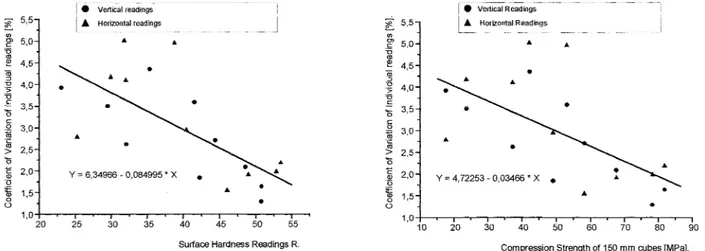
The coefficient of variation of the individual readings obtained on different slab locations, with the apparatus in a vertical position facing down varied from 1.29% to 4.35%, being the average value 2.76% (see Tables 2 and 3). If the readings were separated into normal strength concrete and high strength concrete, the average values would be 3.60% and 1.91 %, respectively. These values indicate a decrease of the coefficient of variation as the concrete strength increases.
BS 1881: Part 202 [5] indicates that the coefficient of variation for individual readings of harness surface tests varies from 2% to 15%, being typically around 10%. The values obtained in the investigation reported here are in the lower zone of the range presented by BS 1881 : Part 202 because of the homogeneity of the concrete achieved in laboratory conditions.
To show the variability of the results more clearly, a set of graphs were plotted. For the graphics study the readings were divided into two groups: tests on vertical direction and tests on horizontal direction. Fig. 1 shows the coefficient of variation versus rebound number and versus concrete strength and the conclusions presented above are now clear.
!eV;tic-aI7;;din~'---I 1.--V~rti~~R~adi~g~---"---,-, -_. --;
~ 5,5 ~_~rizontal readings _, ________ _ ~ 5,5 l~_., _~_oriz~_~.t~~.e~_~s _ . ____ ' _ i "' "' Ol 5,0 c '0 Ol 5,0 c '0
..
..
..
'" '" ~ 4,5 ro :J•
ro ~ :J 4,5•
"0 4,0 's; "0 'S; 4,0 '0 '0 ,'0 3,5 '0 ,'0 3,5 '0•
c 0 3,0 ~ c 0 3,0 ~ .~ 2,5 > '0 .~ > 2,5 '0 C 2,0 <D '0 c 2,0 <ll '0•
Y = 6,34966 - 0,084995 • X Y = 4,72253 - 0,03466' X • ~ 1,5 0 ~ 0 1,5 0 0 1,0 20 25 30 35 40 45 50 55 1,0 10 20 30 40 50 60 70 80Surface Hardness Readings R. Compression Strength of 150 mm cubes [MPaJ,
Fig. 1 - Coefficient of variation of surface hardness tests versus compressive strength
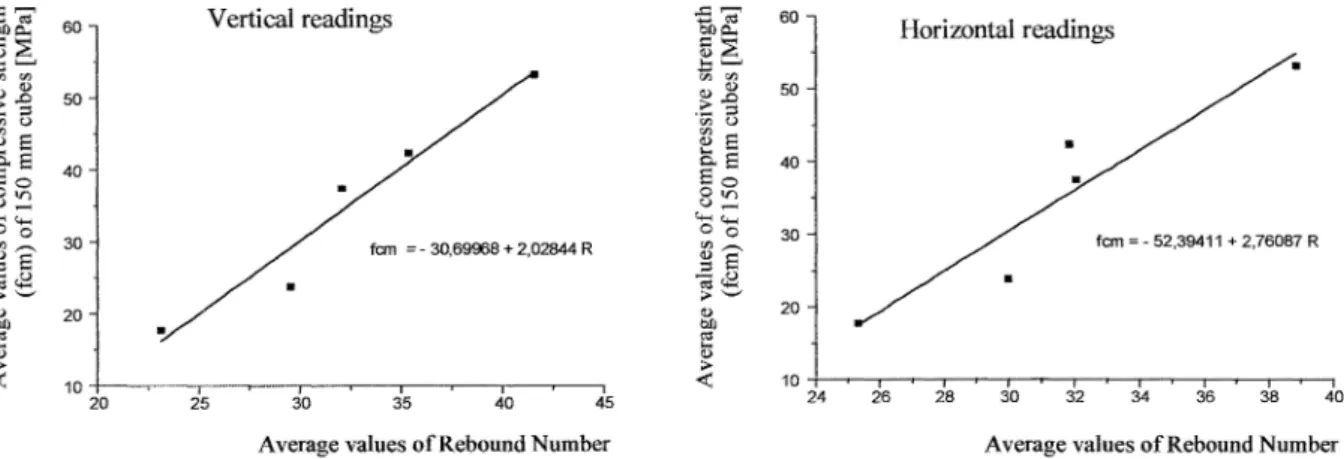
5.1.2 Relationships between Test Readings and Concrete Strength a) Normal Strength Concrete
Fig. 2 shows two graphs of the results presented in Table 2. The results show that a relationship between compressive strength and rebound number is possible for normal strength concrete. The results are closer to the correlation line for horizontal readings. The results of the horizontal readings are more scattered because, for these tests, the Schmidt hammer was fired against the vertical sides of the concrete slabs with visually were not as homogenous as the bottom side.
90
5. Discussion of the Results
5.1 Surface Hardness Tests 5.1.1 Accuracy of Assessment
The coefficient of variation of the individual readings obtained on different slab locations, with the apparatus in a vertical position facing down varied from 1.29% to 4.35%, being the average value 2.76% (see Tables 2 and 3). If the readings were separated into normal strength concrete and high strength concrete, the average values would be 3.60% and 1.91 %, respectively. These values indicate a decrease of the coefficient of variation as the concrete strength increases.
BS 1881: Part 202 [5] indicates that the coefficient of variation for individual readings of harness surface tests varies from 2% to 15%, being typically around 10%. The values obtained in the investigation reported here are in the lower zone of the range presented by BS 1881 : Part 202 because of the homogeneity of the concrete achieved in laboratory conditions.
To show the variability of the results more clearly, a set of graphs were plotted. For the graphics study the readings were divided into two groups: tests on vertical direction and tests on horizontal direction. Fig. 1 shows the coefficient of variation versus rebound number and versus concrete strength and the conclusions presented above are now clear.
!eV;tic-aI7;;din~'---I 1.--V~rti~~R~adi~g~---"---,-, -_. --;
~ 5,5 ~_~rizontal readings _, ________ _ ~ 5,5 l~_., _~_oriz~_~.t~~.e~_~s _ . ____ ' _ i "' "' Ol 5,0 c '0 Ol 5,0 c '0
..
..
..
'" '" ~ 4,5 ro :J•
ro ~ :J 4,5•
"0 4,0 's; "0 'S; 4,0 '0 '0 ,'0 3,5 '0 ,'0 3,5 '0•
c 0 3,0 ~ c 0 3,0 ~ .~ 2,5 > '0 .~ > 2,5 '0 C 2,0 <D '0 c 2,0 <ll '0•
Y = 6,34966 - 0,084995 • X Y = 4,72253 - 0,03466' X • ~ 1,5 0 ~ 0 1,5 0 0 1,0 20 25 30 35 40 45 50 55 1,0 10 20 30 40 50 60 70 80Surface Hardness Readings R. Compression Strength of 150 mm cubes [MPaJ,
Fig. 1 - Coefficient of variation of surface hardness tests versus compressive strength
5.1.2 Relationships between Test Readings and Concrete Strength a) Normal Strength Concrete
Fig. 2 shows two graphs of the results presented in Table 2. The results show that a relationship between compressive strength and rebound number is possible for normal strength concrete. The results are closer to the correlation line for horizontal readings. The results of the horizontal readings are more scattered because, for these tests, the Schmidt hammer was fired against the vertical sides of the concrete slabs with visually were not as homogenous as the bottom side.
62 .s:::~
bh'" 60
5~
Vertical readings 60 Horizontal readings.b~ '" '" 50 (\,) (\,) 50 >.0 .- ::!
'" °
~ Sas
40 So 0.,., 0 _ 40 fern = -30,69968 + 2,02844 R""'''"'
o 0 30 "'"...,g
S tatS 30 fern =-52,39411 + 2,76087 R >'-' (\,) 20 00 20'"
t ~ 10 20 25 30 35 40 45Average values of Rebound Number Average values of Rebound Number
Fig. 2 - Compressive strength versus rebound number for normal strength concrete
b) High Strength Concrete
Similarly to Fig. 2, Fig. 3 shows the relationships between average compressive strength and average values of rebound number for high strength concrete. As for normal strength concrete, The results show that a relationship between compressive strength and rebound number is possible for high strength concrete. For this concrete, the results are closer to the correlation line when compared with graphs of Fig. 2 for normal strength concrete .
.s:::~
-S~ bh'"
5~
80 Vertical readings .b~5~
80 Horizontal readings .b~ '" '" '" '" ~~ ~~ .- ::!'" °
";i 8 ~ S ~ S 70as
70as
So So 0.,., 0.,., 0 _ 0 _""'''"'
""'''"'
o 0 o 0 60 "'"..., 60ga
fern = -97,89197 + 3,48181 Rg
S tar.S ~~ >'-' >'-' (\,) fern = -54,82662 + 2,51688 R (\,) 00 50 00 50 ~•
~ ~ ~ 42 44 46 46 50 52 40 42 44 46 48 50 52 54Average values of Rebound Number Average values of Rebound Number
Fig. 3 - Compressive strength versus rebound number for high strength concrete
5.2 Ultrasonic Tests
5.2.1 Accuracy of Assessment
From Tables 4 to 7 some conclusions can be drawn. For instance, for both normal strength concrete and high strength concrete the coefficient of variation was typically higher for readings parallel to casting direction when compared with those perpendicular to casting. For normal strength concrete the average value of coefficient of variation equalled 0.56% and 1.92%, respectively for readings parallel to casting and readings perpendicular to casting. Similarly, for high strength concrete, those values were 0.72% and 1.12%, respectively. These figures
..c~ _ oj 60 OJ) 0-; ii:;S Vertical readings 60 Horizontal readings I-<~ t;; en ~2 ._ ;:l en U 50 50 O'l S
as
40 SO OV) u_ 40 fern = -30,69968 + 2,02844 R 4-..4-.. o 0 30 ~E '"2cS 30 fern = -52,38411 + 2,76087 R >'-' <l) 20 OJ) 20'"
I-< <l) > <: 10 20 25 30 35 40 45Average values of Rebound Number Average values of Rebound Number
Fig. 2 - Compressive strength versus rebound number for normal strength concrete
b) High Strength Concrete
Similarly to Fig. 2, Fig. 3 shows the relationships between average compressive strength and average values of rebound number for high strength concrete. As for normal strength concrete, The results show that a relationship between compressive strength and rebound number is possible for high strength concrete. For this concrete, the results are closer to the correlation line when compared with graphs of Fig. 2 for normal strength concrete .
..c~ ..c~ _ oj th'" Vertical readings ::::0-; OJ) 0-;
!:'!6
Horizontal readings ii::8 80 80 t:~ t;; en en '" ~] <l) <l) >.D ._ ;:l en U '00a
O'l S O'l S 70as
70as
So SO OV) OV) C l _ C l _""''''''
""''''''
o 0 o 0 60 ~E 60 ~E fern = -97,89197 + 3,48181 R d~ -;r,E >'-' fern = -54,82862 + 2,51888 R >'-' 0) 0) OJ) 50 OJ) 50 ~ ~ > ~ 42 44 46 48 50 52 <: 40 42 44 46 48 50 52 54Average values of Rebound Number Average values of Rebound Number
Fig. 3 - Compressive strength versus rebound number for high strength concrete
5.2 Ultrasonic Tests
5.2.1 Accuracy of Assessment
From Tables 4 to 7 some conclusions can be drawn. For instance, for both normal strength concrete and high strength concrete the coefficient of variation was typically higher for readings parallel to casting direction when compared with those perpendicular to casting. For normal strength concrete the average value of coefficient of variation equalled 0.56% and 1.92%, respectively for readings parallel to casting and readings perpendicular to casting. Similarly, for high strength concrete, those values were 0.72% and 1.12%, respectively. These figures
63
also show that the difference between readings parallel and perpendicular to casting direction is smaller for high strength concrete when compared to those of normal strength concrete, which may indicate more homogeneity in high strength concretes.
Fig. 4 shows the standard deviation and the coefficient of variation of ultrasonic tests. Although being difficult to defend that a relationship is possible, the visual observation of the graphs shows a slight decrease of the standard deviation and of the coefficient of variation as the concrete strength increases .
•
10 20 30 40 50 60 70 60 90
Average values of compressive strength (fcm) ofl50 mm cubes [MPa]
10 20 30 40 50 60 70 80 Average values of compressive strength
(fcm) ofl50 mm cubes [MPa]
90
Fig. 4 - Standard deviation and coefficient of variation of ultrasonic tests
5.2.2 Relationships between Test Readings and Concrete Strength
a) Normal Strength Concrete
Fig. 4 shows the compressive strength versus ultrasonic pulse velocity for normal strength concrete. The correlation line of readings parallel to casting for normal strength concrete is not very good since the points are somehow scattered. However, the correlation for readings perpendicular to casting is better as can be seen in Fig.
5.
-='d
60~~
"til '" ~] 50.-
::; '" u g; Sas
40 So 0.,., u _ '<-<,<-< o 0 30 "',-..g
S "il~ >'-' 20'"
OJ)'"
~ ~ 10 4,0 fem = 0,000 15 * exp (2.855 * V) -=~ 60 '00'"5~
./:I~ '" '" ~~ 50 "VJ 5 g; Sas
40 So 0.,., u_ '<-<,<-< o 0 30 "',-.. g S tatS >'-''"
OJ) 20 ~ ~ 10 4,0 Parallel to casting 4,1 4,2 4,3 4,4 4,5 fcm=O,OOOI3*exp(2,89 * V) Perpendicular to casting 4,1 4,2 4,3 4,4 4,5Average values of ultrasonic pulse velocity, v [kmls] Average values of ultrasonic pulse velocity, v [kmls]
Fig. 5 - Compressive strength versus ultrasonic pulse velocity for normal strength concrete
also show that the difference between readings parallel and perpendicular to casting direction is smaller for high strength concrete when compared to those of normal strength concrete, which may indicate more homogeneity in high strength concretes.
Fig. 4 shows the standard deviation and the coefficient of variation of ultrasonic tests. Although being difficult to defend that a relationship is possible, the visual observation of the graphs shows a slight decrease of the standard deviation and of the coefficient of variation as the concrete strength increases.
0,1 .~ r;;' 0:---o E ~~ 0,0 l::c ;:1--"'" u 0,.2 0,06 0:
"
0 ;. .~ ~ 0,04 ';;: -; (l) 0-'d "8 to 'd 0: $l VJ. w m w @ ~ 00 m 00 00Average values of compressive strength (fcm) ofl50 mm cubes [MPa]
.~~
Be
~ ~ 2,0.:g.g
"'"u o 0 1,5 §~ .~ ~ 'c"3 1,0 ~0-""
o ~ 0,5"
-0 i:S Il) 0,0 o UAverage values of compressive strength (fcm) ofl50 mm cubes [MPaj
Fig. 4 - Standard deviation and coefficient of variation of ultrasonic tests
5.2.2 Relationships between Test Readings and Concrete Strength
a) Normal Strength Concrete
Fig. 4 shows the compressive strength versus ultrasonic pulse velocity for normal strength concrete. The correlation line of readings parallel to casting for normal strength concrete is not very good since the points are somehow scattered. However, the correlation for readings perpendicular to casting is better as can be seen in Fig. 5. ..t:~ 00 ~ on""
'"
~6 1;; '""
"
50 .2:: '"§ '" u ~ E aE 40 Eo Olr) u~"'""'"
o 0 30 "',-..g
E ta~ ;.~ 20"
on ~ ~ 10 ..t:~ 60 tD~ §::8...
~ 1;; '""
"
50 ;."" __ ;:I '" u ~ E aE 40 Eo Olr) u~ "'"4-< o 0 30 enr-. ~ E ~~ ;.~"
20 on ~ ;. <r: 10 fem = O,00013*cxp (2,89 * V) fem = 0,000 15 *' exp (2,855 * V)Parallel to casting Perpendicular to casting
4,0 4,1 4,2 4,3 4,4 4,5 4,0 4,1 4,2 4,3 4,4 4,5
Average values of ultrasonic pulse velocity, v [lnn/s] Average values of ultrasonic pulse velocity, v [kmls]
64 a) ffigh Strength Concrete
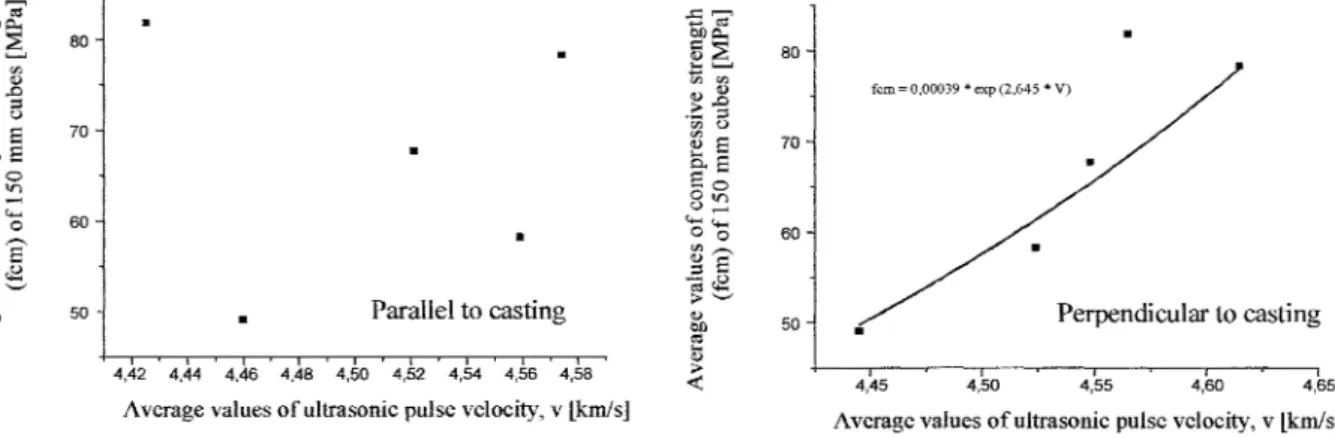
Fig. 6 shows the compressive strength versus ultrasonic pulse velocity for high strength concrete. The readings parallel to casting for high strength concrete are very scattered and a correlation line can not be found. A correlation line for readings perpendicular to casting is possible to be drawn, as can be seen in Fig. 6. However as the concrete strength increases the points became more scattered, mainly for concrete strength above 70 MPa (or velocity equals to 4.55 km/s).
Due to the exponential type correlation line, particular precautions need to be taken for pulse velocities greater than 4.55 km/s, since a small variation ofthe pulse velocity may lead to great variations of the concrete strength.
80
70
80
50 Parallel to casting
4,42 4,44 4,46 4,48 4,50 4,52 4,54 4,56 4,58
Average values of ultrasonic pulse velocity, v [km/s]
80 70 60 50 fem = 0,00039 * exp (2.645 • V)
•
Perpendicular to casting 4,45 4,50 4,55 4,80 4,65Average values of ultrasonic pulse velocity, v [km/s]
Fig. 6 - Compressive strength versus ultrasonic pulse velocity for high strength concrete
6. Conclusions
6.1 Surface Hardness Tests
As far as the hardness test method is concerned, the analysis of the results of tests carried out by of a Schmidt hammer Type N, with impact energy of 2,207 N.m lead to the following conclusions:
The hardness test can be successfu1ly used in high strength concrete up to 82 MPa, measured in 150 mm cubes;
The standard deviation from the individual readings of the rebound number, which can be expected in any location of the high strength concrete up to 82 MPa was approximately constant, thus revealing typical values between 0.66 and 1.93 being the average value 1.11;
The standard deviation is the statistical parameter which better evaluates the repetitiveness of the hardness test;
The coefficient of variation from the individual readings of the rebound number, which can be expected in any location of the high strength concrete up to 82 MPa (evaluated in 150mm cubes) decreases as the concrete increases.
a) High Strength Concrete
Fig. 6 shows the compressive strength versus ultrasonic pulse velocity for high strength concrete. The readings parallel to casting for high strength concrete are very scattered and a correlation line can not be found. A correlation line for readings perpendicular to casting is possible to be drawn, as can be seen in Fig. 6. However as the concrete strength increases the points became more scattered, mainly for concrete strength above 70 MPa (or velocity equals to 4.55 km/s).
Due to the exponential type correlation line, particular precautions need to be taken for pulse velocities greater than 4.55 km/s, since a small variation of the pulse velocity may lead to great variations of the concrete strength.
80
70
60
50 Parallel to casting
4,42 4,44 4,46 4,46 4,50 4,52 4,54 4,56 4,58
Average values of ultrasonic pulse velocity, v [km/s]
80 70 60 50 fern = 0,00039 * exp (2,645 .. V) Perpendicular to casting 4,45 4,50 4,55 4,60 4,65
Average values of ultrasonic pulse velocity, v [kmls]
Fig. 6 - Compressive strength versus ultrasonic pulse velocity for high strength concrete
6. Conclusions
6.1 Surface Hardness Tests
As far as the hardness test method is concerned, the analysis of the results of tests carried out by of a Schmidt hammer Type N, with impact energy of2,207 N.m lead to the following conclusions:
The hardness test can be successfully used in high strength concrete up to 82 MPa, measured in 150 mm cubes;
The standard deviation from the individual readings of the rebound number, which can be expected in any location of the high strength concrete up to 82 MPa was approximately constant, thus revealing typical values between 0.66 and 1.93 being the average value 1.11;
The standard deviation is the statistical parameter which better evaluates the repetitiveness of the hardness test;
The coefficient of variation from the individual readings ofthe rebound number, which can be expected in any location of the high strength concrete up to 82 MPa (evaluated in 150mm cubes) decreases as the concrete increases.
65
The coefficient of variation from the individual readings of the rebound number, which can be expected in any location for a normal strength concrete between 17 MPa and 53 MPa was typically between 2.62% and 5.01% being the average value 3.90%.
The coefficient of variation from the individual readings of the rebound number which can be expected in any location of a high strength concrete between 49 MPa and 82 MPa, was typically between 1.29% and 2.94% being the average value 2.01%.
For compressive strength of concrete between 17 MPa and 82 MPa (measured in 150mm cubes and produced from similar materials and on the basis of the same Faury's curve, with different strengths and mixes), a good correlation between surface hardness and compressive strength of concrete was found.
6.2 mtrasonic Tests
The experimental results presented in this paper lead to the following conclusions:
Tests indicate a slight reduction of the standard deviation and of the coefficient of variation, when both the compressive strength and the ultrasonic pulse velocity increase.
The coefficient of variation of the individual readings of ultrasonic pulse velocity in a location of a good quality surface of high strength concrete, between 17 MPa and 53MPa (referred to 150mm cubes) showed an average value of 0.56% in readings on moulded faces.
The coefficient of variation of the individual readings of ultrasonic pulse velocity in a location of a good quality surface of concrete strengths between 49 MPa and 53 MPa, showed an average value of 1.12 in readings on moulded faces;
The maximum coefficient value of variation of ultrasonic pulse velocity obtained in different locations (test slabs), among the tested concrete (with the same materials and different
Ale
values) was of2.16%.It is possible to establish a correlation between the ultrasonic pulse velocity (by direct readings between moulded faces) and compressive strength (between 17 MPa and 70 MPa), when the variable is the ratio water/concrete (in mass) and are kept constant some parameters, including: the maturity, the type of materials and the reference Faury's curve;
The value of pulse velocity obtained by direct reading, involving a moulded face and a non-moulded face diverged in a large extent from the direct reading among moulded faces;
The correlation between high strength and ultrasonic pulse velocity obtained by direct readings involving a moulded face and a non-moulded face showed great dispersion of results.
The correlation curve between the ultrasonic pulse velocity and compressive strength is an exponential type curve which seems to be more acceptable than a straight, as proposed by Bungey and Millard [24];
For concrete strengths from 45 MPa to 50 MPa and possibly up to 82 MPa, the correlation curve between the ultrasonic pulse velocity and compressive strength of concrete tends to a straight when granitic aggregates are used;
The correlation between the ultrasonic pulse velocity (direct reading on moulded faces) and the compressive strength of concrete might indicate a loss of reliability for compressive strengths above 70 MPa .. This can be caused by the exponential type of the correlation. Any slight variation of ultrasonic pulse velocity above 4,55 km/s would result on a great variation ofthe value of the compressive strength of concrete.
The coefficient of variation from the individual readings of the rebound number, which can be expected in any location for a normal strength concrete between 17 MPa and 53 MPa was typically between 2.62% and 5.01% being the average value 3.90%.
The coefficient of variation from the individual readings of the rebound number which can be expected in any location of a high strength concrete between 49 MPa and 82 MPa, was typically between 1.29% and 2.94% being the average value 2.01%.
For compressive strength of concrete between 17 MPa and 82 MPa (measured in 150mm cubes and produced from similar materials and on the basis of the same Faury's curve, with different strengths and mixes), a good correlation between surface hardness and compressive strength of concrete was found.
6.2 Ultrasonic Tests
The experimental results presented in this paper lead to the following conclusions:
Tests indicate a slight reduction of the standard deviation and of the coefficient of variation, when both the compressive strength and the ultrasonic pulse velocity increase.
The coefficient of variation of the individual readings of ultrasonic pulse velocity in a location of a good quality surface of high strength concrete, between 17 MPa and 53MPa (referred to 150mm cubes) showed an average value of 0.56% in readings on moulded faces.
The coefficient of variation of the individual readings of ultrasonic pulse velocity in a location of a good quality surface of concrete strengths between 49 MPa and 53 MPa, showed an average value of 1.12 in readings on moulded faces;
The maximum coefficient value of variation of ultrasonic pulse velocity obtained in different locations (test slabs), among the tested concrete (with the same materials and different
Ale
values) was of2.16%.It is possible to establish a correlation between the ultrasonic pulse velocity (by direct readings between moulded faces) and compressive strength (between 17 MPa and 70 MPa), when the variable is the ratio water/concrete (in mass) and are kept constant some parameters, including: the maturity, the type of materials and the reference Faury's curve;
The value of pulse velocity obtained by direct reading, involving a moulded face and a non-moulded face diverged in a large extent from the direct reading among moulded faces;
The correlation between high strength and ultrasonic pulse velocity obtained by direct readings involving a moulded face and a non-moulded face showed great dispersion of results.
The correlation curve between the ultrasonic pulse velocity and compressive strength is an exponential type curve which seems to be more acceptable than a straight, as proposed by Bungey and Millard [24];
For concrete strengths from 45 MPa to 50 MPa and possibly up to 82 MPa, the correlation curve between the ultrasonic pulse velocity and compressive strength of concrete tends to a straight when granitic aggregates are used;
The correlation between the ultrasonic pulse velocity (direct reading on moulded faces) and the compressive strength of concrete might indicate a loss of reliability for compressive strengths above 70 MPa .. This can be caused by the exponential type of the correlation. Any slight variation of ultrasonic pulse velocity above 4,55 km/s would result on a great variation of the value of the compressive strength of concrete.
![Table 1- Quick description ofNDT [4]](https://thumb-eu.123doks.com/thumbv2/123dok_br/18844789.929052/5.1263.92.1173.179.759/table-quick-description-ofndt.webp)
![Table 1- Quick description ofNDT [4] (continued)](https://thumb-eu.123doks.com/thumbv2/123dok_br/18844789.929052/6.1263.117.1182.145.709/table-quick-description-ofndt-continued.webp)