ConGu
Checking Java Classes Against
Property-Driven Algebraic
Specifications
Jo˜
ao Abreu
Alexandre Caldeira
Ant´
onia Lopes
Isabel Nunes
Lu´ıs S. Reis
Vasco T. Vasconcelos
DI–FCUL
TR–07–7
March 28, 2007
Departamento de Inform´
atica
Faculdade de Ciˆ
encias da Universidade de Lisboa
Campo Grande, 1749–016 Lisboa
Portugal
Technical reports are available at http://www.di.fc.ul.pt/tech-reports. The files are stored in PDF, with the report number as filename. Alternatively, reports are available by post from the above address.
ConGu
Checking Java Classes Against Property-Driven
Algebraic Specifications
Jo˜
ao Abreu
Alexandre Caldeira
Ant´
onia Lopes
Isabel Nunes
Lu´ıs S. Reis
Vasco T. Vasconcelos
Abstract
ConGu is a tool that supports the checking of Java classes against property-driven algebraic specifications. This document presents the specification, lan-guages, the tool usage, and its implementation, version 1.32.
Chapter 1 describes the two specification languages: the language of abstract data types specifications, and that for defining refinement mappings between these specifications and Java classes.
Chapter 2 explains how to install and use ConGu tool.
And finally, Chapter 3 presents the implementation details of the tool.1
1This work was partially supported through the POSI/CHS/48015/ 2002 Project Contract
Guided System Development project. Thanks are due to Jos´e Luiz Fiadeiro for many fruitful discussions that have helped putting the project together.
Chapter 1
The Specification and the
Refinement Languages
1.1
Introduction
The Contract Guided System Development project aims at developing a method-ology to test implementations of abstract data types against their specifications. The key idea is to reduce this problem to the run-time monitoring of classes an-notated with contracts that represent the specification. In order to make this approach systematic and to allow for the development of tools, a language for specification and a language for refining these specifications into Java classes were developed; they are described in Sections 1.2 and 1.4, respectively. Re-finement into Java works at the level of modules; Section 1.3 describes this notion.
1.2
The specification language
This section describes the specification language. Subsection 1.2.1 presents the general structure of specifications; Subsection 1.2.2 presents the conformance rules to which specifications must obey and that are not covered by the grammar. The grammar itself is presented in Appendix A.1.
1.2.1
General structure
According to the grammar presented in Appendix A.1 and the extra require-ments on operation signatures, domains and axioms, any particular specification must obey the general structure in Figure 1.1.
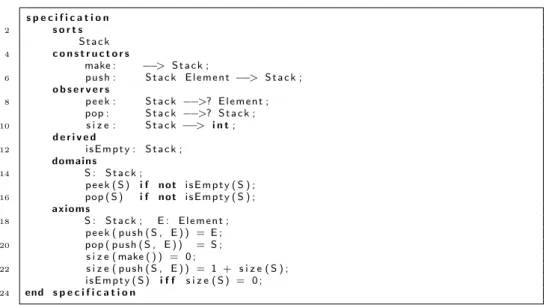
The contents of each clause are described below and, in general, start with a keyword, followed by a sequence of signatures, domain conditions or axiom declarations. The sorts clause is the only mandatory one; the others must only be declared if they are not empty. We use the specification of a Stack in Figure 1.2 as a running example.
s p e c i f i c a t i o n s o r t s f i e l d c o n s t r u c t o r s f i e l d ? o b s e r v e r s f i e l d ? d e r i v e d f i e l d ? d o m a i n s f i e l d ? a x i o m s f i e l d ? end s p e c i f i c a t i o n
Figure 1.1: The outline of a specification
s p e c i f i c a t i o n 2 s o r t s S t a c k 4 c o n s t r u c t o r s make : −−> S t a c k ; 6 p u s h : S t a c k E l e m e n t −−> S t a c k ; o b s e r v e r s 8 p e e k : S t a c k −−>? E l e m e n t ; pop : S t a c k −−>? S t a c k ; 10 s i z e : S t a c k −−> i n t ; d e r i v e d 12 i s E m p t y : S t a c k ; d o m a i n s 14 S : S t a c k ; p e e k ( S ) i f n o t i s E m p t y ( S ) ; 16 pop ( S ) i f n o t i s E m p t y ( S ) ; a x i o m s 18 S : S t a c k ; E : E l e m e n t ; p e e k ( p u s h ( S , E ) ) = E ; 20 pop ( p u s h ( S , E ) ) = S ; s i z e ( make ( ) ) = 0 ; 22 s i z e ( p u s h ( S , E ) ) = 1 + s i z e ( S ) ; i s E m p t y ( S ) i f f s i z e ( S ) = 0 ; 24 end s p e c i f i c a t i o n
Figure 1.2: Specification of a stack
1.2.1.1 Sorts
This clause is used to declare the name of the sort under specification. The clause starts with keyword sorts, followed by the name of the sort. In the stack example these declarations are in lines 2 and 3 of Figure 1.2.
If you are specifying sortMySort this clause is declared as:
s o r t s MySort
1.2.1.2 Constructors
Use this clause to declare the signatures of constructor operations. Constructors form a minimal set of operations needed to build any conceivable value of the sort. The clause starts with keyword constructors followed by a sequence of signatures. The signature for a constructor of sort S is of a particular form: both its first parameter (if present) and its result must be of sort S. Lines 4–6 in Figure 1.2 reflect this structure.
1.2.1.3 Observers
This clause starts with keywordobservers, and is followed by a list of operation or/and predicate signatures. Observers are the operations used to analyze (to dissect, to disassemble, to deconstruct) a given value. Observers must have at least one parameter. Also, the first parameter must be the sort under specifica-tion. Lines 7–10 of our example illustrate this structure.
1.2.1.4 Derived
Derived operations are definable directly in terms of the other operations, and make programming easier and more readable. But they are not absolutely nec-essary. This clause is defined exactly as the observersclause in Section 1.2.1.3. The only difference regards the axiom construction rules, as described in Sec-tion 1.2.2. In the given example, lines 11–12 illustrate this structure.
1.2.1.5 Domains
This section describes the conditions under which operations are required to be defined. The clause starts with keyword domains and is followed by a list of sort variables declaration and a list of domain conditions. Variables are used in operations and formulæ, and their sorts must be declared beforehand.
In the stack specification example lines 13–16 illustrate this clause. Both operations, pop and peek, must respect the same condition, namely, that the stack should not be empty.
1.2.1.6 Axioms
This clause is dedicated to axiom declaration. It starts with the keywordaxioms, followed by a list of variable declarations and a list of axioms. For further details on axioms see Section 1.2.2.4. In our example this clause corresponds to lines 17–23.
1.2.2
Operation and Predicate signatures
An operation or predicate signature is an expression with one of the following basic forms, where n ≥ 0.
f : MySort S o r t 1 . . . S o r t n −−> S o r t ’ ; f : MySort S o r t 1 . . . S o r t n −−>? S o r t ’ ; f : S o r t 1 . . . S o r t n −−> S o r t ’ ; f : S o r t 1 . . . S o r t n −−>? S o r t ’ ; f : MySort S o r t 1 . . . S o r t n ; f : S o r t 1 . . . S o r t n ;
The first four forms are for operations; the later two are for predicates. A signature is built with the components:
• f, the operation or predicate name;
• MySort, the first parameter, the sort under specification;
• Sort1 ... Sortn, the remaining parameters, a list of sorts that must all belong to the module (see Section 1.3) or be the language primitive int;
• The identification of a total (−−>) or a partial operation (−−>?); • Sort ’, the return sort, must belong to the module (see Section 1.3) or be
the language primitive int (operations only).
Operations must return a sort belonging to the module or the primitiveint; predicates have no return sort whatsoever.
1.2.2.1 Rules
A specification must conform to rules that do not derive solely from the grammar in Appendix A.1. The following rules apply to the signatures, domains and axioms of the specification operations and predicates.
1.2.2.2 Constructors
Constructors are characterized by returning the sort under specification. They agree with the first four forms above, where Sort ’ is the sort under specifica-tion (MySort). As a consequence, predicates cannot be constructors because predicates have no returning sort.
1.2.2.3 Domains
A domain condition is an expression of the form
op ( x1 , . . . , xn ) i f <f o r m u l a >
whereopis an operation (opmust be declared as an operation, not a predicate), and the argumentsx1, ..., xnmust be variables.
Some operations may not be defined for some specific instances (e.g, we can-not pop from an empty stack); those instances must be prohibited as arguments to the operation. The <formula> is a definition domain on which op must be defined.
When writing domain conditions, one must take in consideration:
• Any total operation, marked with−−>in the operation signature, which no domain condition is required, is provided atruedefault condition; • Any partial operation, marked with −−>? in the operation signature,
for which no domain condition is specified, is provided a false default condition;
• Argumentsx1, ..., xnhave sortsSort1 , ..., Sortnas described in the sig-nature of operationop.
• <formula>respects the rules in this Section.
1.2.2.4 Axioms
An axiom must have one of the following basic structures, being that the part
op ( t1 , . . . , t n ) = t i f <f o r m u l a >; p r e d ( t1 , . . . , t n ) i f <f o r m u l a >; x1 = x2 i f <f o r m u l a >; op ( t1 , . . . , t n ) != t i f <f o r m u l a >; not p r e d ( t1 , . . . , t n ) i f <f o r m u l a >; x1 != x2 i f <f o r m u l a >; op ( t1 , . . . , t n ) = t when <f o r m u l a > e l s e u ; op ( t1 , . . . , t n ) = t i f f <f o r m u l a >; p r e d ( t1 , . . . , t n ) i f f <f o r m u l a >; x1 = x2 i f f <f o r m u l a >;
whereopis an operation,predis a predicate,t , t1 , ..., tnare terms,x1, x2are identifiers. The following restrictions apply to these axiom patterns.
• Ifop is a constructor, thent1 must either be a variable or a constructor applied to variables (this last case only applies if the first parameter of
op belongs to MySort); the remaining arguments t2 , ..., tn must all be variables;
• Ifoporpredare observers, thent1must either be a variable or a constructor applied to variables;
• Ifoporpredare derived, then all argumentst1 , ..., tn must be variables; • x1, x2must be variables of the sort under specification (MySort);
• <formula>must agree with the rules in Section 1.2.2.5. The axiom
op ( t1 , . . . , t n ) = t when <f o r m u l a > e l s e u ;
is short for the two axioms below.
op ( t1 , . . . , t n ) = t i f <f o r m u l a >; op ( t1 , . . . , t n ) = u i f not <f o r m u l a >;
Similarly, the three axioms
op ( t1 , . . . , t n ) = t i f f <f o r m u l a >; p r e d ( t1 , . . . , t n ) i f f <f o r m u l a >; x1 = x2 i f f <f o r m u l a >;
are abbreviations. The first for
op ( t1 , . . . , t n ) = t i f <f o r m u l a >; op ( t1 , . . . , t n ) != t i f not <f o r m u l a >;
the second for
p r e d ( t1 , . . . , t n ) i f <f o r m u l a >;
not p r e d ( t1 , . . . , t n ) i f not <f o r m u l a >;
and the third for
x1 = x2 i f <f o r m u l a >; x1 != x2 i f not <f o r m u l a >;
s p e c i f i c a t i o n s o r t s
E l e m e n t end s p e c i f i c a t i o n
Figure 1.3: Specification of a generic element
1.2.2.5 Formulæ
Formulæ are built from variables and terms, using the disjunction operator
or, conjunction and, negation not, equality = or !=, and the primitive integer operators.
• A variable identifier is a formula;
• if f1 , ..., fn are formulæ and op is an operation (or predicate), then
op(f1 , ..., fn)is a formula.
• Iff1 , f2are formulæ, thenf1 = f2,f1 != f2, f1 and f2,f1 or f2, andnot f1
are formulæ;
• If f1 , f2 are formulæ, then so is f1 # f2, where#is one of the following
+ − ∗ / % > < >= <=, and so ismax(f1,f2)andmin(f1, f2). • Nothing else is a formula.
1.3
Modules
The meaning of symbols external to a specification (sort Element in the stack specification of Figure 1.2, for example) is only fixed when the specification is embedded, as a component, into a module. A module is a surjective function from a set of names N into specifications, such that all symbols (sorts, operations and predicates) are provided by some specification in the module.
For example, moduleStackcan be given by the mapping stack.spc 7→ Figure 1.2
element.spc 7→ Figure 1.3
A file directory (implicitly) defines a module, where N is the set of .spc
filenames in the directory, and the associated specifications are the contents of the files.
The module of our running example is a directory containing two files, named
stack .spc and element.spc, where contents are described in figure 1.2 and 1.3, respectively.
1.4
The refinement language
This section describes the language of refinement mappings. Subsection 1.4.1 presents the general structure of refinements, and subsection 1.4.2 describes the refinement into Java classes. The grammar itself is presented in Appendix A.2.
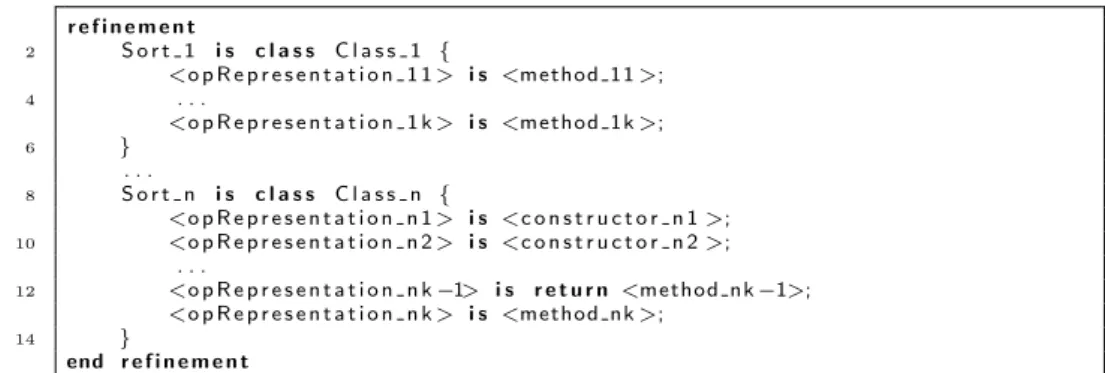
r e f i n e m e n t 2 S o r t 1 i s c l a s s C l a s s 1 { <o p R e p r e s e n t a t i o n 1 1 > i s <method 11 >; 4 . . . <o p R e p r e s e n t a t i o n 1 k > i s <me t ho d 1 k >; 6 } . . . 8 S o r t n i s c l a s s C l a s s n { <o p R e p r e s e n t a t i o n n 1 > i s <c o n s t r u c t o r n 1 >; 10 <o p R e p r e s e n t a t i o n n 2 > i s <c o n s t r u c t o r n 2 >; . . . 12 <o p R e p r e s e n t a t i o n n k −1> i s r e t u r n <method nk −1>; <o p R e p r e s e n t a t i o n n k > i s <method nk >; 14 } end r e f i n e m e n t
Figure 1.4: The outline of a refinement
r e f i n e m e n t 2 E l e m e n t i s c l a s s j a v a . l a n g . O b j e c t S t a c k i s c l a s s d a t a t y p e s . s t a c k . S t a c k { 4 make ( ) : S t a c k i s S t a c k ( ) ; p u s h ( s : S t a c k , e : E l e m e n t ) : S t a c k i s v o i d p u s h ( j a v a . l a n g . O b j e c t e ) ; 6 pop ( s : S t a c k ) : S t a c k i s j a v a . l a n g . O b j e c t pop ( ) ; p e e k ( s : S t a c k ) : E l e m e n t i s j a v a . l a n g . O b j e c t t o p ( ) ; 8 s i z e ( s : S t a c k ) : i n t i s i n t s i z e ( ) ; i s E m p t y ( s : S t a c k ) i s b o o l e a n i s E m p t y ( ) ; 10 } end r e f i n e m e n t
Figure 1.5: Stack Refinement
1.4.1
General structure
A refinement maps a module (see Section 1.3) into a series of Java classes. Each specification in the module is mapped into a Java class; its operations, if any, are mapped into methods of that class. In Figure 1.4, we present the general structure of a refinement; the grammar is presented in Appendix A.2.
A refinement mapping starts with keyword refinement and ends with key-words end refinement. Between these keywords we declare a non-empty set of mappings, one for each specification in the module. The refinement for each specification in the module is accomplished by a set, possibly empty, of map-pings from operations and predicates to methods. Lines 2–6 represent a mapping fromSort1in JavaClass1, and, enclosed in braces (lines 3–5), the mapping from the sort operations into the class methods.
A refinement mapping for our running example (the Stack module in Sec-tion 1.3), is given in Figure 1.5.
In the particular case where the sort for the specification has no operations or predicates, the refinement mapping consists of a simple declaration of the form:
S o r t n a m e i s c l a s s C l a s s n a m e
In our example, sort Elementhas no operations nor predicates; we map it into class java . lang .Objectas in Figure 1.5, line 2.
In the general case the specification contains operations and/or predicates to refine. In this case the refinement consists of a block containing several mappings, one for each operation of the sort under refinement. Figure 1.5, lines 3–10, show the refinement mapping for the Stacksort.
1.4.2
Refining specifications into Java types
In this section we present the restrictions imposed at the specification language that cannot be captured by the supporting grammar (Appendix A.2).
A refinement mapping for a particular sort includes mappings for operations and for predicates.
1.4.2.1 Mapping a constructor operation into a Java constructor Each operation in a specification may be refined into a Java constructor of the class under consideration. In this case the valid patterns for mappings are:
<c o n s t r u c t o r O p e r a t i o n > i s < c o n s t r u c t o r S i g n a t u r e >;
where <constructorOperation> is the representation for any specified operation constructor, likecopwith signature
cop : S o r t 1 , . . . , S o r t n −−> MySort ;
the representations in the refinement language are, respectively:
cop ( x1 : S o r t 1 , . . . , xn : S o r t n ) : MySort
where
• EachSort1 ,..., Sortnbelongs to the module;
• SortsSort1 ,..., Sortnin signatures and in representations agree in number and order.
• The sort under specification isMySort.
<constructorSignature> is the constructor’s signature as defined in the Java class except for the visibility and the throwsclause.
Representation
cop ( x1 : S o r t 1 , . . . , xn : S o r t n ) : MySort
corresponds to a constructor signature of the form
c o n s t r u c t o r N a m e ( C l a s s 1 y1 , . . . , C l a s s n yn )
where constructorNameis the abbreviated constructor name (no package resolu-tion scope), andy1 ,.., ynare identifiers in the listx1 ,..., xn(but not necessarily in that order).
A key characteristic of this mapping is that an operation with n ≥ 0 param-eters is mapped into a method with n paramparam-eters.
1.4.2.2 Mapping an operation or a predicate into an instance method Each operation and predicate in a specification may be refined into a Java method of the class that refines MySort. In this case the valid patterns for mappings are:
<o p e r a t i o n O r P r e d i c a t e > i s <m e t h o d S i g n a t u r e >;
<o p e r a t i o n O r P r e d i c a t e > i s r e t u r n <m e t h o d S i g n a t u r e >;
where<operationOrPredicate>is the representation for operations and predicates. For operationopand predicatepredwith signatures
op : MySort , S o r t 1 , . . . , S o r t n −−> S o r t ; p r e d : MySort , S o r t 1 , . . . , S o r t n ;
the representations in the refinement language are, respectively:
op ( x0 : MySort , x1 : S o r t 1 , . . . , xn : S o r t n ) : S o r t p r e d ( x0 : MySort , x1 : S o r t 1 , . . . , xn : S o r t n )
where
• EachSort1 ,..., Sortn , Sortbelongs to the module;
• Sorts Sort1 ,..., Sortn , Sort in signatures and in representations agree in number and order.
• The sort under specification isMySort.
<methodSignature> is the method’s signature as defined in the Java class except for the visibility and the throwsclause. Representation
op ( x0 : MySort , x1 : S o r t 1 , . . . , xn : S o r t n ) : S o r t
corresponds to a method signature of the form
Type methodName ( C l a s s 1 y1 , . . . , C l a s s n yn )
where Type is void or int or a class name corresponding to some sort in the module, and y1 ,.., ynare identifiers in the listx1 ,..., xn(but not necessarily in that order).
Representation
p r e d ( x0 : MySort , x1 : S o r t 1 , . . . , xn : S o r t n )
corresponds to a method signature of the form
b o o l e a n methodName ( C l a s s 1 y1 , . . . , C l a s s n yn )
A key characteristic of this mapping is that an operation with n ≥ 1 param-eters is mapped into a method with n − 1 paramparam-eters, since the first parameter of the operation or predicate corresponds to the current instance (this) — the same Sort being specified.
Operation mappings can sometimes be ambiguous. Consider a variant of Figure 1.5 where thepopoperation is associated to method
d a t a t y p e s . s t a c k . S t a c k pop ( ) ;
The question arises as to whether the sort returned by the operation, (de-noted by Stack after the colon, Figure 5, line 6), corresponds to the return type datatypes . stack .Stack of the Java method, or to the instance (this) upon which the method is called. In the former case use:
pop ( s : S t a c k ) : S t a c k i s d a t a t y p e s . s t a c k . S t a c k pop ( ) ;
In the latter use:
pop ( s : S t a c k ) : S t a c k i s r e t u r n d a t a t y p e s . s t a c k . S t a c k pop ( ) ;
1.4.2.3 Mapping an operation or a predicate into a static method Similarly to 1.4.2.2 we have the following valid patterns for mappings:
<o p e r a t i o n O r P r e d i c a t e > i s <s t a t i c M e t h o d S i g n a t u r e >;
<o p e r a t i o n O r P r e d i c a t e > i s r e t u r n <s t a t i c M e t h o d S i g n a t u r e >; <staticMethodSignature>is the only visible difference, where the static method’s signature is defined as in the Java class except for the visibility and thethrows
clause, which are here omitted. Representation
op ( x1 : S o r t 1 , . . . , xn : S o r t n ) : S o r t
corresponds to a static method signature of the form
Type s t a t i c M e t h o d N a m e ( C l a s s 1 y1 , . . . , C l a s s n yn )
where Type is void or int or a class name corresponding to some sort in the module, and y1 ,.., ynare identifiers in the listx1 ,..., xn(but not necessarily in that order).
Representation
p r e d ( x1 : S o r t 1 , . . . , xn : S o r t n )
corresponds to a static method signature of the form
b o o l e a n s t a t i c M e t h o d N a m e ( C l a s s 1 y1 , . . . , C l a s s n yn )
A key characteristic of this mapping is that an operation with n ≥ 0 param-eters is mapped into a method with n paramparam-eters, since there is not the concept of current instance (this).
Chapter 2
User’s Guide
2.1
Introduction
ConGu (Contract Guided System Development) is a tool that supports testing Java implementations of algebraic specifications using JML. It picks a specifi-cation module—a set of .spc files containing specifispecifi-cations—, a package of Java classes that supposedly implements the specification module, and a refinement mapping that maps the sorts and operations of the specification module into the corresponding classes and methods of the given package—, and generates the necessary entities that will allow to monitor the execution of the given original classes against the given specifications.
This document gives a frequently asked questions overview to, and explains how to interact with, the ConGu tool. Chapter 1 describes the specification and the refinement languages.
2.2
Usage
First things first. . .
2.2.1
System requirements
What are the ConGu tool system requirements?
You need at least Java 1.4.2 and JML 5.3. Notice that in order to use Java 1.5.0 you need JML 5.4.
2.2.2
How to use
How do I use the ConGu tool?
The ConGu tool requires that the user indicates the path where to find the implementation class files (.class or .jar) and packages, the directory where the specification (.spc) and the refinement (.rfn) files are to be found, as suggested by the following example:
java −cp congu.jar:< client classpath > congu.Congu [<directory>]
Note: if directory is omitted, then your current local directory is implicitly as-sumed. Take into consideration that the explicit client classpath is mandatory
and should reference all implementation files class path. If everything goes smooth then an output directory is created with name output in your current local directory. This directory contains all generated files needed in the moni-toring phase.
2.2.3
Generated files
What is the meaning of the generated files?
The several output files can be grouped into the following categories which can be noticed by ConGu tool verbose messages:
Wrapper classes in Java source format (.java) and Java byte code format (.class). These classes replace the original user’s classes, monitoring the execution. They have the exact same file name as the original user’s classes, and have the same API.
Renamed classes in Java byte code format (.class) only. These classes are the original user’s classes, but with a distinct name so that they can be distinguished from the wrapper classes. Their filename pattern matches the ∗ Original . class.
Immutable classes in Java source format (.java) and Java byte code format (.class). These are the classes that are equipped with JML contracts. They match pattern with ∗ Immutable.javafile names.
Pair classes in Java source format (.java) and Java byte code format (.class). These auxiliary classes allow object exchanges between the wrapper and the immutable classes. They match pattern with ∗ Pair ∗. javafile names. Range class in Java source format (.java) and Java byte code format (.class). This optional auxiliary datatype allows domain range contract predicates (forall) assistance. It is named as Range.java.
2.2.4
Compiling
How do I compile the output files?
As previously stated inside the generatedoutput directory there will be im-mutable, wrapper, renamed and pair classes. Those classes were already com-piled automatically by congu. jar, but if needed, they can be manually compiled by first compiling the immutable classes with jmlc, and finally compiling the wrapper and the pair classes with javac.
2.2.5
Monitoring
How do I monitor contracts?
In this phase you have to take in consideration that the classes you want to test are going to be replaced by the generated classes in the output directory. Also, JML requires some special packages in order to fully monitor contracts. Using jmlracsimplifies the process. We suggest using the following generic com-mand:
where client application is the user test class (where the main entry point exists), and client classpath is the user environment class path.
The above command line tells Java Virtual Machine that theoutputdirectory is the first place where all input classes are to be found and, in case they are missing, they will be resolved inside client classpath path.
2.3
Examples
Can you give me a practical example?
Sure, right away. The following examples are available from http://labmol. di.fc.ul.pt/congu/examples/ website.
2.3.1
Easy
Let us start with a simple example like Stack. Checkout this example on http://labmol.di.fc.ul.pt/congu/examples/stack.html and download
Stack.spc, Element.spc, Stack. java (the original class that implements Stack.spc),
Stack. rfn and ConguItStack.java to the same folder, let us say easy/. Do not for-get to also download the ConGu tool (congu. jar) latest version available from ConGu official website to the same easy/folder.
At this point youreasy/folder will have the following file repository:
e a s y / C o n g u I t S t a c k . j a v a c o n g u . j a r E l e m e n t . s p c S t a c k . j a v a S t a c k . r f n S t a c k . s p c
First we have to compile both implementing Stack. java and testing
ConguItStack.java classes withjavac (our current directory iseasy/):
javac −d . Stack. java javac −d . ConguItStack.java e a s y / C o n g u I t S t a c k . j a v a c o n g u . j a r d a t a t y p e s / s t a c k / C o n g u I t S t a c k . c l a s s S t a c k . c l a s s E l e m e n t . s p c S t a c k . j a v a S t a c k . r f n S t a c k . s p c
At this moment we have the required input files available. So, in a second step, we have to execute the ConGu tool with existing java (our current directory is stilleasy/):
java −cp congu.jar :. congu.Congu .
e a s y /
C o n g u I t S t a c k . j a v a c o n g u . j a r
d a t a t y p e s / s t a c k /
C o n g u I t S t a c k . c l a s s S t a c k . c l a s s E l e m e n t . s p c o u t p u t / d a t a t y p e s / s t a c k / b o o l e a n P a i r S t a c k . c l a s s b o o l e a n P a i r S t a c k . j a v a O b j e c t P a i r S t a c k . c l a s s O b j e c t P a i r S t a c k . j a v a S t a c k . c l a s s S t a c k I m m u t a b l e . c l a s s S t a c k I m m u t a b l e . j a v a S t a c k . j a v a S t a c k O r i g i n a l . c l a s s S t a c k P a i r S t a c k . c l a s s S t a c k P a i r S t a c k . j a v a j a v a / l a n g / b o o l e a n P a i r O b j e c t . c l a s s b o o l e a n P a i r O b j e c t . j a v a O b j e c t I m m u t a b l e . c l a s s O b j e c t I m m u t a b l e . j a v a S t a c k . j a v a S t a c k . r f n S t a c k . s p c
And finally, with the third and final step, you are able to monitor contracts with jmlrac (keepingeasy/as current directory):
jmlrac −Xbootclasspath/p:output/:. datatypes . stack .ConguItStack
2.3.2
Not so easy
In the above example we mixed the specification files with the source code and byte code into the same folder. Let us now split these three categories into three distinct subdirectories inside an arbitrarynotsoeasy/folder. Check the Tic-TacToe example available on http://labmol.di.fc.ul.pt/congu/examples/ tictactoe.html and download the specifications TicTacToe.spc, Board.spc,
Tile .spcand the refinement mappingTicTacToe.rfnto the samespecs/ subdirec-tory; the original classes that implement the datatypeTicTacToe.java,Board.java,
Tile . java and the test class RunTicTacToe.java to the same src / subdirectory. Again, do not forget to also download the ConGu tool (congu. jar) latest ver-sion available from ConGu official website to the samenotsoeasy/folder, making sure that src −bin/subdirectory is also present.
At this point yournotsoeasy/folder will have the following file repository:
n o t s o e a s y / c o n g u . j a r s p e c s / Board . s p c TicTacToe . r f n TicTacToe . s p c T i l e . s p c s r c / Board . j a v a RunTicTacToe . j a v a TicTacToe . j a v a T i l e . j a v a s r c −b i n /
First we have to compile all implementing TicTacToe.java, Board.java,
Tile . java, and testingRunTicTacToe.javaclasses withjavac (our current directory isnotsoeasy/):
javac −d src−bin/ src/∗.java n o t s o e a s y / c o n g u . j a r s p e c s / Board . s p c TicTacToe . r f n TicTacToe . s p c T i l e . s p c s r c / Board . j a v a RunTicTacToe . j a v a TicTacToe . j a v a T i l e . j a v a s r c −b i n / d a t a t y p e s / t i c t a c t o e / Board . c l a s s RunTicTacToe . c l a s s TicTacToe . c l a s s T i l e . c l a s s
At this moment we have the required input files available. So, in a second step, we have to execute the ConGu tool with existing java (our current directory is stillnotsoeasy/):
java −cp congu.jar: src −bin/ congu.Congu specs/
n o t s o e a s y / c o n g u . j a r o u t p u t / d a t a t y p e s / t i c t a c t o e / Board . c l a s s B o a r d I m m u t a b l e . c l a s s B o a r d I m m u t a b l e . j a v a Board . j a v a B o a r d O r i g i n a l . c l a s s B o a r d P a i r B o a r d . c l a s s B o a r d P a i r B o a r d . j a v a B o a r d P a i r T i c T a c T o e . c l a s s B o a r d P a i r T i c T a c T o e . j a v a b o o l e a n P a i r B o a r d . c l a s s b o o l e a n P a i r B o a r d . j a v a b o o l e a n P a i r T i c T a c T o e . c l a s s b o o l e a n P a i r T i c T a c T o e . j a v a b o o l e a n P a i r T i l e . c l a s s b o o l e a n P a i r T i l e . j a v a i n t P a i r B o a r d . c l a s s i n t P a i r B o a r d . j a v a TicTacToe . c l a s s T i c T a c T o e I m m u t a b l e . c l a s s T i c T a c T o e I m m u t a b l e . j a v a TicTacToe . j a v a T i c T a c T o e O r i g i n a l . c l a s s T i c T a c T o e P a i r T i c T a c T o e . c l a s s T i c T a c T o e P a i r T i c T a c T o e . j a v a T i l e . c l a s s T i l e I m m u t a b l e . c l a s s T i l e I m m u t a b l e . j a v a T i l e . j a v a T i l e O r i g i n a l . c l a s s T i l e P a i r B o a r d . c l a s s T i l e P a i r B o a r d . j a v a T i l e P a i r T i c T a c T o e . c l a s s T i l e P a i r T i c T a c T o e . j a v a T i l e P a i r T i l e . c l a s s T i l e P a i r T i l e . j a v a f o r a l l / R a n g e . c l a s s
R a n g e . j a v a s p e c s / Board . s p c TicTacToe . r f n TicTacToe . s p c T i l e . s p c s r c / Board . j a v a RunTicTacToe . j a v a TicTacToe . j a v a T i l e . j a v a s r c −b i n / d a t a t y p e s / t i c t a c t o e / Board . c l a s s RunTicTacToe . c l a s s TicTacToe . c l a s s T i l e . c l a s s
As you can see there are many generated output files. One in particular is
Range.java from forall package. As said before, this is an auxiliary datatype to assist domain range contract predicates (forall).
Like the precedent example, third and final step, you are able to monitor contracts with jmlrac (keepingnotsoeasy/as current directory):
jmlrac −Xbootclasspath/p:output/:src−bin/ datatypes. tictactoe .RunTicTacToe
2.4
Troubleshooting
Q: Why does ConGu keeps telling me that several implemented java meth-ods are not defined in the refinement?
A: Well, that might be explained by the fact your client classpath is incomplete or miss referenced. If this is not the case than you might have an incorrect refinement, or the implemented class does not export those methods after all.
Q: When running ConGu, it reports that some class does not implement theCloneableinterface. Do I have to implement the so called interfaceCloneable? A: If you know for sure that your “default” clone is sufficient since you are dealing with immutable classes then go ahead. Be aware that implementing the clone method implies redefining the equals method.
Q: I got a compilation error when compiling the immutable classes saying that a given class is “synchronized”, why?
A: First of all, JML does not support “synchronized” input classes at the time of this writing. If your input original class is not “synchronized” then you might be using gij compiler which is known to reflect every class as synchronized. Use a Sun Java compiler instead.
Q: How to identify the violated contract source during the monitoring phase? A: During the monitoring phase, and for each violated contract detected, a JML exception is reported. This exception, regarding the Immutable file con-tract specification, will identify if it is a PreconditionError or a PostconditionError
Easy example 2.3.1 we attempt to access an empty Stack top. In this case, the following exception will occur :
E x c e p t i o n i n t h r e a d ” main ” o r g . j m l s p e c s . j m l r a c . r u n t i m e . J M L E n t r y P r e c o n d i t i o n E r r o r : by method S t a c k I m m u t a b l e . t o p r e g a r d i n g s p e c i f i c a t i o n s a t F i l e ” d a t a t y p e s / s t a c k / S t a c k I m m u t a b l e . j a v a ” , l i n e 6 3 , c h a r a c t e r 70 when ’ o n e ’ i s d a t a t y p e s . s t a c k . S t a c k O r i g i n a l @ 7 a 7 8 d 3 a t d a t a t y p e s . s t a c k . S t a c k I m m u t a b l e . c h e c k P r e $ t o p $ S t a c k I m m u t a b l e ( S t a c k I m m u t a b l e . j a v a : 1 9 7 2 ) a t d a t a t y p e s . s t a c k . S t a c k I m m u t a b l e . t o p ( S t a c k I m m u t a b l e . j a v a : 2 0 6 0 ) a t d a t a t y p e s . s t a c k . S t a c k . t o p ( S t a c k . j a v a : 6 2 ) a t d a t a t y p e s . s t a c k . C o n g u I t S t a c k . t o p ( C o n g u I t S t a c k . j a v a : 1 1 9 ) a t d a t a t y p e s . s t a c k . C o n g u I t S t a c k . showMenu ( C o n g u I t S t a c k . j a v a : 7 9 ) a t d a t a t y p e s . s t a c k . C o n g u I t S t a c k . main ( C o n g u I t S t a c k . j a v a : 3 4 )
And the line 63 ofoutput/datatypes/stack/ Stack Immutable.javaspecifies:
@ /∗ p e e k ( S ) i f n o t i s E m p t y ( S ) ; ∗/ r e q u i r e s t r u e ==> ! ( d a t a t y
p e s . s t a c k . S t a c k I m m u t a b l e . i s E m p t y ( o n e ) . v a l u e ) ;
As you can see the domain condition/∗ peek ( S ) if not isEmpty ( S ) ; ∗/ trig-gered the JML notification. This is the same domain condition as specified in
Stack.spc.
2.5
Limitations
• The input. class to be monitored cannot have public attributes.
• ConGu does not cope with packages of classes that are hierarchically related in any way.
• An operation cannot have a domain condition that can be reduced to the operation itself, since that would cause infinite recursion.
• Refinement into Java interfaces is not supported at the time of this writing. • Client final methods can not be overridden from the wrapper class; if this
is the case, avoid calling them.
• Be aware that in our implementation the wrapper class calls the client super-constructor twice.
Chapter 3
Implementation Guide
3.1
Introduction
ConGu is a tool that supports testing Java implementations of algebraic spec-ifications using JML. It was designed to support the methodology described in references [4, 5]. This document gives an overview of the implementation of ConGu. After reading it you should have acquired a notion of how ConGu is implemented and how the source code is organized, and should be able to move faster into extending the ConGu functionalities if that is your objective. In order to read this document you should already have a good grasp on how ConGu and the methodology it supports work.
The input to ConGu is a series of source files written in the specification language and one source file written in the refinement language. The definition of these languages can be found in Chapter 1. The ConGu User’s manual can be found in Chapter 2.
This chapter is organized as follows. Section 3.2 describes the overall ar-chitecture of the tool. Section 3.3 describes the parser. Sections 3.4 and 3.5 describe the analyzers for the specification module and for the refinement bind-ings. Section 3.6 presents the class renamer. Sections 3.7 to 3.11 describe the generators for the various classes produced, namely, wrapper, immutable, con-tracts for the immutable, pairs, and the writing to files. Section 3.12 puts it all together.
3.2
Architecture
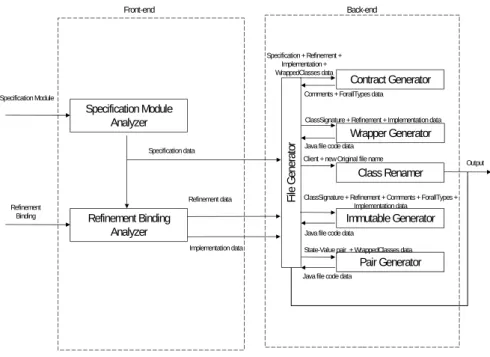
ConGu is organized into several logical components each responsible for one of the tasks that together make up the ConGu functionality (see Figure 3.1). Components Specification Module Analyzer and Refinement Binding Analyzer make up the front-end of ConGu. Together, these two components are re-sponsible for dealing with the input files and translating the information they contain into an internal representation. The back-end, formed by the generators and the Class Renamer, uses that internal information to produce the output of ConGu. The implementation of ConGu maps this logical structure. Each of the components is implemented, insofar as possible, by a distinct Java class
Specification Module Analyzer Refinement Binding Analyzer Class Renamer Wrapper Generator Immutable Generator Contract Generator Pair Generator Front-end Back-end Specification data Refinement data Implementation data Specification Module Output Refinement Binding F ile G en e ra to r Specification + Refinement + Implementation + WrappedClasses data
Comments + ForallTypes data
ClassSignature + Refinement + Implementation data
Java file code data Client + new Original file name
ClassSignature + Refinement + Comments + ForallTypes + Implementation data
Java file code data
Java file code data
State-Value pair + WrappedClasses data
Figure 3.1: The architecture of ConGu. Each box represents a component.
or set of classes. In the following sections the implementation of each of these components is addressed.
3.3
Parsing with SableCC
ConGu takes as input a set of specification files and one refinement binding file. In order for ConGu to validate and make sense of the content of those files, the files need to be parsed and analyzed against either the specification grammar or the refinement grammar. In order to simplify the implementation of this task, the SableCC parser generator is used. SableCC takes as input a .grammar file that specifies the lexicon and the production rules of a language and outputs a set of Java classes that allow:
• The parsing of a text file against that language. This consists on creating a tree that represents the syntactic structure of the contents of the file. • Walking through the nodes of that tree and executing certain actions.
These actions are specified by extending some of the classes that are gen-erated by SableCC: the tree-walkers.
By using SableCC the effort of implementing the analysis of the input files is reduced to the implementation of its semantic analysis. After defining the gram-mar for the language of specifications (gramgram-mars/specification.gramgram-mar) and the language of refinement bindings (grammars/refinement.grammar)
SableCC is executed on each of this .grammar files therefore creating two parsers, one for each language, and also the tree-walker classes. SableCC cre-ates four packages for each language. For the specification language the follow-ing packages are created by SableCC: spec. analysis, spec. lexer, spec.node and
spec. parser. Four equivalent packages were created for the refinement language:
refine . analysis, refine . lexer, refine .node and refine . parser.
Each of the tree-walker classes is then extended to allow the semantic analysis of the trees that are generated by the parser. In the following sections we describe in detail this process. For more information about SableCC please refer to reference [3].
3.4
The Specification Module Analyzer
The Specification Analyzer Module (SMA) takes as input a list of .spc files with specifications, parses each file, checks the static semantics, reports errors if they exist and outputs a spec.semant.SpecQuerier object through which all the other modules of ConGu can obtain information about the specification. SMA is implemented mainly by the classes in packagesspec.∗, together with the classes in package symbol. Class spec.semant.SpecModuleAnalyser is the main class of SMA.
SMA is the only module of ConGu that can be used as a stand-alone tool. In order to support the use of SMA as such, classcongu.specAnalyzer.SpecAnalyzer
which has a main method is created. This class provides a user interface for SMA. This class is ignored when SMA is used as part of the ConGu tool.
3.4.1
Semantic analysis
If every file is parsed without errors and the corresponding syntactic tree is cre-ated (spec.semant.SpecModuleAnalyser) then the specifications are syntactically correct i.e., they obey the rules of the specification language as defined in grammars/specification.grammar. Yet, specifications must conform to some other properties, of semantic nature, which are not captured by the grammar.
As in a standard compiler, identifier declarations and their uses must be checked for consistency by the SMA [1]. For instance, when analyzing the op-eration call push(R, E), SMA issues an error if the signature of operation push
ispush: Stack Element −−> Stack andRhas the sortRational instead ofStackas expected for the first argument of this operation. Class spec.semant.Semantics
has methods responsible for this part of the semantic analysis: variable and signature declaration analysis and checking that variables and operations and predicates are used accordingly to those declarations. This corresponds to the semantic analysis phase of a standard compiler [1].
In addition to the standard semantic analysis, the underlying methodol-ogy of ConGu imposes restrictions on the specification language which must also be ensured by the SMA. There are strong restrictions on the form of the axioms that depend on the properties of the operations or predicates.Class
spec.semant. Restrictions, which extends spec.semant.Semantics, is responsible for this part of the semantic analysis.
3.4.2
Three stage analysis
A specification is divided into three main sections: sort declaration, operation signature declaration and the axioms (in this group we include the domain definition of the operations). There are semantic dependencies among these sections, i.e., some of these sections have elements which can only be interpreted after analyzing some other section: the signatures refer to the sorts that are declared in the sorts section and the axioms have references to both the sorts and the operations (or predicates) that are declared in the signature section. These dependencies also exist among the various specifications in the module. Each specification may have references to sorts or operations (or predicates) that are declared in some other specification. In terms of semantic analysis this means the three sections must be analyzed in the correct order: first SMA must analyze all sorts in all specifications, then all signatures and, at last, all axioms. In order to implement this three stage analysis three classes are created that extend the tree walker spec. analyses .DepthFirstAdapter generated by SableCC. They are:
1. spec.semant.SortAnalyser
2. spec.semant.SignatureAnalyser
3. spec.semant.DomainAxiomAnalyser
Each of these tree walkers is applied to all specifications, in this order, by the spec.semant.SpecModuleAnalyser, i.e., first the sort analyzer is applied to all the specifications, then the same thing with signature analyzer and then the axiom analyzer. These tree walkers extend spec. analyses .DepthFirstAdapter
by adding calls to the appropriate methods of spec.semant.Semantics and
spec.semant. Restrictions on the tree nodes they visit. Each tree walker triggers the semantic analysis of the nodes that form the section of the specification it is responsible for, while ignoring the remaining nodes.
3.4.2.1 Sort checking
Axioms are first-order logic formulæ. Each sub-formula belongs to a sort. Vari-ables evaluate to the sort they have been declared with, while operations eval-uate to their return sort. For instance, the variable E evaleval-uates to the sort Element, if it has been declared as E: Element. The operation call push(S, E)
evaluates to the sortStack, ifpush: Stack Element −−> Stackis the signature of operationpush. Notice that the first argument of the operation callpushdoesn’t have to be a variable, it can be a complex expression as long as it evaluates to the sortStack. SMA is responsible for checking that each expression evaluates to the correct sort. If the first argument of the operation callpushwere to evaluate to a sort other than Stack, SMA would issue an error. In order to validate an expression, SMA must determine the sort of each of the expression’s immediate components. For instance an operation or a predicate call is valid in what con-cerns sort consistency, if all of its arguments evaluate to the expected sort. On the other hand, an equality is valid if both sides evaluate to the same sort.
Class spec.semant.DomainAxiomAnalyser, which is the tree-walker responsible for the axioms part of the specifications, plays an important role in the mecha-nism that evaluates the sort of each expression.
Classspec.semant.DomainAxiomAnalyserhas a stack as an attribute, where the sort of each expression is pushed when the tree-walker leaves the tree node that corresponds to that expression. Since the tree-walker visits the tree in a depth-first manner, when it enters a new expression the sorts of the immediate components of that expression are already in the stack. At that point all the tree-walker has to do is: pop the sorts out of the stack, validate the expression against those sorts and then push the sort of that expression into the stack. In order to validate the expression, spec.semant.DomainAxiomAnalyser calls the appropriate method ofspec.semant.Semanticswhich takes as arguments the sorts collected from the stack and returns the sort the expression evaluates to.
3.4.3
Storing and retrieving information
While performing the semantic analysis, class spec.semant.Semantics and class
spec.semant. Restrictions store much of the information regarding the semantic properties of the several elements of the specification. This is done for two reasons: first, as mentioned in Section 3.4.1, the analysis of many parts of the specification requires knowledge about other elements of the specification, so this information must be readily available, and second the other components of ConGu also require knowledge about the specification module, which must be provided by SMA. Classesspec.semant.Semantics andspec.semant. Restrictions
have several data structures as attribute that store all the relevant information about the specification module.
3.4.3.1 Semantic bindings
A specification module contains several elements with relevant semantic infor-mation. For instance, the identifierStack declared in “sorts Stack” is a sort, in which case we need to know its name and the file where it is declared. In order to store this information, the identifier Stack becomes bound to an object of typespec. binds . Sort which stores all the relevant information about a sort. On the other hand, the identifier S, declared in “S: Stack;”, is a variable, in which case we need to register the association between the name and the sort. We do this by binding the identifierSto an object of type spec. binds . Variable that stores the relevant information. Packagespec. bindscontains the classes that are used for storing semantic information. The elements of the specification with relevant semantic information are bound to an instance of one of this classes. This is achieved via map like structures, fields of classes spec.semant.Semantics
andspec.semant. Restrictions. The elements of the specification whose semantics we wish to store are used as keys in the map; the associated values arespec. binds
objects. Notice that, in addition to identifiers, some of the tree nodes are also used as keys.
3.4.3.2 Symbol table
The part of the semantic analysis that concerns identifier analysis use is usually implemented with the help of a symbol table. This symbol table maps each identifier to its semantics. As SMA reaches each identifier declaration (sort, signatures and variables) it binds the identifier (after converting it into asymbol) to its semantic properties in the table. When SMA encounters an identifier usage
it looks up the identifier in the table and checks that it is used in accordance to its semantics.
The symbol table used in SMA was originally created for the TyCO com-piler [6], as an extension of that in book [1]. The main class that implements the table (symbol.Table) together with its auxiliary classes form the packagesymbol. Among other things, this symbol table is different from a simple java . util .Map
in that has a scoping mechanism. The scoping mechanism is useful for SMA since the variables in the specifications must be interpreted according to the place where they are used. For instance, assuming that there are two different variable declarations with nameA, if variableAis being used in a domain defi-nition than its sort is the one declared after thedomains token and not the one declared after theaxiomstoken.
3.4.3.3 Specification querier
Class spec.semant. Restrictions, which extends spec.semant.Semantics, implements interfacespec.semant.SpecQuerier. The interfacespec.semant.SpecQuerier provides a set of methods that return information about the specification module. It is through this interface that the other components of ConGu get all the informa-tion they require about the specificainforma-tion module. Classspec.semant. Restrictions
implements the methods from the interface spec.semant.SpecQuerier by access-ing directly to its private data structure attributes but returnaccess-ing only the re-quired data. The instance of spec.semant. Restrictions that is used during the analysis of the specification module is returned by the main class of SMA,
spec.semant.SpecModuleAnalyser, and then passed on to the modules of ConGu that need to make queries about the specification module.
3.5
Refinement Binding Analyzer
The Refinement Binding Analyzer (RBA) takes as input a .rfn file and a SpecQuerier object that represents the specification module (see Sec-tion 3.4.3.3). RBA parses the .rfn file, verifies its semantics against the specification and the class system, reports errors if they exist and outputs a
refine .semant.RefinementQuerierobject through which the other modules can ob-tain information about the refinement. RBA is implemented mainly by the classes from the refine .∗ packages. Class spec.semant.RefinementAnalyser is the main class of RBA.
In terms of implementation, RBA has the general structure of the Specifi-cation Module Analyzer. For that reason, the structure of this section follows that of Section 3.4, albeit more succinct. We advise reading that section before proceeding.
3.5.1
Semantic analysis
The semantic analysis of a refinement consists of two main tasks:
• Making sure the refinement is compatible with the specification module and the class hierarchy. This means checking that all sorts and signa-tures are refined into a single type or method, checking that all sorts and signatures that are referenced in the refinement are indeed part of the
specification module, and also that all types and methods do exist in the class hierarchy.
• Checking that the refinement is consistent and that it complies to the ConGu methodology.This part of the analysis implies checking that op-eration and predicate refinements are consistent with sort refinements. For instance, the operationpop(s: Stack): Elementcannot be bound to method
String pop()of class Stack, unless class String implements the sortElement
and classStackimplements the sortStack.
The semantic analysis of the refinement is conducted by the methods of class
refine .semant.Semanticswhich are invoked while tree-walking the refinement.
3.5.2
Two stage analysis
A refinement contains two types of bindings: those that specify which Java type implements which sort and those that specify which methods implement which operations or predicates. Since operation and predicate signatures mention sorts, in order to validate a binding between an operation or predicate and a Java method, RBA must know which types implement each of the sorts that compose the signature. For instance, in order to validate the binding between operationpush: Stack Element −−> Stackand methodvoid push(String s)of class
Stack, RBA must first know that class String implements sortElementand class
Stack implements sort Stack. This means that the analysis of the refinement must be done in two stages: first sort bindings; then operation bindings. In order to implement the two stage analysis two classes were created that extend the tree walker generated by SableCC refine . analyses .DepthFirstAdapter. These are:
1. refine .semant.SortRefinementAnalyser
2. refine .semant.OpRefinementAnalyser
These two classes call methods of class refine .semant.Semanticson the appro-priate tree nodes.
3.5.3
Using Java reflection
While the specification module and the refinement binding are provided to ConGu as text files that need to be parsed, the Java classes that form the implementation are obtained by ConGu by using Java Reflection [2]. When the refinement analysis reaches a class name it tries to find the class in the classpath using Java Reflection. If the class is not found an error is issued; oth-erwise all information regarding the class (methods, variables, etc) is collected. By using Java Reflection ConGu gives the user the possibility to provide only .class files as input (by making them accessible through the classpath) and not the original .java source code. This strategy has two advantages:
• It allows the user to test implementations for which he does not have access to the source code, and
• it simplifies the implementation of ConGu by avoiding the need to parse and analyze Java source code. This effort is put upon the Java compiler and the Java Reflection mechanism.
3.5.3.1 Getting class information
The refinement binding defines the set of classes upon which the implementa-tion of the specificaimplementa-tion module relies. The properties of each of these classes must be checked by the RBA in order to validate the refinement. Also, those properties must be made available for consultation by the other components of ConGu. Whenever RBA reaches a sort that is implemented by a class, it finds the class through reflection and collects all relevant information regarding the class. A implement.ClassSignature object is used to store this information. The constructor of implement.ClassSignaturetakes the full qualified name of the class as argument and uses the methods of java . lang . Class to obtain all the infor-mation about that class. It then stores that inforinfor-mation in the fields of class
implement.ClassSignature. Among other things, this constructor is responsible for creating a set of implement.MethodSignature objects that represent the methods of the given class and a set ofimplement.ConstructorSignature that represent the constructors of the class.
3.5.4
Storing and retrieving information
3.5.4.1 Semantic bindings
Class refine .semant.Semantics contains two java . util .Map fields that are used for storing the information concerning the refinement of sorts and the re-finement of operations and predicates. The first maps sort names into objects of class refine . binds .SortRefinement that store all the relevant infor-mation regarding the sort and the type that implements it. The sec-ond maps operation or predicate signatures into refine . binds .OpRefinement
objects that store all the relevant information regarding the operation or predicate and the method or expression that implements it. Class
refine . binds .OpRefinement is abstract. There are four (non abstract) classes that extend it: refine . binds .OpToConstructorRef, refine . binds .OpToMethodRef,
refine . binds .OpToNullRef and refine . binds .OpToExpressionRef. These classes are used according to whatever implements the operation: a Java constructor, a method, the null value or an expression.
3.5.4.2 Parameter binding
Whenever an operation or predicate is implemented by a method or a Java constructor, the mapping between the operation or predicate parameters and the method parameters must be taken into consideration, since the order of the parameters in the operation or predicate need not be matched in the method. The first parameter of an operation may, for instance, correspond to the second parameter of the method. This correspondence between parameters is specified by the user through the parameter names. When analyzing the refinement of an operation into a method, RBA must not only take this into consideration, but also store this information, so that when an operation or predicate call is
translated into a method call by the other components of ConGu, the correct parameter order is used.
The correspondence between the parameters of an operation or predi-cate and those of the method is kept in an integer array either in class
refine . binds .OpToMethodRefor in class refine . binds .OpToConstructorRef. The ar-ray index gives the operation parameter and the integer value contained on that index gives the corresponding method parameter. For example, if the first in-teger in the array is 0, then the first parameter of the operation corresponds to the first parameter of the method. This array is a private field. The other components of ConGu access this information through the use of methods
getMethodParameterName, getMethodParameterIndex, getConstructorParameterName
andgetConstructorParameterIndex that take as input the operation parameter in-dex and give as output either the name or the inin-dex of the corresponding method or Java constructor parameter.
3.5.4.3 Refinement querier and implementation querier
Class refine .semant.RefineQuerier is the interface that defines the set of meth-ods through which the other components of ConGu can obtain information about the refinement binding. Class refine .semant.Semanticsimplements this in-terface. An object of this type is returned by the main method of the RBA. Class
refine .semant.RefineQuerier contains the method getImplementationwhich returns all the information regarding the implementation, through an object of class
implement.ImplementQuerier. This interface provides methods that return infor-mation about the implementation in itself, independently of its relation to the specification module.
3.5.4.4 Implementation package
The refinement binding is what makes the connection between the specifica-tion module and its Java implementaspecifica-tion. In order to store and process the information regarding the elements that compose the implementation (classes, expressions, etc), several classes are available. These classes form theimplement
package. In this package we have classimplement.ClassSignaturewhich stores the information regarding a class, class implement.MethodSignature which stores the information regarding a method and implement.Constructor which stores the in-formation that concerns a constructor. Classimplement.Nullis used to represent the null value and classimplement.Expressionrepresents a generic Java expression.
implement.Implementationstores the totality of the information that concerns the implementation of a specification module. This class also implements interface
implement.ImplementQuerierand as so, provides the set of methods that supply all the required information about the implementation.
3.6
Class Renamer
Class congu.ClassRenamer (CR) takes as input the original classpath (it can be either a regular directory or a .jar file name), the original class filename, the new classpath directory, the new class filename and outputs the new assembled Java byte-code.
In terms of implementation, CR inner class Class File (CF) is the Java byte-code main structure used to manipulate the renaming process. CF constructor fills this structure and thedump()method outputs it to the file system. In order to successfully rename a class-file, CR:
• Initially loads CF as the original Java byte-code representation;
• Updates all explicit and implicit internal attribute references inside CF such as: SourceClass, ThisClass, constant-poolNameAndType, constant-pool
FieldsInfo,constant−pool MethodsInfoand, recursively, the for inner classes. Notice that renaming one class file may not be enough if the class file has, for instance, inner classes. Although renaming can be automatically performed we still need access to bytecode files involved.
• Renames the class-file.
• Finally writes CF as the new Java bytecode representation with the new filename.
3.7
Wrapper Generator
Class congu.WrapperGenerator (WG) takes as input the
implement.ClassSignature (CS), the refinement .semant.RefinementQuerier (RQ), the implement.ImplementQuerier (IQ) provided by ConGu’s earlier stages and outputs a wrapper Java file, acting like a String factory. This wrapper Java file intends to replace the original class.
In what concerns clients of the original class, the wrapper object is similar to the original object: its constructors and methods have the same signature and they apparently behave in the same way; however they allow monitoring the original constructors and methods execution by redirecting client calls to the corresponding constructor or method in theImmutableclass.
In terms of implementation, CS gives all necessary Java class signatures and RQ the contextualized signature from the specification.
The output file is generated by instantiating WG and calling toJavaCode()
method. This method generates the new Java file code by declaring the same package class, class name, public attributes, constructors and methods (exclud-ing the final ones and omitt(exclud-ing native keyword) as the original class. It also includes auxiliary methods for the purpose of wrapping and unwrapping ob-jects when necessary.
3.8
Immutable Generator
Class congu.ImmutableGenerator (IG) takes as input the implement.ClassSignature
(CS), the refinement .semant.RefinementQuerier (RQ) provided by ConGu’s ear-lier stages, the Hashtable provided by Contract Generator (CG) getComments()
method, the Collection provided by CG getForallTypes () method, the
implement.ImplementQuerier (IQ) provided by ConGu’s earlier stages, and out-puts an immutable Java file containing JML contracts within Java comments,
acting like a Stringfactory. This immutable file is responsible for contract mon-itoring during execution time and is generated by instantiating IG and calling
toJavaCode()method.
In terms of implementation, IG generates a Java file belonging to the same package as CS, all “constructors” and methods specified in RQ, theequals () and the clone () methods (the latter only when CS implements interface Cloneable). The generated “constructors” are actually static methods that return the same datatype CS being specified. Both, “constructors” and methods are equipped with JML contracts as Java comments. In addition, the generated Java file might also includes a static forall.Range field (FR) for each input Collection
element (when asserting over free variables). Those FR’s are Objectsets popu-lated with objects that are passed as argument, and returned as results, in all method calls that happen in the context of the givenImmutableclass during con-tract monitoring execution time. This populating process is achieved by a new post-condition with JML syntax through FR updateCache() method comment. Later on, when monitoring a JML forall assertion, the domain range scans the appropriate FR.1
The final stage consists in combining each “constructor” and method with the associated JML assertion predicates. By iterating over the input Hashtable
(an Hashtable of Hashtable’s) one can identify the sub-Hashtable for each RQ specified “constructor” or method. The latter hashtable collects the StringBuffer
containing JML formated pre- and post-conditions grouped by Operation cri-teria. These Operation collections are then merged with JML alsokeyword to ensure correct design-by-contract behavior. The contract for theclone ()method is built without input hashtable query since it is not generated by a specified axiom but rather stating that a cloned object is always equals to the object itself.
3.9
Contract Generator
Class congu.ContractGenerator (CG) takes as input, through its constructor, the
spec.semant.SpecQuerier (SQ), the refinement .semant.RefinementQuerier (RQ), the
implement.ImplementQuerier (IQ), the Hashtable identifying the renamed original class name for each original client class name provided by FileGenerator (FG), all prepared by ConGu’s earlier stages. CG outputs two data structures: the
Hashtableaccessible viagetComments()method and theHashtableaccessible from
getForallTypes () method.
3.9.1
Output
The former output data structure (accessible viagetComments() method) is a hashtable of hashtables that groups contracts either by ConstructorSignature or by MethodSignature (MS) and then byOperationkeys; think that as a double key hashtable. The MS is unique since it also identifies the belonging class (also known as CS identifier) through its classFile attribute. Each contract is a StringBuffer representing a JML syntax assertion characters sequence. Later 1This strategy might need revision starting with JML 5.3, forupdateCache()is not apure
on, the IG will perform the task of placing each contract inside the expected immutable file and associated java method.
The latter output data structure (accessible from getForallTypes () method) is a String collection hashtable with CS as key. It contains all domain types used in forall assertions within contracts grouped by client class criteria. Later on, the IG when declaring the immutable class attributes will declare as many static FR’s as these String collection elements. IG will also perform the task of declaring extra post conditions for each method whose signature (return and arguments type) contains any collected domain type used in forall assertions. These extra post conditions are nothing more than ensuring updateCache() on each static FR previously declared, giving the opportunity to dynamically grab objects during monitoring phase and reuse them when executing domain range assertions.
3.9.2
Implementation
This contract factory uses two depth first walkers named DefWalker (DW) and TranslateWalker (TW) to travel the specifications tree, although CG itself is al-ready a depth first adapter too, on a specific simple case when collecting variable identifiers from an operation or from an equality node. After DW and/or TW walks we assemble the contract output according to our methodology.
3.9.2.1 The translation tree-walker
This class translates the formulæ of our specification language, cooperating with DW for the equality axiom. It is implemented with a translation stack that, in the end, is supposed to have one and only one translated element. During this process the operationResult node indicates when to replace the actual node with result,mainOpVarhas the main operation variables substitution andmainOpNode
binds the variable identifiers with associated nodes. It is also a CG client by means of reading or updating static attributes.
3.9.2.2 The definedness tree-walker
This class translates the definedness conditions for both terms and formulæ of our specification language, cooperating with TW. It is implemented with a translation stack that, in the end, is supposed to have one and only one trans-lated element. During this process the operationResult node indicates when to replace the actual node with result,mainOpVarhas the main operation variables translation ready to pass to TW, and mainOpNode reflects the specific case of getting the definedness condition from a second level depth translated domain condition. It is also a CG client by means of reading their static attributes.
3.9.3
Virtual equals node operation
Due to the fact that translating an observer operation automatically results, ac-cording to our methodology, in an equality axiom, there is the need to translate nodes that do not belong to the specification. Such node, for the purpose of code reuse, was virtually created and then translated with minor impacts to the implemented solution. One of these is the protected static Operation observerOp