Yield of Broilers
Author(s)
Carvalho CMC* Fernandes EAII
Carvalho AP deIII
Maciel MPIV
Caires RMV
Fagundes NSVI
* Parte da Dissertação do primeiro autor,
apresentada à FAMEV/UFU, Rua Pedro Crosara Cherulli, 143 apto1, Cep:38400044 Uberlândia-MG.
II Docente da Faculdade de Medicina
Veterinária-FAMEV/UFU, Uberlândia-MG
III Secretaria Estadual de Meio
Ambiente-SEMAD, Uberlândia-MG
IV Docente do curso de Zootecnia –
UNIMONTES, Montes Claros-MG
V Aluna do curso de Zootecnia- UFMG,
Montes Claros-MG
VI Mestre em produção animal-FAMEV/UFU
Mail Adress
* Corresponding author e-mail address E-mail: [email protected]
Keywords
Broilers, performance, blood meal, carcass yield, meat and bone meal.
Submitted: October/2012
ABSTRACT
The objective of this study was to evaluate the performance and carcass characteristics of broilers fed exclusively vegetable diets and diets containing animal meal with the addition of creatine or not after day 8. In the experiment, 1080 one-day-old male chicks were distributed according to a completely randomized experimental design into six treatments with six replicates each. A control diet based on corn and soybean meal was formulated, to which animal meals and creatine were included or not. Diets were formulated to contain equal mineral (calcium, phosphorus and sodium) and amino acid (available methionine + cystine, lysine and threonine) levels. The following treatments were applied: A. control (diet based on corn and soybean meal); B. control + creatine (600g/ton); C. inclusion of 5% meat and bone meal (MBM), D. inclusion of 5% MBM + creatine (600g/ton), E. inclusion of 5% blood meal (BM), F. inclusion 5% BM + creatine (600g/ton). Weight gain, feed intake, feed conversion, carcass yield and viability were evaluated. At 42 days of age, BM dietary inclusion impaired weight gain and feed conversion ratio. The inclusion of MBM affected only feed conversion ratio. The addition of creatine ito the diet with BM improved weight gain when compared with the BM diet with no creatine. The addition of creatine to the diet containing 5% BM improved weight gain when compared with the same diet without the use of the additive.
INTRODUCTION
Animal products are frequently included in broiler diets to reduce feed cost. The quality of the protein in meat and bone meal and blood meal is good and these ingredients may partially replace soybean meal in feed formulation. In addition of being a protein source, meat and bone meal is a significant source of minerals, such as calcium (Ca) and phosphorus (P), which are considered totally available, whereas in plant feedstuffs, only 33% of the phosphorus is available to the animals due to the presence of phytate.
Sartorelli (1998) included meat and bone meal from five different sources in broiler diets and compared them with a diet containing dicalcium phosphate, but did not find any performance differences.
Junqueira et al. (2000), using meat and bone meal containing 37.51%
or 41.58% crude protein (CP) at two inclusion levels (3 or 6%) in the diet of one- to 49-d-old broilers, also did not find any differences in weight gain, feed intake, feed conversion ratio, or livability.
In the study of Donkoh et al. (1999), the inclusion of 5% or 7.5%
The use of feed additives is becoming increasingly frequent in broiler diets to improve performance. Creatine, a compound based on amino acids (arginine, glycine, and methionine), may participate in this market because it is an essential precursor in the production of muscle energy, in addition of favoring muscle growth.
Studies with broilers performed by Halle et al.
(2006) showed the creatine supplementation (1, 2, 5, and 10g/kg) to a corn- and soybean meal-based diet improved weight gain compared with a control group in 35-d-old broilers.
The objective of the present study was to evaluate the live performance and carcass traits of broilers fed diets including only plant feedstuffs and diets containing animal products with the inclusion or not of creatine.
MATERIALS AND METHODS
The experiment was carried out at the Glória poultry experimental farm of the School of Veterinary Medicine of the Federal University of Uberlândia, state of Minas Gerais, Brasil. In this experiment, 1080 one-d-old male Avian 48 chicks, with 43g average initial weight, were distributed in a completely randomized experimental design with six treatments of six replicates of 30 birds each. The house was divided in 36 pens, with 30 birds each, at a density of 12 birds/m2. Feed and water were
offered ad libitum. A continuous lighting program was used, with 24 hours of light. The average minimal and maximal house temperatures daily recorded from day 10 to market were 25.34 ºC and 25.86 ºC, respectively. Diets were formulated and manufactured to supply the birds’ nutritional requirements according to the
recommendations of Rostagno et al. (2005). Before
feed formulation, corn, soybean meal, and animal meals were chemically analyzed (Table 1). Diets contained different combinations of corn, soybean meal, meat and bone meal (MBM), blood meal (BM), soybean oil, dicalcium phosphate, limestone, vitamin and mineral premix, synthetic amino acids (Dl-methionine, L-lysine, and threonine), and creatine (600 g/ton of feed). Diets were supplied according to a four-phase feeding program: pre-starter, starter, grower, and finisher.
Animal products and creatine (creAminotm) were
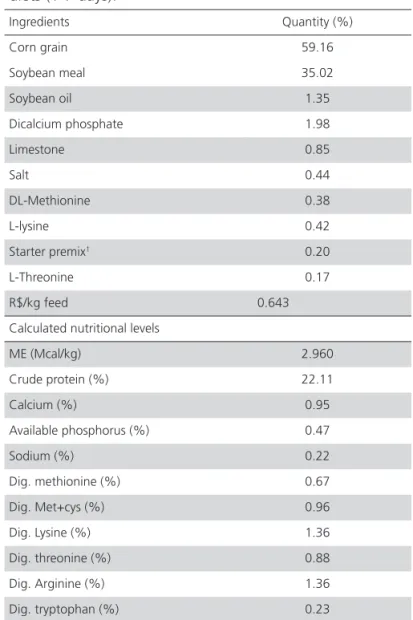
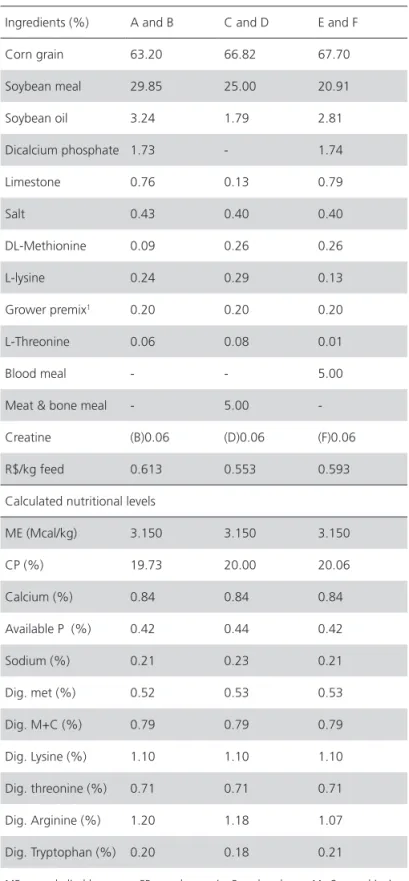
included in the diets after day 8. Tables 2, 3, 4, and 5 show the ingredient and nutritional composition of the experimental feeds.
Table 1 – Chemical composition of the animal meals, corn, and soybean meal used in the experimental diets.
Nutrients MBM (%) BM (%) Corn (%) SBM Crude protein 42.02 84.74 8.05 46.84 Ether extract 14.11 0.38 2.18 1.63 Ashes 38.02 3.44 1.93 6.42 Calcium 13.80 0.20 0.03 0.24 Phosphorus 6.81 0.21 0.24 0.53 Dry matter 92.06 93.50 88.00 89.52 Dig. Arginine 3.11 2.73 0.36 3.15 Dig. Lysine 2.03 5.80 0.20 2.53 Dig.
methionine
0.53 0.83 0.15 0.60
Dig. Met+cys 0.81 1.31 0.32 1.12 Dig. threonine 1.25 3.32 0.27 1.57 Dig. tryptophan 0.21 1.13 0.05 0.59
Table 2 – Composition of the pre-starter experimental diets (1-7 days).
Ingredients Quantity (%)
Corn grain 59.16
Soybean meal 35.02
Soybean oil 1.35
Dicalcium phosphate 1.98
Limestone 0.85
Salt 0.44
DL-Methionine 0.38
L-lysine 0.42
Starter premix1 0.20
L-Threonine 0.17
R$/kg feed 0.643 Calculated nutritional levels
ME (Mcal/kg) 2.960
Crude protein (%) 22.11
Calcium (%) 0.95
Available phosphorus (%) 0.47
Sodium (%) 0.22
Dig. methionine (%) 0.67 Dig. Met+cys (%) 0.96 Dig. Lysine (%) 1.36 Dig. threonine (%) 0.88 Dig. Arginine (%) 1.36 Dig. tryptophan (%) 0.23
1 MC-Mix Frango Inicial SAA 2kg (®M-Cassab Comércio e Indústria Ltda) –
Table 3 – Composition of the starter experimental diets (7-21 days).
Ingredients (%) A and B C and D E and F
Corn grain 60.51 65.24 61.78
Soybean meal 33.31 27.57 26.84
Soybean oil 2.23 0.55 2.71
Dicalcium phosphate 1.87 0.02 1.87
Limestone 0.80 0.24 0.82
Salt 0.45 0.40 0.41
DL-Methionine 0.27 0.29 0.27
L-lysine 0.25 0.32 0.06
Starter premix1 0.20 0.20 0.20
L-Threonine 0.08 0.11 0.0006
Blood meal - - 5.00
Meat & bone meal - 5.00
-Creatine (B)0.06 (D)0.06 (F)0.06
R$/kg feed 0.611 0.547 0.601
Calculated nutritional levels
ME (Mcal/kg) 3.050 3.050 3.050
CP (%) 21.14 21.14 22.24
Calcium (%) 0.90 0.90 0.90
Available P (%) 0.45 0.45 0.45
Sodium (%) 0.22 0.23 0.22
Dig. met+cys (%) 0.56 0.57 0.57
Dig. Met+cys (%) 0.85 0.85 0.85
Dig. Lysine (%) 1.18 1.18 1.18
Dig. threonine (%) 0.78 0.78 0.78
Dig. Arginine (%) 1.31 1.26 1.24
Dig. Tryptophan (%) 0.22 0.20 0.24
ME - metabolizable energy, CP - crude protein, P – phosphorus, M+C – methionine + cystine.
1MC-Mix Frango Inicial SAA 2kg (®M-Cassab Comércio e Indústria Ltda) –
composi-tion/kg feed – Vit-A 11,000IU; D3 2,000IU; E 16mg; folic acid 400mcg; calcium panto-thenate 10mg; biotin 60mcg; niacin 35mg; pyridoxine 2mg; riboflavin 4.5mg; thiamin 1.2mg; B12 16mcg; K 1.5mg; Se 250mcg; choline 249mg; Cu 9mg; Zn 60mg; I 1mg; Fe 30mg; Mn 60mg; growth promoter 384mg; coccidicide 375mg; antioxidant 120mg.
Table 4 – Composition of the grower experimental diets (21-35 days).
Ingredients (%) A and B C and D E and F
Corn grain 63.20 66.82 67.70
Soybean meal 29.85 25.00 20.91
Soybean oil 3.24 1.79 2.81
Dicalcium phosphate 1.73 - 1.74
Limestone 0.76 0.13 0.79
Salt 0.43 0.40 0.40
DL-Methionine 0.09 0.26 0.26
L-lysine 0.24 0.29 0.13
Grower premix1 0.20 0.20 0.20
L-Threonine 0.06 0.08 0.01
Blood meal - - 5.00
Meat & bone meal - 5.00
-Creatine (B)0.06 (D)0.06 (F)0.06
R$/kg feed 0.613 0.553 0.593
Calculated nutritional levels
ME (Mcal/kg) 3.150 3.150 3.150
CP (%) 19.73 20.00 20.06
Calcium (%) 0.84 0.84 0.84
Available P (%) 0.42 0.44 0.42
Sodium (%) 0.21 0.23 0.21
Dig. met (%) 0.52 0.53 0.53
Dig. M+C (%) 0.79 0.79 0.79
Dig. Lysine (%) 1.10 1.10 1.10
Dig. threonine (%) 0.71 0.71 0.71
Dig. Arginine (%) 1.20 1.18 1.07
Dig. Tryptophan (%) 0.20 0.18 0.21
ME - metabolizable energy, CP - crude protein, P – phosphorus, M+C – methionine + cystine.
1MC-Mix Frango engorda SAA 2kg (®M-Cassab Comércio e Indústria Ltda) -
Table 5 – Composition of the finisher experimental diets (35-42 days).
Ingredients (%) A and B C and D E and F Corn grain 59.36 61.20 66.88 Soybean meal 32.33 29.34 20.72 Soybean oil 5.07 4.04 4.13 Dicalcium phosphate 1.56 - 1.58 Limestone 0.75 0.23 0.79
Salt 0.40 0.33 0.36
DL-Methionine 0.08 0.08 0.12 L-lysine 0.11 0.11 0.09 Finisher premix1 0.30 0.30 0.30
L-Threonine - -
-Blood meal - - 5.00
Meat & bone meal - 5.00 -Creatine (B)0.06 (D)0.06 (F)0.06 R$/kg feed 0.578 0.528 0.572 Calculated nutritional levels
ME (Mcal/kg) 3.200 3.200 3.200 CP (%) 20.28 20.92 19.76 Calcium (%) 0.80 0.80 0.80 Available P (%) 0.39 0.40 0.39 Sodium (%) 0.20 0.20 0.20 Dig. methionine (%) 0.48 0.48 0.50 Dig. M+C (%) 0.75 0.75 0.75 Dig. Lysine (%) 1.05 1.05 1.05 Dig. threonine (%) 0.68 0.68 0.69 Dig. Arginine (%) 1.26 1.28 1.05 Dig. Tryptophan (%) 0.21 0.20 0.21
ME - metabolizable energy, CP - crude protein, P – phosphorus, M+C – methionine + cystine.
1 MC-Mix Frango Abate 3kg (®M-Cassab Comércio e Indústria Ltda) – composition/
kg feed – Vit-A 2,700IU; D3 450IU; E 4.5mg;calcium pantothenate 3.6mg; biotin 13.5mcg; niacin 4.5mg; pyridoxine 360mcg; riboflavin 900mcg; thiamin 270mcg; B12 2.7mcg; K3 450mcg; Se 180mcg; choline 130mg; methionine906 mg; Cu 9mg; Zn 60mg; I 1mg; Fe 30mg; Mn 60mg; antioxidant 120mg.
Birds, feed offer, and feed residues were weighed on days 7, 14, 21, 35, and 42 to determine feed intake (FI), body weight gain (WG), and feed conversion ratio (FCR). The number of dead birds was daily recorded to calculate livability (L). Actual feed conversion ratio (aFCR) was expressed as the ratio between feed intake and weight gain per period added to dead bird weight minus initial chick weight.
On day 42, four birds per pen, which body weight was representative of the average body weight of their experimental unit, were selected to evaluate carcass yield. Broilers were feed-fasted for eight hours, and then sacrificed, plucked, and eviscerated. Carcass, bone-in breast, deboned breast, and leg (drumstick+thighs) yields were determined. Carcass yield was expressed relative to live weight [CY% = (carcass weight without
in breast, and deboned breast yields were expressed relative to carcass weight [Part yield% = (part weight x 100)/carcass weight].
The obtained results were submitted to analysis of variance and to the F test at 5% significance level. Means were compared by the test of Scott-Knott, using the SISVAR statistical package (Ferreira, 2000).
RESULTS AND DISCUSSION
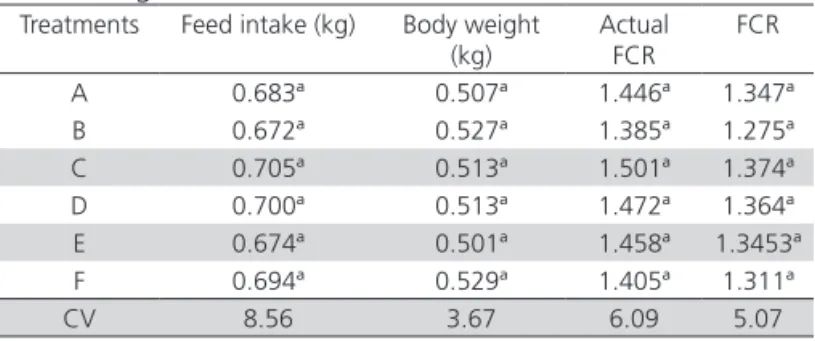
Broiler performance results on day 14 are shown in Table 6. There was no influence of the treatments (p>0.05) on feed intake, weight gain, feed conversion ratio, or livability. This shows that the animal meals did not affect broiler performance when compared with the control feed. The use of creatine in the control diet and in the diet with 5% BM promoted numerically better actual feed conversion ratio and weight gain compared with the diets with no creatine; however, differences were not statistically significant (p>0.05). Sartorelli (1998) and Junqueira et al. (2000) did not find any effect of the dietary inclusion of MBM on the performance of broilers during the same period. On the other hand, Khawaja et al. (2007), evaluating different BM levels (0, 3, 4, 5, or 6%), observed better weight gain, lower feed intake, and better feed conversion ratio in broilers fed 3% BM during the period of 0 to 28 days of age.
Table 6 – Performance of 14-d-old broilers fed diets containing or not animal meals and creatine.
Treatments Feed intake (kg) Body weight (kg)
Actual FCR
FCR
A 0.683ª 0.507ª 1.446ª 1.347ª B 0.672ª 0.527ª 1.385ª 1.275ª C 0.705ª 0.513ª 1.501ª 1.374ª D 0.700ª 0.513ª 1.472ª 1.364ª E 0.674ª 0.501ª 1.458ª 1.3453ª F 0.694ª 0.529ª 1.405ª 1.311ª CV 8.56 3.67 6.09 5.07
A-control feed; B-Control+Creatine; C-Inclusion of 5% MBM; D-Inclusion of 5% MBM+Creatine; E-Inclusion of 5% BM; F-Inclusion of 5% BM+Cretine.
Means followed by different letters in the same column are different by the test of Scott-Knott (p<0.05).
Filho et al. (2002) did not find any effect of the dietary inclusion of MBM on the performance of broilers during the same period. Also, Bellaver et al. (2005), comparing the inclusion of 4% meat and bone meal, 3% poultry offal meal, and vegetable diets, did not find any difference among diets relative to the performance of 21-d-old broilers.
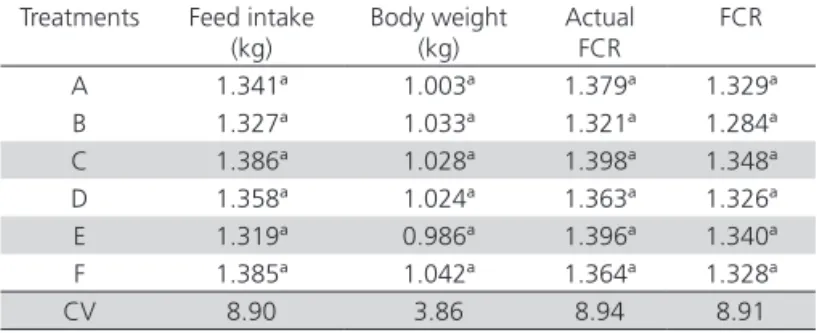
Table 7 – Performance of 21-d-old broilers fed diets containing or not animal meals and creatine.
Treatments Feed intake (kg) Body weight (kg) Actual FCR FCR
A 1.341ª 1.003ª 1.379ª 1.329ª B 1.327ª 1.033ª 1.321ª 1.284ª C 1.386ª 1.028ª 1.398ª 1.348ª D 1.358ª 1.024ª 1.363ª 1.326ª E 1.319ª 0.986ª 1.396ª 1.340ª F 1.385ª 1.042ª 1.364ª 1.328ª CV 8.90 3.86 8.94 8.91
A-control feed; B-Control+Creatine; C-Inclusion of 5% MBM; D-Inclusion of 5% MBM+Creatine; E-Inclusion of 5% BM; F-Inclusion of 5% BM+Cretine.
Means followed by different letters in the same column are different by the test of Scott-Knott (p<0.05).
When broilers were 35 days old (Table 8), it was observed that the studied parameters were not influenced by the treatments (p>0.05). Broilers fed animal meals had the same performance as those fed the control diet. Weight gain was numerically higher when creatine was included in the control diet and that containing 5% BM compared to the same treatment with no additive; however, these differences were not statistically significant (p>0.05). These results are consistent with those obtained by Sartorelli (1998)
and Junqueira et al. (2000), who did not find any
significant differences in broiler performance when MBM was added to the diets during the same period. On the other hand, Faria Filho et al. (2002) found that the dietary inclusion of 6% MBM resulted in lower feed intake and weight gain of broilers evaluated during the same period. According to those authors, performance was impaired because the diets were formulated on total amino acid basis and not on digestible amino acids.
On the other hand, Halle et al. (2006) showed the
creatine supplementation (1, 2, 5, and 10g/kg) to a corn- and soybean meal-based diet improved weight gain compared with a control group during the same period, differently from the findings of the present study. However, those authors also found that creatine supplementation did not affect feed intake.
Table 8 – Performance of 35-d-old broilers fed diets containing or not animal meals and creatine.
Treatments Feed intake (kg) Body weight (kg)
Actual FCR FCR
A 3.655ª 2.392ª 1.505ª 1.527ª B 3.917ª 2.444ª 1.504ª 1.606ª C 3.696ª 2.376ª 1.461ª 1.555ª D 3.575ª 2.342ª 1.503ª 1.528ª E 3.723ª 2.335ª 1.528ª 1.596ª F 3.799ª 2.397ª 1.478ª 1.585ª CV 8.23 3.29 7.65 8.73
A-control feed; B-Control+Creatine; C-Inclusion of 5% MBM; D-Inclusion of 5% MBM+Creatine; E-Inclusion of 5% BM; F-Inclusion of 5% BM+Cretine.
Means followed by different letters in the same column are different by the test of Scott-Knott (p<0.05).
Table 9 shows the performance of broilers at 42 days of age. Feed intake ranged between 5.397 and 5.999 kg, but there were no significant differences (p>0.05). On the other hand, the live weight of birds fed diet E, which included 5% BM, was significantly lower than that obtained in the other treatments. However, when creatine was added (diet F: 5% BM+creatine) to this diet, live weight improved. The worst feed conversion ratio was obtained with diet E (5% BM), followed by diet C (5% MBM) and diet F (5% BM+C). These results do not agree with those of Sartorelli (1998) and Junqueira et al. (2000), who did not find any effect of the dietary inclusion of MBM on the performance of broilers during the same period. On the other hand, Faria Filho et al. (2002) found that the dietary inclusion of 6% MBM resulted in lower feed intake and weight gain of broilers evaluated during the same period. Donkoh et al. (1999) concluded that the inclusion of 5 and 7.5% BM resulted in better weight gain and feed conversion ratio when compared with the inclusion of 0.0 and 2.5% BM.
be used for meat production was diverted to nitrogen excretion.
There are two theories to explain the positive effect of the diets with creatine inclusion. Firstly, it is assumed that creatine supplementation promotes water retention, and secondly, that it actually promotes protein synthesis. Therefore, further studies are required to determine the contribution of each of these processes (Williams, 1998) to the observed effect.
According to Wyss & Kaddurah-Daouk (2000), even when creatine is correctly used, the expected effects may not be detected. This may be explained by the individual variability in creatine absorption, transport, and intramuscular storage.
Table 9 – Performance of 42-d-old broilers fed diets containing or not animal meals and creatine.
Treatments Feed intake (kg)
Body weight (kg)
Actual FCR FCR
A 5.397ª 2.994ª 1.756ª 1.806ª
B 5.738ª 3.048ª 1.738ª 1.881ª
C 5.999ª 2.945ª 1.841ª 2.035b
D 5.411ª 2.915ª 1.798ª 1.856ª
E 5.677ª 2.745b 1.886ª 2.070b
F 5.867ª 3.004ª 1.796ª 1.953b
CV 7.22 3.85 5.20 7.20
A-control feed; B-Control+Creatine; C-Inclusion of 5% MBM; D-Inclusion of 5% MBM+Creatine; E-Inclusion of 5% BM; F-Inclusion of 5% BM+Cretine.
Means followed by different letters in the same column are different by the test of Scott-Knott (p<0.05).
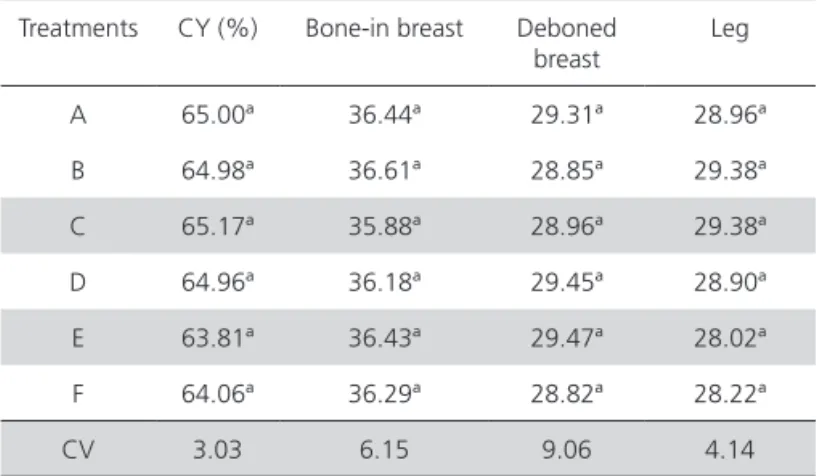
Table 10 presents carcass, bone-in breast, deboned breast, and leg yield results. These parameters were not (p>0.05) influenced by the evaluated treatments. These results are consistent with the findings of Halle et
al. (2006), who showed that creatine supplementation
(1g, 2g, 5g, or 10g/kg) to a corn- and soybean meal-based diet did not affect carcass yield during the same period. Junqueira et al. (2000) and Faria Filho et al. (2002) did not find any effect of the dietary inclusion of MBM on the carcass yield of broilers during the same period. The obtained results show that the dietary inclusion of animal meals did not affect carcass yield; however, feed cost may be reduced in 7%, in average
Table 10 – Carcass yield of 42-d-old broilers fed diets containing or not animal meals and creatine.
Treatments CY (%) Bone-in breast Deboned breast
Leg
A 65.00ª 36.44ª 29.31ª 28.96ª B 64.98ª 36.61ª 28.85ª 29.38ª C 65.17ª 35.88ª 28.96ª 29.38ª D 64.96ª 36.18ª 29.45ª 28.90ª E 63.81ª 36.43ª 29.47ª 28.02ª F 64.06ª 36.29ª 28.82ª 28.22ª CV 3.03 6.15 9.06 4.14
A-control feed; B-Control+Creatine; C-Inclusion of 5% MBM; D-Inclusion of 5% MBM+Creatine; E-Inclusion of 5% BM; F-Inclusion of 5% BM+Cretine.
Means followed by different letters in the same column are different by the test of Scott-Knott (p<0.05).
CONCLUSION
Creatine supplementation did not influence the performance or carcass yield of broilers fed diets containing meat and bone meal. However, when broilers were 42 days of age, the addition of creatine in the feed with blood meal inclusion improved weight gain compared with the same feed with no creatine.
REFERENCES
Bellaver C, Costa CA, Avila VS, Fraha M, Lima GJ, Hackenhar L, Baldi L. Substituição de farinhas de origem animal por ingredientes de origem vegetal em dietas para frangos de corte. Ciência Rural 2005;35(3):671-677.
Bellaver C. Ingredientes de origem animal destinado à fabricação de rações. Simpósio sobre Ingredientes na Alimentação Animal; 2001; Campinas, São Paulo. Brasil, p-167-190.
Donkoh A, Atuahene CC, Anang DM. Chemical composition of solar-dried blood meal and its effect on performance of broiler chickens. Animal Feed Science and Technology 1999;81:299-307.
Faria Filho DE, Junqueira OM, Rizzo MF, Araújo LF, Araújo CSS. Avaliação da farinha de carne e ossos na limentação de frangos de corte. Revista Brasileira de Ciência Avícola 2002;4(1):01-09.
Ferreira DF. Analise estatísticas por meio do Sisvar para o Windows versão 4.0. Anais da 45th Reunião Anual da Região Brasileira da Sociedade Internacional de Biometria; 2000; São Carlos, São Paulo. Brasil: UFSCar; 2000. p.255-258.
Halle I, Henning M, Kohler P. Untersuchungen zum einfluss von kreatin auf die leistungsmerkmale von legehennen, das wachstum und die ganzkörperzusammensetzung von broilern. Landbauforschung Völkenrode 2006;56(1/2):11-18.
dietas de frangos de corte [CD-Rom]. Anais da 37th Reunião Anual da Sociedade Brasileira de Zootecnia; 2000; Viçosa, Minas Gerais. Brasil: Viçosa: Sociedade Brasileira de Zootecnia; 2000.
Khawaja, T., Khan, S.H., Ansari, N.N. Efectt of different levels of blood meal on broiler performance during two phases of growth. International Journal Poultry Science 2007;6(2):860-865.
Leclercq B. Les rejet azote issus de láviculture: importance et progress envisageables. INRA Produción Animal 1996; 9:91-101.
Rostagno HS, Albino LF, Donzele JL, Gomes PC, Oliveira RF, Lopes DC, Ferreira AS, Barreto SL. Tabelas brasileiras para aves e suínos: Composição dos alimentos e exigências nutricionais. Viçosa, MG, UFV; 2005. 141p
Sartorelli SAA. Uso de farinha de carne e ossos em rações de frango de corte [dissertação].
Lavras [dissertação]. Lavras (MG): Universidade Federal de Lavras; 1998.
Williams M. Rating the sports ergogenics. The ergogenic edge. Champaing: Human Kinetics; 1998. p.178-182.
Wyss M, Kaddurah-Daouk R. Creatine and creatinine Metabolism. Physiological Reviews 2000; 80:1107-1213.