Acta Scientiarum
http://www.uem.br/acta ISSN printed: 1806-2636 ISSN on-line: 1807-8672
Doi: 10.4025/actascianimsci.v37i2.24836
Quantitative analysis of rumen microbial populations by qPCR in
heifers fed on
Leucaena leucocephala
in the Colombian Tropical Dry
Forest
Erika Angarita1,3*, Isabel Molina2,3, Gonzalo Villegas3, Olga Mayorga1, Julián Chará3 and
Rolando Barahona2
1
Colombian Corporation of Agricultural Research Corpoica, Mosquera, Cundinamarca, Colombia. 2
National University of Colombia, Medellin, Antioquia, Colombia. 3
Center for Research on Sustainable Farming Systems, Cipav. Carrera 25 No 6-62 Cali, Valle del Cauca, Colombia. *Author for correspondence. E-mail: [email protected]
ABSTRACT. Rumen fermentation and methanogenesis are vital metabolic processes in cattle and are carried out by microbial populations that are affected by dietary factors such as secondary metabolites, nutritional composition and degradability. The aim of this study was to monitor populations of total bacteria, total methanogens and Butirivibrio fibrisolvens in the rumen of Lucerne heifers fed on diets typical of intensive silvopastoral systems (ISS) or of a traditional (control) system. Rumen contents (RC) were collected orally from eight heifers consuming 100% Cynodon plectostachyus (control) and 76% C. plectostachyus + 24% Leucaena leucocephala (ISS) following a crossover design and DNA was extracted and quantified by quantitative PCR. Populations [Log10 (ng g-1 RC)] were 5.6 and 5.8 for total bacteria (p = 0.5343), 3.6 and
3.5 for B. fibrisolvens (p = 0.4742) and 5.0 and 5.3 for total methanogens (p = 0.2661) respectively in control and ISS diets. However, when measured in a separate parallel study, enteric methane emissions (g kg-1 of fermented dry matter) were significantly reduced with the inclusion of L. leucocephala. This fact
indicated the importance of investigating the structure, function and interactions of populations beyond quantitative analysis to determine how diet affects rumen microbial populations and their function.
Keywords: bacteria, diversity, legume, methanogens, Real Time Polymerase Chain Reaction (RT-PCR).
A análise quantitativa de populações microbianas ruminais por qPCR em novilhas
alimentadas com
Leucaena leucocephala
na Colômbia Tropical Dry Forest
RESUMO. A fermentação ruminal e metanogênisis são processos metabólicos vitais para os rumianteso e são realizados por populações microbianas afetados por fatores dietéticos, como a presença de metabólitos secundários, composição nutricional e degradabilidade. O objetivo deste estudo foi monitorar as populações de bactérias totais, metanogênicas e Butyrivibrio fibrisolvens no rúmen de novilhas Lucerna alimentadas com dietas típicas de sistemas silvopastoris intensivos (SSI) ou de um sistema tradicional (controle). Conteúdo do rúmen (CR) foram recolhidos por via oral de oito novilhas consumindo 100% Cynodon plectostachyus (controle) e 76% C. plectostachyus + 24% Leucaena leucocephala (SSI), após um estudo cruzado o DNA foi extraído e quantificado por PCR quantitativo. Populações [Log10 (ng g-1 CR)] foram
de 5,6 e 5,8 para as bactérias totais (p = 0,5343), 3,6 e 3,5 para B. fibrisolvens (p = 0,4742) e 5,0 e 5,3 para o total metanogênicas (p = 0,2661) para o controle e dietas ISS, respectivamente. No entanto, quando medida em um estudo paralelo, as emissões de metano entérico (g kg-1 de matéria seca fermentada) foram
significativamente reduzidas com a inclusão de leucena. Isso indica a importância de investigar a estrutura, função e interações de populações além da análise quantitativa para determinar como a dieta afeta populações microbianas no rúmen e sua função.
Palavras-chave: bactéria, diversidade, leguminosa, metanigênisis, Tempo real Reação em Cadeia da Polimerase (RT-PCR).
Introduction
The sustainability of livestock production demands the use and evaluation of strategies that increase its energetic efficiency, reduce its environmental impact and increase its contribution towards food security (Chará et al., 2011). Intensive
silvopastoral systems (ISS) have recently become
high density (5000-40000 shrubs ha-1) of the forage
shrub L. leucocephala, associated with grasses such as
C. plectostachyus (stargrass) under a rotational grazing scheme with 12 - 24-hour periods of occupancy (Chará et al., 2011). The ISS system has shown great potential for the production of meat and milk, for the increase in energy efficiency and the provision of environmental benefits in terms of biodiversity, water availability (Calle et al., 2013), carbon
sequestration from 4.4 to 22.4 ton CO2 eq Ha-1 yr-1
(Calle et al., 2013)and, according to Naranjo et al.
(2012), ISS removal of GHG from the atmosphere
in amounts ranging between 8.8 and 26.6 ton CO2
eq Ha-1 yr-1, alone or associated with timber trees,
respectively.
Rumen fermentation is a major source of greenhouse gases and represents energy losses of 2 to 12% of gross feed energy (Johnson & Johnson, 1995). Rumen methanogenesis, a feed fermentation process associated with methanogenic microorganisms, depends on complex interactions with other microbial populations (bacteria, fungi and protozoa), diet and animal intrinsic factors such as retention time of particles in the rumen and host feed efficiency (Morgavi et al., 2010). Due to its high nutritional quality, palatability, ability to fix nitrogen and tolerance to drought and grazing, Leucaena is considered an appropriate species for sustainable intensification of tropical livestock production (Garcia et al., 1996). Further, the dietary
inclusion of Leucaena, in vitro (Molina et al., 2013)
and in vivo (Abdalla et al., 2012; Possenti et al., 2008), has shown its potential to reduce methane emissions in cattle, which is attributable to a modulating effect on rumen microbial populations. Huang et al. (2011) suggested a direct effect of condensed tannins from Leucaena with higher
molecular weight on CH4 production with
anti-methanogenic activity. On the other hand, when availability of nutrients increases and there are secondary metabolites, such as condensed tannins, methane production will be reduced (Galindo et al., 2008; Moreira et al., 2013).
Exploring changes in the structure, function and diversity of the rumen’s microbial populations in response to dietary changes is important within the integral assessment of strategies to mitigate and adapt to climate change (Kittelmann et al., 2013). The employment of phylogenetic analysis tools is one way to accomplish this end. They are derived from the genomic sequencing of the 16s rDNA region which enables the characterization of microbial
communities in complex ecosystems such as the rumen (McSweeney et al., 2007).
Among the Colombian native and crossbreed cattle, the Lucerna cattle have received attention due to their milk production and superior reproductive performance. However, few studies have been carried out to describe their ruminal microbial populations. The current study monitored through quantitative PCR (qPCR) the changes in the populations of total bacteria, total methanogens and the proteolytic bacteria
B. fibrisolvens in the rumen of Lucerne heifers which received diets with and without the
inclusion of L. leucocephala.
Material and methods
Location
The study was conducted at the Natural Reserve “El Hatico” in the municipality of Cerrito, Valle del Cauca, Colombia, at 3° 27’ N and 76° 32’ W. According to Holdridge, its ecological classification corresponds to Bs-T (Espinal, 1992). The reserve is located at 1000 m.a.s.l. and its average temperature, relative humidity and annual rainfall are 24°C, 75% and 750 mm, respectively.
Animals and diet
Eight Lucerne breed heifers with an initial weight of 218 ± 18 kg and 19 months old were included in the study following a crossover design with two treatments and two replicates in time. The animals were housed in 3 x 3 m individual wooden pens.
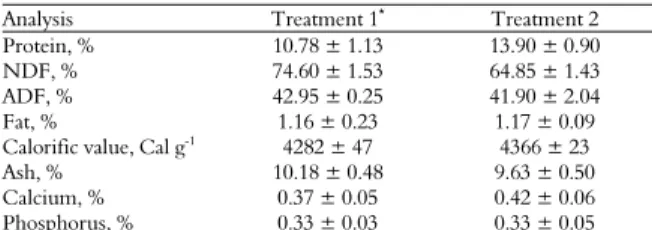
The diets evaluated were: 100% stargrass (C. plectostachyus) and 76% stargrass (C. plectostachyus) plus 24% Leucaena (L. leucocephala), mineralized salt and water were
available ad libitum, Table 1 shows the nutritional
composition of the diets. Adaptation to the diet comprised 10 days for each period.
Table 1. Nutritional composition of the diets offered in the four experimental periods.
Analysis Treatment 1* Treatment 2
Protein, % 10.78 ± 1.13 13.90 ± 0.90
NDF, % 74.60 ± 1.53 64.85 ± 1.43
ADF, % 42.95 ± 0.25 41.90 ± 2.04
Fat, % 1.16 ± 0.23 1.17 ± 0.09
Calorific value, Cal g-1
4282 ± 47 4366 ± 23
Ash, % 10.18 ± 0.48 9.63 ± 0.50
Calcium, % 0.37 ± 0.05 0.42 ± 0.06
Phosphorus, % 0.33 ± 0.03 0.33 ± 0.05
Leucaena and rumen microbial populations 137
Forages were harvested at a regrowth age of 45 days. The stargrass was harvested from different paddocks, with and without legumes, depending on treatment. Diet was provided in four daily meals offered at 8.00, 11.00 am, 2.30 and 6.00 pm. Dry matter intake (DMI) was determined as the difference between feed offered and rejected, which were weighed daily; nutrient intake was estimated by taking into account DMI and feed nutrient content.
Sampling of rumen contents
Samples of rumen contents were collected by a ruminal probe at the end of each experimental period (Martín et al., 2005) to analyze quantitatively microbial populations by real-time PCR (qPCR). Samples were stored at -20°C for subsequent lyophilization and total DNA extraction.
DNA extraction
Total DNA was extracted with methodology described by McSweeney et al. (2007) and DNA isolation was carried out with a modified method by Denman et al. (2007). Briefly, an aliquot (1·5 mL) from the preserved sample was placed in the 2 mL capacity screw-capped microcentrifuge tube containing 1 g of zirconium beads (1 mm; BioSpec Products, Inc., Roth, Karlsruhe, Germany). One milliliter of lysis buffer (2% SDS, 100 Tris-HCl, 5 EDTA, 200 mM-NaCl) was added and the tubes were placed in liquid nitrogen (-196°C) for 1 min. The sample tubes were then thawed at room temperature and vortexed for 2 min. The freeze–thawing step was repeated twice to enhance the efficiency of DNA extraction. Thereafter, the samples were incubated at 48°C for 10 min. and then
centrifuged at 14 000 g for 15 min. at 48°C. The
supernatants (0·3 mL in duplicate) were transferred to 1.5 mL-Eppendorf tubes and an equal volume of the glass milk (5 g silica in 30 mL guanidine isothio- cyanate (3M), pH 6·0-6·5) was added. The tubes were shaken gently for 5 min. to
allow DNA bonding. The glass milk suspension
was then centrifuged at 10 000 g for 1 min. and
then washed with aqueous cold ethanol (70:30,
ethanol:nanopore water, v v-1). DNA was finally
eluted with 100 mL of PCR grade water (Sigma) and stored at -20°C until analysis. The purity and concentration of DNA in the extracted sample was determined with a nanospectrophotometer A260/A280.
Quantitative analysis of populations by qPCR
Microbial DNA was amplified from total DNA with primers specific for each population. In the case of methanogens, the mrcA (methyl coenzyme-M reductase; Denman et al. (2007) gene was used, whereas 16S rRNA was employed
for total bacteria (McSweeney et al., 2007) and B.
fibrisolvens (Klieve et al., 2003), as described in Table 2.
The different microbial groups, such as total
bacteria, total methanogens and B. fibrisolvens,
were determined in the samples by SYBR green quantitative PCR assay. The PCR machine used was from Biorad (Hercules, CA, USA; iQ5 Real-Time PCR detection system) with a 96-well plate. The PCR conditions and primers for different communities used were from Denman et al. (2007) and Klieve et al. (2003) (Table 2). The reaction mixture (25 mL) comprised SYBR green mix (12.5 mL), primers (forward and reverse, 0.71 mL each), PCR grade water (8.58 mL) and template (2.5 mL). Total microbial rumen DNA
was diluted to a concentration of 20 ng mL-1
before use in the quantitative PCR assays. The assay was conducted with the following cycle conditions: one cycle at 50°C for 2 min. and at 95°C for 2 min. for initial denaturation; 40 cycles at 95°C for 15 s and at 60°C for 1 min. for primer annealing and product elongation. The dissociation curve analysis of PCR end products was performed with 71 cycles at 95°C for 1 min., followed by 60°C for 10 s. A negative blank (without the DNA template) was also run for each primer pair.
Table 2. Primer sequences used to quantify total bacteria, B. fibrisolvens and total methanogens by qPCR.
White Forward primer Reverse primer Amplicon Reference
Total Bacteria 5'CGGCAACGAGCGCAACCC3 ' 5'CCATTGTAGCACGTGTGTAGCC3 ' 130 bp Denman et al.
(2007)
Total methanogens 5'TTCGGTGGATCDCARAGRGC3 ' 5'GBARGTCGWAWCCGTAGAATCC3 ' 128 bp Denman et al.
(2007)
B. fibrisolvens 5'ACACACCGCCCGTCACA3 ' 5'TCCTTACGGTTGGGTCACAGA3 ' 90 bp Klieve et al. (2003)
Absolute quantification was carried out by generating calibration curves using serial dilutions
(20 to 0.0002 ng mL-1) of reference DNA, with the
equation:
log = SQmeans x C x DVS x P
where:
SQmeans is the average number of copies quantified during the amplification;
C is the DNA sample concentration;
DV is the dilution volume of extracted DNA; S is the quantity of DNA (ng) used in the analysis;
P is the amount (mg) of rumen contents used in the extraction.
Statistical Analysis
Experimental design corresponded to that of a crossover in which all animals received all treatments. The model is described as:
Yijk = μ + Ti + Vj + Pk + Eijk,
where:
μ is the overall mean;
Ti is the treatment effect, with i1 = 100%
stargrass; i2 = 76% stargrass, 24% Leucaena;
Vj is the effect of the jth experimental unit, with j
= 2 heifers per treatment;
Pk is the effect of the kth period, with k = 2
periods;
Eijk is the experimental error of the effect of time
and treatment.
Data were analyzed by analysis of variance (ANOVA). When significant differences between treatments were found, a comparison test of means was performed using the Tukey’s procedure at an alpha of 0.05, by SAS (2004) statistical package, version 9.2.
Results and discussion
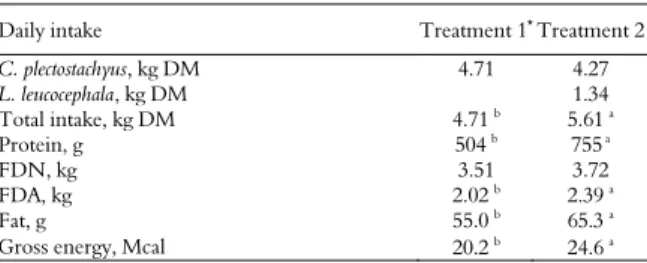
Dry matter intake (DMI, kg day-1) was 1.2 times
greater in the Leucaena diet than in the 100% stargrass diet (p < 0.05, Table 3). Specifically, the
average intake (kg per-1 day-1) was 23.68 and 18.98
for the leucaena and 100% stargrass diet, respectively (p < 0.05, data not shown).
Heifers consumed 1.5, 1.22 and 1.18 times more protein, energy and fat when fed on Leucaena diet
than when given 100% C. plectostachyus diet
(p < 0.05, Table 3). Although DMI was different, there were no differences in NDF intake between
the two diets, perhaps due to the low content of
NDF in L. leucocephala, reported to be around 32%
of DM (Cuartas et al., 2014).
Table 3. Intake of dry matter and nutrients by heifers fed on stargrass with and without L. leucocephala.
Daily intake Treatment 1* Treatment 2
C. plectostachyus,kg DM 4.71 4.27
L. leucocephala, kg DM 1.34
Total intake, kg DM 4.71 b 5.61 a
Protein, g 504 b 755a
FDN, kg 3.51 3.72
FDA, kg 2.02 b
2.39 a
Fat, g 55.0 b 65.3 a
Gross energy, Mcal 20.2 b
24.6 a
*Treatment 1 = 100% C. plectostachyus; Treatment 2 = 76% C. plectostachyus + 24% L. leucocephala a,b
. Means across rows with different letters are statistically different (p < 0.05).
Although not quantified in the current study, L.
leucocephala contains up to 10% of condensed tannins (Barahona et al., 2003), and this is relevant in terms of DMI, rumen fermentation and methane
emissions. Several in vitro studies have reported that
L.leucocephala is a substrate of high degradability but low gas production in proportion to the amount of
substrate degraded (Molina et al., 2013). During the
ruminal fermentation of the substrates, greater microbial biomass, more efficient microbial protein synthesis and lower VFA production are reported. They are actually factors that lead to greater DMI and reduced methane emissions (Blümmel et al., 1997; Molina et al., 2013).
Real-time PCR quantification of total bacteria,
total methanogens and B. fibrisolvens is shown in
Table 4. Microbial populations were not significantly affected by the dietary inclusion of
Leucaena, with 5.8, 3.5 and 5.3 ng DNA g-1 rumen
content for total bacteria, methanogens and B.
fibrisolvens, respectively.
Table 4. Microbial populations in rumen samples from heifers fed on stargrass with and without L. leucocephala.
Parameters evaluated Treatment 1*
Treatment 2 P value Total bacteria
Log [ng DNA g-1
CR] 5.6 5.8 0.53
B. fibrisolvens
Log [ng DNA g-1 CR] 3.66 3.57 0.47
Total methanogens Log [ng DNA g-1
CR] 5.01 5.35 0.27
*Treatment 1 = 100% C. plectostachyus; Treatment 2 = 76% C. plectostachyus + 24% L. leucocephala.
Leucaena and rumen microbial populations 139
Synergistes jonesii, a bacteria capable of degrading 3,4 dihydroxypyridine (3,4 DHP), a degradation product of the non-protein amino acid mimosine present in different leucaena species and resulting from the adaptation to leucaena intake (Hammond, 1995).
Our results are similar to those of Galindo et al.
(2008), who carried out in vitro incubations of
stargrass and leucaena in proportions similar to those evaluated in our study (100% and 70 stargrass: 30% legume). Using traditional quantification techniques, these authors did not report any changes in colony-forming units in the presence of Leucaena. Differences may arise from variances in the methods used for estimating the growth of rumen bacteria. In fact, it is one of the main reasons for increasing use and development of molecular markers tools for monitoring rumen microbial
populations (Tajima et al., 2001). Moreover, in vivo
experiments evaluating supplementation with pelleted Leucaena leaves at inclusion levels of 150,
300 and 450 g day-1 showed increased populations of
total bacteria and of cellulolytic species such as R.
albus, R. flavefaciens and F. succinogenes as supplement and DM intake increased (Hung et al., 2013).
The similarity of the populations of B.fibrisolvens
in the animals consuming the two diets is consistent with reports that this microbe grows well in forage or high fiber diets, but its growth is significantly reduced (up to 20 times less DNA was quantified by qPCR; Fernando et al. (2010) when soluble carbohydrates are added to the diet. Studies monitoring 16s rRNA has shown that the microorganism is polyphyletic with high metabolic variability (Forster et al., 1997). The metabolic
versatility of B. fibrisolvens has been reported for
proteolytic (Cotta & Hespell, 1986), cellulolytic (Krause & Russell, 1996) and biohydrogenation (McKain et al., 2010) activities, making it an organism of interest for the current work in which the inclusion of Leucaena affects the amount of structural carbohydrates and crude protein entering the rumen (Table 3). Biohydrogenation is not only associated with the production of precursors of linoleic acid in the rumen (McKain et al., 2010), but is also considered an alternative metabolic pathway for hydrogen produced during the fermentation and therefore, an efficient strategy to reduce ruminal
methanogenic activity (Alemu et al., 2011; Cieślak et
al., 2006).
As for the quantification of microorganisms, the amount of methanogens was not different when animals consumed Leucaena (Table 4). These data are consistent with previous studies that monitored
the total population of methanogens in high and low feed efficiency animals receiving diets with high and low energy content ((Zhou & Hernandez-Sanabria, 2010).
In a parallel investigation using closed chambers (poly-tunnel), it has been observed that, despite greater DMI with Leucaena, there was no increase in overall methane production. The animals emitted
less methane (liters of CH4 kg-1 DMI) when
consuming Leucaena versus 100% C. plectostachyus
diet 37.7 versus 43.5, respectively (com pers). It is evident that changes in methanogenesis cannot be explained solely by a reduction in the abundance of methanogens due to the diversity of this community in terms of composition and function, and different molecular tool should be used to monitor the other factors (Mosoni et al., 2011).
Previous reports have suggested that microbial
populations have a tendency to increase even if in
vivo methane emissions are reduced (Hook et al.,
2010), suggesting that the size of the population is not the sole factor associated with enteric methane production (Zhou & Hernandez-Sanabria, 2010). Methane emissions may be more influenced by metabolic activity and community composition of methanogens (McSweeney & Mackie, 2012). Likewise, if DMI increases simultaneously with crude protein intake, it may be expected that the degradation of the substrates and their rate of passage will increase with a decrease in methane production due to the dynamics of production and
utilization of CO2 and H2 in the rumen (Janssen,
2010).
In this experiment, no significant differences were observed in rumen pH in animals consuming both diets (p = 0.4641), as it was 7.02 for 100% stargrass diet and 7.12 for legume diet. They are within physiological limits, usually between 5.5 and 7.0 (Araujo & Vergara, 2007). Rumen pH is a function indicator in terms of concentration of volatile fatty acids (VFA), ammonia production and buffer capacity. Galindo et al. (2008) reported that pH increased as greater proportions of Leucaena were included to stargrass in the diet, which may be associated with the greater calcium content in Leucaena when compared to the grass (Table 1).
High nutrition forages, with rapid ruminal degradation, may lead to low rumen pH (Kolver & De Veth, 2002). According to Janssen (2010), rumen pH is associated with rates of passage, methane formation and rumen VFA proportions. Moreover,
both in vivo and in vitro, a high correlation has been
reported between the rumen’s pH and the acetic:
propionic acid ratio (R2 = 0.82) and ruminal
even in diets composed exclusively of forages, this rumen function parameter should be monitored. Increased pH in diets including Leucaena could be associated with greater ammonium concentrations and possibly with lower concentrations of VFA, a response consistent with increased dietary protein. The amphipathic nature of proteins may increase the rumen’s pH, explaining the slight increase of rumen pH observed in animals consuming Leucaena. The production of VFA and ammonia nitrogen was not determined in this study and future studies should monitor these two factors to obtain a better understanding of enteric methane production.
Conclusion
In the current study, the total number of bacteria
and methanogens, and the population of B.
fibrisolvens in terms of ng of DNA per gram of rumen contents were not affected by the introduction of Leucaena in the diet.
Since the animals in this experiment had been previously exposed to Leucaena, the microbial populations in these animals should have been stable. However, it would be advisable to perform another experiment with a slightly longer adaptation period or to ensure that all changes in microbial populations take place in the animals consuming
only C. plectostachyus. For future rumen
microbiological studies associated with the adoption of silvopastoral systems, it is recommended to investigate population changes of other bacterial species or of microbial groups such as anaerobic fungi and protozoa. Further, it would be desirable to employ methodologies that yield information on diversity (genomics, proteomics and metabolomics). Exploring the structure of rumen microbial populations and their metabolism through metagenomic methodologies is becoming more feasible and necessary to improve the integration of animal response to rumen microbial behavior.
Acknowledgements
The current study was funded by Colciencias and the Francisco José de Caldas Fund for Science, Technology and Innovation by the projects: “Nitrogen Usage by Colombian Creole Cattle Under Intensive silvopastoral systems with Leucaena leucocephala in Tropical Dry Forest” (Agreement 561 of 2011) executed by Cipav, the National University of Colombia, Medellín and Corpoica’s Center for
Biotechnology and Bioindustry and “Strengthening the
Centre for Research on Sustainable Farming Systems –
Cipav” (contract 0823-2013). The authors would
like to thanks the Molina Durán family and the “Natural Reserve El Hatico” for the cooperation received during the implementation of this project.
References
Abdalla, A. L., Louvandini, H., Sallam, S. M. A. H., Silva, I. C. B., Tsai, S. M. & Oliveira Figueira, A. V. (2012). In vitro evaluation, in vivo quantification, and microbial diversity studies of nutritional strategies for reducing enteric methane production. Tropical Animal Health and Production, 44(5), 953-964.
Alemu, A. W., Dijkstra, J., Bannink, A., France, J. & Kebreab, E. (2011). Rumen stoichiometric models and their contribution and challenges in predicting enteric methane production. Animal Feed Science and Technology, 166–167, 761-778.
Araujo, F. O. & Vergara, L. J. (2007). Propiedades físicas y químicas del rumen. Archivos Latinoamericanos de Producción Animales, 15(Supl 1), 34-38.
Barahona, R., Lascano, C. E., Narvaez, N., Owen, E., Morris, P. & Theodorou, M. K. (2003). In vitro degradability of mature and immature leaves of tropical forage legumes differing in condensed tannin and nonstarch polysaccharide content and composition. Journal of the Science of Food and Agriculture, 83(12), 1256-1266.
Blümmel, M., Steingas, H. & Becker, K. (1997). The relationship between in vitro gas production, in vitro microbial biomass and N-15 incorporation and its implications for the prediction of voluntary feed intake of roughages. British Journal Nutrition, 77, 911-921. Calle, Z., Murgueitio, E., Chará, J., Molina, C. H.,
Zuluaga, A. F. & Calle, A. (2013). A strategy for scaling-up Intensive Silvopastoral Systems in Colombia. Journal of Sustainable Forestry, 32(7), 677-693.
Chará, J. D., Girado, C., Zuliaga, A. F. & Murgueitio, E. (2011). Ganadería colombiana sostenible: Mainstreaming biodiversity in sustainable cattle ranching. Bogotá - Colômbia: Fundación - Cipavi.
Cieślak, A., Soliva, C. R., Potkański, A., Szumacher-Strabel, M., Scheeder, M. R. L. & Machmüller, A. (2006). Effect of plant oils on methane emission and biohydrogenation in vitro. Paper presented at the International Congress Series.
Cotta, M. A. & Hespell, R. B. (1986). Proteolytic activity of the ruminal bacterium Butyrivibrio fibrisolvens. Applied and Environmental Microbiology, 52(1), 51-58. Cuartas, C. A., Naranjo Ramírez, J. F., et al. (2014).
Contribution of intensive silvopastoral systems to animal performance and to adaptation and mitigation of climate change. Revista Colombiana de Ciencias Pecuarias, 27(2), 76-94.
Leucaena and rumen microbial populations 141
Espinal, L. S. (1992) Geografía ecológica de Antioquia. Zonas de vida. Medellín, Colombia: Universidad Nacional de Colombia, Facultad de Ciencias Agropecuarias. Fernando, S. C., Purvis, H. T., et al. (2010). Rumen
microbial population dynamics during adaptation to a high-grain diet. Applied and Environmental Microbiology, 76(22), 7482-7490.
Forster, R. J., Gong, J. & Teather, R. M. (1997). Group-specific 16S rRNA hybridization probes for determinative and community structure studies of Butyrivibrio fibrisolvens in the rumen. Applied and Environmental Microbiology, 63(4), 1256-1260.
Galindo, J., González, N., et al. (2008). Efecto modulador de Leucaena leucocephala sobre la microbiota ruminal Modulator effect of Leucaena leucocephala on the rumen microbiota. Zootecnia tropical, 26(3), 249-252. Garcia, G. W., Ferguson, T. U., Neckles, F. A. &
Archibald, K. A. E. (1996). The nutritive value and forage productivity of Leucaena leucocephala. Animal Feed Science and Technology, 60(1), 29-41.
Hammond, A. C. (1995). Leucaena toxicosis and its control in ruminants. Journal of Animal Science, 73(5), 1487-1492.
Hook, S. E., Wright, A. D. G. & McBride, B. W. (2010). Methanogens: methane producers of the rumen and mitigation strategies. Archaea, 2010(Article ID 945785), 11.
Huang, X. D., Liang, J. B., Tan, H. Y., Yahya, R. & Ho, Y. W. (2011). Effects of Leucaena condensed tannins of differing molecular weights on in vitro CH4 production. Animal Feed Science and Technology, 166, 373-376.
Hung, L. V., Wanapat, M. & Cherdthong, A. (2013). Effects of leucaena leaf pellet on bacterial diversity and microbial protein synthesis in swamp buffalo fed on rice straw. Livestock Science, 151(2), 188-197.
Janssen, P. H. (2010). Influence of hydrogen on rumen methane formation and fermentation balances through microbial growth kinetics and fermentation thermodynamics. Animal Feed Science and Technology, 160(1–2), 1-22. doi: http://dx.doi.org/10.1016/ j.anifeedsci.2010.07.002
Johnson, K. A. & Johnson, D. E. (1995). Methane emissions from cattle. Journal of Animal Science, 73(8), 2483-2492.
Kittelmann, S., Seedorf, H., et al. (2013). Simultaneous amplicon sequencing to explore co-occurrence patterns of bacterial, archaeal and eukaryotic microorganisms in rumen microbial communities. PLoS ONE, 8(2), e47879.
Klieve, A. V., Hennessy, D., Ouwerkerk, D., Forster, R. J., Mackie, R. I. & Attwood, G. T. (2003). Establishing populations of Megasphaera elsdenii YE 34 and Butyrivibrio fibrisolvens YE 44 in the rumen of cattle fed high grain diets. Journal of Applied Microbiology, 95(3), 621-630.
Kolver, E. S. & De Veth, M. J. (2002). Prediction of ruminal pH from pasture-based diets. Journal of Dairy Science, 85(5), 1255-1266.
Krause, D. O. & Russell, J. B. (1996). How many ruminal bacteria are there? Journal of Dairy Science, 79(8), 1467-1475.
Lana, R. P., Russell, J. B. & Van Amburgh, M. E. (1998). The role of pH in regulating ruminal methane and ammonia production. Journal of Animal Science, 76(8), 2190-2196.
Martín, E., Pérez, E., Cañon, S., Rodríguez, J. & Rodriguez, F. (2005). Sonda oro-ruminal experimental como alternativa para la obtención de microorganismos anaeróbicos del rumen. Revista CORPOICA Ciencia y Tecnología Agropecuaria, 6, 39-42. McKain, N., Shingfield, K. J. & Wallace, R. J. (2010).
Metabolism of conjugated linoleic acids and 18: 1 fatty acids by ruminal bacteria: products and mechanisms. Microbiology, 156(2), 579-588.
McSweeney, C. & Mackie, R. (2012). Micro-organisms and ruminant digestion: state of knowledge, trends and future prospects. Background study paper, (61). Roma. McSweeney, C. S., Denman, S. E., Wright, A. & Yu, Z.
(2007). Application of recent DNA/RNA-based techniques in rumen ecology. Asian-Australasian Journal of Animal Science, 20(2), 283.
Molina, B. I. C., Cantet, J. M., Montoya, S., Londoño, G. A. C. & Rosales, R. B. (2013). Producción de metano in vitro de dos gramíneas tropicales solas y mezcladas con Leucaena leucocephala o Gliricidia sepium. Revista CES Medicina Veterinaria y Zootecnia, 8(2), 15-31. Moreira, G. D., Lima, P. d. M. T., et al. (2013). Tropical
tanniniferous legumes used as an option to mitigate sheep enteric methane emission. Tropical Animal Health and Production, 45(3), 879-882.
Morgavi, D. P., Forano, E., Martin, C. & Newbold, C. J. (2010). Microbial ecosystem and methanogenesis in ruminants. Animal, 4(7), 1024-1036.
Mosoni, P., Martin, C., Forano, E. & Morgavi, D. P. (2011). Long-term defaunation increases the abundance of cellulolytic ruminococci and methanogens but does not affect the bacterial and methanogen diversity in the rumen of sheep. Journal of Animal Science, 89(3), 783-791.
Murgueitio, E., Calle, Z., Uribe, F., Calle, A. & Solorio, B. (2011). Native trees and shrubs for the productive rehabilitation of tropical cattle ranching lands. Forest Ecology and Management, 261(10), 1654-1663.
Naranjo, J. F., Cuartas, C. A., Murgueitio, E., Chará, J. & Barahona, R. (2012). Balance de gases de efecto invernadero en sistemas silvopastoriles intensivos con Leucaena leucocephala en Colombia. Livestock Research for Rural Development, 24(150), 15.
emissão de gás metano em bovinos. Revista Brasileira de Zootecnia, 37(8), 1509-1516.
SAS. (2004). SAS/STAT User guide, Version 9.1.2. Cary, NC, USA: SAS Institute Inc.
Tajima, K., Aminov, R. I., Nagamine, T., Matsui, H., Nakamura, M. & Benno, Y. (2001). Diet-dependent shifts in the bacterial population of the rumen revealed with real-time PCR. Applied and Environmental Microbiology, 67(6), 2766-2774.
Zhou, M. & Hernandez-Sanabria, E. (2010). Characterization of variation in rumen methanogenic communities under different dietary and host feed efficiency conditions, as
determined by PCR-denaturing gradient gel electrophoresis analysis. Applied and Environmental Microbiology, 76(12), 3776-3786.
Received onSeptember 2, 2014. Accepted on January 22, 2015.