Cite this: DOI: 10.1039/c7cc07549a
The antibacterial activity of polyoxometalates:
structures, antibiotic effects and future
perspectives†
Aleksandar Bijelic, aManuel Aureliano band Annette Rompel *a
Polyoxometalates (POMs) are, mostly anionic, metal oxide compounds that span a wide range of tunable physical and chemical features rendering them very interesting for biological purposes, an continuously emerging but little explored field. Due to their biological and biochemical effects, including antitumor, -viral and -bacterial properties, POMs and POM-based systems are considered as promising future metallodrugs. In this article, we focus on the antibacterial activity of POMs and their therapeutic potential in the battle against bacteria and their increasing resistance against pharmaceuticals. Recent advances in the synthesis of POMs are highlighted, with emphasis on the development and properties of biologically active POM-based hybrid and nanocomposite structures. By analysing the antibacterial activity and structure of POMs, putative mode of actions are provided, including potential targets for POM–protein interactions, and a structure–activity-relationship was established for a series of POMs against two bacteria, namely Helicobacter pylori and Streptococcus pneumoniae.
1. Introduction
Polyoxometalates (POMs) are a class of discrete, mostly anionic, clusters of early transition metal oxides (mostly Mo-, W- and V-oxides) exhibiting a broad diversity of structures and out-standing properties.1There are two major types of POMs, namely isopoly- and heteropolyoxoanions with the general formulas
aUniversita¨t Wien, Fakulta¨t fu¨r Chemie, Institut fu¨r Biophysikalische Chemie,
Althanstraße 14, 1090 Wien, Austria. E-mail: [email protected]; Web: http://www.bpc.univie.ac.at
bCCMar, FCT, Faculdade de Cieˆncias e Tecnologia, Universidade do Algarve,
8000-139 Faro, Portugal
†Electronic supplementary information (ESI) available: Additional MIC tables, additional compound figures and additional structure-relationship graphs. See DOI: 10.1039/c7cc07549a
Aleksandar Bijelic
Aleksandar Bijelic is currently a postdoctoral research fellow at the Department of Biophysical Chemistry at the University of Vienna (Austria). He received his master’s degree in Molecular Life Science in 2012 from the University of Erlangen (Germany) and a PhD in Chemistry from the University of Vienna in 2016 (Austria). His research interests include the X-ray structure analysis of diverse metalloenzymes and the investigation of polyoxometalate-mediated protein crystallization. In 2017 he received the Dissertationspreis from the Faculty of Chemistry of the University of Vienna (academic year: 2015/16).
Manuel Aureliano
Manuel Aureliano is an Associate Professor (with habilitation) of Biochemistry and he was Director of the Biochemistry degree at the University of Algarve, Faro, Portugal (1998–2013). Besides Biochemistry, he teaches disciplines related to Metallomics and Muscle Contraction. Till now, he was super-visor and/or co-supersuper-visor of several post-doc, PhD, MSc and under-graduate students (over 90), and has published about 80 peer-reviewed journal articles, reviews and book chapters. He is editor of the book ‘‘Vanadium Biochemistry’’, ResearchSignPost, 2007, Kerala, India. His research topics include (i) the role of decavanadate in biology; (ii) proteins as POM targets; (iii) vanadium and diabetes; (iv) antioxidants: toxic and/or beneficial effects. Received 27th September 2017, Accepted 2nd January 2018 DOI: 10.1039/c7cc07549a rsc.li/chemcomm
FEATURE ARTICLE
Open Access Article. Published on 12 January 2018. Downloaded on 22/01/2018 18:13:28.
This article is licensed under a
Creative Commons Attribution 3.0 Unported Licence.
View Article Online
[MmOy]n and [XxMmOy]n , respectively, where M represents the
addenda atom, which is mostly restricted to W, Mo and V, and X the central heteroatom, which can be almost any other element. A myriad of POM structures have been synthesized in the last decades and their broad variety of physicochemical properties led to their application in various fields such as catalysis,2photochemistry,3electrochemistry,4material science,5 protein crystallography6,7and medicine.8Biological applications of POMs are very promising as almost every feature that affects the interaction of POMs with biological target macromolecules can be altered in order to enhance their beneficial activities on the respective biological system.6,9With targeted and reprodu-cible synthetic routes, it is nowadays possible to obtain tailor-made POM systems, including organic–inorganic hybrids and other nanocomposites, with enhanced biological properties.10–17 The foundation for the research of biologically active POMs has been laid in 1970, when Chermann et al. discovered the inhibi-tory effect of silicotungstic acid on murine leukaemia and sarcoma viruses.18This led to systematic studies of the antiviral
effect of this and other POMs revealing that enzyme inhibition (e.g. inactivation of reverse transcriptase in the case of HIV) plays a major role for their activity.19–21 Further biological activities were consequently discovered: the insulin mimetic effect of POMs to combat diabetes;22–25anticancer23,26,27and antibiotic23,27,28 activities, and the antiparasitic potential of decavanadate against leishmania.29It is believed that in many cases these POM-associated biological activities are the result of POM–protein/POM–enzyme interactions, which are of electro-static nature as evidenced by crystallographic studies showing that the negatively charged metal clusters are mainly found within or at positively charged regions of the proteins.6,30–36 However, also covalent interactions between biomacromole-cules and POMs are possible as was shown by our group.35 The inhibition of certain enzymes by POMs can trigger the impairment of vital cell functions.37In this regard, the group of
Aureliano extensively studied the interaction between POMs, especially polyoxovanadates (POVs), and diverse biochemical targets like ion pumps.6,38–40However, the exact mode of the
biological activity of POMs is still elusive and thus also the POM’s target biomolecules, which are responsible for the observed biological effects. This article focuses on antibacterially active POMs as bacteria pose a threat to global public health, especially due to the rapid emergence of resistant bacteria occurring world-wide. Besides the activity of purely inorganic POMs, the anti-microbial potentials of POM-based hybrid and nanocomposite structures represent highlights of this article emphasizing the recent developments in the synthetic approach of POMs. Using our experience regarding POM–protein interactions, we tried to deduce structure–activity-relationships and potential targets to provide possible mode of actions for the antibacterial activity of POMs.
2. Antibacterial activity of
inorganic POMs
The antibacterial activity of purely inorganic POMs can be subdivided into two major modes, namely (1) synergistic and (2) direct antibacterial activity. Most of the inorganic POMs did not exhibit significant antibacterial activity at pharmacologi-cally acceptable concentrations but were active in synergy with conventional antibiotics.
2.1. Synergistic activity of inorganic POMs
As is often the case with discoveries, it was serendipity that the group of Tajima revealed the antibacterial properties of POMs in 1993.28Back then, they reported on an aged mixture of tungstate and phosphate named ‘Factor T’, which greatly enhanced the antibacterial effect of b-lactam antibiotics in methicillin-resistant Staphylococcus aureus (MRSA) strains, which is a Gram-positive bacteria and one of the most resistant ones around the world. Years later, namely in 1997, ‘Factor T’ was identified as the lacunary Keggin POM species [PW11O39]7 (Fig. 1F).41
[PW11O39]7 showed only synergistic effects with
b-lactam-based antibiotics and was only active on MRSA, Staphylococcus epidermis and Staphylococcus auricularis. Inspired by these findings, the same group investigated the antibacterial activity of b-lactam antibiotics in synergy with in total 76 POMs (Tables S1 and S2, ESI†).42–46Fig. 1 illustrates the most prominent POM structures that were used for these antibacterial studies. The results revealed that especially Keggin- (including lacunary, double and sandwich structures) and Wells–Dawson-type (including lacunary structures) structures were most potent in terms of sensitizing the MRSA strains SR3605 (constitutive resistance) and ATCC43300 (inducible resistance) towards b-lactam antibiotics. While almost all investigated polyoxotung-states (POTs) showed promising synergistic activity by exhibit-ing an average fractional inhibitory concentration (FIC) index of o0.5 (average FICPOTsB 0.141), the tested polyoxomolybdates
(POMos) and polyoxovanadates (POVs) did not exhibit any significant effect with the b-lactam antibiotic on neither MRSA Annette Rompel
Annette Rompel studied Chemistry at the Westfa¨lische Wilhelms University of Mu¨nster where she received her doctoral degree. Besides research at the University of California, Berkeley, and the Lawrence Berkeley National Laboratory, she was a visiting scientist at the RIKEN, Institute of Physical and Chemical Research, Sendai, Japan, and the University of Southern Denmark, Odense. Since 2008, she is the head of the Department of Biophysical Chemistry at the University of Vienna. Her main research interests are the structure/function elucidation of metal containing enzymes by synchrotron based techniques and the synthesis and characterization of bioactive polyoxometalates.
Open Access Article. Published on 12 January 2018. Downloaded on 22/01/2018 18:13:28.
This article is licensed under a
strain (average FICPOMos B 0.725 and FICPOVsB 0.740).42–45
Some POMs like the Wells–Dawson-type [P2W18O62]6 (Fig. 1D)
and the Keggin-type [SiMo12O40]4 (Fig. 1C) exhibited sensitizing
effects also against vancomycin-resistant Staphylococcus aureus (VRSA) strains, which is surprising for the latter POM as POMos were in general ineffective against MRSA.42,43 Some lacunary Keggin structures (Fig. 1F and G), especially tungstates, were more effective than their fully saturated parent structure sug-gesting a special role for the lacuna.44,45For example, the FIC of [SiW12O40]4 against the MRSA strain SR3605 is 0.094, whereas
the value for the corresponding lacunary structure [SiW11O39]8
is 0.041. However, a series of lacunary-substituted [SiW11O39]8
structures, where the lacuna was filled by VIVO, CrIII, MnII, FeII/III, CoII, NiII, CuII, LaIII, YbIIIor BiIII, had very similar or even stronger sensitizing effects than the unsubstituted species (e.g. FIC against MRS394-1 of [SiW11O39]8 = 0.041 vs. FIC of
[SiW11O39Co(II)]6 = 0.033) indicating that the hole in the
lacunary structure has no activity-enhancing effect.44,45 Further-more, there was no obvious correlation between the activity and the substituted metal.
It is known that the b-lactam resistance of bacteria is acquired by the expression of a peptidoglycan-synthetic enzyme that possesses a low affinity for b-lactam, namely the penicillin-binding-protein 2a (PBP2a), which is encoded by the mecA gene.47Yamase group demonstrated that POTs ([P2W18O62]6
and [PTi2W10O40]7 ) affect the transcription process of PBP2a
in MRSA.42,43,48Suppression of PBP2a formation inhibits the
resistance mechanism of MRSA and increases its susceptibility towards b-lactam antibiotics, which then interfere with the cell wall generation. POTs were also shown to reduce the produc-tion of b-lactamase, an antibiotic resistance-associated enzyme, which inactivates b-lactam antibiotics by hydrolyzing their b-lactam ring.43 Thus, POTs are able to overcome two kinds of bacterial resistance modes against b-lactam antibiotics.
Fig. 1 Overview of most prominent and commonly used POM structures. (A) Lindqvist, (B) Anderson-Evans, (C) Keggin, (D) Wells–Dawson, (E) decavanadate, (F) monolacunary Keggin, (G) trilacunary Keggin, (H) Keggin sandwich and (I) double Keggin structure are shown in polyhedra representation mode. X = heteroatom (ochre polyhedra), M = addenda atom (cyan polyhedra) and Y = other metal (dark blue octahedra and yellow ball, respectively). The scheme within the figure illustrates how the mono- and trilacunary Keggin structures are deduced from the fully saturated parent Keggin structure by subtracting one and three MO6octahedra, respectively, and the origin of the two large Keggin-structures (H) and (I). Vanadium atoms
are shown as grey octahedra, whereas oxygen atoms are illustrated as small red spheres.
Open Access Article. Published on 12 January 2018. Downloaded on 22/01/2018 18:13:28.
This article is licensed under a
The biological reduction of POMs, more precisely [P2W18O62]6 ,
in MRSA and VRSA cells was observed by dispersive X-ray analysis and transmission electron microscopy revealing the accumulation of POMs at the periphery of the bacterial cells.48
2.2. Direct antibiotic activity of inorganic POMs
2.2.1. Direct antibiotic activity against Gram-positive bacteria. Only a few POMs (Tables S1 and S2, ESI†), which were tested against different Staphylococcus aureus strains, showed significant antibacterial activity on their own accord by exhibiting a minimum inhibitory concentration (MIC) ofo100 mg ml 1(for comparison good antibiotic drugs have MIC values ranging from 0.001 to 10 mg ml 1). These POMs were [Ge2Ti6W18O77]14 43 (Fig. 1I)
(MIC = 50 mg ml 1vs. SR3605, 10–25 mg ml 1vs. ATCC43300), [V10O28]6 49 (Fig. 1E) (MIC = 50 mg ml 1 vs. SR3605) and
[Si2Nb6W18O77]8 43(Fig. 1I) (MIC = 25 mg ml 1vs. ATC43300).
Fukuda and Yamase tested the antibacterial activity of 20 purely inorganic POMs against six strains of Streptococcus pneumoniae (intermediate-resistant IID553, IID554 and penicillin-resistant BS225, BS234, BS259, BS269) without the use of any additional antibiotic (Table S3, ESI†).50All tested POVs showed
high antibacterial activities with MIC values in the range of 4–32 mg ml 1(positive control with conventional antibiotics: 2–32 mg ml 1), whereas the used POTs and POMos were signi-ficantly less active with MIC values ofB128–8000 mg ml 1. Two of the investigated POVs, [V4O12]4 and [MnV13O38]7 , were
subsequently tested against various other bacteria (MRSA, methicillin-susceptible Staphylococcus aureus, coagulase-negative staphylococci, Enterococcus faecalis, E. coli and Pseudomonas aeruginosa) and did not show any significant inhibitory activity at the investigated concentrations indicating that these POVs are selectively active against Streptococcus pneumoniae. The study also revealed that POVs, more precisely [V4O12]4 and
[V10O28]6 , did not only inhibit the incorporation of the
sub-strates thymidine, uridine, leucine and glucose into the cell in a non-selective manner but also induced potassium efflux from the cells indicating that the inhibitory activity of POVs against Streptococcus pneumoniae is partially based on their interference with the transport of substrates and ions.50
The group of Aureliano extensively investigated the effects of POVs on biologically relevant macromolecules such as ion pumps and therefore it is suggested that the interaction of certain POVs such as decavanadate [V10O28]6 with, for example,
P-type ATPases may induce the uncoupling of ATP hydrolysis and thus transforming these ion pumps into channels, which under certain circumstances can severely affect cellular ion gradients and concomitantly lead to the death of the organism.40,51This kind of ATPase inhibition was, among other inhibition mechanisms, also suggested for palytoxin, a marine toxin, which induces K+efflux upon exposition to Na+/K+-ATPase
by putatively uncoupling the ion pump and inducing the for-mation of channels.40,52–54Decavanadate was also observed to mediate cell distortions that led to concentration-depending morphological changes of the bacterial cells.50 Elongated bac-teria cells were observed at POV concentration less than MIC, whereas at a high concentration (100 mg ml 1) the cells became
swollen indicating cell death (bactericidal activity). Morphol-ogical changes can be ascribed, at least partially, to changes in cytoskeletal dynamics.55 Considering this, [V
10O28]6 was also
reported to affect the G-actin polymerization in animals39 as
POVs are able to interact with actin at its ATP binding site,56
which might also explain some POV-mediated effects in bacteria as their cytoskeleton possesses homologous elements to actin that control the bacterial shape such as MreB.57MreB is present in both Gram-positive and -negative bacteria and is involved in relevant cellular functions such as coordination of cell wall formation and chromosome segregation and therefore repre-sents a promising target.58
2.2.2. Direct antibiotic activity against Gram-negative bacteria. As late as 2005, the first study devoted to the antibacterial activity of POMs against a Gram-negative bacterium was pub-lished (Gram-negative bacteria possess a thinner peptidoglycan layer in comparison to Gram-positive ones but instead contain an additional membrane, namely the outer membrane).46 Yamase group tested 13 POMs on Helicobacter pylori (Table 3), which is usually found in the stomach and responsible for the majority of ulcers in the stomach and small intestine. Regard-ing the antibacterial effect of POMs, highly negatively charged POTs such as [KAs4W40O140]27 , [KSb9W21O86]18 , Keggin-type
POTs and polyoxovanadotungstates (Fig. 1) have shown promising antibacterial activity on their own accord (MICso 100 mg ml 1).46 The former large cryptate anion, [KAs4W40O140]27 , exhibited
the highest activity and was even more active than the antibiotic drug metronidazole (MTZ) against MTZ-susceptible Helicobacter pylori strains when comparing the MIC values in mM units (MICPOTB 1.4 mM vs. MICMTZB 2.9–23.4 mM). However, none of
the most active POTs, [KAs4W40O140]27 (MIC = 1.4 mM/16 mg ml 1),
[KSb9W21O86]18 (MIC = 2.3–9.0 mM/16–64 mg ml 1) and
[SiVW11O40]5 (MIC = 5.4–87.2 mM/16–256 mg ml 1), exhibited
synergistic effects with the antibiotics MTZ, amoxicillin and clarithromycin as indicated by FIC indices of 40.5. Further-more, it was shown that the investigated POTs are uptaken into the cells of the Gram-negative bacterium, more precisely, into the periplasmic space or the inner membrane but not into the cytoplasm, which was also shown for Gram-positive bacteria. The authors suggested that POM incorporation into Gram-negative cells is mediated by porins.46As was already the case for Gram-positive bacteria like MRSA, POMos exhibited only minor activity against the Gram-negative Helicobacter pylori (MIC values of 4256 mg ml 1/140–236 mM) which is most likely due to the lower chemical stability of molybdate in comparison to tungstate, demonstrating the importance of the stability of POMs for their biological activity.
Another example of directly exhibited antibacterial activity of POMs is the photocatalytic inactivation of Escherichia coli (Gram-negative) and Bacillus subtilis (Gram-positive) by the Keggin heteropolyacids H3PW12O40, H3PMo12O40 and H4SiW12O40.59
The investigated POMs showed also some antibacterial activity in the absence of UV-irradiation but to a much lesser extent than upon UV-excitation. The POM-mediated photocatalytic inactivation performances were superior to that of TiO2, which
is a known photocatalytic disinfectant. The concentration of
Open Access Article. Published on 12 January 2018. Downloaded on 22/01/2018 18:13:28.
This article is licensed under a
inactivated cells (e.g. Escherichia coli), after 20 minutes of UV-irradiation, was three orders of magnitude higher in the presence of 0.05 mM H3PMo12O40or 0.1 mM H4SiW12O40than
in the presence of 12.5 mM of the control TiO2, whereas in the
presence of 0.35 mM H3PW12O40 it was only one order of
magnitude higher. The antibacterial activity was ascribed to the oxidant power of the excited POMs as they were able to carry out the in situ alcohol dehydrogenation of methanol demon-strating their ability to exhibit damaging oxidation reactions within the cell, which, finally, could lead to cell death.
Table 1 summarizes the effects of the above described inorganic POM-types on all tested bacteria.
3. Antibacterial activity of POM-based
organic–inorganic hybrids
A major focus in the field of POMs lies on the synthesis of organic–inorganic hybrid structures, that is, the attachment of
organic moieties to the POM core. This expands the already rich structural and functional versatility of POMs and opens the door to further applications.10,13,16Organic functionalities are especially interesting for bioactive POMs as they do not only enhance the stability of the POMs in certain media but also their interaction with biologically important targets. In this way, the antibacterial properties of some POMs were drastically improved.
3.1. Organoantimony(III)-containing POTs
The groups around Kortz and Ullrich synthesized a series of organoantimony(III)-containing POTs and tested their
anti-bacterial activity on a variety of anti-bacterial strains. The first three reported organic–inorganic POM hybrids of this series were [(PhSbIII)4(A-a-GeIVW9O34)2]12 , [(PhSbIII)4(A-a-PVW9O34)2]10
and [{2-(Me2NCH2C6H4)SbIII}3(B-a-AsIIIW9O33)]3 (Ph = phenyl
group, Me = methyl group).61 All three hybrid POTs were stable in aqueous media at physiological pH and showed promising antibacterial activity against both Escherichia coli
Table 1 Overview of the effect of purely inorganic POMs on all tested bacteria
POM-type Synergistic effect ona Ref. No synergistic effect ona Ref. Antibacterially active on (alone) Ref. Antibacterially inactive on (alone) Ref. Polyoxotungstates: MR/VR S. aureus(+) 42–46 MR S. haemolyticus(+) 45 and 60 S. pneumoniae(+) 50 MR/VR S. aureus(+) 42–46
MR S. epidermis(+) 60 MR S. capitis(+) 45 and 60 (very low activity) MR S. epidermis(+) 43 and 60 MR S. auricularis(+) 60 MR S. caprae(+) 45 and 60 B. subtilis(+)b 59 MR S. auricularis(+) 60
MS S. haemolyticus(+) 60 MR S. saprolyticus(+) 45 and 60 DS H. pylori( )c 46 MS S. haemolyticus(+) 45 and 60 MZR H. pylori( ) 46 MR S. sciuri(+) 45 and 60 MZR H. pylori( )c 46 MR S. haemolyticus(+) 45 and 60
CLR H. pylori( ) 46 PR S. pneumoniae(+) 50 CLR H. pylori( )c 46 MR S. capitis(+) 60 PR E. faecalis(+) 60 E. coli( )b 59 MR S. caprae(+) 60
PR E. coli( ) 60 MR S. saprolyticus(+) 60 PR E. cloacae( ) 60 MR S. sciuri(+) 60 PR P. aeruginosa( ) 60 PR S. pneumoniae(+) 60 BLR S. marcescens( ) 60 PR E. faecalis(+) 60 CPR K. pneumoniae( ) 60 PR E. coli( ) 60 PR E. cloacae( ) 60 PR P. aeruginosa( ) 60 BLR S. marcescens( ) 60 CPR K. pneumoniae( ) 60 Polyoxomolybdates: MR/VR S. aureus(+) (only [SiMo12O40]4 ) 42–46 MR/VR S. aureus(+) (except [SiMo12O40]4 ) 42–46 S. pneumoniae(+)
(very low activity)
50 MR/VR S. aureus(+) 42–46
DS H. pylori( )
(very low activity) 46 MZR H. pylori( ) (very low activity)
46 CLR H. pylori( ) (very low activity)
46
Polyoxovanadates: MR/VR S. aureus(+) 42, 43
and 50
MR/VR S. aureus(+) 42–46 PR S. pneumoniae(+) 50 MR/VR S. aureus(+)
(except [V10O28]6 ) 42, 43 and 50 MR S. aureus(+) (only [V10O28]6 ) 49 CoN Staphylococci(+) 50 PR E. faecalis(+) 50 E. coli( ) 50 P. aeruginosa( ) 60
aPOM used in combination with an antibiotic drug (b-lactam antibiotics).bAntibacterial activity of POTs against E. coli and B. subtilis via
photocatalytic inactivation (see text).cOnly Keggin and huge and highly charged POTs ([KAs
4W40O140]27 and [KSb9W21O86]18 , see text) were
antibacterially active against H. pylori strains. (+)/( ) indicate Gram-positive and -negative bacteria, respectively. MR = methicillin resistant, VR = vancomycin-resistant, MZR = metronidazole-resistant, CLR = clarithromycin-resistant, PR = penicillin-resistant, BLR = b-lactam-resistant (in general), CPR = carbapenem-resistant, DS = drug-susceptible, CoN = coagulase negative. Note that for bacteria lacking a resistance label there was either no further information in the respective publication or a normal drug-susceptible bacterium was used. For more information regarding the exact POM-type, please see Table 3 and Tables S1–S4 (ESI).
Open Access Article. Published on 12 January 2018. Downloaded on 22/01/2018 18:13:28.
This article is licensed under a
and Bacillus subtilis (MIC values ranging from 40–130 mg ml 1) with the latter Gram-positive bacterium being slightly more sensi-tive to the POTs. [{2-(Me2NCH2C6H4)SbIII}3(B-a-AsIIIW9O33)]3
(MIC = 130 mg ml 1 against E. coli and 60 mg ml 1 against
B. subtilis) was slightly less active than the other two com-pounds, whereas [(PhSbIII)
4(A-a-GeIVW9O34)2]12 (MIC = 80 and
40–80 mg ml 1) was more active than [(PhSbIII)4(A-a-PVW9O34)2]10
(MIC = 110 and 50 mg ml 1) indicating the importance of both the structure (bulkiness of the organic moiety) and the negative charge for the biological activity (Table S4, ESI†). In 2015, the same groups synthesized and investigated three further organoantimony(III)-based POTs, namely the tungstoarsenates
[(PhSbIII){Na(H2O)}AsIII2W19O67(H2O)]11 , [(PhSbIII)2AsIII2W19
-O67(H2O)]10 and [(PhSbIII)3(B-a-AsIIIW9O33)2]12 .62 These
iso-structural compounds differed in the number of the incor-porated {PhSbIII} group. The compounds were tested on six different bacterial strains (three positive and three Gram-negative) and exhibited activity against all of them (MIC values of 7.8–500 mg ml 1) (Table S4, ESI†). With increasing number of
attached {PhSbIII} groups the antibacterial activity of the POT
was also enhanced revealing the importance of this organic group for the biological effectiveness (Fig. 2). This was the first unambiguous structure–activity relationship for antibacterially active POMs showing the possibility to fine-tune or synthesize tailor-made hybrid POMs with enhanced bioactivity. The activity dependency on the organic moiety {PhSbIII} was later confirmed when the hybrid compound [(PhSbIII)4(A-a-AsVW9O34)2]10 was
compared with [(OHSbIII)4(A-a-AsVW9O34)2]10 , which bears
hydroxyl groups in the structure instead of phenyl groups.63 Antibacterial tests revealed that the hybrid POT containing the organic {PhSbIII} groups was 4–7 times more active than its inorganic counterpart proving that the organic group is respon-sible for the improved antibacterial activity (MIC value range of 7.8–62.5 vs. 125–1000 mg ml 1).61–63
Another related study was testing the influence of changes within the organic group of the hybrid POTs on their anti-bacterial activity.64 For this reason, three organic–inorganic
hybrid structures were synthesized similar to those mentioned before but with Me2NCH2-derivatized {PhSbIII} groups. These
hybrids were significantly less active than their non-derivatized counterparts (MIC values of 250–1000 mg ml 1). Even slight
changes within the organic {PhSbIII} group had led to dramatic
changes in the bioactivity of the hybrid POT suggesting that both the number and kind of the organic group is a crucial key factor for the bioactivity (addition of a Me2HN+CH2group to the
{PhSbIII} unit doubles the MIC value). The hybridization enhanced the stability of the POTs (at physiological conditions) and their antibacterial activity due to the insertion of hydro-phobic properties into the POT core, which might assist the POT in interfering with the peptidoglycan production of the bacterial cells.
3.2. Quinolone-based antibiotic–POM hybrids
An organic–inorganic antibacterial hybrid complex consisting of the Keggin POT [HSiW12O40]3 , cobalt (II) cation and the
clini-cally approved antibacterial agent gatifloxacin (C19FH22N3O4),
[CoII(C
19FH22N3O4)3][C19FH23N3O4][HSiW12O40] (Fig. 3), showed
activity against Staphylococcus aureus and Escherichia coli (MIC = 2.52 and 2.42 mg ml 1, respectively).65 This unusual complex was slightly less active than free gatifloxacin against Escherichia coli when applied at the same mass concentration (MICHybrid-POT= 2.42 mg ml 1vs. MICgatifloxacin= 1.28 mg ml 1).
However, when used at the same molar concentration, the hybrid-complex showed the highest antibacterial activity in this study indicating synergy between the drug and [HSiW12O40]3
(MICHybrid-POT = 0.726 mg ml 1). The pristine [HSiW12O40]3
alone was not active at all.
Another bioactive organic–inorganic hybrid structure consisting of a POM and a quinolone-based antibiotic is {[Zn(HPPA)2H2O]2[H2ZnW12O40]} (HPPA = pipemidic acid).66
This POM–drug hybrid exhibits a quadruple-stranded helical structure (Fig. 4). Its antibacterial activity against Staphylococcus aureus and Escherichia coli (judged by the size of the inhibition zone on agar plates) is similar to those of the sole antibiotic
Fig. 2 Structure–function-relationship of organoantimony(III)-containing POTs. (A) [(PhSbIII)
4(A-a-AsVW9O34)2],10–61(B) [(PhSbIII)3(B-a-AsIIIW9O33)2]12 ,62
(C) [(PhSbIII)2AsIII2W19O67(H2O)]10 62and (D) [(PhSbIII){Na(H2O)}AsIII2W19O67(H2O)]11 62are illustrated in the polyhedra representation mode, whereas the
organic moiety is shown as sticks. The figure shows that with increasing number of attached (PhSbIII) units the antibacterial activity of the hybrid is increased, which is indicated by the MIC values in mg ml 1(numbers in small boxes) against Escherichia coli. The red arrow in (B) indicates the location of the third (PhSbIII) unit as it points toward the background. Color code: tungsten, blue polyhedra; antimony, deep purple; arsenic, magenta; sodium, green (sphere); carbon, green (sticks) and oxygen, red.
Open Access Article. Published on 12 January 2018. Downloaded on 22/01/2018 18:13:28.
This article is licensed under a
HPPA and therefore the activity might be attributed to HPPA due to the lack of unambiguous synergy.
The hybrid compound (C9H8N)3[NbW5O19] showed bio-activity
against Escherichia coli, Salmonella typhimurium (Gram-negative),
Streptococcus agalactiae (Gram-positive) and Lactobacillus acido-philus (Gram-positive) according to the size of the inhibition zones of bacterial growth.67 The complex is based on the
Nb-substituted Lindqvist POT [NbW5O19]3 , which is
coordi-nated to three quinolinium cations via hydrogen bonds and stabilized by p–p stacking interactions (Fig. S1, ESI†). Besides the quinoline, of which derivatives are known to be antimicro-bially active, the Nb-substituted POT itself exhibited also good antibacterial activity but much lower than that of the hybrid structure. Thus, the synergistic effect of both compounds led to the high antibacterial activity of the hybrid complex, which was suggested to be based on the electrostatic/Coulombic inter-actions between charged ions (e.g. quinolinium cations) and the charged bacterial cell wall and on the presence of both proton donor and acceptor groups within the hybrid facilitating the reactions with the cell membrane and/or bacterial compounds.
4. Antibacterial activity of POM-based
nanocomposites
Hybrid nanocomposites are of great interest for the pharmaco-logical and medicinal fields as nanocomposite-based drug delivery systems are very promising for targeted therapies due to the possibility to deliver therapeutic agents with improved properties to their destination while minimizing adverse effects.68,69Since the constituents of nanocomposites are usually very different in their structural, physical and chemical properties, their combination and synergy offers an extraordinary versatility in their function and bioactivity. The associated nanosize-effect increases the surface of the reactive and/or bioactive compound and thus enlarges the interaction area with the target.70Furthermore, the embedding of POMs into nanocomposites reduces their toxicity.44 POMs have been shown to be ideal building blocks for nanocomposites due to their unique range of properties and their ability to form clusters of different sizes ranging from several angstroms up to the nanometer scale.
4.1. Chitosan–POM nanocomposites
One well-studied nanocomposite system is that of POM and chitosan (CT).71 CT is a linear polysaccharide, which results from the partial N-deacetylation of the biopolymer chitin, and consists of randomly distributed b-(1-4)-linkedD-glucosamine
and N-acetyl-D-glucosamine. In 1992, Draget et al. reported on
the first POM–CT gels, where CT was crosslinked with Mo(VI)
polyoxyanions, however, the exact POMo species was not deter-mined as the gel was in situ formed by addition of solid MoO3.72
Later studies revealed that POM-loaded chitosan dramatically enhances the uptake of POMs into the target cells. For example, the deposition of [PTi2W10O40]7 in the human cell lines FaDu
(squamous carcinoma) and HT-29 (colon adenocarcinoma) was increased by up to 16- and 24-fold (according to the amount of tungsten in the cell), respectively, via chitosan-loading and the cytotoxicity was remarkably reduced.73 In 2006, Chen et al. showed that a CT-Ca3V10O28 complex exhibited strong
anti-bacterial activity against both Gram-negative and -positive
Fig. 3 Structure of [CoII(C19FH22N3O4)3][C19FH23N3O4][HSiW12O40].65
(A) Structure of the organic–inorganic hybrid is shown, with the POM [HSiW12O40]3 being represented as polyhedra and the organic drug as ball
and stick. Color code: tungsten, blue polyhedra; silicon, orange tetrahedron; cobalt, pink (sphere connecting three gatifloxacin molecules); carbon, green; nitrogen, dark blue; fluorine, light blue; oxygen, red. (B) Structural formula of gatifloxacin is depicted to provide a better understanding of (A).
Fig. 4 Structure of {[Zn(HPPA)2H2O]2[H2ZnW12O40]}.66 (A) Structure of
the organic–inorganic hybrid is shown, with the POM [H2ZnW12O40]4
being represented as polyhedra and the organic drug as ball and stick. Color code: tungsten, blue polyhedra; zinc as a heteroatom, purple tetrahedron; zinc as a linker, black; carbon, green; nitrogen, dark blue; oxygen, red. (B) Structural formula of pipemidic acid is depicted to provide a better understanding of (A). (C) The left- (a) and right- (e) hand helical chains, the left- (b) and right- (d) double-stranded helical chain and the final quadruple-stranded helices (c) are shown in both ball and stick and space-filling representation. (C) Is reprinted from Li et al. (2014)66with permission from the copyright holder (Elsevier).
Open Access Article. Published on 12 January 2018. Downloaded on 22/01/2018 18:13:28.
This article is licensed under a
bacteria (MIC value of 12.5 mg ml 1for both Escherichia coli and Staphylococcus aureus).49 The CT-Ca3V10O28 exhibited
anti-bacterial activity was comparable to that of the antibiotic potassium G penicillin (MIC = 12.5 mg ml 1) and even higher
than that of ofloxacin (MIC = 25 mg ml 1). Both CT and
[V10O28]6 showed also antibacterial performance on their
own accord which, however, was much lower than that of the nanocomposite (MICCT= 500 mg ml 1and MICPOV= 50 mg ml 1)
(Table S4, ESI†). The antibacterial activity of CT is well known and two mechanisms have been suggested as the cause of their inhibitory effect:74 (1) CT as a polycation interacts with the negatively charged bacterial cell wall and in this way electro-statically disrupts the cell envelope and leads to the leakage of intracellular substances. (2) Low-molecular-weight CT is able to penetrate into the cell and inhibits the transcription of RNA from DNA by directly interacting with DNA molecules. However, the mechanism behind the antibacterial activity of both dec-avanadate [V10O28]6 and the nanocomposite is not known but
it is considered, as already mentioned earlier (Section 2.2.1), to be based on the inhibition of ion pumps (e.g. Na+/K+ATPase).40
Also multilayer films consisting of the Keggin-type structures, [SiW12O40]4 and [PMo12O40]3 , and CT have been prepared
and showed antibacterial activity against Escherichia coli.75 Further CT–POM nanocomposites like that between CT and the redox-active [PMo12O40]3 (active against Escherichia coli)
confirmed the antibacterial potential of this complex group. Fiorani et al. tested several nanocomposites derived from low-molecular weight CTs and different POM-types, namely deca-vanadate [V10O28]6 , the phosphovanadomolybdic Keggin-structure
[PMo10V2O40]5 and decatungstate [W10O32]4 , regarding their
antibacterial activity against Escherichia coli and their surface charge.76 All nanocomposites were antibacterially active in a dose-dependent manner, whereby systems exhibiting an in total more positively charge (CT-[PMo10V2O40]5 and CT-[W10O32]4 )
were more active than less positively charged systems (CT-[V10O28]6 ). This suggests, in this case, a direct correlation
between the activity and the z-potential (surface charge) of the nanocomposites as those bearing a more positive charge were able to completely inhibit the bacterial growth (at a concen-tration of 0.6 mg ml 1) and induce morphological changes of the cells. Furthermore, the activity of CT-based complexes depends on a series of factors like average molecular weight of CT, type of the crosslinking agent, average nanocomposite size and as already stated the surface charge of the nanoparticle. Another CT–POM nanocomposite study explored the difference in the antibacterial activity between a POT ([PW12O40]3 ) and a POMo
([PMo12O40]3 ) based spherical nanohybrid capsule.77 In
contrast to the aforementioned CT–POM nanocomposites, where the POM was added to a pre-processed CT-containing solution, these structures were synthesized by a micelle-based approach as the surfactant cetyltrimethylammonium bromide (CTAB) was used as a cationic nucleating agent leading to CT–CTAB–POM capsules (Fig. 5). The POMo-containing capsule showed signi-ficant antibacterial activity against Escherichia coli according to the resazurin viability assay,78 (cell viability was reduced by B85% with 50 mg ml 1 of the POMo-capsule), whereas the
corresponding POT-containing structure showed no activity. The reason for this discrepancy was attributed to the different shape of the nanocomposites as the POMo-based capsules were more spherical and tended to form capsules of smaller size (100–200 nm) in comparison to the POT-based systems (200–300 nm). The smaller size and the more spherical shape might facilitate the internalization and/or direct contact of the CT–CTAB–POMo capsules with the bacterial cell (wall).
4.2. POM-based silver and gold nanoparticles
For millennia, ionic silver (Ag+) has been used as a disinfectant due to its antimicrobial properties. However, it was not until the turn of the millennium that comprehensive research on the antibacterial action of silver nanoparticles (AgNPs) was done revealing their promising activity against a broad range of microbes with little systemic toxicity towards human and mammalian cells.79 Silver is believed to electrostatically inter-act with the binter-acterial membrane, which results in the destabi-lization and/or destruction of the cell wall and interference with the bacterial respiratory chain.80Therefore, the production of
such AgNPs in conjunction with POMs were considered pro-mising as both compounds are bioactive and could lead to an enhanced activity. Indeed, multifunctional films consisting of [BW12O40]5 and AgNPs exhibited antibacterial activity against
Escherichia coli as agar plates incubated with the bacterium and the film did not produce bacterial colonies.81 On the other hand, the POT alone showed hardly any antibacterial activity indicating the necessity of the AgNPs within the film. Antibacterial tests of AgNPs, which were surface-modified by the Keggin-type POMs H3PW12O40and H3PMo12O40, showed enhanced physical
damage to both Gram-negative (Escherichia coli) and -positive (Staphylococcus albus) cells compared to the unmodified AgNPs.82 At a fixed Ag+ concentration of 1 mM, the AgNPs
caused 36% cell death in Escherichia coli, which increased to 66% and 85% in the case of the AgNPs–H3PW12O40 and the
Ag-NPs–H3PMo12O40system, respectively, whereas both pristine
POMs did not show antibacterial activity. Similar observations were made in the case of Staphylococcus albus but to a lesser extent indicating a lower antibacterial activity against Gram-positive bacteria (31%, 49% and 57% bacterial cell death, respectively).
Fig. 5 Scheme of the chitosan–cetyltrimethylammonium bromide–POM capsule.77POM = [PW
12O40]3 or [PMo12O40]3 , CTAB =
cetyltrimethyl-ammonium bromide and CT = chitosan.
Open Access Article. Published on 12 January 2018. Downloaded on 22/01/2018 18:13:28.
This article is licensed under a
The antibiotic activity of Ag+seems to potentiate the action of the investigated POMs as their synergy led to a remarkable increase in activity. It is suggested that these POMs are stabi-lized and transported into the bacterial cells by the AgNPs as Ag+is able to disrupt the cell wall under the production of high
concentration of reactive oxygen species (ROS). Furthermore, the nanoparticles did not exhibit toxicity against human cells (tested on the human prostate cancer cell line PC3).
The same two POMs, H3PW12O40and H3PMo12O40, exhibited
similar effects with gold nanoparticles (AuNPs) against Escher-ichia coli, although AuNPs are normally biocompatible with this bacterium.83Surface functionalization of the AuNPs with POMs turned them into strong antibacterially active agents as bacterial cell death was increased from 7% to 43% in the case of H3PW12O40 and to 49% in the case of H3PMo12O40. The
anti-bacterial activity was even further enhanced by modification of the AuNP–POM systems with cationic lysine leading to cell death rates of 75% (POT) and 96% (POMo), respectively. In contrast to the AgNP systems, POMo functionalized AuNPs showed higher bioactivity than the corresponding POT-functionalized particles due to a higher contentment of both gold and lysine in the former system. The significant improve-ment in activity by lysine modification can be attributed to its cationic nature, which most likely guides the nanomaterial towards the negatively charged cell walls and thus increases the interaction rate between the material and the bacterial cells. The same experiment against Gram-positive bacteria was not undertaken as the unmodified AuNPs were already too active on Staphylococcus albus leading to almost complete bacterial cell death.83
4.3. Amino acid–/peptide–POM nanocomposites
Compounds having amino acid and/or peptide moieties are known to possess biological and pharmacological activities, among them also antibacterial activity.84Therefore, the
asso-ciation between amino acids/peptides and POMs is a good strategy to improve their antibacterial properties. Three nano-rod-amino acid phosphomolybdates, (HGly)3[PMo12O40](Gly)9
(Gly = glycine), (HLys)9[PMo12O40](Lys)4 (Lys = lysine) and
(HHis)3[PMo12O40](His)3(His = histidine), were reported to have
remarkable antibacterial activity against Escherichia coli as they produced inhibition zones ofB1.2–1.3 cm on solid growth agar plates.85 The Keggin POM and the amino acids themselves had only very weak antibacterial activity (inhibition zone of B0–0.7 cm) indicating a significant synergy effect, which could be mainly attributed to the nano-size effect rather than to e.g. electrostatic aspects as all three compounds were similarly active independent of the used amino acids. Li et al. demon-strated the POM-driven ([SiW12O40]4 ) self-assembly of short
peptides into multivalent nanofibers (Fig. 6).86The nanofibers
exhibited high surface areas and concentrated positive charges, which resulted in antibacterial activity against Escherichia coli (MIC = 60 mM). The constituents themselves had only poor activity. The bacterial growth inhibiting effect was suggested to be based on the electrostatic binding of the cationic peptides to the cell membrane, on which surface the peptides are
accumulated before they enter the cell in order to induce cell lysis. However, it cannot be excluded that in this case the role of the POM was solely the initiation of the self-assembly of the nanofibers and the subsequent stabilization of the suprastruc-ture with no direct antibacterial contribution.
4.4. Other POM-based nanocomposites
Nanohybrid membranes consisting of the Keggin POM H5PV2Mo12O40and poly(vinylalcohol)/polyethylenimine (PVA/PEI)
exhibited antibacterial activity against the Gram-positive bacteria Staphylococcus aureus and Bacillus subtilis and the Gram-negative Escherichia coli and Pseudomonas aeruginosa.87 The bioactivity increased with increasing H5PV2Mo12O40content
within the PVA/PEI membrane exhibiting MIC values in the range of 0.02–2 mg ml 1for the Gram-positive and 0.2–2 mg ml 1for the Gram-negative bacteria (Table S4, ESI†). Another promising nanocomposite system is that of the same Keggin structure H5PV2Mo12O40 and bamboo charcoal (BC).88 BC is a kind of
carbon-based material and one of the most used adsorbents in extraction studies. The POM–BC system was strongly active against seven bacterial strains, including both Gram-positive and -negative strains, in a POMo-concentration dependent manner (Table S4, ESI†). The nanocomposite with the highest POMo content (weight ratio of BC : POMo = 1 : 3) exhibited a MIC of 4 mg ml 1 against all tested bacteria. Even antibiotic
resistant strains like the ciprofloxacin-resistant strain of Pseudomonas aeruginosa (CRPA) were inhibited and at higher composite concentrations (16 mg ml 1of the most highly POMo-loaded composite) even completely killed as evidenced by morphological changes of the respective bacteria. Very recently, a series of compounds composed of POM and phosphonium
Fig. 6 Structure of the peptide–POM nanocomposite.86(a) Structure of the cationic peptides L1–L7, which were used in the study. (b) Ionic self-assembly of peptide L1 and H4SiW12O40. The figure is reprinted from
Li et al. (2016)86with permission from the copyright holder (Wiley).
Open Access Article. Published on 12 January 2018. Downloaded on 22/01/2018 18:13:28.
This article is licensed under a
groups (MePh3P) showed also antibacterial activity against both
Staphylococcus aureus and Escherichia coli, which was even stronger than that of the antibiotic ampicillin as judged by the size of the inhibitory zones on agar plates.89The (MePh
3P)n–POM
systems (n = 3 or 4) are based on the Keggin-type POMs [SiW12O40]4 , [PW12O40]3 or [PMo12O40]3 and the quaternary
phosphonium salt methyl triphenyl phosphonium iodide (MePhPI). It was described that the antibacterial activity increased with increasing content of crystal water within the structures. This was attributed to the hydrophilic affinity between the compounds and the bacterial cell wall as the latter contains hydrophilic constituents. However, the main factor for the antibacterial activity of these compounds was the increase of the positive charge of the phosphonium cations due to the POM-induced polarization, which increases the electrostatic force between the compounds and the bacterial cell membrane.
Multilayer films based on the Keggin POMs [SiW12O40]4
and [PMo12O40]3 and the dye methylene blue were reported to
be active against Escherichia coli.90 Methylene blue as being
involved in the electron transport of different biological pro-cesses is a natural antibiotic and is used in the photodynamic therapy of bacteria, fungi, viruses and cancer.91 However, a control experiment with a PEI-film containing only methylene blue exhibited negligible activity and therefore the antibacterial activity of the methylene blue/POMo film could be, at least partially, ascribed to the Keggin-POMo suggesting some kind of synergy. A similar study with a layer-by-layer film of [H4PV6Mo6O40]5 and methyl violet, which is a strong
bacteri-cide, showed the same result as in the case of methyl blue as only the POM–dye hybrid film performed antibacterial
activity against Escherichia coli, whereas the control film lacking POM did not.92
Very recently, the antibacterial potential of POM-ionic liquids (POM-ILs) were reported.93,94The studied POM-ILs were
composed of the lacunary Keggin-POT [SiW11O39]8 (Fig. 1F)
and three antimicrobial tetraalkylammonium cations differing in their alkyl chain length. All three POM-ILs were active against the tested bacteria, namely Staphylococcus aureus, Pseudomonas aeruginosa and Escherichia coli, whereby Staphylococcus aureus was particularly sensitive to the POM-ILs. The antibacterial activity of these nanocomposites somehow correlated with the alkyl chain length of the cations as POM-ILs bearing cations with C7 and C8 alkyl chains (MIC values of 2–100 mg ml 1) were significantly more active than their counterparts posses-sing C6 chained cations (MIC values of 10–1000 mg ml 1) (Table S4, ESI†).
The effects of the above described POM-hybrid and nano-structure on all tested bacteria are summarized in Table 2.
5. Structure–activity-relationship of
antibacterially active POMs and their
putative mechanisms
5.1. Structure–activity-relationship
In total 74 inorganic POMs were tested on the MRSA strains SR3605 and ATCC43300 (Table S1, ESI†), where only seven compounds showed considerable antibacterial activity by them-selves (MIC up to 100 mg ml 1). The most effective ones were double Keggin, Keggin-type and Wells–Dawson-type structures.
Table 2 Overview of the effect of POM-based hybrids and nanocomposites on all tested bacteria
POM-hybrid/nanocomposite Antibacterial active on Ref. POM-hybrid/nanocomposite Antibacterial active on Ref. Organoantimony-polyoxotungstates: B. subtilis(+) 61–64 PVA/PEI–POM: S. aureus(+) 87
C. michiganensis(+) 62–64 B. subtilis(+) 87
Paenibacillus sp.(+) 62–64 E. coli( ) 87
E. coli( ) 61–64 P. aeruginosa( ) 87
P. putida( ) 62–64
Vibrio sp.( ) 62–64 Peptide–POM: E. coli( ) 85 and 86
Gatifloxacin–POM: S. aureus(+) 65 Bamboo charcoal–POM: S. aureus(+) 88
E. coli( ) 65 MR S. aureus(+) 88
B. subtilis(+) 88
Zn–pipemidic acid–Zn–POM: S. aureus(+) 66 E. coli( ) 88
E. coli( ) 66 P. aeruginosa( ) 88 CR P. aeruginosa( ) 88 (C9H8N)3[NbW5O19]: S. agalactiae(+) 67 L. acidophilus(+) 67 MePh 3P–POMs: S. aureus(+) 89 E. coli( ) 67 E. coli( ) 89 S. typhimurium( ) 67
Chitosan–POMs: S. aureus(+) 49 Multilayer films: E. coli( ) 90 and 92
E. coli( ) 49 and 75–77
Ag/AuNPs–POM: S. albus(+) 82 and 83 POM ionic liquids: S. aureus(+) 94
E. coli( ) 82 and 83 E. coli( ) 94
P. aeruginosa( ) 94 (+)/( ) indicate Gram-positive and -negative bacteria, respectively. MR = methicillin resistant. CR = ciprofloxacin-resistant. For the remaining
bacteria there was either no further information in the respective publication or a normal drug-susceptible bacterium was used. For more information regarding the exact POM-type, please see Table 3 and Tables S1–S4 (ESI).
Open Access Article. Published on 12 January 2018. Downloaded on 22/01/2018 18:13:28.
This article is licensed under a
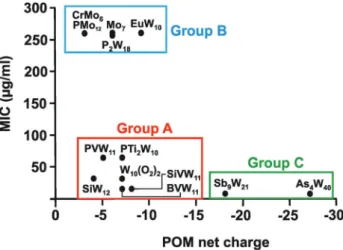
However, most of the tested POTs exhibited significant anti-bacterial activity in synergy with b-lactam antibiotics. Analysis of the structure–activity-relationship considering the parameters POM size (number of addenda atoms), POM total net charge, POM charge density (charge per number of addenda atoms), number of certain atoms within the POM (e.g. different metals and oxygen atoms) and POM redox potential did neither reveal any unambiguous correlation nor any trend or structure-function pattern for these POMs. The same was also observed for the synergy effect, where no correlation between the POM-mediated sensitizing effect and its structure was found. How-ever, considering the biological activity of the so far studied POMs against Helicobacter pylori, structure–activity patterns were identified (Table 3 and Fig. 7). The charge–activity-relationship of all tested POMs against the IID3023 strain of Helicobacter pylori was determined (Fig. 7).
From Fig. 7 it can be deduced that POMs possessing a net charge between 2 to 8 can be divided into two groups, namely POMs exhibiting MIC values up to 100 mg ml 1(group A)
and those possessing MICs over 200 mg ml 1(group B). Among POMs belonging to group A, vanadium-containing POMs showed the highest activity. POMs exhibiting a negative charge higher than 15 showed the highest activity against almost all Helicobacter pylori strains (one exception: strain Hp030, Fig. S4, ESI†) as indicated by MIC valueso 50 mg ml 1
(group C).
The same or similar trends were observed for 16 of the 17 tested Helicobacter pylori strains (Fig. S2 to S14, ESI†). The only strain not following this pattern was the clarithromycin-resistant Hp027, where most of the POMs belonging to group A (MIC values up to 100 mg ml 1in most of the strains) shifted towards lower activity and thus to group B (MIC 4200 mg ml 1) (Fig. 8). Only the vanadium-containing [SiVW11O40]8 and the
two large and highly charged POMs from group C maintained their high activity in this strain. The Wells–Dawson anion [P2W18O62]6 was the most strain sensitive POM as depending
on the strain its antibacterial activity was fluctuating the most (from lower to intermediate activity).
Table 3 Antibacterial activity of POMs alone (MIC) against drug-susceptible and metronidazole- and clarithromycin-resistant H. pylori strains
POM MIC (mg ml 1) DSSa Hp Hp Hp IID ATCC Hp Hp Ref. 018b 030b 065b 3023b 43504b 027c 067c Polyoxotungstate: Keggin: H4[SiW12O40] 16–256 128 32 64 32 64 256 64 46 K7[PTi2W10O40] 64–256 256 128 128 64 128 256 64 46 (NH3Pri)6H[PTi2W10O38(O2)2] 32–256 64 64 32 32 64 256 64 46 Wells–Dawson: K6[P2W18O62] 256 to 4256 128 n.d.d 256 256 256 256 256 46 Decatungstate: Na9[EuW10O36] 4256 4256 n.d.d 4256 4256 4256 4256 4256 46 Other structure: K27[KAs4W40O140] 16 16 16 16 8 8 8 32 46 K18[KSb9W21O86] 16–64 16 64 16 8 16 8 32 46 Polyoxovanadotungstate: Keggin: K5[PVIVW11O40] 16–256 32 64 128 64 32 256 128 46 K5[SiVVW11O40] 16–256 64 16 16 16 64 64 64 46 K7[BVIVW11O40] 32–256 32 16 128 16 32 128 64 46 Polyoxomolybdate: Keggin: H3[PMo12O40] 4256 4256 n.d.d 4256 4256 4256 4256 4256 46 Anderson-Evans: Na3[CrMo6O24H6] 4256 4256 4256 4256 4256 4256 4256 4256 46 Heptamolybdate: (NH4)6[Mo7O24] 4256 4256 4256 4256 4256 4256 4256 4256 46 Antibiotic: Amoxicillin 0.001–0.063 0.008 0.032 0.063 0.016 0.032 2 0.25 46 Clarithromycin 0.001–0.125 0.032 0.004 16 0.032 0.032 32 256 46 Metronidazole 0.5–4 32 16 128 128 128 4 2 46
aTen drug-susceptible strains (DSS) of H. pylori were tested and the MIC range is given. No further information about the exact strains is given. bHp018, Hp030, Hp065, IID3023 and ATCC43504 are metronidazole (MTZ)-resistant H. pylori strains.cHp027 and Hp067 are clarithromycin
(CLR)-resistant H. pylori strains.dNo data available. NH3Pri= isopropylammonium.
Open Access Article. Published on 12 January 2018. Downloaded on 22/01/2018 18:13:28.
This article is licensed under a
Regarding the POM size vs. activity correlation, where the size is defined as the total number of addenda atoms, a similar pattern as described above for the charge was observed (Fig. 9). Thus, POMs exhibiting a size from 6 to 22 addenda atoms can also be subdivided into group A (MIC up to 100 mg ml 1) and group B (MIC 4 200 mg ml 1), whereas the huge and highly charged [KSb9W21O86]18 and [KAs4W40O140]27 form again
their own group C (MIC o 50 mg ml 1). Within both the charge–activity- and size–activity-relationship, there are some POMs showing intermediate activities (MIC value between 100 and 200 mg ml 1), for example, [BVW11O40]7 against the strain
Hp027 (Fig. 8). According to the above observations, Helicobacter pylori is most sensitive to large and highly negatively charged POMs but also susceptible to Keggin-type POMs with vanadium-substituted structures being among the most effective ones. On the other hand, the least active POMs were in general POMos and POMs with other than Keggin-type structures like the Anderson-Evans and decatungstate structure (Fig. 8 and Fig. S2–S14, ESI†).
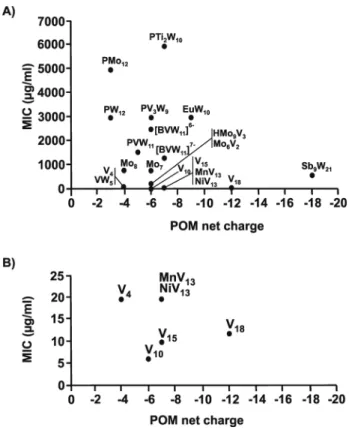
The same structure–activity analysis was performed for Streptococcus pneumoniae revealing that this bacterium is especially sensitive to POVs with decavanadate exhibiting the highest antibacterial activity (Fig. 10 and 11). In contrast to Helicobacter pylori, most of the tested POMos were determined to be more active than POTs (Table S3, ESI†). Furthermore, as can be seen in Fig. 10 and 11, isostructural POMs (Keggin-type) present completely different antibacterial activity with MIC values ranging from 192 mg ml 1 for [HMo9V3O38]6 to
6000 mg ml 1for [PTi2W10O40]7 indicating the generally low
response of this bacterium towards this POM-type. According to our analysis, the activity of POMs are highly bacteria-dependent as different bacteria react distinctly to certain types of metal species and it seems that there is a certain threshold for the parameters charge, size and shape (POM-type) determining the biological activity of POMs. However, decavanadate seems to be special in this regard as it exhibits promising antibacterial activity against the majority of the tested bacteria, which most likely is connected to its putative mechanisms of action as its biological behavior and activity is well studied not only in vitro but also in vivo.38,40,95–101However, the susceptibility of certain bacterial strains (e.g. Streptococcus pneumoniae) towards vanadium-containing POMs could be also indicative of the
Fig. 7 Charge–activity-relationship of POMs against the metronidazole-resistant strain IID3023 of Helicobacter pylori. The net charges of the POMs are plotted against their MIC values. Specific groups are marked, namely group A (red) of POMs with higher activity (MIC up to 100 mg ml 1),
group B (blue) of POMs with lower activity (MIC 4 200 mg ml 1) and group C (green) of large and highly charged POMs exhibiting the highest activity. CrMo6 = [CrMo6O24H6]3 , PMo12 = [PMo12O40]3 , Mo7 = [Mo7O24]6 ,
EuW10 = [EuW10O36]9 , P2W18= [P2W18O62]6 , PVW11 = [PVW11O40]5 ,
PTi2W10 = [PTi2W10O40]7 , W10(O2)2 = [PTi2W10O38(O2)2]7 , SiW12 =
[SiW12O40]4 , SiVW11= [SiVW11O40]7 , BVW11= [BVW11O40]7 , Sb9W21=
[KSb9W21O86]18 , As4W40= [KAs4W40O140]27 .
Fig. 8 Charge–activity-relationship of POMs against the clarithromycin-resistant strain Hp027 of Helicobacter pylori. The net charges of the POMs are plotted against their MIC values. Specific groups are marked, namely group A (red) of POMs with higher activity (MIC up to 100 mg ml 1), group B
(blue) of POMs with lower activity (MIC 4 200 mg ml 1) and group C
(green) of large and highly charged POMs exhibiting the highest activity. Between MIC values of 100 and 200 mg ml 1there is an intermediate zone (black) representing moderately active POMs. For full POM formula, see caption of Fig. 7.
Fig. 9 Size–activity-relationship of POMs against the metronidazole-resistant strain IID3023 of Helciobacter pylori. Specific groups are marked, namely group A (red) of POMs with higher activity (MIC up to 100 mg ml 1), group B (blue) of POMs with lower activity (MIC 4 200 mg ml 1) and group
C (green) of large and highly charged POMs exhibiting the highest activity. For full POM formula, see caption of Fig. 7.
Open Access Article. Published on 12 January 2018. Downloaded on 22/01/2018 18:13:28.
This article is licensed under a
involvement of redox-processes in the killing process as vana-dium is most readily reduced, among the typical addenda atoms (W, Mo and V), leading to an increase in the redox activity of the corresponding POMs.102 Another function-activity-relationship was already mentioned in Section 3.1, where a series of organoantimony(III)-containing POTs showed a direct correlation
between their antibacterial activity and the amount of attached organic moieties.
Note, that it is in general difficult to deduce structure– activity correlations for POMs as their stability is a critical issue and therefore the identity of the active species is unknown for most POMs, especially in cases, where the POMs have been analyzed in bacterial growth media. In addition to this, the available data describing the antibacterial activity of POMs is more or less biased as the vast majority of the tested com-pounds are Keggin-based structures leading to a clustering of data in favor of this archetype.
5.2. Putative mode of actions
The putative mechanisms of action of POMs with antibacterial activity can be briefly resumed in the scheme of Fig. 12.
The POM targets include extracellular- and membrane-associated proteins/enzymes and processes such as respiration96(or other redox processes) or cytoskeleton dynamics.39,56 POMs were successfully localized within or at the inner membrane of bacteria, suggesting the interference or interaction with the bacterial cell wall and membrane compounds (Fig. 12, A).46,48
There is no report about antibacterial POMs reaching the cytoplasm, however, some suggested mechanisms would highly benefit from POMs being active within the cytoplasmic space. There are some theories suggesting that POMs (without con-sidering hybrid or nanocomposite structures) could be inter-nalized by some surface proteins via endocytosis-like processes, for example, macrophage receptors as it was proposed that POTs do compete with their ligand, acetylated low density lipoprotein, for receptor binding.103 Depending on the POM type, the transcription or translation or even both processes of PBP2a are reduced.27In addition, POMs inhibit the production of b-lactamases.43 Thus, POMs are able to interfere with two proteins that are responsible for the b-lactam resistance of some bacteria (Fig. 12, B). However, the exact mode of action is unknown but POMs might interact with protein targets, which are part of a signal cascade necessary for the production of the aforementioned proteins. POMs, especially decavanadate, were shown to be potent inhibitors of P-type ATPases and thus it is suggested that, at least partially, the malfunction of ATPases is also responsible for the observed antibacterial effects.40
Fig. 10 Size–activity-relationship of POMs against six strains of Strepto-coccus pneumoniae. (A) The sizes of the POMs expressed as number of addenda atoms are plotted against their MIC values. (B) Zoom view of (A) by plotting the MIC value only in the range of 0 to 25 mg ml 1. PMo
12=
[PMo12O40]3 , Mo6V2= [Mo6V2O26]6 , HMo9V3= [HMo9V3O38]6 , Mo7=
[Mo7O24]6 , Mo8= [Mo8O26]4 , EuW10= [EuW10O36]9 , PVW11= [PVW11O40]5,
PTi2W10= [PTi2W10O40]7 , PW12= [PW12O40]3, [BVW11]6 = [BVVW11O40]6 ,
[BVW11]7 = [BVIVW11O40]7 , PV3W9 = [PV3W9O40]6 , Sb9W21 =
[KSb9W21O86]18 , V4= [V4O12]4 , VW5= [VW5O19]4 , V10 = [V10O28]6 ,
MnV13= [MnV13O38]7 , NiV13= [NiV13O38]7 , V15= [V15O36(CO3)]7 , V18=
[V18O42(H2O)]12 .
Fig. 11 Charge–activity-relationship of POMs against six strains of Strepto-coccus pneumoniae. (A) The sizes of the POMs expressed as number of addenda atoms are plotted against their MIC values. (B) Zoom view of (A) by plotting the MIC value only in the range of 0 to 25 mg ml 1. For POM sum
formula, see caption of Fig. 10.
Open Access Article. Published on 12 January 2018. Downloaded on 22/01/2018 18:13:28.
This article is licensed under a
Inhibition of P-type ATPases has a severe impact on the cellular metabolism (Fig. 12, C). As most POMs are highly redox-active, they could impair the bacterial electron-transport-chain (respira-tory system) by oxidizing important electron carriers like NADH and thus affect ATP production.98,104This in turn leads to lethal
damage in bacterial cells (Fig. 12, D). One aftermath of impairing the respiratory system is the increase of the ROS level. However, POMs can also directly produce ROS by oxidizing proteins, lipids and other bacterial compounds (Fig. 12, E). In addition, POMs are able to elevate the ROS level by oxidizing the antioxidant gluta-thione (GSH), which leads to the depletion of the GSH-pool.105 POMs can also react with important membrane anchored pro-teins and enzymes, which could lead to serious damage within the bacterial cell. For example, some POMs are able to inhibit sialyl-and sulfotransferases sialyl-and thus could interfere with the bacterial carbohydrate metabolism (Fig. 12, F).106 Another possible mechanism is the disruption of the bacterial cytoskeleton dynamics by POM-interactions with cytoskeletal elements like FtsZ and MreB (Fig. 12, Q). Some POM-based nanocomposites like CT–POMs or AgNP–POMs are able to disrupt the bacterial cell wall, which leads to the leakage of intracellular substances (Fig. 12, 8a).74,79Once the cell wall is disrupted, POMs could interact with cytoplasmic elements or proteins that are anion-sensitive like nucleic acid binding proteins. On the other hand, other constituents of the hybrid system like CT can directly interact with DNA molecules and thus causing lethal damages to the bacteria (Fig. 12, 8b).74
In general, it seems that POM–protein interactions are mainly responsible for the antibacterial activity of the inorganic compounds. As these interactions are of electrostatic nature, almost every protein is a potential target for POMs as they normally bear positively charged regions. Besides the (possibly) reversible electrostatic inter-actions, POMs are also able to covalently bind to proteins.6,35This
demonstrates the wide applicability of POMs in biological fields. Due to the POM’s ability to inhibit a series of biologically relevant proteins and enzymes, the mode of action of antibacterially active POMs might not be explained by one strict mechanism with one single target but rather by multiple POM–protein interactions affect-ing several biological pathways at the same time and the sum of these disturbances ultimately leads to the death of the bacterial cell.6 In the next years, we expect that important questions will be answered: (1) What is the exact mechanism of POM uptake? (2) Where is the exact location of the POM and (3) its action within the cell? (4) What is the exact bioactive POM species and how does it function (mode of action)? (5) What is the exact mecha-nism of POM-induced bacterial resistance reversion? These and other questions will require continuous development of new techniques and approaches to explore the effects of POMs on bacteria and their medicinal applications in more detail.
6. Conclusions and future perspective
The high potential of POMs, especially POM-based hybrid systems, as antibacterial agents has been proved by the research activities
Fig. 12 Schematic overview of the putative mechanisms of antibacterially active POMs. A POMs are uptaken into the inner membrane but not into the cytoplasm. B POMs inhibit the production of both PBP2a (green squares) and b-lactamases (green circles). C POMs, especially decavanadate, target P-type ATPases. D Impairment of the bacterial electron-transport-chain (respiratory system) by POMs. E POM-mediated increase of the ROS-level via oxidation. F POMs can also react with important membrane anchored proteins and enzymes (red triangle and purple pentagon). Q The disruption of the bacterial cytoskeleton dynamics by POM-interactions with cytoskeletal elements (yellow triangles). (8a) POM-based nanocomposites (e.g. CT–POMs or AgNP–POMs) are able to disrupt the bacterial cell wall leading to leakage of intracellular substances (blue and red circles). (8b) Upon cell wall disruption, POMs could interact with cytoplasmic elements or proteins that are anion-sensitive like nucleic acid binding proteins.
Open Access Article. Published on 12 January 2018. Downloaded on 22/01/2018 18:13:28.
This article is licensed under a


![Fig. 2 Structure–function-relationship of organoantimony( III )-containing POTs. (A) [(PhSb III ) 4 (A-a-As V W 9 O 34 ) 2 ], 10–61 (B) [(PhSb III ) 3 (B-a-As III W 9 O 33 ) 2 ] 12 , 62 (C) [(PhSb III ) 2 As III 2 W 19 O 67 (H 2 O)] 10 62 and (D) [(PhSb II](https://thumb-eu.123doks.com/thumbv2/123dok_br/18926671.938100/6.892.137.752.768.981/structure-function-relationship-organoantimony-containing-pots-phsb-phsb.webp)
![Fig. 4 Structure of {[Zn(HPPA) 2 H 2 O] 2 [H 2 ZnW 12 O 40 ]}. 66 (A) Structure of the organic–inorganic hybrid is shown, with the POM [H 2 ZnW 12 O 40 ] 4 being represented as polyhedra and the organic drug as ball and stick](https://thumb-eu.123doks.com/thumbv2/123dok_br/18926671.938100/7.892.89.405.82.386/structure-structure-organic-inorganic-hybrid-represented-polyhedra-organic.webp)
![Fig. 5 Scheme of the chitosan–cetyltrimethylammonium bromide–POM capsule. 77 POM = [PW 12 O 40 ] 3 or [PMo 12 O 40 ] 3 , CTAB = cetyltrimethyl-ammonium bromide and CT = chitosan.](https://thumb-eu.123doks.com/thumbv2/123dok_br/18926671.938100/8.892.463.822.75.274/scheme-chitosan-cetyltrimethylammonium-bromide-capsule-cetyltrimethyl-ammonium-chitosan.webp)