FACULDADE DE PSICOLOGIA
PRÁTICAS DE RECURSOS HUMANOS, PERCEPÇÃO DE
UNIVERSIDADE DE LISBOA
FACULDADE DE PSICOLOGIA
Job characteristics and general well-being: The mediate
role of burnout
Inês Ferreira de Figueiredo Ferro
MESTRADO INTEGRADO EM PSICOLOGIA
(Secção dos Recursos Humanos, do Trabalho e das Organizações)
ii Resumo
Abstract
UNIVERSIDADE DE LISBOA
FACULDADE DE PSICOLOGIA
Job characteristics and general well-being: The mediate
role of burnout
Inês Ferreira de Figueiredo Ferro
Dissertação Orientada pela Professora Doutora Maria José Chambel
MESTRADO INTEGRADO EM PSICOLOGIA
(Secção dos Recursos Humanos, do Trabalho e das Organizações)
iii Dedicated to them, Mother, Father and Sister.
iv Acknowledgments
The present work would not have been possible without the excellence mentoring of Professor Maria José Chambel. Her dedication knows no boundaries. Thank you for all the support, motivation, availability to answer late-night existential questions and for always having an enthusiastic outlook towards my work. I also have to acknowledge all the precious help that Doctor Vânia Carvalho gave me along the way.
My deepest gratitude to my holy trinity – my family. They believed in me when no else did, including myself. To my father, whose knowledge and sense of humour are infinite. To my mother, whose kindness and support knows no precedents. To my sister, whose strength and bravery I will always envy. To them, who inspire me every day to be the best version of myself and to go follow my dreams, my most heartfelt appreciation.
My college experience would not have been the same without a very special group of people. Luís, Vânia, Daniela and Catarina, you made the two years of master’s degree the most memorable and dear part of my academic path. Thank you for the motivation, belief, aid and sharing of both bitter and hysterical moments. I will always cherish the road we wandered together and the unforgettable stories that came along the way.
In this sense, I also have to acknowledge three people who were crucial during my psychology degree: Ricardo, Nuno and Sílvia. Thank you for the lack of judgement, for the friendship, for all the help and support and for never leaving my side.
To all my amazing friends who put up with me and assured me I would make it.
To my maternal grandparents; I hope you know how much you are missed.
To Mónica, whose meaningful life taught me to put everything in perspective.
To all of you,
v Table of Contents
Abstract ... vi
I. Introduction ... 1
II. Theoretical Framework ... 3
1. Job Characteristics ... 3
1.1 Job Demands ... 3
1.2 Job Control ... 5
2. Burnout ... 7
3. Well-Being ... 9
4. General Conceptual Model ... 13
III. Method ... 14
1. Sample ... 14
2. Procedure ... 15
3. Measures ... 15
4. Data Analysis Method ... 16
IV. Results ... 18
1. Confirmatory factor analysis ... 18
2. Mean values, standard deviations and correlations between the study variables 18 3. Structural Equations Model ... 20
V. Discussion ... 23
VI. Limitations and Future Research ... 24
VII. Practical Implications ... 24
VIII. Conclusion ... 27
vi Abstract
Well-being plays a focal role not only on the quality of life of employees but also on the financial revenue of an organization and the quality of work that is produced. There are several variables that can affect well-being, namely job characteristics and burnout.
The present research aims to examine the relationship between job characteristics and well-being, as well as the mediation effect of burnout in this relation. Data was collected from a universe of employees who directly deal with clients on a daily basis. These workers are from three different sectors of activity, specifically pharmaceutical industry, textile industry and technology industry, composing a sample of 1031 employees. Results show a significant relationship between job characteristics and burnout, a significant relationship between job demands both well-being and stress and a significant relationship between job control and both well-being and stress. It was also found that burnout partially mediates and helps to explain the relationship between both job characteristics and both dimensions of well-being. Some literature review is presented to justify these results. Research limitations and suggestions for future research are presented, as well as practical implications related with the obtained results.
1 I. Introduction
For an economy to ensure high levels of prosperity to their citizens, it is essential to present a high level of productivity. However, it becomes increasingly clear that in the long term, in order to remain competitive, it is not enough that we focus only on the short and medium term productivity engines but also in a number of additional features that are also important to support the long-term productivity. An economy must be socially cohesive, live within their financial means and should ensure the correct and efficient use of their resources (i.e., financial, environmental, human). In this context, the World Health Organization (WHO) and the United Nations (UN) developed a list of goals for the post-2015 agenda to ensure this development. Among those are goals such as health and well-being, quality of work and economic growth.
The last 10 Goals of the Millennium Development Goals (UN, 2000) helped to accelerate development in low and middle income countries (UNDP; United Nations Development Programme, 2013). While improvements have been visible in all health areas (UNDP, 2013), mental health, although highly relevant for sustainable development, was totally excluded from these goals. For the new goals of sustainable development, the international community needs to recognize the evidence demonstrating the increasing amount of diseases and extensive global social and economic consequences of mental disorders and psychosocial risks (World Economic Forum, 2011).
What is the importance of mental health for the sustainable development goals? Looking at the numbers, the relationship becomes clearer. WHO (2011) estimates that 1 in 4 people will experience a disturbance of mental disorders throughout their lives - 600 million people are disabled as a result of those disorders (Kohn, Saxena, Levav & Saraceno, 2003). 1 billion people experience a disabling condition - 60% of the causes are strongly related to mental disorders, neurological and substance abuse (World Health Organization, 2011). Mental, behavioural and neurological disorders represent 10.4% of the diseases identified in a global panorama. By 2030, depression will be the largest contributor to the years lived with disability (World Health Organization, 2013).
The focus of mental health on organizations thrives because there is a consistent relationship between psychosocial risks associated with work and mental health professionals. Across the European Union (EU) psychosocial risks, which are defined as those aspects of the design and management of work, and their social and organizational
2 contexts, which have the potential for causing psychological, social or physical harm (Cox & Griffiths, 2005) have been identified as an emerging risk and as a key challenge in modern occupational safety and health management (EU-OSHA, 2007). Psychosocial risks go hand in hand with the experience of work-related stress. Work-related stress is the response people may have when presented with work demands and pressures that are not matched to their knowledge and abilities and which challenge their ability to cope (WHO, 2003). In addition, the issue of burnout has also gained prevalence as a result of exposure to a poor psychosocial environment and the resulting work-related stress experience. As reported by the Fourth European Working Conditions Survey (Eurofound, 2007), 1 out of 5 workers from the EU15 and almost 1 in 3 from the 10 new member states believed their health was at risk due to work-related stress.
Organizational ill-health consequences are vast and extremely burdensome for the organizations. Investigations revealed four major areas that are directly related to the lack of health of employees (World Health Organization, 2000): absenteeism, performance, attitudes and behaviours and interpersonal relationships. Within absenteeism, there is an increase of sick as a result of poor health (e.g. depression, stress and burnout) and physical disorders (e.g., heart disease, ulcers and sleep disturbance). In performance, there is a decrease in productivity as a result of increased error rates, increased amount of accidents, poor decision making and deterioration in the planning and control of work. Regarding attitudes and behaviours, there is poor motivation and commitment, increased levels of burnout, presentism, lack of punctuality and increased turnover. With regard to interpersonal relationships, there is an increase in tension and conflict between colleagues, poor customer relations and an increase in disciplinary proceedings.
Considering all this data, we find that is of extreme importance to focus on mental health in organizations. As well-being reflects how, among others, individuals feel about themselves, their life and health, we focused on that construct. We choose to study the relationship between job characteristics and well-being, with burnout as a mediator on said relationship. We hope to add to the existing literature on well-being and try to bring to the attention of organizations how these variables are key to their sustainability in the current market. This because, as previously stated, there are serious outcomes for the employee and the organization if well-being, or mental health, are neglected.
3 II. Theoretical Framework
1. Job Characteristics 1.1 Job Demands
During the past three decades, many studies have shown that job characteristics can have a profound impact on employee well-being. For instance, research has revealed that job demands such as high work pressure, emotional demands and role ambiguity may lead to sleeping problems, exhaustion, and impaired health (e.g. Doi, 2005; Halbesleben & Buckley, 2004).
Point of departure of several models in the occupational health literature is that job strain is the result of a disturbance of the equilibrium between the demands employees are exposed to and the resources they have at their disposal. For example, according to the well-known job demand-control model (JDC; Karasek, 1979; 1998) job strain is particularly caused by the combination of high job demands (particularly work overload and time pressure) and low job control – “the working individual’s potential control over his tasks and his conduct during the working day” (Karasek, 1979, pp. 289-290). Job demands refer to physical, social or organizational job aspects that require sustained physical and/or psychological effort and are associated with certain physiological and/or psychological costs (Demerouti, Bakker, Nachreiner & Schaufeli, 2001). Examples of job demands are work overload, heavy lifting, interpersonal conflict and job insecurity. By definition, job demands consume energy because additional effort must be exerted to achieve the work goals and to prevent decreasing performance and may therefore eventually lead to physical and psychological problems such as exhaustion, fatigue, irritability and related health problems. Thus, one basic premise in the JDC model is that employees who can decide themselves how to meet their job demands do not experience job strain (e.g. job-related anxiety, health complaints, exhaustion, and dissatisfaction). According to Karasek (1979): “The individual’s decision latitude is the constraint which modulates the release or transformation of “stress” (potential energy) into the energy of action” (p. 287). There is indeed empirical evidence showing that particularly the combination of high job demands and low job control is an important predictor of psychological strain and illness (Karasek, 1979; Schnall, Landsbergis & Bakker, 1994).
Research has shown that job demands have a profound influence on burnout and indirectly lead to increased absenteeism (e.g. Bakker, Demerouti & Schaufeli, 2003a),
4 impaired organizational performance (e.g. Bakker, Demerouti & Verbeke, 2004) and health problems (Schaufeli & Bakker, 2004). A study by Bakker, Dollard, Schaufelli, Taris and Schreurs (2007) showed that job demands are the strongest predictors of burnout. Similarly, results from a study by Bakker, Demerouti and Schaufeli (2003b) showed that job demands were unique predictors of burnout and indirectly of absence duration. They hypothesized and found that job demands (e.g. work pressure and emotional demands) were the most important antecedents of the exhaustion component of burnout, which, in turn, predicted in-role performance. In a study by Demerouti, Bakker, Nachreiner and Schaufeli (2001) the results showed that job demands were primarily and positively related to exhaustion.
Furthermore, Schaufeli and Bakker (2004) found that burnout fully mediated the relationship between job demands and health problems. Likewise, Hakanen, Bakker and Schaufeli (2006) found that burnout mediated the effect of job demands on ill-health. In a study conducted by Hu, Schaufeli and Taris (2011) the employees experiencing high job demands and low resources showed higher risks of burnout. However, after controlling for the additive effects of job demands and job resources, the predictive power of this synergetic effect decreased sharply. Similarly, this relation is also found in longitudinal studies: in a 3-year follow-up study among Finnish dentists (Hanaken, Schaufeli & Ahola, 2008b) job demands predicted burnout over time, which in turn predicted future depression. In an analogous study among Dutch managers, increases in job demands and decreases in job resources predicted burnout across a 1-year period (Schaufeli, Bakker & van Rhenen, 2009).
Since job demands play a central role in the energetic process that might lead not only to burnout and health problems but also to potential negative organizational outcomes (e.g., intention to leave the organization), reducing those demands seems to be warranted. Many preventive organizational based strategies exist to tackle high job demands, such as job redesign, flexible work schedules, and goal setting. The main aim of an organization should be to design the job demands such that people can fulfil them without damaging their health. Bakker et al. (2007) emphasized that the initial concern of organizations should be to avoid overwhelming levels of job demands in order to prevent employees’ health impairment.
5 1.2 Job Control
Occupational health psychologists have long tried to detect which job resources may diminish the impact of job demands on burnout. One of the most studied resources that may act as buffer is job control (Van der Doef & Maes, 1999). As we previously stated, the importance of job control was initially emphasized by Karasek’s (1979) JDC model. This author proposed that control might offset the negative impact of high job demands (i.e., workload and time pressure) on negative job strain. Job control is an umbrella concept referring to the degree to which workers can choose their actions (Ganster & Fusilier, 1989; Spector, 1998). There are several sub-constructs of job control such as decision latitude, decision authority, skill discretion, and autonomy. Decision latitude is the basis of job control and is composed of decision authority and skill discretions (Hystad, Eid & Brevik, 2011). Decision authority is the liberty to make decisions on a job, whereas skill discretion is freedom in choosing the range of skills used at work (Hystad et al., 2011). Autonomy refers to control over immediate scheduling and tasks (Spector, 1998). In the literature on occupational health, job control is viewed as a central resource in a workplace (Leiter & Maslach, 2004; Spector, 1998).
In a study by Park, Jacob, Wagner and Baiden (2014) it was found that job control had a stronger relationship with depersonalisation and personal accomplishment than with emotional exhaustion. Specifically, when resources such as job control are depleted, employees may attempt to minimise their emotional expenditure in interpersonal situations in order to conserve their energy, which would result in depersonalisation and dehumanisation.
At the heart of the Job Demand-Resources model (JD-R, Bakker, Demerouti, De Boer, & Shaufeli, 2003; Demerouti et al., 2001) lies the assumption that whereas every occupation may have its own specific risk factors associated with job stress or burnout, these factors can be classified in two general categories (i.e., job demands and job resources), thus constituting and overarching model that may be applied to various occupational settings, irrespective of the particular demands and resources involved. Job resources refer to those physical, psychological, social, or organizational aspects of the job that (a) are functional in achieving work goals, (b) reduce job demands and the associated physiological and psychological costs, or (c) stimulate personal growth and development. Another assumption of the JD-R model is that job stress or burnout develops – irrespective of the type of job or occupation – when certain job demands are
6 high and when certain job resources are limited (Demerouti et al., 2001). Previous studies in several organizations have confirmed that the absence of job resources undermines motivation and leads to cynism and reduced extra-role performance (motivational process; e.g., Bakker, Demerouti, De Boer, & Schaufeli, 2003; Bakker, Demerouti, & Schaufeli, 2003; Bakker, Demerouti, & Verbeke, 2004; Demerouti et al., 2001).
The proposition in the JD-R model that has received little research so far is that job resources may buffer the impact of job demands on stress reactions, including burnout (Bakker, Demerouti, Taris, Schaufeli, & Schreurs, 2003). This assumption is consistent with the Demand-Control model (JDC; Karasek, 1979; 1998). The basic tenet of the JDC Model is that job control or decision latitude is a crucial resource that moderates the potential negative effects of job demand in job strain. Hence, increasing employee’s control prevents the occurrence of job strain, that is, job stress will not affect employee’s physical and/or mental health when sufficient levels of control exist (Karasek, 1979; Karasek & Theorell, 1990; Rodríguez, Bravo, Peiró & Shaufeli, 2001). In line with this models, Bakker, Demerouti and Euwema (2005) found that the interaction between job demands and job resources explained a unique proportion of the variance in exhaustion and cynism. In the majority of the cases, employees reported the highest levels of fatigue and demoralization when job demands coincided with low job resources.
Control is a key factor in leading to increased job satisfaction and, in this sense, control may take many forms. Blauner (1964), for instance, found that control over freedom of movement, control of the pace of work and general control of the near environment all led to increased job satisfaction. Furthermore, a meta-analysis from 1986 found an association of high levels of perceived control with high levels of job satisfaction, commitment, involvement, performance and motivation, and low levels of physical symptoms, emotional distress, role stress, absenteeism, intent to turnover, and turnover (Spector, 1986). Hence, increasing job control is an intervention shown to help counteract exhaustion and cynicism in the workplace, which are two symptoms of occupational burnout (Hätinen, Kinnunen, Pekkonen & Kalimo, 2007).
However, there is criticism concerning the conceptual difference between job demands and job resources because is not as clear-cut as it may seem at first glance (Schaufeli & Taris, 2014). For instance, consider the situation in which an employee experiences a lack of resources. This implies that more effort has to be spent to achieve work goals. Since the JD-R model argues that the expenditure of effort is a hallmark of
7 job demands, this reasoning leads to the paradoxical conclusion that lack of resources may be construed as a job demand. For certain employees a resource like job control might be experienced negatively, i.e., as a threat rather than as an opportunity for learning and development therefore a negatively appraised resource could be conceptualized as a demand. It should be noted that as a rule demands are appraised negatively, whereas resources are appraised positively, but occasionally demands can be challenging and resources can be threatening (Schaufeli & Taris, 2014). So it is possible to assume that job control does not always act as a moderator between job demands and burnout. Instead it can also be perceived as a demand and have an additive effect that can eventually lead to burnout.
2. Burnout
Burnout is a metaphor that is commonly used to describe a state of mental weariness. Originally, burnout was considered to occur exclusively in the human services among those who do ‘people work’ of some kind (Maslach, 1982). However, gradually it became clear that burnout also exists outside the human services (Maslach & Leiter, 1997). Hence, the original version of Maslach Burnout Inventory (Maslach & Jackson, 1986) was adapted to use outside the human services.
Burnout is defined as a syndrome of emotional exhaustion, cynicism towards work and reduced professional efficacy, occurring among individuals in their work environment (Maslach, Jackson & Leiter, 1996). According to Schaufeli and Taris (2005), exhaustion (i.e. energy depletion) and cynicism (i.e. callous attitudes towards work and clients) are the core dimensions of burnout. The first dimension – exhaustion – measures fatigue without referring to other people as the source of one’s tiredness. The second dimension – cynism – reflects indifference or a distant attitude towards work in general, not necessarily with other people. Finally, professional efficacy encompasses both social and non-social aspects of occupational accomplishments. As stated by Maslach (1993), burnout is caused by high job demands that drain the employee’s energy and in an attempt to cope with the resulting exhaustion the employee withdraws mentally. However, this is an inadequate strategy since this prevents proper performance. Bakker, Van Emmerik, and Van Riet (2008) showed that cynism predicted the sales performance of teams, whereas Bakker, Demerouti and Verbeke (2004) found that cynism and exhaustion were related to colleague-rated extra-role and in-role performance, respectively.
8 The job demands–resources (JD-R) model provides a theoretical context to explain burnout’s development in the work environment. In the JD-R model’s health impairment process, distress in the form of chronic job demands leads to a deterioration of energy levels into exhaustion, cynicism, and the eventual state of burnout (Bakker & Demerouti, 2007; De Beer, Rothmann, & Pienaar, 2012). Burnout negatively impacts quality of life leading to various negative outcomes for the employee and the organisation: that is, psychological ill-health, eventual physical ill-health, and a reduced sense of commitment to the organisation (Bakker & Demerouti, 2007; De Beer et al., 2012; Schaufeli & Bakker, 2004). Moreover, in line with the burnout literature (e.g., Melamed, Shirom, Toker, Berliner, & Shapira, 2006), it is assumed that burnout will lead to health problems such as depression, cardiovascular disease, or psychosomatic complaints. Thus, burnout is expected to mediate the relation between job demands and employee health and well-being (at least partly), through the gradual draining of mental resources (i.e., burnout). This is the energetic or health impairment process of the revised JD-R model (Schaufeli & Bakker, 2004).
Furthermore, burnout is personally distressing (Freudenberger, 1975) and has been linked to many stress-related physical and mental health outcomes (Maslach, Shaufeli & Leiter, 2001). In a recent study about job burnout’s relationship with sleep difficulties (De Beer, Pienaar & Rothman Jr., 2014) it was found that burnout had a significant relationship with reporting sleep difficulties even in the presence of other variables. Armon, Shirom, Shapira & Melamed (2008) found that burnout was associated with insomnia and Söderström, Ekstedt, Åkerstedt, Nilsson & Axelsson (2004) found that individuals with higher levels of burnout show more arousal from sleep compared to those scoring low on burnout. Therefore, employees who are experiencing increasing sleep difficulties could have a tell-tale sign of the health impairment process at work in them. Research has also found that impaired sleep may also hinder recovery from burnout (Sonnenschein, Sorbi, van Doornen, Schaufeli & Maas, 2007), and that burnout and impaired sleep may adversely affect one another over time (Armon, 2009).
All models and theories considered, burnout may negatively impact employer’s life quality which in turn may affect may their work quality and thus the services the organizations provide to its clients. Therefore, our first hypothesis for this investigation aims to validate and measure the relationship between the variables above mentioned not only as a whole but also separately.
9 Hypothesis 1: Job characteristics have a relationship with burnout.
H1a: Job demands have a positive relationship with burnout. H1b: Job control has a negative relationship with burnout. 3. Well-Being
Well-being plays a central role in any person’s life. For an individual to maintain good levels of motivation and physical and mental health, it is necessary that they feel good about themselves, their life and the events that occur in it. However, well-being, as a theoretical construct, is relatively diverse in scope and composition which causes topic for debate. According to Caetano and Silva (2002), in a global approach of well-being, there are two main distinctive approaches that despite some attempts at reconciliation still occupy different compartments within well-being studies: objective well-being (OWB) and subjective well-being (SWB).
Objective well-being theories are usually supported by a list of requirements that people should have satisfied in order to live a good life - those requirements are universal and do not vary among societies. OWB relates to a set of socio-economic parameters such as level of education, health (psychosomatic symptoms), security, employment, income and other indicators, which are used to express objective levels of life quality (Caetano & Silva, 2010).
Subjective well-being is an umbrella term used to describe the level of well-being people experience according to their subjective evaluations of their lives. This subjective definition of quality of life is democratic in that it grants to each individual the right to decide whether his or her life is worthwhile. According to Diener (2000) there are a number of separable components of SWB: life satisfaction (global judgments of one's life), satisfaction with important domains (e.g., work satisfaction), positive affect (experiencing many pleasant emotions and moods), and low levels of negative affect (experiencing few unpleasant emotions and moods). However, it is important to note that although well-being is subjective in that it occurs within a person’s experience, manifestations of subjective well-being can be measured objectively in verbal and non-verbal behaviour, actions, biology, attention, and memory (e.g., Sandvik, Diener & Seidlitz, 1993) A person will have a high subjective well-being high if it regularly feels more positive emotions than negative ones such as happiness and joy, engages in
10 interesting activities, is generally satisfied with their life and rarely feels negative emotions such as sadness and anger (Diener Suh & Oishi, 1997).
Early research focused on the causes of well-being, but recently researchers have begun to focus on its consequences, and particularly on whether high levels of subjective well- being are beneficial to effective functioning, or alternately, whether they hamper success. A growing body of evidence suggests that high well-being and life satisfaction significantly improve life within the four areas of health and longevity, work and income, social relations, and societal benefits (Diener & Biswas-Diener, 2008; Lyubomirsky, King, & Diener, 2005).
As previously stated, there are a number of studies that provide evidence that subjective well-being improves both health and longevity. In general, people who report high subjective well-being also report better health and fewer unpleasant physical symptoms (Roysamb, Tambs, Reichborn-Kjennerud, Neale & Harris, 2003). In a study where researchers infected participants with the common cold, those who reported higher levels of well-being were more resistant to the virus (Cohen, Doyle, Turner, Alper & Skoner, 2003). Danner, Snowdon, and Friesen (2001) also found that baseline subjective well-being predicted longevity for nuns living under identical environmental conditions, and Pressman & Cohen (2007) achieved a similar result in a study of autobiographies of psychologists. Furthermore, individuals with higher subjective well-being tend to have stronger immune systems and better cardiovascular health (i.e., fewer heart attacks and less artery blockage), to engage in healthier behaviours such as wearing seatbelts and sunscreen, and to have fewer lifestyle diseases such as addictions to alcohol or drugs (Diener & Biswas-Diener, 2008).
Currently there is a large body of empirical evidence on the relationship between well-being and labour market outcomes. Studies in this area come primarily from psychology and organizational behaviour, showing that people high in well-being are more likely to secure a call-back second job interview (Burger & Caldwell, 2000). They may also be more likely to receive higher ratings from supervisors (Wright & Staw, 1999), because they generally tend to show lower job burnout (Wright & Cropanzano, 1998), higher levels of organizational citizenship (Donovan, 2000) and reduced absenteeism (Pelled & Xin, 1999). In addition to this, people who have high levels of well-being tend to handle managerial jobs better (Staw & Barsade, 1993) and show superior job performance (Christian, Garza, & Slaughter, 2011; Wright & Cropanzano,
11 2000). Work-related subjective well-being contributes to employee performance because engagement (a component of work-related subjective well-being) leads to stronger devotion to work and protects against burnout (Schaufeli, Bakker, van der Heijden, & Prins, 2009).
Another benefit of high subjective well-being lies in the fact that people who attain it are likely to earn more money than others, regardless of occupation (Diener, Nickerson, Lucas, & Sandvik, 2002), and are more likely to enjoy their work (Lyubomirsky, King, & Diener, 2005). Importantly, this result indicating that well-being causes economic and career success has been replicated in studies conducted in other parts of the world (Graham & Pettinato, 2002; Marks & Fleming, 1999). Continuing research also suggests that individuals who enjoy their work tend to have higher supervisor ratings (Wright & Staw, 1999; Cropanzo & Wright, 1999) and are judged as having more productivity, dependability, creativity, and overall higher work quality while on the job (Staw, Sutton, & Pelled, 1994). Moreover, happy workers (i.e. individuals in a positive affective state) also tend to have higher levels of organizational citizenship, which means they are more likely to do tasks not required by their job (Diener & Biswas-Diener, 2008; Donovan, 2000; Ilies, Scott & Judge, 2006; Spence, Ferris, Brown & Heller, 2011) and showing organizational citizenship behaviours specifically directed toward the supervisor, co-workers, and the organization (Spence, Brown, Keeping & Lian, 2014).
A person’s well-being can change over time. For instance, age shows a curvilinear relationship with work-related well-being (Warr, 1992; Zacher, Jimmieson & Bordia, 2014). Well-being decreases from early adulthood until midlife and then increases again. Within the organizational socialization process, well-being can also undergo changes, with a noticeable decline in positive and an increase in negative states over the first few months after organizational entry (Dunford, Shipp, Boss, Angermeier & Boss, 2012; Kammeyer-Mueller, Wanberg, Rubenstein & Song, 2013). In a longitudinal study concerning the development of employee well-being (Mäkikangas, Kinnunen, Feldt & Schaufeli, 2016) it was found that age and job change were found to affect the stability of well-being. For age, the rank-order stabilities were lower and mean-level changes more prevalent among younger than older employees. The authors suggested several alternative explanations for this novel finding. It could be that younger employees face several detrimental stressors, such as job insecurity (Scheibe & Zacher, 2013), that have shown great variability over time (Kinnunen, Mäkikangas, Mauno, Cuyper, & Witte, 2014),
12 thereby also contributing to instability in levels of employee well-being. It might be also that instability among young employees is caused by changing attitudes towards the job; that is, young employees start their first job with a rosy outlook which, however, becomes less rosy over time, as suggested by the curvilinear trend found in job satisfaction (Boswell, Shipp, Culbertson & Payne, 2009).
Literally hundreds of studies have addressed the question of whether job stressors relate to well-being. Over the years, more and more studies have used longitudinal research designs that offer the possibility to examine how job stressors are related to changes in well-being over time. Sonnentag and Frese (2012) summarized empirical evidence from 70 longitudinal studies on job stressors and predominantly negative well-being indicators (e.g., emotional exhaustion, psychological distress). The majority of these studies found both positive relationships between job stressors assessed at time 1 and an increase in negative well-being indicators from time 1 to time 2. In a meta-analysis, Ford, Matthews, Wooldridge, Mishra, Kakar and Strahan (2014) pursued a similar goal and analysed lagged relationships between job stressors and indicators of psychological and physical strain. They found a significant lagged relationship between stressors assessed at time 1 and strain assessed at time 2, indicating that strain increases after exposure to job stressors. Effect sizes were relatively small for exhaustion and fatigue, but larger for symptoms such as anxiety, irritation, and tension. Another meta-analysis that focused on musculoskeletal symptoms as a negative well-being indicator found that high job demands and highly monotonous work were associated with an increase in musculoskeletal problems (e.g. lower back symptoms) over time (Lang, Ochsmann, Kraus & Lang, 2012).
With respect to positive well-being indicators, research has shown that perceptions of job resources—particularly autonomy—predict an increase in work engagement over time (De Lange, De Witte & Notelaers, 2008; Hakanen, Perhoniemi, & Toppinen-Tammer, 2008a; Xanthopoulou, Bakker, Demerouti & Schaufeli, 2009; Kinnunen & Feldt, 2013). Findings are a bit less consistent for negative well-being indicators. In some studies, job resources predicted a decrease in strain symptoms such as exhaustion (Akkermans, Brenninkmeijer, Van den Bossche, Blonk & Schaufeli, 2013; Hakanen et al. 2008b), depression (Holman & Wall, 2002) or musculoskeletal symptoms (Lang et al. 2012). Other studies, however, failed to find any association between job resources and changes in negative well-being indicators (De Lange, Taris, Kompier, Houtman &
13 Bongers, 2004; Xie, Schaubroeck & Lam, 2008) or found changes with respect to some resources, but not others (Leiter, Hakanen, Ahola, Toppinen-Tanner, Koskinen & Väänänen, 2013). Overall, autonomy and other job resources are linked to positive changes in well-being over time. These changes are reflected more in an increase in work engagement and other positive well-being indicators than in a decrease in negative indicators. One reason for this pattern of findings could be that job resources in themselves are experienced as something positive, resulting in feelings of energy and positive affect; job resources, however, might not always be fully effective in removing job stressors, thereby leaving the strain level unaffected (Sonnentag, 2015).
As we have highlighted the importance of well-being in both in-work context and out-of-work context, our second hypothesis for this investigation is to validate and measure the relationship between job characteristics and the two dimensions (i.e., positive and negative) of well-being (i.e., well-being and stress, respectively). Furthermore, we aim to find out if the negative and positive relationships with job demands and well-being and stress, respectively, are validated. Moreover, and in similarity, if the positive and negative relationship with job control and well-being and stress, respectively, are validated.
Hypothesis 2: Job characteristics have a relationship with well-being.
H2a: Job demands have a relationship with well-being, namely negative with the positive dimension and positive with stress dimension.
H2b: Job control has a relationship with well-being, namely positive with the positive dimension and negative with the stress dimension
Considering all the literature review previously presented, we can conjecture that there may be a mediation between out three main variables. Therefore, our third hypothesis of this investigation aims to learn if burnout mediates the relationship between job characteristics and well-being.
Hypothesis 3: Burnout mediates the relationship between job characteristics and well-being.
4. General Conceptual Model
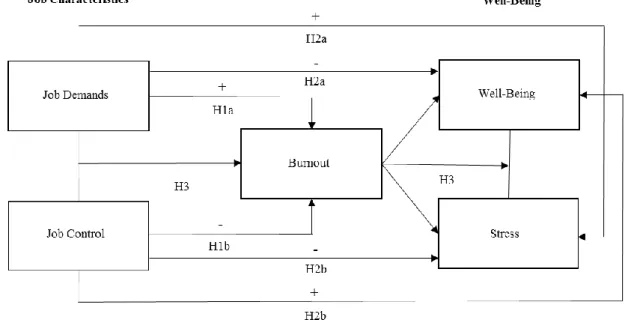
The model below (Figure 1) shows schematically and briefly the hypotheses previously made following the literature review.
14 The objective is to understand the relationship between the variables proposing that job characteristics (i.e., job demands and job control) have not only a direct relationship with burnout and well-being but also that burnout mediates this relationship.
Figure 1: Conceptual Model III. Method
1. Sample
In order to test the previously specified hypothesis of this investigation we performed a correlational study based on the application of a questionnaire to a sample comprising 1031 employees from three different sectors of activity. The data was collected in 2015 and the sample comprises 52 employees (5%) from a pharmaceutical company, 57 workers (5,5%) from a contact centre company and 922 employees (89,4%) from a large retail store. Given the fact that our sample is spread through different types of organizations there is the possibility of encountering different levels of job demands depending on the kind of job that is developed in each one. These employees amount for more than 80% of the total number of workers of their respective organizations. It is also significant to note that all the organizations have been in the market for 10 years or less.
Most of our sample was composed of women (74,6%) as the men accounted for the rest (25,4%). Regarding tenure, “less than a year” was the most answered (46,2%), closely followed by “between 1 and 5 years” (43,5%). Finally, as for “between 5 and 10 years” 10,4% of the sample was accounted.
15 2. Procedure
The data was collected due to the request of the organizations for a diagnosis of psychosocial risks to its employees. The answers were collected through a questionnaire placed on an online platform (SurveyMonkey). The confidentiality and anonymity of the answers provided was granted to all participants. After the assembly of all the data and its analysis, it was prepared a summary report of the results that was then delivered to each organization.
3. Measures
Job Demands. To assess the job demands we used the Job Content Questionnaire (JCQ; Karasek, Brisson, Kawakami, Houtman, Bongers & Amick, 1998) which was used in a previous Portuguese study (Carvalho & Chambel, 2014). The JCQ is a self-administered instrument designed to measure social and psychological characteristics of jobs. The best-known scales—(a) decision latitude, (b) psychological demands, are used to measure the high-demand/low-control model of job strain development.
Job demands were assessed through 7 items. It was asked to the participants that they evaluated each item in a Likert scale of 5 points that varied from 1 (totally disagree) to 5 (completely agree). Examples of said items are “My work demands that I work fast” and “I feel that I don’t have enough time to finish my work”. This variable presented an internal consistence of .86.
Job control was assessed through 4 items. It was asked to the participants that they evaluated each item in a Likert scale of 5 points that varied from 1 (totally disagree) to 5 (completely agree). Examples of questions are “I have the possibility to decide how to organize my work” and “My work allows me to make decisions autonomously”. This variable presented an internal consistency of .86.
Burnout. As for burnout, we used the widely known Maslach Burnout Inventory – General Survey (MBI) (Maslach et al., 1996). This scale was also previously used in a Potugal (Carvalho & Chambel, 2016). We measured the core burnout dimensions: exhaustion and cynicism.
Emotional exhaustion was assessed though 5 items. It was asked to the participants that they evaluated each item in a scale of 7 points that varied from 1 (never) to 7 (every day). Examples of said items are “I feel emotionally drained by my work”, “I feel tired
16 when I wake up in the morning and have to face another day of work” and “Working all day is really a strain for me”. This variable presented an internal consistency of .92.
Cynism as assessed through 5 items. It was asked to the participants that they evaluated each item in a scale of 7 points that varied from 1 (never) to 7 (every day). Examples of said items are “I have lost interest for my work ever since I have started this job” and “I doubt the value and utility of my work”. This variable presented an internal consistency of .81.
Well-being. Finally, we used the General Health Questionnaire to measure general well-being (GHQ-12; Goldberg, 1972). The General Health Questionnaire (GHQ) is a self-administered screening questionnaire designed to detect probable psychiatric disorder in primary care settings which is highly popular and widely used in research (e. g., Gureje & Obikoya, 1990; Lobo, Perez-Echeverria & Artal, 1986; Schmitz, Kruse & Tress, 1999). In order to measure well-being in this investigation, it was used the translation and adaptation of the GHQ-12 for the portuguese language made by Laranjeira (2008).
In various studies this scale is characterized as assessing only one dimension. However, in many other is indicated the existence of two dimension. Thus we made an exploratory analysis in order to evaluate the best fit of our data. With this analysis we concluded that the data of this study fitted better in two dimensions: stress (5 items, α=.81) and well-being (7 items, α=.88). This are represented in the following examples of items: well-being “Have you been able to focus in what you do”, “Have you been feeling that you play an important role in the things in which you get yourself involved?” and “Have you been thinking of yourself as a person of value?”; stress “Have you been losing a lot of sleeping hours due to worries?”, “Have you been feeling not able to face your problems?” and “Have you been feeling sad and depressed?”. We assessed this variable though 12 items. It was asked to the participants that they evaluated each item through a Likert scale of 4 points that varied from 1 (not at all) to 4 (more than usual).
4. Data Analysis Method
The analysis of our data was made using the statistical program IBM Statistical Package for Social Sciences (SPSS) (Windows 23.0 software). The characterization of our sample – sex and tenure – was made in SPSS along with the calculations of the mean
17 values, Pearson correlation and the internal consistency (Cronbach's alpha) for the variables in study.
Additionally, we used the program SPSS AMOS 23.0 to make a confirmatory factor analysis (CFA) in order to test the measurement model that was created with our latent variables (i.e., demands, control, burnout, stress and well-being) and then compare it with the one-single factor model where all items loaded on a single latent variable as proposed by Anderson and Gerbing (1988). These models allow us to make the CFA - testing the relationships between the variables in order to verify if the obtained data fits our theoretical built model.
After, in order to execute the hypothesis test, it was used the analysis methodology of the structural equation model (SEM) which allows to test the relationships between our initial variables (independent variables), the mediation variable and the next variable (dependent variable). As this is an analysis based on comparison models we can improve the specific parameters that have interest and calculate viable alternatives in opposition to effect patterns. Therefore, to test the relationship between job characteristics and burnout (H1), the relationship between job characteristics and well-being (H2) and burnout as a mediator in the relationship between job characteristics and well-being (H3) it were created and analysed three structural equation models (i.e., Direct Model, Partial Mediated Model and Total Mediation Model).
In both the CFA and the SEM the comparison between the models was based in the analysis of the results and differences of the chi-square and the adjustment fit indices (i.e., the Standardized Root Means Square Residuals (SRMR), the Bentler Comparative Fit Index (CFI), the Tuckler Lewis Index (TLI) and the Root Mean Square Error of Approximation (RMSEA)). According to Arbuckle (2003), the models fit reasonably well to the data when the values of the CFI and TLI are .90 or superior, when the values for the RMSEA are .06 or inferior and when the values of the SRMR are .80 or inferior. However, according to some researchers, values for RMSEA and SRMR lower to .10 are also acceptable (Schermelleh-Engel, Moosbrugger, & Muller, 2003).
18 IV. Results
1. Confirmatory factor analysis
Our theoretical model covered five factors (i.e., job demands, job autonomy, burnout, stress and well-being). Burnout included exhaustion and cynicism as second latent variables. The confirmatory factor analysis was used in order to test the validity of our theoretical model and if fits the obtained data – verifying the need to execute some modifications. For comparison we used a one-single factor model.
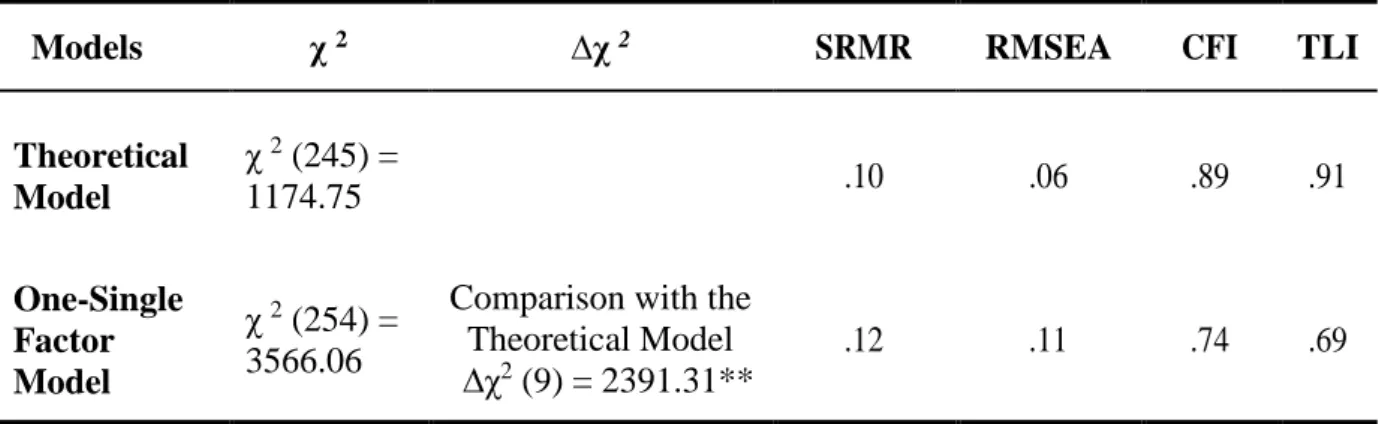
The one-single factor model showed poor fit to the data (χ2(254) = 3566.06, p < .001; SRMR =.12; RMSEA =.11; CFI =.74; TLI =.69). Whereas the five-factor model obtained an acceptable fit (χ2(245) = 1174.75, p < .01; SRMR =.10; RMSEA =.06; CFI =.89; TLI =.91). Furthermore, we verified that the five-factor model fits the data significantly better than the one-single factor model (Δχ2(9) = 2391.31, p < .01). In that sense, our theoretical model presented the best fit to the data as can be verified in Table 1.
Table 1. Confirmatory Factor Analysis
Models χ 2 ∆χ 2 SRMR RMSEA CFI TLI
Theoretical Model
χ 2 (245) =
1174.75
Comparison with the Theoretical Model ∆χ2 (9) = 2391.31** .10 .06 .89 .91 One-Single Factor Model χ 2 (254) = 3566.06 .12 .11 .74 .69 Note: ** p < .01; * p < .05
2. Mean values, standard deviations and correlations between the study variables
In Table 2 it is possible to observe the calculated means, standard deviations and correlations for our study variables.
With respect to the obtained mean values, the results revealed that the employees perceive their job demands to be relatively high. This because in a Likert scale of 5 points the mean of responses lies in 3.51 (SD = .76). Regarding job control our sample also revealed a positive mean considering that in a Likert scale of 5 points the mean of answers
19 was 3.32 (SD = .79). Regarding the two dimension of burnout, exhaustion, measured through a Likert scale of 7 points, presented a mean of 3.01 (SD = 1.55). This reveals that our employees sometimes perceive themselves as feeling exhausted and drained by their daily work. Similarly, regarding cynicism, which was also assessed through a Likert scale of 7 points, the results revealed a mean of 2.18 (SD = 1.28). This mean exposes that our sample rarely perceive themselves as being cynical over their work. Therefore, the results of our questionnaire suggest that our sample has some risk of exhaustion. Regarding well-being, we also assessed two dimensions. Well-well-being, the positive dimension, scored a mean of 2.70 (SD = .62). Considering that the answers were evaluated through a Likert scale of 4 points, the results reveal that our sample perceives their well-being to be nor low nor high, being in the middle of the spectrum although closer to the higher side. Regarding stress, the negative dimension, employees revealed a low mean of 1.79 (SD = .66). This tell us that our sample perceives their level of stress to be low, not having a significance on their actions, feelings and attitudes in and out of their work context.
As to correlations, which can also be observed in Table 2, there is a positive however not significant correlation between the two dimension of job characteristics - job demands and job control (r = .05; p >.05). Nonetheless this is not the case among all the other studied variables. Exhaustion showed a positive and significant correlation with job demands (r = .48; p <.01) and a negative but significant relationship with job control (r = -.09; p <.01). Cynicism revealed positive and significant correlations with both job demands (r = .29; p <.01) and exhaustion (r = .63; p <.01) and a negative but significant correlation with job control (r = -.16; p <.01). Well-being shows a positive and significant correlation with job control (r = .25; p <.01) and negative but significant correlations with job demands (r = -.23; p <.01), exhaustion (r = -.34; p <.01) and cynicism (r = -.30; p <.01). Finally, stress reveals positive and significant correlations with job demands (r = .42; p <.01), exhaustion (r = .70; p <.01) and cynicism (r = .60; p <.01) and a negative yet significant correlation with job control (r = -.12; p <.01) and well-being (r = -.35; p <.01).
20 Table 2. Mean values, standard deviations and correlations of the variables in study (N=1031) Mean SD 1 2 3 4 5 1. Job Demands 3.51 .76 2. Job Control 3.32 .79 .05 3. Exhaustion 3.01 1.55 .48** -.09** 4. Cynism 2.18 1.28 .29** -.16** .63** 5. Well-Being 2.70 .62 -.23** .25** -.34** -.30** 6. Stress 1.79 .66 .42** -.12** .60** .52** -.35** Note: ** p < .01; * p < .05
3. Structural Equations Model
To test the hypothesized relationships of this study we made use of the structural equation model (SEM). As our third hypothesis is a mediation, it was required that our analysis followed the norms of Baron and Kelly (1986). These authors state that a mediation must follow 4 assumptions: there should be a relationship between the independent variable (IV) and the mediation variable (MV), a relationship between the IV and the dependent variable (DV), a relationship between the MD and the DV and that the relationship between the IV and DV decrease (partial mediation) or is not significant (total mediation) when MV is present.
In this sense, firstly, we made a direct model (model 1) between both dimensions of job characteristics and both dimensions of well-being. Thus, we could observe the direct relation between these variables without the influence of burnout. Model 1 presented an adequate fit for the data (χ2 (206) = 1115.295, p < .01, SRMR = .10, RMSEA = .07, CFI = .92, TLI = .90). We found a significant and negative relationship between demands and well-being (β = -.09; p < .05). Furthermore, the relationship between job demands and stress revealed to positive and significant (β = .48; p < .01) meaning that our hypothesis 2a was supported. Regarding job control, we found a positive and significant relationship between job control and well-being (β = .17; p < .01). As hypothesized, the relationship between job control and stress revealed to be negative and significant (β=-.11; p < .01)
21 meaning that our hypothesis 2b was also supported. All relationships considered, these results fully support our hypothesis 2.
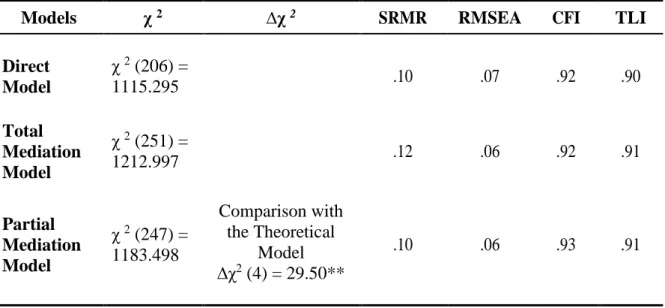
Secondly, we tested our theoretical model (model 2) where we considered a partial mediation among the constructs of the study. Model 2 provided an adequate fit for the data (χ2 (247) = 1183.498, p <.01, SRMR = .10, RMSEA = .06, CFI = .93, TLI = .91). Then, we compared our theoretical model with a total mediation model that could also be theoretically plausible (see table 3).
Model 3, that is, the total mediation model, also presented an acceptable fit (χ2 (251) = 1212.997, p < .01, SRMR = .12, RMSEA = .06, CFI = .92, TLI = .91). When we compared this model with the theoretical model (model 2), which adds to the previous model a direct link between the variables of job characteristics (i.e., job demands and job control) and well-being (i.e., well-being and stress), model 2 presented a better fit (∆χ2 (4) = 29.50, p < .001). Therefore, the partial mediation modelbecame our final model.
Table 3. Structural Equation Model
Models χ 2 ∆χ 2 SRMR RMSEA CFI TLI
Direct Model χ 2 (206) = 1115.295 .10 .07 .92 .90 Total Mediation Model χ 2 (251) = 1212.997 Comparison with the Theoretical Model ∆χ2 (4) = 29.50** .12 .06 .92 .91 Partial Mediation Model χ 2 (247) = 1183.498 .10 .06 .93 .91 Note: ** p < .01; * p < .05
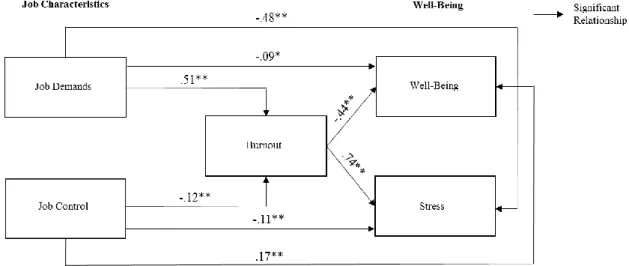
Analysing the standardized coefficients for each of the significant paths in our model (see Figure 2) we can observe a significant and positive relationship between job demands and burnout (β = .51; p < .01). These results support our hypothesis 1a. Moreover, there is a significant and negative relationship between job control and burnout (β = -.12; p < .01), thus supporting our hypothesis 1b. Taken together, these results fully support our hypothesis 1.
22 Regarding burnout, we found a negative and significant relationship between burnout and well-being (β= -.44; p < .01) and a positive and significant relationship between burnout and stress (β= .74; p < .01).
Therefore, in order to analyze our mediation hypothesis, (hypothesis 3), we performed the Sobel Test (Sobel, 1982) with the intention of discovering if burnout mediates the relationship between job characteristics and well-being. This test allows us to understand if the difference in the relationship between the independent variable and the dependent variable is significant with and/or without the mediator variable (Baron & Kenny, 1986). That is, this is a significance test in order to give the indirect effect, through the mediating variable, of the independent variable on the dependent variable (Baron & Kenny, 1986).
Firstly, we verified that the relationship between job demands and well-being through burnout was statically significant (Z = -5.88; p < .001). Similarly, we confirmed that the relationship between job demands and strain through burnout was also significant (Z = 6.79; p < .001). Then we verified that the relationship between job control and well-being through burnout was significant (Z = 3.16; p < .001). Finally, we observed that the relationship between job control and strain is also significant (Z = -3.28; p < .001).
Thus, we observed that burnout acts as a total mediator between the relationship of both job characteristics and stress and a partial mediator between both job characteristics and well-being. In this way, our hypothesis 3 was supported.
Note: ** p < .01; * p < .05
23 V. Discussion
This study analysed the relationship between job characteristics proposed by Karasek (1979) and well-being. We also aimed to find if burnout mediated the relationship between job characteristics and well-being. In sum we wanted an overall look of the relationship between the three previously stated variables in order to verify the consequences for the employees in and out of work context instead of just focusing in one of said dimensions.
In this sense, the results of our study allowed to verify the existence of a positive and significant relationship between job demands and burnout. These results are in line with the extensive literature review that supports that job demands are the strongest predictors of burnout (e.g., Bakker et. al, 2003b; Bakker et. al, 2007) and, for instance, that may lead to sleeping problems and exhaustion among other health problems (e.g., Doi, 2005; Halbesleben & Buckley, 2004). As expected, the results of this study also supported the hypothesis that job control has a negative relationship with burnout This is consistent with previous investigations that found a relationship between job control and job satisfaction (Blauner, 1964), motivation, low levels of emotional distress and physical symptoms (Spector, 1986). Therefore, job control presents significant relationships with constructs that are opposite of burnout.
Our results also showed that job demands have a relationship with well-being, namely negative with the positive dimension and positive with stress dimension. As we have previously identified, job demands are detrimental to employee’s health because they have a relationship with burnout. In this sense, it was expected that their relationship with well-being - the positive dimension - proved to be negative. Regarding stress – the negative dimension - it was expected that the relationship was positive considering that job demands, among other, lead to anxiety, fatigue, irritability and thus, stress. As expected, we found that, on the contrary, job control has a relationship with well-being, namely positive with the positive dimension and negative with the stress dimension.
Regarding burnout acting as a mediator between job characteristics and well-being, we verified that this mediation is of extreme importance in explaining how job characteristics affect employees well-being. There was a significant relationship between both job characteristics and burnout and the latter with both dimensions of well-being. Meaning that both job demands and control, through burnout, lead to well-being and
24 stress. These results are in line with the health impairment process of the JD-R (Schaufeli & Bakker, 2004) which states that burnout is expected to mediate the relation between job demands and employee health and well-being through the gradual draining of mental resources at work.
All results considered, we could support that job characteristics are a predictor of burnout and well-being out of work. Meaning that these two variables can have a profound impact in both work context and out of work context leading to an endless list of possible outcomes that can have a serious impact on both dimensions.
VI. Limitations and Future Research
Our study has some limitations that ought to be addressed so future investigations take it into account and be able to improve the work that has been developed. First, the fact that this study made use of data collected in just a single moment in time, making it impossible to establish cause-effect relationships. Thus, it is only possible to make inferences from the results in terms of nature (positive or negative) of the relationships between variables. Thus for future studies it would be interesting to conduct longitudinal studies. Also, this was a questionnaire-based research which made use of self-assessment questions. Therefore, it has a high facial validity, which can lead to issues like social desirability. Another limitation of our study that acts like a suggestion for future research is the integration of the social support variable as proposed by Karasek (1979). We choose to not incorporate that variable in our study but it should be interesting to make use of the whole JDC model (Karasek, 1979) to verify if such support changes and how it changes the results of the relationships between variables. Finally, we have to account to the fact that our sample is Portuguese, meaning that may lack for generalization purposes. Conducting an investigation with a multi-cultural sample would be extremely relevant.
VII. Practical Implications
Considering that well-being is vital for every individual’s quality of life, our study is of extreme importance. It has particular relevance for the human resources management who focal point and aim should be to guarantee the well-being of the employees of their organization. This could be said only in a human perspective, meaning that the organizations should have a concern about their workforce life quality. However, unfortunately, we are heading to a conjuncture where employees are not much more than
25 a number. Therefore, it is mandatory to warn organizations of the financial and quality of work consequences that not addressing this topic has on their sustainability.
Considering that job characteristics have a significant relationship with burnout, changes should be made considering the demands that employees face on a daily work and the control they have over their tasks. Changes to the way work is organised, provision of training (e.g., time management), redesign of the work area, changes to working time arrangements, appropriate employee consultation and involvement should be highly considered (e.g., Leka, Vartia, Hassard, Pahkin, Sutela, Cox & Lindstrom, 2008). Organizations should mitigate job demands as much as possible. For instance, foster certain adaptive characteristics in employees to alleviate the negative effects of job demands (via employees’ perceptions of these demands), such as personal resources (e.g., self-efficacy; Jex, Bliese, Buzzell & Primeau 2001). As for control, enhancing bottom-up communication within the organization, implementing autonomous teams, taking measures to avoid structural and incidental understaffing and providing training possibilities (e.g., specialization) (Michie & Williams, 2003; Schalk, Bijl, Halfens, Hollands & Cummings, 2010) are all possible interventions on increasing employees control over their work.
As burnout negatively impacts quality of life leading to various negative outcomes for the employee and the organization (e.g., psychological ill-health, physical ill-health, psychosomatic complaints, reduced sense of commitment to the organization, performance, intentions of turnover, turnover) there should be programmes to prevent and support the employees who may experience or are experiencing burnout. Individual-based interventions to reduce burnout symptoms might be an avenue to explore (Schaufeli & Enzmann, 1998). For instance, implementing an Employee Assistance Program (EAP) could be a valid strategy as it provides, among others, confidential counselling for employees. In a meta-analysis of 48 studies (Van der Klink, Blonk, Schene, & Van Dijk, 2001) it was found that particularly stress management programs that use a cognitive-behavioural approach are effective in reducing stress reactions, including burnout. Clearly, such individual-based programs should be supplemented by organization-based programs in order to be effective in the long run. Above all, managers should show awareness and sympathy towards this issues and consult employees regarding measures to deal with psychosocial risks and encourage them to participate actively in the implementation of these measures.
26 It can be argued that implementing programs or redesigning work costs money that the organization is not willing to spend due to cost reduction or not understanding the return value of such investment. It is often stated that prevention is better than cure. Indeed, preventing a problem is often cheaper than solving it. If the investment leads to cost savings larger than the investment, the return on investment is positive. Seen this way, everything that helps to prevent health problems arising should lead to lower costs for solving health problems and to lower associated costs’ (such as costs of sickness absence or for return to work programs). Effective investments in preventive psychosocial risk management may therefore imply fewer costs associated with health problems and consequently lead to higher job satisfaction and increased work commitment. Thus further reduction in organizational costs would be accounted due to knowledge retention, lower staff turnover and resulting reduction in training and recruitment costs. For instance, along with the data we presented in the introduction, in the 15 Member States of the pre-2004 EU, the cost of stress at work and the related mental health problems was estimated to be on average between 3% and 4% of gross national product, amounting to €265 billion annually (Levi, 2002). In Sweden in 1999, 14% of the 15000 workers on long-term sick leave reported the reason to be stress and mental strain with an associated total cost of sick leave of €2.7 billion (Koukoulaki, 2004). In a report by the European Agency for Safety and Health at Work (EU-OSHA, 2009) it is reported that in France stress-related illnesses cost the society between €830 and €1,656 million.
As a reflexion on this matter, we find interesting to take a closer look at Portugal’s numbers on this matter. According to the European Agency for Safety and Health at Work (EU-OSHA, 2010), Portugal reported a little over 60% of sickness absences in 2010. Regarding the health and safety services used, Portugal presents 77% on use of safety experts, 94% on occupational health doctors, 71% on general occupational safety and health consultancy, 26% on ergonomics experts and 13% on psychologists. Regarding concern on work-related stress, 70% of the organizations enquired reported major concern, 20% some concern and 10% having no concern. As for psychosocial risk factors, 37% employees reported lack of control in organising their work, 64% reported time pressure, 53% having to deal with difficult customers and 26% reported long or irregular working hours. However, according to this survey, little over 10% of all Portuguese organizations have procedures to deal with work-related stress. It is interesting to note that while establishments in Portugal were among the most frequent to identify causes of
27 psychosocial risks (especially those relating to the individual) and a higher than average share of establishments showing major concern for work-related stress, the country is well below the average when it comes to preventive procedures. Unfortunately, regarding major reasons for addressing health and safety in the workplace, Portugal reported a whopping 96% due to fulfilment of legal obligation. Concerning main difficulties in dealing with health and safety in the establishment in the EU-27, a lack of resources such as time, staff or money is clearly identified as the most important barrier. However, a breakdown of the results by size shows that for larger enterprises a lack of awareness and the culture within the establishment become more important barriers, while a lack of expertise and a lack of technical support or guidance become less important. Also worth noting is the high degree of consistency in the countries reporting highest prevalence, with Portugal being in the top five places for all barriers. As for willingness by companies (assessed by employee representatives) to introduce measures for tackling psychosocial risks, Portugal reports that a little over 40% are very willing, and a similar number reported “quite willing”. In sum, there is a lot to be done regarding employee health and safety in Portugal.
VIII. Conclusion
Overall, health - physical and psychological - needs to be seen as a strategic asset that creates added value in terms of innovation and development, besides reducing various costs (e.g., sickness absence costs and medical costs). This can be attained if organizations implement programs and practices that foster the well-being of their workforce. However, there is an urgent need to change the focus of the organizations from complete cost reduction to how much can be gained: financially, quality and productivity wise. As we have seen, if the paradigm does not change, the organizations will lose a lot of value, potential and possibly their sustainability. Furthermore, it will negatively affect the individuals who work - whose quality of life and mental and physical resources can become scarce - and, consequently, the society as a whole.