1Department of Mineralogy and Geotectonics, Institute of Geoscience, São Paulo University – São Paulo (SP), Brazil. E-mails: [email protected], [email protected], [email protected]
2School of Earth Sciences, University of Queensland – Queensland, Australia. E-mail: [email protected]
*Corresponding author.
Manuscript ID 20170095. Received on: 07/10/2017. Approved on: 03/03/2018.
ABSTRACT: The Poços de Caldas Alkaline Massif, located in southeast Brazil, is composed of tinguaites, as well as phonolites and nepheline syenites (NeS), together with assorted pyroclastic rocks. The latter constitute deposits within the Vale do Quartel, and show fragments of alkaline rocks (NeS, tinguaites), basaltic and ultramafic volcanics/subvolvanics, sandstones, and quartz-feldspathic rocks from the crystalline basement. NeS fragments with melanite, previously unknown, and cm-sized fragments of phlogopite megacrysts from related conduit breccia were chosen for detailed studies. The NeS fragments are medium- to coarse grained and contain K-feldspar (Or95-83), secondary albite (Ab97), altered nepheline, clinopyroxene (diopside, minor hedenbergite) and partially altered, zoned, idiomorphic melanite. These NeS fragments are typically metaluminous, and point to the existence of similar intrusions hidden at depth, an important input to the massif ’s petrology. The phlogopite megacrysts are compositionally homogeneous, with high Ti, Mg and Al contents; Ba and F are minor components. Two phlogopite aliquots were dated and yielded identical 40Ar/39Ar plateau ages of 87.1(± 0.5) Ma and 86.6(± 0.5) Ma, which represent minimum and maximum values for phlogopite crystallization and breccia emplacement, respectively. Previously obtained ages for the Poços de Caldas rocks are concentrated in the 75-86 Ma range interval.
KEYWORDS: Melanite-bearing nepheline syenite fragments; phlogopite megacrysts; conduit breccia; 40Ar/39Ar age; Poços de Caldas Alkaline Massif.
Melanite-bearing nepheline syenite fragments
and
40
Ar/
39
Ar age of phlogopite megacrysts
in conduit breccia from the Poços de Caldas
Alkaline Massif (MG/SP), and implications
Silvio Roberto Farias Vlach1*, Horstpeter Herberto Gustavo Jose Ulbrich1,
Mabel Norma Costas Ulbrich1, Paulo Marcos Vasconcelos2
ARTICLE
INTRODUCTION
The Poços de Caldas alkaline massif is one of the larg-est intrusions of its kind (around 800 km2), comparable in
size to the kindred Lovozero (Kola Peninsula, 600 km2) and
the Pilansberg (South Africa) intrusions, and second only to the Khibina massif, Kola Peninsula (1,350 km2). It is one
of over a hundred alkaline occurrences that cut across the so-called Brazilian Platform, a manifestation of orogenic revival (the “Wealdenian reactivation”; Almeida 1983) that mainly emplaces alkaline intrusions along the northern and eastern margins of the large volcano-sedimentary Paraná Basin. The massif itself is the westernmost occurrence of a series of intrusions that form an arc-like structure, the “Poços de Caldas-Cabo Frio seismo-tectonic lineament” (Sadowski
& Dias Neto 1981), which continues to the east with the sequentially younger Passa Quatro and Itatiaia, Barra do Piraí, Morro Redondo, Canaá, Tinguá, Rio Bonito, Morro de São João and, finally, the Cabo Frio occurrences. This belt was interpreted to be the result of sublithospheric mantle-plume activity, which pierced the continental lithosphere at intervals that are roughly consistent with assumed plate-displacement speeds (e.g. Sadowski & Dias Neto 1981, Ulbrich & Gomes 1981, Comin-Chiaramonti & Gomes 2005).
mineralogic characterizations of previously unknown melanite (Ti-andradite) -bearing nepheline syenite fragments, as well as of phlogopite megacrysts, common mineral fragments found in the breccia. 40Ar/39Ar ages for selected phlogopite
macrocrysts are reported, adding important data to an age framework currently being refined.
GEOLOGIC BACKGROUND
The Poços de Caldas alkaline massif (Fig. 1) shows a roughly subcircular outline, with some smaller, bulge-like irregularities found especially along its northern site (location of the main lujavrite-khibinite occurrence) and its south-western part (the “’Águas da Prata structure”; Ulbrich 1984). Most of its perimeter is marked by a well-developed topo-graphic outline, especially pronounced along its northern
and southern limits, constituting “topographic rims”, which in the earlier literature were taken as the topographic expres-sion of ring-dikes, fitting a “caldeira model” of emplacement (Ellert 1959). However, they are most likely the result of dif-ferential erosion (massive tinguaites are more resistant than syenites, which concentrate in the interior of the massif).
The district was mapped for the first time by R. Ellert, J.M.V. Coutinho and A.J.S. Björnberg (Ellert 1959, Björnberg 1959). Later mapping work was done by Bushee (1971) and geologists from the Nuclebrás state enterprise. The lat-ter present a new map emphasizing hydrothermally allat-tered areas and related mineralizations, such as caldasite (a zir-con-baddeleyite intergrowth) and zircon occurrences, and breccia-hosted U deposits. H. Ulbrich mapped the main nepheline syenites (NeS) and the lujavrite-khibinite intru-sions in detail (Ulbrich 1984, Ulbrich & Ulbrich 2000, Ulbrich etal. 2005; cf. also Schorscher & Shea 1992; Fig. 1).
The intrusion is made up of massive, mostly aphyric, tinguaites (subvolcanic intrusive phonolites), together with minor amounts of phonolites and many different types of NeS. The fine-grained rocks occupy around 70% of the dis-trict, and the NeS, no more than 20%. The NeS (mostly medium- to coarse-grained rocks) are clearly intrusive into the fine-grained varieties, thus leading to an unusual geo-logic pattern, as pointed out by the title of a pioneering ref-erence that studied the district: the “coexistence of plutonic and volcanic rocks”, by Derby (1887). These rocks are made up mainly of K-feldspar, nepheline, sodic-calcic and sodic pyroxenes as main rock-forming phases; a few NeS present biotite (Ulbrich 1983, 1993).
The NeS can be divided, on the basis of mineralogi-cal and geochemimineralogi-cal features, into agpaitic (typimineralogi-cal peral-kaline), largely subordinate, and predominant intermedi-ate-miaskitic (slightly metaluminous to slightly peralkaline) varieties (cf. definitions in Sorensen 1974a). The first ones are recognized in Poços de Caldas by the presence of pink eudyalite, joined by several rare-metal silicates (e.g., astro-phyllite, lamproastro-phyllite, rinkite), a useful criterion to sep-arate agpaites from miaskites and intermediate rocks in the field. Eudyalite, in fact, can become a rock-forming min-eral in lujavrites (meso- to melanocratic, foliated, eudyalite NeS, rich in incompatible elements) and khibinites (leuco-cratic massive eudyalite NeS, with analogous geochemical patterns; cf. Sorensen 1974b). A similar subdivision applies to tinguaites and phonolites, although they do not contain significant amounts of eudyalite and the diagnosis depends, in general, on thin section analysis under the microscope (e.g., Ulbrich 1983, 1993).
Hydrothermal alteration, frequently associated with mineralizations, may affect all rock types in varying pro-portions. It is fairly concentrated in “circular structures”,
Figure 1. Simplified geological map of the Poços de Caldas alkaline massif (Ulbrich etal. 2002, 2005). Legend:
showing a radial drainage pattern, a geomorphological fea-ture probably associated with tinguaite forming dome-like intrusions. The largest one (the “central-eastern circular structure”) occupies an area of over a hundred square km, and concentrates, in its interior and along its outer limits, most of the mineral deposits that dot the district (caldasite occurrences, the Osamu Utsumi open pit mine, the Campo de Agostinho strip with U deposits, cf. Paradella & Almeida Filho 1976, Ulbrich etal. 2005, and Fig. 1). The hydro-thermal alteration is homogenously distributed through-out the district and is characterized by pyrite, recrystallized K-feldspars, and sericite (altered nepheline); mafic minerals are converted into oxides-hydroxides. The disappearance of pyrite and the increase in kaolinite contents signal the onset of supergene alteration (Garda 1990).
The N-S running Vale do Quartel structure (Fig. 1) is filled in with several types of pyroclastic rocks, specially constituted by mafic to ultramafic varieties (“ankaratrites”), according to Ellert (1959), as well as broken fragments of both country and the main types of Poços de Caldas rocks (Alves 2003). These mafic/ultramafic rocks constitute a sep-arate genetic lineage, as documented by petrographic and chemical-isotopic data, in contrast to the feldspathic lineage, represented by the predominant Poços de Caldas felsic rocks (Ulbrich etal. 2005).
Country rocks are mostly basement granitic, gneissic and charnockitic rocks, as well as sedimentary cover forma-tions, represented by sandstones from the Lower Cretaceous Botucatu Formation of the Paraná Basin, still preserved at the border areas of the massif, and, to a lesser extent, by some minor outcrops of the Serra Geral Formation diabases (Fig. 1).
Stratigraphy and geochronology
Geological observations indicate time gaps between the emplacements of different rock types in the massif. The Vale do Quartel pyroclastics and associated mafic-ultramafic rocks are closely related to the emplacement of the Poços de Caldas rocks themselves. Similar rock types are also observed cut-ting across basement and alkaline rocks (plugs and dikes), found both within (e.g., lamprophyre dikes in the Osamu Utsumi open pit; cf. Shea 1992, Garda 1990) and outside of the massif (e.g., Minas Pedras ultramafic lamprophyres and silico-carbonatite rocks, Vlach etal. 1996, 1998, 2003, Ulbrich etal. 2002), as well as isolated tuff and breccia out-crops found in assorted regional locations, some within the district. The breccia outcrops were identified as erosion rem-nants of a pyroclastic apron that probably covered the entire massif and was coeval with the main eruption episodes (e.g., Björnberg 1959, Oliveira etal. 1975).
The majority of tinguaites are invaded by NeS varieties. Characteristics reminiscent of commingling structures are,
however, observed (e.g., fine-grained tinguaite enclaves in the Pedreira NeS type, cf. Fig. 1) leading to a common interpre-tation that both rock types were roughly coeval and intruded as partly or mostly liquid magmas at the emplacement site (Ulbrich etal. 2002, 2005). Some late tinguaites cut across the NeS, as observed in the Pedreira da Prefeitura quarry (Fig. 1). The agpaitic NeS varieties are certainly somewhat younger than the coarse- and fine-grained, intermediate-miaskitic, rock varieties. In fact, khibinites are clearly intrusive in the northern-rim grey NeS, and both khibinites and lujavrites con-tain tinguaite xenoliths (Ulbrich 1984, Ulbrich etal. 2005). The first attempts at K/Ar dating of alkaline rocks from Poços de Caldas were made by Amaral etal. (1967) and Bushee (1971), using mineral separates (mica, K-feldspar) and whole-rock samples from both feldspathic and maf-ic-ultramafic rocks, in a total of 40 determinations. The results, calculated with reference to the last recommended K decay constants, listed in Sonoki and Garda (1988), point to a large age span for the eruption history, from ca. 54 Ma (a NeS) to over 89 Ma (an ankaratrite).
Ulbrich etal. (2002) and Shea (1992) presented the first obtained results with the Rb/Sr dating method, considering conventional, internal, as well as reference isochrons. Ulbrich etal. (2002) reported isochrons of about 83 (± 21) Ma for the
northern lujavrite-khibinite body and 89 (± 8), Ma for the
northern grey NeS (see detailed map in Ulbrich & Ulbrich, 2000). Shea presented isochronic ages of about 79 (± 7) Ma
for the Pedreira type NeS and 77 (± 3) Ma for hydrothermally
altered NeS from a borehole in the Osamu Utsumi open pit. The same author also reported the first 40Ar/39Ar ages,
dat-ing phlogopites concentrates from mica lamprophyre dikes in the open pit, which yielded 75.7 (± 0.6) Ma (phlogopite
phenocrysts) and (76 ± 2) Ma (groundmass phlogopite).
Ulbrich etal. (2002) reviewed all these results in light of the available geological and geomagnetic data and suggested that the main magmatic episodes in the Poços de Caldas massif occurred in a relatively short age span (1 to 2 Ma) at about 79 Ma, emphasizing, however, the discrepancies between the age results and the geomagnetic reversals. Thompson et al. (1998) suggested a somewhat larger intrusion inter-val, between 80 and 85 Ma. Vlach etal. (2003) reported an
40Ar/39Ar age of 83.9 (± 0.3) Ma in phlogopite concentrates
from a calcite-phlogopite-fluorite late vein associated with the ultramafic rocks from the Minas Pedras quarry.
SAMPLING AND
ANALYTICAL METHODS
which runs along with the Vale do Quartel. Two samples from the same continuous outcrop (PC-17, Fig. 1), one with melanite-bearing NeS fragments, the other bearing phlogo-pite macrocrysts, were chosen for this study.
Sample preparation, petrographic and geochemical ana-lytical works were carried out at the GeoAnalitica-USP core facility. 40Ar/39Ar phlogopite dating was done at the UQ-AGES
Laboratory of the University of Queensland, Australia. Both conventional and large polished thin sections were examined under transmitted and reflected light with a con-ventional petrographic microscope. Backscattered electronic images (BSE), qualitative energy, and quantitative wavelength dispersive spot analysis (EDS, WDS) were done with the JEOL FXA FE-8530 EPMA with 5 WD and 1 ED spec-trometers. Analytical conditions for WDS analyses were 15 kV and 20 nA for the column accelerating voltage and beam current, respectively. Beam diameter was set to 5 μm for pyroxene, garnet and mica, and enlarged to 10-15 μm in the case of the alkali-feldspars. Standard analytical routines available in the lab were employed (e.g., Gualda & Vlach 2007), and both synthetic and natural minerals (mainly from the Smithsonian collection) were used as standards. Matrix effect corrections and data reduction were performed with the PRZ/Armstrong scheme. Cationic proportions, struc-tural formulae and Fe3+/Fe2+ partitions were computed using
the MinCal software (e.g., Gualda & Vlach 2005) and con-sidering 32, 24, 22 and 6 O in the formula unit of feldspar, garnet, mica and pyroxene, respectively. Garnet end mem-bers were recast following Locock (2008).
40Ar/39Ar dating routine followed the procedures
established by Vasconcelos etal. (2002, see details in the Supplementary Materials). Samples were irradiated at the Cadmiun-lined B-1 CLICIT facility (Oregon State University, USA). Data were corrected for nucleogenic interferences, atmospheric contamination and mass discrimination, con-sidering 40Ar/39Ar = 298.6 (± 0.3) in atmospheric argon
(Renne etal. 2009). Ages were calculated using decay stants established by Steiger and Jäger (1977) at a 95% con-fidence level. The GA1550 (MD2) biotite standard, with a 98.5±0.5 Ma recommended age (McDougall & Wellman,
2011), was analyzed simultaneously; two aliquots averaged 99.7 ± 0.5 Ma (age-probability spectrum, MSWD = 1.65,
P = 0.04, N = 19).
PETROGRAPHY OF
THE STUDIED SAMPLES
General field and petrographic aspects of the magmatic breccia types related to the evolution of the Poços de Caldas massif were presented by Ellert (1959), Ulbrich (1984, see
also Ulbrich 1986), and Alves (2003). Here we present a brief petrographic characterization of the studied conduit breccia samples, emphasizing their melanite-bearing NeS fragments and the phlogopite megacrysts.
The conduit breccias have typically grayish-green to dark green colors and are heterogeneous from outcrop to out-crop with respect to dimensions, abundance, and type of mineral and rock-fragment contents; the mineral fragments are always more abundant. They are polimictic and mostly clast-supported, with modal fragment volumes higher than ca. 75–80%. Two main contrasting varieties were recognized: the first one is a fine-grained variety with large amounts of reddish-brown mica (phlogopite) megacrysts (up to 2 cm), which also contains smaller rock fragments, while the sec-ond contains larger and more abundant rock fragments and fewer and smaller mica megacrysts.
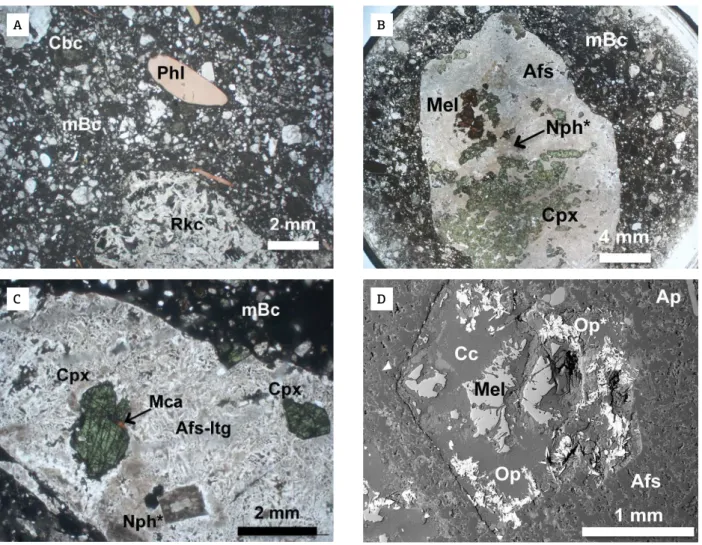
In our samples, the rock fragments are made up of plu-tonic and volcanic/subvolcanic igneous rock varieties with a medium- to high-grade alteration, as well as sandstones from the Botucatu Formation. Their dimensions vary from less than one cm to several cms (rarely over a decimeter in outcrops) and they have subrounded to angular shapes. The medium- to coarse-grained igneous rocks include granite, quartz-feldspar gneiss, and charnockite types from the crys-talline basement, as well as syenite varieties from the alka-line massif itself. Volcanic-subvolcanic types are made up of ankaratrite-like mafic-ultramafic varieties with pyroxene microcrysts in a fine-grained matrix, basaltic rocks, probably related to the Serra Geral Formation (Fig. 2A), and some unidentified, dark-colored, aphanitic varieties. Alves (2003) also reported the presence of pyrochlore-bearing carbonate fragments in neighboring outcrops.
through reaction with dilute HCl in hand specimens, but most of its constituents are generally not recognizable even under the optical microscope. XRD analysis of a ground-mass concentrate points to the occurrence, besides calcite, of aegirine, arfvedsonite and some unidentified phyllosilicate; quartz and K-feldspar reminiscent of the mineral fragments were also detected.
Melanite-bearing
nepheline syenite fragments
The melanite-bearing NeS fragments are greyish to slightly reddish-grey, angular to slightly rounded, and measure up to 4 cm (Fig. 2B). They are medium- to coarse-grained and
present a massive structure. In thin-polished sections, the contacts between fragments and the groundmass are sharp. Flow structures are observed around the fragments in some places. Modal contents vary: alkali-feldspar up to 65%, pseu-domorphs after nepheline up to 30%, clinopyroxene up to 15%, and melanite garnet up to 5%. The main accessory is apatite (up to 1%). All fragments present intense late alter-ation and the secondary minerals may amount to up to 40%. K-feldspar (2.5–5.0 mm) forms subidiomorphic to xenom-orphic tabular to irregular crystals, sometimes Carlsbad-twinned, with irregular mutual contacts. Intense substitution by clay minerals, carbonate, hematite and white mica give most grains a clouded aspect. Rare clean and fresh surfaces
A
C
B
D
are homogeneous and free of exsolved phases. The alteration patterns observed in some crystals suggest some kind of pre-vious intergrowths between feldspar and nepheline (Fig. 2C), resembling former pseudo-leucite aggregates (e.g., Rogova 1966, Ruberti etal. 2012). Albite appears as late, pristine, interstitial xenomorphic crystals.
Quadrangular and rectangular pseudomorphs (up to 3.0 mm) with idiomorphic outlines and relict orthogonal cleavage traces, composed mainly of thin white mica and some carbonate, are interpreted as former nepheline crys-tals (Fig. 2C).
Idiomorphic to subidiomorphic clinopyroxene (up to 2.5 mm) appears as crystal clusters or isolated grains showing a green to yellow-green pleochroism, and a slightly irregular patchy zoning. Carbonate and orange-reddish mica (Fig. 2C) are substitution products and occur along cleavage planes and as thin outer zones.
Melanite (up to 1.5 mm) is idiomorphic to subidiomor-phic and shows strong oscillatory zoning patterns accom-panying its crystal faces. It is reddish-orange to dark red in color and presents variable alteration. Crystals form small clusters or appear isolated and are often associated with pyroxene (Fig. 2B). Alteration is strongest over the darkest crystal zones. The main substituting phases are calcite (dom-inant) and Fe-Ti oxides (mainly ilmenite); titanite, pyrite, chalcopyrite, and some other unidentified phases appear in trace quantities (Fig. 2D). In some places, just pseudomorphs after garnet, made up of these late phases, are observed.
The main accessory is apatite (up to 0.7 mm), which occurs as pristine fresh idiomorphic crystals. Rare opaque phases appear in some fragments.
Phlogopite megacrysts
Phlogopite is the easiest recognizable mafic mineral in breccia hand samples. Under the microscope, it appears as slightly deformed, pristine, and inclusion-free megacrysts, typically with rounded contours and reddish to yellowish-or-ange pleochroic colors. Deformation is best evidenced in sec-tions normal to the cleavage, as crystals or crystal aggregates may appear bent around other mineral or rock fragments. Minute crystals made up of Fe-Ti oxides, mainly magnetite, armor some megacrysts. This late feature, and the rounded mica contours suggest the occurrence of emplacement-re-lated absorption reaction and oxidation phenomena.
MINERAL CHEMISTRY
Quantitative WDS spot analyses were obtained for alka-li-feldspars, clinopyroxene, melanite and late phlogopite from the rock fragments,, as well as for the phlogopite macrocrysts.
Representative compositions are shown in Table 1. The com-plete data set is available in the Supplementary Materials. The main chemical signatures of each mineral phase are described in the following paragraphs.
Alkali-feldspars
The primary alkali-feldspar has a relatively homogeneous composition, varying in the Or83Ab17 - Or95Ab05 range, with low An (≤ 0.6 mol) contents (Tab. 1, Fig. 3). Fe, Sr and Ba contents are low: ≤ 0.08, ≤ 0.08, and ≤ 0.12 cpfu (cations per formula unit), respectively (Tab. 1). Sr and Ba show a slightly negative correlation with K. Of note, these compo-sitions strongly contrast with those measured in alkali-feld-spar from the Pedreira NeS facies, which are characterized by very high Sr contents (SrO up to 1.4 wt.%, cf. Ulbrich 1983, 1993).
Secondary albite, formed probably by late exsolution reactions, is almost pure, with Ab ≥ 97.5 mol% (Fig. 3), and low Or (≤ 2.7) and An (≤ 0.8) molecular contents. Fe, Sr and Ba occur in trace amounts.
Clinopyroxene
The clinopyroxene compositions (Tab. 1, Fig. 4A) plot mainly as diopside, with some minor hedenbergite and aug-ite compositions in the quadrilateral scheme of Morimoto (1988). Of importance, the classic pyroxene classification (e.g., Deer etal. 1978) uses the names salite and sodian salite (instead of diopside), sodian ferrosalite (instead of hedenbergite) and sodian augite (instead of augite), which have better petrologic meaning. They are characterized by 0.44 ≤ mg# ≤ 0.65, low to moderate Al (0.04 ≤ AlT (cpfu)
≤ 0.16) and a significant acmite molecular content (up to 11.1%, see Tab. 1).
The compositional variations observed in our data set are well described by the substitution vector [M2+]
-2[NaFe3+]
as depicted in Figure 4B, a feature typically observed in common Ca-rich pyroxenes of alkaline igneous rocks (e.g., Deer etal. 1978).
Garnet
The analyzed titanian garnet presents 0.274 ≤ Ti ≤ 0.596, 0.020 ≤ Zr ≤ 0.144, AlT ≤ 0.451 (cpfu), and 0.85 ≤ Fe3+/
(Fe2++Fe3+) ≤ 0.98 (Tab. 1). As mentioned, the darker zones
within melanite crystals were the most susceptible to late alteration, thus Ti(Zr) compositions richer than those mea-sured probably did exist. When compared with several com-positions published in the literature (e.g., Deer etal. 1982), our melanite structural formulae fit better considering that most Fe2+ fills in octahedral, rather than dodecahedral sites.
Supplementary Material), are andradite [Andr, Ca3Fe3+ 2Si3O12,
up to 85%], morimotoite [Mrmt, (CaFe+2)
3Ti(Mg,Fe2+)Si3O12,
up to 19%], schorlomite [Schrlm, Ca3Ti2Si(Fe3+,Al) 2O12, up
to 10% ], kimzeyite [Kimz, Ca3Zr2SiAl2O12, up to 4%] and the hypothetical NaTi garnet [NaTiGrt, Na2CaTi2Si3O12, up to 2.5%]. It is worth noting that Antao (2014), on the basis of structural refinement results, shows that morimotoite and schorlomite are very similar mineral species. The observed compositional variations are well represented in the ternary diagrams Andr-Schrlm-Mrmt and Mrmt-Kimz-Schrlm, as depicted in Figure 5. Zr has a strong negative correlation with Al in our data set, resulting in a progressive increase of the Kinz molecule as Schrlm decreases, as evidenced in Fig. 5.
Ti and Zr, because of their crystallochemical proper-ties, are expected to substitute Si in the melanite tetrahedral sites. However, in general, they are mainly partitioned into octahedral coordination, and enter into the garnet struc-ture through the coupled substitution defined by the vector [R3+]
-2 [(Ti,Zr)(R2+)], as suggested by Grapes etal. (1979).
Micas
Both the micas constituting the breccia megacrysts and the late crystals in the melanite-bearing NeS breccia frag-ments have relatively homogeneous chemical compositions (Tab. 1). They are classified and compared in the triangular diagram Mg-AlT-(Fe2++Mn) in Fig. 6.
Table 1. Representative chemical compositions (WDS quantitative spot analysis) of alkali-feldspars, clinopyroxene, garnet and late mica from the melanite-bearing NeS fragments, and of phlogopite megacrysts from the Poços de Caldas conduit breccia. n.a. = not analyzed, b.d. = below detection limit. mg# = cationic Mg/(Mg + Fe2+(T) + Mn). See
text for discussion, and the Supplementary Material for the complete data set.
Mineral K-feldspar Late
Albite Clinopyroxene
Melanite Garnet
Megacrystic Phlogopite
Late Mica Point ID 02.1.5 02.1.9 02.01.9a c.1.1 c.2.1 b.2.1 i1.1 i.2.1 b.2.1 i.3.2 c1.c c2.i c3.c p.1 p.2
SiO2 64.50 64.73 68.31 51.22 51.30 50.89 33.68 34.27 35.40 33.92 37.69 37.95 37.21 41.07 38.37 TiO2 b.d. b.d. 0.02 0.47 0.63 0.28 3.86 3.50 2.22 2.75 6.39 6.62 6.51 0.40 1.82 ZrO2 n.a n.a n.a n.a n.a n.a 1.21 0.22 0.15 0.29 n.a. n.a. n.a. n.a. n.a. Al2O3 19.19 18.45 19.68 1.25 1.49 0.94 1.43 2.08 2.22 1.95 16.11 16.11 15.80 9.56 12.87 Cr2O3 n.a. n.a. n.a. n.a. n.a. n.a. b.d. b.d. b.d. b.d. n.a. n.a. n.a. n.a. n.a. FeOT 0.23 0.35 0.21 11.74 13.47 17.26 24.18 23.98 24.23 24.12 6.36 6.59 9.81 14.54 16.70 MnO b.d. b.d. b.d. 0.58 0.68 0.70 0.55 0.50 0.44 0.44 0.04 0.04 0.06 0.48 0.56 MgO 0.02 0.00 0.00 10.81 9.60 7.57 0.21 0.23 0.20 0.21 18.53 18.55 16.31 19.88 15.53 ZnO n.a. n.a. n.a. n.a. n.a. n.a. n.a. n.a. n.a. n.a. b.d. b.d. b.d. 0.08 0.08 CaO b.d. b.d. 0.03 22.35 21.52 18.91 31.67 32.08 32.42 32.18 0.00 0.08 0.05 0.12 0.24 SrO b.d. 0.05 0.04 n.a. n.a. n.a. n.a. n.a. n.a. n.a. n.a. n.a. n.a. n.a. n.a. BaO 0.02 b.d. 0.03 n.a. n.a. n.a. n.a. n.a. n.a. n.a. 0.25 0.23 0.26 b.d. 0.11 Na2O 1.85 0.72 11.66 1.19 1.49 3.00 0.10 0.19 0.16 0.15 0.12 0.15 0.16 b.d. 0.14 K2O 14.53 15.75 0.18 b.d. b.d. 0.09 n.a. n.a. n.a. n.a. 10.24 10.17 10.11 9.04 9.70 F n.a. n.a. n.a. n.a. n.a. n.a. n.a. n.a. n.a. n.a. b.d. b.d. b.d. 0.30 0.18 Cl n.a. n.a. n.a. n.a. n.a. n.a. n.a. n.a. n.a. n.a. 0.02 0.04 0.01 b.d. b.d.
O(=F,Cl) - - - 0.01 0.01 0.00 0.12 0.08
Sum 100.39 100.06 100.17 99.60 100.17 99.64 96.88 97.05 97.47 96.03 95.75 96.52 96.30 95.35 96.23
mg# - - - 0.61 0.55 0.43 - - - - 0.84 0.83 0.75 0.70 0.62
Molecular components
Or 83.73 93.51 1.52 Wo 45.47 44.26 38.67 Kimz 2.51 0.45 0.31 0.60 Ab 16.20 6.49 98.23 En 30.60 27.47 21.54 Schrlm 4.14 5.29 1.82 5.17 An 0.06 0.01 0.25 Fs 19.57 22.73 28.69 Mrmt 14.77 8.49 7.74 4.80 Ac 4.36 5.55 11.10 Gros 0.00 2.08 6.40 2.56 Andr 74.60 79.62 79.95 84.11 Others 3.98 4.07 3.78 2.76
The phlogopite megacrysts present a peculiar chemical composition, defined especially by high Ti (up to 0.71 cpfu) and Al (up to 2.75 AlT cpfu). Mg contents are also high
(0.74 ≤ mg# ≤ 0.85), while Ba (≤ 0.02 cpfu) and F (≤ 0.01 cpfu) appear in trace concentrations. Cationic Ti contents show a strong positive correlation (not shown) with IVAl and
negative correlations with the M2+ cations (Fe2+(T) + Mn,
Mg) and Si, indicating that Ti cations enter the phlogopite
structure mainly through the substitution vector [M2++2Si] -1[Ti4+2IVAl], as modified from the original suggestion of
Robert (1976, see also Arima and Edgar 1981). Based on experimental and crystallochemical evidence, these latter authors conclude that phlogopite Ti contents depend on temperature, pressure, and Oxygen fugacity (ƒO2).
The late mica, substituting for pyroxene in the melanite-bearing NeS fragments, presents 0.61 ≤ mg#
Figure 4. Compositional variations in clinopyroxenes of melanite-bearing NeS fragments from the Poços de Caldas conduit breccia. (A) Quadrangular Enstatite-Diopside-Hedenbergite-Ferrosilite [Mg2Si2O6-CaMgSi2O6-CaFeSi2O6 -Fe2Si2O6] diagram, with compositional field names as defined by Morimoto (1988, see text for discussion).
(B) Compositional variations related by the [Ca+Fe2++Mn+Mg]
-1[Na+Fe3+] coupled cationic substitution.
A B
Figure 5. Compositional variations of garnet in the melanite-bearing NeS fragments from the Poços the Caldas conduit breccia plotted in ternary molecular diagrams. Molecular end members as defined by Locock (2008): Andradite, Andr [Ca3Fe3+
2Si3O12]; Kimzeyite, Kimz
[Ca3Zr2SiAl2O12]; Morimotoite, Mrmt [(CaFe+2)
3Ti(Mg,Fe2+)
Si3O12]; Schorlomite, Schrlm [Ca3Ti2Si(Fe3+,Al)2O12]. See
text for discussion.
Figure 6. Compositional variations of phlogopite megacrysts and of late biotite and phlogopite from the melanite-bearing NeS fragments from the Poços de Caldas conduit breccia in the Mg-AlT-(Fe2++Mn) diagram.
Molecular end members: Ann, Annite [K2Fe6(Si6Al2O20)
(OH)4]; Est, Eastonite [K2Mg4Al2(Si4Al4O20)(OH)4]; Phl,
Phlogopite [K2Mg6(Si6Al2O20)(OH)4]; Sid, Siderophyllite
[K2Fe4Al2(Si4Al4O20)(OH)4]. Compositional fields as
≤ 0.70 and relatively low AlT (1.68–2.28 cpfu). In fact,
sev-eral analyses have (Si+AlT) < 8 cpfu and some Fe3+ is needed
to fill in the tetrahedral sites (see also Suppl. Tab. 1.). It also has low Ti (≤ 0.22 cpfu), Ba (≤ 0.01 cpfu) and F (≤ 0.19 cpfu) contents, and relatively high Ca (up to 0.05 cpfu) con-tents. The compositions plot in a transitional field between biotite and phlogopite, as defined by Mitchell (1995) and depicted in Fig. 6.
40
Ar/
39Ar DATING
OF PHLOGOPITE MEGACRYSTS
Analytical isotope data for phlogopite concentrates from sample PC-17 (IBI-42q) are presented in full in the Supplementary Materials. Two megacryst aliquots were ana-lyzed and yielded very similar results (Fig. 7). The step-heat-ing spectra show well-defined age plateaus, compatible with closed systems, and give integrated 40Ar/39Ar ages of 87.1 (±
0.5) Ma and 86.6 (± 0.5) Ma, respectively. The combined
age-probability spectrum peeks at 86.7 Ma, and indicates a probable 40Ar/39Ar age of 86.7 (± 0.4) Ma (MSWD =
1.35, P = 0.14, N = 21) for the isotopic system closure. The computed isochronic 36Ar/40Ar - 39Ar/40Ar age (86.6 ± 0.4
Ma, 40Ar/36Ar = 309 ± 14, MSWD = 1.2, P = 0.2, N = 25,
not shown) is almost identical and indicates strong inter-nal data consistency.
This age is significantly older than the 40Ar/39Ar
phlo-gopite ages reported for the late carbonatitic veins from the Minas Pedras quarry (ca. 84 Ma; Vlach etal. 2003) and for
the lamprophyre dike from the Osamu Utsumi open pit (ca. 76 Ma; Shea 1992), as summarized in section 2.1.
DISCUSSION AND SUMMARY
On the occurrence of melanite-bearing
nepheline syenites and its petrologic
implications
Melanite garnet occurs in several felsic to mafic-ultramafic alkaline rocks, such as metaluminous NeS, ijolites, melteigites, various lamprophyres and silico-carbonatite types, and their volcanic-subvolcanic equivalents (e.g., Deer etal. 1982, Rock 1991, and references therein). In southern Brazil, its presence was previously described in several Mesozoic alkaline massifs (Gomes 1969, Brotzu etal. 1997, Ruberti etal. 2012).
Few reports exist regarding the presence of melanite in the Poços de Caldas Massif. The first mention came from the pioneering work of Machado (1888), who described the presence of melanite in a coarse-grained clinopyroxene NeS. The author studied many other minerals and rocks, supposedly collected within the massif, but did not pro-vide enough information as to identify the exact collection sites. Bushee (1971) described an unusual occurrence of melanite in khibinites from the northern area of the massif, but our previous work showed that this mineral is sphaler-ite (G. Gualda and S. Vlach, pers. commun.) Thus, in the Poços de Caldas region, confirmed reports up to now indi-cate that melanite occurs in ultramafic lamprophyres and
Figure 7. 40Ar/39Ar age diagrams for phlogopite megacrysts from the Poços de Caldas conduit breccia (Sample
PC-17.1 = IBI-42q). Left: 40Ar/39Ar step heating spectra (colors represent results for the two analyzed aliquots); note
related silico-carbonatitic rocks at the Minas Pedras quarry (Vlach et al. 1996, 1988, Vilalva & Vlach 2004).
Typical metaluminous (miaskitic) NeS types are rela-tively rare in the district, a statement that apply also to tin-guaites. However, detailed data for them are incomplete, available only for certain areas within the massif (Ulbrich 1983, Ulbrich etal. 2005, and references therein). In fact, the largest NeS intrusion, the Pedreira facies, outcropping in the central and northern area of the massif, is made up of moderately miaskitic, slightly metaluminous, as well as slightly peralkaline, types [0.98 ≤ [(Na
2O+K2O)/Al2O3,
molar] ≤ 1.05, cf. Ulbrich 1984, Ulbrich etal. 2005].
The rock fragments found in the conduit breccia point to the existence of hidden or unexposed NeS, with a marked met-aluminous geochemical character in Poços de Caldas, a feature shared by several Brazilian and worldwide alkaline massifs.
Experimental data on the equilibrium of hedenber-gite-andradite assemblages indicate that these minerals coexist under relatively high oxygen fugacities (fO2 above the Ni-NiO buffer at T ≤ 650ºC) in skarn-like natural sys-tems (e.g., Gustafson 1974, Liou 1974, Moecher and Chou 1990). In mafic-ultramafic and feldsphatic alkaline igne-ous rocks, however, Virgo etal. (1976) have shown that Ca-pyroxene and Ti-andradite could coexist well below the QFM (quartz-fayalite-magnetite) buffer.
Several metaluminous NeS contain melanite, with vari-able Ti contents, coexisting with Ca-pyroxene, titanite and primary calcitic carbonate (e.g., melanite-bearing pseudo-leucite syenites from the Banhadão Alkaline Complex, Ruberti etal. 2012). This mineralogical association may be constrained to some extent by the prevailing fCO2 of the crystallizing environment, according to the following reac-tion, which is independent of fO2 (Eq. 1):
[Ca3TiFe2+Si
3O12]Grt + CO2↔ [CaFe2+Si2O6]Cpx +
[CaTiSiO5]Ttn + [CaCO3]Cb (1) This reaction suggests that the presence and increase of the morimotoite molecular component in garnet is favored by rela-tively low fCO2. It could help constrain the presence of Ti-garnets in CO2-bearing alkaline feldsphatic as well as silico-carbon-atite systems, like those appearing at the Minas Pedras quarry.
Phlogopite megacrysts
compositions, age, and implications
The chemical fingerprints of the studied phlogopite megacrysts, especially the relatively high contents of Al, Ti, and Mg, are com-mon features of phlogopites from worldwide occurrences in lam-prophyric rocks, as well as some carbonatites, kimberlite, and other related types (e.g., Rock 1991, Mitchell 1995, and refer-ences therein). Thus, our measured compositions do not provide
a diagnostic chemical characterization that would undoubtedly tie mineral chemistry to rock association.For instance, chemi-cally similar phlogopites, both with relatively high and low Ba and F contents, were described in samples from the ultramafic lamprophyres and related silico-carbonatites from the Minas Pedras quarry (Vlach etal. 1996, 2003).
Textures in the phlogopite megacrysts suggest that they are pieces torn off from still crystallizing magma mushes from an unknown depth, rather than fragments of solid rocks. In fact, they are not highly deformed or broken up, as would be expected if they had been subjected to a vio-lent explosion of a host solid media. Our chemical data, as well as the occurrence of augite/Ti-augite companion crys-tal fragments, suggest a source akin to magmatic systems associated with ultramafic lamprophyres, silico-carbonatites, and ankaratrites, such as those cropping out in the Minas Pedras quarry and the Vale do Quartel area.
The obtained 40Ar/39Ar age (ca. 87 Ma) should represent
a minimum age for phlogopite crystallization and formation of melanite-bearing NeS and other hosted fragments as well as a maximum age for breccia emplacement. Considering the relatively shallow crustal emplacement levels involved, such minimum and maximum values are expected to be similar, within error estimates. This age is somewhat older than the
40Ar/39Ar age available for the carbonatite late veins in the
Minas Pedras quarry (ca. 84 Ma, Vlach etal. 2003) and the Rb/Sr isochron reported for the lujavrite-khibinite body (ca. 83 Ma, Ulbrich etal. 2002, 2005), and somewhat younger than a whole-rock K/Ar age obtained for an ankaratrite (Bushee 1971, Sonoki & Garda 1988) as well as the Rb/Sr isochron for the northern NeS (ca. 89 Ma, cf. Ulbrich et al., 2002, 2005). It should be noted that all of them are significantly older than the “best” presumed (ca. 79 Ma) age for the main magmatism of the massif according to Ulbrich etal. (2002).
results. Ongoing detailed geochronological work would help solve such a conundrum.
ACKNOWLEDGEMENTS
We thank the staff of the GeoAnalitica-USP (São Paulo, Brazil) core facility and the IQ-Ages Laboratory (Queensland, Australia) for analytical support, Ms. M. Arroyave for imaging help, and Fundação de Amparo à Pesquisa do Estado de São Paulo (FAPESP, Thematic Project No 2012/06082-6, Coord.
E. Ruberti) for financial support. H. Ulbrich and M. Ulbrich would like to thank FAPESP for previous grants that allowed for field and laboratory work on the Poços de Caldas massif for several years. Lastly, the suggestions and criticism from G. Gualda and an anonymous reviewer were much appreciated.
SUPPLEMENTARY DATA
Supplementary data associated with this article can be found in the online version: Suplementary Table 1.
Almeida F.F.M. 1983. Relações tectônicas das rochas alcalinas mesozóicas da região meridional da plataforma sul-americana. Revista Brasileira de Geociências, 13:139-158.
Alves A.D. 2003. Rochas Vulcanoclásticas do Complexo Alcalino de Poços de Caldas - MG/SP. MS Dissertation, Instituto de Geociências, Universidade de São Paulo, São Paulo, 106 p.
Amaral G., Bushee J., Cordani U.G., Kawashita K., Reynolds J.H. 1967. Potassium-argon ages of alkaline rocks from southern Brazil. Geochimica et Cosmochimica Acta, 31:117-142. https://doi. org/10.1016/S0016-7037(67)80041-3
Antao S.M. 2014. Schorlomite and morimotoite: what’s in a name? Powder Diffraction, 29:346-351. https://doi.org/10.1017/ S0885715614000529
Arima M., Edgar A.D. 1981. Substitution mechanisms and solubiity of titanium in phlogopites from rocks of probable mantle origin. Contributions to Mineralogy and Petrology, 77:288-295. https://doi. org/10.1007/BF00373544
Björnberg A.J.B. 1959. Rochas clásticas do Planalto de Poços de Caldas. Boletim Faculdade de Filosofia, Ciências e Letras, Universidade
de São Paulo, Geologia, 237(18): 65-123.
Brotzu P., Gomes C.B., Melluso L., Morbidelli L., Morra V., Ruberti E. 1997. Petrogenesis of coexisting SiO2-undersaturated to SiO2 -oversaturated felsic igneous rocks: The alkaline complex of Itatiaia, southeastern Brazil. Lithos, 40:133-156. https://doi.org/10.1016/ S0024-4937(97)00007-8
Bushee J. 1971. Petrographical and geochronological studies in alkaline rocks from southern Brazil. PhD Thesis, The University of California, Berkeley, 145 p.
Cande S.C., Kent D.V. 1995. Revised calibration of the geomagnetic polarity timescale for the Late Cretaceous and Cenozoic. Journal of Geophysical Research, 100:6093-6095. https://doi. org/10.1029/94JB03098
Comin-Chiaramonti P., Gomes C.B. 2005. Mesozoic to Cenozoic Alkaline Magmatism in the Brazilian Platform. São Paulo, EDUSP/ FAPESP, 751 p.
Deer W.A., Howie R.A., Zussman J. 1978. Rock-forming minerals, v. 2A: Single-chain silicates. 2ed. London, Longman Group Limited, 668 p. Deer W.A., Howie R.A., Zussman J. 1982. Rock-forming minerals, v. 1: Orthosilicates. New York, Longman Group Limited, 919 p.
Derby O.A. 1887. On nepheline rocks in Brazil, with special reference to the association of phonolite and foyaite. Quarterly Journal of the
Geological Society of London, 43:457-473. https://doi.org/10.1144/ GSL.JGS.1887.043.01-04.35
REFERENCES
Ellert R. 1959. Contribuição à geologia do Maciço Alcalino de Poços de Caldas. Boletim da Faculdade de Filosofia, Ciência e Letras,
Universidade de São Paulo, 237(18):5-63. http://dx.doi.org/10.11606/
issn.2526-3862.bffcluspgeologia.1959.121851
Garda G.M. 1990. A alteração hidrotermal no contexto da evolução geológica do maciço alcalino de Poços de Caldas, MG-SP. MS Dissertation, Instituto de Geociências, Universidade de São Paulo, São Paulo,161 p.
Gomes C.B. 1969. Electron microprobe analysis of zoned melanites. American Mineralogist, 54:1654-1661.
Grapes R.H., Yagi K., Okumura K. 1979. Aenigmatite, sodic pyroxene, arfvedsonite and associated minerals in syenites from Morou, Sakhalin. Contributions to Mineralogy and Petrology, 69:97-103. https://doi.org/10.1007/BF00371853
Gualda G.A.R., Vlach S.R.F. 2005. Stoichiometry-based estimates of ferric iron in calcic, sodic-calcic and sodic amphiboles: A comparison of various methods. Anais da Academia Brasileira de Ciências, 77:521-534. http://dx.doi.org/10.1590/ S0001-37652005000300012
Gualda G.A.R., Vlach S.R.F. 2007. The Serra da Graciosa A-type granites and syenites, southern Brazil. Part II: Petrographic and mineralogical evolution of the alkaline and aluminous associations.
Lithos, 93:310-327. DOI: 10.1016/j.lithos.2006.06.002
Gustafson W.I. 1974. The stability of andradite, hedenbergite, and related minerals in the system Ca-Fe-Si-O-H. Journal of Petrology,
15:455-496. https://doi.org/10.1093/petrology/15.3.455
Liou J.G. 1974. Stability relations of andradite-quartz in the system Ca-Fe-Si-O-H. American Mineralogist, 59:1016-1025.
Locock A.J. 2008. An Excel spreadsheet to recast analyses of garnet into end-member components, and a synopsis of the crystal chemistry of natural silicate garnets. Computer Geosciences,
34:1769-1780. https://doi.org/10.1016/j.cageo.2007.12.013
Machado J. 1888. Beitrag zur Petrographie der suedwestlichen Grenze zwischen Minas Gerais und São Paulo. Tschermak’s Mineralogische und Petrographische Mitteilungen, 9:318-360.
McDougall I., Wellman P. 2011. Calibration of GA1550 biotite standard for K/Ar and 40Ar/39Ar dating. Chemical Geology, 280 :19-25. DOI: 10.1016/j.chemgeo.2010.10.001
Mitchell R.H. 1995. Kimberlites, orangeites, and related rocks. New York, Plenum Press, 410 p.
Moecher D.P., Chou I-M. 1990. Experimental investigation of andradite and hedenbergite equilibria employing the hydrogen
sensor technique, with revised estimates of ÞfG0
Montes Lauar C.F. 1988. Estudo paleomagnético dos maciços alcalinos de Poços de Caldas, Passa Quatro e Itatiaia. MS Dissertation, Instituto Astronômico e Geofísico, Universidade de São Paulo, São Paulo, 101 p.
Morimoto N. 1988. Nomenclature of pyroxenes. Mineralogy and Petrology, 39:55-76. https://doi.org/10.1007/BF01226262
Oliveira M.A.F., Alves F.R., Coimbra A.M. 1975. Sedimentação associada ao vulcanismo alcalino de Poços de Caldas (Divinolândia, SP). Boletim do Instituto de Geociências da Universidade de São
Paulo, 6:13-19.
Paradella W.R., Almeida Filho R. 1976. Condicionamento das mineralizações radioativas no Planalto de Poços de Caldas baseado em imagens MSS de Landsat. In: Congresso Brasileiro de Geologia, 29., Ouro Preto. Anais… 3:181-190.
Renne P.R., Cassata W.S., Morgan L.E. 2009. The isotope composition of atmospheric argon 40Ar/39Ar geochronology: Time for a change? Quaternary Geology, 4:288-298. DOI: 10.1016/j.quageo.2009.02.015
Robert J.L. 1976. Titanium solubility in synthetic phlogopite solid solutions. Chemical Geology, 17:213-227. https://doi. org/10.1016/0009-2541(76)90036-X
Rock N.M.S. 1991. Lamprophyres. New York, Blackie and Son, 285 p.
Rogova V.P. 1966. Pseudoleucite rocks of the Murun alkali complex.
Doklady Academy of Sciences USSR. Earth Science Section,
169:170-173.
Ruberti E., Enrich G.E.R., Azzone R.G., Comin-Chiaramonti P., De Min A., Gomes C.B. 2012. The Banhadão Alkaline Complex, southeastern Brazil: source and evolution of potassic SiO2-undersaturated high-Ca and low-Ca magmatic series. Mineralogy and Petrology, 104:63-80. https://doi.org/10.1007/s00710-011-0171-9
Sadowski G.R., Dias Neto C.M. 1981. O lineamento sismo-tectônico de Cabo Frio. Revista Brasileira de Geociências, 11:209-212. Schorscher H.D., Shea M.E. 1992. The regional geology of the Poços de Caldas alkaline complex: mineralogy and geochemistry of selected nepheline syenites and phonolites. Journal of Geochemical Exploration, 45:25-51. DOI: 10.1016/0375-6742(92)90121-N
Shea M.E. 1992. Isotopic geochemical characteristics of selected nepheline syenites and phonolites from the Poços de Caldas alkaline complex. Minas Gerais, Brazil. Journal of Geochemical Exploration,
45:173-214. DOI: 10.1016/0375-6742(92)90125-R
Sonoki I.K., Garda G.M. 1988. Idades K-Ar de rochas alcalinas do Brasil meridional e Paraguai oriental: compilação e adaptação às novas constantes de decaimento. Boletim IG-USP, Série Científica, 19:63-85.
Sorensen H. 1974a. Alkali syenites, feldspathoidal syenites and related lavas. In: Sorensen H. (Ed.). The Alkaline Rocks. New York, Wiley, p. 22-52.
Sorensen H. 1974b. Glossary of alkaline and related rocks. In: Sorensen H. (Ed.). The Alkaline Rocks. New York, Wiley, p. 577-588.
Steiger R.H., Jäger E. 1977. Subcommission on geochronology: Convention on the use of decay constants in geo- and cosmochemistry. Earth and Planetary Science Letters, 36:359-362.
Thompson R.N., Gibson S.A., Mitchell J.G., Dickin A.P., Leonardos O.H., Brod J.A., Greenwood J.C. 1998. Migrating Cretaceous-Eocene magmatism in the Serra do Mar alkaline province, SE Brazil: melts
from the deflected Trindade mantle plume? Journal of Petrology,
39:1493-1526.
Ulbrich H.H.G.J. 1984. A petrografia, a estrutura e o quimismo de nefelina sienitos do Maciço Alcalino de Poços de Caldas, MG-SP. Thesis, Instituto de Geociências, Universidade de São Paulo, São Paulo, 480 p.
Ulbrich H.H.G.J. 1986. As brechas de origem ígnea: Revisão e proposta
para uma classificação geológica. Boletim IG-USP, Publicação Especial,
3. 78 p. http://dx.doi.org/10.11606/issn.2317-8078.v0i3p01-82
Ulbrich H.H., Ulbrich M.N.C. 2000. The lujavrite and khibinite bodies in the Poços de Caldas alkaline massif, southeastern Brazil: a structural and petrographic study. Revista Brasileira de Geociências,
30:615-622.
Ulbrich H.H.G.J., Gomes C.B. 1981. Alkaline rocks from continental Brazil. Earth Science Reviews, 17:135-154. https://doi. org/10.1016/0012-8252(81)90009-X
Ulbrich H.H.G.J., Vlach S.R.F., Demaiffe D., Ulbrich M.N.C. 2005.
Structure and origin of the Poços de Caldas alkaline massif, SE Brazil. In: Comin-Chiaramonti P., Gomes C.B. (Eds.). Mesozoic to Cenozoic Alkaline Magmatism in the Brazilian Platform. São Paulo, EDUSP/FAPESP, p. 367-418.
Ulbrich H.H.G.J., Vlach S.R.F., Ulbrich M.N.C., Kawashita K. 2002. Penecontemporaneous syenitic-phonolitic and basic-ultrabasic-carbonatitic rocks at the Poços de Caldas Alkaline Massif, SE Brazil. Revista Brasileira de Geociências, 32:15-26.
Ulbrich M.N.C. 1983. Aspectos mineralógicos e petrológicos do Maciço Alcalino de Poços de Caldas, MG-SP. Doctoral Thesis, Instituto de Geociências, Universidade de São Paulo, São Paulo, 369 p.
Ulbrich M.N.C. 1993. Mineralogy of nepheline syenites from the Poços de Caldas alkaline massif, SE Brazil: chemistry, XR data and microtextures of feldspars. Revista Brasileira de Geociências,23:388-399.
Vasconcelos P.M., Onoe A.T., Kawashita K., Soares A.J., Teixeira W. 2002. 40Ar/39Ar geochronology at the Instituto de Geociências, USP: instrumentation, analytical procedures, and calibration. Anais da Academia Brasileira de Ciências, 74:297-342. http://dx.doi. org/10.1590/S0001-37652002000200008
Vilalva F.C.J., Vlach S.R.F. 2004. Variações químicas em granada, espinélios e ilmenita de rochas lamprofíricas e sílico-carbonatíticas associadas ao Maciço Alcalino Poços de Caldas (MG-SP). In: Simpósio
Internacional de Iniciação Científica, 12., São Paulo. Anais... Universidade de São Paulo, São Paulo. CD-ROM.
Virgo D., Rosenhauer M., Huggins F.E. 1976. Intrinsic oxygen fugacities of natural melanites and schorlomites and crystal-chemical implications. Annual Report of the Carnegie Institute of Washington (1975-1976), p. 720-729.
Vlach S.R.F., Ulbrich H.H.G.J., Ulbrich M.N.C. 1998. Isótopos
radiogênicos (Sr, Nd) e estáveis (C, O) de rochas máfico-ultramáficas
potássicas da região de Poços de Caldas, MG-SP: inferências sobre a natureza do manto litosférico mesozóico. In: Congresso Brasileiro de Geologia, 40., Belo Horizonte. Anais... p. 475.
Vlach S.R.F., Ulbrich M.N.C., Ulbrich H.H.G.J., Gualda G.A.R. 1996.
Rochas de afinidades alnoíticas e sílico-carbonatíticas periféricas ao
Maciço Alcalino de Poços de Caldas (MG-SP). In: Congresso Brasileiro de Geologia, 39., Salvador. Anais… 2:128-130.
Vlach S.R.F., Vilalva F.C.J., Ulbrich M.N.C., Ulbrich H.H.G.J., Vasconcelos P.M. 2003. Phlogopite from carbonatitic veins associated with the Poços de Caldas Alkaline Massif, SE Brazil: mineralogy and 40Ar/39Ar dating by the laser step heating method. In: South American Symposium on Isotope Geology, 4., Salvador. Short Papers… p. 702-705.