DOI: 10.5935/2359-4802.20180034
ORIGINAL ARTICLE
Mailing Address: Eduardo del Bosco Brunetti Cunha
Rua Costa Rica, 858. Postal Code: 82510-180, Bacacheri, Curitiba, PR - Brazil. E-mail: [email protected], [email protected]
Evaluation of Lipid Profile in Adolescents
Eduardo del Bosco Brunetti Cunha,1,2 Rafael Pereira Fagundes,2 Edson Emílio Scalabrin1, Roberto Hirochi Herai1
Pontifícia Universidade Católica do Paraná (PUCPR),1 PR - Brazil
Faculdade Educacional Araucária,2 PR - Brazil
Manuscript received October 10, 2017; revised manuscript January 17, 2018; accepted February 16, 2018.
Abstract
Background: Atherosclerosis is a chronic, multifactorial and insidious disease that can begin in childhood and adolescence, and whose major consequences appear during adulthood. Serum levels of lipoproteins, such as LDL-c, total cholesterol (TC), HDL-c, and non-HDL-c can be used as a screening method for disease diagnosis. In Brazil, few studies have correlated the serum levels of those lipoproteins with age.
Objective: To evaluate the serum concentrations of TC, LDL-c, HDL-c, VLDL-c, non-HDL-c and triglycerides (TG) of adolescents aged 10 to 19 years in the municipality of Araucária, Paraná state.
Methods: Cross-sectional retrospective study, collecting the following data from 600 adolescents: age, sex and serum levels of TC, LDL-c, HDL-c and TG from June to December 2016. Data were analyzed using the SPSS software 2.0, with Mann-Whitney U test and Spearman coefficient of correlation to identify statistical significance (p < 0.05).
Results: The female sex showed higher serum levels of TC, TG and LDL-c than the male sex. The HDL-c levels were identical in both sexes, with 48% of desirable values and 52% of low values. This study identified a strong correlation between the lipids and association with the age group of 10 to 14 years.
Conclusion: Non-HDL-c showed stronger correlation with the other lipids (TG, LDL-c and TC) as compared to LDL-c, suggesting that non-HDL-c can be used as an effective complementary diagnostic method to assess the risks for atherosclerosis in adolescents. (Int J Cardiovasc Sci. 2018;31(4)367-373)
Keywords: Dyslipidemias/epidemiology; Adolescent; Lipoproteins; Hypercholesterolemia/epidemiology.
Such lipoproteins can adhere to the intimal layer of arteries, causing the formation of atheromatous plaques
that lead to atherosclerosis.6 This atherosclerotic process
begins in childhood, before clinical symptoms can be
perceived.7 In the aorta, fatty streaks begin at the age of
3 years, while in the coronary arteries, 5 to 10 years later.8
Over time, such fatty streaks form fatty plaques that can rupture, leading to different ischemic processes, such as
acute myocardial infarction and stroke.9
The lipid profile is a panel of blood tests to assess the serum concentrations of lipoproteins, such as total cholesterol (TC), high-density lipoprotein cholesterol (HDL-c), LDL-c, very-low-density lipoprotein cholesterol
(VLDL-c), non-HDL-c, and triglycerides (TG).10
Introduction
Cardiovascular diseases (CVD) are the major cause
of death of men and women worldwide.1 In Brazil,
according to the last 2013 Ministry of Health survey, of a total of 201,062,789 inhabitants, 678,556 of the deaths
were related to the circulatory system.2
The risk factors for CVD are classified as modifiable and nonmodifiable. Some of the modifiable risk factors are
sedentary lifestyle, smoking, obesity and dyslipidemia.2
Some nonmodifiable risk factors are family history
of CVD, age, sex and ethnicity.3 Dyslipidemia has a
great influence on the development of CVD, since an inadequate diet increases the concentration of
Knowing that dyslipidemia is associated with CVD, its diagnosis in adolescence can reduce the chances of future complications, because a change in lifestyle to healthier
habits can be the best prevention.11,12
This study was aimed at assessing the lipid profile of adolescents of the municipality of Araucária, Paraná state. It collected data of 600 adolescents aged 10 to 19 years and compared them to those of studies conducted in other regions of Brazil.
Methods
This study was approved by the Ethics Committee in
Research of the Instituto Paranaense de Otorrinolaringologia
and is registered under the number 65932917.0.0000.5529, according to the Resolution 466/12 of the National Board of Health of the Ministry of Health, which regulates research with human beings. The results of 600 lipid profiles were collected from the Araucária Municipal Laboratory, which had been approved by the local coordinator, so that the study could begin even before approval by the Ethics Committee in Research.
This is a cross-sectional, retrospective study with convenience sampling of the lipid profile of 600 adolescents aged 10 to 19 years, through systematic random sampling, from July to December 2016. Tests with TG levels greater than 400 mg/dL were excluded. The samples were collected 5-mL tubes containing serum separating gel and particles to activate clotting, and were tested by enzymatic photometric assay (Abbott Architect c8000), using the direct precipitation method for HDL-c quantitation (Ultra HDL). To calculate VLDL-c, the TG level was divided by 5, and to calculate LDL-c, the Friedewald formula was used. The collected data were organized in Excel 2007 sheets and stratified as TC, LDL-c, HDL-c, non-HDL-c (sum of the lipoproteins without HDL), VLDL-c and TG, in addition to age and sex of the adolescents, being identified by codes and organized in tables and graphs.
Statistical analysis
The descriptive statistical analysis included percentage and median with respective interquartile range (IQR). Continuous variables were expressed as median and IQR, because they had no normal distribution, while categorical variables were expressed as percentages. Normality was assessed by use of the Kolmogorov-Smirnov test. The statistical analysis comprised
Mann-Whitney U test and Spearman coefficient of correlation (S), using the SPSS software 2.0. The adopted significance level was 5% of probability and 95% confidence interval, and all tests were two-tailed.
Results
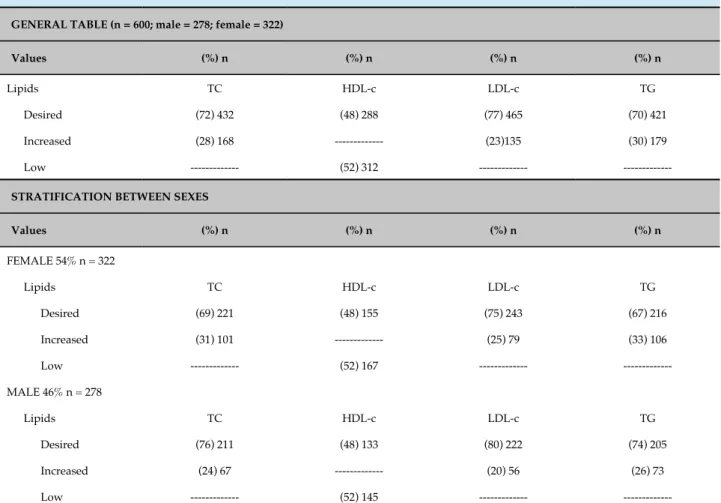
The lipid profiles of 600 adolescents aged 10 to 19 years from the Araucária Municipal Laboratory were assessed. Of the 600 adolescents, 322 (54%) were of the female sex and 278 (46%) were of the male sex. Table 1 shows the analyzed data, which, in 1.83% (n = 11) of the adolescents,
it is suggested familial hypercholesterolemia.10 Tables
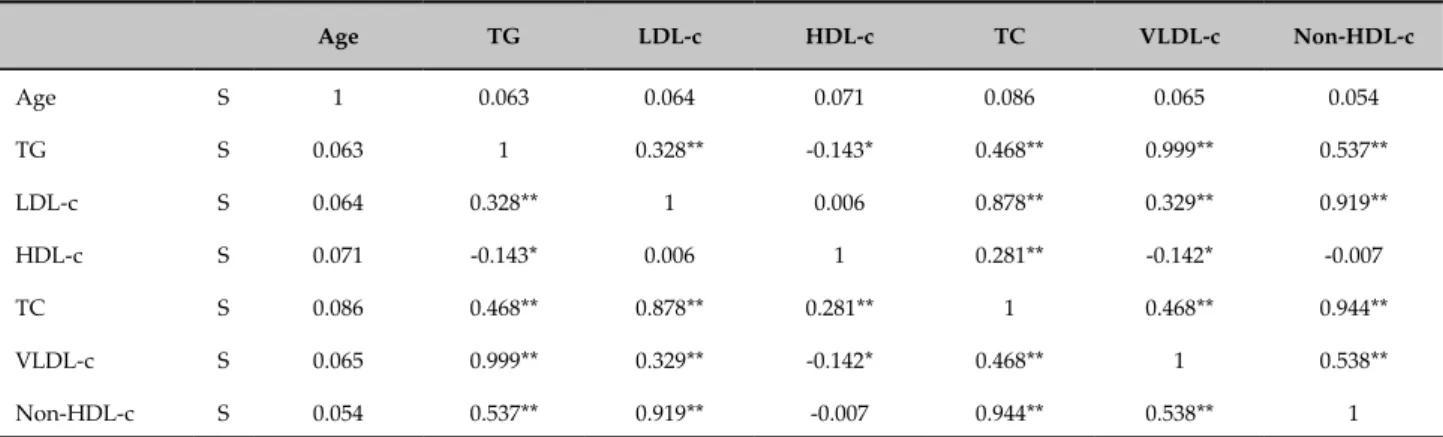
2, 3 and 4 show the correlations between the lipids, where 1 means perfect positive correlation, that is, when one variable increases, the other increases at the same intensity, and -1 means perfect negative correlation, that is, when one variable increases, the other decreases at the same intensity.
When comparing between sexes, the female sex had a higher TC than that of the male sex (Figure 1A). Regarding non-HDL-c, the female sex had a median of 109 and IQR of 40.25, while the male sex had a median of 101 and IQR of 32.25, with no significant difference between them. In addition, in the non-stratified sample, positive correlations of non-HDL-c were found with TG, TC and VLDL-c as compared to LDL-c, and fewer negative correlations with HDL-c (Table 2).
In adolescents aged 10 to 14 years, more positive correlations of non-HDL-c with TG, TC and VLDL-c were found as compared to LDL-c, and some negative correlations of LDL-c, TC and non-HDL-c with age (Table 3). When comparing between sexes, only TG showed a difference (Figure 1B). Regarding sexes, in adolescents aged 15 to 19 years, the correlations showed the same trend of the other age group (Table 4), and the comparisons between sexes achieving significance for the LDL-c (Figure 1C) and TC (Figure 1D), while the other lipids showed no statistically significant variation.
Discussion
The study by Silva et al.11 has reported desirable values
of TC of 50%, similar to those found in the present study (49%), but different from the 37% reported by Araki et
al.13 This difference was observed in a study conducted
Table 1 - Lipid profile of adolescents aged 10 to 19 years
GENERAL TABLE (n = 600; male = 278; female = 322)
Values (%) n (%) n (%) n (%) n
Lipids TC HDL-c LDL-c TG
Desired (72) 432 (48) 288 (77) 465 (70) 421
Increased (28) 168 --- (23)135 (30) 179
Low --- (52) 312 ---
---STRATIFICATION BETWEEN SEXES
Values (%) n (%) n (%) n (%) n
FEMALE 54% n = 322
Lipids TC HDL-c LDL-c TG
Desired (69) 221 (48) 155 (75) 243 (67) 216
Increased (31) 101 --- (25) 79 (33) 106
Low --- (52) 167 ---
---MALE 46% n = 278
Lipids TC HDL-c LDL-c TG
Desired (76) 211 (48) 133 (80) 222 (74) 205
Increased (24) 67 --- (20) 56 (26) 73
Low --- (52) 145 ---
---Values according to the 2017 Brazilian Guideline on Dyslipidemia and Atherosclerosis Prevention.10 TC: total cholesterol; HDL-c: high-density
lipoprotein cholesterol; LDL-c: low-density lipoprotein cholesterol; TG: triglycerides; n: absolute number of individuals.
in this study and in the specialized literature. Similar
results have also been reported by Silva et al.14 in a study
conducted in the city of Janeiro, and by Araki et al.15 in a
study conducted in the city of Aracaju, Sergipe state, and
by Kruger et al.16 in a study conducted in the municipality
of Mamboré, Paraná state.16
The serum levels of TG in adolescents aged 10 to 14 years were higher in the female sex, which has been also reported by Silva et al.14 and Kruger et al.16
Regarding LDL-c, the findings are similar to those
reported by Araki et al.13 and by Seki et al.,17 who have
shown a strong positive correlation between LDL-c and HDL-c, between LDL-c and TC, and between non-HDL-c and TC. Some negative correlations have been reported involving non-HDL-c and HDL-c, coinciding with the same studies. In addition, our study showed that as the adolescents from the 10-to-14-year-old group aged, their serum levels of LDL-c, TC and non-HDL-c decreased.
Several studies have shown that non-HDL-c is one of the best indicators of the atherosclerotic risk in children
and adolescents,18-20 because it is more strongly associated
with lesions in the abdominal aorta and coronary arteries than the other lipids are,20-22 in addition to being associated
with metabolic diseases.23 The stronger correlations of
non-HDL-c with the other lipids (TG, LDL-c and TC) found in this study as compared to those of LDL-c are in accordance with the literature, and the National Heart, Lung and Blood Institute (NHLBI) has already included reference values for non-HDL-c, recommending it for
screening during childhood.24 In adults, non-HDL-c is a
better predictor of CVD than LDL-c is.25,26
In this study, among the adolescents aged 10 to 19 years, changes in HDL-c levels were observed in 52% of the
sample, similarly to the study by Silva et al.11 conducted
Table 2 - Correlations of the lipid variables in adolescents aged 10 to 19 years (n = 600)
Age TG LDL-c HDL-c TC VLDL-c Non-HDL-c
Age S 1 0.004 -0.079 -0.010 -0.071 0.004 -0.080
TG S 0.004 1 0.292** -0.232** 0.396** 0.999** 0.493**
LDL-c S -0.079 0.292** 1 0.024 0.896** 0.289** 0.935**
HDL-c S -0.010 -0.232** 0.024 1 0.282** -0.230** -0.032
TC S -0.071 0.396** 0.896** 0.282** 1 0.394** 0.934**
VLDL-c S 0.004 0.999** 0.289** -0.230** 0.394** 1 0.490**
Non-HDL-c S -0.080 0.493** 0.935** -0.032 0.934** 0.490** 1
TC: total cholesterol; HDL-c: high-density lipoprotein cholesterol; LDL-c: low-density lipoprotein cholesterol; TG: triglycerides; Non-HDL-c: sum of the lipoproteins without HDL-c; S: Spearman correlation. * p < 0.05; ** p < 0.001.
Table 3 - Correlations of the lipid variables in adolescents aged 10 to 14 years (n = 339)
Age TG LDL-c HDL-c TC VLDL-c Non-HDL-c
Age S 1 -0.056 -0.140** -0.079 -0.138* -0.056 -0.136*
TG S -0.056 1 0.262** -0.300** 0.337** 0.999** 0.457**
LDL-c S -0.140** 0.262** 1 0.039 0.912** 0.257** 0.949**
HDL-c S -0.079 -0.300** 0.039 1 0.282** -0.298** -0.053
TC S -0.138* 0.337** 0.912** 0.282** 1 0.333** 0.926**
VLDL-c S -0.056 0.999** 0.257** -0.298** 0.333** 1 0.452**
Non-HDL-c S -0.136* 0.457** 0.949** -0.053 0.926** 0.452** 1
TC: total cholesterol; HDL-c: high-density lipoprotein cholesterol; LDL-c: low-density lipoprotein cholesterol; TG: triglycerides; Non-HDL-c: sum of the lipoproteins without HDL-c; S: Spearman correlation. * p < 0.05; ** p < 0.001.
Table 4 - Correlations of the lipid variables in adolescents aged 15 to 19 years (n = 261)
Age TG LDL-c HDL-c TC VLDL-c Non-HDL-c
Age S 1 0.063 0.064 0.071 0.086 0.065 0.054
TG S 0.063 1 0.328** -0.143* 0.468** 0.999** 0.537**
LDL-c S 0.064 0.328** 1 0.006 0.878** 0.329** 0.919**
HDL-c S 0.071 -0.143* 0.006 1 0.281** -0.142* -0.007
TC S 0.086 0.468** 0.878** 0.281** 1 0.468** 0.944**
VLDL-c S 0.065 0.999** 0.329** -0.142* 0.468** 1 0.538**
Non-HDL-c S 0.054 0.537** 0.919** -0.007 0.944** 0.538** 1
Figure 1 - Assessment of the lipid profile of adolescents for the serum levels of total cholesterol (TC), low-density lipoprotein cholesterol (LDL-c) and triglycerides (TG). F: female; M: male. A) TC; difference between F (IQR = 44) and M (IQR = 36.25), p: 0.043* (Mann-Whitney U test); B) TG; difference between F (IQR = 37.5) and M (IQR = 42), p: 0.017* (Mann-Whitney U test); C) LDL; difference between F (IQR = 31.75) and M (IQR = 29.5), p: 0.049* (Mann-Whitney U test); D) TC; difference between F (IQR = 43.5) and M (IQR = 32), p: 0.026* (Mann-Whitney U test).
study by Ramos et al.25 conducted in the municipality of
Campina Grande, Paraíba state, which reported changes in HDL-c levels in 80.6% of the sample. Some different results
have also been reported. Silva et al.14 have reported 22% of
changed HDL-c values in a study conducted in the city of
Rio de Janeiro, while Seki et al.,28 in a study conducted in
Londrina, Paraná state, have reported 14.3% of changed HDL-c values. Such differences reported in the literature might be related to genetic, environmental and local factors, because the studies are from distinct geographic, ethnical and cultural regions. It is worth noting that this study has limitations, because it is a retrospective study with convenience sampling of a specific population, whose samples had already been collected.
Conclusion
This study’s results showed that, of the 600 adolescents, 30% had some type of hypercholesterolemia and more than 50% had some type of dyslipidemia. Regarding the
adolescents with dyslipidemia, the female sex had the highest prevalence, suggesting that preventive measures should be taken considering sex.
In conclusion, the serum level of non-HDL-c showed stronger correlation with the other lipids (TG, LDL-c and TC) as compared to LDL-c. This suggests that non-HDL-c can be used as an effective complementary diagnostic method to assess the risks for atherosclerosis in adolescents of this study’s age group. Non-HDL-c can be an important biomarker, and should be included in the lipid profile, as already used for adults.
Author contributions
1. Schmidt MI, Duncan BB, Silva GA, Menezes AM, Monteiro CA, Barreto SM, et al. Doenças crônicas não transmissíveis no Brasil: carga e desafios atuais. In: Victora CG, Leal MC, Barreto ML, Schimidt MI, Monteiro CA. Saúde no Brasil: a série The Lancet. Rio de Janeiro: Fiocruz; 2011. p. 61-74.
2. Brasil.Ministerio da Saúde. DATASUS. Indicadores de mortalidade [Internet]. [access in 2017 May 16] Available in: http://tabnet2.datasus. gov.br/cgi/tabcgi.exe?idb2013/c08.def
3. Magalhães FJ, Mendonça LB, Rebouças CB, Lima FE, Custódio IL, de Oliveira SC. [Risk factors for cardiovascular diseases among nursing professionals: strategies for health promotion]. Rev Bras Enferm. 2014;67(3):394-400.
4. Boni A, Pugliese C, Cláudio CC, Patim RV, Olveira FL. Antioxidant vitamins and prevention of atherosclerosis in childhood. Rev Paul Pediatr. 2010;28(4):373-80.
5. Cromwell WC, Otvos JD, Keyes MJ, Pencina MJ, Sullivan L, Vasan RS, et al. LDL particle number and risk of future cardiovascular disease in the Framingham Offspring Study—Implications for LDL management. J Clin Lipidol. 2007;1(6):583-92.
6. Xavier HT, Izar MC, Faria-Neto JR, Assad MH, Rocha VZ, Sposito AC, et al; Sociedade Brasileira de Cardiologia. [V Brazilian Guidelines on Dyslipidemias and Prevention of Atherosclerosis]. Arq Bras Cardiol. 2013;101(4 Suppl 1):1-20.
7. Santos MG, Pengoraro M, Sandrini F, Macuco EC. Risk factors for the development of atherosclerosis in childhood and adolescence. Arq Bras Cardiol. 2008;90(4):301-8.
8. McGill HC Jr. Fatty streaks in the coronary arteries and aorta. Lab Invest. 1968;18(5):560-4.
9. Mackman N. Triggers, targets and treatments for thrombosis. Nature. 2008;451(7181):914-8.
10. Faludi AA, Izar MC, Saraiva JF, Chacra AP, Bianco HT, Afiune Neto A, et al; Sociedade Brasileira de Cardiologia. Atualização da Diretriz Brasileira de Dislipidemias e Prevenção da Aterosclerose – 2017. Arq Bras Cardiol. 2017;109(2 supl 1):1-76.
11. Silva IP, Lima HM. Perfil lipídico de adolescentes em uma escola de Barras-PI. Revista Interdisciplinar UNINOVAFAPI. 2015;8(1):157-66.
12. Medeiros YM, Pinheiro LB, Rodrigues PM. Analysis on the lipid profile of adolescents from a municipality of sertao paraibano. Temas em Saúde. 2016;16(2):45-8.
13. Araki MV, Martins IC, Barros C, Santos EG. Não-HDL colesterol em escolares e adolescentes. Scientia Plena. 2013;9(2):1-8.
14. Silva RA, Kanaan S, Silva LE, Peralta RH. Lipid profiles associated with dyslipidemic risk in children and teenagers from the pediatric clinic of the University Hospital Antônio Pedro. J Bras Med Lab. 2007;43(2):95-100.
15. Araki MV, Martins IC, Barros C, Santos EG. Análise de perfil lipídico de crianças e adolescentes do estado de Sergipe. Scientia Plena. 2010;6(12):45-58.
16. Kruger GR, Ribas-Silva RC. Perfil lipídico e índice de massa corporal de escolares de um colégio estadual da região centro-ocidental do Paraná. Adolesc Saude. 2014;11(4): 54-60.
17. Seki MO, Matsuo T, Seki M. [Non-HDL cholesterol levels in students aged 7 to 17 years in a Brazilian town]. Rev Panam Salud Publica. 2007;21(5):307-12.
18. Srinivasan SR, Frontini MG, Xu J, Berenson GS. Utility of childhood non-high-density lipoprotein cholesterol levels in predicting adult dyslipidemia and other cardiovascular risks: the Bogalusa Heart Study. Pediatrics. 2006;118(1):201-6.
19. Rainwater DL, McMahan CA, Malcom GT, Scheer WD, Roheim PS, McGill HC Jr, et al. Lipid and apolipoprotein predictors of atherosclerosis in youth: apolipoprotein concentrations do not materially improve prediction of arterial lesions in PDAY subjects. The PDAY Research Group. Arterioscler Thromb Vasc Biol. 1999;19(3):753-61.
20. Frontini MG, Srinivasan SR, Xu JH, Tang R, Bond MG, Berenson G. Utility of non-high-density lipoprotein cholesterol versus other lipoprotein measures in detecting subclinical atherosclerosis in young adults (The Bogalusa Heart Study). Am J Cardiol. 2007;100(1):64-8.
21. Virani SS. Non-HDL Cholesterol as a metric of good quality of care: opportunities and challenges. Tex Heart Inst J. 2011;38(2):160-2.
22. Ma H, Lin H, Hu Y, Li X, He W, Jin X, et al. Relationship between non–high-density lipoprotein cholesterol and carotid atherosclerosis in normotensive and euglycemic Chinese middle-aged and elderly adults. Lipids Health Dis. 2017;16(1):55.
23. Li C, Ford ES, McBride PE, Kwiterovich PO, McCrindle BW, Gidding SS. Non-high-density lipoprotein cholesterol concentration is associated with the metabolic syndrome among US youth aged 12-19 years. J Pediatr. 2011;158(2):201-7.
24. Expert Panel on Integrated Guidelines for Cardiovascular Health and Risk Reduction: National Heart, Lung and Blood Institute. Expert panel on integrated guidelines for cardiovascular health and risk reduction in children and adolescents: summary report. Pediatrics. 2011;128 Suppl 5:S213-56.
25. Rana JS, Boekholdt SM, Kastelein JJ, Shah PK. The role of non- HDL cholesterol in risk stratification for coronary artery disease. Curr Atheroscler Rep. 2012;14(2):130-4.
26. Boekholdt SM, Arsenault BJ, Mora S, Pedersen TR, LaRosa JC, Nestel PJ, et al. Association of LDL cholesterol, non-HDL cholesterol, and apolipoprotein B levels with risk of cardiovascular events among patients treated with statins: a meta-analysis. JAMA. 2012;307(12):1302-9. Erratum in: JAMA. 2012;307(18):1915. JAMA. 2012;307(16):1694.
References
Potential Conflict of Interest
No potential conflict of interest relevant to this article was reported.
Sources of Funding
There were no external funding sources for this study.
Study Association
This article is part of the thesis of Graduation by Rafael Pereira Fagundes and Doctoral submitted by Eduardo
del Bosco Brunetti Cunha, from Pontifícia Universidade
Católica do Paraná and Faculdade Educacional Araucária.
Ethics approval and consent to participate
This study was approved by the Ethics Committee
of the Instituto Paranaense de Otorrinolaringologia under
This is an open-access article distributed under the terms of the Creative Commons Attribution License 27. Ramos AT, Carvalho D, Gonzaga NC, Cardoso AS, Noronha JA, Cardoso
MA. Perfil lipídico em crianças e adolescentes em excesso de peso. Rev Bras Crescimento Desenvolvimento Hum. 2011;21(3):780-8.