Carlos Pestana Barros & Nicolas Peypoch
A Comparative Analysis of Productivity Change in Italian and Portuguese Airports
WP 006/2007/DE _________________________________________________________
José Pedro Pontes
Location of Upstream and Downstream Industries
WP 30/2008/DE/UECE _________________________________________________________
Department of Economics
W
ORKINGP
APERSISSN Nº0874-4548
School of Economics and Management
March 2008
Location of upstream and downstream industries
Abstract
This paper studies the issue of agglomeration versus fragmentation of vertically related industries. While the downstream industry works under perfect competition, the upstream industry is a duopoly where each firm supplies a differentiated input to the competitivefirms. These process the inputs under a quadratic production function entailing decreasing returns as in PENG, THISSE and WANG (2006). It is found that fragmentation occurs if the transport cost offinal goods is medium to high, while the transport cost of inputs is low. Otherwise, agglomeration prevails. Multiple agglomerated equilibria are possible if the transport cost of intermediate goods is either medium or high.
Keywords: Oligopoly; Vertically-Linked Firms; Location; Spatial Fragmentation.
J.E.L.Codes: L13; R10.
Author’s Address: ISEG, Rua Miguel Lupi, 20, 1249-078 Lisboa, Portugal. Tel. +351 21 3925916
Fax +351 21 3922808 Email<[email protected]>
1
Introduction
As AMITI (2005) remarked, the evolution of the location of vertically linked industries exhibits
trends of both clustering and fragmentation. For instance, in the textile sector, manufacturing is
shifted to low labour cost countries, while design and marketing are placed close tofinal consumers.
This pattern characterizes a wide range of consumer goods industries.
By contrast, in more technologically industries such as the car, aerospace, pharmaceutical
and electronics, suppliers an buyers of intermediate goods usually stay close in order to save on
transport costs of the inputs, regardless of the labor intensity in their production. In the case of
the car industry, producers of parts often co-locate with assembly plants.
The different locational pattern of vertically linked industries can be accounted for by the
different transport costs of consumer goods and of intermediate goods. According to PAIS and
PONTES (2008), upstream and downstreamfirms locate in low labor cost countries if the transport
costs (both final and intermediate) are low. Fragmentation takes place if the transport cost of
intermediate goods is low and the transport cost offinal goods is medium to high. Agglomeration
in the high labor cost countries occurs if the transport cost of the final good is high. Multiple
equilibria (agglomeration of upstream and downstreamfirms in either country) take place if both
transport costs are high.
However PAIS and PONTES (2008) assume a very simple vertical structure, based on a
succes-sive monopoly where each firm produces under afixed proportions, constant returns technology.
In this paper, we introduce a more realistic structure, where a duopoly sells differentiated inputs
to competitive firms that produce under a decreasing returns quadratic technology inspired in
PENG, THISSE and WANG (2006).
In section 1, the assumptions and the structure of the game are described. In section 2, the
2
The model
We assume a spatial economy with two countries: H(ome) and F(oreign). H is a market point of
a consumer good, while F is a low labor cost location. Two upstream firms (U1 and U2) supply
differentiated inputs to a consumer good industry under perfect competition. We assume that
this industry is represented by a single competitivefirmD. Thisfirm charges a parametric price,
which we assume w.l.g. to be equal to 1.
All transactions of the consumer good are located in a central exchange in country H. If the
downstreamfirm locates in F, its price net of transport cost is given by1−τ, whereτ is the unit
transport cost of the consumer good between H and F.
Firms U1 and U2 use a unit of labour per unit of output. F is a low labor cost location,
so that wF < wH where wF, wH are wage rates. The upstream firms supply amounts x1, x2
of differentiated inputs that are transformed in a homogeneous consumer good according to the
following quadratic productionfirm inspired in PENG, THISSE and WANG (2006):
Y (x1, x2) =α(x1+x2)− µ
β
2
¶ ¡
x2 1+x
2 2 ¢
−δx1x2 (1)
withα >0, β > δ≥0. In this setting,β−δmeasures the degree of sophistication of the productive
process, i.e., the degree of differentiation of the inputs. The fact that δ is nonnegative implies
that the inputs are substitutes in production. The interregional unit transport cost of the inputs
is expressed byt.
Each upstreamfirm charges a fob mill price, so that its profit function is
πi= (pi−wj)xi, i= 1,2;j =H, F (2)
The spatial economy is modelled through a noncooperative game with three stages:
1st Stage FirmsU1, U2 andD select simultaneously locations in{H, F}.
3rd Stage FirmDselects the amounts to buy of the inputsx1, x2and hence the amount produced
of thefinal good.
As usual, the game is solved by backward induction in order to find a subgame perfect
equi-librium.
3
Solving the game
In what follows, we solve the 3rd stage and the 2nd stage for each set of locations selected by the
firms. In order to solve the game quickly, the following parameter specifications are made:
α = 10, β= 2, δ= 1 (3)
wh = 1, wf = 0
Let(s1, s2,sd)be the vector of locations so thatsi (i= 1,2) is the location offirm Ui andsd
is the location offirm D. Then the location subgames are as follows.
3.1
Case
(
H, H, H
)
The profit function of the downstreamfirm is
πd=Y −p1x1−p2x2
where Y is given by 1. The profit functions of the upstreamfirms are given by
π1 = (p1−wh)x1 (4)
π2 = (p2−wh)x2
Maximizing πd with relation to x1, x2, we obtain the demand functions of the inputs by the
downstreamfirm (bearing in mind 3):
x1 =
1 3p2−
2 3p1+
10 3
x2 =
1 3p1−
2 3p2+
Substituting these outputs in 4 and maximizing with relation top1, p2, we obtainp1=p2= 4.
3.2
Case
(
F, H, H
)
The profit function of the downstreamfirm is
πd=Y −(p1+t)x1−p2x2
where Y is given by 1. The profit functions of the upstreamfirms are given by
π1 = (p1−wf)x1 (5)
π2 = (p2−wh)x2
Maximizing πd with relation to x1, x2, we obtain the demand functions of the inputs by the
downstreamfirm (bearing in mind 3):
x1 =
1 3p2−
2 3p1−
2 3t+
10 3
x2 =
1 3t+
1 3p1−
2 3p2+
10 3
Substituting these outputs in 5 and maximizing with relation top1, p2, we obtain
p1 =
52 15 −
7 15t
p2 =
2 15t+
58 15
3.3
Case
(
H, F, H
)
The profit function of the downstreamfirm is
πd=Y −p1x1−(p2+t)x2
where Y is given by 1. The profit functions of the upstreamfirms are given by
π1 = (p1−wh)x1 (6)
Maximizing πd with relation to x1, x2, we obtain the demand functions of the inputs by the
downstreamfirm (bearing in mind 3):
x1 =
1 3t−
2 3p1+
1 3p2+
10 3
x2 =
1 3p1−
2 3t−
2 3p2+
10 3
Substituting these outputs in 5 and maximizing with relation top1, p2, we obtain
p1 =
2 15t+
58 15
p2 =
52 15 −
7 15t
3.4
Case
(
F, F, H
)
The profit function of the downstreamfirm is
πd=Y −(p1+t)x1−(p2+t)x2
where Y is given by 1. The profit functions of the upstreamfirms are
π1 = (p1−wf)x1 (7)
π2 = (p2−wf)x2
Maximizing πd with relation to x1, x2, we obtain the demand functions of the inputs by the
downstreamfirm (bearing in mind 3):
x1 =
1 3p2−
2 3p1−
1 3t+
10 3
x2 =
1 3p1−
1 3t−
2 3p2+
10 3
Substituting these outputs in 7 and maximizing with relation top1, p2, we obtain
p1 =
10 3 −
1 3t
p2 =
10 3 −
3.5
Case
(
H, H, F
)
The profit function of the downstreamfirm is
πd= (1−τ)Y −(p1+t)x1−(p2+t)x2
where Y is given by 1. The profit functions of the upstreamfirms are
π1 = (p1−wh)x1 (8)
π2 = (p2−wh)x2
Maximizing πd with relation to x1, x2, we obtain the demand functions of the inputs by the
downstreamfirm (bearing in mind 3):
x1 =
1
3τ−3(t+ 10τ+ 2p1−p2−10)
x2 =
1
3τ−3(t+ 10τ−p1+ 2p2−10)
Substituting these outputs in 7 and maximizing with relation top1, p2, we obtain
p1 = 4−
10 3τ−
1 3t
p2 = 4−
10 3τ−
1 3t
3.6
Case
(
F, H, F
)
The profit function of the downstreamfirm is
πd= (1−τ)Y −p1x1−(p2+t)x2
where Y is given by 1. The profit functions of the upstreamfirms are
π1 = (p1−wf)x1 (9)
Maximizing πd with relation tox1, x2, we obtain the demand functions of the inputs by the
downstreamfirm (bearing in mind 3):
x1 =
1
3τ−3(10τ−t+ 2p1−p2−10)
x2 =
1
3τ−3(2t+ 10τ−p1+ 2p2−10)
Substituting these outputs in 9 and maximizing in relation top1, p2, we obtain:
p1 =
2 15t−
10 3τ+
52 15
p2 =
58 15−
10 3 τ−
7 15t
3.7
Case
(
H, F, F
)
The profit function of the downstreamfirm is
πd= (1−τ)Y −(p1+t)x1−p2x2
where Y is given by 1. The profit functions of the upstreamfirms are:
π1 = (p1−wh)x1 (10)
π2 = (p2−wf)x2
Maximizing πd with relation to x1, x2 we obtain the demand functions of the inputs by the
downstreamfirm (bearing in mind 3)
x1 =
1
3τ−3(2t+ 10τ+ 2p1−p2−10)
x2 =
1
3τ−3(10τ−t1−p1+ 2p2−10)
Substituting these outputs in 10 and maximizing in relation top1, p2 we obtain:
p1 =
58 15−
10 3 τ−
7 15
p2 =
2 15t−
10 3τ+
3.8
Case
(
F, F, F
)
The profit function of the downstream function is
πd= (1−τ)Y −p1x1−p2x2
where Y is given by 1. The profit functions of the upstreamfirms are
π1 = (p1−wf)x1 (11)
π2 = (p2−wf)x2
Maximizing the downstream profit function with relation to x1, x2, we obtain the demand
functions of the inputs:
x1 =
1
3τ−3(10τ+ 2p1−p2−10)
x2 =
1
3τ−3(10τ−p1+ 2p2−10)
Substituting these in 11 and maximizing in relation top1, p2, we obtain the prices
p1 =
10 3 −
10 3τ
p2 =
10 3 −
10 3τ
3.9
Pro
fi
ts in the
fi
rst stage game
Pluggingx1, x2, p1, p2 in the profit functions, bearing in mind the production function 1., we can
write the profits in thefirst stage game.
Case (H, H, H)
πd = 12
π1 = 6
Case (F, H, H)
πd =
4 675
¡
13t2
−251t+ 2263¢
π1 =
2
675(7t−52)
2
π2 =
2
675(2t+ 43)
2
Case (H, F, H)
πd = 4
675
¡
13t2
−251t+ 2263¢
π1 =
2
675(2t+ 43)
2
π2 =
2
675(7t−52)
Case (F, F, H)
πd = 4
27(t−10)
2
π1 =
2
27(t−10)
2
π2 =
2
27(t−10)
2
Case (H, H, F)
πd = µ
−274

(τ−1)−1(t+ 10τ−9)2
π1 = µ
−272

(τ−1)−1(t+ 10τ−9)2
π2 = µ
−272

(τ−1)−1(t+ 10τ−9)2
Case (F, H, F)
πd = µ
−6754

(τ−1)−1¡250tτ−4750τ−224t+ 13t2
+ 2500τ2
+ 2263¢
π1 = µ
−6758

(τ−1)−1(t−25τ+ 26)2
π2 = µ
−6752

Case (H, F, F)
πd = µ
−6754

(τ−1)−1¡250tτ−4750τ−224t+ 13t2
+ 2500τ2
+ 2263¢
π1 = µ
−6752

(τ−1)−1(7t+ 50τ−43)2
π2 = µ
−6758

(τ−1)−1(t−25τ+ 26)2
Case (F, F, F)
πd = µ
−40027 
(τ−1)
π1 = π2= µ
−20027 
(τ−1)
4
Solving the location game
We consider first the truncated 2×2 symmetric game where the downstream firm locates in
country H. In order to assess the candidates of a locational equilibrium, we calculate a1 anda2,
where
a1 = π1(H, H, H)−π1(F, H, H) (12)
=
µ −67514

(t−1) (7t−97)
a2 = π1(F, F, H)−π1(H, F, H)
= 14
225(t−1) (t−31)
It is clear from 12 that:
a1<0∧a2>0 ift <1 F is a dominant strategy
a1>0∧a2<0 if1< t < 97
7 H is a dominant strategy
a1<0∧a2<0 if 97
3 < t <31
There are two asymmetric Nash equilibria(H, F)
and (F, H)
F. Again we computea1 anda2such that
a1 = π1(H, H, F)−π1(F, H, F) (13)
=
µ −67514

(τ−1)−1(3t+ 100τ−97) (t+ 1)
a2 = π1(F, F, F)−π1(H, F, F)
= 14
675(τ−1)
−1
(7t+ 100τ−93) (t+ 1)
It is clear from 13 thata1<0∧a2>0for allt, so thatF is a dominant strategy. Hence the
candidates to equilibrium in the game with three players are:
(F, F, H) if t <1
(H, H, H) if t >1
(F, F, F) for allt
We check now whether these profiles of strategies are indeed Nash equilibria in the location
game, i.e., whether they are robust to deviations by the downstream firm. The no-deviation
conditions are:
πd(F, F, H) > πd(F, F, F)⇔t <10−10√1−τ (14)
πd(F, F, F) > πd(F, F, H)⇔t >10−10√1−τ
πd(H, H, H) > πd(H, H, F)⇔t >−10τ−9
√
1−τ+ 9
The last condition in 14 is always met since−10τ−9√1−τ+ 9is negative forτ∈[0,1]. A
sufficient condition so that the output of the downstreamfirm is non-negative is
x2(F, H, F)≥0⇔t≤
43 7 −
50
7τ (15)
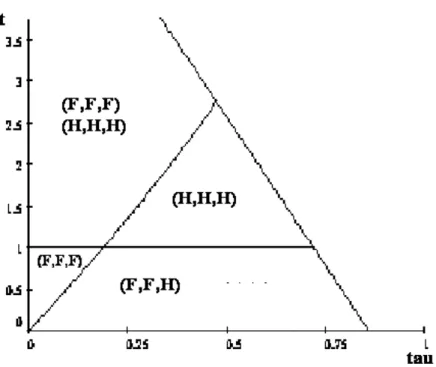
In Figure 1, we plot in(τ , t)space the following expressions:
t = 10−10√1−τ
t = 1
t = 43 7 −
Figure 1: Location regions in(τ , t)space.
5
Concluding remarks
Figure 1 shows that all location equilibria entail the agglomeration of both upstream firms in the
same country. This follows from the fact that the market for thefinal good is located in a single
region. Agglomeration of allfirms occurs in country F if both transport costs,tandτ ,are low, so
that locations are driven by labor cost considerations only, apart from considerations related with
access to market. By contrast, agglomeration takes place in region H ifτis high andtis medium.
In this case, location of all firms is driven towards the location of the market for the consumer
good.
Two special cases are of interest. Thefirst one entails spatial fragmentation, the downstream
firm being located close to the consumer good market in H while the upstream firms locate in
the low labor cost country F. Unsurprisingly, fragmentation arises if tis low and τ is medium to
in country H or in country F. This case arises if the transport cost of the inputs is high, so that
every cluster of locations is an equilibrium.
Hence, we can conclude that the location of vertically-linked firms is completely determined
by the transport costs of the inputs and of the final good. We hope that this result, that was
reached through a numeric simulation, can generalized to a wider setting.
References
PAIS, Joana and José Pedro PONTES (2008), "Fragmentation and clustering in vertically-linked industries",Journal of Regional Science,forthcoming.
AMITI, Mary (2005), "location of vertically-linked industries: agglomeration versus com-parative advantage",European Economic Review, 49, 809-832.