87
Sr/
86Sr ratios discrimination applied to the main Paleozoic carbonate
sedimentation in Ossa-Morena Zone
Lo ratio
87Sr/
86Sr aplicado a la discriminación de los episodios de sedimentación carbonatada en
la Zona de Ossa-Morena
N. Moreira1, J. Pedro2, J.F. Santos3, A. Araújo4, J. Romão5, R. Dias6, A. Ribeiro7, S. Ribeiro8, J. Mirão9
1 Earth Sciences Institute (ICT), Pole of the University of Évora, Rua Romão Ramalho, nº 59, 7000-671 Évora, Portugal; LIRIO- Escola de Ciências e Tecnologia da Universidade de Évora (ECTUE). [email protected]
2 ICT, Pole of the University of Évora; Dep. Geociências da ECTUE, Largo dos Colegiais, 2-Apartado 94, 7002-554 Évora, Portugal. [email protected]
3 GeoBiotec, Dep. Geociências, Universidade of Aveiro, 3810-193 Aveiro, Portugal; Isotope Geology Laboratory. [email protected] 4 ICT, Pole of the University of Évora; Dep. Geociências da ECTUE; [email protected]
5 UGCG, Laboratório Nacional de Energia e Geologia, Estrada da Portela, Apartado 7586 - Zambujal, 2720 Alfragide, Portugal; Universidade Europeia, Estrada da Correia, nº53, 1500-210 Lisboa. [email protected]
6 ICT, Pole of the University of Évora; Dep. Geociências da ECTUE; LIRIO-ECTUE. [email protected]
7 Centro de Geologia da Universidade de Lisboa (UL), Dep. Geologia da Faculdade de Ciências da UL, Museu Nacional de História Natural e da Ciência (UL), Edifício C6, Piso 4, Campo Grande, 1749-016 Lisboa, Portugal. [email protected]
8 GeoBiotec, Dep. Geociências, Universidade of Aveiro; Isotope Geology Laboratory. [email protected]
9 Laboratório HERCULES | Instituto de Investigação e Formação Avançada e Departamento de Geociências | Escola de Ciências e Tecnologia, Universidade de Évora. [email protected]
Abstract: The carbonated sedimentation in Ossa-Morena Zone during the Palaeozoic is formed, at least, by two main
episodes. However, some chronological questions remain open, due to lack of biostratigraphic data in some carbonates. Sr isotope analysis was performed in selected limestones and marbles of Ossa-Morena Zone, in order to discriminate the Sr signature of the two main carbonate sedimentation episodes. The Sr isotopic data from the analyzed carbonate show two clusters of 87Sr/86Sr ratios, one related with the Lower Cambrian and other with the Lower-Middle Devonian
carbonates.
Palabras clave: Ossa-Morena Zone, carbonated sedimentation, 87Sr/86Sr.
Resumen: La sedimentación carbonatada en la Zona Ossa-Morena durante el Palaeozoic está formado, por lo menos, por dos episodios principales. Sin embargo, algunas cuestiones cronológicas permanecen abiertos, debido a la falta de datos bio-estratigráficos en algunos carbonatos. Se han realizado análisis de isótopos de Sr en calizas y mármoles seleccionados de la Zona de Ossa-Morena, con el fin de discriminar la signatura de Sr de los dos episodios principales de sedimentación de carbonatos. Los datos isotópicos de Sr analizados en los carbonatos muestran dos grupos de relaciones 87Sr / 86Sr, uno relacionado con el Cámbrico Inferior y otros con los carbonatos de lo Devónico
Inferior-Medio.
Key words: Zona de Ossa-Morena, sedimentación carbonatada, 87Sr/86Sr
INTRODUCTION AND GEOLOGICAL SETTINGS OF OSSA-MORENA ZONE CARBONATES
The Palaeozoic carbonate sedimentation in Ossa-Morena Zone (OMZ) has been issue of discussion from various authors (e.g. Oliveira et al., 1991; Piçarra, 2000; Pereira et al., 2012; Araújo et al., 2013 and included references). However, it is unambiguous the presence, at least, of two different carbonate sedimentation episodes in this tectonostratigraphic zone:
(i) the first in the Lower Cambrian, related with the first pulses of Variscan Cycle (Moreira et al., 2014), is characterized by sequences of marbles (dolomite and calcite) or limestones, sometimes
with siliciclastic beds and interbedded metavolcanic rocks (e.g. Oliveira et al., 1991; Vera, 2004; Pereira et al., 2012; Araújo et al., 2013; Moreira et al., 2014). The Ovetian-Marianian age is constrained by paleontological data in Spain (Vera, 2004 and included references) and in Portugal (Alter-do-Chão-Elvas Domain; e.g. Oliveira et al., 1991; Araújo et al., 2013). However, in the sequences with absence of biostratigraphic data, the assigned age is based on lithostratigraphic correlations, such as the cases of Abrantes, Estremoz, Ficalho and Viana do Alentejo sequences (Oliveira et al., 1991). In Estremoz and Ficalho sequences, onto the carbonated sequences (mostly dolomitic marbles) appears a volcano-sedimentary complex with abundant calcitic marbles (Oliveira et al., 1991;
Araújo et al., 2013). Piçarra (2000) describes some crinoid fragments in the calcitic marbles in Ferrarias (according to the author, equivalent of Estremoz Marbles) and Ficalho, assigning at least an Upper Silurian or Devonian age for the calcite marbles contained in the volcano-sedimentary complex. Pereira et al. (2012) argue that these ages are not depositional, but results from sub-aerial exposure and remobilization of Devonian faunal material. The same authors obtain a 499.4 ± 3.3 Ma age (SHRIMP U-Pb zircon) in meta-rhyolites intercalated into dolomitic marbles from the Estremoz sequence, proposing a Middle-Upper Cambrian transition age. However, the stratigraphic position of the meta-rhyolite is uncertain with regard to the carbonate sequence and it is not interbedded in the marble sequence.
(ii) the second episode in the Lower-Middle Devonian, it seems to be represented only in Portugal, in the southernmost domains of OMZ, and it is related with a reef system. Machado et al. (2010) describe a calciturbiditic sequence (calcitic limestones) spatially associated to volcanic rocks with low-K tholeiitic to calc-alkaline geochemical signatures in Odivelas (Ferreira do Alentejo; Santos et al., 2013). The paleontological data from the calcitic limestones provides a Lower to Middle Devonian age (Oliveira et al., 1991; Machado et al., 2010 and included references).
The aim of this work is establish 87Sr/86Sr
signatures in marbles and limestones from different domains of OMZ, compare and correlate the obtained data with available data in previous works, in order to discriminate and achieve strontium isotopic patterns for the carbonate episodes and isotopic-stratigraphic correlation for Paleozoic OMZ carbonates.
THE 87Sr/86Sr RATIO
The ability to correlate and, in some cases, date sediments using strontium isotope ratios (87Sr/86Sr) derives from the fact of this ratio value
dissolved in the oceans has varied over the time, and these differences are preserved in carbonated sediments (McArthur, 1994; McArthur et al., 2012).
The 87Sr/86Sr variation has been caused by
changing fluxes of Sr to the ocean, from two main sources: mantle and continental crust (McArthur, 1994). In middle ocean ridges the interaction between oceanic crustal rocks and seawater, related to hydrothermal circulation, generates a modification of Sr isotope ratio in seawater. The loss of Sr from seawater is replaced by leached Sr from middle ocean ridge rocks, decreasing the
87Sr/86Sr of marine seawater. On the other hand,
the continental weathering supplies are higher than that of marine Sr. Indeed, addition of crustal Sr to the ocean therefore increases the 87Sr/86Sr
of marine Sr. The 87Sr/86Sr ratio in seawater was
always higher than 0,703 (minimum value of mid ocean ridge rocks) and generally lower than 0,713 (best estimated value to modern rivers; McArthur, 1994 and included references).
At the analytical precision of the 87Sr/86Sr ratio
that can be measured, which is ± 0.00002, this ratio in seawater from worldwide localities are analytically indistinguishable. This uniformity is resulted from the residence time of Sr in the Ocean that is far longer than the time it takes currents to mix the oceans, so the oceans are thoroughly mixed on time scale that are short relative to the rates of gain and loss of Sr (McArthur, 1994). As such, it is assumed that the ocean has always been well mixed, as in present, and consequently is isotopically uniform with respect to 87Sr/86Sr.
SAMPLES AND METHODS
37 samples of OMZ carbonated rocks were collected. The samples were characterized by conventional petrographic techniques, with special attention to textural and/or metasomatic (i.e. secondary dolomitization) features. After the conventional petrographic characterization, samples underwent specific preparation, such as cleaning and removing meteoric alteration surfaces followed by crushing, gridding and sieving, in order to obtain powdered carbonate samples smaller than 63 µm.
The detailed mineralogical composition of carbonates was analysed in X-Ray difractometer (XRD) Bruker D8 Discover with DaVinci geometry and using a Lynxeye linear detector (Hercules Laboratory, University of Évora). The scans was collected from 2θ 3º to 75º, with steps of 0.005º and one second by step. The semiquantification of the phases abundances are done using the DIFFRAC.SUITE software from Bruker by the RIR-Reference Intensity Ratio (Hubbard et al, 1988 and included references).
The strontium isotope analyses was performed in the Isotopic Geology Laboratory (University of Aveiro) using a Mass Spectrometer Thermal
Ionization (TIMS) with a VG Sector 54
spectrometer. The main procedure involve a first stage of rocks sample dissolution with HCl with some drops of HF and HNO3 for the carbonates.
Afterwards, the remaining solutions, including the carbonate leachate samples, were dried and redissolved in HCl and subject to conventional two-stage ion chromatography separation with cation exchange resins for Sr purification. This methodology should guarantee the non-carbonate fraction separation from the whole sample. After the carbonate concentration and purification in each sample the isotopic measurements 87Sr/86Sr
ratios were performed by means of a thermal ionization mass spectrometry (VG Sector 54).
SUMMARY SAMPLE DESCRIPTION AND XRD ANALYZES
From the #37 analysed samples #21 are calcitic-dominated, #14 mostly dolomitic and #1 ankeritic (or dolomitic Fe-rich) carbonates and #1 is a sandstone with calcite cement. Some dolomitic carbonates show macro and microscopic textural evidences of secondary dolomitization, while others the dolomitization is regarded as “primary” due the nonexistence of textural/metasomatic features. In this cases is possible that the dolomitization results from diagenetic process.
The XRD analyses reveals variable carbonate contends in the analysed samples: #29 samples have more than 75% (#14 with more than 95%); #6 samples have 60-75% (ETZ-6A; VB-2; ALT-1; FIC-2; BEN-1; GQAB-37) and #2 samples (BA-3; BA-4) have less than 60%.
The remaining mineralogical component is mainly composed by silicates, generally quartz, muscovite and chlorite. Sometimes, plagioclase, K-feldspar, amphiboles and biotite are also present, as well some iron oxides. It is important to emphasize the presence of some clay mineral detected in XRD analysis, which could reveal some alteration of sample (GQAB-13; GQAB-27; GQAB-37; VIA-1; VIA-2), although the percentage is generally lower 3%.
87Sr/86Sr RATIOS OF THE CARBONATED
EPISODES: A DISCUSSION
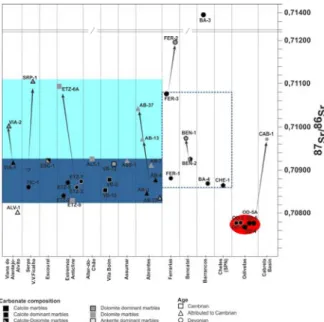
The projection of 87Sr/86Sr values clearly shows
the presence of two distinct clusters (Fig.1). One of them is only composed by the Odivelas limestones with 87Sr/86Sr lower than 0,70800. The
lower values obtained could be related with the interaction between seawater and the host volcanics rock (Santos et al., 2013), or result from lower values of 87Sr/86Sr in seawater, which is
typical for the Lower-Middle Devonian transition (McArthur et al., 2012). However, the reworked limestones with similar age (and genesis?) in the Cabrela Carboniferous Basin (Pereira et al., 2006) presents higher 87Sr/86Sr values (0,70972), when
compared with the Odivelas limestones. This may be the result of meteoric fluids interactions over the resedimentation of the Cabrela limestones inside this intracontinental basin. This fact also could explain the presence of dolomite-rich limestones in Cabrela Basin, since the Odivelas limestones are clearly calcitic (only two samples presents circa of 1% of dolomite).
The other cluster is composed by limestones and marbles attributed to Cambrian, and has
87Sr/86Sr values higher than the Odivelas
limestones (0,70825-0,70925; Fig.1). The Abrantes, Escoural, Viana do Alentejo and Estremoz marbles, affected by medium-high metamorphic grade, presents 87Sr/86Sr values
similar to the analized in the Vila Boim and Alter-do-Chão limestones, which have low metamorphic grade. This evidence seems to show that the metamorphic grade do not change significantly the primary signature of 87Sr/86Sr. The dolomitic
marbles and limestones from Estemoz, Assumar, Alter do Chão and Vila Boim displays similar
87Sr/86Sr values. The data are concordant with the
Cambrian worldwide seawater values presented by McArthur et al (2012).
FIGURA 1. Projection of 87Sr/86Sr values, showing the presence of
two distinct clusters, one of them composed by Odivelas Lower-Middle Devonian Limestones and the other one composed by Cambrian Carbonates. The arrows represents the effect of secondary dolomitization related to the interaction with meteoric fluids.
As mentioned to Cabrela limestones, the samples with macro evidences of secondary dolomitization (VIA-2, SRP-1; ETZ-6A; AB13; AB37) also presents highly values of 87Sr/86Sr,
comparatively to the calcitic and dolomitic limestones/marbles without evidences of secondary dolomitization. The Viana do Alentejo sample (VIA-2), sampled inside a marble centimetric fracture-filling dolomite (secondary dolomitization process) was collected as a control sample and shows high 87Sr/86Sr ratio values. This
increment in the 87Sr/86Sr ratio is interpreted as
the result from the interaction between meteoric fluids/rock.
The Alvito Fe-rich carbonate (ALV-1) despite exposes textural evidences of metassomatic process, shows a lowest 87Sr/86Sr value and is
regarded as an outlier. This require more data in order to understand the influence of ankeritic or
dolomite Fe-rich fluids in the 87Sr/86Sr ratio during
the metasomatism.
The Barrancos, Ferrarias and Bencatel limestones have low metamorphic grade and are attributed to Silurian-Devonian age (Piçarra, 2000). The 87Sr/86Sr data obtained for these
limestones are distinct to the data obtained for the the Odivelas limestones and displays 87Sr/86Sr
values partly similar to the values obtained from the limestones/marbles attributed to Cambrian (0,70860-0,71800). With exception to BA-3 sample (see discussion below), all these carbonates are NW-SE aligned, and their stratigraphic position is ambiguous. In Ferrarias, the carbonates are affected by intense fracturing and display several evidences of intense rock/fluid interaction. This may be justify the highly values observed in samples FER-2 and FER-3.
The BA-3 sample is the most impure "carbonate", with significant amounts of siliciclastic components and display the highest
87Sr/86Sr values (Fig.1). This higher value should
be the result of the high siliciclastic component which may provide values that are not representative of Sr isotopic signature of seawater during the deposition. The interaction between silicate and carbonate components during the diagenetic process or the interaction rock/fluid dominated by crustal fluids can be invoked to justify this highest 87Sr/86Sr value.
FINAL CONSIDERATIONS
The differentiation is clear between two dissimilar events of carbonate sedimentation in OMZ based in the Sr isotopic signature of carbonates. This methodology could be applied to others OMZ domains without biostratigraphic data and allowing to correlate the different carbonates and assign the same age, based on 87Sr/86Sr
ratios. However, it is crucial use samples without meteoric or hydrothermal alteration, once the
87Sr/86Sr ratio could be modified.
Although, this methodology is suitable applied to the Cambrian and Lower-Middle Devonian carbonated episodes, some doubts remain unresolved as regards to the age and origin of the Barrancos-Ferrarias-Bencatel carbonates, not being possible to differentiate this episode from the others.
ACKNOWLEDGEMENTS
Noel Moreira acknowledges Calouste Gulbenkian Foundation for the financial support and FCT PhD grant (SFRH/BD/80580/2011). The authors acknowledge the funding provided by ICT, under contract with FCT.
REFERENCES
Araújo, A., Piçarra de Almeida, J., Borrego, J., Pedro, J. y Oliveira, J.T. (2013): As regiões central e sul da Zona de Ossa-Morena, In: Dias, R., Araújo, A., Terrinha, P., Kullberg, J.C. (Eds.), Geologia de Portugal (Vol. I), Escolar Editora, Lisboa, 509-549.
Hubbard C. R. y. Snyder, R.L. (1988): RIR-Measurement and Use in Quantitative XRD, Powder Diffraction 3(2), 74.
Machado, G., Hladil, J., Slavík, L., Koptíková, L., Moreira, N., Fonseca, M. y Fonseca, P. E., (2010): An Emsian-Eifelian Calciturbidite sequence and the possible correlatable pattern of the Basal Choteč event in Western Ossa-Morena Zone, Portugal (Odivelas Limestone). Geologica Belgica 13 (4), 431-446.
McArthur, J.M. (1994): Recent trends in strontium isotope stratigraphy. Terra Nova 6, 331-358. McArthur, J.M., Howarth, R.J. y Shields, G.A.
(2012): Strontium Isotope Stratigraphy. In: Gradstein F.M., Ogg J.G., Schmotz M.D., Ogg G.M. (Eds.), A Geologic Time Scale 2012 (Chapter 7), Elsevier, 127-144
Moreira, N., Araújo, A., Pedro, J.C., Dias, R. (2014): Evolução geodinâmica da Zona de Ossa-Morena no contexto do SW Ibérico durante o Ciclo Varisco. Comunicações geológicas 101 (Vol. Especial I), 275-278. Oliveira, J.T., Oliveira, V., Piçarra, J.M., 1991.
Traços gerais da evolução tectono-estratigráfica da Zona de Ossa Morena, em Portugal: síntese crítica do estado actual dos conhecimentos. Comun. Serv. Geol. Port. 77, 3-26.
Pereira, M.F., Solá, A.R., Chichorro, M., Lopes, L., Gerdes, A. y Silva, J.B. (2012): North-Gondwana assembly, break up and paleogeography: U–Pb isotope evidence from detrital and igneous zircons of Ediacaran and Cambrian rocks of SW Iberia. Gondwana Research 22(3–4), 866-881.
Pereira, Z., Oliveira, V., Oliveira, J.T., 2006b. Palynostratigraphy of the Toca da Moura and Cabrela Complexes, Ossa Morena Zone, Portugal. Geodynamic implications. Review of Palaeobotany and Palynology 139, 227-240. Piçarra, J.M. (2000): Estudo estratigráfico do
sector de Estremoz-Barrancos, Zona de Ossa Morena, Portugal. Vol. I -.Litoestratigrafia do intervalo Câmbrico médio?-Devónico inferior, Vol. II - Bioestratigrafia do intervalo Ordovícico-Devónico inferior. PhD Thesis (unpublished), Évora University, Portugal. Santos, J.F., Mata, J., Ribeiro, S., Fernandes, J. y
Silva, J. (2013): Sr and Nd isotope data for arc-related (meta) volcanics (SW Iberia), Goldschmidt Conference Abstracts, 2132.
Vera, J.A., (Eds.), 2004. Geología de España. SGEspaña y IGME, 884 .