usjt • arq.urb • número 15 | primeiro quadrimestre de 2016
86
Abstract
This paper focuses on the transformation of housing typologies by using a grammar-based methodology assisted by the use of space syn-tax measures. In this paper we start by describing three different types of housing buildings regard-ing their functionality by usregard-ing syntactic meas-ures. The studied buildings were constructed in Lisbon from the 18th to the 20th century and are representative repetitive cases in the city. The buildings’ descriptions are then used as part of the systematization of rehabilitation principles for the transformation grammar. We concluded that the particular characteristics of those buildings enable specific rehabilitation strategies to be car-ried out and that those different strategies may be integrated in the general grammar framework but defining specific sub-grammars.
Keywords: Housing types. Use. Evaluation.
Spa-ce syntax, Shape grammar.
Transforming housing typologies. Space syntax
evaluation and shape grammar generation
Transformação de tipologias habitacionais. Avaliação através da sintaxe
espacial e a geração através das gramáticas de forma
Sara Eloy* e Rosália Guerreiro**
Resumo
Este paper centra-se na transformação de tipologias habitacionais através do uso de uma metodologia baseadas nas gramáticas de forma e assistida por uma avaliação realizada através da sintaxe espacial. Neste paper começamos por descrever sob o ponto de vista funcional três tipos diferentes de habitação utilizando para isso medidas sintáticas. Os edifícios em estudo foram construídos em Lisboa desde o séc. XVIII ao séc. XX e são casos repetitivos e repre-sentativos da cidade. A descrição destes edifícios são depois utilizadas como parte da definição dos princípios de reabilitação que irão informar uma gra-mática de transformação. Concluímos que as carac-terísticas particulares destes edifícios permitem que sejam aplicadas estratégias específicas de reabilita-ção e que estas podem integradas na estrutura de uma gramática geral mas definindo sub-gramáticas.
Palavras-chave: Tipos habitacionais. Uso. Avaliação
Sintaxe espacial. Gramáticas da forma. *Graduated in Architecture
(FA.UTL 1998) and PhD in Architecture (IST.UTL 2012). She is an Assistant Professor in ISCTE-IUL and a research-er in ISTAR-IUL (Informa-tion Sciences Technologies and Architecture Research Center) and her main areas of research are Computer Aided Design, Shape Gram-mar, Space Syntax, Immer-sive Virtual Reality and Aug-mented Reality.
**Assistant professor and re-searcher at the Department
of Architecture and Urban-ism in ISCTE-IUL. Graduated in Town and Country Plan-ning (1994), MA in Urban De-sign (2002) and PhD in Archi-tecture and Urbanism (2011). Her main research interests relate to design patterns and complexity theories applied to the study of self-organiza-tion in cities. In this context she has explored theories like Biomimicry, Space Syn-tax and Space Cognition to understand spatial systems.
Sara Eloy e Rosália Guerreiro | Transforming housing typologies. Space syntax evaluation and shape grammar generation
R
ehabilitating the existing old housing stock is a requirement in European cities due to con-structional anomalies and functional inadequacy to meet the new household’s composition and the changing needs of inhabitants in living areas. Within the present-day context of construction in Europe rehabilitation is the future for the housing market. In some EC countries in the past decades the building rehabilitation industry has grown al-most as large as the new construction industry. Now, after a period of recession in the EC countries construction, the forecast of Euroconstruct (2014) is that residential renovation and maintenance will grow 1,2% a year between 2014 and 2016. In the scope of the presented research it’s our aim to study the mass urban housing buildings built in Europe that are still in use and in need of rehabili-tation. There are several examples all over Europe of mass housing typologies designed by almost anonymous architects or engineers and takingIntroduction
part of the regular building stock of the city being recognized as part of its identity. These repetitive elements in the urban fabric are an important part of the cities and house a large number of citizens which makes their maintaining and renovation a crucial issue to cities. Examples of these typolo-gies are the Terrace Houses in London, the
Ham-burger Terrassen in Hamburg, the Megablock
in Copenhagen, the Casa de Blocco in Genoa among others (Firley & Stahl 2009).
In this study we considered the classification of buildings into categories with similar features, known as types (Habraken, 1988). A study of typi-fication aims at identifying the unchanging char-acteristics that explain and distinguish types. A type is based on a set of rules: typological design rules (organisation of the whole and particular type shapes) and technological design rules (the physical concretisation of the dwelling). In this paper we address three types of regular housing
usjt • arq.urb • número 15 | primeiro quadrimestre de 2016
88
buildings in Lisbon built between the 18th andthe 20th centuries. To support a rehabilitation process of adapting existing dwellings a rehabili-tation methodology was developed (Eloy, 2012a) based on a transformation grammar generation process. This rehabilitation methodology is par-tially a general methodology applicable to all the apartment building types and also a specific methodology to housing buildings called
“Rabo-de-bacalhau” (“cod-tail”), built in Lisbon between
1945 and 1965.
Both shape grammar and space syntax were used as part of the rehabilitation methodology as tools to identify and encode the principles and rules behind the adaptation of existing dwell-ings to new living requirements. Research has been developed that combines shape grammar and space syntax in order to provide an accurate means of describing and evaluating spatial prop-erties and therefore, to increase the likelihood of generating grammar’s solutions that closely cor-respond to the user’s requirements (Heitor et al., 2004). The development of the grammar included the description of the original apartments with the goal to understand their spatial structure and its social effects at the time they were built. Work is being developed to enable the use of the trans-formation grammar in a general context of reha-bilitation. The generalization of the transformation grammar will integrate specificities of different building types, enabling them to be changed to meet new demands.
An analysis to other extensively constructed types of building in Portugal – “Pombalinos” (after 1755 earthquake) and “Gaioleiros” (between 1870 and 1930) – was done to describe the configurational properties of those apartments and the diversity of space usage. Commonalities and differences of morphology regarding the relationship to space usage and human behaviors were identified. The configuration regularities of houses are means for the buildings to show culturally significant house-holds practices (Hanson 1998; Hillier et all 1987) and therefore constitute marks of a certain period in time. The description of different types of build-ings enables that the developed transformation methodology can incorporate their specificities and generate transformation solutions based on their characteristics.
In the first part of the paper we characterize dif-ferent housing buildings according to their func-tionality and social meaning. In the second part we focuses on how a transformation grammar methodology may be developed and how it can a tool to enable the changing of buildings using their specific morphology characteristics. Finally we end with some conclusions and identification of the future work.
Research methodology
This paper focuses on the description of three different types of housing buildings constructed in Lisbon from the 18th to the 20th century and
Sara Eloy e Rosália Guerreiro | Transforming housing typologies. Space syntax evaluation and shape grammar generation
how this description enable the systematization of rehabilitation principles in a transformation gram-mar-based methodology. The types of building under analysis are Pombalinos, Gaioleios and
Ra-bo-de-bacalhau. The sample used to study these
types is composed by three dwellings of each type of building selected from among bigger samples. For Rabo-de-bacalhau type, in most of the analy-sis, we chose three cases from a larger sample of twenty five (Eloy, 2012a). For Gaioleiros we chose three samples from identified types from different authors (Appleton, 2007; Monteys, 2013) and for
Pombalinos we also chose three cases identified
by different authors as being typical cases (Mon-teys, 2013; Santos, 2000).
This study uses three different types of procedures, such as, data collecting, graphic analysis through space syntax and transformation grammar gen-eration process. Based on the original floor plans of the dwellings the layouts of all the cases in the sample were redrawn to enable a systematic and equal analyses. Within space syntax two main techniques are used to analyze each dwelling type through graph information. First we used graph analysis of nodes embedded in convex spaces and connections, which can be demonstrated by a geometric graph of point-to-point followed by a justified graph using the Agraph Software (Manum et al 2005). Secondly we made visibility analysis on Depthmap Software, which is also a primarily graph analysis tool which creates maps of visual fields at points within plans of buildings. In Visual
Graph Analyses, a grid of points is overlaid on the plan and then a graph is made of those points, where each point is connected to every other point that it can see. (Turner, 2004:1)
In the graph analysis of nodes embedded in con-vex spaces we calculate the syntactic measures of Total Depth, Integration and Control Value by using Agraph software [Table 1, Table 5, Table 9]. Total Depth of a node n (TDn) is the total of the shortest distances from node n to the other nodes in the system. Integration (i) is a measure related to the mean depth (the average shortest distance from node n to all the others) of a sys-tem, a higher number means that a node is well integrated in the system. The Control Value (CV) of node n is the total value it receives by letting each node give the total value of 1 equally distrib-ute to its connected nodes. (Manum et al, 2005) In Visual Graphic Analyses we treat the syntactic measures of Visual Connectivity, Integration and Intelligibility. Visual Connectivity is a local static measure and corresponds to the connectivity of each node or how many locations each node can see [Figure 3, Figure 7, Figure 11]. Visual Integra-tion is a global static measure and it is essentially a normalized version of the mean depth and it measures the accessibility of a node (the shortest path) from all other nodes. The nodes of a system can then be ranked from the most integrated to the most segregated. [Figure 2, Figure 6, Figure 10]. Finally the intelligibility, which is a second-ary measure as it results from the correlation
usjt • arq.urb • número 15 | primeiro quadrimestre de 2016
90
between connectivity and integration, describeswhat can be understood of the global relation of a space from what can be observed within that space (Klarqvist, 1993:11) [Figure 4, Figure 9, Fig-ure 12]. Within the visibility analysis we have the possibility to make both a global analysis (inte-gration) of the graph and a local analysis (con-nectivity) of the graph (Turner, 2004:14). The grid to process the maps of visibility was set out in 20 cm. The color range (from red to blue) expresses the highest and lower values. To better compare the difference between the cases we transform the measure in percentage. In the case of visual integration this was done by using a mathemati-cal artifice of standardization: transforming the values obtained in the investigated systems to a scale from 0 to 100. (Medeiros, 2006)
A transformation grammar is a generative design process that uses shape grammar formalism to enable the design of several solutions for a given design problem. Shape grammars were invented more than thirty years ago by George Stiny and James Gipps (1972) and are “algorithmic systems
for creating and understanding designs directly through computations with shapes, rather than indirectly through computations with text or sym-bols.” (Knight, 2000) In the context of this work
shape grammars formalism were used as a tool to encode the principles and rules that guide the transformation of existing dwellings in order to define a new layout that responds to the new housing requirements.
Housing buildings in Lisbon from the 18th to the 20th century
In the scope of this study we chose three types of housing buildings in Lisbon that due to their age and lack of maintenance are in need of re-habilitation. These buildings represent repetitive typologies of a “still existing urban fabric [which] elevates them to more than just historic remnants of a previous era (…)” (Firley & Stahl, 2009, p.9). These buildings, constructed in different periods of time and with several different ways of addressing the household represent the changes in the Portu-guese society. The comparative analysis we aim at doing in this paper might enable the understand-ing of the evolution performed at the way mass housing has been designed in the city of Lisbon. In this section, the characterisation of the three ty-pologies of housing buildings is undertaken consid-ering the spatial organisation, studying the different dwellings’ spaces and the relationships between them. For the three types the same analysis is per-formed using space syntax measures. Beside the functional analysis and since dwellings are cultural artefacts - a collective product that portrays a pop-ulation (Habraken, 1988) - it is also necessary to un-derstand the cultural context, social patterns and lifestyles of the period in which the studied build-ings were built. In order to understand the functional organisation of the dwellings’ types in the study it was considered necessary to briefly analyse the so-ciety during the periods they were built.
Sara Eloy e Rosália Guerreiro | Transforming housing typologies. Space syntax evaluation and shape grammar generation
Political and social context
After the 1755 earthquake in Lisbon the city was reconstructed following a general plan of excep-tional quality in the Portuguese context of that period, which proposed the overlap of the previ-ous medieval urban structure. The adopted plan, authored by Eugénio dos Santos, encompasses a close interdependence between the urban mor-phology and the residential structures (Leal, 2005: 41), given the urgent need to house in the shortest possible time the population who became home-less. This plan was, among the other presented plans, the most rational, both by respecting the pre-existence and by respecting the new order this opportunity was bringing to the city. The ide-als of civility and public health were consistent with the meaning of progressivism of Marquês de Pombal, the first minister of the Kingdom. Despite the technical and economic constraints the answer found followed an innovative meth-odology, based on the application of methods of standardization and pre-fabrication, making this the first attempt to perform a rational systemati-zation of production (Monteiro, 2010: 338 [1947]). Due to these characteristics the reconstruction of the nowadays called area of Baixa was a special event in the context of the city urban history with a significant impact on its morphology.
It is however at the level of redefining the urban building typology that Pombalino’s proposal
brought major changes which lead to social
impli-cations. Among these proposals the appearance of the “Prédio de rendimento” (building of income) owned by a family or investor with the aim to rent the floors and use it as an income. Also very rel-evant in this period is the emergence of a formal housing architectural project in the common urban building (Carita, 1994). The income Pombalino’s building was based on a multifamily structure or-ganized into individual apartments, with a left and right arrangement and where common spaces, like entrances, hallways, stairs and landings, were introduced. Pombalino’s model and the cage structure (the main technical innovation regarding building construction) become a popular model of constructing, repeated as an empirical knowledge between masters and novice (Carita 1994: 127). The spatial characteristics of these dwellings fol-low certain patterns. One of the most distinctive is the high degree of permeability triggered by the fact that inhabitants circulate within the house by crossing the rooms. This characteristic was also present in houses prior to the earthquake (Mas-carenhas, 2005). Reminiscences of palatial archi-tecture can be noticed in these layouts. In Pom-balino’s apartments the use of the corridor was occasional and was primarily used to establish the link between the rooms along the front façade with the ones in the rear. According to Raul Lino (1937: 19) Pombalino’s typology, sets the average national housing type, whose validity would be ex-tended with minimal variation until the 1930s. The
Gaioleiros buildings, built betwwen the 1880 and
usjt • arq.urb • número 15 | primeiro quadrimestre de 2016
92
Gaioleiros were firstly built in the north plateau
of Lisbon, an area which started to be built after the opening of Avenida da Liberdade, the large boulevard that connected Baixa (the area recon-structed after the earthquake) to the new expan-sion of the city (Pereira, 2005). This new area of Lisbon, called “Avenidas Novas” was designed by Ressano Garcia in the late 19th century. The emergence of the bourgeoisie in Portuguese so-ciety and the increase in population around 1870’ lead to the need of more housing in the city and Gaioleiros were quickly built to answer this de-mand. According to Appleton (2005) the plan for Avenidas Novas didn’t incorporated impositions on heights or length of buildings but neverthe-less the set of Gaioleiros buildings created and homogeneous group. Land lots were used at their most extend by constructing very deep buildings, with left and right displacement, and inner yards to where bedrooms had their windows. Gaiolei-ros follow Pombalinos’ buildings and also were constructed with loadbearing stone masonry fa-çades and wood frame structures in floors and interior partitions. The name Gaioleiros (cage) was adopted as a pejorative name to indicate a less qualified and well-constructed wood frame comparing to the one of Pombalinos’ buidings. Within the city of Lisbon Gaioleiros have a large representation and are located in privileged parts of the city. These building were also construct-ed with the goal of renting the apartments and therefore constituting a financial insurance for the families who own them. Apartments are in most
extend large ranging from more simple ones to others more detailed and luxury. The living room was the larger room and was often located in the rear part of the building next to the kitchen and connecting to the back veranda (Appleton, 2005) The typology known in professional jargon as Ra-bo-de-bacalhau first appeared in the 1930s,
be-came common in the 1940s and 50s, due to an easing of the economic and social crisis after the Second World War, and ceased by around 1960s. Throughout this period the Estado Novo regime governed in Portugal. Portuguese society was tra-ditional, a concept opposed to the modernity with which the expression Estado Novo was associat-ed, and exaggerated the expressions and dangers of degeneration, the unnatural, dissolution and for-eign influences (Cunha, 1994). Although the lack of housing the state only began to build housing for the population in the 1930s. According to Pereira (2006: 8) state intervention in this sector can be divided into three areas: the programme of neigh-bourhoods of prefabricated houses for the needi-est section of the population, Casas Económi-cas (affordable housing) for those “protected by the state” and quality dwellings for the elites and wealthier classes. The better quality dwellings for the wealthier classes of the time, which are the subject of this study, aimed to replace the earlier Gaioleiro model – with its functional and social mix within the dwellings – and to reflect, both in morphological and aesthetic terms, the superior-ity of the Estado Novo (Pereira, 2006). The
build-Sara Eloy e Rosália Guerreiro | Transforming housing typologies. Space syntax evaluation and shape grammar generation
ings have a right and left arrangement and vary in height with six floors being the average, with a gradual increase in the height of buildings during the two decades in which they were built. These buildings have a predominance of reticulate con-crete structures filled with masonry walls as well as the use of new construction techniques and the in-creasing use of concrete. In general the dwellings are essentially very similar and usually have a two or three bedroom layout and relatively small and much divided areas [Figure 9]. Dwellings in Rabo-de-bacalhau buildings are characterised by the very marked segregation of the various functional areas, particularly between the service and the so-cial or private areas. The segregation of the private sector reveals a clear intention to preserve family intimacy, placing greater importance on individuals and their privacy (Pereira, 2006). The totally sepa-rate service sector (with the kitchen, laundry ad a maid’s bedroom) is located in the less prestigious part of the dwelling, the back wing of the buildings, set apart from the family living area. This distance reinforces the social hierarchies evident in the or-ganisation of domestic space that is characteristic of the period, together with the role of the woman – “the professional home-maker” (Pereira, 2006). The design of the circulation areas in dwellings is the result of their position within the system and the relationships between the social, private and service areas. The large circulation areas, con-sisting of corridors and anterooms in the connec-tions between the different functional sectors, are another general characteristic of these dwellings.
The characteristics of each one of the studied types are more than just restricted to formal con-siderations about shape and aesthetics or a direct reflexion of the society of that time. Some of the characteristics of the dwellings’ layout are a re-flection of alterations in building regulations which made typological transformations in their layouts. The shape of the buildings in Lisbon has evolved through time following building regulations. Ac-cording to Reis (2000: 56), the shape of the rear of the “rabo-de-bacalhau” is the result of the widen-ing of the (side and interior) yard to the back of the building, meaning that the inner yard was com-pletely merged with the open space in the rear. In various Lisbon’ blocks it is possible to observe the evolution of the inner yard from its beginnings, when it was enclosed in the centre of the building or adjacent to the side wall (as in Gaioleiros), to its complete opening out onto the open space in the rear. Building regulations in the 1951 (RGEU, Gen-eral Urban Building Regulations) banned the use of indirect, reflected or diffused light as the only form of natural lighting in certain parts of buildings (forbidding it in inner habitable rooms). This altera-tions had an accentuated impact on the buildings layout causing a gradual disappearance of the in-ner yard of the “rabo-de-bacalhau” after 1951.
Syntatic analysis
In this section the three types of dwellings are analysed according to space syntax techniques throughout graph analysis.
usjt • arq.urb • número 15 | primeiro quadrimestre de 2016
94
In Pombalinos’ buildings the outcomes of theperformed graph analysis are that, in general, all the dwelling spaces have standard levels of integration, depth and control values [Table 1]. The circulation areas show a high level of in-tegration and the kitchen a high level of depth with the all system. The most distinctive char-acteristic is the fact that all the dwelling shows low control values indicating that the spaces are of alternative passage and that the degree of importance of mostly all the spaces as a point of passage in relation to the surrounding areas is similar instead of some having a very high control level and others very low. This happens
because most rooms connect to each other as seen in the graphs of [Figure 1]. Pombalinos’ rooms are mostly reached by two or more arcs meant for enabling movement and the number of rings (2 to 5), which enable alternative routes to be taken within the house, is high [Figure 1]. The mean number of circulation nodes is 2 for a mean number of nodes of 10,8 representing 18% of the dwelling’s rooms. [Figure 2] and [Ta-ble 2] represent the global analysis, through the visibility graph, showing the shortest paths from each area of the Pombalinos’ dwelling to all the other areas. The most visual integrated dwelling is Pc and the less is Pa. In all cases the inte-gration core is well distributed in the dwellings through a cluster of red spots (highest values) linked to each other in a clear network which defines the pattern of movement. The areas of greatest visual connectivity [Figure 3 and Table 3] correspond to areas of greatest visual integra-tion and are located mainly in social areas. Ar-eas of lower visual connectivity are the smallest rooms and also some passageways. The intel-ligibility for Pombalinos’ dwellings is very good and the dwelling Pc presents the highest value - very close to 1 (the maximum value). These high values of intelligibility result from the good cor-relation between connectivity and visual integra-tion represented by the scattergrams in [Figure 4]. This means that wherever the place a person is in the house, the whole can be inferred by a short number of direct connections.
Figure 1 – A sample of Pombalinos’ dwellings floor plans and jus-tified graphs showing distributness. (from left to right: Pa, Pb, Pc)
Sara Eloy e Rosália Guerreiro | Transforming housing typologies. Space syntax evaluation and shape grammar generation
Figure 1 – A sample of Pombalinos’ dwellings floor plans and justified graphs showing distributness. (from left to right: Pa, Pb, Pc)
Pa Pb Pc TDn i CV TDn i CV TDn i CV Circulation rooms 18 6 1,76 26 4,48 1,3 19 3,6 2 Kitchen 23 3,46 1,2 38 2,53 0,33 20 3,3 0,6 Min 16 1,95 0,2 23 2,53 0,25 16 2,1 0,3 Mean 24,9 3,47 1 29,07 4,12 1 21 3,2 1 Max 33 7,5 3 38 6 2 26 5,1 2,8
Table 1 – Total Depth (TD) for actual node, Integration and Control Value for for Pombalino’s dwellings.
Figure 2 – VGA showing integration values for a sample of Pombalinos’ dwelling (from left to right: Pa, Pb, Pc)
Integration Pa Pb Pc
Average 8,4 54% 9,5 61% 10,3 66%
Minimum 4,9 32% 4,7 30% 4,4 0%
Maximum 13,7 88% 13,9 90% 15,5 100%
Figure 1 – A sample of Pombalinos’ dwellings floor plans and justified graphs showing distributness. (from left to right: Pa, Pb, Pc)
Pa Pb Pc TDn i CV TDn i CV TDn i CV Circulation rooms 18 6 1,76 26 4,48 1,3 19 3,6 2 Kitchen 23 3,46 1,2 38 2,53 0,33 20 3,3 0,6 Min 16 1,95 0,2 23 2,53 0,25 16 2,1 0,3 Mean 24,9 3,47 1 29,07 4,12 1 21 3,2 1 Max 33 7,5 3 38 6 2 26 5,1 2,8
Table 1 – Total Depth (TD) for actual node, Integration and Control Value for for Pombalino’s dwellings.
Figure 2 – VGA showing integration values for a sample of Pombalinos’ dwelling (from left to right: Pa, Pb, Pc)
Integration Pa Pb Pc
Average 8,4 54% 9,5 61% 10,3 66%
Minimum 4,9 32% 4,7 30% 4,4 0%
Maximum 13,7 88% 13,9 90% 15,5 100%
Table 1 – Total Depth (TD) for actual node, Integration and Control Value for for Pombalino’s dwellings.
Figure 2 – VGA showing integration values for a sample of Pombalinos’ dwelling (from left to right: Pa, Pb, Pc)
usjt • arq.urb • número 15 | primeiro quadrimestre de 2016
96
Figure 3 – VGA showing connectivity values for a sample of Pombalinos’ dwelling (from left to right: Pa, Pb, Pc)
Table 3 – Connectivity for Pombalinos’ dwellings.
Table 2 – Visual Integration for Pombalinos’ dwellings
Figure 3 – VGA showing connectivity values for a sample of Pombalinos’ dwelling (from left to right: Pa, Pb, Pc) Conectivity Pa Pb P3 Average 589 20% 606 22% 517 28% Minimum 81 3% 100 4% 33 2% Maximum 1174 40% 1091 40% 883 47% Grid Unit (0.2m) 2941 100% 2757 100% 1876 100%
Table 3 – Connectivity for Pombalinos’ dwellings.
4.93856 13.7489 81 1174 R² = 0.625235 y = 91.5882 x - 189.925 Visual Integration [HH] C o n n e c ti v it y 4.65304 13.9193 100 1091 R² = 0.753711 y = 96.0383 x - 306.194 Visual Integration [HH] C o n n e c ti v it y 4.41598 15.5999 33 883 R² = 0.886077 y = 69.9342 x - 209.033 Visual Integration [HH] C o n n e c ti v it y
Figure 4 – Scattergrams showing inteligibility values for a sample of Pombalinos’ dwelling (from top left to bottom right: Pa, Pb, Pc)
Inteligibility Pa Pb Pc
R2 0,62 0,75 0,88
Sara Eloy e Rosália Guerreiro | Transforming housing typologies. Space syntax evaluation and shape grammar generation
Figure 4 – Scattergrams showing inteligibility values for a sample of Pombalinos’ dwelling (from top left to bottom right: Pa, Pb, Pc)
Table 2 – Visual Integration for Pombalinos’ dwellings
Figure 3 – VGA showing connectivity values for a sample of Pombalinos’ dwelling (from left to right: Pa, Pb, Pc) Conectivity Pa Pb P3 Average 589 20% 606 22% 517 28% Minimum 81 3% 100 4% 33 2% Maximum 1174 40% 1091 40% 883 47% Grid Unit (0.2m) 2941 100% 2757 100% 1876 100%
Table 3 – Connectivity for Pombalinos’ dwellings.
4.93856 13.7489 81 1174 R² = 0.625235 y = 91.5882 x - 189.925 Visual Integration [HH] C o n n e c ti v it y 4.65304 13.9193 100 1091 R² = 0.753711 y = 96.0383 x - 306.194 Visual Integration [HH] C o n n e c ti v it y 4.41598 15.5999 33 883 R² = 0.886077 y = 69.9342 x - 209.033 Visual Integration [HH] C o n n e c ti v it y
Figure 4 – Scattergrams showing inteligibility values for a sample of Pombalinos’ dwelling (from top left to bottom right: Pa, Pb, Pc)
Inteligibility Pa Pb Pc
R2 0,62 0,75 0,88
Table 4 – Inteligibility for Pombalinos’ dwellings.
usjt • arq.urb • número 15 | primeiro quadrimestre de 2016
98
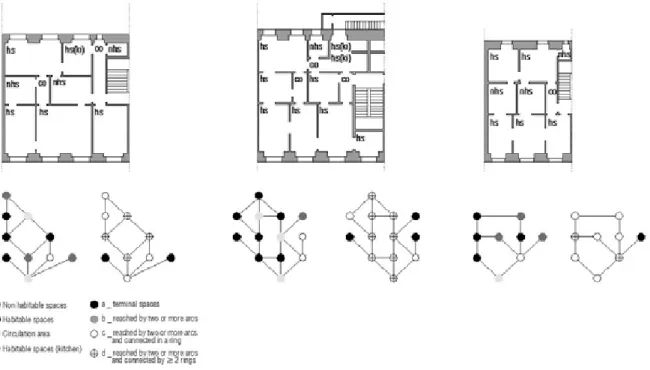
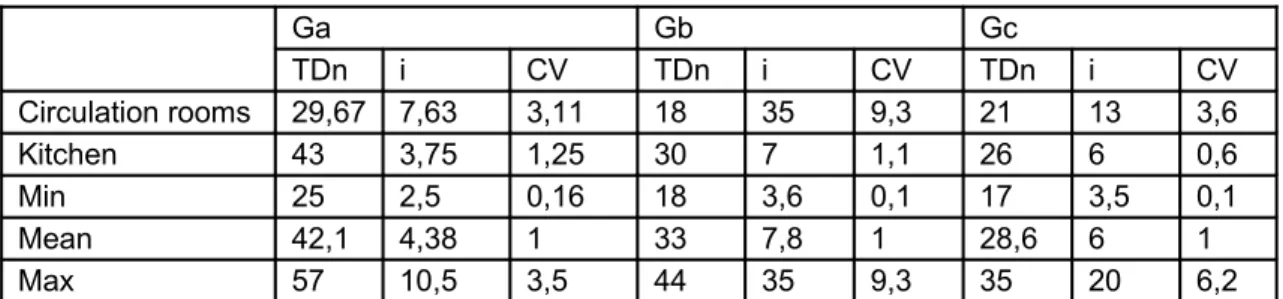
In Gaioleiros’ buildings the outcomes of theperformed graph analysis are show that in gen-eral, all the spaces have high levels of integration showing the degree of centrality (or accessibility) of the system spaces [Table 5]. The circulation spaces have a very high level of integration as well as control value making them spaces of obligatory passage and indicating that the de-gree of importance of those spaces as a point of passage in relation to the surrounding areas is very high. This happens because most rooms connect to the same long corridor as seen in the graphs of [Figure 5]. Gaioleiros’ rooms are mostly terminal spaces meant for occupation
and the number of rings (0 to 3), which enable alternative routes to be taken within the house, is low [Figure 5]. The mean number of circula-tion nodes is 1,7 for a mean number of nodes of 13,3 representing 13% of the dwelling’s rooms. Figure 6 and Table 6 show Visual Integration for Gaioleiros’. The most visual integrated dwelling is Gc almost with the same value of Gb. The pat-tern of visual integration is very similar in all cas-es: a linear core distributed along and within the corridor showing a big asymmetry with the rest of the compartments which are very segregated. Figure 7 and Table 7 show Visual Connectivity for Gaioleiros’ with a similar range of values and respective locations for the three dwellings. The highest values of Visual Connectivity are located both on corridors and within the bigger compart-ments, like social and service areas.
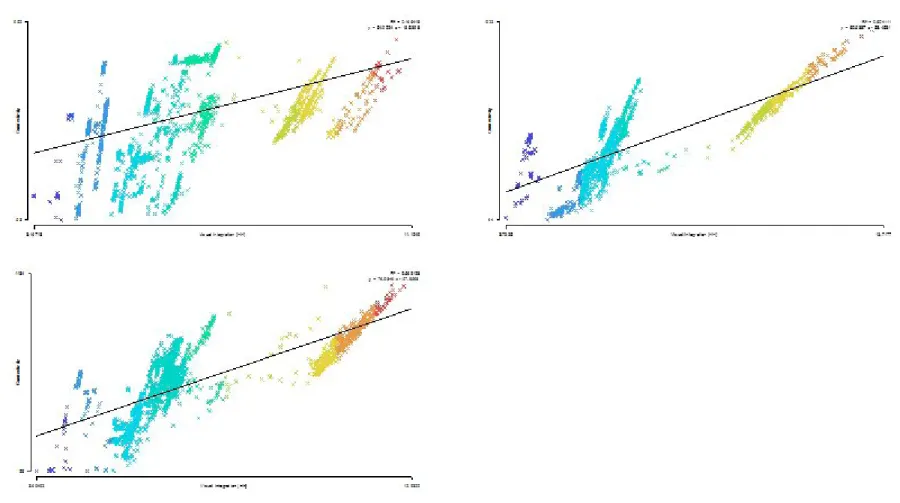
The calculations for intelligibility indicate as the most intelligible Gb and Ga to be less intelligi-ble. Of note is the strong difference between the Ga and the other two cases, which points to some difficulty in understanding the relation-ship between a space of the house with all the other spaces. This Ga dwelling, which is the one with the lowest value indicates a labyrinth space which is related with the existence of some very segregated spaces as we can see by the map of visual integration [Figure 5 and Fig-ure 6FigFig-ure 1] even with a good value of visual connectivity [Figure 7].
Sara Eloy e Rosália Guerreiro | Transforming housing typologies. Space syntax evaluation and shape grammar generation
Table 5 - Total Depth (TD) for actual node, Integration and Control Value for for Gaioleiro’s dwellings.
Figure 6 – VGA showing integration values for a sample of Gaioleiros’ dwelling (from left to right: Ga, Gb, Gc)
Figure 5 – A sample of Gaioleiros’ dwellings floor plans and justified graphs showing distributness. (from left to right: Ga, Gb, Gc)
Ga Gb Gc TDn i CV TDn i CV TDn i CV Circulation rooms 29,67 7,63 3,11 18 35 9,3 21 13 3,6 Kitchen 43 3,75 1,25 30 7 1,1 26 6 0,6 Min 25 2,5 0,16 18 3,6 0,1 17 3,5 0,1 Mean 42,1 4,38 1 33 7,8 1 28,6 6 1 Max 57 10,5 3,5 44 35 9,3 35 20 6,2
Table 5 - Total Depth (TD) for actual node, Integration and Control Value for for Gaioleiro’s dwellings.
Figure 6 – VGA showing integration values for a sample of Gaioleiros’ dwelling (from left to right: Ga, Gb, Gc)
usjt • arq.urb • número 15 | primeiro quadrimestre de 2016
100
Figure 7 – VGA showing connectivity values for a sample of Gaioleiros’ dwelling (from left to right: Ga, Gb, Gc)
Integration Ga Gb Gc
Average 5,9 43% 7,1 52% 7,3 53%
Minimum 3,2 0% 3,7 27% 3,7 27%
Maximum 11,1 81% 13,7 100% 12,9 94%
Table 6 – Visual Integration for Gioleiros’ dwellings.
Figure 7 – VGA showing connectivity values for a sample of Gaioleiros’ dwelling (from left to right: Ga, Gb, Gc) Connectivity Ga Gb Gc Average 505 14% 371 16% 502 14% Minimum 53 2% 44 2% 29 1% Maximum 952 27% 923 39% 1134 33% Grid Unit (0,2m) 3547 100% 2357 100% 3472 100%
Table 7 – Connectivity for Gaioleiros’ dwellings.
3.16713 11.1249 53 952 R² = 0.166418 y = 54.0224 x + 185.898 Visual Integration [HH] C o n n e cti v it y 3.7325 13.7177 44 923 R² = 0.604111 y = 60.5387 x - 58.4531 Visual Integration [HH] C o n n e cti v it y 3.69492 12.9322 29 1134 R² = 0.569123 y = 76.9846 x - 57.8598 Visual Integration [HH] C o n n e c tiv it y Integration Ga Gb Gc Average 5,9 43% 7,1 52% 7,3 53% Minimum 3,2 0% 3,7 27% 3,7 27% Maximum 11,1 81% 13,7 100% 12,9 94%
Table 6 – Visual Integration for Gioleiros’ dwellings.
Figure 7 – VGA showing connectivity values for a sample of Gaioleiros’ dwelling (from left to right: Ga, Gb, Gc) Connectivity Ga Gb Gc Average 505 14% 371 16% 502 14% Minimum 53 2% 44 2% 29 1% Maximum 952 27% 923 39% 1134 33% Grid Unit (0,2m) 3547 100% 2357 100% 3472 100%
Table 7 – Connectivity for Gaioleiros’ dwellings.
3.16713 11.1249 53 952 R² = 0.166418 y = 54.0224 x + 185.898 Visual Integration [HH] C o n n e cti v ity 3.7325 13.7177 44 923 R² = 0.604111 y = 60.5387 x - 58.4531 Visual Integration [HH] C o n n e cti v ity 3.69492 12.9322 29 1134 R² = 0.569123 y = 76.9846 x - 57.8598 Visual Integration [HH] C o n n e c tiv it y
Table 7 – Connectivity for Gaioleiros’ dwellings. Table 6 – Visual Integration for Gioleiros’ dwellings.
usjt • arq.urb • número 15 | primeiro quadrimestre de 2016
101
Sara Eloy e Rosália Guerreiro | Transforming housing typologies. Space syntax evaluation and shape grammar generation
Figure 8 – Scattergrams showing inteligibility values for a sample of Gaioleiros’ dwellings (from top left to bottom right: Ga, Gb, Gc)
Table 8 – Inteligibility for Gaioleiros ’ dwellings.
Figure 8 – Scattergrams showing inteligibility values for a sample of Gaioleiros’ dwellings (from top left to bottom right: Ga, Gb, Gc)
Inteligibility Ga Gb Gc
R2 0,16 0,60 0,57
Table 8 – Inteligibility for Gaioleiros ’ dwellings.
I n Rabo-de-bacalhau’ buildings the outcomes of the performed graph analysis show shows that, in general, all the spaces have high levels of depth showing a strong segregation of space Table 9 . The service spaces in which the kitchen is included are very deep in the overall structure of the dwelling. This phenomenon is related to the fact that most of the spaces are terminal spaces, make occupation the priority, and the number of rings are few (1 or 2), which means that alternative routes to be taken within the house and therefore movement are not a priority Figure 9 . The mean number of circulation nodes is 4,5 for a mean number of nodes of 15,3 representing 30% of the dwelling’s rooms and 16% of the average floor area.
Figure 10 represents the global analysis showing the shortest paths from each area of the dwelling, through the visibility graph, to all other areas. In the majority of the analyzed cases, namely case Rba and RBb Figure 10 a n d Table 9], visual integration presents a radial pattern with the center in the entrance hall or alongside the corridors which corresponds to the high values of visual integration. An exception in this pattern is case RBc Figure 10 which corresponds to a lower value of visual integration where the core is located in the center of the dwelling. In this case, which break the radial pattern, the integration pattern presents a higher asymmetry between the rear wing of the dwelling and the front wing. Despite the difference in the pattern of integration of this type of dwelling, the service zones are always the most segregated spaces of the system. The areas of greatest visual connectivity Figure 11 and Table 11 are located in the entrance halls or along corridors and passageways that make the functional and spatial distribution of spaces. Areas of lower visual connectivity are the smallest areas of the dwelling like the maid's room, the bathrooms or some service areas. Most of the values of intelligibility are below the value with which a system can be considered intelligible (R2>=0,5) Table 12 . This lowest value of intelligibility is due to the fact that the connectivity and integration are quite different and do not correlate well. Generally systems with low intelligibility are difficult to understand. This fact confirms the strong division between social space and the service space as well as
usjt • arq.urb • número 15 | primeiro quadrimestre de 2016
102
In Rabo-de-bacalhau’ buildings the outcomesof the performed graph analysis show shows that, in general, all the spaces have high lev-els of depth showing a strong segregation of space [Table 9]. The service spaces in which the kitchen is included are very deep in the overall structure of the dwelling. This phenomenon is related to the fact that most of the spaces are terminal spaces, make occupation the priority, and the number of rings are few (1 or 2), which means that alternative routes to be taken within the house and therefore movement are not a pri-ority [Figure 9]. The mean number of circulation nodes is 4,5 for a mean number of nodes of 15,3 representing 30% of the dwelling’s rooms and 16% of the average floor area.
Figure 10 represents the global analysis showing the shortest paths from each area of the dwelling, through the visibility graph, to all other areas. In the majority of the analyzed cases, namely case Rba and RBb [Figure 10 and Table 9], visual inte-gration presents a radial pattern with the center in the entrance hall or alongside the corridors which corresponds to the high values of visual integra-tion. An exception in this pattern is case RBc
[Figure 10] which corresponds to a lower value of visual integration where the core is located in the center of the dwelling. In this case, which break the radial pattern, the integration pattern presents a higher asymmetry between the rear wing of the dwelling and the front wing. Despite the differ-ence in the pattern of integration of this type of dwelling, the service zones are always the most segregated spaces of the system. The areas of greatest visual connectivity [Figure 11 and Table 11] are located in the entrance halls or along cor-ridors and passageways that make the functional and spatial distribution of spaces. Areas of lower visual connectivity are the smallest areas of the dwelling like the maid’s room, the bathrooms or some service areas. Most of the values of intel-ligibility are below the value with which a system can be considered intelligible (R2>=0,5) [Table 12]. This lowest value of intelligibility is due to the fact that the connectivity and integration are quite different and do not correlate well. Gener-ally systems with low intelligibility are difficult to understand. This fact confirms the strong divi-sion between social space and the service space as well as the separation between the space of movement and co-presence.
Sara Eloy e Rosália Guerreiro | Transforming housing typologies. Space syntax evaluation and shape grammar generation
usjt • arq.urb • número 15 | primeiro quadrimestre de 2016
104
Table 9 – Total Depth (TD) for actual node, Integration and Control Value for Rabo-de-Bacalhau’s dwellings.
RBa RBb RBc TDn i CV TDn i CV TDn i CV Circulation rooms 34,67 4,43 1,98 25 6,7 3,5 25,66 6,69 2,87 Kitchen 44 3,03 0,83 33 3,9 1,14 32 4,1 1,14 Min 33 1,44 0,2 23 2,43 0,14 22 2,51 0,14 Mean 47,73 3 1 34,42 4,97 1 34,28 4,1 1 Max 77 4,78 3,2 45 7,8 5,33 44 8,66 5,58
Table 9 – Total Depth (TD) for actual node, Integration and Control Value for Rabo-de-Bacalhau’s dwellings.
Figure 10 – VGA showing integration values for a sample of Rabo-de-bacalhau’s dwelling (from left to right: RBa, RBb, RBc)
Figure 10 – VGA showing integration values for a sample of Rabo-de-bacalhau’s dwelling (from left to right: RBa, RBb, RBc)
Integration RBa RBb RBc
Average 5,82 48% 6,00 50% 5,22 43%
Minimum 2,85 24% 3,20 26% 2,73 0%
Maximum 10,43 86% 12,12 100% 8,74 72%
Table 10 – Visual Integration for Rabo-de-bacalhau’s dwellings.
Figure 11 – VGA showing connectivity values for a sample of Rabo-de-bacalhau’s dwelling (from left to right: RBa, RBb, RBc) Conectivity RBa RBb RBc Average 369 14% 346 15% 354 14% Minimum 52 2% 41 2% 39 2% Maximum 742 28% 707 31% 795 32% Grid Unit (0.2m) 2649 100% 2281 100% 2478 100%
Table 11 – Conectivity for Rabo-de-bacalhau’s dwellings.
Sara Eloy e Rosália Guerreiro | Transforming housing typologies. Space syntax evaluation and shape grammar generation
Figure 11 – VGA showing connectivity values for a sample of Rabo-de-bacalhau’s dwelling (from left to right: RBa, RBb, RBc)
Figure 10 – VGA showing integration values for a sample of Rabo-de-bacalhau’s dwelling (from left to right: RBa, RBb, RBc)
Integration RBa RBb RBc
Average 5,82 48% 6,00 50% 5,22 43%
Minimum 2,85 24% 3,20 26% 2,73 0%
Maximum 10,43 86% 12,12 100% 8,74 72%
Table 10 – Visual Integration for Rabo-de-bacalhau’s dwellings.
Figure 11 – VGA showing connectivity values for a sample of Rabo-de-bacalhau’s dwelling (from left to right: RBa, RBb, RBc) Conectivity RBa RBb RBc Average 369 14% 346 15% 354 14% Minimum 52 2% 41 2% 39 2% Maximum 742 28% 707 31% 795 32% Grid Unit (0.2m) 2649 100% 2281 100% 2478 100%
Table 11 – Conectivity for Rabo-de-bacalhau’s dwellings.
usjt • arq.urb • número 15 | primeiro quadrimestre de 2016
106
Figure 12 – Scattergrams showing inteligibility values for a sample of Rabo-de-bacalhau’ dwellings (from top left to bottom right: RBa, RBb, RBc)
Table 12 – Inteligibility y for Rabo-de-bacalhau’s dwellings.
2.85243 10.4295 52 742 R² = 0.472949 Visual Integration [HH] C o n ne c ti v ity 3.19914 12.1222 41 707 R² = 0.547159 Visual Integration [HH] C o n ne c ti v ity 2.7256 8.34148 39 795 R² = 0.421925 Visual Integration [HH] C o nn e c ti vit y
Figure 12 – Scattergrams showing inteligibility values for a sample of Rabo-de-bacalhau’ dwellings (from top left to bottom right: RBa, RBb, RBc)
Inteligibility RBa RBb RBc
R2 0,47 0,55 0,42
Table 12 – Inteligibility y for Rabo-de-bacalhau’s dwellings.
Comparison between the housing buildings in Lisbon
The three studied types of housing buildings showed different ways of housing design over two centuries of Portuguese story. According to Bellal (2004) the differences that occur in the integration values of different spatial systems are one of the keys to the way in which culture and social relations express themselves through space. Because functions in a dwelling are usually assigned to spaces they acquire a spatial expression, which can be assigned a numerical value. If these numerical differences in functions are in a consistent order across a sample, it can be said that a cultural pattern exists (Bellal, 2004). Integration values are higher in Gaioleiros’s dwellings showing that the degree of centrality (or accessibility) of those houses is a characteristic of that period. Gaioleiros’s rooms, specially the circulation spaces, have a very high level of integration as well as control value indicating that the degree of importance of those spaces as a point of passage in relation to the surrounding areas is very high. This phenomenon does not occur in Pombalinos’ nor in Rabo-de-bacalhau’s dwellings where the values are average Table 13 . According to Holanda (1999), several studies have suggested that well-integrated buildings promote more informal and intense use, whereas more segregated buildings correspond to strongly hierarchical relationships amongst the inhabitants.
Pombalinos’s dwellings show a very distributed system with multiple routes leading to a room, prioritizing movement and circulation. This type of layout take advantage of the
Sara Eloy e Rosália Guerreiro | Transforming housing typologies. Space syntax evaluation and shape grammar generation
Pombalinos’s dwellings show a very distributed system with multiple routes leading to a room, prioritizing movement and circulation. This type of layout take advantage of the permeability relation-ship between different spaces creating alternative routes and enabling choice for the users. Regarding space distribuitedness, it can be seen that in Gai-oleiros’s and Rabo-de-bacalhau’s dwellings non-distributed spaces prevail over non-distributed spaces. According to sociologic logics higher distributed-ness values occur in a space with no strong barri-ers between inhabitants and the activities carried out there (Holanda, 1999). Therefore it’s clear that through time the flexible distribution of the dwell-ing’s layout lost flexibility and the possibility for having different routes to reach a space. Consid-ering the Total Depth values, Rabo-de-bacalhau’s dwellings are the ones that show most segregation within the different areas stressed by the fact that most of the spaces are terminal spaces and the number of rings are few [Table 13].
The comparison between the three types of housing building considering syntactic measures indicate differences especially regarding visual integration and intelligibility. The visual integration amplitude between the average and maximum values is higher within Pombalinos and de-bacalhau. Rabo-de-bacalhau type is the one which presents lower values for visual integration corroborating the lower values of intelligibility, as in the case RBc which in-telligibility value indicates that it is an unintelligible system (R2 = 0 42 [Table 12]).
Comparison between the housing buildings in Lisbon
The three studied types of housing buildings showed different ways of housing design over two centuries of Portuguese story. According to Bellal (2004) the differences that occur in the integration values of different spatial sys-tems are one of the keys to the way in which culture and social relations express themselves through space. Because functions in a dwelling are usually assigned to spaces they acquire a spatial expression, which can be assigned a nu-merical value. If these nunu-merical differences in functions are in a consistent order across a sam-ple, it can be said that a cultural pattern exists (Bellal, 2004). Integration values are higher in Gaioleiros’s dwellings showing that the degree of centrality (or accessibility) of those houses is a characteristic of that period. Gaioleiros’s rooms, specially the circulation spaces, have a very high level of integration as well as control value indicating that the degree of importance of those spaces as a point of passage in relation to the surrounding areas is very high. This phe-nomenon does not occur in Pombalinos’ nor in Rabo-de-bacalhau’s dwellings where the values are average [Table 13]. According to Holanda (1999), several studies have suggested that well-integrated buildings promote more informal and intense use, whereas more segregated buildings correspond to strongly hierarchical relationships amongst the inhabitants.
usjt • arq.urb • número 15 | primeiro quadrimestre de 2016
108
Sara Eloy e Rosália Guerreiro | Transforming housing typologies. Space syntax evaluation and shape grammar generation
In social terms these indicators suggest a strong formal and orthodox layout of the social spaces, with a sharp differentiation between the social and service spaces. Corridors have a dual func-tion of accessibility to all spaces, attesting their high visual integration, and as a means to sepa-rate uses within the dwelling.
The visual integration and intelligibility for Pom-balinos’s buildings prove that its spaces are eas-ily read from all the others, (the whole dwelling can be inferred by a short number of direct con-nections). The high visual connectivity provides a good visual perception and hence a more flexible use of the housing space.
A transformation grammar based methodology to the rehabilitation of existing housing stock
Shape grammars are generative design systems that enable the generation of multiple design
so-lutions based on shape rules that are applied step by step to shapes in order to generate a language of design. Instead of looking for one solution to a given problem shape grammar languages seek to find for multiple solutions based on the same set of rules or criteria. Shape grammars may be analytical if they make it possible to understand existing languages or original if they enable new design languages to be created (Stiny, 1976). This study proposes the use of a generative system based on shape grammars to transform dwellings and therefore promoting the refurbish-ment of the existing housing stock in cities. This system is called a transformation grammar (Eloy, 2012a) since it enable the transformation of ex-isting dwellings by introducing changes related to the new ways of living. The transformation grammar developed was applied to Rabo-de-Bacalhau buildings because of their representa-tive character in the city and because those
Table 13 – Total Depth (TD) for actual node, Integration and Control Value for Pombalino’s/Gaioleiro’s/Rabo-de-bacalhau’s dwellings (mean values from all the samples shown). de-bacalhau data was calculated from a sample of 25 Rabo--de-bacalhau dwellings included in (omitted authors, 2012a).
enabling choice for the users. Regarding space distribuitedness, it can be seen that in Gaioleiros’s and Rabo-de-bacalhau’s dwellings non-distributed spaces prevail over distributed spaces. According to sociologic logics higher distributedness values occur in a space with no strong barriers between inhabitants and the activities carried out there (Holanda, 1999). Therefore it’s clear that through time the flexible distribution of the dwelling’s layout lost flexibility and the possibility for having different routes to reach a space. Considering the Total Depth values, Rabo-de-bacalhau’s dwellings are the ones that show most segregation within the different areas stressed by the fact that most of the spaces are terminal spaces and the number of rings are few Table 13 .
The comparison between the three types of housing building considering syntactic measures indicate differences especially regarding visual integration and intelligibility. The visual integration amplitude between the average and maximum values is higher within Pombalinos and Rabo-de-bacalhau. Rabo-de-bacalhau type is the one which presents lower values for visual integration corroborating the lower values of intelligibility, as in the case RBc which intelligibility value indicates that it is an unintelligible system (R2 = 0 42 Table 12 ).
TDN i CV Pombalino/Gaioleiro/ Rabo-de-bacalhau Pombalino/Gaioleir o/Rabo-de-bacalhau Pombalino/Gaioleir o/Rabo-de-bacalhau Circulation rooms 21,00 / 24,83 / 38,21 4,49 / 13,98 / 4,36 1,51 / 4,29 / 2,05 Kitchen 24,20 / 33,00 / 49,10 3,85 / 5,58 / 2,89 1,24 / 0,98 / 1,31 Min 17,00 / 20,00 / 34,00 2,23 / 3,22 / 1,78 0,24 / 0,12 / 0,20 Mean 22,90 / 34,40 / 48,74 3,59 / 6,06 / 3,14 1,00 / 1,00 / 1,00 Max 29,25 / 45,33 / 69,60 6,06 / 21,67 / 5,18 2,58 / 6,33 / 3,40 T a b l e 13 – T o t a l D e p t h ( T D ) f o r a c t u a l n o d e , I n t e g r a t i o n a n d C o n t r o l V a l u e f o r Pombalino’s/Gaioleiro’s/de-bacalhau’s dwellings (mean values from all the samples shown). Rabo-de-bacalhau data was calculated from a sample of 25 Rabo-Rabo-de-bacalhau dwellings included in (omitted authors, 2012a).
In social terms these indicators suggest a strong formal and orthodox layout of the social spaces, with a sharp differentiation between the social and service spaces. Corridors have a dual function of accessibility to all spaces, attesting their high visual integration, and as a means to separate uses within the dwelling.
The visual integration and intelligibility for Pombalinos’s buildings prove that its spaces are easily read from all the others, (the whole dwelling can be inferred by a short number of direct connections). The high visual connectivity provides a good visual perception and hence a more flexible use of the housing space.
Sara Eloy e Rosália Guerreiro | Transforming housing typologies. Space syntax evaluation and shape grammar generation
buildings are in need of both constructive and functional refurbishment.
The development of the Rabo-de-bacalhau gram-mar included the description of the original apart-ments’ morphology using syntactic measures such as integration, control, depth and distribut-ness as showed in a previous section. The aim was to analyze the original apartments in terms of the time when they were built in order to un-derstand their spatial structure and its social ef-fects. A grammar like this one enables to define several design solutions for the transformation of a dwelling for the same given design problem
or for different design problems [Figure 13]. The analysis presented in this paper of three types of housing buildings allowed us to understand the specificities of other types and to analyse the dif-ferences that a transformation grammar for those types would have.
Syntactic measures were used as part of the transformation grammar with the aim to under-stand which transformations could be proposed for dwellings in order to meet present day re-quirements and how these transformations could be handled using space syntax measures. The analysis of original Rabo-de-bacalhau buildings, shown in a previous section of this paper, high-lighted some of their characteristics that were not conforming to nowadays lifestyles, e.g. a very deep and segregated service area and a clear separation between social and private areas. These and other characteristics were incorpo-rated in the transformation grammar by the use of graphs and by the manipulation of nodes and arcs by shape rules. [Figure 13] shows the graph of the original dwelling (on the left) and some de-sign solutions dede-signed with the transformation grammar that answered the enumerated conflicts in the use of space.
In the shown case at [Figure 13] the aspects which were highlighted to be changed were: i) the segregation of the service areas (level 5 in the graph); ii) the lack of alternative routes (graph showing distributness); iii) separation
be-Figure 13 – Original Rabo-de-bacalhau dwelling (left) and five di-fferent solutions to refurbish it (from left to right - a, b, c, d, e). On the top the floor plan, on the middle the justified graph showing the functional areas, on the bottom graphs showing distributness.
usjt • arq.urb • número 15 | primeiro quadrimestre de 2016
110
tween the service areas and social areas. Theconnection of rooms if adjacent and the assign-ment of new functions to the existing rooms en-able those conflicts to be solved.
The transformation grammar is a compound grammar which uses five modes of representing a dwelling in order to guide the transformation us-ing the most appropriate data at each step. Be-sides the normal arc to represent the connection
between two nodes (rooms), a second type of arc was used to represent the adjacency between different nodes (the hidden line in image (i) in [Fig-ure 14]), since adjacencies are extremely relevant in rehabilitation processes. Therefore the use of space syntax theories enable to access whether the proposed rehabilitation solutions generated by the transformation grammar are successful in creating the expected social benefits.
The Rabo-de-bacalhau transformation grammar encompasses four steps in order to define new layouts for the existing dwellings. The derivation of a solution should follow the four steps in the following order: 1) prepare the floor plan; 2) as-sign functional areas (hall, kitchen, private area, social area, service area, storage area); 3) ad-aptation of shape; 4) integration of Information Communication and Automation Technologies (ICAT). Shape rules were divides into different groups according to the nature of the work in-volved: i) rules for the assignment of functions to rooms; ii) rules for permuting room functions; iii) rules which add walls to enable rooms to be divided and wall openings to be eliminated or reduced; iv) rules which eliminate walls to en-able rooms to be connected or one room to be enlarged; v) rules for changing the stage in the derivation; vi) rules for preparing the floor plan; vii) rules for integrating ICAT elements. Although these groups of rules were used for Rabo-de-bacalhau buildings, they reflect the types of ac-tions that are involved in all rehabilitation works.
Figure 14 – Different modes of representing the dwelling i) nodes and arcs (for rooms and connections); ii) floor plan; iii) convex shapes / pla-nar surfaces (for spatial voi-ds); iv) weights (for construc-tion technologies); v) labels (for room functions) (omitted authors, 2012: 310)
Sara Eloy e Rosália Guerreiro | Transforming housing typologies. Space syntax evaluation and shape grammar generation
Work is now being developed to enable the use of the transformation grammar in a general con-text of rehabilitation (Eloy & Duarte, 2012b). The generalization of the transformation grammar will use the same general framework of rules and in-tegrate specificities of different building types, e.g. considering different construction constrains and different functional organizations. Consider-ing that the major aspects of rehabilitation works are already implemented in the grammar its gen-eralization as to do, in an initial phase, with a more complete and embracing parameterization
Figure 15 – Framework for the general transformation grammar with the sequence of steps and types of rules and the specificities that have to be introduced when generali-zing the grammar to other types of buildings.
of shape as well as taking into consideration the order of spaces to be assigned.
Figure 15 shows a possible framework of the general transformation grammar where most of the structure remains the same developed for Rabo-de-bacalhau but some specificities are in-troduced in the order the grammar should be im-plemented as well as in the shape rules.
Concluding remarks and future work
In this paper we addressed the need of rehabili-tating the housing stock in European cities and proposed a methodology to fulfill that task based on a transformation grammar. We argue that the particular characteristic of different types of build-ings enable specific rehabilitation strategies to be carried out (omitted authors, 2012a). For that we characterized three different housing types constructed in Lisbon from the 18th to the 20th century by using space syntax measures so that the social effect of their layout could be analyzed. This analysis revealed the evolution of mass urban housing in Lisbon in the past two centuries and the connection between the floor plans and the society of the studied periods. From the output of the building characterization we are able to fore-cast how specificities of each types could lead to different transformation strategies. A transforma-tion grammar for one of the buildings, Rabo-de-bacalhau, was briefly presented as a viable meth-odology to transform existing housing layouts to
usjt • arq.urb • número 15 | primeiro quadrimestre de 2016
112
meet current day requirements. The introduction ofspecific principles of transformation for each one of the also studied housing types will enable the use of this transformation design tool in a broader way. A tool like this one allows the refurbishing of apartments in an individualized way and could be made available directly to the apartment inhabit-ants. Ongoing and future work will concern the extension of the general transformation grammar with the specificities of the Gaioleiros’ and Pom-balinos’ dwellings and the implementation of the transformation grammar in a software.
References
Appleton, J. G. F. (2005) Reabilitação de edifí-cios “gaioleiros”. Lisboa: Edições Orion.
Bellal, T. (2004): “Understanding home cultures through syntactic analysis: the case of Berber housing” in Housing, Theory & Society, 21, nº3.
Taylor & Francis. pp 111-127.
Carita, Hélder (1994) O Bairro Alto: Tipologias e
Modos Arquitectónicos. Lisboa: CML.
Cunha, L. M. J. (1994): A nação nas malhas da sua identidade: o Estado Novo e a con-strução da identidade nacional. Braga, Uni-versidade do Minho, ICS. Available at WWW: <URL: < https://repositorium.sdum.uminho.pt/ bitstream/1822/6440/1/1994%20Provas%20 APCC%20Tese.pdf>
Euroconstruct (2014) Pres Release 77th Eurocon-struct Confenrece 13th June 2014, Oslo. Avail-able at WWW <URL: http://www.euroconstruct. org/pressinfo/2013_77_PressRelease.pdf>
Firley, E., Stahl, C. (2009) The Urban Housing Handbook. Wiley.
Habraken, N. J. (1988): “Type as a Social Agree-ment”. Paper presented at the Asian Congress of
Architects, Seoul.
Hanson, J. (1998) Decoding Homes and Hous-es. Cambridge University Press.
Heitor, T. V., Duarte, J. P., Pinto, R. M. (2004): “Com-bining Grammars and Space Syntax: Formulating, Generating and Evaluating Designs”, in Interna-tional Journal of Architectural Computing,
Vol-ume 2, Number 4, December 2004, pp. 492-515(24). Hillier, B., Hanson, J. and H. Graham (1987) “Ideas are in things: an application of the space syntax method
to discovering house genotypes”, Environment and Planning B: Planning and Design 14: 363–385
Holanda, F. (1999): “Sintaxe de uma casa-átrio moderna”. Document based on the paper pre-sented in Seminário DOCOMOMO Brasil, São Paulo, 8-11 December 1999. Available at <http:// vsites.unb.br/fau/pos_graduacao/paranoa/edi-cao1999/sintaxe_casa_atrio_ moderna/sintaxe. htm> (accessed January 2010)
Sara Eloy e Rosália Guerreiro | Transforming housing typologies. Space syntax evaluation and shape grammar generation
Klarqvist, B. (1993) A Space Syntax Glossary, Nordisk Arkitecturforskning. Available at WWW: <URL https://fenix.tecnico.ulisboa.pt/download-File/3779573909551/glossarySS.pdf>
Knight, T. (2000): Shape Grammars in educa-tion and practice: history and prospects. Massa-chusetts: MIT, 14 September 2000. Available at WWW: <URL http://web.mit.edu/tknight/www/ IJDC/> (accessed on 2009-03-21).
Lino, R. (1937) L’evolution de l’ architecture do-mestique au Portugal. Lisboa: Institut Français
au Portugal.
Manum, B., Rusten, E., Benze, P. (2005): “AGRAPH, Software for Drawing and Calculating Space Syn-tax Graphs”, in 5th International Space Syntax Symposium, Delft 13-17 Jun 2005.
Mascarenhas, J. (2005) Sistemas Construtivos V, 2.ª Edição. Lisboa: Livros Horizonte.
Medeiros, V. A. S. (2006) Urbis Brasiliae, ou sobre cidades do Brasil. Phd Dissertation, Brasília: FAU UnB. Available at WWW <URL: www.fredericode-holanda.com.br>
Monteiro, P. P. (1949) Os Portugueses precur-sores da Arquitectura Moderna e do Urban-ismo. Porto: Círculo José de Figueiredo.
Monteys, X. (2013) “O edifício comum, casas
lisboetas” in C. D. Coelho, coordination, Os El-ementos Urbanos 1, pages 189-205. Cadernos
MUrb Morfologia Urbana estudos da cidade por-tuguesa. Argumentum.
Pereira, N.T. (2005) Prefácio. in Appleton, J. G. F. (2007) Reabilitação de edifícios “gaioleiros”.
Lisboa: Edições Orion. Pp. XIII-XX.
Pereira, S. M. (2006): “Housing structures and contemporary family patterns: Lisbon private mar-ket”, in ENHR Proceedings “Housing in an ex-panding Europe: theory, policy, participation and
implementation” Workshop 22 – Housing Markets Dynamics, Ljubljana, Slovenia, 2 – 5 July 2006. Reis, N. M. A. (2000): O Saguão como person-agem conceptual estruturador da habitação ur-bana: o caso de Lisboa – o seu passado recente e o seu futuro: trabalho de síntese. Lisboa: FAUTL.
Santos, M. H. (2000) A Baixa Pombalina.
Pas-sado e Futuro. Livros Horizonte.
Stiny, G. (1976): “Two exercises in formal composi-tion,” Environment and Planning B 3, pp. 187-210. Stiny, G., GIPS, J. (1972): “Shape Grammars and the Generative Specification of Painting and Sculpture”. in C. V. Freiman, ed., Informa-tion Processing 71 (North Holland, Amsterdam,
1972), pp. 1460-1465.. Available at WWW: <URL http://www.shapegrammar.org/ifip/ifip1.html>.
usjt • arq.urb • número 15 | primeiro quadrimestre de 2016
114
Turner, Alasdair (2004) Depthmap 4. AResearch-er’s Handbook Bartlett School of Graduate Stud-ies, UCL, London. Available at WWW: <URL http://www.vr.ucl.ac.uk/depthmap/handbook/ depthmap4r1.pdf>
Eloy, S. (2012) A transformation grammar-based methodology for housing rehabilitation. PhD thesis, Instituto Superior Técnico, Universidade Técnica de Lisboa. Available at http://hdl.handle. net/10071/7055
Eloy, S., Duarte, J.P. (2012) Transformation Gram-mar for Housing Rehabilitation: from a specific to a general grammar. Achten, Henri; Pavlicek, Jiri; Hulin, Jaroslav; Matejdan, Dana (eds.), Digi-tal Physicality - Proceedings of the 30th eCAADe Conference - Volume 1, Czech Technical Univer-sity, Prague, pp. 471-478.