Volume 2013, Article ID 362894,8pages http://dx.doi.org/10.1155/2013/362894
Research Article
Bonding, Structure, and Stability of
[(
Na
)
𝑛
(
Phe
)
𝑚
]
𝑛+
Clusters:
Some Surprising Results from an Experimental and Theoretical
Investigation in Gas Phase
Melissa S. Caetano,
1Teodorico C. Ramalho,
1Tales G. Vieira,
2Arlan da Silva Gonçalves,
3Daiana T. Mancini,
1and Elaine F. F. da Cunha
11Department of Chemistry, Federal University of Lavras, Campus Universit´ario, 37200-000 Lavras, MG, Brazil
2UNILAVRAS—Centro Universit´ario de Lavras, Rua Padre Jos´e Poggel 506, Centen´ario, 37200-000 Lavras MG, Brazil
3Chemistry Department, Federal Institute of Education Science and Technology, Estrada da Tartaruga S/N,
29215-090 Bairro Muquic¸aba, Guarapari, ES, Brazil
Correspondence should be addressed to Teodorico C. Ramalho; [email protected]
Received 1 July 2012; Revised 14 January 2013; Accepted 15 January 2013
Academic Editor: Antonio M. Romerosa
Copyright © 2013 Melissa S. Caetano et al. This is an open access article distributed under the Creative Commons Attribution License, which permits unrestricted use, distribution, and reproduction in any medium, provided the original work is properly cited.
Structure and stability of[(Na)𝑛(Phe)𝑚]𝑛+clusters in the ground state were analyzed at the theoretical and experimental levels. Our experimental and theoretical findings showed that the[(Na)𝑛(Phe)𝑚]𝑛+clusters in gas phase tend to form mainly planar rings of four members. The symmetry and the small dipole moment in these specific configurations suggested that their stability could be associated with an alignment of the water molecules, maximizing attractive electrostatic interactions caused by changes in the charge distribution of the clusters.
1. Introduction
Three-dimensional structures of proteins are strongly influ-enced by noncovalent interactions. Van der Waals bonding, hydrophobic interactions, hydrogen bonds, and ionic bonds are responsible for these structural effects and biological activity. Several individually weak bonds, acting coopera-tively, often allow molecular recognition by precisely posi-tioning partner atoms and groups [1].
Since metal ions are essential cofactors in many important proteins, several studies have been performed toward under-standing the factors governing metal binding in metallopro-teins [2].
Among metal ions, alkali metals chemistry has received
an increasing interest during the past decades [3,4], because
their cations play an important role, especially in biochemical processes. They interact with proteins and peptides to control
structural and regulating properties [5,6]. For instance, the
role of alkali cations in peptide conformation deserves special
attention and the study of their interaction with amino acids is expected to give insights to support structural assumptions necessary to interpret some molecular biology phenomena.
In this line, phenylalanine (Phe) is often chosen as a representative unit of the hydrophobic backbone in a protein. In order to simulate what may occur in biology, where the alkali metal-hydrophobic core is an important component,
we carried out a study of various Na+ clusters with
pheny-lalanine amino acids.
Alkali metal ion clusters present unusual structural, mag-netic, and catalytic properties, which ultimately depend on their electronic structure, different from those of the ion alone [2].
The Electrospray Ionization Mass Spectrometry (ESI-MS) has been used as a tool to investigate the metal-bound
tetrameric complexes [7, 8] and in general is useful for
In general, the ESI-MS data are shown to display high cor-relations with expectations based on solution-phase studies [9–12]. However, it is not to be expected that the correlation will be perfect, since ion-molecule reactions may intervene and, in any event, the three-dimensional structure of the gas-phase complex cannot be the same as the solvated species [9]. Nevertheless, the operating hypothesis when using ESI for the study of cluster ions [13–15] is that it is possible to sample species present in solution, allowing gas-phase data to be acquired and compared with the solution data.
On the theoretical side, electronic structure calculations on alkali metal clusters pose a considerable challenge: the existence of multiple isomers, and the electronic nature of alkali metal ions, which leads to several interactions between
the metal ions and ligands [16,17].
Furthermore the nonbonded interactions can play an important role in the stability and structural chemistry of alkali metal clusters. In fact, nonbonded interactions modu-late the conformations of virtually every molecule. The influ-ence of electrostatic and dispersive forces on the conforma-tion of biological macromolecules offers another well-known example of this phenomenon [2]. An approach to investigate this problem is the use of theoretical calculations. Calcula-tions involving coordination compounds are, however, com-plicated by a variety of possible geometries and by different metal oxidation states [15]. For instance, it is well known that the use of post-Hratree–Fock techniques to describe plexes between metals and amino acids is limited by the com-plexity of the system to be studied. On the other hand, DFT methods have been increasingly applied to the study of the interaction of metals with biomolecules. This approach is interesting because it includes the effect of electronic correla-tions and allows for the calculation of larger systems [17].
Thus, the main goal of this paper was to study the
inter-action between phenylalanine and Na+ ions in gas phase
using theoretical and experimental approaches.
2. Methodology
2.1. Studies by ESI-MS. The analysis of the solution
composi-tion after the reaccomposi-tion was conducted by introducing aliquots of the solution into the ESI source (Agilent Technologies, Santa Clara, CA, USA) with a syringe pump at a flow rate
of 5 mL min−1. The spectra were obtained as an average of
50 scans of 0.2 s each. Typical ESI conditions were as follows:
capillary temperature of 1508∘C, carrier gas (N2) at a flow rate
of ca. 4 L min−1, spray voltage of 4 kV, capillary voltage of 25 V,
and tube lens offset voltage of 25 V.
Charge states of cluster ions were determined by mass/ charge ratio measurements and confirmed by higher resolu-tion experiments and tandem mass spectrometry. Isolaresolu-tion of the ions of interest was achieved using a notched waveform to affect broadband excitation and ejection of the undesirable ions.
The d-phenylalanine and the salt (sodium chloride) were obtained from Aldrich. Methanol was purchased from Fisher Scientific and used to prepare the mobile phase,
methanol–water (1 : 1 v/v), and also used to prepare 0.01 M solutions of amino acids and salts.
2.2. Quantum Chemical Methods. The calculations were
car-ried out with the Gaussian 03 package [18]. Each conformer was fully optimized by PM3 [19] and Density Functional Theory (DFT) methods. The energy profile at selected DFT geometries along the reaction pathway was computed at HCTH level of theory using the LANL2DZ basis set. This computational procedure has been employed previously on
similar systems with success [20,21]. Furthermore, after each
optimization, the nature of each stationary point was estab-lished by calculating and diagonalizing the Hessian matrix (force constant matrix). The unique imaginary frequency associated with the transition vector (TV) [22], that is, the eigenvector associated with the unique negative eigenvalue of the force constant matrix, was characterized. All discussions concerning the energy differences and the energy barriers
refer to theΔ𝐺 term ((1),Figure 1), corrected for the zero
point energy (ZPE) at 298.15 K in the Gaussian 03 program [20–23].
The basis on which the thermodynamic cycle approach rests is the fact that the (Gibbs) free energy is a thermody-namic state function. This means that as long as a system is
changed in a reversible way the change in free energyΔ𝐺will
be independent of the path. Therefore, along a closed path or
cycle one hasΔ𝐺 = 0. It can be used to study the relative free
energy of solvation of species [24]. One has
Δ𝐺aq= Δ𝐺SOLV[(Na)𝑛(Phe)𝑚]𝑛+
− [Δ𝐺SOLV(Na)++ Δ𝐺SOLV(Phe)] + Δ𝐺g.
(1)
For all the species studied, we have checked⟨𝑆2⟩values
to evaluate whether spin contamination can influence the quality of the results. In all cases we have found that the
calculated values differ from𝑆(𝑆 + 1)by less than 10%.
3. Results and Discussion
3.1. Identification of the Cluster Formed via Online ESI-MS
Monitoring. In order to identify the behavior of alkali metal
clusters in gas phase, we simulated the chemical reaction
between d-phenylalanine amino acid and Na+ ion. The
identification of reaction intermediates was performed online by the ESI-MS equipment. It is worth noting that the signal
corresponding to𝑚/𝑧 = 683was the most intense in the mass
spectrum.
Figure 2shows the whole mass spectrum obtained from
the solution of phenylalanine with Na+ion. The main signal
(𝑚/𝑧 = 683.0) corresponds to four molecules of
pheny-lalanine and one sodium ion. According to our calculations,
the 𝑚/𝑧 = 683.0 fragment is due to tetramer formation
between four molecules of phenylalanine amino acid with
one Na+ion. It is interesting to mention that the𝑚/𝑧 = 683.0
fragment might also refer to all tetramer multiples because
eight molecules of phenylalanine bonded to two Na+ions can
Δ𝐺(g)
Δ𝐺(aq)
𝑛Na(g)+ 𝑚Phe(g)
𝑚Phe(aq)
[(Na)𝑛(Phe)𝑚]𝑛+(g)
[(Na)𝑛(Phe)𝑚]𝑛+(aq)
Δ𝐺solv[(Na)𝑛(Phe)𝑚]𝑛+
+
+
𝑛Na(aq)+
Δ𝐺solv(Na+) Δ𝐺solv(Phe)
Figure 1: Thermodynamics cycle.
100 200 300 400 500 600 700 800 900 1000
100
90
80
70
60
50
40
30
20
10
0 166
188
352
516
683
847
Relative abundance
𝑚/𝑧
Figure 2: ESI mass spectra in the positive ion mode for monitoring the chemical reaction.
The𝑚/𝑧 = 188.0fragment exists in the same proportion
of molecules of phenylalanine and number of Na+ions. The
𝑚/𝑧 = 188.0 fragment displays a less intense signal when
compared to the fragment at𝑚/𝑧 = 683(tetramer derivative
fragments). Other less intense signals were observed in
Figure 2; the fragment at𝑚/𝑧 = 353.0is related to two
pheny-lalanine molecules and one Na+ion, while the fragment at
𝑚/𝑧 = 166corresponds to protonated phenylalanine.
In line with our findings, we can therefore observe that it is likely that there is an extra stabilization with respect to the fragments from the tetramers.
3.2. Theoretical Calculations. In order to investigate the
fac-tors that govern the stabilization of the tetramer fragments, we have used theoretical calculations. Thus, we performed Gibbs free energy calculations for the fragments related to
phenylalanine and Na+clusters found in the mass spectrum.
For the fragment𝑚/𝑧 = 188, we carried out the theoretical
calculations with two phenylalanine molecules and two Na+
ions; for the fragment at 𝑚/𝑧 = 353, two molecules of
phenylalanine and one Na+ion were used; and for𝑚/𝑧 = 683,
we have performed calculations using the tetramer. Each situation was investigated using different geometries and a
coordination environment with the phenylalanine residues
bonded to the cation through the NH2, C=O, or OH groups.
The calculated energies and geometries of the studied systems
are reported inTable 1at the DFT level. The semiempirical
calculations were performed just for a step of preoptimization of the system.
Different potential binding sites (electron-rich sites) for
the Na+ion on the free phenylalanine molecule were
consid-ered: the N and O ions and the aromatic ring, considering both the mono- and bidentate coordinations.
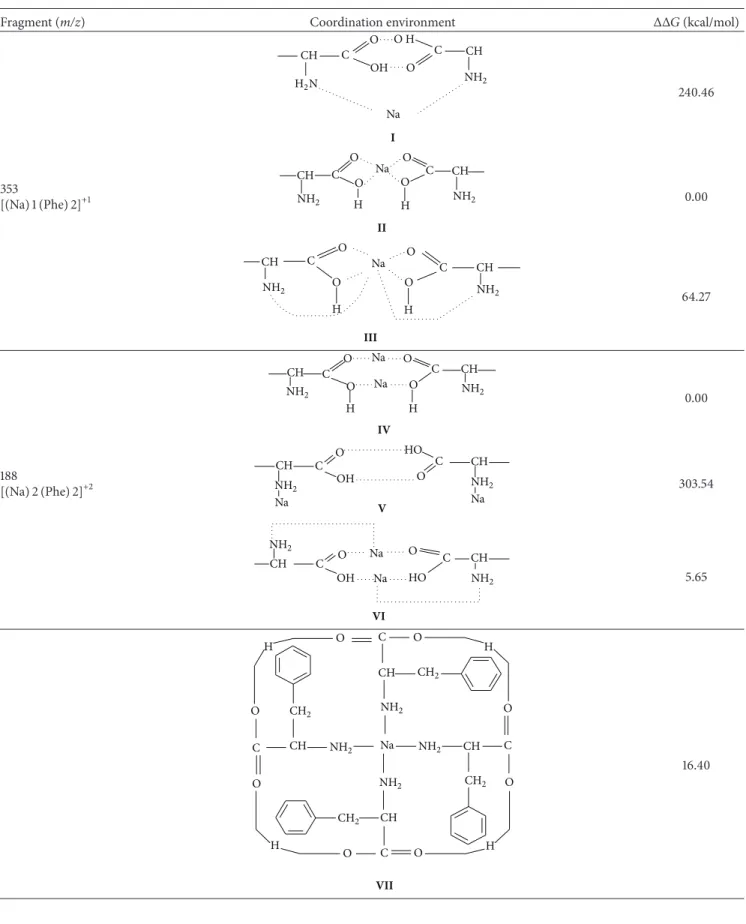
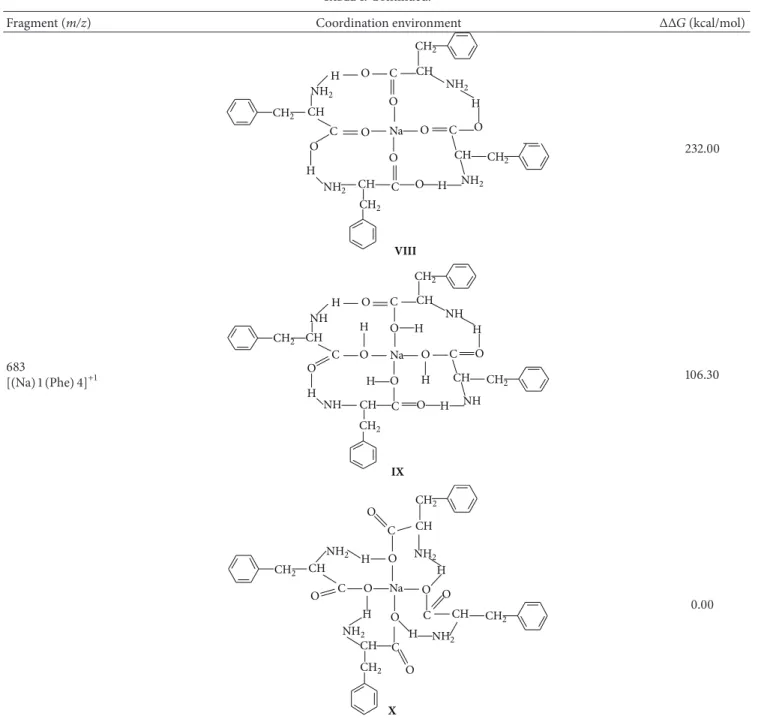
According to Table 1, for the fragment at 𝑚/𝑧 = 353
(structures fromItoIII), the lowest free energy was obtained
for the cluster model where the Na+ cation is bonded only
between the carboxyl groups of two molecules of
pheny-lalanine (structure II). There is a difference of +240 and
+64.27 kcal/mol for Iand III, respectively. We got similar
results for𝑚/𝑧 = 188(structuresIV–VI), because the energy
values indicated that the most stable cluster was that with
the Na+ ion coordinated with the carboxyl groups without
the participation of the amino group. For 𝑚/𝑧 = 188,
the energy difference between the structures IV and V is
303.53 kcal⋅mol−1. For the fragment𝑚/𝑧 = 683(structures
VII–X), the Na+ion bonded alternately to the C=O and OH
groups was the more stable cluster, revealing the following
stability order:X>VII>IX>VIII.
From a topological point of view, very similar complexes were found for the other aromatic amino acids, in agreement
with previous studies involving other metals [25,26], which
suggested that the hydroxyl substituent does not significantly influence the binding.
Thus, in order to shed some light on this fact from a thermodynamic point of view, we carried out potential energy curve (PEC) calculations varying the Na–O=C, Na–
OH, and Na–NH2 bond lengths (Figure 3). The Gibbs free
energy data indicated that the carboxyl group seems to have
a more stable chemical bond with the Na+ion than both the
amino and hydroxyl groups of the amino acid residue. In this line, we have also observed that hydroxyl groups increased the strength of the intracluster hydrogen bonds between the amino acids molecules.
Table 1: Relative Gibbs free energy values obtained with proposed cation at the DFT level.
Fragment (m/z) Coordination environment ΔΔ𝐺(kcal/mol)
CH
H2N
C
O O H
Na
CH C
O OH
NH2
I
240.46
353
[(Na)1(Phe)2]+1
O
CH Na
NH2
H H
CH
NH2
C
O
C
O
O
II
0.00
C
O
Na CH
NH2
O O
O
C
CH
NH2
H H
III
64.27
O CH
Na
NH2 H O
C
Na O O
C CH
NH2 H
IV
0.00
188
[(Na)2(Phe)2]+2
C
O CH
Na
NH2 OH O
C CH
NH2 Na HO
V
303.54
OH
CH Na CH
NH2
HO
C O
Na O
C
NH2
VI
5.65
C
O
Na
CH NH2
CH2
O
NH2 H
O
O
H
C
H
CH CH2
C
O
C
O CH2
CH NH2 CH
CH2
H O
O NH2
VII
Table 1: Continued.
Fragment (m/z) Coordination environment ΔΔ𝐺(kcal/mol)
CH2
H O C CH NH2 NH2
NH2 CH
CH2
H O
C Na O
H C O
H
C O
O
O CH
CH2
NH2 O
CH
CH2
VIII
232.00
683
[(Na)1(Phe)4]+1
Na
CH NH
H O C
CH2
NH H
O C O CH
H O
C
CH
H O
C NH
CH H
O
CH2
NH CH2 O
H
H O H CH2
IX
106.30
CH H O
C CH2
NH2
CH H O
C CH2 NH2
Na
CH H
O C
CH2
NH2
CH
H O
C
CH2
NH2 O
O O
O
X
0.00
for both Na–OH and Na–N chemical bonds. Indeed, a deeper analysis reveals that the C=O group is the most promising group to bind with the cation, stabilizing the cluster formed
between the amino acid phenylalanine and the cation Na+. It
seems that a smaller cation leads to better H-bonding among the molecules bound to the cation. Thus, the tetramer formed
should have the form shown inFigure 4.
The tetrameric cluster of Phe and the Na+ ion is clearly
a magic number cluster, as illustrated by the data shown
in Figure 3. In fact, monovalent cations may stabilize the
tetraplex cluster with guanine in the order K+ >Na+ >Li+
[27–30].
Regarding this hypothesis, the higher stability of alkali metal ion clusters with amino acids containing “magic
numbers” can be related to the predominance of electrostatic effects over van der Waals or other intermolecular effects. The lower stability for those clusters containing magic numbers +1 also reflects the difficulty of stabilization of the electrostatic interaction, because the tetrameric systems distribute the electronic charge in a uniform way, resulting in a smaller dipole moment.
Table 2 shows that the magic numbers concerning the
[(Na)1(Phe)2]+ and [(Na)1(Phe)4]+ have a small dipole
moment, so that the relative stability of the magic number
(𝑚 = 4, 8, . . .) observed both theoretically and
experi-mentally can be rationalized at the molecular level due to an arrangement between the dipoles, which can be
−449440
449460
449480
449500
449520
449540
1.4 1.6 1.5 2.2 2.4 2.6
Binding N–Na Binding O–Na Binding OH–Na
B
indin
g ener
g
y (k
cal/mo
l)
−449560
Binding distance ( ˚A)
2.0
Figure 3: Potential energy curve for the chemical bond between the Na+ion with NH2, C=O, and OH groups.
Figure 4: Geometry for the most stable conformation of the Na+ -phenylalanine tetramer.
clusters. In addition, the tetrameric clusters present stronger intramolecular hydrogen bond among the carboxyl groups
of the phenylalanine molecule.[(Na)𝑛(Phe)𝑚]𝑛+clusters also
tend to form maximum number of planar rings of four members, because it is well known that this kind of molecular structure maximizes the hydrogen bond strength. Therefore
the stable conformer of the[(Na)𝑛(Phe)𝑚]𝑛+clusters tends to
form a maximum number of planar rings of four members, as already noted by Lee for water rings [31]. Recently, the discovery of the serine tetramer and octamer may also
reinforce our rationalization [15,32,33]. Despite the
impor-tance of the alkali metals chemistry in biochemical process, few theoretical and experimental works are devoted to the understanding of this subject at the molecular level.
The presence of the aromatic ring in the side chain of the amino acid might be another important molecular aspect necessary for stabilizing the tetrameric structure. In fact, it may help the coordination with the metal, because the charge on the metal may be better dispersed. The comparison of Phe with the nonaromatic amino acids has been taken as a useful indication of the extent of charge delocalization in the metal complexes [34].
Table 2: Conformation versus the calculated dipole moment (Debye).
Conformation Dipole moment (Debye)
I 10.63
II 3.99
III 7.76
IV 3.35
V 4.82
VI 4.10
VII 4.16
VIII 7.77
IX 4.74
X 2.87
According to Meyer, most observations concerning the
cation-𝜋interaction can be rationalized by the fact that the
sp2 carbon is more electronegative than hydrogen [35]. This situation generates 6 local C–H bond dipoles around the benzene ring, which create an overall charge distribution that is a build-up of negative charge in the center of the ring and a belt of positive charge around the edge. Thus, cations are attracted to the negative electrostatic potential over the face to the benzene ring. In this line, the cation interacts with the face, not the edge, of the ring [36].
Recently, the electrostatic model developed by Dougherty and coworkers describes trends in binding energy based on differences in electrostatic attraction [37]. Interaction
energies of cation-𝜋 pairs correlate well with electrostatic
potential above the 𝜋 face of arenes. Besides electrostatic
attraction, other electronic effects can take place in cation-𝜋
bonding. In this context, it should be kept in mind that tran-sition metals have the ability to share electron density with
𝜋-systems through d-orbitals, creating bonds that are highly
covalent in character and cannot be modeled as a classical
cation-𝜋interaction [37]. For a deeper understanding of the
nature of this interaction, it is need to employ QM methods with electronic correlation.
4. Conclusion
From our experimental and theoretical findings, we noticed
that the structures of [(Na)𝑛(Phe)𝑚]𝑛+ clusters tend to
form mainly planar rings of four members. Thus, our data
indicated that the formation of[(Na)𝑛(Phe)𝑚]𝑛+clusters in
gas phase was built up based on maximizing the number of planar shaped four-membered rings as occurs with the
water clusters [30, 38]. In this work, we used the ESI-MS
by comparison with theoretical calculations which reveal formation of tetrameric clusters.
References
[1] T. Aggerholm, S. C. Nanita, K. J. Koch, and R. G. Cooks, “Clustering of nucleosides in the presence of alkali metals: bio-logically relevant quartets of guanosine, deoxyguanosine and uridine observed by ESI-MS/MS,”Journal of Mass Spectrometry, vol. 38, no. 1, pp. 87–97, 2003.
[2] A. R. Timerbaev, C. G. Hartinger, S. S. Aleksenko, and B. K. Keppler, “Interactions of antitumor metallodrugs with serum proteins: advances in characterization using modern analytical methodology,”Chemical Reviews, vol. 106, no. 6, pp. 2224–2248, 2006.
[3] M. Benzakoura, A. Cartierb, M. Mcharfic, and A. Daoudia, “Interaction of aminoacids with cations. I- the glycine-Li+
-n(H20) (𝑛 = 0 − 3) complexes,”Journal of Molecular Structure, vol. 681, no. 1–3, pp. 99–104, 2004.
[4] R. G. Cooks, J. S. Patrick, T. Kotiaho, and S. A. McLuckey, “Thermochemical determinations by the kinetic method,”Mass
Spectrometry Reviews, vol. 13, no. 4, pp. 287–339, 1994.
[5] D. A. Dougherty, “Cation-𝜋 interactions in chemistry and biology: a new view of benzene, Phe, Tyr, and Trp,”Science, vol. 271, no. 5246, pp. 163–168, 1996.
[6] J. Sauer, “Molecular models in ab initio studies of solids and surfaces: from ionic crystals and semiconductors to catalysts,”
Chemical Reviews, vol. 89, no. 1, pp. 199–255, 1989.
[7] K. Fukushima and H. Iwahashi, “1 : 1 complex of guanine quartet with alkali metal cations detected by electrospray ionization mass spectrometry ,”Chemical Communications, vol. 11, pp. 895–896, 2000.
[8] K. J. Koch, T. Aggerholm, S. C. Nanita, and R. G. Cooks, “Clustering of nucleobases with alkali metals studied by elec-trospray ionization tandem mass spectrometry: implications for mechanisms of multistrand DNA stabilization,”Journal of Mass
Spectrometry, vol. 37, no. 7, pp. 676–686, 2002.
[9] J. A. Loo, “Electrospray ionization mass spectrometry: a tech-nology for studying noncovalent macromolecular complexes,”
International Journal of Mass Spectrometry, vol. 200, no. 1–3, pp.
175–186, 2000.
[10] I. Manet, L. Francini, S. Masiero, S. Pieraccini, G. P. Spada, and G. Gottarelli, “An ESI-MS and NMR Study of the self-assembly of guanosine derivatives,”Helvetica Chimica Acta, vol. 84, p. 2096, 2001.
[11] R. D. Smith, “Evolution of esi-mass spectrometry and fourier transform ion cyclotron resonance for proteomics and other biological applications,”International Journal of Mass Spectrom-etry, vol. 200, no. 1–3, pp. 509–544, 2000.
[12] M. Cai, X. Shi, V. Sidorov, D. Fabris, Y. F. Lam, and J. T. Davis, “Cation-directed self-assembly of lipophilic nucleosides: The cation’s central role in the structure and dynamics of a hydrogen-bonded assembly,”Tetrahedron, vol. 58, no. 4, pp. 661–671, 2002.
[13] M. J. Van Stipdonk, M. P. Ince, B. A. Perera, and J. A. Martin, “Cluster ions derived from sodium and potassium tetraflu-oroborate and their collision induced dissociation in an ion trap mass spectrometer ,” Rapid Communications in Mass
Spectrometry, vol. 16, no. 5, pp. 355–363, 2002.
[14] M. P. Ince, B. A. Perera, and M. J. Van Stipdonk, “Production, dissociation, and gas phase stability of sodium fluoride cluster
ions studied using electrospray ionization ion trap mass spec-trometry,”International Journal of Mass Spectrometry, vol. 207, pp. 41–55, 2001.
[15] R. G. Cooks, D. Zhang, K. J. Koch, F. C. Gozzo, and M. N. Eberlin, “Chiroselective self-directed octamerization of serine: implications for homochirogenesis,”Analytical Chemistry, vol. 73, no. 15, pp. 3646–3655, 2001.
[16] H. W. P. de Carvalho, A. P. L. Batista, and T. C. Ramalho, “The interaction between atoms of Au and Cu with clean Si(1 1 1) surface: a study combining synchrotron radiation grazing incidence X-ray fluorescence analysis and theoretical calculations ,”Spectrochimica Acta A, vol. 74, no. 1, pp. 292–296, 2009.
[17] T. C. Ramalho, T. L. C. Martins, L. E. P. Borges, M. H. de Pinho, R. R. de Avillez, and E. F. F. da Cunha, “Influence of Zn-Cd substitution: spectroscopic and theoretical investigation of 8-hydroxyquinoline complexes ,”Spectrochimica Acta A, vol. 72, no. 4, pp. 726–729, 2009.
[18] M. J. Frisch, G. W. Trucks, H. B. Schlegel et al.,Gaussian 03,
Revision D. 01, Gaussian, Wallingford, Conn, USA, 2004.
[19] J. J. P. Stewart, “Optimization of parameters for semiempirical methods I. Method,”Journal of Computational Chemistry, vol. 10, no. 2, pp. 209–220, 1989.
[20] E. F. F. da Cunha, R. B. de Alencastro, and T. C. Ramalho, “Theoretical Study of Adiabatic and Vertical Electron Affinity of Radiosensitizers in Solution—part 2: analogues of tirapaza-mine,”Journal of Theoretical and Computational Chemistry, vol. 3, no. 1, 2004.
[21] R. R. Da Silva, T. C. Ramalho, J. M. Santos, and J. D. Figueroa-Villar, “On the limits of highest-occupied molecular orbital driven reactions: the frontier effective-for-reaction molecular orbital concept,”Journal of Physical Chemistry A, vol. 110, no. 3, pp. 1031–1040, 2006.
[22] J. Andr´es, V. Moliner, V. S. Safont, L. R. Domingo, M. T. Picher, and J. Krechl, “On transition structures for hydride transfer step: a theoretical study of the reaction catalyzed by dihydrofolate reductase enzyme,”Bioorganic Chemistry, vol. 24, no. 1, pp. 10– 18, 1996.
[23] C. Gonzalez and C. B. Schlegel, “An improved algorithm for reaction path following,”The Journal of Chemical Physics, vol. 90, no. 4, pp. 2154–2161, 1989.
[24] W. F. van Gunsteren and H. J. C. Berendsen, “Thermodynamic cycle integration by computer simulation as a tool for obtaining free energy differences in molecular chemistry,” Journal of
Computer-Aided Molecular Design, vol. 1, no. 2, pp. 171–176, 1987.
[25] R. Dunbar, “Complexation of Na+ and K+ to aromatic amino acids: a density Functional Computational Study of cation-𝜋 interactions,”The Journal of Physical Chemistry A, vol. 104, no. 34, pp. 8067–8074, 2000.
[26] A. Rimola, L. Rodriguez-Santiago, and M. Sodupe, “Cation-𝜋 interactions and oxidative effects on Cu+and Cu2+binding to Phe, Tyr, Trp, and His amino acids in the gas phase. Insights from first-principles calculations,”Journal of Chemical Physics, vol. 110, p. 24189, 2006.
[27] J. M. Darlow and D. R. F. Leach, “Secondary structures in d(CGG) and d(CCG) repeat tracts,”Journal of Molecular Biol-ogy, vol. 1, pp. 3–16, 1998.
[28] J. Gu and J. Leszczynski, “A remarkable alteration in the bonding pattern: an HF and DFT Study of the interactions between the metal cations and the hoogsteen hydrogen-bonded G-tetrad,”
The Journal of Physical Chemistry A, vol. 104, no. 26, pp. 6308–
[29] W. Guschlbauer, J. F. Chantot, and D. J. Thiele, “Four-stranded nucleic acid structures 25 years later: from guanosine gels to telomer DNA,”Journal of Biomolecular Structure & Dynamics, vol. 8, no. 3, pp. 491–511, 1990.
[30] J. R. Williamson, “G-quartet structures in telomeric DNA,”
Annual Review of Biophysics and Biomolecular Structure, vol. 23,
pp. 703–730, 1994.
[31] C. Lee, H. Chen, and G. Fitzgerald, “Chemical bonding in water clusters,”Journal of Chemical Physics, vol. 102, no. 3, article 1266, 4 pages, 1995.
[32] W. A. Tao, R. G. Cooks, and E. N. Nikolaev, “Chiral preferences in the dissociation of homogeneous amino acid/metal ion clusters,”European Journal of Mass Spectrometry, vol. 8, no. 2, pp. 107–115, 2002.
[33] M. Li, H. W. Chen, and Z. Q. Liu, “Chiral analysis by mass spectrometric kinetic method,”Progress in Chemistry, vol. 18, p. 1369, 2006.
[34] E. Rezabal, T. Marino, J. M. Mercero, N. Russo, and J. M. Ugalde, “Complexation of Al𝐼𝐼𝐼 by aromatic amino acids in the gas phase,”Inorganic Chemistry, vol. 46, no. 16, pp. 6413–6419, 2007. [35] E. A. Meyer, R. K. Castellano, and F. Diederich, “Interactions with aromatic rings in chemical and biological recognitio-nAngewandte Chemie International Edition,” vol. 42, p. 1210, 2003.
[36] D. A. Dougherty, “Cation-𝜋 interactions involving aromatic amino acids,”The Journal of Nutrition, p. 1504S, 2007.
[37] J. C. Ma and D. A. Dougherty, “The cation-𝜋 interaction,”
Chemical Reviews, vol. 97, no. 5, pp. 1303–1324, 1997.
[38] C. Lee, C. Sosa, and J. J. Novoa, “Evidence of the existence of dissociated water molecules in water clusters,”The Journal of
Submit your manuscripts at
http://www.hindawi.com
Hindawi Publishing Corporation
http://www.hindawi.com Volume 2014 Inorganic Chemistry
International Journal of
Hindawi Publishing Corporation
http://www.hindawi.com Volume 2014
Photoenergy
Hindawi Publishing Corporation
http://www.hindawi.com Volume 2014
Carbohydrate
Chemistry
International Journal ofHindawi Publishing Corporation
http://www.hindawi.com Volume 2014
Journal of
Chemistry
Hindawi Publishing Corporation
http://www.hindawi.com Volume 2014
Physical Chemistry
Hindawi Publishing Corporation http://www.hindawi.com
Analytical Methods in Chemistry Journal of
Volume 2014
Bioinorganic Chemistry and Applications
Hindawi Publishing Corporation
http://www.hindawi.com Volume 2014
Spectroscopy
International Journal ofHindawi Publishing Corporation
http://www.hindawi.com Volume 2014
The Scientific
World Journal
Hindawi Publishing Corporation
http://www.hindawi.com Volume 2014
Medicinal Chemistry
Hindawi Publishing Corporation
http://www.hindawi.com Volume 2014
Chromatography Research International Hindawi Publishing Corporation
http://www.hindawi.com Volume 2014
Applied ChemistryJournal of Hindawi Publishing Corporation
http://www.hindawi.com Volume 2014
Hindawi Publishing Corporation
http://www.hindawi.com Volume 2014
Theoretical Chemistry Journal of
Hindawi Publishing Corporation
http://www.hindawi.com Volume 2014
Journal of
Spectroscopy
Analytical Chemistry Hindawi Publishing Corporation
http://www.hindawi.com Volume 2014
Journal of
Hindawi Publishing Corporation
http://www.hindawi.com Volume 2014 Quantum Chemistry
Hindawi Publishing Corporation
http://www.hindawi.com Volume 2014
International
Hindawi Publishing Corporation
http://www.hindawi.com Volume 2014
Catalysts
Journal ofElectrochemistry
International Journal ofHindawi Publishing Corporation