Vol.48, n. 2 : pp. 171-180, March 2005
ISSN 1516-8913 Printed in Brazil
BRAZILIAN ARCHIVES OF
BIOLOGY AND TECHNOLOGY
A N I N T E R N A T I O N A L J O U R N A L
Genetic Variability of Pre and Post-Fragmentation Cohorts
of
Aspidosperma polyneuron
Muell. Arg. (Apocynaceae)
José Marcelo Domingues Torezan
1,
Rogério Fernandes de Souza
2, Paulo Maurício Ruas
2,
Claudete de Fátima Ruas
2, Elvis Hassmann Camargo
1and André Luís Laforga Vanzela
2*1
Departamento de Biologia Animal e Vegetal; 2Departamento de Biologia Geral; CCB; Universidade Estadual de Londrina; [email protected]; C. P. 6001; 86051-990; Londrina - PR - Brazil
ABSTRACT
RAPD was used to access the genetic variability in Aspisdosperma polyneuron, a long-lived, late-reproducing tropical tree, and highly important for the Atlantic Forest. RAPD profiles from adults (pre-fragmentation, >300 years old) and seedlings (post-fragmentation, <<50 years old) were analyzed. Results showed a decrease of genetic polymorphism of post-fragmentation cohorts in small fragments and higher genetic diversity within population. The genetic diversity distribution suggested the establishment of fragments as protected reserves, and the transference of seedlings among fragments for conservation of A. polyneuron.
Key words: Aspidosperma, DNA markers, forest fragmentation, genetic variability, Peroba-rosa, RAPD
*
Author for correspondence
INTRODUCTION
The Seasonal Semidecidual Forest of the North Paraná state (Southern Brazil), where only 2% of mature Atlantic forest are remaining, is one of the most threatened Brazil’s ecosystems, represented by almost only small isolated fragments, many of which exhibiting structural alterations, due to selective logging, reduction of populations, and edge effects (Kapos, 1989; Malcolm, 1994). The remaining populations have to deal with isolation effects, reduced between-patch dispersion, lack of pollinators and dispersers. The overall effects of these processes are gene flow reduction and endogamy increase (Murcia, 1996).
According to Simberloff (1998), conservation strategies based on keystone species can contribute to the conservation of entire ecosystems. One of these strategies is the use of genetic diversity monitoring as a tool to access key species
populations status, and use this information to propose methods for habitat fragments conservation and management. Aspidosperma polineuron Muell. Arg., locally named as Peroba-rosa, can be seen as a keystone species in Seasonal Semidecidual Forest, due to its high biomass (up to 40% of total aboveground live biomass, Trevisan, 1998). A. polyneuron was one of the most common tree species in Northern Paraná region and it was intensely used for buildings and furniture. Due to its late reproductive phase (50 years or more) and very slow growth rate (10 to 15 years to reach 5cm of breast height diameter), A. polyneuron
DNA-based molecular techniques have been used in many plant population genetic studies (Lerceteau et al., 1997; Gillies et al., 1999; Sales et al., 2001; Caraffa et al., 2002). According to Lu et al. (1996), intra and inter-population genetic diversity is better accessed when randomly dispersed molecular markers are detected, because they cover a higher genome portion. Molecular markers obtained by RAPD (Random Amplified Polymorphic DNA) show those characteristics and can be useful for biodiversity studies.
The purpose of this study was to screen the genetic variability of fragmented A. polyneuron
populations, using RAPD markers, in order to help assess the actual level of forest fragments conservation of different sizes and isolation degrees. One key feature of this study was that, as a consequence of A. polyneuron life history traits (long life - up to hundreds of years, slow growth and late reproductive age), it was possible to identify a pre-fragmentation cohort (the today’s adults) and a post-fragmentation one (the seedlings), as long as the process of fragmentation in our study area has 60-80 years only.
MATERIAL AND METHODS
Sampling sites were selected visiting different fragments to verify the occurrence of adults and seedlings of A. polyneuron, and using a forest map derived from Landsat-TM imagery. The process was finished with 6 fragments varying in size and isolation degrees. A conservation unit “Parque Estadual Mata dos Godoy” (PEMG) was included as the greater and the best conserved fragment, free of selective logging and other direct impacts. Data about size of fragments and border-to-border distance to the nearest neighbor (NND) containing populations of A. polyneuron were recorded. Distances between pairs of sample sites were recorded ignoring fragment borders.
DNA extraction, amplification and gel electrophoresis
Samples of young leaves of 10 adults were collected, and packed in ice chests for transport and stored at –20o C. Seedlings were removed from the field, transferred to the greenhouse and leaves where collected and stored at –20o C. Genomic DNA extraction was carried out
using a DyNA Quant-200 (Hoefer-Pharmacia), according to manufacturer’s instructions. The PCR reactions were performed in a final volume of 15 µl, containing 1.2 U Taq polimerase; 1.5 µl of 10X enzyme buffer; 3.5 mM of MgCl2; 0.4 mM of each
dATP, dTTP, dCTP, and dGTP; 0.4 µM of 10 mer arbitrary primers, and 30 ng of template DNA. Samples were amplified using a thermal cycler PTC 100 MJ Research, programmed with 3 min at 94oC for initial DNA denaturation, followed by 40 cycles of 15 sec at 94oC, 45 sec at 35oC, and 2 sec at 72oC. The cycle finished at 72oC for 7 min. Fifteen out of 118-tested RAPD primers (Operon Technologies, series: OPN, OPR, OPAF, OPAE, OPAS, OPAD, OPAT and OPP) were selected, according to consistency, reproducibility and polymorphism degree of electrophoretic bands. Electrophoresis of amplified samples were made at 130V, in 1.0% Agarosis (Gibco), containing 3µl of 10g/ml ethidium bromide in TAE buffer (0.04M Tris-acetato; 0,01M EDTA, pH 7. 5-7. 8).
Statistical analysis
Statistical analysis was performed using the TFPGA software (Miller, 1997) for calculations of polymorphic loci number (P - 95% criterion) and polymorphic loci percentage (%P), and genetic diversity index (H) for each population, and interpopulation variance (ΦST) and gene flow [Nm
= (1-ΦST)/4ΦST] according to criterion of Lynch
and Milligan (1994). A dendrogram was constructed based on a Jaccard similarity coefficient matrix, using the UPGMA method. The cophenetic correlation of these matrix was done using Mantel (1968) test. Popgene software (Yeh et al., 2000) was used for calculation of Shannon diversity index (I), total genetic diversity (HT), and
genetic diversity within populations (HS).
Tests were performed following three configurations: (i) all joined plants, (ii) adults plus seedlings from each fragment (the fragment as a sample unit), and (iii) all adults clustered compared to seedlings clusters of each fragment.
RESULTS
were polymorphic, under 95% of polymorphism criterion. Genetic diversity indexes were calculated for both adults and seedlings separately, and the data was used to access the influence of the last 60 years old regional forest fragmentation process. The adults were considered as the control, because they were much older than 60 years, and the seedlings were considered as post-fragmentation samples.
The total genetic diversity (HT=0.278±0.03) and
within-population (Hs=0.195±0.02) was estimated for RAPD markers for all populations together. Genetic diversity indexes, as genetic diversity index of Nei (H), Shannon index (I), polymorphic loci number (P), and polymorphic loci percent (%P), were calculated for each population, and it was higher for the three sites in the PEMG (Table 1). Average genetic diversity for the whole PEMG is H = 0.312 (seedlings plus adults). Other sites have shown values ranging from H = 0.125 (Fazenda São José) to H = 0.208 (Patrimônio Regina). Results showed a higher genetic diversity in the pool of adults (H = 0.287) when compared with the seedlings of each fragment, except for the PEMG samples, which exhibited diversity close to that obtained for the adults (Table 1). Although the samples of largest area (PEMG) exhibited higher
genetic diversity than some of the small areas, the coefficient of correlation between size of areas and genetic diversity was not significant.
The ΦST component, that served as differentiation
index among the populations of different fragments (Table 2), was not significant for samples collected in the PEMG when comparing adults and seedlings together. However, all the ΦST
values were higher than 0.05, which indicated a higher level of genetic structuring of these populations. The estimated gene flow (Nm) was higher to 1.0 only among PEMG samples, as well as between PEMG-1 and Patrimônio Regina (1.199, Table 2). The ΦST values, both calculated
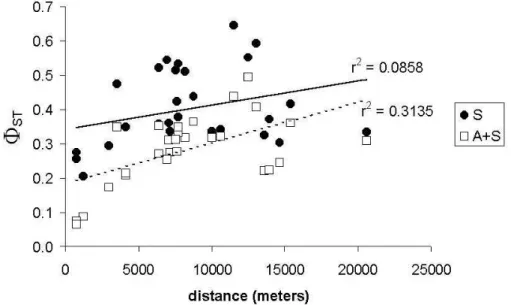
with and without the adult individuals showed no significant correlation with the physical distance between fragments (Fig. 1).
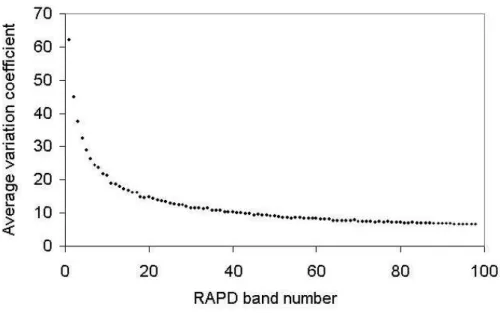
Coefficients of variation for errors associated with estimated genetic distance among A. polyneuron
genotypes were calculated for different numbers of RAPD markers and the results indicated that 50 bands would result in a coefficient near 10%, being 6.43% the result for 98 markers. This indicated that further increase in the number of markers could not result in an important reduction in the coefficient of variation (Fig. 2).
Figure 1 - Correlation between genetic differentiation (ΦST) and physical distance for all
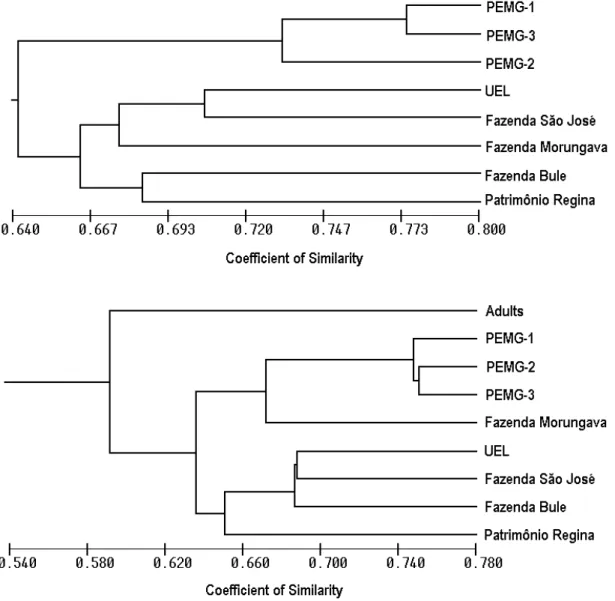
Measures of Jaccard similarity coefficient, used to make the dendrograms (Fig. 3a and b), are shown in the Tables 3 and 4. When adults and seedlings of each fragment were analyzed together (Figura 3a), it was possible to observe the formation of two clusters, with the isolation of PEMG of the
other analyzed fragments. When considering the 10 adult individuals as a group, apart from seedlings (Fig. 3b), these were isolated of the other fragments, and PEMG formed a cluster with Fazenda Morungava.
Figure 2 - Coefficients of variation for errors associated with estimated genetic distance calculated for different numbers of RAPD markers.
DISCUSSION
Although fragmentation may have strong genetic effects, these effects can vary in different situations due to biology of focal species, landscape and forest community structure. The overall genetic diversity level (HT=0.2776) and the
polymorphic loci percentage (78.57%) of A. polyneuron, were close to some reports for other tropical species. Lerceteau et al., (1997) studied samples of an ex situ genetic bank of cocoa tree (Theobroma cacao L, Sterculiaceae), a small sub-canopy tree, with animal-dispersed seeds and bat-pollinated flowers, and showed a total diversity (HT) of 0.340 for RFLP markers.
Whitkus et al. (1998), in an analysis with 57 markers of RAPD with samples of Theobroma cacao found a percentage of polymorphism of 77.2%. Gillies et al. (1999) studied Mahogany populations (Swietenia macrophylla, Meliaceae), a species with wind-dispersed seeds like A. polyneuron, through RAPD markers and observed
polyneuron a similar value of Shannon index was found (I=0.446). However, none of these studies reported explicit fragmentation influence over populations.
These results could be auspicious for the conservation of A.polyneuron, if almost all of that genetic diversity was not confined to the pool of adults (established before fragmentation) in isolated fragments and only marginally maintained in the post-fragmentation cohorts in a single site, the “Mata dos Godoy” state park (PEMG), the only population with thousands of mature individuals.
Chalmers et al. (1992) found most of genetic diversity occurring between populations of two
Gliricidia species with RAPD markers. However, Chalmers et al. (1992) pointed out that isozyme analysis could not be directly compared to RAPD data. Our results agreed with Hamrick (1990), but the adults in this study were part of a single, large interconnected population before fragmentation. Thus, only the genetic profile of seedlings could be considered as result of discrete populations.
Physical distance cannot be used to predict their genetic differentiation (ΦST), probably because an
isolation threshold (where gene flow turn into zero) is reached very early, in the first kilometers. Some degree of correlation between ΦST and
physical distance only can be observed when adults are incorporated in the analysis, as long as they are inhabitants of a continuous forest before, where there is a continuous decrease in gene flow.
Table 1 - Genetic diversity in adults and seedlings of Aspidosperma polyneuron (Apocynaceae) in forest fragments of Londrina region, Paraná state, Brazil.
N H I P %P
Forest fragment S1 A+S2 S A+S S A+S S A+S S A+S
PEMG-1 6 7 0.188 0.253 0.237 0.342 40 59 41.84 60.20
PEMG-2 6 7 0.294 0.315 0.383 0.429 66 74 67.35 75.51
PEMG-3 5 7 0.159 0.288 0.176 0.390 29 66 29.59 67.34
Campus UEL 7 8 0.189 0.180 0.233 0.245 39 42 39.80 42.86
Fazenda Morungava 5 7 0.087 0.162 0.099 0.218 17 37 17.35 37.75 Fazenda São José 6 7 0.129 0.125 0.167 0.177 30 33 30.61 33.67 Patrimônio Regina 7 8 0.232 0.208 0.295 0.293 56 57 57.14 58.16
Fazenda Bule 6 7 0.106 0.141 0.143 0.198 28 38 28.57 38.78
Total PEMG 17 21 0.281 0.312 0.386 0.448 74 83 64.29 74.49
Only Adults3 10 - 0.287 - 0.410 - 82 - 83.67
-Total 58 0.299 0.446 92 78.57
N: number of plants studied; H: Nei (1978) genetic diversity coefficient; I: f Shannon genetic diversity index; P: number of polymorphic loci; %P: percent of polymorphic loci (95%); 1: Genetic diversity parameters of the seedlings; 2: Genetic diversity parameters of the seedlings and adults; 3: Genetic diversity parameter of all adults.
Table 2 - Fixation index (ΦST) and gene flow (Nm) of A. polyneuron in forestfragments of Londrina region, Paraná
state, Brazil.
Adults + Seedlings Adults x Seedlings
N ΦST Nm N ΦST Nm
Cont. Table 2
F. São José x P. Regina 14 0.318 ± 0.054** 0.537 13 0.335 ± 0.052** 0.496 F. São José x F. Bule 14 0.495 ± 0.059** 0.255 12 0.551 ± 0.060** 0.203 P. Regina x F. Bule 14 0.364 ± 0.063** 0.437 13 0.437 ± 0.057** 0.322
PEMG1 x Adults - - - 16 0.296 ± 0.039** 0.594
PEMG2 x Adults - - - 16 0.148 ± 0.032* 1.440
PEMG3 x Adults - - - 15 0.378 ± 0.037** 0.412
UEL x Adults - - - 17 0.276 ± 0.035** 0.656
F. Morungava x Adults - - - 15 0.432 ± 0.040** 0.329
P. Regina x Adults - - - 17 0.215 ± 0.041** 0.915
F. São José x Adults - - - 16 0.375 ± 0.040** 0.417
F. Bule x Adults - - - 16 0.408 ± 0.042** 0.363
* p<0.05, ** p<0.01
Table 3 - Jaccard similarity coefficient in adults and seedlings of A. polyneuron in forest fragments of Londrina region, Paraná state, Brazil.
PEMG-1 PEMG-2 PEMG-3 UEL Fazenda
Morungava
Fazenda São José
Patrimônio Regina
PEMG-2 0.7156
PEMG-3 0.7767 0.7512
UEL 0.6383 0.5469 0.6245
Fazenda Morungava 0.6858 0.6053 0.6986 0.6505
Fazenda São José 0.6943 0.6043 0.6659 0.7088 0.7042
Patrimônio Regina 0.6855 0.5996 0.6288 0.6273 0.6482 0.6961
Fazenda Bule 0.6920 0.6214 0.6667 0.6810 0.6645 0.6769 0.6864
Table 4 - Jaccard similarity coefficient of adults x seedlings of A. polyneuron in forestfragments of Londrina region, Paraná state, Brazil.
Adults PEMG-1 PEMG-2 PEMG-3 UEL Fazenda Morungava
Fazenda São José
Patrimônio Regina
PEMG1 0.6219
PEMG2 0.5954 0.7506
PEMG3 0.5684 0.7459 0.7549
UEL 0.6204 0.6486 0.5884 0.6119
Fazenda Morungava 0.5431 0.6472 0.6485 0.7221 0.5990
Fazenda São José 0.6041 0.7118 0.6469 0.6632 0.6919 0.5990
Patrimônio Regina 0.6232 0.6805 0.6335 0.6317 0.6195 0.6146 0.6798
Fazenda Bule 0.5653 0.6884 0.6524 0.6604 0.6898 0.6037 0.6878 0.6609
The results of ΦST analysis indicated a high degree
of genetic structure in the studied forest fragments (Table 2). However, gene flow estimation (Nm) among PEMG samples and Patrimônio Regina contrasted with Jaccard results, where only among PEMG samples a higher degree of similarity could be observed. Though A. polyneuron trees are long-lived, catastrophic events, such as tropical storms, have been causing more damage in small than in
Demographic data indicated that fecundity of A. polyneuron trees did not seem to be a problem for the maintenance of viable populations. Average seedling density (0.1 to 1m in height) was 22,000.ha-1, which dropped to less than 1000.ha-1 for saplings (1m in height to 5cm DBH; Pires 1995) in PEMG, where average adult density was 98.ha-1 (Soares-Silva and Barroso, 1992). However, each loss of an adult in small fragments with few mature trees could reduce seed rain and consequently weak regeneration, besides of genetic losses. In spite we made no seedling inventory, we observed that in some of our study sites, seedling density was far less than in PEMG. As could be seen in dendrogram (Fig. 3b), genetic distance data of the adult’s pool against seedlings from different sites showed that there was no site where seedlings grouped with adults. Thus, the allelic frequencies in seedlings already showed changes, when compared to the pre-fragmentation scenario, which could be accredited to reduction of both number of mature adults and gene flow. According to Moritz (1994), the divergence in allele frequencies among populations, regardless of distinctiveness of alleles themselves could turn those populations in independent “management units”. As pointed out by Paetkau (1999) in early phases of an isolation process, local populations could be genetically homogenous, but should be managed independently. The fragmentation process in Northern Paraná began 60 years ago and all studied fragments were in recent isolation, but exhibited some degree of genetic divergence. All fragments in this study could be considered as several operational units. The goal of identifying management units is to help select spatially structured reserves of most of the genetic diversity of a species (Diniz-Filho and Telles, 2002). However, there is a need to ensure the viability of conservation inside each operational unit and to keep an adequate gene flow, besides of creating preserves of most genetic diversity. Restricted gene flow could strongly impair survival of populations sizing fewer than 100 individuals (Couvet, 2002), and most of A. polyneuron
populations of forest fragments in the study area were under this size.
Genetic diversity results indicated that the contribution of seedlings to overall polymorphism, with exception of PEMG, was decreasing, and allele fixation could be occurring in the process of
but this could only be achieved in a short time by transplanting seedlings, because of the late reproduction of the species. Corridors allowing pollinators transit and containing sites for establishment of A. polyneuron individuals can be efficient only in the long time.
Genetic data presented here was useful in revealing patterns of effects of habitat fragmentation in the studied species and showing the importance of local populations in the conservation of A. polyneuron. Although PEMG is unquestionably an important part of a regional strategy for conservation, it cannot be sufficient alone. Thus, the establishment of a system of reserves, based on remaining forest fragments, is imperative. Such a system should provide (1) buffer zones for protection of small forest fragments from edge effects, (2) mature trees active protection (e.g. controlling vines), (3) active transfer of seeds or seedlings among management units (i.e. forest fragments) and (4) plantation of seedlings with reasonable polymorphism in restoration areas near and directly into remnants. Forest fragmentation, due to clearing and selective logging, drive Atlantic forests of Northern Paraná region to a situation that, even if no more forest is cleared, the remaining patches can no longer sustain all biodiversity components in a short time scale, and the only way to halt this tendency is to manage the remnants and increase forest area by reforesting.
ACKNOWLEDGEMENTS
This work was supported by Fundação O Boticário de Proteção à Natureza (process number 047520002) and CPG-UEL. Authors thanks Dr. Waldemar de Paula Carvalho for help with statistics.
RESUMO
foi analisado em adultos (pré-fragmentação, >300 anos) e plântulas (pós-fragmentação, <<50 anos). Os resultados mostram uma queda no polimorfismo genético em gerações pós-fragmentação nos pequenos fragmentos e alta diversidade genética dentro das populações. A distribuição da diversidade genética sugere o estabelecimento dos fragmentos como reservas protegidas, e a transferência de plântulas entre os fragmentos para a conservação de A. polyneuron.
REFERENCES
Caraffa, V. B.; Giannettini, J.; Gambotti, C. and Maury, J. (2002), Genetic relationships between cultivated and wild olives of Corsica and Sardinia using RAPD markers. Euphytica, 123, 263-271.
Chalmers, K. J.; Waugh, R.; Sprent, J. I.; Simons, A. J. and Powell, W. (1992), Detection of genetic variation between and within populations of Gliricidia sepium
and G. maculata using RAPD markers. Heredity, 69, 465-472.
Couvet, D. (2002), Deleterious effects of restricted gene flow in fragmented populations. Conservation Biology, 16, 369-376.
Diniz-Filho, J. A. F. and Telles, M. P. C. (2002), Spatial autocorrelation analysis and the identification of operational units for conservation in continuous populations. ConservationBiology, 16, 924-935. Eizirik, E. (1996), Ecologia molecular, genética da
conservação e o conceito de unidades evolutivamente significativas. Brazilian Journal of Genetics, 19, 23-29.
Ferreira, M. E. and Grattapaglia, D. (1995), Introdução ao uso de marcadores RAPD e RFLP em análise genética. 2. ed. Brasília : Embrapa-Cenargen. 220 pp. Gillies, A. C. M.; Navarro, C.; Lowe, A. J.; Newton, A. C.; Hernandez, M.; Wilson, J. and Cornelius, J. P. (1999), Genetic diversity in Mesoamerican populations of mahogany (Swietenia macrophylla), assessed using RAPDs. Heredity, 83, 722-732. Hamrick, J. L. (1990), Isosyme analysis of genetic
structure in plant population. In: Soltis, D. E. and Soltis, P. S. (Eds.). Isozymes in plant biology. Portland : Dioscorides Press. pp. 87-105.
Kapos, V. (1989), Effects of isolation on water status of forest patches in the Brazilian Amazon. Journal of TropicalEcology, 5, 173-185.
Kapos, V. (1989), Effects of isolation on water status of forest patches in the Brazilian Amazon. Journal of TropicalEcology, 5, 173-185.
Laurance, W. F. (1997), Hyper-disturbed parks: edge effects and the ecology of isolated rainforest reserves in tropical Australia. In: Laurance, W. F, and Bierregaard Jr., R. O. (Eds.). Tropical Forest Remnants, Chicago, The University of Chicago Press. pp.71-85.
Lerceteau, E., Robert, T., Petiard, V. and Crouzillat, D. (1997), Evaluation of the extent of genetic variability among Theobroma cacao accessions using RAPD and RFLP markers. Theoretical and Applied Genetics, 95, 10-19.
Lynch, M. and Milligan, B. G. (1994), Analysis of population genetic structure with RAPD markers.
MolecularEcology, 3, 91-99.
Malcolm, J. R. (1994), Edge effects in central Amazonian forest fragments. Ecology, 75, 2438-2445. Mantel, N. (1967), The detection of disease clustering
and a generalized regression approach. Cancer Research, 27, 209-220.
Miller, M. P. (1997), Tools for population genetic analysis (TFPGA) 1.3: A Windows program for the analysis of allozyme and molecular population genetic data. Department of Biological Sciences, Northern Arizona University, Flagstaff, Arizona. Disp. in: http://www.public.asu.edu/~mmille8/tfpga.htm. Accessed: 20 dez. 2000.
Moritz, C. (1994), Defining “Evolutionary Significant Units” for conservation. Trends Ecology and evolution, 9, 373-375.
Murcia, C. (1996), Forest fragmentation and the pollination of neotropical plants. In: Schelhas, J. and R. Greenberg (Eds.). Forest Patches in Tropical Landscapes.
Washington, D.C. : Iland Press. pp. 149-186.
Paetkau, D. (1999), Using genetic to identify intraspecific conservation units: a critique of current proposals. ConservationBiology, 13, 1507-1509. Pires, L. A. (1995), Estudo da regeneração natural no
Parque Estadual “Mata dos Godoy”. Londrina,
Monografia (Bacharelado), Universidade Estadual de Londrina, Londrina. pp.1-25.
Sales, E.; Nebauer, S. G.; Mus, M. and Segura, J. (2001), Population genetic study in the Balearic endemic plant species Digitalis minor
(Scrophulariaceae) using RAPD markers. American JournalofBotany, 88, 1750-1759.
Simberloff, D. (1998), Flagships, umbrellas and keystones: Is single-species management passé in the landscape era? BiologicalConservation, 83, 247-257. Soares-Silva, L. H. and Barroso, G. M. (1992).
Fitossociologia do estrato arbóreo da floresta na porção norte do “Parque Estadual Mata dos Godoy”, Londrina-PR., Brasil. In: Congresso da Sociedade Botânica de São Paulo, 8. Anais... pp.101-112. Trevisan, G. (1998). Biomassa e deposição de
Whitkus, R., Mota-Bravo, L., Gomez-Pompa, A. and De la Cruz, M. (1998). Genetic diversity and relationships of cacao (Theobroma cacao L.) in Southern Mexico. Theoretical andAppliedGenetics, 96, 621-627.
Yeh, F.; Yang, R. and Boyle, T. (2000), Popgene version 1.32: A Microsoft Window-based freeware
for population genetic analysis. Disp. in:
http://www.ualberta.ca/~fyeh/info.htm. Accessed: 20 nov. 2002.
Yu, K. F.; Deynze, A. V. and Pauls, P. (1993), Random amplified polymorphic DNA (RAPD) analysis. In: Glick, B. R. and Thompson, J. E. (Eds.). Methods in Plant Molecular Biology and Biotechnology. CRC Press. pp. 1-360.