Vol.57, n.4: pp. 606-612, July-August 2014 http://dx.doi.org/10.1590/S1516-8913201402126
ISSN 1516-8913 Printed in Brazil
BRAZILIAN ARCHIVES OF BIOLOGY AND TECHNOLOGY
A N I N T E R N A T I O N A L J O U R N A L
Enhanced Production of Vitamin K
2from Bacillus subtilis
(natto) by Mutation and Optimization of the Fermentation
Medium
Junying Song
1, Hongxia Liu
1,2, Li Wang
1, Jun Dai
1, Yan Liu
1, Hui Liu
1, Genhai Zhao
1,
Peng Wang
1and Zhiming Zheng
1*1Key Laboratory of Ion Beam Bioengineering; Chinese Academy of Sciences; Hefei - P.R - China. 2School of Life
Science; University of Science and Technology of China; Hefei - P.R - China
ABSTRACT
The aim of this study was to enhance the production of vitamin K2 by using N-methyl-N-nitro-N-nitroso-guanidine (NTG) and low energy ion beam implantation and optimizing the fermentation medium. Mutation resulted in 1.66-fold higher production of vitamin K2 than that of the parentl strain. The production by the mutant BN-P15-11-1was increased 55% and reached 3.593±0.107 mg/L by using the Plackett-Burman and Box-Behnken designs to optimize the fermentation medium. The optimal fermentation culture medium was composed of (g/L) glycerol 69.6, sucrose 34.5, K2HPO4 4.0, peptone 20, yeast extract 25 and fermented at 37 °C and 150 rpm for 72 h. The results showed that the NTG and low energy ion beam implantation mutations and optimizing fermentation medium were effective methods to enhance vitamin K2 production.
Key words:Bacillus subtilis (natto), Mutant, Optimization, Vitamin K2
*Author for correspondence: [email protected]
INTRODUCTION
Vitamin K was discovered almost 80 years ago to be an anti-hemorrhagic factor, capable of correcting dietary-induced bleeding disorders in chickens (Dam 1935) and blood clotting deficiencies caused by biliary diseases in humans (Almquist 1941). Studies in recent years have shown that vitamin K is an essential cofactor not only in blood coagulation but also in bone
metabolism (Kruger and Horrobin 1997;
Schurgers et al. 2007; Gast et al. 2009). Vitamin K is a series of compounds and there are two types
of vitamin K occurring naturally: vitamin K1
(phylloquinone/phytomenadione) and vitamin K2
(menaquinones). Both the forms of vitamin K have a common 2-methyl-1,4-napthoquinone
nucleus but differ in the structure of a side chain
(Vermeer and Schurgers 2000). Vitamin K1 is
mainly formed in the plants (Meurer et al. 1996)
and vitamin K2 is mainly produced by the
microorganisms (Collins and Jones 1981; Suttie 1995). The menaquinones have variable side chain lengths of 4-13 isoprene units, referred to as
MK-n, where n denotes the number of isoprenoid
residues.
It has shown that MK-7 may play an important role in reducing the risk of bone fractures (Tsukamoto et al. 2000; Schurgers et al. 2007) and specific cardiovascular disorders (Cranenburg et al. 2008; Gast et al. 2009). MK-7 is produced by
fermentation with Bacillus species and can be
very low. Natto is a traditional fermented soybean food in Japan; it contains comparatively high amounts of MK-7 (about 800-900 µg/100 g natto) compared with other foods (Sakano et al. 1988).
Since the strains of B. subtilis used for
manufacturing natto are edible, they are among the best sources of MK in the food industry. To improve the production of MK-7, studies have focused on genetic mutation and the nutrients in the fermentation media. Many previous studies have been carried out largely on microorganism isolation and process development in order to enhance vitamin K2 production (Sato et al. 2001; Tsukamoto et al. 2001; Berenjian et al. 2011; Mahanama et al. 2011). At present, there are many mutagenic sources, such as ultraviolet rays (Said et al. 2010), γ-rays (Fatnassi et al. 2011), laser irradiation (Liu et al. 2012) and the N+ ion beam (Nie et al. 2012). N+ ion beam implantation has been increasingly used in various fields, especially in industrial microbial mutagenesis and mutation breeding (Yu et al. 1991). This is due to the controllable damage rate, higher mutation rate,
and wider spectrum of mutations obtained by N+
ion beam implantation compared to traditional mutation methods (Feng et al. 2006). In recent years, many achievements have been realized by using N+ ion beam implantation (Ge et al. 2004; Gu et al. 2006; Gong et al. 2009; Wang et al. 2011). However, there are as yet few reports on
improving the vitamin K2 production of B. subtilis
(natto) by N+ ion beam implantation.
In this study, NTG was used as a chemical method and low energy ion beam implantation as a physical one to obtain the mutants and optimized
the fermentation medium to enhance vitamin K2
production.
MATERIALS AND METHODS
Microorganism and culture conditions
The strain B. subtilis (natto)-2-6 was isolated from
the laboratory and named as BN-2-6. The medium was prepared as follows. Solid medium (%): 0.3 beef extract, 1.0 peptone, 0.5 sodium chloride, 2.0 agar, pH 7.0 to 7.2. Seed medium (%): 1.0 glucose, 1.0 peptone, 0.5 sodium chloride, pH 7.2 to 7.4. Fermentation medium (%): 7.0 glycerol, 2.5 yeast extract, 1.5 peptone, 0.05 K2HPO4, and the pH was adjusted to 7.3.
Ion beam implantation device
Ion beams was obtained by accelerating nuclei (ions) at a high, near-light speed using the ion implantation facility (Fig. 1) at ASIPP (Chinese Academy of Sciences, Institute of Plasma Physics). In this machine, ions were produced by a plasma generator, electrostatically extracted and accelerated, focused, and finally transported to the target chamber where a special bio-sample holder was installed.
Figure 1 - Schematic of the ion beam implantation device. 1. Air supply 2. Plasma generator 3. Ion beam 4. Big target chamber 5. Rotatable scaffold 6. Small target chamber 7. several vacuum pump
Mutation and screening procedures
For the NTG mutation, strain BN-2-6 was first inoculated into fresh seed medium. The cells were harvested at the end phase of the exponential stage (15 h) by centrifuging at 6797 g for 10 min and the cells were suspended in physiological saline at
a concentration of 108 cells/mL after washing.
Cells were incubated in physiological saline containing NTG (200 µg/mL) at 37°C for 20 min. The cells were washed three times with fresh seed medium and shaken in seed medium for 3-4 h at 37°C. They were then spread on a plate containing the solid medium supplemented with 50 mg/L 1-hydroxy-2-naphthoic acid (HNA) (Sato et al. 2001; Tsukamoto et al. 2001).
implantation. The dose for implantation ranged
from 0×2.6×1013 to 200×2.6×1013 ions/cm2, and the energy was 0-20 Kev. At the same time, in order to evaluate the effects of vacuum on mutation, the mycelium of control group without
N+ beam implantation were also put into the target
chamber. After irradiation, each treated plate was washed with 1.0 mL sterile physiological saline individually, diluted to an appropriate spore concentration, and spread on the plating medium according to the NTG procedure. Colonies that appeared during 2-4 days of incubation at 37°C were isolated. Colonies were chosen randomly for continued cultivation on a solid medium and they were inoculated into flasks to define the final
vitamin K2 production.
Analysis of vitamin K2
The broth was centrifuged at 6797 g for 5 min after fermentation, and the resulting cells were mixed with 15 mL distilled water and stirred well. The mixed solution was ultrasonicated for 4 min in an ultrasonic cell disintegrator. Then 15 mL n-hexane were added to the solution, which was vigorously shaken for 2 min and then centrifuged at 6797 g for 5 min to separate the two phases. The organic phase was then separated and the absorbance was determined at a wavelength of
248 nm by UV spectrophotometer. The
concentration of vitamin K2 was derived by
putting the optical density (OD) value into the equation of a standard curve of menaquinones. Each experiment was repeated three times.
Experimental design
To optimize the fermentation conditions of B.
subtilis (natto)-P15-11-1, the conditions that had a significant effect on vitamin K2 production were identified by Plackett-Burman (PB) design. In this design, eight components were selected for this study and the factors with a confidence level at or above 95% were selected to be optimized later. Then the Box-Behnken design was employed to optimize the selected effective factors chosen from the PB design, and the results were analyzed by response surface methodology (RSM).
RESULTS AND DISCUSSION
Mutation of Bacillus subtilis (natto)
In the mutation procedure, mutation efficiency less than 5.0% or higher than 5.0% was ruled as
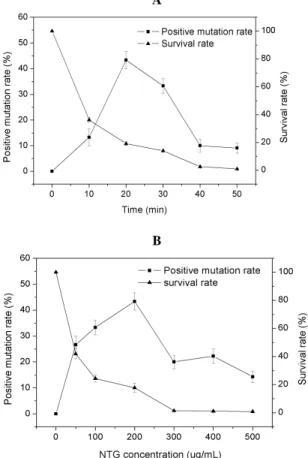
either negative mutation or positive mutation, respectively. Figure 2 shows the results of mutagenesis under different reaction times and NTG concentrations. The positive mutation rate for each set of NTG mutation conditions was calculated as the number of positive mutant strains divided by the number of colonies. It was observed that the cell survival rate decreased with increasing reaction time and NTG concentration. In addition, it was noted that a high survival rate could not be acquired simultaneously with a high positive mutation rate. Upon concentration with 200 mg/L NTG for 20 min, a 43.3% positive mutation rate was obtained, and the survival rate was 17.8%. Thus, the optimum NTG mutation parameters could be obtained when the NTG concentration was 200 mg/L and the reaction time was 20 min.
A
B
Figure 2 - The survival rate and positive mutation rate at different reaction times and NTG concentrations.
Figure 3 shows the results of mutagenesis under different doses and energies of N+ implantation. According to statistical analysis, the cell survival
implantation, and the maximum positive mutation
rate was obtained when the energy of N+
implantation was 15 keV (Fig. 3A). As for the
doses of N+ implantation, the survival curve
exhibited a typical saddle shape as the dose of N+
implantation increases, as shown in Figure 3B. The survival rate declined sharply to 11.1% when the dose of N+ implantation ranged from 0 to 60 (×2.6×10¹³ N+/cm2). After treatment with a dose of 80 (×2.6×10¹³ N+/cm2), the survival rate increased to 23.3% and the maximum positive mutation rate of 40% was obtained; subsequently, the survival rate decreased with further increases in the dose of N+ implantation. So, 15 keV and 80 (×2.6×10¹³ N+/cm2) was selected as the optimum conditions
for the energy and dose of N+ implantation.
A
B
Figure 3 - The survival rate and positive mutation rate at different energies and doses of N+ implantation.
The saddle shape of the survival curve suggested that there were some obvious differences between this procedure and other traditional mutagen
irradiations, such as UV and γ-rays. The following
were regarded as the appropriate and important
mutation effects of ion beam implantation, and this was confirmed by the results again. The biological effect of ion beam implantation may not only be induced by energy absorption, but also results from mass deposition and charge exchange. In the beginning, more ions reached the cellular cytoplasm; deposition of energy and mass in the cytoplasm might play an important role in breakage of the cytoskeleton and indirect induction of nucleolus damage, which could lead directly to the death of the cell. As the ion beam dose increases, further deposition of both energy and mass taking place in the nucleolus is likely to be the main factor that causes the cellular damage and activates the cell repair system. When the dose increases even further, the cells are subjected to serious damage that accumulates to an unrecoverable level that leads to a further decrease in the cell survival rate (Foti et al.1999; Wu et al. 1999; Yu et al. 2006).
Screening of high-production mutants
After the NTG mutation, a mutant strain named BN-N-30-1 was obtained and the production of
vitamin K2 increased by 53% over the original
strain BN-2-6. Then the mutant strain was mutated further by using N+ implantation. After a total of
five N+ implantation experiments and several
generations of screening, one mutant strain named BN-P15-11-1 was obtained in which the
production of vitamin K2 increased by 74% over
the strain BN-N-30-1 and by 166% over the original strain BN-2-6. These results suggested that NTG mutation and low energy ion beam
implantation were effective methods for
enhancing the production of vitamin K2.
The genetic stability of mutant BN-P15-11-1 was
detected. As shown in Figure 4, vitamin K2
production remained relatively stable for five generation. Therefore, the mutant strain BN-P15-11-1 was selected for further studies.
Optimization of the fermentation medium Initial screening of the most important conditions
affecting vitamin K2 production by BN-P15-11-1
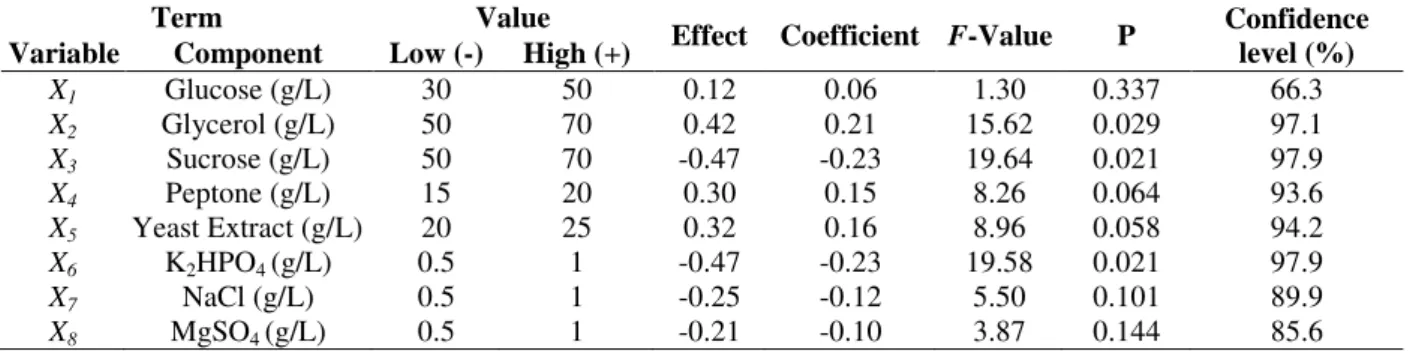
was performed by Plackett-Burman design. Table 1 represents the Plackett-Burman experimental design for 12 trials with two levels of values for each variable and the results of the design with
respect to vitamin K2 production. Table 2
represents the results of the Plackett-Burman experiment with respect to the effect, coefficient,
F-value, p-value, and confidence level of each
component. The components for which the confidence level was at or above 95% were screened.
Table 1 - Plackett-Burman design matrix with
corresponding results.
Run Variable Production
of vitamin K2(mg/L)
X1 X2 X3 X4 X5 X6 X7 X8 D1 D2 D3
1 +1 -1 -1 -1 +1 -1 +1 +1 -1 +1 +1 2.556 2 -1 +1 +1 +1 -1 -1 -1 +1 -1 +1 +1 2.62 3 -1 -1 +1 -1 +1 +1 -1 +1 +1 +1 -1 1.582 4 -1 +1 +1 -1 +1 +1 +1 -1 -1 -1 +1 2.25 5 -1 -1 -1 -1 -1 -1 -1 -1 -1 -1 -1 2.664 6 +1 -1 +1 +1 -1 +1 +1 +1 -1 -1 -1 1.696 7 +1 +1 +1 -1 -1 -1 +1 -1 +1 +1 -1 2.232 8 +1 +1 -1 -1 -1 +1 -1 +1 +1 -1 +1 2.434 9 -1 -1 -1 +1 -1 +1 +1 -1 +1 +1 +1 2.034 10 +1 -1 +1 +1 +1 -1 -1 -1 +1 -1 +1 2.844 11 +1 +1 -1 +1 +1 +1 -1 -1 -1 +1 -1 3.23 12 -1 +1 -1 +1 +1 -1 +1 +1 +1 -1 -1 3.118
X1-X8: variable; D1-D3: dummy variable; (+1): high level;
(-1): low level.
Table 2 - Plackett-Burman regression analysis.
Term Value
Effect Coefficient F-Value P Confidence
level (%)
Variable Component Low (-) High (+)
X1 Glucose (g/L) 30 50 0.12 0.06 1.30 0.337 66.3
X2 Glycerol (g/L) 50 70 0.42 0.21 15.62 0.029 97.1
X3 Sucrose (g/L) 50 70 -0.47 -0.23 19.64 0.021 97.9
X4 Peptone (g/L) 15 20 0.30 0.15 8.26 0.064 93.6
X5 Yeast Extract (g/L) 20 25 0.32 0.16 8.96 0.058 94.2
X6 K2HPO4 (g/L) 0.5 1 -0.47 -0.23 19.58 0.021 97.9
X7 NaCl (g/L) 0.5 1 -0.25 -0.12 5.50 0.101 89.9
X8 MgSO4 (g/L) 0.5 1 -0.21 -0.10 3.87 0.144 85.6
Glycerol, sucrose, and K2HPO4 were considered to
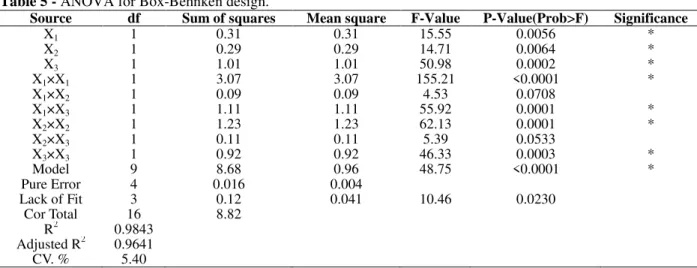
be significant and optimized by using the Box-Behnken design. The experimental designs are given in Table 3. According to the Box-Behnken design matrix generated by Design-Expert software, a total of 17 experiments that included 12 factorial points and five replicates at the center point were performed as shown in Table 4, and the results were analyzed by ANOVA (Table 5). Results showed that the squared correlation coefficient R2 and adjusted R2 were 0.98 and 0.96, respectively, which indicated that the model could explain 98% variability in the response and showed the adequacy of the model to predict the response. Moreover, the value of the coefficient of variation (CV% =5.40) also indicated the precision and reliability of the model.
Predicted production of vitamin K2 was calculated
using the following second order polynomial equation: 3 3 2 2 1 1 3 2 3 1 2 1 3 2 1 47 . 0 54 . 0 85 . 0 16 . 0 53 . 0 15 . 0 36 . 0 19 . 0 2 . 0 48 . 3 X X X X X X X X X X X X X X X Y × × − × × − × × − × × − × × + × × − × − × − × − =
Table 3 - Design of factors and levels. X1
(K2HPO4 )/(g/L)
X2
(Glycerol)/(g/L)
X3
(Sucrose)/(g/L)
-1 0.3 60 30
0 0.4 70 40
1 0.5 80 50
Table 4 - Arrangement and results of RSM.
X1 X2 X3 Y
1 -1 -1 0 2.280
2 1 -1 0 2.099
3 -1 1 0 2.369
4 1 1 0 1.589
5 -1 0 -1 3.113
6 1 0 -1 1.757
7 -1 0 1 1.507
8 1 0 1 2.255
9 0 -1 -1 3.018
10 0 1 -1 2.792
11 0 -1 1 2.478
12 0 1 1 1.599
13 0 0 0 3.396
14 0 0 0 3.488
15 0 0 0 3.549
16 0 0 0 3.524
Table 5 - ANOVA for Box-Behnken design.
Source df Sum of squares Mean square F-Value P-Value(Prob>F) Significance
X1 1 0.31 0.31 15.55 0.0056 *
X2 1 0.29 0.29 14.71 0.0064 *
X3 1 1.01 1.01 50.98 0.0002 *
X1×X1 1 3.07 3.07 155.21 <0.0001 *
X1×X2 1 0.09 0.09 4.53 0.0708
X1×X3 1 1.11 1.11 55.92 0.0001 *
X2×X2 1 1.23 1.23 62.13 0.0001 *
X2×X3 1 0.11 0.11 5.39 0.0533
X3×X3 1 0.92 0.92 46.33 0.0003 *
Model 9 8.68 0.96 48.75 <0.0001 *
Pure Error 4 0.016 0.004
Lack of Fit 3 0.12 0.041 10.46 0.0230
Cor Total 16 8.82
R2 0.9843
Adjusted R2 0.9641 CV. % 5.40
*Significant at 99% confidence level.
According to the equation, the optimum levels for
glycerol, sucrose, and K2HPO4 were determined to
be 69.6, 34.5, and 0.4 g/L, respectively. Under these optimal conditions, the predicted value was 3.603 mg/L and the practical production of vitamin
K2 was 3.593±0.107 mg/L, which was in
reasonable agreement with the predicted value. After optimization, the production of vitamin K2 was 4.1 times that of the original strain BN-2-6 and 1.5 times that of the mutant strain BN-P-15-11-1. Figure 5 shows the results of a time-course
study of cell growth and vitamin K2 production of
the strains BN-2-6 and BN-P-15-11-1.
Figure 5 - The biomass concentration and vitamin K2
production of the original and mutant strains at different cultivation times.
Fermentation was carried out in a 500 mL flask containing 50 mL fermentation medium on a
shaker at about 150 rpm at 37°C. It was observed that the biomass and production of vitamin K2 of the mutant were higher at the same fermentation time compared with the original strain. The production of vitamin K2 increased sharply after the biomass reached a maximum, showing that the
production of vitamin K2 was partly growth
associated.
CONCLUSIONS
The aim of this work was to enhance the
production of vitamin K2. The mutant
BN-P15-11-1 was screened as a promising microbial producer
and the production of vitamin K2 was increased
166% over that of the original strain BN-2-6. In addition, the production of the mutant
BN-P15-11-1 was increased by 55% using the
Plackett-Burman and Box-Behnken designs to optimize the fermentation medium. The results showed that NTG and low energy ion beam implantation mutation technology and optimization of the fermentation medium were effective methods for
enhancing vitamin K2 production.
ACKNOWLEDGMENTS
REFERENCES
Almquist HJ. Vitamin K. Physiol Rev. 1941; 21: 194 -216. Berenjian A, Mahanama R, Talbot A, Biffin R, Regtop H,
Valtchev P, et al. Efficient media for high menaquinone-7 production: response surface methodology approach. New Biotechnol. 2011; 28: 665-672.
Collins MD, Jones D. Distribution of isoprenoid quinone structural types in bacteria and their taxonomic implications. Microbiol Rev. 1981; 45: 316-354. Cranenburg ECM, Vermeer C, Koos R, Boumans ML,
Hackeng TM, Bouwman FG, et al. The circulating inactive form of matrix Gla Protein (ucMGP) as a biomarker for cardiovascular calcification. J Vasc Res. 2008; 45: 427-436.
Dam H. The antihaemorrhagic vitamin of the chick. Biochem J. 1935; 29: 1273-1285.
Fatnassi IC, Jebara SH, Jebara M. Selection of symbiotic efficient and high salt-tolerant rhizobia strains by gamma irradiation. Ann Microbiol. 2011; 61: 291-297. Feng HY, Yu ZL, Chu PK. Ion implantation of organisms.
Mat Sci Eng R.2006; 54: 49-120.
Foti AM, Milano F, Torrisi L. Amino acid decomposition induced by keV ion irradiation. Nucl Instrum Meth B. 1999; 46: 361-363.
Gast GCM, De Roos NM, Sluijs I, Bots ML, Beulens JWJ, Geleijnse JM, et al. A high menaquinone intake reduces the incidence of coronary heart disease. Nutr Metab Cardiovas. 2009; 19: 504-510.
Ge CM, Gu SB, Zhou XH, Yao RM, Pan RR, Yu ZL. Breeding of L(+)-Lactic Acid Producing Strain by Low-Energy Ion Implantation. J Microbiol Biotechnol. 2004; 14: 363-366.
Gong GH, Zheng ZM, Chen H, Yuan CL, Wang P, Yao LM, et al. Enhanced production of surfactin by Bacillus subtilis E8 mutant obtained by ion beam implantation. Food Technol Biotech. 2009; 47: 27-31.
Gu SB, Yao JM, Yuan QP, Xue PJ, Zheng ZM, Wang L, et al. A novel approach for improving the productivity of ubiquinone-10 producing strain by low-energy ion beam irradiation. Appl Microbiol Biot. 2006; 72: 456-461. Kruger MC, Horrobin DF. Calcium metabolism,
osteoporsis and essential fatty acids: A review. Prog Lipid Res. 1997; 36: 131-151.
Liu Y, Xue ZL, Zheng ZM, Gong GH, Wang P, Nie GJ. He-Ne Laser Irradiation of Folate-producing Candida utilis and Optimization of Culture Conditions under Submerged Fermentation. Ann Microbiol. 2012; DOI: 10.1007/s13213-012-0514-8.
Mahanama R, Berenjian A, Valtchev P, Talbot A, Biffin R, Regtop H, et al. Enhanced Production of Menaquinone 7 via Solid Substrate Fermentation from Bacillus subtilis. Int J Food Eng. 2011; DOI: 10.2202/1556-3758.2314.
Meurer J, Meierhoff K, Westhoff P. Isolation of high-chlorophyll-fluorescence mutants of Arabidopsis thaliana and their characterisation by spectroscopy, immunoblotting and Northern hybridisation. Planta. 1996; 198: 385-396.
Nie GJ, Yang XR, Liu H, Wang L, Gong GH, Jin W, et al. N+ ion beam implantation of tannase-producing Aspergillus niger and optimization of its process parameters under submerged fermentation. Ann Microbiol. 2012; 63: 279-287.
Said MB, Masahiro O, Hassen A. Detection of viable but non cultivable Escherichia coli after UV irradiation using a lytic Q beta phage. Ann Microbiol. 2010; 60: 121-127.
Sakano T, Notsumoto S, Nagaoka T, Morimoto A, Fujimoto K, Masuda S. Measurement of K vitamins in food by high-performance liquid chromatography with fluorometric detection. Vitamins. 1988; 62: 393-398. Sato T, Yamada Y, Ohtani Y, Mitsui N, Murasawa H,
Araki S. Efficient production of menaquinone (vitamin K2) by a menadione-resistant mutant of Bacillus subtilis. J Ind Microbiol Biot. 2001; 26: 115-120. Schurges L, Teunisse K, Hamulyak K, Knapen M, Vik H,
Vermeer C. Vitamin K-containing dietary supplements: comparison of synthetic vitamin K1 and natto-derived menaquinone-7. Blood. 2007; 109: 3279-3283.
Suttie JW. The importance of menaquinones in human nutrition. Annu Rev Nutr. 1995; 15: 399-417.
Tsukamoto Y, Ichise H, Kakuda H, Yamaguchi M. Intake of fermented soybean (natto) increases circulating vitamin K2 (menaquinone-7) and carboxylated osteocalcin concentration in normal individuals. J Bone Miner Metab. 2000; 18: 216-222.
Tsukamoto Y, Kasai M, Kakuda H. Construction of a Bacillus subtilis (natto) with high productivity of vitamin K2 (menaquinone-7) by analog resistance. Biosci Biotech Bioch. 2001; 65: 2007-2015.
Vermeer G, Schurgers LJ. A comprehensive review of vitamin K and vitamin K antagonists. Hematol Oncol Clin N. 2000; 14: 339-353.
Wang P, Zhang LM, Zheng ZM, Wang L, Wang H, Yuan CL, et al. Microbial lipid production by co-fermentation with Mortierella alpine obtained by ion beam implantation. Chem Eng Technol. 2011; 34: 422-428. Wu LJ, Randers-Pehrson G, Xu A, Waldren CA, Geard
CR, Yu ZL, et al. Targeted cytoplasmic irradiation with alpha particles induces mutations in mammalian cells. Proc Natl Acad Sci USA. 1999; 96: 4959-4964.
Yu ZL, Deng JG, He JJ, Huo YP, Wu YJ, Wang XD, et al. Mutation breeding by ion implantation. Nucl Instrum Meth B. 1991; 59: 705-708.
Yu ZL, Yu LD, Brown I, Vilaithong T. Introduction to ion beam biotechnology. New York: Springer; 2006.