Vol.48, n. 1 : pp. 23-29, January 2005
ISSN 1516-8913 Printed in Brazil
BRAZILIAN ARCHIVES OF
BIOLOGY AND TECHNOLOGY
A N I N T E R N A T I O N A L J O U R N A L
Antagonism of Bacillus spp. Against Xanthomonas
campestris pv. campestris
Leila Monteiro
1, Rosa de Lima Ramos Mariano
2and Ana Maria Souto-Maior
1*1
Departamento de Antibióticos; Universidade Federal de Pernambuco; Cidade Universitária; 50.670-90; Recife - PE - Brazil. 2 Departamento de Agronomia/Fitossanidade; Universidade Federal Rural de Pernambuco; Dois Irmãos; 52.071-900; Recife - PE - Brazil
ABSTRACT
The antagonism of eight Bacillus isolates was investigated against nine strains of Xanthomonas campestris pv.
campestris (causal agent of crucifers black rot) to assess the role of lipopeptides in this process. Antimicrobial and hemolytic (surfactant) activity tests were performed in vitro using agar diffusion methods. Antibiosis and hemolysis were positive for four Bacillus isolates against all X. campestris pv. campestris strains. The correlation observed between antimicrobial and hemolytic activities indicated that lipopeptides were involved in the antibiosis mechanism of the studied antagonists. Fermentation studies were carried out with the isolates that showed highest antimicrobial and hemolytic activities, to follow up growth and production of bioactive and surfactant compounds. Production of bioactive and surfactant compounds was observed during the late growth phase of the Bacillus
isolates.
Key words: Bacillus, biological control,Xanthomonas campestris pv. campestris, crucifers black rot
*
Author for correspondence
INTRODUCTION
Xanthomonas campestris pv. campestris is the
causal agent of crucifers black rot, a disease responsible for severe economic losses. Plants belonging to this family are susceptible to this disease in all developmental stages. The black rot occurs more frequently in humid soils and temperatures ranging from 20 to 30oC, which are common in tropical and subtropical regions (Mariano et al., 2001). The symptoms are characterized by yellow V-shaped lesions that begin on the leaf margins and progress to the center through the vascular tissue, resulting, in general, in the leaf necrosis (Assis et al., 1997).
The use of chemical compounds has failed to control plant diseases due to resistance, environment pollution, and damage to human health. Because of these disadvantages, the use of microorganisms for pathogen control and for plant growth promotion is becoming more common. However, the success of biocontrol and yield increase depends on the nature of the antagonistic properties and on the mechanisms of action of the organism. The modes of action are widely varied and can be, for instance, nutrient competition, direct parasitism, and production of secondary metabolites (Melo, 1998).
comprehends a heterogeneous group of Gram-positive, aerobic or facultative anaerobic, endospore-forming bacteria. The endospores are termotolerant structures, resistant to dryness, to ultraviolet radiation and to organic solvents. These properties, associated to the ability of producing peptide antibiotics, contribute to the utilization of this genus on the biocontrol of several root and foliar diseases (Backman et al., 1997; Kloepper, 1997; Melo, 1998). Bacillus spp. have been formulated and registered for commercial use in the United States, and one of the products, Serenade, is recommended for foliar diseases of several crops (Gardener and Fravel, 2002).
Assis et al. (1996) investigated the antagonism of 32 epiphytic Bacillus spp., isolated from cabbage, kale and radish. Among these isolates, 13 reduced 100% the incidence of black rot in kale under greenhouse conditions. In another study (Assis et al., 1997), 13 isolates reduced incidence in cabbage, ranging from 48% to 78%, in field experiments. Among them, B. cereus C210, B. megaterium C116, B. subtilis R14 and B. cereus C240 reduced 78%, 74%, 73% and 71%, respectively.
Bacillus spp. are involved in the control of plant diseases through a variety of mechanisms of action, such as competition, systemic resistance induction and antibiotic production. The mechanism of antibiosis has been shown to be one of the most important (Tomashow and Weller, 1996). Among several peptide antibiotics, Bacillus spp. produce lipopeptides, which are amphiphilic compounds with surfactant activity (Zuber et al., 1993). In the present study, the production of lipopeptides and
the role of these compounds in Bacillus
antagonism against X. campestris pv. campestris were investigated.
MATERIALS AND METHODS
Microorganisms
Eight epiphytic Bacillus studied, B. subtilis R14, B. megaterium pv. cerealis RAB7, Bacillus sp. RAB9, B. megaterium pv. cerealis C211, B. megaterium C116, B. cereus C240, Bacillus sp. C11 and B. cereus C210, were isolated from cabbage, radish and kale. Nine strains of X.
campestris pv. campestris: C3, C4, C8, C10, C11, C12, C18, S2 and S6, were isolated from cabbage.
Antimicrobial Activity
Antimicrobial activity was determined by agar diffusion technique. One hundred microliters of X. campestris pv. campestris suspensions (around 109 cells/mL) were mixed to yeast-malt agar in pour plates. After solidification, 1 µL of Bacillus suspensions were placed on the agar surface and incubated at 37ºC for 12 h, followed by incubation at 30ºC for 24 h. After the 36 h of incubation, inhibition halos were measured and antimicrobial activity (mm) was expressed as the difference between diameter of inhibition zone and diameter of Bacillus colony (Monteiro, 2002).
Hemolytic Activity
Hemolytic activity was also determined by agar diffusion technique. One microliter of Bacillus suspensions were placed on the surface of plates containing blood agar medium and incubated at 30ºC and 37ºC. At 72 h of incubation, the diameters of hemolysis zones were measured, and the results expressed as hemolytic activity (mm) (Monteiro, 2002).
Statistical Analysis
All experiments were performed in a completely randomized design. The results were subjected to analysis of variance (ANOVA) and means were compared by Tukey Test (P < 0,05) using the
software SANEST (“Sistema de Análises
Estatísticas, Instituto Agronômico de Campinas” – IAC, 1989).
Fermentation
antimicrobial activity (mm), was determined by agar diffusion method using paper disks and X. campestris pv. campestris C10 as microorganism-test. Biosurfactant production was estimated by superficial tension measurements (CSC–Dunoüy interfacial tensiometer). Methodology proposed by Cooper et al. (1981) and Kowall et al. (1998) was used to isolate the surfactant compounds (Monteiro, 2002).
RESULTS AND DISCUSSION
Bioactivity of Bacillus Isolates
Growth inhibition of all X. campestris pv. campestris strains by four of the Bacillus isolates tested: R14, RAB7, C116, and C210, are presented in Table 1. The other four isolates: RAB9, C211, C240, and C11, did not show any inhibition halo or showed a negligible one. Analysis of the data showed that there was specificity among the antagonists and the X. campestris pv. campestris strains. Not all antagonists inhibited the phytopathogenic strains with the same efficiency and not all the strains had the same sensitivity to the antagonists. This fact could be explained by the genetic variability of both the phytopathogens and the antagonists. B. subtilis R14 and B. megaterium pv. cerealis RAB7 were the most efficient of all
antagonists, without showing difference between themselves.
Hemolytic Activity of Bacillus Isolates
The hemolytic activity presented by lipopeptides can be used for selecting lipopeptide-producing microorganisms. Therefore, hemolytic activity tests were performed to investigate the possible role of these compounds in the antimicrobial activity of the Bacillus isolates. The results are shown in Table 2. The same isolates that showed antimicrobial activity also produced hemolysis zone on blood agar plates. Only three isolates showed hemolytic activity at 30o C: RAB7, R14 and C116, without significant differences among them. At 37o C, four of the antagonists tested showed activity: C116, RAB7, R14 and C210. In addition, the isolates that presented hemolytic activity showed wider zones at 37o C. The isolates C116 and RAB7 differed significantly from R14 and C210, and they all differed from the others isolates, which did not show any hemolysis zone.
B. megaterium pv. cerealis RAB7 showed both high antimicrobial activity and high hemolytic activity. B. subtilis R14 was the best antagonist among all, but showed less hemolytic activity then B. megaterium C116, which showed the highest activity on the hemolytic activity tests. B. cereus C210 activity was less significant in both experiments when compared to the other antagonists.
Table 1 - Antimicrobial activity of Bacillus spp. against Xanthomonas campestris pv. campestris (Xcc) after 24
hours of incubation. Antimicrobial activity (mm) is expressed as the difference between diameter of inhibition zone and diameter of Bacillus colony
Antagonists
Xcc Isolates RAB 71 R14 C116 C210
C3 9.3 ab A2 11.3 ab A 10.7 a A 3.0 a B
C4 9.7 ab A 10.7 ab A 9.7 ab A 2.0 a B
C8 8.0 b AB 9.7 abc A 4.0 d C 5.0 a BC
C10 8.5 ab A 6.0 c AB 4.3 cd B 2.3 a B
C11 9.5 ab A 8.0 bc A 8.0 abc A 3.7 a B
C12 12.0 a A 12.7 a A 4.0 d B 5.0 a B
C18 6.3 b A 8.5 bc A 6.0 bcd A 2.0 a B
S2 7.3 b AB 8.0 bc A 3.7 d BC 3.0 a C
S6 7.3 b A 8.7 bc A 3.0 d B 2.3 a B
1
RAB7= B. megaterium pv. cerealis; R14= B. subtilis; C116= B. megaterium and C210= B. cereus.
2Average of three replications. Mean values followed by the same letter (lower-case letters for rows and upper-case letters for
Table 2 - Hemolytic activity of Bacillus isolates at different temperatures after 72 hours of incubation. Hemolytic activity (mm) is expressed as diameter of hemolysis zone
Antagonists
T (o C) RAB71 R14 C116 C210 C211 C240 C11 RAB9
30 2.7 bA2 1.7 bA 2.7 bA 0.0 bB 0.0 aB 0.0 aB 0.0 aB 0.0 a B
37 7.7 aA 3.7 aB 8.3 aA 3.0 aB 0.0 aC 0.0 aC 0.0 aC 0.0 a C
1
RAB7= B. megaterium pv. cerealis; R14= B. subtilis; C116= B. megaterium, C210= B. cereus, C211= B. megaterium pv. cerealis, C240= B. cereus, C11= Bacillus sp. and RAB9= Bacillus sp.
2 Average of three replications. Mean values followed by the same letter (lower-case letters for rows and upper-case letters for
columns) do not differ according to Tukey test (P=0.05)
The correlation found between hemolytic activity and growth inhibition of the phytopathogenic bacterium indicated that lipopeptides were involved in the antagonism. However, although lipopeptides showed surfactant as well as antimicrobial activities, a potent lipopeptide surfactant could show low antimicrobial activity and vice versa. Moreover, more than one lipopeptide, with different antimicrobial and surfactant activities, were normally produced by Bacillus (Ohno, et al., 1995), and synergistic effects have been observed, as discussed below.
Hiraoka et al. (1992) studied the activity of the lipopeptides surfactin (a potent surfactant) and iturin, either together or separately. Surfactin alone did not show antimicrobial activity against the phytopathogenic fungus Fusarium oxysporum f. sp. lycopersici, causal agent of crown and root rot of tomato. Nevertheless, the combination of both lipopeptides enhanced pathogen inhibition, in relation to iturin alone. B. subtilis RB14, a surfactin and iturin producer, inhibited not only Fusarium oxysporum f. sp. lycopersici, but also the growth of other phytopathogens, more significantly than B. subtilis NB22, which produced only iturin A.
Production of Bioactive and Surfactant Compounds by Bacillus Isolates
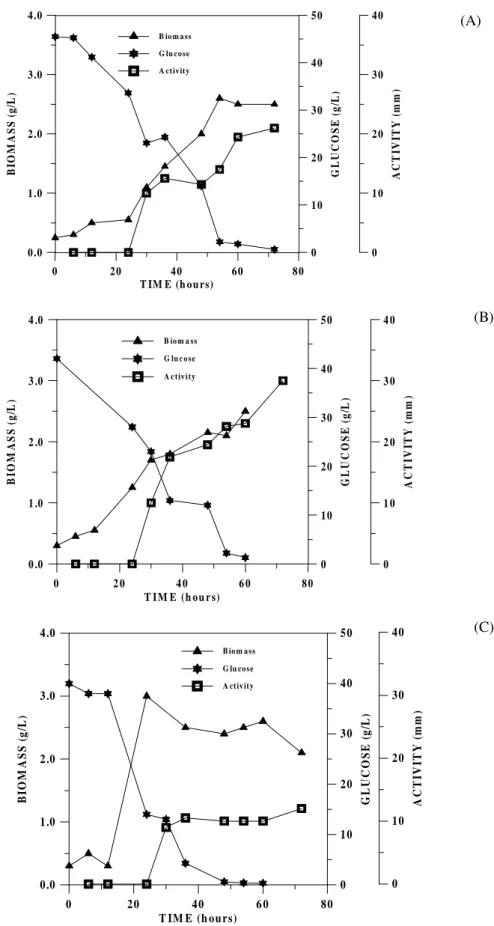
The three isolates that showed the highest antimicrobial and hemolytic activities: RAB7, R14 and C116, were selected for fermentation studies. Figure 1 shows biomass production, glucose consumption and antimicrobial activity production during the growth of the three isolates. B. megaterium pv. cerealis RAB7 and B. subtilis R14
had a longer growth phase then B. megaterium C116, but in all cases the antimicrobial activity production was observed at the late growth phase. The antimicrobial activities in liquid medium were similar to that observed on solid medium, where the isolates R14 and RAB7 produced wider inhibition zones then C116.
Fermentations were carried out at the same growth conditions to follow the variation of the medium superficial tension, which indicated the production of biosurfactants. The results are shown in Table 3.
B. megaterium C116 showed the fastest growth
Figure 1 - Biomass production, glucose consumption and bioactive compounds production during fermentation of (A) Bacillus megaterium pv. cerealis RAB7, (B) Bacillus subtilis R14, and (C) Bacillus megaterium C116
0 2 0 4 0 6 0 8 0
T I M E (h o u r s) 0 .0 1 .0 2 .0 3 .0 4 .0 B IO M A SS ( g /L ) 0 1 0 2 0 3 0 4 0 5 0 G L U C O S E ( g /L ) 0 1 0 2 0 3 0 4 0 A C T IV IT Y ( m m )
B io m a ss
G lu c o se
A c tiv i ty
0 20 40 6 0 80
T IM E (h ou rs) 0.0 1.0 2.0 3.0 4.0 B IO M A SS ( g /L ) 0 10 20 30 40 50 G L U C O S E ( g /L ) 0 10 20 30 40 A C T IV IT Y ( m m )
B io m a ss
G lu co se
A ctiv ity
0 2 0 4 0 6 0 8 0
T IM E (h o u rs) 0 .0 1 .0 2 .0 3 .0 4 .0 B IO M A SS ( g /L ) 0 1 0 2 0 3 0 4 0 5 0 G L U C O S E ( g /L ) 0 1 0 2 0 3 0 4 0 A C T IV IT Y ( m m )
B io m a ss
G lu co se
A ctiv ity
(A)
(B)
Table 3 - Mediumsuperficial tensions measured at 24, 48 and 72 hours of fermentation by Bacillus isolates
Superficial Tension (mN/m)
Isolates Time 01 24 hours 48 hours 72 hours
B. megaterium pv. cerealis RAB7 42.8 40.8 36.6 35.4
Bacillus subtilis R14 43.5 42.4 35.3 37.6
B. megaterium C116 41.5 30.0 37.8 35.5
1
Time 0 = sample obtained after inoculation
Table 4 - Medium, water with solubilized precipitate, and supernatant superficial tensions at 72 hours of
fermentation by Bacillus isolates
Superficial Tension (mN/m)
Isolates Medium Supernatant Water + precipitate1
B. megaterium pv. cerealis RAB7 35.4 40.3 41.9
Bacillus subtilis R14 37.6 38.2 45.4
B. megaterium C116 35.5 41.0 44.1
1
The water utilized to dissolve the precipitate had its pH adjusted to 12 and its superficial tension was 65.9 mN/m
As shown in Table 4, after the removal of precipitates, the medium superficial tension raised, indicating that tensoactive compounds were removed through the precipitation. The water with dissolved precipitates showed superficial tension lower than pure water (65.9 mN/m), indicating the presence of biosurfactants in these precipitates. The production of both antimicrobial and surfactant activities during growth of B. megaterium pv. cerealis RAB7, B. subtilis R14 and B. megaterium C116 on solid and liquid media indicated that lipopeptides could have a major role on the reduction of the incidence of black rot observed previously in greenhouse and field trials using these microorganisms as biocontrol agents. More than one lipopeptide, with different antimicrobial and surfactant activities, might have been produced by each Bacillus isolate.
ACKNOWLEDGEMENT
The authors are grateful to “Coordenação de Aperfeiçoamento de Pessoal de Nível Superior (CAPES)” for a scholarship to L. M.
RESUMO
Investigação sobre o antagonismo de oito isolados de Bacillus: B. subtilis R14, B. megaterium pv. cerealis RAB7, B. megaterium pv. cerealis C211,
B. megaterium C116, Bacillus sp. RAB9, B.
cereus C240, Bacillus sp. C11 e B. cereus C210, contra nove linhagens de X. campestris pv.
campestris (bactéria responsável pela podridão
REFERENCES
Assis, S. M. P.; Mariano, R. L. R.; Michereff, S. J. and Coelho, R. S. B.(1997), Antagonism of Bacillus spp. to Xanthomonas campestris pv. campestris on cabbage phyloplane in the field. Proceedings of the Fourth International Workshop on Plant Growth-Promoting Rhizobacteria – Present Status and Future Prospects. Japan : OECD. pp. 345-348. Assis, S. M. P.; Mariano, R. L. R.; Michereff, S. J. and
Coelho, R. S. B.(1996), Biocontrol of Xanthomonas campestris pv. campestris on kale with Bacillus spp. and endophytic bacteria. In: T. Wenhua et al. (Eds.).
Advances in Biological Control of Plant Diseases. Beijing. pp. 347-353.
Backman, P. A.; Wilson, M. and Murphy, J. F.(1997), Bacteria for biological control of plant diseases.
In-Environmentally Safe Approaches to Crop Disease Control, Eds. N. A. Rechcigl and J. E. Rechcigl. Boca Rota : CRC Press. pp. 95-109.
Cooper, D. G.; MacDonald C. R.; Duff, S. J.B. and Kosaric, N. (1981), Enhanced production of surfactin from Bacillus subtilis by continuous product removal and metal cation additions. Appl. and Environ. Microbiol., 42, 408-412.
Fox, S. and Bala, G. A. (2000), Production of surfactant from Bacillus subtilis ATCC 21332 using potato substrates. Biores. Technol., 75, 235-240. Gardener, B. B. M. and Fravel, D. R. (2002),
Biological control of plant pathogens: research, commercialization and application in the USA. [on line]. Plant Health Progress. www.plantmanage mentnetwork.org/pub/php/Review/biocontrol. Hiraoka, H.; Asaka, O.; Ano, T. and Shoda, M. (1992),
Characterization of Bacillus subtilis RB14, coproducer of peptide antibiotics iturin A and surfactin. J. Gen. Appl. Microbiol., 38, 635-640. Kim, H., Yoon, B. D.; Lee, C.-H.; Suh, H.-H.; Oh, H.
M.; Katsuragi, T. and Tani, Y. (1997), Production and properties of a lipopeptide biosurfactant from
Bacillus subtilis C9. J. Ferment. Bioeng., 84, 41-46. Kloepper, J. W. (1997), Current status and future
trends in biocontrol research and development in the U. S. Proceedings of the International Symposium of Clean Agriculture. Japan. pp. 49-52.
Kowall, M.; Vater, J.; Kluge, B.; Stein, T.; Franke, P. and Ziessow, D. (1998), Separation and characterization of surfactin isoforms produced by Bacillus subtilis OKB 105. J. Coll. Interf. Sci.,
204, 1-8.
Mariano, R. L. R.; Silveira, E. B.; Assis, S. M. P.; Gomes, A. M. A.; Oliveira, I. S. and Nascimento, A. R. P. (2001), Diagnose e manejo de fitobacterioses de importância no Nordeste Brasileiro. In: Michereff, S. J. and Barros, R. (Eds.). Proteção de Plantas na Agricultura Sustentável. Recife. pp. 141-169. Melo, I. S. (1998), Agentes microbianos de controle de
fungos fitopatogênicos. In: Melo, I. S. and Azevedo, J. L. (Eds.). Controle Biológico. Embrapa, Jaguariúna. v. 1. pp. 17-30.
Monteiro, L. (2002), Produção de substâncias bioativas de Bacillus spp. contra Xanthomonas campestris pv.
campestris. MSc Thesis, Universidade Federal de Pernambuco, Brazil.
Ohno, A., Ano, T. and Shoda, M. (1995), Effect of temperature on production of lipopeptides antibiotics, iturin A and surfactant by a dual producer, Bacillus subtilis RB14, in solid-state fermentation. J. Ferment. Bioeng., 80, 517-519. Thomashow, L. S. and Weller, D. M. (1996), Current
concepts in the use of introduced bacteria for biological disease control: mechanisms and antifungal metabolites. In: Stacey, G. and Keen, N. T. (Eds.). Plant-Microbe Interactions. New York : Chapman and Hall. v. 1. pp. 187-235.
Zuber, P.; Nakano, M. M. and Marahiel, M. A. (1993), Peptide antibiotics. In: Sonenshein, A. L.; Hoch, J. A. and Losick, R. (Eds.). Bacillus subtilis and Other Gram-positive Bacteria. Washington : ASM Press. pp. 897-916.