ABSTRACT
BACKGROUND AND OBJECTIVES:he use of opioids as
irst and second line agents to adequately treat pain requires systematization in diferent clinical syndromes which course with acute pain. his study aimed at discussing recommenda-tions for the use of opioids in acute postoperative pain, neu-ropathic pain, musculoskeletal pain and pain during gestation and lactation.
CONTENTS:his review has addressed the use of opioids in frequent chronic and acute painful syndromes, in gestation and lactation, discussing indications, drugs used, doses, risks, com-plications and recommendations.
CONCLUSION: Opioids for acute postoperative pain have been broadly studied and are established for minor medium and major surgeries. Recommendations for the use of opioids in neuropathic and musculoskeletal pain are restricted to sec-ond line treatment and require further discussions. Few studies have investigated the interaction of opioids with physiologic changes typical of gestation and the repercussions of the use of such agents to treat acute and chronic pain in the short and long term.
Keywords:Gestation, Lactation, Musculoskeletal pain, Neuro-pathic pain, Opioid, Postoperative pain.
Recommendations for the use of opioids in Brazil: Part III. Use in special
situations (postoperative pain, musculoskeletal pain, neuropathic pain,
gestation and lactation)*
Recomendações para uso de opioides no Brasil: Parte III. Uso em situações especiais (dor
pós-operatória, dor musculoesquelética, dor neuropática, gestação e lactação)
Durval Campos Kraychete1, José Tadeu Tesseroli de Siqueira2, Telma Regina Mariotto Zakka3, João Batista Santos Garcia4 and
Specialists Group
*Received from the Brazilian Society for the Study of Pain, São Paulo, SP, Brazil.
1. Federal University of Bahia, Salvador, BA, Brazil. 2. University of São Paulo, São Paulo, SP, Brazil.
3. University of São Paulo, School of Medicine, Clinicas Hospital, Interdisciplinary Pain Center, São Paulo, SP, Brazil.
4. Federal University of Maranhão, São Luis, MA, Brazil.
Correspondence to: Durval Campos Kraychete
Rua Rio de São Pedro, 327/401 – Bairro Graça 40150-350 Salvador, BA, Brasil.
E-mail: [email protected]
© Sociedade Brasileira para o Estudo da Dor
RESUMO
JUSTIFICATIVA E OBJETIVOS: O emprego de opioides
como agentes de primeira e segunda linha no tratamento da dor ainda é motivo de discussão na literatura. O uso de opioides de maneira adequada exige sistematização em diversas síndromes clínicas que cursam com dor aguda e crônica. O objetivo deste estudo foi discutir recomendações para o emprego de opioides na dor aguda de pós-operatório, na dor neuropática, na dor musculoesquelética e na dor durante a gestação e lactação.
CONTEÚDO: Nesta revisão abordou-se o emprego de opioi-des em síndromes dolorosas agudas e crônicas frequentes, na gestação e lactação discutindo as indicações, os fármacos uti-lizados, as doses, os riscos, as complicações e as recomendações.
CONCLUSÃO: O uso de opioides na dor aguda pós-oper-atória tem sido bem estudado e está estabelecido em cirurgias de pequeno, médio e grande porte. As recomendações para o emprego de opioides na dor neuropática e musculoesquelética são restritas à segunda linha de tratamento e exigem futuras discussões. Poucos estudos investigaram a interação dos opi-oides com as alterações isiológicas próprias da gestação e as repercussões do emprego desses agentes no tratamento da dor aguda e crônica em curto e em longo prazo.
Descritores: Dor musculoesquelética, Dor neuropática, Dor pós-operatória, Gestação, Lactação, Opioide.
INTRODUCTION
he correct and monitored use of opioids is still a challenge for health professionals. So, by initiative of a group of spe-cialists, with institutional validation of the Brazilian Society for the Study of Pain (SBED), we decided for a publication, the major proposal of which is to present recommendations to guide health professionals in the use of opioids to control acute and chronic pain. Continuing with our work, this study will discuss the use of opioids in acute postoperative pain, neu-ropathic pain, musculoskeletal pain, pain in pregnant women and during lactation. Recommendations presented here and in future publications in a sequenced manner, aim at starting the development of a practical guide for the adequate treatment of patients, disclosing available recommendations with regard
pain, neuropathic pain, gestation and lactation)
to the use of opioids in diferent clinical situations, encourag-ing studies related to their safety and efectiveness, as well as at demystifying the inadequate association between addiction/ dependence and the use of opioids.
OPIOIDS FOR POSTOPERATIVE PAIN
Opioids may be prescribed to treat acute postoperative pain after minor, medium or major surgeries or after outpatient pro-cedures. So, when using opioids by any route, pain evaluation and measurement should be constant, by monitoring, record-ing and treatrecord-ing adverse efects, as well as by adjustrecord-ing doses according to pain intensity and patients’ sedation level1.
Opioids administration routes may be oral, intravenous, intra-articular, epidural, subarachnoid and subcutaneous1.
Most common adverse effects observed in the postopera-tive period are itching, nausea, vomiting, urinary retention, sleepiness, dizziness and constipation2. Most feared adverse
effect is respiratory depression, the incidence of which is ap-proximately 0.25%3.
Continuous or intermittent intravenous administration of tramadol hydrochloride, morphine and fentanyl is indicated for moderate to severe pain or when the oral route cannot be used. hese drugs should be used with caution and initial dose should be low in the elderly, in the presence of liver and renal disease, prostate hypertrophy and intracranial hy-pertension4. Intravenous patient-controlled analgesia (PCA)
is efective alternative to control postoperative pain, allowing that minimum necessary opioid analgesic dose be progres-sively titrated and adjusted according to age, pain evaluation and patients’ clinical status. his prevents undesirable adverse efects, decreasing of drug blood concentration and the gap generally existing between analgesic request and its prepara-tion and administraprepara-tion by the nursing team5. Epidural PCA
for abdominal surgical procedure induces better pain control as compared to intravenous PCA, however patients refer more itching6. Patients duly oriented by the pain group will feel
safe and independent, resulting in a better quality of analgesia as compared to conventional methods.
Drugs
Tramadol:may be administered to relief mild to moderate pain and may produce adverse efects such as irritability, headache, nausea, vomiting, diaphoresis and dizziness7.
Oxycodone:with controlled release, it is safe and efective to control postoperative pain as compared to intravenous mor-phine for orthopedic surgeries8.
Caution: prolonged action opioids should be used with caution.
Fentanyl: it is also used for epidural analgesia in continuous infusion or fractioned doses. It has fast onset of action and short duration of effects. Transdermal route is not indicated for patients needing fast titration, as the case of postopera-tive pain9.
Morphine:it has been prescribed as golden-standard for post-operative analgesia of medium and major surgical procedures,
by intravenous, epidural and subarachnoid routes4. he
asso-ciation of intra-articular morphine (4mg), ropivacaine (90mg) and ketorolac (30mg) for shoulder surgeries decreases systemic morphine consumption10. Intra-articular morphine in the knee
in the postoperative period with doses above 5mg is also efec-tive11. It is important to point out that subcutaneous route,
in addition to being as efective as the intravenous route, has bioavailability equivalent to the oral rout, is better accepted by patients and operational cost is low12. Continuous infusion
morphine to reach plasma balance for analgesia may take 4 to 6 half-lives13, so, one should remind that the PCA concept takes
into account that: 1) there is variation among individuals in the need for opioids, which may be of 4 times or more; 2) mini-mum efective analgesic concentration is not constant; 3) any dose may be excessive for some and not enough for others; 4) transition from severe pain to efective analgesia involves minor serum concentration changes12,13.
Codeine: it is available as combined presentation with paracetamol, diclofenac or alone. In single 60 mg doses for mi-nor to medium surgeries it seems to promote analgesia in few individuals with relief of approximately 26%14.
Peripheral anesthetic blocks: there are no evidences support-ing the use of the association of opioids for peripheral anes-thetic blocks15.
Spinal administration
he infusion of local anesthetic solutions with opioids com-bines faster analgesia of local anesthetics and more prolonged opioids analgesia3. Epidural and subarachnoid routes provide
more prolonged analgesia with lower concentrations as com-pared to the systemic route. Low doses decrease the incidence of respiratory depression4.
he association of spinal opioids and adjuvants may result in adequate analgesic control16. Subarachnoid sufentanil produces
analgesic concentration with doses of 12.5 and 25µg, but may induce early respiratory depression within 30 minutes17.
Caution: sufentanil dose should vary from 2 to 10µg to pro-duce analgesia within 1-20 minutes after labor analgesia, but increases the incidence of itching18.
Opioids administration in single or intermittent doses via cath-eters has incidence of respiratory depression between 0.01 and 3%. When compared to parenteral administration (intrave-nous or ve(intrave-nous PCA), there is no diference in the frequency of respiratory depression and is associated to less sleepiness and sedation19.
OPIOIDS FOR MUSCULOSKELETAL PAIN
Osteoarthritis
non signiicant pain decrease. here has been loss of patients’ follow-up due to adverse efects20.
Extended release tramadol in the dose of 200 to 300mg was more efective than placebo when pain, stifness and function were evaluated with the WOMAC tool (Western Ontario and McMaster Universities). here have been more adverse efects (constipation, dizziness, nausea, sleepiness and headache) with the dose of 400mg/day21. A meta-analysis with 11 clinical trials
has observed that one out of six individuals using tramadol or the association tramadol and paracetamol have improved pain, joint stifness and daily life activities. Adverse efects were well tolerated22.
Opioids (codeine, oxycodone, morphine) were also efective to improve pain, stifness and function by the WOMAC tool, and sleep quality, as compared to placebo in clinical trials and a systematic review with meta-analysis23-25. Codeine dose has
varied from 100 to 300 mg, oxycodone dose from 20 to 40mg/ day and morphine dose from 30 to 50mg/day. Extended release opioids were used. Pain decrease was approximately 20 to 30% and was maintained to up to 60 days; adverse efects were toler-able (nausea, vomiting, itching and headache).
Chronic low back pain
Opioids may be considered to treat chronic low back pain more than to improve functional capacity. hey are more efective than placebo and comparable to anti-inlammatory drugs. Adverse efects limit its prolonged use26. However a recent
meta-analysis with 5540 patients has observed that opioids (morphine, oxycodone, tapentadol) were better than placebo to relief pain and improve functional capacity. Tramadol has also promoted further pain relief and improvement of daily life activities as compared to placebo for low back pain27.
here have been no reports of severe adverse efects, risks of ad-diction or overdose and severe complications (apnea, hyperal-gesia or hypogonadism). Clinical trials were of low to moderate quality, there have been many follow-up losses, short observa-tion period and limited interpretaobserva-tion of funcobserva-tional improve-ment. Authors have concluded that efectiveness and safety of prolonged use of opioids for chronic low back pain are still lacking evidences.
Fibromyalgia
Tramadol and tramadol/paracetamol relieve ibromyalgia pain. he efect was better as compared to placebo and has improved several FIQ (Fibromyalgia Impact Questionnaire) aspects28.
Mean tramadol dose has varied from 150 to 200mg and ad-verse efects were tolerable. However, opioids are not recom-mended for patients with this syndrome since risks do not out-weigh beneits29.
OPIOIDS FOR NEUROPATHIC PAIN
In the past, opioids were considered inefective for neuropathic pain and many patients were inadequately treated for not using such agents. Opioids may be used during the titration of irst line drugs and for acute neuropathic pain in patients already
treated or who will start treatment. Recent guidelines, however, include opioids as second line drugs to treat neuropathic pain in patients not responding to irst line drugs. his because: 1) there are no studies on the safety of prolonged use; 2) they cause more adverse efects than tricyclic drugs and gabapenti-noids; 3) may induce hyperalgesia.
Due to diferent neuropathic pain (NP) etiologies it is not pos-sible to determine in which patient or disease the opioid will be more efective and for how long, since in most studies observa-tion periods were not long. Pain relief, however, was considered satisfactory30-36. Such data may be evidenced by NNT
(neces-sary number to treat) which is the number of patients who shall be treated with a given drug to obtain 50% pain intensity de-crease. NNT shall be used only in placebo-controlled studies. he lower the NNT, the better the drug eicacy (Table 1)31,36.
Recommended doses are also described (Table 2).
Table 1. Necessary number to treat (NTT) of opioids (per available study)
Drug or class NNT (study)
Tramadol 3.430
3.936 9.036
Opioids 2.630
Morphine 2.536
Oxycodone 2.636
Table 2. Tramadol and opioid doses to treat neuropathic pain
Drugs Dose Observations
Codeine 20-180mg/day
Tramadol 200-400/day Treatment with tramadol may
be started with 50 mg once or twice a day and then gradually increased in 50-100 mg/day, as necessary, until 400 mg/day.
Morphine 10-15mg/4h Dose varies among patients or
as needed
Morphine LC 15-300mg/d
Oxycodone 10-120mg/day
Methadone 10-20mg/day There are no clinical trials on this
drug
OPIOIDS AND GESTATION
Studies on drug risk estimates during gestation and lactation were case reports, epidemiological, cohort and retrospective studies and studies with experimental animals. Such studies present variables, such as mother’s clinical-nutritional status, maternal age, use of alcohol and illicit drugs, smoking, gesta-tional age, drug dose, genetic history and environmental toxins which interfere with authors results and conclusions.
To guide drug prescription during gestation and lacta-tion, the Food and Drug Administration (FDA)37, in the
United States of America, has developed a risk classification based on medication potential to cause fetal malformations. Yankowitz and Nieby38 have reviewed and rewrote in a more
pain, neuropathic pain, gestation and lactation)
Table 3. Risk classiication of drugs during gestation
A Controlled studies have not shown risk B There is no evidence of risk for humans
C Risk cannot be ruled out; recently introduced and/or still not studied drugs are included
D There is positive evidence of risk
X Not indicated during pregnancy
his classiication is an orientation for the prescription mo-ment, which shall consider gestational period for therapeutic safety. Criteria for selecting and prescribing drugs should be based on the cost-beneit ratio of each clinical situation. Much of what is known about the efects of chronic exposure to opioids during pregnancy is based on drug addiction studies, being heroin and methadone the most widely used by pregnant women for pain relief or abuse39.
Most studies suggest the association of methadone and neo-nates with low weight and smaller cephalic perimeter, but increase of congenital malformations has not been observed. FDA places methadone in Category B, provided it is not used in high doses and/or close to term40.
Neonatal withdrawal syndrome is present in 30 to 90% of newborns (NB) exposed to heroin or methadone during gesta-tion and symptoms are more frequent with daily methadone doses above 20mg. Neonatal withdrawal syndrome symptoms include unrest, irritability, diiculty to breastfeed, weight loss and, in severe cases, seizures.
NB with opioids withdrawal syndrome in general are symp-tomatic during 48 postpartum hours, however symptoms may appear or persist for 7 to 14 days. Methadone levels in maternal milk seem to be enough to prevent infants’ withdrawal symp-toms41,42. he American Academy of Pediatrics (AAP) considers
that neonatal withdrawal syndrome is mild with methadone and is compatible with lactation in the dose of up to 20mg/ day43.
Opioids directly reach the fetus via placental transfer or in-directly by uterine tone alteration. Low molecular and lipo-soluble opioids cross the placenta more easily and the amount of free drug depends on placental blood low and on the level of binding to maternal proteins44,45.
In postoperative analgesia of pregnant women submitted to non-obstetric surgeries, fentanyl, morphine and hydromor-phone are safe and efective alternatives for parenteral admin-istration. Drugs administered for postoperative analgesia in spinal compartments minimize maternal plasma concentration of opioids and decrease placental transfer to the fetus or infant exposure46.
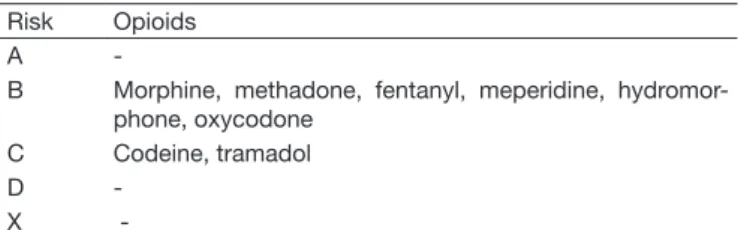
To date, there are no data showing the presence of sequelae after prolonged intrauterine exposure to opioids, especially major or minor malformations (Table 4). Study carried out at the Michigan Medical has shown lack of teratogenic efects in 289 fetuses exposed to oxycodone. he Collaborative Perinatal Project has monitored 50282 pregnant women who have used opioids during gestation and there have been reports of respi-ratory malformations associated to the use of codeine39,47. So,
codeine is considered Category C.
Table 4. Risk classiication of drugs during gestation
Risk Opioids
A
-B Morphine, methadone, fentanyl, meperidine,
hydromor-phone, oxycodone
C Codeine, tramadol
D
-X
-Hydromorphone: not available in Brazil.
Drugs47-52
Codeine:used during gestation may be associated to fetal mal-formations in the irst and second trimesters, to low analgesic eicacy and constipation. Constipation is especially undesir-able during gestation since women have already this symptom and hemorrhoids.
Tramadol: it use during pregnancy and lactation is limited, since there are no suicient clinical investigation with this pop-ulation. Tramadol has lipophilic characteristics, freely crosses the placenta and may determine NB withdrawal syndrome.
Fentanyl: parenteral fentanyl in the preoperative period may induce NB respiratory depression when administered immedi-ately before birth. Maternal administration of fentanyl or other opioid may determine alteration in fetal heart rate variability and fetal hypoxemia. Maternal-fetal exchange of fentanyl is fast, with increased umbilical venous blood concentration 5 minutes after intravenous administration in pregnant women. In term gestation, epidural fentanyl and alfentanil establish a fast balance between mother and fetus and are found in placen-tal intervillous spaces after birth.
Meperidine: repeated doses may lead to build-up of its me-tabolites (normeperidine) and may produce central nervous system excitation with generalized shivering, myoclonus and seizures. Signiicant normeperidine build-up is unlikely in par-turients receiving single dose, however, meperidine is not better than other parenteral opioids and should be avoided.
Morphine: during gestation there is morphine pharmacoki-netic alteration, plasma clearance is increased, half-life is de-creased, distribution volume decreases and 3-glucoronide me-tabolite formation is increased. Morphine and its meme-tabolite rapidly cross the placenta and establish maternal-fetal balance in approximately 5 minutes, so that concentrations in umbili-cal cord blood are similar to those observed in maternal blood.
Methadone: transfer and clearance indices are signiicantly higher on fetal-maternal direction than on mother-fetus direc-tion, without adverse efects on placental viability and on func-tional parameters, in spite of the retention of a large percentage in placental tissue. Methadone does not have active metabolites and, diferently from morphine, may be used for long periods. During gestation there is increased methadone metabolism and some pregnant women, who used the same dose in the long term, present withdrawal syndrome in the third trimester. Dose fractioning, without increasing total dose, may decrease with-drawal symptoms.
as compared to the third trimester. Women who have chron-ically used opioid analgesia in general decrease the dose to the level before gestation. Many women have cut the dose in half one day after delivery or have increased the interval between doses.
According to the Canadian Guideline for Safe and Efective Use of Opioids for Chronic Non-Cancer Pain50, pregnant women
with chronic non-cancer pain or being treated with opioids for a long time should gradually decrease the dose and, if possible, discontinue its use during gestation. Opioid withdrawal should be slow to prevent irritating uterine smooth muscles and conse-quently miscarriage or premature labor. In chronic non-cancer pain pregnant women depending on opioid prescription, treat-ment with methadone is recommended.
OPIOIDS AND LACTATION
Drugs to be used during lactation are classiied as safe, moder-ately safe, indicated with caution and contraindicated.
Safe drugs are those not producing adverse efects on infant and maternal milk. Agents used with caution during lactation are those with evidences of risk to infant health or milk produc-tion. heir use for shorter time and in the minimum possible dose is recommended, strictly observing the infant. Drugs con-traindicated during lactation are those where evidences have shown that cause signiicant damages to infant health and re-quire interruption of lactation43,53,54.
Opioid analgesics are excreted in maternal milk and are clas-siied as:
1. Safe during lactation: fentanyl and propoxyphene;
2. Moderately safe: codeine, tramadol, morphine, hydromor-phone, methadone and oxycodone.
he American Academy of Pediatrics (AAP) considers compat-ible with lactation the use of opioids such as codeine, fentanyl, methadone, morphine and propoxyphene43.
Pharmacokinetic analysis has shown that codeine and mor-phine concentrations in maternal milk are equal or slightly higher that concentrations in maternal plasma. Morphine is transferred to maternal milk in small amounts and neonatal exposure is limited due to its poor bioavailability53,54.
After absorption by NB gastrointestinal tract, opioids are me-tabolized. Morphine is glucorinated in inactive metabolites. Meperidine sufers N-demethylation in normeperidine, active metabolite with signiicantly long half-life in the NB. Regular lactation leads to the build-up of normeperidine resulting in neurobehavioral depression and seizures53,54.
here are no evidences of adverse behavioral efects in children exposed to tramadol, so its use in the postpartum is considered compatible with lactation. Oxycodone is present in maternal milk up to 72 hours after its administration, however in low concentration which poses no risk to the infant53,54.
Oral methadone transfer to the maternal milk is minimal, oc-curs regardless of the dose used by the mother and adverse ef-fects on infants are distinct53,54.
NBs with prenatal exposure to opioids for long periods re-quire weaning to be very slow (decrease of 10% every three
days) to prevent withdrawal symptoms. Methadone levels in maternal milk seem to be enough to prevent infant withdraw-al symptoms53,54.
According to AAP, prenatal or neonatal exposure to opioids may induce acute toxicity, inding that suggests drug efect in the long term or its slow weaning to prevent neonate withdraw-al symptoms. In neonates at risk, hospitwithdraw-al discharge should be delayed until the absence of withdrawal signs and symptoms for the period of 24 to 48 hours and after opioids are com-pletely discontinued43,53,54.
Support assistance for withdrawal syndrome includes minimiz-ing environmental stimuli, promotminimiz-ing adequate rest and sleep and providing enough caloric ingestion to establish weight gain. Breastfeeding or feeding with human milk should be en-couraged.
CONCLUSION
he use of opioids for acute postoperative pain is well estab-lished for minor, medium and major surgeries. Recommenda-tions for the use of these drugs for neuropathic and muscu-loskeletal pain are restricted to second line of treatment and require further discussions. Most clinical trials have not con-templated multiple etiologies of such syndromes and it is not possible to anticipate in which patient or disease the opioid will be more efective and for how long, since in most studies the observation period was not long.
Few studies have investigated the interaction of opioids and physiological changes typical of gestation and the short and long term repercussions of the use of such agents to treat acute and chronic pain. Ongoing education on the subject is nec-essary, encouraging clinical research and the development of evidence-based recommendations.
GROUP OF SPECIALISTS:
Alexandre Annes Henriques Anderson Arantes Silvestrini Ângela Maria Sousa
Ariel de Freitas Q. Américo Cláudio Fernandes Corrêa Daniel Ciampi Andrade Eduardo Grossmann Erich Talamoni Fonof Gualter Lisboa Ramalho Guilherme A. M. de Barros Grace Haber
Inês T. V. e Melo Irimar De Paula Posso Janaina Vall
João Marcos Rizzo João Valverde Filho
pain, neuropathic pain, gestation and lactation)
Lin Tchia Yeng
Manoel Jacobsen Teixeira Mario Luiz Giublin
Maria Teresa R. Jalbut Jacob Miriam Seligman Menezes Mirlane Guimarães Cardoso Newton Monteiro de Barros Onofre Alves Neto
Patrick Raymond Stump Rioko Kimiko Sakata Roberto T. de Castro Bettega Rogério Teixeira
Sandra Caires Serrano
Sílvia Maria de Macedo Barbosa Telma M. Zakka
heodora Karnakis Toshio Chiba Waleska Sampaio William Gêmio Teixeira William Jacobsen Teixeira
ACKNOWLEDGMENTS
his recommendation was developed by the Brazilian Society for the Study of Pain with support of Janssen do Brazil.
REFERENCES
1. Macintyre PE, Walker SM. he scientiic evidence for acute pain treatment. Curr Opin Anaesthesiol. 2010;23(5):623-8.
2. Walder B, Schafer M, Henzi I, Tramèr MR. Eicacy and safety of patient-controlled opioid analgesia for acute postoperative pain. A quantitative systematic review. Acta Anaesthesiol Scand. 2001;45(7):795-804.
3. Duarte LT, Fernandes Mdo C, Costa VV, Saraiva RA. [he incidence of postoperative respiratory depression in patients undergoing intravenous or epidural analgesia with opioids]. Rev Bras Anestesiol. 2009;59(4):409-20. Portuguese.
4. Fredheim OM, Borchgrevink PC, Kvarstein G. [Post-operative pain management in hospitals. Tidsskr Nor Laegeforen. 2011;131(18):1772-6. Norwegian.
5. Hudcova J, McNicol E, Quah C, Lau J, Carr DB. Patient controlled opioid analgesia versus conventional opioid analgesia for postoperative pain. Cochrane Database Syst Rev. 2006;18(4):CD003348.
6. Werawatganon T, Charuluxanun S. Patient controlled intravenous opioid analgesia versus continuous epidural analgesia for pain after intra-abdominal surgery. Cochrane Database Syst Rev. 2005;25(1):CD004088.
7. Smith AB, Ravikumar TS, Kamin M, Jordan D, Xiang J, Rosenthal N. CAPSS-115 Study Group. Combination tramadol plus acetaminophen for postsurgical pain. Am J Surg. 2004;187(4):521-7.
8. Rothwell MP, Pearson D, Hunter JD, Mitchell PA, Graham-Woollard T, Goodwin L, et al. Oral oxycodone ofers equivalent analgesia to intravenous patient-controlled analgesia after total hip replacement: a randomized, single-centre, blinded, non--inferiority study. Br J Anaesth. 2011;106(6):865-72.
9. Ginosar Y, Riley ET, Angst MS. he site of action of epidural fentanyl in hu-mans: the diference between infusion and bolus administration. Anesth Analg. 2003;97(5):1428-38.
10. Gupta A, Bodin L, Holmström B, Berggren L. A systematic review of the peripheral analgesic efects of intraarticular morphine. Anesth Analg. 2001;93(3):761-70. 11. Capdevila X, Barthelet Y, Biboulet P, Ryckwaert Y, Rubenovitch J, d’Athis F. Efects of
perioperative analgesic technique on the surgical outcome and duration of rehabilita-tion after major knee surgery. Anesthesiology. 1999;91(1):8-15.
12. Bruera E, Fainsinger R, Spachynski K, Babul N, Harsanyi Z, Darke AC. Steady-state pharmacokinetic evaluation of a novel, controlled-release morphine suppository and subcutaneous morphine in cancer pain. J Clin Pharmacol. 1995;35(7):666-72. 13. Breda M, Bianchi M, Ripamonti C, Zecca E, Ventafridda V, Panerai AE. Plasma
morphine and morphine-6-glucuronide patterns in cancer patients after oral, sub-cutaneous, sublabial and rectal short-term administration. Int J Clin Pharmacol Res. 1991;11(2):93-7.
14. Derry S, Moore RA, McQuay HJ. Single dose oral codeine, as a single agent, for acute postoperative pain in adults. Cochrane Database Syst Rev. 2010;14(4):CD008099.
15. Picard PR, Tramèr MR, McQuay HJ, Moore RA. Analgesic eicacy of peripheral opioids (all except intra-articular): a qualitative systematic review of randomized con-trolled trials. Pain. 1997;72(3):309-18.
16. Khan MI, Walsh D, Brito-Dellan N. Opioid and adjuvant analgesics: compared and contrasted. Am J Hosp Palliat Care. 2011;28(5):378-83.
17. Lu JK, Schafer PG, Gardner TL, Pace NL, Zhang J, Niu S, et al. he dose-res-ponse pharmacology of intrathecal sufentanil in female volunteers. Anesth Analg. 1997;85(2):372-9.
18. Bucklin BA, Chesnut DH, Hawkins JL. Intrathecal opioids versus epidural local anes-thetics for labor analgesia: a metaanalysis. Reg Anesth Pain Med. 2002;27(1):23-30. 19. American Society of Anesthesiologists Task Force on Neuraxial Opioids,
Horlo-cker TT, Burton AW, Connis RT, Hughes SC, Nickinovich DG, Palmer CM, et al. Practice guidelines for the prevention, detection, and management of respira-tory depression associated with neuraxial opioid administration. Anesthesiology. 2009;110(2):218-30.
20. Bjordal JM, Klovning A, Ljunggren AE, Slørdal L. Short-term eicacy of pharmaco-therapeutic interventions in osteoarthritic knee pain. A meta-analysis of randomised placebo-controlled trials. Eur J Pain. 2007;11(2):125-38
21. Gana TJ, Pascual ML, Fleming RR, Schein JR, Janagap CC, Xiang J, et al. Ex-tended-release tramadol in the treatment of osteoarthritis: a multicenter, ran-domized, double-blind, placebo-controlled clinical trial. Curr Med Res Opin. 2006;22(7):1391-401.
22. Cepeda MS, Camargo F, Zea C, Valencia L. Tramadol for osteoarthritis: a systematic review and metaanalysis. J Rheumatol. 2007;34(3):543-55.
23. Peloso PM, Bellamy N, Bensen W, homson GT, Harsanyi Z, Babul N, et al. Double blind randomized placebo control trial of controlled release codeine in the treatment of osteoarthritis of the hip or knee. J Rheumatol. 2000;27(3):764-71.
24. Taylor R Jr, Rafa RB, Pergolizzi JV Jr. Controlled release formulation of oxycodone in patients with moderate to severe chronic osteoarthritis: a critical review of the lite-rature. J Pain Res. 2012;5:77-87.
25. Caldwell JR, Rapoport RJ, Davis JC, Ofenberg HL, Marker HW, Roth SH, et al. Eicacy and safety of a once-daily morphine formulation in chronic, moderate-to-se-vere osteoarthritis pain: results from a randomized, placebo-controlled, double-blind trial and an open-label extension trial. J Pain Symptom Manage. 2002;23(4):278-91. 26. White AP, Arnold PM, Norvell DC, Ecker E, Fehlings MG. Pharmacologic Management
of Chronic Low Back Pain. Synthesis of the Evidence. Spine. 2011;36(21S):S131-43. 27. Chaparro LE, Furlan AD, Deshpande A, Mailis-Gagnon A, Atlas S, Turk DC.
Opio-ids compared with placebo or other treatments for chronic low back pain: an update of the Cochrane review. Spine. 2014;39(7):556-63.
28. Bennett RM, Kamin M, Karim R, Rosenthal N. Tramadol and acetaminophen com-bination tablets in the treatment of ibromyalgia pain: a double-blind, randomized, placebo-controlled study. Am J Med. 2003;114(7):537-45.
29. Painter JT, Croford LJ. Chronic opioid use in ibromyalgia syndrome: a clinical re-view. J Clin Rheumatol. 2013;19(2):72-7
30. Eisenberg E, McNicol ED, Carr DB. Eicacy and safety of opioid agonists in the treatment of neuropathic pain of nonmalignant origin. Systematic review and meta--analysis of randomized controlled trials. JAMA. 2005;293(1):22-9.
31. Eisenberg E, McNicol ED, Carr DB. Eicacy of mu-opioid agonists in the treatment of evoked neuropathic pain: Systematic review of randomized controlled trials. Eur J Pain. 2006;10(8):667-76.
32. Finnerup NB, Sindrup SH, Jensen TS. he evidence for pharmacological treatment of neuropathic pain. Pain. 2010;150(3):573-81.
33. Canadian Guideline for Safe and Efective Use of Opioids for Chronic Non-Cancer Pain. Canada: National Opioid Use Guideline Group (NOUGG); 2010. Available from: http://nationalpaincentre.mcmaster.ca/opioid/
34. Finnerup NB, Otto M, McQuay HJ, Jensen TS, Sindrup SH. Algorithm for neuropa-thic pain treatment: an evidence based proposal. Pain. 2005;118(3):289-305. 35. Dworkin RH, O’Connor AB, Audette J, Baron R, Gourlay GK, Haanpää ML, et
al. Recommendations for the pharmacological management of neuropathic pain: an overview and literature update. Mayo Clin Proc. 2010;85(3):S3-14.
36. Furlan AD, Sandoval JA, Mailis-Gagnon A, Tunks E. Opioids for chronic pain: a meta-analysis of efectiveness and side efects, CMAJ. 2006;174(11):1589-94. 37. EUA. Departamet of Health and Humans Service. U.S. Food and Drug
Administra-tion (FDA) – center for Drug EvaluaAdministra-tion and Research. Disponivel em URL:http:// www.fda.gov/cder/index.html.
38. Yankowitz J, Niebyl JR. Drug therapy in pregnancy. 3th ed, Philadelphia: Lippincott, Williams&Wilkins; 2001.
39. Hudak ML, Tan RC. Committee on drugs: Committee on fetus and newborn. Ameri-can Academy of Pediatrics. Neonatal drug withdrawal. Pediatrics. 2012;129(2):e540-60. 40. EUA. Department of Health and Humans Service. U.S. Food and Drug Administra-tion (FDA) – center for Drug EvaluaAdministra-tion and Research. Disponível em URL:http:// www.fda.gov/cder/index.html.
41. Ellwood DA, Sutherland P, Kent C, O’Connor M. Maternal narcotic addiction: preg-nancy outcome in patients managed by a specialized drug-dependency antenatal cli-nic. Aust N Z J Obstet Gynaecol. 1987;27(2):92-8.
42. Dryden C, Young D, Hepburn M, Mactier H. Maternal methadone use in pregnancy: factors associated with the development of neonatal abstinence syndrome and impli-cations for healthcare resources. BJOG. 2009;116(5):665-71.
44. Behravan J, Piquette-Miller M. Drug transport across the placenta, role of the ABC drug elux transporters. Expert Opin Drug Metab Toxicol. 2007;3(6):819-30. 45. de Barros Duarte L, Moisés EC, Carvalho Cavalli R, Lanchote VL, Duarte G, da
Cunha SP. Distribution of fentanyl in the placental intervillous space and in the dife-rent maternal and fetal compartments in term pregnant women. Eur J Clin Pharma-col. 2009;65(8):803-8.
46. Eisenach JC, Grice SC, Dewan DM. Patient-controlled analgesia following cesare-an section: a comparison with epidural cesare-and intramuscular narcotics. Anesthesiology. 1988;68(3):444-8.
47. American Academy of Pediatrics Committee on Drugs. Use of psychoactive medi-cation during pregnancy and possible afects on the fetus and newborn. Pediatrics. 2000;105(4):880-7.
48. Federação Brasileira das Sociedades de Ginecologia e Obstetrícia. Manual de
Orienta-ção. Drogas na Gravidez. São Paulo: Ponto Editora; 2003. 9-12p.
49. Andrade SE, Gurwitz JH, Davis RL, Chan KA, Finkelstein JA, Fortman K, et al. Prescription drug use in pregnancy. Am J Obstet Gynecol. 2004;191(2):398-407. 50. Canadian Guideline for Safe and Efective Use of Opioids for Chronic Non-Cancer
Pain. In: National Opioid Use Guideline Group. 2010, part B, 53-4.
51. Malek A, Obrist C, Wenzinger S, von Mandach U. he impact of cocaine and heroin on the placental transfer of methadone. Reprod Biol Endocrinol. 2009;7:61. 52. van Baar AL, Soepatmi S, Gunning WB, Akkerhuis GW. Development after prenatal
exposure to cocaine, heroin and methadone. Acta Paediatr Suppl. 1994;404:40-6. 53. Federação Brasileira das Sociedades de Ginecologia e Obstetrícia. Manual de
Aleita-mento Materno. São Paulo; 2010. 77-86p.