ORAL LANGUAGE DISORDERS IN CHILDREN
FROM 4 TO 6 YEARS OLD IN BELO HORIZONTE
Alterações da linguagem oral no nível fonológico/fonético
em crianças de 4 a 6 anos residentes em belo horizonte
Fernanda Rodrigues Campos(1), Alessandra Terra Vasconcelos Rabelo(2),
Clarice Passos Friche(3), Bárbara Suelen Vasconcelos da Silva(4), Amélia Augusta de Lima Friche(5),
Claudia Regina Lindgren Alves(6), Lúcia Maria Horta de Figueiredo Goulart(7)
(1) School of Medicine, Universidade Federal de Minas Gerais
– UFMG, Belo Horizonte (MG), Brazil.
(2) Universidade Federal de Minas Gerais – UFMG, Belo
Hori-zonte (MG), Brazil
(3) Universidade Federal de Minas Gerais – UFMG, Belo
Hori-zonte (MG), Brazil
(4) Universidade Federal de Minas Gerais – UFMG, Belo
Hori-zonte (MG), Brazil
(5) Department of Speech-Language Pathology and Audiology,
School of Medicine, Universidade Federal de Minas Gerais Federal – UFMG, Belo Horizonte, MG, Brazil.
(6) Department of Pediatrics, School of Medicine, Universidade
Federal de Minas Gerais Federal – UFMG, Belo Horizonte, MG, Brazil.
(7) Department of Pediatrics, School of Medicine, Universidade
Federal de Minas Gerais Federal – UFMG, Belo Horizonte, MG, Brazil.
Study held at the Post-graduation in Health Sciences, School of Medicine, Universidade Federal de Minas Gerais – UFMG – Belo Horizonte (MG), Brasil.
Conlict of interest: non-existent
INTRODUCTION
Communication aims to transmit messages. It can occur through many different channels such as writing, gestures and sounds. For its occurrence, there must be a message, a sender and a receiver,
a channel, a code and a reference (context,
situation and real objects to which the message refers). The main channel of human communication is speech, i.e., the transmission of a message ABSTRACT
Purpose: to verify the prevalence of oral language disorders in children from four to six years old and its association with variables age, gender, orofacial motor skills impairments and auditory processing disorders. Methods: three evaluation protocols were used: stomatognathic system protocol adapted from the Myofunctional Evaluation Guidelines, the Phonology task of the ABFW – Child Language
Test and a simpliied auditory processing evaluation. Data were statistically analyzed using the
chi-square test to compare proportions and analysis of variance to compare means and 5% (p<0.05)
was considered as a threshold of statistical signiicance. Results: 242 children from 4 years to 6 years and 11 months old were assed. The prevalence of 36.0% (n=87) of oral language disorders
and an association with age group with statistical signiicance (p=0.009) were found. We observed a statistically signiicant association between phonological deviation and age (p<0.001); between the
presence of phonetic deviation and orofacial motor skills impairments (p<0.001) and the presence of phonological deviation and auditory processing disorders (p<0.001). Conclusion: the high prevalence of deviations observed shows the need for developing actions in primary health care in order to prevent the onset of these disorders, improve access to intervention and enable prevention of more serious
problems in school. The highest occurrence of oral language disorders at the age group of four to ive years old suggests that this is a good stage for the identiication and prevention of these deviations.
KEYWORDS: Speech, Language and Hearing Sciences; Child Health; Child Development;
kindergarten in the of the catchment area of a health center in Belo Horizonte.
METHODS
This project was approved by the Research Ethics Committee of UFMG (opinion ETIC 263/08 of 18/06/2008).
It is a cross-sectional study conducted from September 2009 to May 2010. We studied children
from four to six years and 11 months old in both genders enrolled in six public schools in the
catchment area of a health center in Belo Horizonte.
This area comprises a population of approximately
12,500 inhabitants, and the health center is respon-sible for the health of this population.
A representative random sample stratiied by
school and age group was constituted based on a universe of 664 children enrolled in the schools selected for the study. The following parameters were taken as the basis for calculating the sample: 40% prevalence of speech disorders, margin of
error of 5%, conidence interval of 95% and 10% of
losses added totaling 261 children3,15-18.
Children were randomly selected through the lists of students enrolled and the date of birth of the same. Inclusion criteria were: age between four and
six years and 11 months, being enrolled in a school
or day care included in the survey and presenting the Informed Consent Form (ICF) signed by a parent or legal guardian of the child, agreeing with
the participation of the minor. Exclusion criterion
was the presence of severe comorbidities that would prevent the tests for being performed such as chronic nonprogressive encephalopathy, trisomy 21 and cleft palate.
Each child drawn was identiied by a number
and information on birth date, age, school and
school period. Assessments lasted approximately
30 minutes and were conducted in the school environment, in a room assigned by the school. The class schedule and availability of each class, as well as the school, were respected. Each child was evaluated by a speech therapist trained for the study, one of three researchers participating in the collection of information.
For the assessment of oral language the Phonology task of the ABFW – Child Language Test – Part I was used and the analysis was conducted through the production and reception of sounds that
constitute it1.
Speech can be deined as the motor act or physical event that expresses the language. For the
speech to occur it is required the structural integrity of the central nervous system and peripheral struc-tures involved in four functions that must act in an integrated way: breathing, phonation, articulation and resonance. In addition, cognitive and
phono-logical developments should be adequate2-4.
The spoken language has several implications in cognitive development: it allows you to communicate with others, initiates socialization, the internalization of the word for the formation of thought, and the formation of mental images, representations of the
meanings of signs5. In turn, these representations
allow experiences to occur more rapidly, leading to
the development of language6.
Speech intelligibility i.e. the fact that the words are well pronounced is a decisive factor in the process of message transmission. For speech to be intel-ligible, the child must learn to produce contrastive
sounds that are part of your mother tongue well2.
Preschool is the period of greatest development of the phonological system, when quantitative and
qualitative changes are noticed. At irst the children
have a limited inventory of speech sounds and,
approximately at the age of ive, there is already
a complete phonological system. This moment is also the beginning of syntactic development, when
a signiicant expansion of vocabulary happens, reaching approximately 8000 words at the age of ive. In this period, the grammatical forms of the
language are already there and the subjects are
able to use language to communicate effectively7.
Studies on the phonological acquisition of Portuguese speakers in Brazil show that children at
about four or ive years old have already acquired
phonemic contrasts of an adult speaker and the period of acquisition of phonological rules ends
around the age of six, with the acquisition of the last
sounds8-13.
The timely detection of speech disorders and impairments of skills and structures associated with these disorders is the best way to increase the chances of access to adequate and timely treatment and to decrease the chances that these disorders may negatively impact the social relations of the individual. Therefore, it is possible for the individual
checking the disorders studied and not requiring sophisticated equipment. Faced with the impos-sibility of assessing hearing thresholds using pure tone audiometry, we chose to conduct the
cochleo-eyelid relex evaluation for the exclusion of children
with hearing loss from moderate to severe. The criteria for application and analysis of the results
complied with the rules deined by the tests21,22.
The results were categorized into a dichotomous variable, being considered impaired when the child had impaired result in at least one of three tests.
Those responsible for children selected for
the study were explained and informed about all
research procedures by means of written information (Statement of Consent). The IC was delivered to children in school to be signed by a parent or guardian. Children who did not return the signed document after two attempts to contact by letter and
one telephone contact were considered excluded.
After diagnosis, feedback was given by letter to the children with not impaired results. For the children who showed deviations, the parents were invited to attend the school for feedback interview, and the same were referred to the health center for pediatric care, guidance and referrals when necessary.
To maintain conidentiality, the schools were identiied by numbers.
Data were stored in electronic format. To compare proportions, we used the chi-square test and to compare means we used analysis of variance. For continuous variables that did not present a Gaussian distribution we used the Kruskal Wallis median test. We established 5% (p <0.05) as the threshold for
statistical signiicance.
RESULTS
The sample size calculation included 261 children. We evaluated and analyzed the results of 242 children, which represented 7.27% of losses. These losses included children who did not return the consent form signed by a parent or guardian, after three attempts.
The children’s ages ranged from four to six years
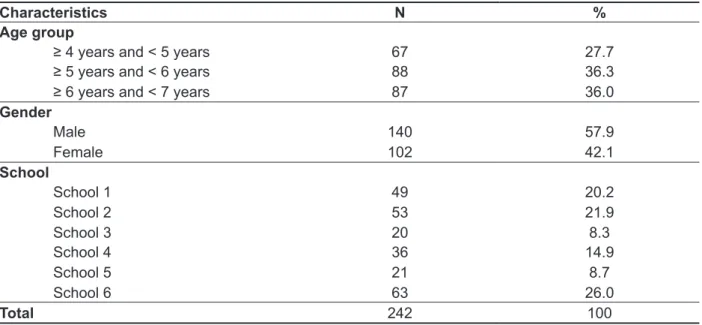
and 11 months. The median age was 5.7 years and the mean was 5.6 (± 0.8). Table 1 shows the main characteristics of the children in the study.
phonemes and appear in all possible positions for each phoneme of Brazilian Portuguese.
The Phonology task of the ABFW – Child Language Test is widely used in clinical practice and research to verify the acquisition and devel-opment of the phonological and phonetic inventory of children from the age of three. Since it is easily
applied and validated for the veriication of speech
disorders – phonetic and phonological deviations for Brazilian Portuguese speaking population, this test
was chosen for this study19.
We opted for the use of the term ‘oral language’ when treated jointly phonetic deviations, charac-terized by disorders in the articulation of sounds, and phonological deviations which are language disorders characterized by the presence of productive asynchronous phonological processes (in older age group than that of overcoming this same process for most children), and/or the presence of unusual phonological processes (which are not observed in normal acquisition of the phonological system), in the child’s speech.
We also performed evaluation of orofacial motor skills (OM) impairments and auditory processing disorders in order to verify possible associations between different speech-language disorders studied. To evaluate the orofacial motor skills we drafted a stomatognathic system protocol adapted from the Myofunctional Evaluation Guidelines for verifying myofunctional aspects of the
stomato-gnathic system20. The protocol used does not
deine normal standards and criteria for the analysis of results, and the disorders are deined by the
speech therapist’s observations from their clinical
experience. Thus, the criteria for which the child
was considered to have an OM impairment were
deined by consensus of four speech therapists,
considering the number of structures affected, the characteristics aspect, tension and mobility and its possible repercussions on other oral functions. The
evaluation result was deined as a dichotomous
variable: impaired or not impaired.
The simpliied auditory processing evaluation
consisted of the following tests: (1) Sequential Memory Test for Non-verbal sounds, (2) Sequential Memory Test for Verbal Sons, (3) Sound Location Test21,22. The choice of tests for the simpliied evalu
-ation was proposed based on the assessment
described in the literature21,22. The tests were chosen
Table 1 – Characterization of the study population in terms of age, gender and school in the period 2009/2010, Belo Horizonte
Characteristics N %
Age group
≥ 4 years and < 5 years 67 27.7
≥ 5 years and < 6 years 88 36.3
≥ 6 years and < 7 years 87 36.0
Gender
Male 140 57.9
Female 102 42.1
School
School 1 49 20.2
School 2 53 21.9
School 3 20 8.3
School 4 36 14.9
School 5 21 8.7
School 6 63 26.0
Total 242 100
Prevalence of 36.0% (n=87) of language disorders, 19.0% (n=46) orofacial motor skills impair-ments and 39.0% (n = 92) of auditory processing disorders were observed.
Of 242 children evaluated, 13.6% (n=33) showed phonological deviations, 16.1% (n=39), phonetic deviations and concomitant presence of phonetic and phonological deviations was observed in 6.2% (n=15) of the sample.
Among the 87 children with oral language disorder, we note that 44.8% had phonetic devia-tions, which was the most prevalent disorder found. In addition, 37.9% of children in this group had phonological deviation and 17.3%, both disorders (Table 2).
Among the 39 children who had phonetic devia-tions alone, we observed that more than half showed distortion of phone [s] (lisping or lateral lisp).
The substitution process was more prevalent in children with phonological deviations alone or not. Of the 33 children with phonological deviation alone, 24 (72.7%) showed this process. It was also observed that 12 (80.0%) of 15 children who had both deviations had substitution processes.
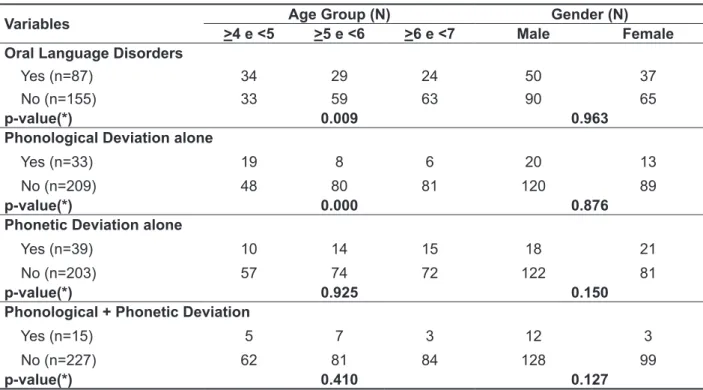
Table 3 shows the distribution of oral language disorders arranged by age and gender. We noticed a higher frequency of children with impaired oral language – including phonetic and phonological
deviations – among children aged four to ive years, with statistical signiicance (p=0.009). We observed
Table 2 – Distribution of oral language/speech disorders in the period 2009/2010, Belo Horizonte (N=87)
Deviation N %
Phonetic deviation 39 44.8
Distortion phoneme /s/ 10 11.5
Distortion other phonemes 19 21.8
Distortion phoneme /s/ + Distortion other phonemes 10 11.5
Phonological deviation 33 37.9
Simpliication 9 10.3
Substitution 11 12.6
Simpliication + substitution 7 8.1
Simpliication + substitution + unusual 6 6.9
Phonetic deviation + Phonological deviation 15 17.3
Distortion + Simpliication 2 2.3
Distortion + Substitution 5 5.7
Distortion + Unusual 1 1.2
Distortion + Simpliication + Substitution 4 4.6
Distortion + Substitution + unusual 1 1.2
Distortion + Simpliication + Substitution + unusual 2 2.3
Table 3 – Distribution of oral language /speech disorders in terms of age group and gender in the period 2009/2010, Belo Horizonte (N=242)
Variables Age Group (N) Gender (N)
>4 e <5 >5 e <6 >6 e <7 Male Female
Oral Language Disorders
Yes (n=87) 34 29 24 50 37
No (n=155) 33 59 63 90 65
p-value(*) 0.009 0.963
Phonological Deviation alone
Yes (n=33) 19 8 6 20 13
No (n=209) 48 80 81 120 89
p-value(*) 0.000 0.876
Phonetic Deviation alone
Yes (n=39) 10 14 15 18 21
No (n=203) 57 74 72 122 81
p-value(*) 0.925 0.150
Phonological + Phonetic Deviation
Yes (n=15) 5 7 3 12 3
No (n=227) 62 81 84 128 99
p-value(*) 0.410 0.127
processes involving substitutions17,24,28. There was also a high prevalence of simpliication processes,
which is also in accordance with the results of other studies29-31.
In this study we did not observe statistically signif-icant association between oral language disorders and gender. Some studies indicate a higher preva-lence in males, especially related to phonological
deviation15,16,29 while others relate similar proportion
among different genders3,17,26.
The results indicate a greater number of children with oral language disorders at the age group of
four to ive years. The same was observed when
analyzing the presence of phonological disorders. The literature shows a higher possibility of failure of younger children in tests of speech and auditory skills. Even with the possibility of overcoming the disorders without intervention, studies indicate that these children must be followed, as they present
results short from expected for age and the possi
-bility of dificulty aggravation and/or impact of other
skills such as mastery of written language. These children have lower performance than the normal
range found in the healthy population7, 12,19,21,30.
In the analysis of the relationship between the deviations of oral language and other speech-language disorders, we observed statistically
signiicant association between phonological and
auditory processing disorders. This association was observed in other studies that indicate that children with inadequate auditory processing may present
dificulties in discriminating sounds and temporal
processing during speech acquisition, leading to omissions and substitutions of phonemes, charac-terized as phonological deviation. Researchers indicate that impairments in phonemic discrimi-nation, working memory, auditory processing and
acoustic relexes are commonly associated with
phonological deviation32-35.
Another study shows that 70% of children aged
four to six years and with phonological disorders have failed at least one of the tests of a simpliied
evaluation of auditory processing, with a predomi-nance of failure in sequential memory for verbal sounds test, results which are similar to those in this paper33.
It is stated that the integrity and proper functioning of the auditory structures are prerequisites for the acquisition and development of language, within the normal range. The functions of attention, When we investigated the relationship between
the deviations of oral language and other
speech-language disorders, there was a signiicant associ -ation between phonetic devi-ation and orofacial motor skills impairments (p<0.001).
It was also observed statistically signiicant
association between phonological deviation and auditory processing disorders (p<0.001).
The prevalence of failure in the simpliied auditory
processing evaluation was 39.0% (n=92), among a
total of 236 children, since six were excluded only for the analysis of auditory processing: ive children
who refused to perform the test for fear of putting on the mask, which prevented the testing of non-verbal sequential memory and sound localization from being held, and a child who had oral language disorder precluding the test of sequential memory
for verbal sounds. We veriied a predominance of
failure in the test for sequential memory for verbal sounds, observed in 58 (73.3%) of these 92 children.
Regarding OM, there was 19.0% (n=46) of preva-lence of impairments which represent children who had inadequate tension, mobility and positioning of the articulators and those who had abnormal bite and occlusion concurrently or not.
It was observed that 80.0% (n=124) of children without oral language disorders had one or more productive phonological processes considered normal for age according to the ABFW test
analysis19. The most frequent productive
phono-logical processes in this population were
simpli-ication of inal consonant and consonant cluster simpliication.
DISCUSSION
These results suggest a high prevalence of oral language disorders – phonetic and phono-logical in preschoolers. Studies in different places of the Brazilian territory including all or part of the
age group of four to six years show a prevalence
ranging from 21.0% to 45.2% for oral language
disorders3,16,18, 9.2% to 18.6% for phonological
deviations16,23,24, and 2.10% to 22.5% for phonetic
deviations23-26. This large variation is probably due
to methodological differences and age of children
in the sample of each study, making it dificult to
compare results.
CONCLUSION
The high prevalence of oral language disorders
– phonetic/phonological deviations veriied in this
study points to the need for development of thera-peutic and prevention actions for children of the age group studied. For this to happen, it is essential that there is good communication between teachers and health professionals. By being in constant contact with children, educators are often able to identify
children with speech dificulties and can stimulate
them.
Other important associations observed were associations between auditory processing disorders and orofacial motor skills impairments with oral language deviations. The methodology does not allow the establishment of temporal or causal relationship between these variables. For this reason, greater attention to children whose
devel-opment of these skills is found short than expected
is mandatory.
The accumulation of oral language disorders at
the age of four to ive years suggests that this is a good stage for the identiication and prevention of
these deviations. This age group is considered a milestone in the development of language, involving morphological, syntactic, semantic and pragmatic aspects, which are essential to the understanding and use of language features.
It is suggested that further studies both in this and in other areas of Belo Horizonte are held, to compare the results. It is believed that research to
examine the factors associated with these changes
may complement the results. Thus, it would be possible to determine what types of actions would
be most beneicial to this population, facilitating the
adoption of preventive measures of oral language disorders prior to the interference of these devia-tions in the learning process of children at school age. Ensuring the quality of life of these individuals should be the main goal of the professionals who deal with these children.
ACKNOWLEDGEMENTS
We thank our research collaborators, former students of Medicine and Speech Therapy at UFMG, Maria Clara Assis Brito Alves, Tamara Alves Rita Gennaro and Mayra Lopes, who assisted in the stage of data collection, and also to the health center, schools, students and their families for participating in this project.
interfere with the performance of oral and written
communication1,7,12,21,29,35.
The articulation of speech sounds is linked to the development and maturation of sensory-motor-oral system and the stomatognathic functions of
breathing, sucking, chewing and swallowing27.
The occurrence of oral language disorders in preschoolers may result from dysfunction of the stomatognathic system, since the integration of motor, sensory and auditory systems is essential for the development of motor control of speech production, which depends directly on maturation of neuronal and skeletal muscle growth during the
irst two years36. Furthermore, it is worth noting that
the presence of prolonged sucking habits, apart from breastfeeding, can affect speech development in young children, as the structures of the
stomato-gnathic system are inluenced by these habits and
anatomical changes that impair the articulation of
sounds may occur 37,38.
Another interesting inding of this study was
the high number of children without oral language disorders that had some productive synchronic phonological process (considered normal for age) according to the test analysis, with the
predomi-nance of processes of inal consonant simplii
-cation and consonant cluster simplii-cation. In oral
language evaluation of 95 children with an average
age of ive years and four months, in the northwest
of the state capital, presence of consonant cluster
simpliication was observed in 24 children and the process of simpliication of inal consonant in
20 children17. In some surveys, these simpliica
-tions are considered linguistic varia-tions of the population, as they also appear in adult speech. Study of children from 1st to 4th grade, from the same area where this study was conducted, also showed high prevalence of processes of consonant
cluster simpliication and simpliication of inal
consonant in the children evaluated. These devia-tions are described as linguistic variation common to the region’s population, since children were no
longer in the process of acquiring these sounds26.
In Minas Gerais, the variation of consonant cluster
simpliication is frequently observed in adults, which could be explained by the /r/ sound being the most dificult sound to be pronounced39. Children have
their parents and family as models of speech and tend to use words in the same way as their peers. Thus children who live with adults who have these characteristics are more likely to produce the same
patterns of oral language than children who don’t13,40.
Pontifícia Universidade Católica do Rio Grande do Sul; 1990.
9. Lamprecht RR. Peril da aquisição da fonologia
do português. [Tese]. Porto Alegre (RS): Pontifícia Universidade Católica do Rio Grande do Sul, Instituto de Letras e Artes; 1990.
10. Yavas M. Padrões na aquisição da fonologia do
português. Letras de Hoje, Porto Alegre,1988; v. 23, p.7-30.
11. Wertzner HF. Aquisição da articulação: um
estudo em crianças de três a sete anos. Estud.
psicol. 1994;11(1,2):11-21.
12. Mourão LF, Parlato EM, Silvério KCA, Altmann EBC, Chiari BM. Descrição da ocorência dos fonemas da língua portuguesa em pré-escolares.
Pró-Fono Rev Atual Cient. 1994;6(1):27-32.
13. Ferrante C, Van Borsel J, Medeiros M. Aquisição fonológica de crianças de classe sócio econômica
alta. Rev CEFAC. 2008;10(4):452-60.
14. Prates LPCS, Martins VO. Distúrbios da fala e da linguagem na infância. Rev Med Minas Gerais. 2011;21(4 Supl 1):S54-S60.
15. Silva EI, Lima EM, Silveira PCM. Ocorrência
de desvios fonológicos em crianças de escolas
REFERENCES
1. Ruben RJ. Redeining the survival of the ittest: communication disorders in the 2st century. Laryngoscope. 2000;110:241-5.
2. Zorzi JL. Diferenciando Alterações da Fala e da
Linguagem. In: Marchesan IQ. Fundamentos em Fonoaudiologia: Aspectos Clínicos da Motricidade Oral. Rio de Janeiro: Guanabara Koogan, 1998. p. 62.
3. Goulart BNG, Chiari BM. Prevalência de desordens de fala em escolares e fatores associados. Rev Saúde Pública. 2007;1(5):726-31. 4. Andrade CRF. Prevalência das desordens
idiopáticas da fala e da linguagem em crianças
de um a onze anos de idade. Rev Saude Pública. 1997;31(5):495-501.
5. Piaget J. O raciocínio na criança. Rio de Janeiro; Record; 1967. 241p.
6. Wadsworth BJ. Inteligência e Afetividade da
Criança na Teoria de Piaget. São Paulo: Pioneira;
1997. 223p.
7. Lowe RJ. Fonologia – avaliação e intervenção:
aplicações na patologia da fala. Tradução:
RESUMO
Objetivo: estudar a prevalência de alterações da linguagem oral em crianças de quatro a seis anos e
veriicar sua associação com as variáveis idade, sexo, presença de alterações de motricidade orofa
-cial e presença de alterações de processamento auditivo. Métodos: realizou-se avaliação da lingua
-gem oral (teste de avaliação de lingua-gem ABFW – Fonologia), avaliação de motricidade orofaciale
avaliação simpliicada do processamento auditivo. Os dados foram armazenados em formato eletrô
-nico para análise estatística. Para comparação de proporções foi empregado o Teste Qui-Quadrado e para comparação de médias foi empregada a análise de variância. Foi considerado valor de 5% (p<
0,05) como limiar de signiicância estatística. Resultados: foram avaliadas 242 crianças de 4 anos a
6 anos e 11 meses de idade. Observou-se prevalência de 36,0% (n=87) de alterações de linguagem oral, e associação com faixa etária com signiicância estatística (p=0,009). Veriicou-se associação entre desvio fonológico e faixa etária (p<0,001); entre a presença de desvio fonético e alterações de motricidade orofacial (p<0,001) e presença de desvio fonológico e alterações do processamento audi
-tivo (p<0,001). Conclusão: a alta prevalência de alterações veriicada aponta para a necessidade
de elaboração de ações em atenção primária à saúde, de maneira a prevenir o aparecimento destas alterações, melhorar o acesso à intervenção e possibilitar a prevenção de problemas escolares mais graves. A maior ocorrência de alterações da linguagem oral na faixa etária de quatro a cinco anos sugere que esta seja uma boa fase para identiicação e prevenção destes desvios.
DESCRITORES: Fonoaudiologia; Saúde da Criança; Desenvolvimento Infantil; Atenção Primária à
28. Nunes DA, Payão LMC, Costa RCC. Desvios fonológicos na educação infantil. Rev. CEFAC.
2010;12(2):331-6.
29. Patah LK, Takiuchi N. Prevalência das
alterações fonológicas e uso dos processos
fonológicos em escolares aos 7 anos. Rev. CEFAC. 2008;10(2):158-67.
30. Farias SR, Ávila CRB, Vieira MM. Relação entre fala, tônus e praxia não-verbal do sistema estomatognático em pré-escolares. Pró-Fono R
Atual Cient. 2006;18(3):267-76.
31. Soares K, Blanco APF, Mota, HB. O desvio
fonológico caracterizado por índices de substituição e omissão. Rev Soc Bras Fonoaudiol. 2004;9:10-8.
32. Linassi LZ, Keske-Soares M, Mota HB. Habilidades de memória de trabalho e o grau de severidade do desvio fonológico. Pró-Fono R Atual Cient. 2005;17(3):383-92.
33. Magalhães ATM, Paolucci JF, Ávila CRB.
Estudo fonológico e da percepção auditiva de crianças com ensurdecimento de consoantes. Fono
Atual. 2006;8(35):22-9.
34. Attoni TM. Discriminação fonêmica, processamento auditivo e relexo acústico em crianças com desenvolvimento de fala normal e desviante. [Dissertação]. Santa Maria (RS):
Universidade Federal de Santa Maria, Centro de Ciências da Saúde; 2009.
35. Caumo DTM, Ferreira MIDC. Relação entre
desvios fonológicos e processamento auditivo. Rev Soc Bras Fonoaudiol. 2009;14(2):234-40.
36. Frias JS, Forasti FNR, Carmona AS, Di
Ninno CQMS. Relação entre ceceio anterior e crescimento craniofacial e hábitos de sucção não nutritiva em crianças de 3 a 7 anos. Rev CEFAC.
2004;6(2):177-83.
37. Barbosa C, Vasquez S, Parada MA, Gonzalez
JCV, Jackson C, Yanez ND et al. The relationship
of bottle feeding and other sucking behaviors with speech disorder in Patagonian preschoolers. BMC Pediatr. 2009;9(66): [about 8 p.]. Available from: http://www.biomedcentral.com/content/pdf/1471-2431-9-66.pdf
38. Tomé MC, Farias SR, Araújo SM, Schimitt BE. Ceceio interdental e alterações oclusais em crianças de 03 a 06 anos. Pró-Fono R Atual Cient.
2004;16(1):19-30.
39. Wertzner HF, Pagan-Neves LO, CASTRO MM. Análise acústica e índice de estimulabilidade nos sons líquidos do português brasileiro. Rev. CEFAC. 2007;9(3):339-50.
40. Friche CP. Fatores associados às alterações
de linguagem oral em escolares de 6 a 10 anos
de idade em Belo Horizonte. [Dissertação]. Belo
Horizonte (MG): Universidade Federal de Minas Gerais; 2011.
(RS): Centro de Ciências da Saúde, Universidade Federal de Santa Maria; 2006.
17. Vitor MR, Cardoso-Martins C. Desenvolvimento
fonológico de crianças pré-escolares da Região
Noroeste de Belo Horizonte. Psicologia em Revista. 2007;13(2):383-98.
18. Goulart BNG, Ferreira J. Teste de rastreamento
de alterações de fala para crianças: Terdaf.
Pró-Fono R Atual Cient. 2009;21(3):231-6.
19. Wertzner HF. Fonologia (Parte A). In: Andrade
CRF, Bei-Lopes DM, Fernandes FDM, Wertzner
HF. Teste de Linguagem Infantil nas Áreas de
Fonologia, Vocabulário, Fluência e Pragmática. São
Paulo: Pró-Fono, 2000.
20. Junqueira P. Avaliação Miofuncional. In:
Marchesan IQ. Fundamentos em Fonoaudiologia: aspectos clínicos da motricidade oral. Rio de
Janeiro: Guanabara Koogan, 2005. 2ª edição.
p.19-27.
21. Pereira LD. Processamento auditivo. Temas sobre desenvolvimento. 1993;2(11):7-14.
22. Corona AP, Pereira LD, Ferrite S, Rossi
AG. Memória seqüencial verbal de três e quatro
sílabas em escolares. Pró-Fono R Atual Cient. 2005;17(1):27-36.
23. Nacente V, França MP. Estudo de prevalência
de alterações na aquisição fonológica em pré-escolares e escolares. Rev Fonoaudiol Brasil.
2005;3:11-4.
24. Cavalheiro LG, Keske-Soares M. Prevalência
do desvio fonológico em crianças de 4 a 6 anos de
idade. Pró-Fono R Atual Cient. 2008;20:11-3.
25. Machado AS. Veriicação da ocorrência de
ceceio em crianças entre 3 e 10 anos. [dissertação]:
Universidade Veiga de Almeida, Rio de Janeiro; 2006. Available from: http://www.uva.br/cursos/
mestrados/fono/veriicacao_da_ocorr_de_ceceio.
26. Rabelo ATV, Alves CRL, Goulart LMHF, Friche
AAL, Lemos SMA, Campos FR et al. Alterações de
fala em escolares na cidade de Belo Horizonte. J Soc Bras Fonoaudiol. 2011;23(4):344-50.
27. Marchesan IQ. Alterações de Fala de Origem
Musculoesquelética. In: Ferreira LP, Bei-Lopes
DM, Limongi SCO. Tratado de fonoaudiologia. São
Paulo: Roca, 2004. p.292-303.
Received on: January 20, 2013 Accepted on: July 25, 2013
Mailing address:
Fernanda Rodrigues Campos
Av. Prof. Mário Werneck, 1270, apto 502 – Buritis Belo Horizonte – MG – Brasil
CEP: 30455-610