Ti-based BCC Alloy: Dehydrogenation Characterization Using Synchrotron and
Neutron Difraction
Thomas Bibiennea, Roxana Flacaub, Chang-Yong Kimc, Jean-Louis Bobetd, Jacques Huota*
aInstitut de Recherche sur l’Hydrogène, Université du Québec à Trois-Rivières, 3351, Boul. des Forges,
Trois-Rivières, Québec, G9A 5H7, Canada
bCanadian Neutron Beam Centre, National Research Council Canada, Chalk River Laboratories,
Building 459, Chalk River, Ontario, K0J 1J0, Canada
cCanadian Light Source Inc., 44 Innovation Boulevard, Saskatoon, Saskatchewan, S7N 2V3, Canada dInstitut de Chimie de la Matière Condensée de Bordeaux, Université de Bordeaux, 87 Avenue du Dr.
Schweitzer, 33600, Pessac, France
Received: January 28, 2016; Revised: April 17, 2016; Accepted: April 27, 2016
Dehydrogenation of a BCC alloy of composition 52Ti-12V-36Cr doped with 4 wt.% Zr7Ni10 was studied by difraction using synchrotron and neutron radiations. In the case of synchrotron radiation dehydrogenation was imposed by raising the temperature while keeping the sample under vacuum. We found that prior to inal dehydrogenation the FCC dihydride phase is becoming metastable. Neutron in-situ experiment was done by keeping the deuterided sample at 200°C and slowly reducing the pressure. This lead to a reduction of the occupation factor of deuterium in the FCC phase and an increase of the isotropic atomic temperature factor of deuterium.
Keywords: BCC alloys, in-situ measurements, synchrotron radiation, neutron difraction
1. Introduction
For the development of hydrogen as an energy carrier, there is a strong need for a safe, compact, and low cost means to store hydrogen. Metal hydrides are ideal candidates for storing hydrogen because they have high volumetric capacities and could operate under relatively low pressure at room temperature. Titanium containing body centered cubic (BCC) alloys are considered to be good candidates for room temperature applications1-3. In a recent series of papers we
reported the investigation of two T-V-Cr BCC alloys doped with 4 wt.% of Zr7Ni10 alloy: 52Ti-12V-36Cr and 42Ti-21V-37Cr4,5.
In these investigations we used two ways to synthesize the compounds: i) irst melt the Zr7Ni10 and Ti-V-Cr BCC alloys
separately, mix them in the right proportion and thereafter melt the mixture; ii) mix all elements in the desired stoichiometry and perform a single melt. However, irrespective of the synthesis method, the microstructure consisted of a matrix and an intergranular phase. The matrix was made of Ti-V-Cr with small amount of Zr and Ni. The intergranular phase was is also made of Ti-V-Cr-Zr-Ni atoms but, compared to the matrix stoichiometry, depleted in vanadium and chromium and enriched in nickel and zirconium. The main efect of doping Ti-V-Cr BCC alloys with Zr7Ni10 was that the alloys presented a quick irst hydrogenation without prior heat treatment. We found that, even if the microstructure was slightly diferent, the hydrogen sorption behaviour alloys synthesized by both methods was analogous, and their thermodynamic parameters very close. As single melt process is much easier than co-melt we decided to investigate further the alloys made by single melt method. In order to have a better understanding of the dehydrogenation process in these compounds, we performed in-situ experiments using neutron and synchrotron radiations.
2. Experimental details
All alloys were prepared by using raw elements from Alfa-Aesar which had the following purities: Ti (99.95%), V (99%), Cr (99%), Zr (99.95%) and Ni (99.7%). The composition 52Ti-12V-36Cr doped with 4 wt. % of Zr7Ni10 was synthesized which correspond to a bulk nominal value 50.6Ti-11.7V-35Cr-1.1Zr-1.6Ni. The casting was performed using the single melt process, where all raw components were melted together in an arc furnace. In casting, each sample was turned over and melted three times to ensure homogeneity.
The microstructure was investigated with a Tescan Vega3 SEM. An Electron Probe Micro Analyses (EPMA), coupled with Wavelength Dispersive (WDS), was used for elements mapping.
The synchrotron x-ray scattering experiments were carried out at the Hard X-ray MicroAnalysis (HXMA) beamline at the Canadian Light Source (CLS) using X-ray energy of the Zr K-edge (wavelength 0.06884 nm). The sample was inserted into a quartz capillary of outside diameter 1.0 mm and wall thickness 0.01 mm. For desorption the capillary was continuously pumped with a mechanical pump. Two heating coils near the capillary were used to increase the temperature. Integration of 2-D data to 1-D data was performed using Fit2d software6.
Neutron powder difraction (NPD) experiments were carried out on the C2 high-resolution neutron powder difractometer at the NRU reactor at the Chalk River Laboratories. The instrument is equipped with an 800-wire position-sensitive detector covering a range of 80°. Neutron wavelength of 0.13287 nm was selected using an Si(531) monochromator. NPD patterns of as-cast and desorbed samples were registered. Also, in situ desorption neutron difraction were recorded. In this setup, the hydride was kept under deuterium pressure (to prevent it to desorb) and the temperature was raised up.
Then, the hydrogen pressure was decreased step by step and NPD patterns were recorded. The crystallographic parameters (lattice parameters, crystallite size, microstrain, occupation factors and atomic temperature factors) were evaluated by Rietveld reinement of the X-ray and neutron powder difraction patterns using Topas software7.
3. Results and discussion
3.1. Microstructure
The microstructure of the as-cast alloy 52Ti-12V-36Cr+4%wt. Zr7Ni10 is shown in igure 1. The alloy is made up of a matrix (grey phase) and a secondary phase (bright areas). From electron probe micro analysis (EPMA) the chemical composition of the matrix and the one of the intergranular phase were measured to be respectively 51.2Ti-11.8V-34.8Cr-0.8Zr-1.4Ni and 50.3Ti-7.7V-30Cr-7Zr-5Ni. A more complete discussion of the microstructure and respective chemical composition of both phases could be found in ref5.
Figure 1: Backscattering electron micrograph of as-cast 52Ti-12V-36Cr+4%wt.Zr7Ni10.
3.2. Synchrotron radiation difraction patterns
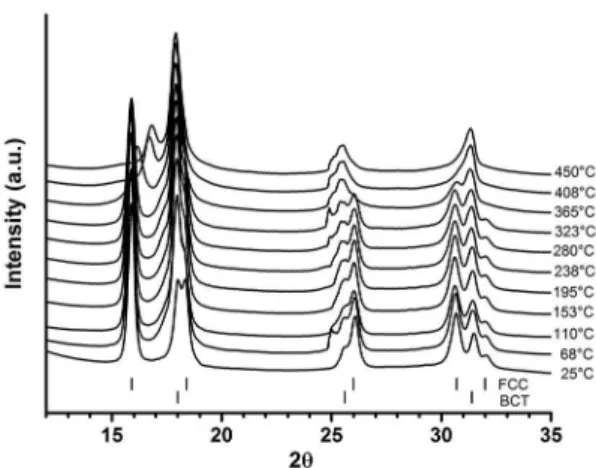
In situ desorption synchrotron analysis was performed on a hydrided sample. Dehydrogenation was performed by heating the sample at 2°C/min while continuously pumping. Figure 2 shows the difraction patterns taken at regular intervals during heating. The initial pattern taken at 25°C present two phases: the FCC (Face Centered Cubic, S. G.Fm3m) dihydride phase and a BCT monohydride phase (Body Centered Tetragonal, S.G. I4/mmm). Details of the FCC and
BCT phases are given in the paper by Nakamura et al.8.
In the present case, it should be pointed out that the lattices parameters of the BCT phase itting the pattern at 25°C are very close to each other. Actually, for all patterns, itting with the monohydride BCT phase just gave a slightly better it than itting with the fully dehydrided BCC phase (Body Centered Cubic, S.G. Im3m). The patterns were itted using the BCT phase mainly for thermodynamic reasons as the dihydride should desorbs to the monohydride8. But from the difraction patterns
Figure 2: Synchrotron radiation difraction patterns of hydrided
52Ti-12V-36Cr+4%wt. Zr7Ni10.
alone the BCT phase could not be distinguish from the BCC phase therefore, we could not claim with 100% certitude that the BCT phase is present instead of a BCC phase. Assuming a BCT phase, from Rietveld reinement we found that, at 25°C, 65 wt.% of the sample is made of FCC phase and 35 wt.% of BCT.
Table 1: Lattice parameters of the BCT and FCC phases in
52Ti-12V-36Cr+4%wt. Zr7Ni10 alloy in function of temperature as
deduced from Rietveld reinement of the synchrotron radiation
patterns. Numbers in parenthesis are one standard deviation of the
last signiicant digit.
Temperature (°C)
BCT FCC
a (nm) c (nm) a (nm)
25 0.311(1) 0.311(2) 0.43204(8)
323 0.3146(5) 0.3129(9) 0.4336(2)
365 0.318 (3) 0.317(6) 0.4321(6)
450 0.313(3) 0.313(2) 0.410(2)
3.3. Neutron difraction
Neutron difraction of 52Ti-12V-36Cr+4%wt. Zr7Ni10
presents a special peculiarity. As measured by EDX, the composition of the matrix and the one of the intergranular phase are respectively 51.2Ti-11.8V-34.8Cr-0.8Zr-1.4Ni and 50.3Ti-7.7V-30Cr-7Zr-5Ni. For neutron difraction, the scattered intensity is proportional to the weighted average of the coherent scattering length of the elements. In the present case, from the published values for Ti, V, Cr, Zr, and Ni scattering the average scattering length of the matrix and the intergranular phase are respectively -0.3389fm and 0.3479fm9. In absolute value, these two numbers are smaller
than the scattering length of vanadium (-0.3824 fm). It is well known that vanadium is ‘transparent’ to thermal neutron. This is the reason why our sample cell was made of vanadium. Therefore, the 52Ti-12V-36Cr+4%wt. Zr7Ni10 alloy is in fact a so-called ‘null matrix’ alloy and do not present any Bragg peaks in neutron difraction. This was conirmed in the present experiment but, as there is no information to be taken from these patterns, the neutron powder difractions (NPD) of the as-cast and desorbed samples are not presented here. However, a small amount of deuterium will give rise to Bragg’s peaks. Thus, doing in-situ difraction could give us information about the localisation and abundance of deuterium in the crystal structure.
Because of the ‘null matrix’ nature of this alloy, special care should be taken in the Rietveld reinement. As the scattering length of metal atoms adds up to almost zero, reining the occupation factor and the corresponding isotropic atomic temperature factors (Biso) could easily leads to unrealistic values of these parameters. Therefore, the occupation factor of the metallic atoms was ixed to the nominal values. In order to use a realistic value of Biso we used the compilation made by Peng et al.10. This compilation is only for pure
elements but it should give us the right order of magnitude for the Biso. At 27°C the Biso values for Ti(HCP), V(BCC), and Cr(BCC) are respectively 0.5261 Å2, 0.5855 Å2, and
0.2569 Å2. As the B
iso value also depends on the crystal
structure we wanted to compare with a transition metal that has a FCC phase at room temperature. In its FCC phase, iron has a Biso of 0.5710 Å2 which is much higher than the
value of 0.3328 Å2 for Fe(BCC). Thus, we are conident that
a Biso value of 0.5 Å2 could be assigned to the metal atoms
in the present FCC phase.
In the Rietveld reinements of neutron difraction patterns only the following crystal parameters were reined: Lattice parameter, crystallite size, microstrain, atomic occupation
factor and Biso of deuterium atom. As the average scattering length of the metal atoms is near zero, the occupation factor was ixed to their nominal values and only the occupation factor of deuterium was reined.
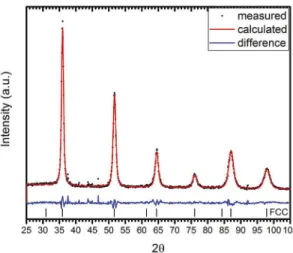
In the in-situ experiment the sample was irst exposed to 500 kPa of deuterium at room temperature. Figure 3 presents the neutron powder difraction pattern of the deuterated sample along with the corresponding Rietveld reinement. One can clearly see the difraction peaks of the dihydride FCC phase. Small peaks can be observed between 2θ = 37° and 47° but the intensities are too small to conclude with certainty on the nature of these peaks and we could not conclude that they belong to the intergranular phase. As explained previously, the bulk composition of this alloy give a neutron scattering length very close to zero. Therefore, it is not surprising to see that the intergranular phase could not be seen unless it absorbs deuterium.
Figure 3: Neutron powder diffraction patterns of hydrided 52Ti-12V-36Cr+4%wt. Zr7Ni10.
As the non-deuterided phases do not show any Bragg peaks the only way to verify that the sample is hydrided is to measure the occupation factor of the deuterium site. In the FCC phase hydrogen is located in a tetragonal site (Wickof position 8c (1/4,1/4,1/4)).
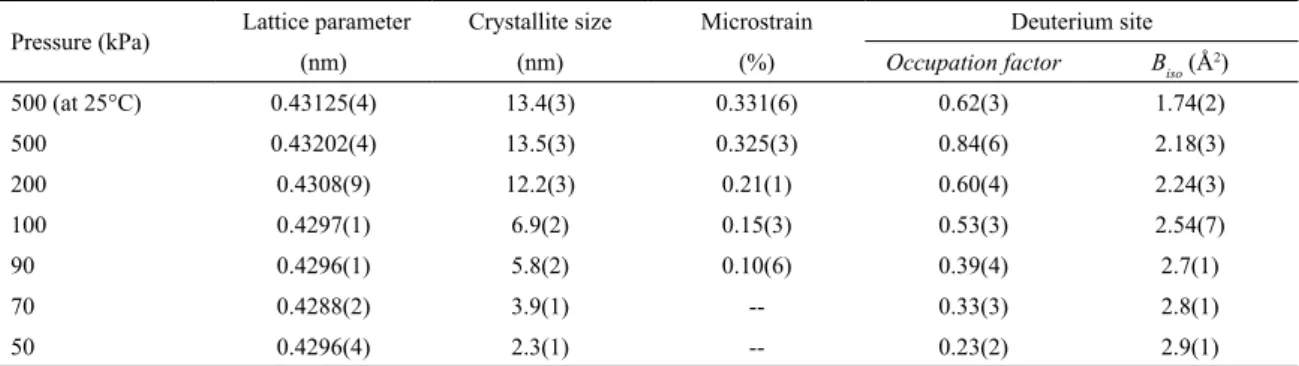
Figure 3 shows that the Rietveld reinement is quite good. The diferent R-values are displayed in Table 2 and the values of the reined crystal parameters are presented in Table 3. We see that the sample is not fully hydride as the occupation factor is only 0.62 which translate to a Ti0.506V0.117Cr0.35Zr0.011Ni0.016D1.24 composition. The reason why a full deuteration was not achieved may be because of the slow absorption kinetics at 25°C.
Table 2: R-values of Rietveld reinement displayed in Figure 3.
GOF: Goodness of it; Rexp: expected weighted proile R-factor; Rwp: weighted proile R-factor; DW: weighted Durbin-Watson.
GOF Rexp Rwp DW
1.81 2.25 4.06 1.13
Table 3: Crystallographic parameters of the FCC phase as evaluated from Rietveld reinement during dehydrogenation of
52Ti-12V-36Cr+4%wt. Zr7Ni10 alloy. All measurements are at 200°C unles stated otherwise. Numbers in parenthesis are one standard deviation of
the last signiicant digit.
Pressure (kPa) Lattice parameter Crystallite size Microstrain Deuterium site
(nm) (nm) (%) Occupation factor Biso (Å
2)
500 (at 25°C) 0.43125(4) 13.4(3) 0.331(6) 0.62(3) 1.74(2)
500 0.43202(4) 13.5(3) 0.325(3) 0.84(6) 2.18(3)
200 0.4308(9) 12.2(3) 0.21(1) 0.60(4) 2.24(3)
100 0.4297(1) 6.9(2) 0.15(3) 0.53(3) 2.54(7)
90 0.4296(1) 5.8(2) 0.10(6) 0.39(4) 2.7(1)
70 0.4288(2) 3.9(1) -- 0.33(3) 2.8(1)
50 0.4296(4) 2.3(1) -- 0.23(2) 2.9(1)
kPa of deuterium. This prevented dehydrogenation during heating. The pattern taken at 200°C under 500 kPa is shown in igure 4 and the reined parameters in Table 3.
Figure 4: In situ desorption neutron difraction of the deuterated
single-melt 52Ti-12V-36Cr+4%wt. Zr7Ni10 alloy. All difraction patterns were recorded at 200°C.
For the Rietveld reinement at 200°C the isotropic atomic temperature factor Biso of metal atoms was also kept ixed. Again, Peng et al. compilation indicated that Ti(HCP), V(BCC), and Fe(FCC) have a Biso of respectively 0.8757
Å2, 0.9744 Å2, and 0.9501 Å2. Therefore, a B
iso value of 1.0
Å2 was assigned to the metal atoms in the deuterided FCC
phase. As for the pattern at 25°C, only occupation factor and Biso of deuterium were reined.
First, comparing the reined values for the patterns at 500 kPa at 25°C and 200°C we see that the lattice parameter slightly increased with temperature which is what was expected. The crystallite size and microstrain are constant within the experimental errors but the biggest change was observed for the deuterium occupation factor which increased. This means that the sample, which was not fully deuterated at 25°C, continued to absorbs deuterium as the temperature raised. Because at 200°C the plateau pressure is still lower than 500 kPa, the sample was always under absorption conditions and thus could continue to absorb deuterium5.
It should be pointed out that we have measured the plateau
pressures using deuterium gas and they are identical to the ones measured under hydrogen and reported in a previous publication5.
The other important change is seen for the isotropic atomic temperature factor which increased from 1.75 Å2 to
2.18 Å2 when the temperature went from 25°C to 200°C.
This is also expected as the deuterium should have stronger thermal agitation on its site at higher temperature. From the Biso one could ind the mean square amplitude of atomic vibration through the relationship11.
Biso 8 r
2 2
G H
r
=
Where <r2> is the mean square amplitude of atomic
vibration. According to Westlake, a hole should have a radius of at least 0.4 Å in order to be able to accommodate a hydrogen atoms12. From the values of B
iso we found that
√<r2> is 0.148 Å at 25°C and 0.166 Å at 200°C which are
reasonable values for a deuterium atom trapped in a hole. The occupation factor of deuterium at 200°C is very close to the one obtained by Nakamura et al. for their FCC dihydride phase of Ti 0.33V0.37Mn0.38. Therefore, we could
consider that the alloy was fully deuterated. The sample was then desorbed by decreasing the deuterium pressure step by step with difraction patterns recorded at each step. The recorded patterns are presented in Figure 4. One can see that the relative intensity of the peaks decreases as the pressure decreases. For a pressure of 100 kPa a small shoulder appears on the lower angle side of the peak at 36° and grows as the pressure is lowered. The nature of this shoulder is unknown. A pattern taken at 10 kPa did not show any Bragg peaks except this broad shoulder.
contrary to the case of synchrotron radiation. Thus, it seems that the desorption mechanism may be diferent when it is induced by a temperature increase or by a pressure change. This discrepancy between desorption behavior as seen by synchrotron and neutron may be explained by the details of each experiment. In the case of synchrotron measurement, the temperature was increased relatively quickly (2°C/min) and thus the system may at one point be in a metastable phase as we see above 400°C. On the contrary, the neutron experiment was done at a much slower speed, taking many hours of equilibrium before taking a pattern. Thus the FCC was not metastable phase in this case.
4. Conclusions
In this paper we reported the analysis of desorption process in 52Ti-12V-36Cr doped with 4 wt.% Zr7Ni10. Two in-situ difraction experiments were performed: one using synchrotron radiation where a hydrided sample was heated under vacuum, the other using neutron radiation where the deuterated sample was made to release its deuterium by reducing the applied pressure. For both cases the dihydride FCC phase was monitored. We found that in the synchrotron experiment the FCC dihydride phase desorbed to a BCT monohydride phase but as the temperature increases, the FCC becomes metastable with an important reduction of its lattice parameter. At above 400°C the kinetics of dihydride → monohydride (FCC→BCT) transformation seems to be much slower than the monohydride → dehydrided (BCT→BCC) reaction and thus the FCC phase was seen to coexist with the BCC phase.
From in-situ neutron difraction we were able to precisely measure the occupation factor of deuterium and observe that the isotropic atomic temperature factor increases when the occupation factor decreases. However, we did not see any evidence of the FCC phase being metastable because the experiment was done in a much longer time-scale than the synchrotron one.
5. Acknowledgements
This work was supported in part by a Discovery grant from the Natural Sciences and Engineering Research Council of Canada (NSERC). T.B would like to thanks the Canadian Light Source (CLS) for a traveling grant.
6. References
1. Sakintuna B, Lamari-Darkrim F, Hirscher M. Metal hydride
materials for solid hydrogen storage: A review. International Journal of Hydrogen Energy. 2007;32(9):1121-1140.
2. Akiba E, Iba H. Hydrogen absorption by Laves phase related
BCC solid solution. Intermetallics. 1998;6(6):461-470. DOI: http://dx.doi.org/10.1016/S0966-9795(97)00088-5
3. Kabutomori T, Takeda H, Wakisada Y, Ohnishi K. Hydrogen absorption properties of Ti-Cr-A (A = V, Mo or other transition
metal) B.C.C. solid solution alloys. Journal of Alloys and Compounds. 1995;231(1-2):528-532. DOI: http://dx.doi. org/10.1016/0925-8388(95)01859-X
4. Bibienne T, Razaindramanana V, Bobet JL, Huot J. Synthesis, characterization and hydrogen sorption properties of a Body
Centered Cubic 42Ti–21V–37Cr alloy doped with Zr7Ni10. Journal of Alloys and Compounds. 2015;620:101-108. DOI: http://dx.doi.org/10.1016/j.jallcom.2014.08.156
5. Bibienne T, Bobet JL, Huot J. Crystal structure and hydrogen storage properties of body centered cubic 52Ti–12V–36Cr alloy doped with Zr7Ni10. Journal of Alloys and Compounds.
2014;607:251-257. DOI: http://dx.doi.org/10.1016/j.jallcom.2014.04.062 6. Hammersley AP, Svensson SO, Hanfland M, Fitch AN,
Hausermann D. Two-dimensional detector software: From
real detector to idealised image or two-theta scan. High Pressure Research. 1996;14(4-6):235-248. DOI: http://dx.doi. org/10.1080/08957959608201408
7. Bruker-AXS. TOPAS V4: General proile and structure analysis software for powder difraction data. User’s manual. Karlsruhe: Bruker-AXS; 2008.
8. Nakamura Y, Oikawa K, Kamiyama T, Akiba E. Crystal structure
of two hydrides formed from a Ti-V-Mn BCC solid solution
alloy studied by time-of-light neutron powder difraction - a NaCl structure and a CaF2 structure. Journal of Alloys and Compounds. 2001;316(1-2):284-289. DOI: http://dx.doi. org/10.1016/S0925-8388(00)01503-6
9. Sears VF. Neutron scattering lengths and cross sections.
Neutron News. 1992;3(3):26-37. DOI: http://dx.doi. org/10.1080/10448639208218770
10. Peng LM, Ren G, Dudarev SL, Whelan MJ. Debye-Waller Factors and Absorptive Scattering Factors f Elemental Crystals. Acta Crystallographica Section A: Foundations of Crystallography. 1996;52(3):456-470.
11. Giacovazzo C. The difraction of X-rays by crystals. In: Giacovazzo C, Ed. Fundamentals of crystallography. Oxford:
International Union of Crystallography texts on crystallography/ Oxford University Press; 1992.