Elizabeth FujimoriI
Ana Paula Sayuri SatoII Sophia Cornbluth SzarfarcIII
Gloria Valeria da VeigaIV
Valterlinda Alves de OliveiraV
Célia ColliVI
Regilda Saraiva dos Reis Moreira-AraújoVII
Other authors are listed at the end of the article
I Departamento de Enfermagem em Saúde Coletiva. Escola de Enfermagem (EE). Universidade de São Paulo (USP). São Paulo, SP, Brasil
II Programa de Pós-Graduação em Enfermagem. EE-USP. São Paulo, SP, Brasil III Departamento de Nutrição. Faculdade de Saúde Pública. USP. São Paulo, SP, Brasil IV Departamento de Nutrição Social Aplicada.
Instituto de Nutrição Josué de Castro. Universidade Federal do Rio de Janeiro. Rio de Janeiro, RJ, Brasil
V Departamento de Ciência da Nutrição. Escola de Nutrição. Universidade Federal da Bahia. Salvador, BA, Brasil
VI Departamento de Alimentos e Nutrição Experimental. Faculdade de Ciências Farmacêuticas. USP. São Paulo, SP, Brasil VII Departamento de Nutrição. Centro de
Ciências da Saúde (CCS). Universidade Federal do Piauí. Teresina, PI, Brasil Correspondence:
Elizabeth Fujimori
Av. Dr. Enéas Carvalho Aguiar, 419 05403-000 São Paulo, SP, Brasil E-mail: [email protected] Received: 10/6/2010 Approved: 5/17/2011
Article available from: www.scielo.br/rsp
Anemia in Brazilian pregnant
women before and after fl our
fortifi cation with iron
ABSTRACT
OBJECTIVE: To compare prevalence of anemia and hemoglobin (Hb) levels in Brazilian pregnant women before and after fl our fortifi cation with iron.
METHODS: A repeated cross-sectional panel study of public health care centers of municipalities in the five Brazilian regions was conducted. Retrospective data were obtained from 12,119 medical records of pregnant women distributed in two groups: before fortifi cation (delivery prior to June 2004) and after fortifi cation (date of last period after June 2005). Anemia was defi ned as Hb<11.0 g/dl. Hb levels according to gestational age were assessed using two references from the literature. Statistical analysis was carried out using chi-squared tests, Student’s t tests, and logistic regression, with a signifi cance level of 5%.
RESULTS: In the total sample, prevalence of anemia fell from 25% to 20% after fortifi cation (p<0.001). However, important regional differences were evident: while signifi cant reductions were seen in the Northeast (37% to 29%) and North (32% to 25%) regions, where pre-fortifi cation prevalence was high, smaller reductions were seen in the Southeast (18% to 15%) and South (7% to 6%) regions, where prevalence was low. Hb levels according to gestational age were slightly higher in the fi rst months of pregnancy and lower after the third or fourth months, depending on the reference used. Logistic regression analysis showed that group, geographic region, marital status, trimester of pregnancy, initial nutritional status, and prior pregnancy were associated with anemia (p<0.05).
CONCLUSIONS: Prevalence of anemia decreased after fortifi cation, but remains high in the North and Northeast regions. Although fortifi cation may have played a role in this favorable outcome, the contribution of other public policies implemented during the studied period should also be considered.
DESCRIPTORS: Pregnant Women. Anemia, Iron-Defi ciency. Flour. Food, Fortifi ed. Prenatal Care.
INTRODUCTION
Iron defi ciency anemia is the most prevalent nutritional defi cit globally. Although it affects all social strata and geoeconomic areas, it is associated with inadequate social and environmental conditions.3,11
Pregnant women are especially susceptible to iron defi ciency anemia due to the increased iron requirements associated with rapid expansion of fetal tissues and production of red blood cells.20 The World Health Organization (WHO)
that frequency of anemia in the country is in the order of 30% to 40%.3 A recent review6 of articles published
since the 1970’s indicates that the available information on pregnancy-related anemia is scarce and shows wide geographical variability. However, the prevalences reported in this study are high.6
The deleterious consequences of pregnancy-related anemia include greater maternal and perinatal mortality, greater risk of preterm birth, and lower hemoglobin (Hb) levels in the newborn.
As an attempt to minimize the effects of anemia on mother and child health, the Ministry of Health has recommended iron supplementation in the second half of pregnancy since the 1980’s, and, in 2005, imple-mented the National Program for Iron Supplementation, which reinforces this recommendation.a Despite the
apparent simplicity of this measure its effectiveness tends to be limited by a number of political, adminis-trative, and planning/management factors, in addition to the interest and motivation of the pregnant woman herself. The adverse side effects of iron supplemen-tation also affect adherence. These include nausea, vomiting, diarrhea, constipation, and abdominal pain.20
When a large fraction of the population is at high risk of becoming defi cient for a specifi c micronutrient, universal food fortifi cation is considered as the best alternative for intervention, as a complement to other strategies also aimed at improving the nutritional status of the population.24 Given the high and widespread
prevalence of anemia across all social strata in Brazil, the federal government, in response to international recommendations and political will to minimize the effects of anemia among public health issues in the country, instituted the mandatory fortifi cation of wheat and corn fl our with iron,b which was implemented in
July 2004. This strategy provides the highly promising perspective of a complementary source of iron to maintain adequate Hb levels and build iron reserves for periods of greater vulnerability.
Although a number of quasi-experimental studies carried out in Brazil have provided evidence of the effi cacy of fl our fortifi cation in controlling anemia in children,2,4,9,12,17,22 only very few studies evaluate the
impact of nutritional programs in the fi eld.
Thus, the aim of the present study was to compare prevalence of anemia and Hb levels among pregnant women before and after fl our fortifi cation with iron.
a Ministério da Saúde, Secretaria de Atenção à Saúde, Departamento de Atenção Básica. Manual operacional do Programa Nacional de Suplementação de Ferro. Brasília (DF); 2005.
b Ministério da Saúde, Agência Nacional de Vigilância Sanitária. Regulamento técnico para a fortifi cação das farinhas de trigo e das farinhas de milho com ferro e ácido fólico. Resolução RDC nº 344, de 13 de dezembro de 2002. Diario Ofi cial Uniao, 18 dez 2002. [cited 3008 Jul 15]. Available from: http://e-legis.anvisa.gov.br/leisref/public/showAct.php?id=1679&word=RDC
c Ministério da Saúde. Pré-natal e puerpério: atenção qualifi cada e humanizada - manual técnico. Brasília (DF): Ministério da Saúde; 2005. METHODS
This collaborative study, designed to evaluate the intervention using repeated cross-sectional panels, was carried out within public prenatal care services in 13 municipalities of the fi ve Brazilian geographical regions: Northeast (Teresina, Recife, Salvador), North (Rio Branco, Belém, Manaus), Central-West (Cuiabá), Southeast (São Paulo, São Bernardo do Campo, Viçosa, Rio de Janeiro) and South (Maringá and Curitiba).
Retrospective data were obtained from medical records of pregnant women attending these facilities, divided into two groups: pre-fortifi cation, comprising women who delivered before June/2004, and post-fortifi ca-tion, formed by women with date of last period after June/2005, at least one year after the implementation of the fortifi cation strategy.
The minimum sample size for each group in each study site was calculated using the formula n=Zα2PQ/
d2, where n=minimum sample size; Z=confidence
coeffi cient, which was set at 1.96 for an alpha of 0.05; P=prevalence; Q=complement of the prevalence (Q=1-P); and d=maximum error in absolute terms. Since there are no consistent estimates of the prevalence of anemia among Brazilian pregnant women, we assumed P=0.50, equivalent to the highest relationship between P and Q, and a precision of d=5%. This yielded a sample size of n=1.962*0.50*0.50/0.052=384 women per group per
study site. The fi nal sample comprised 12,119 women, 6,062 in the pre-fortifi cation group and 6,057 in the post-fortifi cation group.
Data collection took place between 2006 and 2008 and included only low-risk pregnant women whose medical records included at least the Hb result and the date of fi rst prenatal care visit, last period, and Hb testing. Sociodemographic data (age, education, marital status) and gynecological/obstetric and prenatal care history (weight and height at fi rst visit, and number of previous pregnancies and prenatal care visits) were also obtained when available. Initial nutritional status was classifi ed based on the woman’s body mass index according to gestational age.c
Hb level data referred to the test performed at the time of the woman’s fi rst prenatal care visit. This was true also for women who began prenatal care during the second or third trimesters. We assumed that these women had not been oriented to use supplementation, which is recommended beginning at the 20th week of
Gestational age at the time of Hb testing was calculated based on the date of last period and of the blood test. Pregnant women with Hb<11.0 g/dL were considered anemic.23
Taking into account the diffi culty in diagnosing anemia during pregnancy due to hemodilution,20 Hb values
were evaluated according to gestational age, based on two different curves, published by the Centers for Disease Control and Prevention (CDC)5 and by Szarfarc
et al.21 The reason for using two references was the fact
that the CDC curve5 is constructed based on European
studies of pregnant women who received iron supple-mentation, which allows for comparisons of our data with those of other studies in the international literature, while the curve by Szarfarc et al21 is constructed based
on data obtained from healthy but non-supplemented Brazilian pregnant women, and thus represents a setting closer to that of our sample.
We used SPSS version 11.0 software for data analysis. Anemia was defined as the dependent variable. Independent variables included group (pre- and post-fortifi cation); geographic region; age (<20 and ≥20 years); education (elementary and secondary/univer-sity); gestational trimester (I=1-13 weeks, II=14-27 weeks, III=28 weeks or more); initial nutritional status (underweight, adequate weight, overweight/obese); number of previous pregnancies (<2 and ≥2) and of prenatal visits (<6 and ≥6). Results were described using proportions and means, and independent variables associated with the occurrence of anemia were analyzed using the chi-square and Student’s t tests.
Adjustment for potential confounders was done by logistic regression. To avoid the exclusion of poten-tially important variables, all variables associated with the outcome at p<0.20 were included in multiple analysis. The introduction of each variable in the model was ordered by statistical signifi cance, meaning that variables with lower p-values were introduced fi rst. To identify associations, we used a signifi cance threshold of 5% (p<0.05). The strength of the associa-tion between dependent and independent variables was evaluated using odds ratios (OR) both in univariate (crude OR) and multiple (adjusted OR) analysis. The
Hosmer & Lemeshow test was used to determine goodness-of-fi t.
The present study was approved by the Research Ethics Committee of the Universidade de São Paulo School of Nursing (Process no. 521/2006).
RESULTS
At least one year after the effective implementation of fortification, prevalence of anemia fell by 5.3 percentage points in the sample as a whole, a difference which was statistically signifi cant (p<0.001) (Figure 1). However, there were important differences between regions. Signifi cant reductions after fortifi cation were detected both in regions in which initial prevalence was high, such as the Northeast (37.4% to 28.7%) and North (32.2% to 24.9%), and in those in which initial prevalence was lower, such as the Southeast (18.3% to 14.8%).
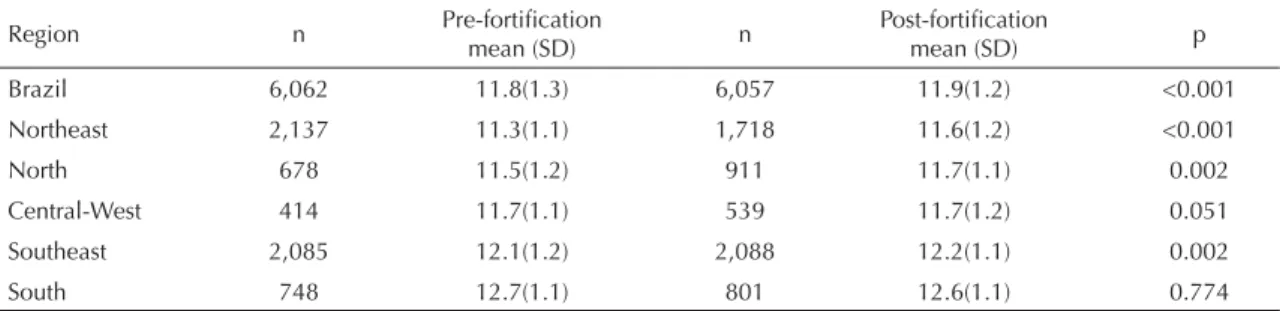
Mean Hb levels were also signifi cantly higher after fortifi cation, both in the sample as a whole (p<0.001) and in the Northeast (p<0.001), North, and Southeast (p=0.002) regions (Table 1).
Based on the CDC reference, Hb levels by gestational age in both groups were slightly higher during the fi rst months of pregnancy, but lower after the fourth month (Figure 2). The same was initially true using as a basis the curve by Szarfarc et al, but after the third month of pregnancy mean Hb in the studied sample conformed to the curve.
Crude analysis of prevalence of anemia showed it to be associated (p<0.20) with the following variables: group (pre- and post-fortifi cation), geographic region, marital status, age, education, trimester of pregnancy, number of prenatal care visits, initial nutritional status, and number of previous pregnancies. In multiple analysis, the selected variables remained signifi cantly associ-ated with the occurrence of anemia when compared to the reference category, with the exception of age, education, and number of prenatal care visits (Table 2).
Table 1. Mean (standard deviation) hemoglobin level before and after fl our fortifi cation. Brazil, 2002-2008.
Region n Pre-fortifi cation
mean (SD) n
Post-fortifi cation
mean (SD) p
Brazil 6,062 11.8(1.3) 6,057 11.9(1.2) <0.001
Northeast 2,137 11.3(1.1) 1,718 11.6(1.2) <0.001
North 678 11.5(1.2) 911 11.7(1.1) 0.002
Central-West 414 11.7(1.1) 539 11.7(1.2) 0.051
Southeast 2,085 12.1(1.2) 2,088 12.2(1.1) 0.002
DISCUSSION
For the sample as a whole (Brazil), prevalence of anemia was high, both before and after fl our fortifi -cation. However, this was lower than the previously estimated 30% to 40% prevalence of anemia among Brazilian pregnant women.3 This degree of prevalence
is considered as moderate epidemiological impor-tance, as defi ned by the WHO (prevalence of anemia in pregnant women and schoolchildren between 20% and 40%).23 Important regional differences persist, as
reported in other studies in the literature.6,11 Whereas
prevalence was moderate in the North, Northeast, and Central-West regions, prevalence in the South and Southeast was low. Mean Hb levels were also signifi -cantly higher in the post-fortifi cation group, both for the sample as a whole and for the Northeast, North, and Southeast regions.
Our results show that anemia prevalence was signifi -cantly lower after fortifi cation in all regions except the Central-West. Prevalence in the entire sample fell by 5.3%; however, in regions with higher prevalence, reductions were more marked: 8.7% in the Northeast, 7.3% in the North, 3.5% in the Southeast, and 1.3% in the South. In the Central-West, differences in some of the sociodemographic characteristics of the studied group may partly explain the increase in prevalence of anemia. Specifi cally, the post-fortifi cation group contained a higher proportion of adolescents and women without a partner. However, these differences were controlled in logistic regression analysis, that is, marital status, which remained as a signifi cant predictor was included in the multiple model as a control vari-able, prevalence of anemia therefore being adjusted for its effect.
A survey carried out in 2002 found that 31 countries in Latin America and the Caribbean had the necessary legislation in place to ensure the fortifi cation of wheat and corn fl our with micronutrients, including iron.8 In
Brazil, although this measure was effectively imple-mented starting in July 2004, the Brazilian fortifi cation program still lacks a regulatory foundation and proce-dures for monitoring and evaluating effectiveness, so as to provide information on the achievements of the program’s goals. Evaluating the effect of the program is indispensable to allow for improvements in the current legislation.
Theoretically, programs and interventions targeting diseases should be evaluated with respect to goals determined a priori, during the planning stages. Certain designs are recommended in order to better evaluate the impact of interventions.13 However, if the frequency of
the event prior to the implementation of the program is known, simply conducting a post-implementation survey allows one to evaluate its effectiveness.
In the case of anemia among pregnant women, prior studies are scarce, geographically localized, and based on small, restricted samples.6 Thus, the inexistence
of solid data on anemia prior to the implementation of fl our fortifi cation prevented us from carrying out a simple post-implementation survey to evaluate the results of the fortifi cation strategy. The evaluation of repeated cross-sectional panels used as a baseline the levels found prior to implementation.
Interventions such as food fortifi cation yield results in the long term. However, experience shows that posi-tive effects are larger and occur faster the greater the physiological need for the effects of the intervention.23
The choice of pregnant women to assess the effect of
Figure 1. Prevalence of anemia among pregnant women (%), before and after fl our fortifi cation. Brazil, 2002-2008.
Brazil Northeast North Central-West Southeast South
<0.001 P-value:
Pre-fortification Post-fortification
<0.001 0.002 0.058 0.002 0.383
%
40.0
35.0
30.0
25.0
15.0
10.0
5.0
0.0 20.0
5.7 7.0 14.8
18.3 22.2
27.8 24.9
32.2 28.7
37.4
fortifi cation is therefore justifi ed, since this is the group which has the highest demand for iron. Moreover, the study could only be carried out because the Brazilian health care system ensures prenatal care to all pregnant women within public services, and includes Hb testing as one of the recommendations for the fi rst prenatal care visit.c However, hematological alterations
asso-ciated with pregnancy complicate the evaluation of anemia in this period,20 and therefore Hb levels were
measured according to gestational age and compared with Brazilian and international curves.
In the present study, data were obtained from medical records. This can be regarded as a limitation given the quality of this information, which is not always
standardized. However, use of secondary data allowed for an assessment of a large number of cases (12,119 pregnant women attending public health care facilities). Thus, it was possible to carry out a baseline survey of anemia in pregnant women and to determine its evolu-tion at least one year after the effective implementaevolu-tion of fl our fortifi cation.
A bibliographical survey of studies published since the 1970’s found that most studies of anemia prevalence in pregnant women in Brazil were carried out in the state of São Paulo, and that their results classify prevalence of anemia as moderate to severe.6 This suggests that
the problem may be even greater in states that are less
Table 2. Crude and adjusted analysis of the occurrence of anemia and its predictors, logistic regression model. Brazil, 2002-2008.
Variable N Anemia
n(%) p*
Univariate Multiple
OR Crude 95%CI OR Adjusted* * 95%CI
Group < 0.001
Pre-fortifi cation 6,062 1,554(25.5) 1 - 1
-Post-fortifi cation 6,057 1,224(20.2) 0.74 0.68;0.81 0.84 0.72;0.98
Geographic region < 0.001
Northeast 3,855 1,293(33.5) 1 - 1
-North 1,589 445(28.0) 0.77 0.68;0.88 0.92 0.69;1.22
Central-West 953 242(25.4) 0.67 0.57;0.79 1.09 0.78;1.52
Southeast 4,173 690(16.5) 0.39 0.35;0.44 0.70 0.56;0.89
South 1,549 98(6.3) 0.13 0.11;0.17 0.25 0.18;0.34
Marital status 0.001
Partner 5,820 1,336(23.0) 1 - 1
-No partner 2,925 766(26.2) 1.19 1.07;1.32 1.51 1.28;1.77
Age (years) < 0.001
<20 2,732 699(25.6) 1
-≥20 9,271 2,045(22.1) 0.82 0.75;0.91
Education < 0.001
Elementary 5,045 1,010(20.0) 1
-Secondary/University 3,942 1,012(25.7) 1.38 1.25;1.52
Trimester of pregnancy < 0.001
I 5,096 582(11.4) 1 - 1
-II 5,358 1,529(28.5) 3.10 2.79;3.44 2.87 2.38;3.46
III 1,665 657(39.5) 5.05 4.43;5.76 4.08 3.19;5.23
Number of prenatal care visits < 0.001
<6 1,895 397(20.9) 1
-≥6 2,668 351(13.2) 0.57 0.49;0.67
Initial nutritional status < 0.001
Underweight 2,080 591(28.4) 1 - 1
-Adequate weight 3,553 712(20.0) 0.63 0.56;0.72 0.79 0.66;0.94
Overweight/obesity 1,735 226(13.0) 0.38 0.32;0.45 0.42 0.42;0.66
Previous pregnancies < 0.001
2 5,553 931(16.8) 1 - 1
->2 3,088 708(22.9) 1.48 1.32;1.65 1.61 1.36;1.91
developed and have less access to health care services. The results of the present study, when analyzed by region, confi rm this possibility.
In addition to the social, economic, and cultural differ-ences between the Brazilian regions, there are also differences in the quality of prenatal care. While only 1.4% of mothers in the South and Southeast do not have access to prenatal care, over half of them having seven or more visits, in the North, 6.4% of births occur without prenatal care, and only 28% of women have seven or more visits.d
Despite the positive experiences with food fortifi ca-tion reported in North America and Western Europe, iron defi ciency continues to be a public health issue in certain population groups in these countries – such as women reproductive age with excessive menstrual blood loss and pregnant women – who cannot fulfi ll their large requirement for the mineral only through dietary intake.19
Few population-based studies have been carried out to measure the effect of fortifi cation, most of which among children. The most compelling data refers to studies of
the fortifi cation of infant formula in the United States, which reduced anemia prevalence from 7.8% in 1975 to 2.9% in 2984 among low-income children under age two years.19 In Venezuela, where wheat and corn fl our
fortifi cation was implemented in 1993, a study carried out with a small group of children showed a reduction from 37% to 15% in prevalence of iron defi ciency and from 19% to 10% in prevalence of anemia.15
In Mexico, fl our fortifi cation with iron contributed towards a reduction in prevalence of anemia from 27.5% to 7.7% among preschool children and from 18.5% to 7.6% among schoolchildren.14 In Chile, iron
defi ciency anemia was controlled by a national program for the fortifi cation of fl our with iron which began in the 1950’s. This strategy, complemented by fortifi ca-tion of milk, reduced prevalence of anemia from 29% to 9% among children under two years of age, although prevalence is still 20% among pregnant women in the second and third trimesters of pregnancy.18
In Brazil, evaluations of fl our fortifi cation, also carried out mostly among children, show discrepant results. In Pelotas, Southern Brazil, in spite of the high prevalence of anemia (30.2% to 41.5%), no effect of fortifi cation
Figure 2. Mean hemoglobin level among pregnant women before and after fl our fortifi cation, according to CDC5 (1989) and
Szafarc et al21 (1983) parameters and gestational age (months). Brazil, 2002-2008.
Hb (g/dL)
Hb (g/dL)
Gestational age (months) 13.50
13.00
12.50
12.00
11.50
11.00
10.50
10.00
1 2 3 4 5 6 7 8 9
Gestational age (months)
Pre-fortification Post-fortification CDC Szarfarc et al. 13.50
13.00
12.50
12.00
11.50
11.00
10.50
10.00
1 2 3 4 5 6 7 8 9
was detected among children under six years of age, which was justifi ed partially by the insuffi cient intake of fl our and/or by the low bioavailability of the iron added as a supplement.1 However, children aged 24-60 months
seen at child education centers in the city of São Paulo evaluated after fl our fortifi cation showed signifi cantly lower prevalence of anemia when compared to prior studies conducted in the same region, allowing the authors to suggest that the iron supplements contained in fortifi ed foods have had a positive effect.7
There are practically no studies of the impact of food fortifi cation on pregnant and reproductive-age women. One example is the reduction in the prevalence of anemia among Swedish reproductive-age women, from 25% in the 1960’s to 7% in the following decade.19 In
Brazil, there no nationwide data is available on the prev-alence of anemia in women of reproductive age prior to fl our fortifi cation. However, the Pesquisa Nacional de Demografia e Saúde da Criança e da Mulher
(PNDS, National Survey of Health and Demographics of Children and Women), carried out in 2006,e that is,
two years after the effective implementation of fl our fortifi cation, found high prevalence of anemia (29.4%). As for pregnant women, a single study carried out in a prenatal care facility within university hospitalf found
a signifi cant reduction in frequency of anemia, from 28.9% to 7.9% one year after the implementation of fortifi cation. According to Côrtes, although variables that were not investigated could have contributed towards such a result, mandatory fortifi cation was essential given the fi nding of a signifi cant increase in iron intake after fortifi cation.
In the present study, pregnant women in both groups started pregnancy with Hb levels that were higher than reference values. However, in the second half of preg-nancy, Hb values fell below CDC parameters.5 Such
a difference may be related to supplementation, since our subjects had not yet been given iron sulfate supple-mentation at the time of Hb testing. The fi nding that the curve in our sample followed the reference by Szarfarc et al21 after the third month of pregnancy corroborates
the previous hypothesis, since the latter curve was built on data obtained from Brazilian pregnant women not under iron supplementation. This reiterates the importance of pharmacological supplementation for the maintenance of normal Hb levels.
Regarding the determinants of anemia, pregnant women in the post-fortifi cation group were 16% less likely to be anemic. Theoretically, this result was expected, in light of the positive experiences obtained with iron fortifi cation in industrialized nations.19
Almost half of the pregnant women underwent Hb testing during the fi rst trimester of pregnancy, a period in which expansion of volemia and increased need for iron by fetus and placenta are not yet signifi cant.20 This
justifi es the fi nding that pregnant women in the fi rst trimester are at lower risk of becoming anemic, given that the same cutoff level of Hb was used for diagnosis. In addition to advanced gestational age, other variables associated with anemia were low initial weight and two prior pregnancies, which are in agreement with the results of other investigations.10
Women without a partner were 50% more likely to be anemic than those with a partner, and women from the Southeast and South regions were 30% and 75% less likely to be anemic than those from the Northeast. Results from the PNDS surveye show that the North
and Northeast concentrate the worst living conditions in the country, in spite of the migration of a proportion of the very poor population to higher classes and of the benefi ts brought by social programs.
Social insertion infl uences access to food, nutritional education, and the quality of the diet. Therefore, occur-rence of anemia is still linked to adverse social and economic conditions, be it through qualitative or quanti-tative defi ciencies in diet, or through the precariousness of environmental sanitation, a condition that is typical of areas inhabited by the lower social classes in Brazil.16
It is therefore important to emphasize the point that prevention and control of anemia must follow an integrated, multidisciplinary and long-term approach, in coordination with other nutritional and health care programs and with other sectors of society, taking the form of an intersectorial nutritional intervention policy. Furthermore, a permanent monitoring system is indis-pensible to identify the evolution of the anemia problem in response to the various strategies that are implemented. A practical and effi cient way to monitor this would be to include this data in the Brazilian health information system, so as to allow for adequate follow-up of pregnant women enrolled in the Programa de Humanização no
Pré-Natal e Nascimento (SISPRENATAL, Program for
Humanization of Prenatal and Delivery Care), of the Brazilian National Health Care System.
Prevalence of anemia remains high in the Northeast, North, and Central-West regions. However, the reduc-tion in prevalence in the sample as a whole suggests that food fortifi cation is an important approach. It should be noted that variables that were not investi-gated – including macroeconomic policies and other public policies that were expanded in the period,
e Ministério da Saúde. Pesquisa Nacional de Demografi a e Saúde da Criança e da Mulher - PNDS 2006: dimensões do processo reprodutivo e da saúde da criança. Brasília (DF); 2009.
1. Assunção MCF, Santos IS, Barros AJD, Gigante DP, Victora CG. Efeito da fortifi cação de farinhas com ferro sobre anemia em pré-escolares, Pelotas, RS. Rev Saude Publica. 2007;41(4):539-48. DOI:10.1590/S0034-89102006005000031
2. Bagni UV, Baião MR, Santos MMAS, Luiz RR, Veiga GV. Efeito da fortifi cação semanal do arroz com ferro quelato sobre freqüência de anemia e concentração de hemoglobina em crianças de creches municipais do Rio de Janeiro, Brasil. Cad Saude Publica. 2009;25(2):291-302. DOI:10.1590/S0102-311X2009000200007
3. Batista Filho M, Souza AI, Bresani CC. Anemia como problema de saúde pública: uma realidade atual. Cienc Saude Coletiva. 2008;13(6):1917-22. DOI:10.1590/S1413-81232008000600026
4. Beinner MA, Lamounier JA, Tomaz C. Effect of iron-fortifi ed drinking water of daycare facilities on the hemoglobin status of young children. J Am Coll Nutr. 2005;24(2):107-14.
5. Centers for Diseases Control and Prevention. Current trends CDC criteria for anemia in children and childbearing-aged women. MMWR Morb Mortal Wkly Rep. 1989;38(22):400-4.
6. Côrtes MH, Vasconcelos IAL, Coitinho DC. Prevalência de anemia ferropriva em gestantes brasileiras: uma revisão dos últimos 40 anos. Rev Nut. 2009;22(3):409-18. DOI:10.1590/S1415-52732009000300011
7. Costa CA, Machado EH, Colli C, Latorre WC, Szarfarc SC. Anemia em pré-escolares atendidos em creches de São Paulo (SP): perspectivas decorrentes da fortifi cação das farinhas de trigo e de milho. Nutrire Rev Soc Bras Aliment Nutr. 2009;34(1):59-74.
8. David LFJ. Fortifi cación de harina de trigo en América Latina y región del Caribe [carta ao editor]. Rev Chil Nutr. 2004;31(3):336-47. DOI:10.4067/S0717-75182004000300009
9. Dutra-de-Oliveira JE, Marchini JS, Desai I. Fortifi cation of drinking water with iron: a new strategy for combating iron defi ciency in Brazil. Am J Clin Nutr. 1996;63(4):612-4.
10. Ferreira HS, Moura FA, Cabral Júnior CR. Prevalência e fatores associados à anemia em gestantes da região semi-árida do Estado de Alagoas. Rev Bras Ginecol Obstet. 2008;30(9):445-51. DOI:10.1590/S0100-72032008000900004
11. Fujimori E, Sato APS, Araújo CRMA, Uchimura TT, Porto ES, Brunken GS et al. Anemia em gestantes de municípios das regiões Sul e Centro-Oeste do Brasil. Rev Esc Enferm USP. 2009;43(Spec No 2):1204-9. DOI:10.1590/S0080-62342009000600011
12. Giorgini E, Fisberg M, de Paula RA, Ferreira AM, Valle J, Braga JA. The use of sweet rolls fortifi ed
with iron bis-glycinate chelate in the prevention of iron defi ciency anemia in preschool children. Arch Latinoam Nutr. 2001;51(1 Suppl 1):48-53.
13. Habicht JP, Victora CG, Vaughan JP. Evaluation designs for adequacy, plausibility and probability of public health programme performance and impact. Int J Epidemiol. 1999;28(1):10-8. DOI:10.1093/ije/28.1.10
14. Jyväkorpi SK, Martínez H, Pineda A, Pizarro S, Monárrez-Espino J. Iron nutrition in
schoolchildren of western Mexico: the effect of iron fortifi cation. Ecol Food Nutr. 2006;45(6):431- 47. DOI:10.1080/03670240600985233
15. Layrisse M, Chaves JF, Mendez- Castellano H, Bosch V, Tropper E, Bastardo B, et al. Early response to the effect of iron fortifi cation in the Venezuelan population. Am J Clin Nutr. 1996;64(6):903-7.
16. Martins IS, Alvarenga AT, Siqueira AAF, Szarfarc SC, Lima FD. As determinações biológica e social da doença: um estudo de anemia ferropriva. Rev Saude Publica. 1987;21(2):73-89. DOI:10.1590/S0034-89101987000200003
17. Miglioranza LHS, Matsuo T, Caballero-Córdoba GM, Dichi JB, Cyrino ES, Oliveira IBN, et al. Effect of long-term fortifi cation of whey drink with ferrous bisglycinate on anemia prevalence in children and adolescents from deprived areas in Londrina, Paraná, Brazil. Nutrition. 2003;19(5):419-21. DOI:10.1016/ S0899-9007(02)00933-4
18. Olivares M, Pizarro F, Hertrampf E, Walter T, Arredondo M, Letelier A. Fortifi cación de alimentos con hierro en Chile. Rev Chil Nutr. 2000; 27(3):340-4.
19. Ramakrishman U, Yip R. Experiences and challenges in industrialized countries: control of iron defi ciency in industrialized countries. J Nutr. 2002;132(4 Suppl):820S-4S.
20. Souza AI, Batista Filho M, Ferreira LOC. Alterações hematológicas e gravidez. Rev Bras Hematol Hemoter. 2002;24(1):29-36. DOI:10.1590/S1516-84842002000100006
21. Szarfarc SC, Siqueira AAF, Martins IS. Avaliação da concentração de ferro orgânico em uma população de grávidas. Rev Saude Publica. 1983;17(3):200-7. DOI:10.1590/S0034-89101983000300002
22. Vítolo MR, Aguirre ANC, Kondo MR, Giuliano Y, Ferreira N, Lopez FA. Impacto do uso de cereal adicionado de ferro sobre níveis de hemoglobina e a antropometria em pré-escolares. Rev Nutr. 1998;11(2):163-71. DOI:10.1590/S1415-52731998000200007
23 World Health Organization. Iron defi ciency anaemia: assessment, preventing, and control: a guide for programme managers. Geneva; 2001.
REFERENCES
such as the Estratégia Saúde da Família and the
Bolsa-Família – may have contributed towards such
an improvement. It is recommended, therefore, that
Authors (continuation):
Ilma Kruze Grande de Arruda (Departamento de Nutrição. Centro de Ciências da Saúde. Universidade Federal de Pernambuco.
Recife, PE, Brasil); Taqueco Teruya Uchimura (Departamento de Enfermagem. Centro de Ciências da Saúde. Universidade Estadual de Maringá. Maringá, PR, Brasil); Gisela Soares Brunken (Departamento de Saúde Coletiva. Instituto de Saúde Coletiva. Universidade Federal do Mato Grosso. Cuiabá, MT, Brasil); Lucia Kiyoko Ozaki Yuyama (Instituto Nacional de Pesquisas da Amazônia. Manaus, AM, Brasil); Pascoal Torres Muniz (Departamento de Ciências da Saúde e Educação Física. Centro de Ciências da Saúde e do Desporto. Universidade Federal do Acre. Rio Branco, AC, Brasil); Silvia Eloiza Priore (Departamento de Nutrição e Saúde. Centro de Ciências Biológicas e da Saúde da Universidade Federal de Viçosa. Viçosa, MG, Brasil); Maria Alice Tsunechiro (Departamento de Enfermagem em Saúde Materno-Infantil e Psiquiátrica. Escola de Enfermagem. USP. São Paulo, SP, Brasil);
Andréa das Graças Ferreira Frazão (Departamento de Nutrição. Faculdade de Nutrição. Universidade Federal do Pará. Belém, PA,
Brasil); Cynthia R Matos Silva Passoni (Curso de Nutrição. Faculdades Integradas do Brasil. Curitiba, PR, Brasil); Claudia Regina
Marchiori Antunes Araújo (Programa de Pós-Graduação em Enfermagem. Escola de Enfermagem. USP. São Paulo, SP, Brasil).
Research supported by Conselho Nacional de Desenvolvimento Científi co e Tecnológico (CNPq –Process no. 402295/2005-6). The authors declare that there are no confl icts of interests.
24. World Health Organization. Guidelines on food fortifi cation with micronutrients. Geneva; 2006.