AID S epidemic trends after
the introduction of
antiretroviral therapy in Brazil
ABSTRACT
OBJECTIVE: Universal access to antiretroviral therapy starting from 1996 has
changed HIV/AIDS epidemic profile in Brazil. The objective of this study was to review the epidemiology of HIV/AIDS epidemic in Brazil.
METHODS: Indicators of temporal trends were developed for Brazilian regions
from 1990 to 2003 using the Ministry of Health’s databases. Exponential regression models adjusted to the 1990-1996 trends were used to estimate expected values for the entire period.
RESULTS: The proportion of AIDS hospitalizations has not changed over the
study period but there was a decrease in hospitalizations among those using therapy. There was a 2.7 growth in those receiving Highly Active Anti-Retroviral Therapy (HAART) from 1997 to 2003. HIV/AIDS incidence and mortality rates rose up to 1995 in all regions. From 1996, there has been a gradual reduction in mortality rates while incidence rates have increased. In all regions, except in the Northern region, expected incidence rates have been greater than the observed ones in the last years but these differences were statistically significant only in the Southeastern and Midwestern regions.
CONCLUSIONS: The observed trend can be explained by universal access to ARV
therapy in Brazil, which had a significant impact on HIV/AIDS mortality. But other factors, such as years of epidemic, prevention actions, knowledge on HIV/AIDS, years of schooling, need to be considered as well.
KEYW O RD S: Acquired immunodeficiency syndrome, prevention & control. Acquired immunodeficiency syndrome, trends. H ighly Active Anti-Retroviral Therapy (H AART). Brazil.
Inês D ouradoI
M aria Amélia de S M VerasII
D ráurio BarreiraIII
Ana M aria de BritoIV
I Instituto de Saúde Coletiva. Universidade
Federal da Bahia. Salvador, BA, Brasil
I I Departamento de Medicina Social.
Faculdade de Ciências Médicas da Santa Casa de São Paulo. São Paulo, SP, Brasil
I I IInstituto de Saúde. Secretaria Estadual de
Saúde. São Paulo, SP, Brasil
I V Centro de Pesquisas Aggeu Magalhães.
Fundação Oswaldo Cruz. Recife, PE, Brasil
Correspondence:
Inês Dourado
Instituto de Saúde Coletiva/UFBA Rua Basílio da Gama s/n Campus do Canela 40110-140 Salvador, BA, Brasil
INTRODUCTION
The introduction of Highly Active Anti-Retroviral Therapy (HAART) allied to prevention and control actions against the acquired immunodeficiency vi-rus (HIV) and other sexually transmitted diseases have changed the HIV/AIDS epidemic profile.
While reverse transcriptase inhibitors have been used in AIDS treatment since 1987, significant advances in HAART have been only possible through studies elucidating HIV infection immunopathogenesis.3,4,7
Declining trends in HIV/AIDS morbimortality have been seen in development countries even before HAART introduction attributed to prophylaxis and better clinical management of opportunistic infec-tions. However, the advent of protease inhibitors has reinforced this trend.14
Brazil was one of the first developing countries to ensure universal free access to ARV drugs through the Brazilian Unified Health System (SUS) available since 1996. A major strategy of the ARV Access Pro-gram created by the National ProPro-gram for STD/AIDS (PN-DST/AIDS) was establishing consensual techni-cal recommendations for antiretroviral therapy by consulting committees (Law 9.313/96). The health care program for those living with HIV/AIDS also includes other actions aiming at reducing hospital admissions by providing specialized outpatient care, day hospital, and home care.
All these strategies to halt the epidemic advance have been built on the involvement of the organized soci-ety and federal and state authorities as well as in-creasing involvement of local authorities.1
In the case of Brazil the question to be raised is whether, given the gaps between and within differ-ent country regions, the aforemdiffer-entioned initiatives have had a similar impact to that seen in developed countries with respect to reducing HIV/AIDS cases
and mortality, opportunistic infections, and hospital admissions. To better describe changes in the HIV/AIDS epidemic profile in Brazil taking into consideration regional differences data review is required. This re-view intends to contribute to the evalua-tion of HIV/AIDS prevenevalua-tion and control actions and the direction of new interven-tions in Brazil.
The present study had the purpose of evalu-ating the epidemiology of HIV/AIDS epide-mic in Brazil. An analysis of time progress, trends, and disease distribution was carried out by country regions, gender, and exposure cat-egory based on data available from the Brazilian Ministry of Health. HAART impact on HIV/AIDS morbimortality was also assessed for the period be-tween 1990 and 2003.
M ETH O D S
The study was conducted based on the analysis of secondary information on HIV/AIDS epidemic in Brazil from the following government databases: DATASUS, National Disease Surveillance Data Sys-tem (SINAN), Mortality Information SysSys-tem (SIM), AIDS Epidemiological Bulletin, and National Pro-gram for STD/AIDS monitoring system (MONITORAIDS).20
The temporal trend analysis of AIDS cases for the years between 1990 and 2002, and deaths occurring two years after disease diagnosis included estimates of incidence and mortality rates for all Brazilian re-gions and by gender.
Exponential regression models adjusted to the 1990-1996 time series, a time period before universal ac-cess to HAART, allowed to estimate expected rates for the entire time series and, more importantly, to compare expected and observed rates for the period between 1997 and 2003. That is to say, what would have happened in the time series if prevention and control actions would have been the same as in the years before 1997 throughout the entire epidemic.
RESU LTS AN D D ISCU SSIO N
Review of AIDS epidemiology in Brazil
Among Latin American countries, Brazil is the most affected by AIDS epidemic in absolute numbers. It is estimated 1.8 million people living with HIV/AIDS in the region, and a third lives in Brazil. Higher HIV prevalences are seen in smaller countries such as
Figure 1 - AIDS hospital admission rates in the SUS. Brazil, 1998-2003.
Guatemala, Honduras, and Belize.* There were re-ported 371,827 AIDS cases in Brazil from 1980 up to June 30, 2004, and an incidence rate of 17.2 cases per 100,000 inhabitants9 in 2004. National estimates of
the number of HIV infected people range around 600,000 for the years 1998,18 2000,19 and 2002.15
Approximately 60% of cases reported in Brazil are related to any category of sexual contact, and almost half (42.9%) of them are due to men having unpro-tected sex with men. This group accounted for the majority of cases in the first years of the epidemic. Then AIDS has disseminated among intravenous drug users and those receiving blood transfusions and/or blood products. From mid 1990’s of the 20th century,
the epidemic has spread among heterosexuals, which now comprise the sexual exposure subcategory with higher number of reported disease cases. Conse-quently, HIV/AIDS incidence has rapidly increased among women and men:women ratio has been reduced
from 18.9:1 in 1984 to 1.5:1 in 2004, reaching 0.9:1 in the 13-19 years age group (adolescents) in 2006. It is estimated 16,410 (0.4%) infected pregnant women aging between 15 and 34 years.20 Mother-to-infant
transmission has been decreasing nationwide: from 16% in 199721 to 7.8% in 2001 and 3.7% in 2002 but
showing regional differences.**
Increasing incidence rates have been seen among those population segments with lower schooling and lower socioeconomic condition. The same has been observed among those living in urban areas with less than 50,000 inhabitants.5,6,15 The epidemic behavior
seems to be evidencing social and gender inequali-ties in Brazil.
In regard to mortality, the cumulative deaths for the period 1980-2004 were 171,923. Mortality rates among men were higher in 1995 (15.1 per 100,000 inhabitants) and then they decreased to lower rates of
*Joint United Nations Programme on HIV/AIDS - UNAIDS. Disponível em http://www.unaids.org [acesso em 24 abr 2006]
**Succi RCM. Transmissão Vertical do HIV no Brasil: resultado preliminar de um estudo colaborativo multicêntrico. In: XIV Congresso Brasileiro de Infectologia Pediátrica e III Jornada Paranaense de Infectologia Pediátrica, 2005, Foz do Iguaçu. Jornal Paranaense de Pediatria - Edição Especial, Curitiba: Sociedade Paranaense de Pediatria 2005;6:13.
around 8.8 per 100,000. Mortality rates among women have remained steady, around 4.0 per 100,000 throughout the time series. The highest rates were seen in 1996, 4.8 per 100,000.11
Antiretroviral Therapy Program covered 160,000 people in 2004. The estimated coverage was 170,000 people in 2005, including all HIV/AIDS cases re-quiring drug therapy, those at risk of HIV exposure due to occupational injuries, and newborns of HIV-infected mothers.12
It was possible to indirectly measure the impact of antiretroviral therapy use on the epidemic using in-dicators such as hospital admission rates, outpatient care, and emergency room and day hospital visits.8
Interestingly, the proportion of AIDS hospital admis-sions in SUS remained the same over time. However, lower admission rates have been reported among HAART patients in healthcare services. Parallel to that, between 1997 and 2003, there was a 2.7 increase in those receiving HAART (Figure 1).
AIDS epidemic trends in five Brazilian regions
Some studies2,20 have pointed out temporal changes
in AIDS epidemic in Brazil showing a trend toward the stabilization of incidence rates, starting mostly
from 1997 after the introduction of universal HAART. However, the epidemic slowdown has not been con-sistent all over Brazil. Brito et al2 assessed regional
patterns of AIDS progress and verified a trend toward stabilization and slowdown mostly in São Paulo (Southeastern region), whereas increasing rates were still seen in the Northeastern region.
The study of time progress of AIDS cases in the pe-riod between 1990 and 2002 and deaths occurring two years after disease diagnosis was possible through comparative analysis of incidence and mortality rates. HIV/AIDS incidence and mortality rates have in-creased steadily and consistently in different Brazil-ian regions up to mid 1990’s. However, there has been gradual decrease in mortality since 1996, and increas-ing incidence rates have no more been associated with increasing deaths. Moreover, in the Southeast-ern region, incidence rates seem to have decreased as well since 1998 to a lower level than mortality with a slight breakout again in 2002 (Figure 2).
The temporal trend analysis of HIV/AIDS incidence and mortality by gender for the same period showed different trends. Incidence rates among men have slowed down since 1999 with slight growth in 2002, while among women there has not been clear evi-dence of slowing down. A case series analysis by re-gions subsequently to 2002 could better in-dicate these trends. Mortality rates by gen-der have showed a more significant reduc-tion among men since 1997 but this trend has been toward stabilization in both men and women in the following years (Figure 3).
A comparison between observed and ex-pected cases for the period 1990-2003 found expected incidence rates higher than those observed in all regions, except in the North-ern region, in the last years of this time se-ries. But differences between means (case incidence) of observed and expected rates were only statistically signif icant in the Southeastern and Midwestern regions. These differences have been evidenced in these re-gions as early as 1999, while they have be-come evident – though much less evident – in the Northern region only since 2000. These differences have also become noticeable in the Northeastern region since 2000 and in the Southern region since 2001 (Figure 4).
HIV surveillance in Brazil
A report of the Joint United Nations Program on HIV/AIDS (UNAIDS)13 called “Second
generation HIV surveillance: the next decade” pro-poses that national and subnational systems of epi-demiological surveillance (ES) for HIV/AIDS mainly focus on recovering the view of ES as a valuable source of information for health actions.
This document presents the would-be principles of these new “second generation surveillance systems” for HIV/AIDS.10 The first two principles recommend
that ES systems should be adjusted to the epidemic trend to be able to monitor changes in the HIV infec-tion dynamics. The third and fourth principles refer to the need of ES to focus on both HIV risk behaviors and HIV infection, targeting those populations at higher risk of getting infected, developing the disease or dy-ing from any HIV-related opportunistic disease. The goal is to detect HIV infection at earlier stages using behavioral studies to better understand the HIV/AIDS epidemiology. The fifth principle of the “Second Gen-eration Surveillance” report suggests the potential use of data from other information sources.
Following the fifth principle, a ES is expected to be
able to track observed changes focused on HIV risk behaviors and HIV infection, targeting the most vul-nerable populations. This “second generation surveil-lance” can be accomplished in Brazil by properly and consistently gathering together several informa-tion sources. This could be made through the assess-ment and link of national databases, such as SINAN, SIM, Drug Logistics Management System (SICLOM), and Laboratory Testing Control System (SISCEL). Besides, periodical population-based surveys and sentinel surveillance (surveillance of sentinel groups and events through sentinel network) could provide additional data on HIV/AIDS epidemiology.
HIV/AIDS surveillance in Brazil now consists of uni-versal reporting of AIDS cases, surveillance of senti-nel populations (STD outpatient clinics and preg-nant women in labor), HIV serological status and/or behavioral studies targeting specific populations and surveillance in testing and counseling centers (CTA).
Over the first 20 years of epidemic (1980-2000) the main ES strategy was universal compulsory AIDS case
reporting. AIDS was included in the listing of compul-sory case reporting in December 22, 1986 (Ministry of Health’s Administrative Decree n. 542) and universal compulsory reporting of HIV-positive pregnant women and HIV exposed children is established by the Minis-try of Health’s Administrative Rule n. 993/2000.11
Since 1992, the Brazilian Ministry of Health has been carrying out surveillance of sentinel groups and repeated behavioral and cross-sectional studies of HIV infection prevalence among target popula-tions such as pregnant women attending prenatal care and STD clinics, Army draftees, and SUS preg-nant women in labor.
Some studies, like the 1998 sentinel study on preg-nant women in labor modified from 2000 to com-prise a representative sample of pregnant women,15
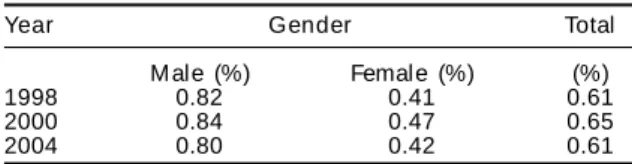
have allowed estimating HIV prevalence at different time points of the epidemic (Table). It can be noted very similar estimates around 0.6% for cross-section studies conducted in 1998,18 200019 and 2004,15 which
suggests likely stabilization of the epidemic.
A study comprising 8,002 pregnant women attending prenatal care in CTAs of 27 municipalities in Southern Brazil, based on data from CTA Information System (SI-CTA), estimated 0.5% HIV prevalence and 0.3%-0.6% 95% confidence interval in this population. The study database comprised 25% minimum coverage of pregnant women for 2003. The variable associated to higher prevalence rates was lower schooling.*
A major study commissioned by the PN-DST/AIDS, opening up the dichotomy between HIV surveillance and sexual behavior information, was carried out among Brazilian Army draftees in 1998. HIV pre-valences of 0.19%, 0.12% and 0.08% were estimated for Northern/Midwestern and Southern regions and the states of Rio de Janeiro and São Paulo, respec-tively. Lower schooling was also found to be associ-ated to higher risk sexual behavior. The Northern and Midwestern regions showed the lowest socioeco-nomic indicators among draftees.17
Also concerning behavioral surveillance, a 2003 study conducted by the Ministry of Health** in a representative sample of Brazilian population aged 14 years and over who were sexually active in the previous six months found that 28% had been HIV tested at least once before. The testing proportion varied by age groups: 22.5% in those aged 15-24 years, 36.4% in 25-39 years, and 21.3% in 40-54 years. Socioeconomic condition was once more associated to HIV status awareness. According to social strata used in the study, lower testing rates were seen among both men (13.7%) and women (28.35) in D/E strata. In A/B strata, 36.1% men and 43.4% women had been tested. HIV testing rates among pregnant women were 51.5% in 2002 and 57.4% in 2003.
Understanding the observed trends has been compli-cated by the different stages and profiles of AIDS epidemic in Brazil. When analyzed by regions, the epidemic showed a mixed trend: increasing incidence rates in most regions but declining rates in the South-eastern region. Mortality rates have generally de-creased but this decrease is only statistically signifi-cant in the Southeastern region. Women mortality rates have significantly increased in the Northern, Northeastern, and Southern regions. There are sev-eral assumptions to explain these scenarios in Brazil and there is a need for further studies specifically focusing on socioeconomic, demographic, and be-havioral aspects, as well as at biological markers for circulating HIV viruses.
Evidence gathered must be examined comparatively taking into consideration their incompleteness and other limitations of information sources. At the time of data analysis (November 2005), the AIDS data-base available showed information inconsistencies from 2003. In an attempt to address case underre-porting, the PN-DST/AIDS joined together different databases, which allowed to recovering hundreds of new cases by state. However, as the unified database has not yet been properly checked there are dupli-cated cases for the year 2004. This has impaired the analysis of major variables such as schooling, which significantly lost consistency after databases were joined together.
Increasing AIDS cases in several Brazilian regions can be partially explained by services response. There are still AIDS cases that have late access to health services and have limited chances of benefiting from adequate therapy. A study by Brito et al2 carried out
in a Northeastern state showed that about half of
*Cardoso AJC, Griep RH, de Carvalho HB, Barros A, da Silva SB, Remien RH. Sexual behavior and HIV-infection among pregnant women receiving prenatal care: an information system for HIV epidemiological surveillance in Brazil 2005 (no prelo).
**Ministério da Saúde. Programa Nacional de DST e Aids. Pesquisa com a população sexualmente ativa, 2003. Disponível em http:// www.aids.gov.br [acesso em 30 abr 2006]
Table - HIV prevalence estimates in those aged 15-49 years. Brazil, 1998, 2000, and 2004.
Year Gender Total
M ale (%) Female (%) (%)
1998 0.82 0.41 0.61
2000 0.84 0.47 0.65
2004 0.80 0.42 0.61
HAART users only got to know their HIV status at the time they are hospitalized due to clinical manifesta-tions of immunodeficiency. In addition, those who did not know their HIV status were 50% more likely to present symptoms at their first visit to a special-ized service compared to those who did it.
Key elements for understanding differences in the epidemic trends by regions are the following: epi-demic course, coverage of prevention actions, peo-ple’s knowledge on HIV/AIDS, level of schooling and other socioeconomic factors.
Universal access to antiretroviral therapy, which im-pact on mortality and survival rates has been well documented, would not be enough to explain declin-ing rates over time. Indicators of behavior changes, such as considerable increase (178%) of condom sales in the period 1995-2004, may not have yet exerted an impact on the number of AIDS cases as they are usually a late manifestation of the infection.
Stabilization of infection prevalence can be explained by other factors, such as increased mortality and/or reduced survival. To monitor HIV prevalence, stud-ies should be conducted to further the analyses and better understand HIV trends and survival and AIDS
mortality taking into account the observed gaps be-tween different regions.
There is also a need to carefully review HIV surveil-lance in Brazil. Data is still scarce to assess whether initiatives such as awareness campaigns like “Fique
sabendo” (You showed know), and the
implementa-tion of 329 CTAs and quick HIV testing in the North-ern region among others, have effectively expanded access to HIV testing to most vulnerable populations in different regions of Brazil.
It is proposed that second generation HIV surveil-lance be implemented linking HIV serological diag-nosis, AIDS surveillance, and risk behavior data. Also, sentinel surveillance studies should be designed to allow estimating HIV infection by region and in par-ticular cases of greater vulnerability such as border areas and large population concentration areas.
Although trend curves stratified by schooling were not presented here, there is well documented evidence of the so-called “epidemic pauperization”.5,6 A national
program for HIV/AIDS management should develop specific actions targeting population segments living in poverty and reflect the different epidemics in the dif-ferent regions requiring specific individual responses.
REFEREN CES
1. Boletim Epidemiológico Aids e DST. Programa Nacional de DST e Aids. Ministério da Saúde. Brasília (DF) 2005;2(1).
2. Brito AM, Castilho EA, Szwarcwald CL. Regional patterns of the temporal evolution of the AIDS epidemic in Brazil following the introduction of antiretroviral therapy. Braz J Infect Dis. 2005;9(1):9-19. 3. Del Rio C, Soto-Ramirez ELE. Bridging the gap. AIDS
Clin Care. 1991;(4):1-5.
4. Fauci AS. The human immunodeficiency virus: infectivity and mechanisms of pathogenesis. Science. 1988;239(12):617-22.
5. Fonseca M GP, Szwarcwald CL, Bastos FI. Análise sociodemográfica da epidemia de Aids no Brasil, 1989-1997. Rev Saúde Pública. 2002;36(6):678-85. 6. Fonseca MGP, Travassos C, Bastos FI, Silva NV,
Szwarcwald CL. Distribuição social da Aids no Brasil, segundo participação no mercado de trabalho, ocupação e status sócio-econômico dos casos de 1987-1998. Cad Saúde Pública. 2003;19(5):1351-63.
7. H ammer SM , Yeni P. Antiretroviral therapy: W here are we? AIDS. 1998;12(Suppl A):S181-S8.
8. Ministério da Saúde. Coordenação Nacional de DST e Aids. Terapia Anti-retroviral e Saúde Pública: Um balanço da experiência brasileira. Brasília (D F); 1999. p. 32.
9. Ministério da Saúde. Coordenação Nacional de DST e Aids, 2000. Bol Epidemiol AIDS 2000;13(1):15-56. 10. M inistério da Saúde. SPS/Coordenação Nacional de DST-Aids. Vigilância do HIV no Brasil: Diretrizes para os próximos anos. Brasília (DF); 2002.
11. Ministério da Saúde/SVS/PN-DST e Aids. Critérios de definição de casos de aids em adultos e crianças. Brasília (DF): Ministério da Saúde; 2003. p. 56. 12. Ministério da Saúde/SVS/PN-DST e Aids. Revista
Resposta + 2005: experiências do Programa Brasilei-ro de Aids. Brasília (DF); 2005.
14. Pezzotti P, Napoli PA, Acciai S, Boros S, Urciuoli R, Lazzeri V, Rezza G. Increasing survival time after AIDS in Italy: the role of new combination antiretroviral therapies. AIDS. 1999;13(2):249-55. 15. Souza-Júnior PRB, Szwarcwald CL, Barbosa-Júnior A,
Carvalho MF, Castilho EA. Infecção pelo HIV durante a gestação: Estudo-Sentinela Parturiente, Brasil, 2002. Rev Saúde Pública. 2004;38(6):764-72.
16. Szwarcwald CL, Bastos FI, Esteves M AP, Andrade CLT. A disseminação da epidemia de Aids no Brasil, no período de 1987-1996: uma análise espacial. Cad Saúde Pública. 2000; 16(Suppl 1):7-19.
17. Szwarcwald CL, Castilho EA, Barbosa Junior A, Gomes MRO, Costa EAMM et al. Comportamento de risco dos conscritos do Exército Brasileiro, 1998: uma apreciação da infecção pelo HIV segundo diferencias socioeconômicos. Cad Saúde Pública. 2000;16(Suppl 1):113-28.
Financed by Fundação Ford/GESTOS/PE, Grupo de Apoio e Prevenção a Aids/SP e Instituto de Saúde/ Secretaria Estadual de Saúde - São Paulo.
18. Szwarcwald CL, Castilho EA. Estimativa do número de pessoas de 15 a 49 anos infectadas pelo HIV, Brasil, 1998. Cad Saúde Pública. 2000;16(Suppl 1):135-41.
19. Szwarcwald CL, Carvalho M F de. Estimativa do número de indivíduos de 15 a 49 anos infectadas pelo HIV, Brasil, 2000. Bol Epidemiol AIDS. 2001;14 (1):SE1/1-13/1.
20. Szwarcwald CL, Barbosa Junior A, Souza Junior PR, Pascom AR, Esteves MA. Situação da Aids no Brasil: uma análise de indicadores para o monitoramento da epidemia. In Ministério da Saúde/SVS/PN-DST e Aids. Monitoraids. Brasília (DF); 2004.
21. Tess BH, Rodrigues LC, Newell ML, Dunn DT, Lago TD. Breastfeeding, genetic, obstetric and other risk factors associated with mother-to-child transmission of HIV-1 in São Paulo State, Brazil. São Paulo