Trends in maternal-infant
transmission of AID S after
antiretroviral therapy in Brazil
ABSTRACT
OBJECTIVE: the increase in the number of AIDS cases among women has lead to an increase in the maternal-infant transmission of human acquired immunodeficiency virus. Measures for the control of this type of transmission were implemented in Brazil in 1996. The aim of the present study was to analyze time trends in maternal-infant transmission of AIDS among Brazilian children.
METHODS: The present study included children born in Brazil between 1990 and
2001. We used the database of notified AIDS cases in children 13 years of age or younger between 1990 and 2004. Exponential regression models adjusted to the time series provided the annual variation rates and observed and expected values for the period.
RESULTS: We found a significant increasing trend for cases born prior to the year in which antiretroviral therapy was introduced, with an increase rate of about 12% (t<0.003) per year. Rates from different states ranged from 5.9% to 31%. The analysis of expected and observed cases for each of the country’s five Regions showed a reduction in the number of cases among children born from 1997 onwards, with a progressive year-to-year reduction. The number of notified cases among children born in 2001 was less than 10% the number of expected cases.
CONCLUSIONS: The results obtained suggest a favorable response the
implementation of policies for the prevention of maternal-infant HIV transmission in Brazil, as observed in other parts of the world.
KEYW O RD S: Acquired immunodeficiency syndrome, transmission. H IV. D isease transmission, vertical, statistics & numerical data. D isease transmission, vertical, prevention & control. Anti-H IV agents. Regression analysis.
Ana M aria de BritoI
Jailson Lopes de SousaII
Carlos Feitosa LunaI
Inês D ouradoIII
I Centro de Pesquisas Aggeu Magalhães. Fundação Oswaldo Cruz. Recife, PE, Brasil
I I Faculdade de Ciências Médicas. Universidade de Pernambuco. Recife, PE, Brasil
I I IInstituto de Saúde Coletiva. Universidade Federal da Bahia. Salvador, BA, Brasil
Correspondence:
Ana Maria de Brito
Av. Moraes Rego, s/n, Cidade Universitária 50670-420 Recife, PE, Brasil
INTRODUCTION
The patterns of dissemination of infection by the human acquired immunodeficiency virus (HIV) have changed due to the predominance of heterosexual transmission. This has been decisive for the increase in the incidence of the disease among women. In its turn, the increase in the number of cases among women led to an increase in maternal-infant trans-mission of HIV infection, with consequent increase in the number of cases of AIDS in children world-wide. In Brazil, about 84% of pediatric AIDS cases – that is, cases among children up to 13 years of age – is due to maternal-infant transmission.1
The probability of maternal-infant transmission of HIV infection has been calculated in a number of studies.4-6,10,11 The majority of cases of transmission –
roughly 65% – occur during labor and delivery, and the remaining 35% occur during intrauterine life, es-pecially during the last weeks of pregnancy. In addi-tion, breastfeeding represents an additional risk of 7-22%. Studies5,6,10 show that a number of factors are
associated with increased risk of maternal-infant trans-mission of HIV. Of these, major risk factors include the time between the rupture of amniotic membranes and delivery and the amount of virus in the mother’s cervical-vaginal secretions and breast milk.
The results of Aids Clinical Trial Group Protocol 076 (ACTG 076), in 1994, have proven the effectiveness of zidovudine (AZT) for the reduction of maternal-infant
transmission in 67.5% of cases.5 Based on this
evi-dence, in the same year, the Centers for Disease Con-trol and Prevention (CDC) published a recommenda-tion for the use of AZT by HIV+ women in the second and third trimesters of pregnancy and during labor, and by children during the first six weeks of life.4
Considering the growth of the epidemic in the female population, the Brazilian Ministry of Health pub-lished, in 1995, specific regulations on the preven-tion of maternal-infant transmission, establishing this as one of the priorities of the National Program for
STD/AIDS (PN-DST/AIDS).14 However, the
recom-mendations included in this publication were only effectively implemented with their updating and in-clusion in the manuals for treatment of adults and children infected with HIV, in 1997 (Ministerial Tech-nical Decree no. 874/97*). Appropriate conducts for antenatal and delivery care of HIV+ women are in-cluded in the “Recommendations for the Prophylaxis
of Maternal-Infant transmission of HIV and Antiret-roviral Therapy of Pregnant Women,” a document pe-riodically revised by the PN-DST/AIDS.3,7,14,**
As an attempt to strengthen this control measure, an-other strategy9 for the evaluation of the use of the
maternal-infant transmission prevention protocol was the inclusion of the surveillance of HIV+ mothers and exposed children as a compulsory notification event, in 2000 (Decree n. 993/2000). Recently, with the intent of implementing measures for the reduc-tion of morbidity and mortality related to congenital syphilis and maternal-infant HIV infection, the
Min-istry of Health implemented the Projeto Nascer –
Maternidades,9 within the scope of the National
Uni-fied Healthcare System (Decree n. 2,104 GM, 19 No-vember 2002).
In Brazil, the estimated number of pregnant women infected with HIV is around 16,410, i.e., 0.4% of the
population of pregnant women.2 The rate of
mater-nal-infant transmission has fallen in recent years,
con-sidering the country as a whole: from 16% in 1997,13
before the introduction of antiretroviral therapy, to 7% in 2002.*** A study conducted in Rio de Janeiro
in 200111 showed a reduction of about 3% in
mater-nal-infant transmission among pregnant women par-ticipating in an intervention program that followed all recommendations made by the Ministry of Health. In 2002, the Sentinela-Parturiente study2 showed an
effective coverage of the detection of HIV infection during pregnancy of about 52% for the country as a whole. Sociogeographic inequalities become patent when comparing the country’s Northeast (24%) and South (71%) regions; illiterate mothers (19%) with those with schooling above the elementary level (64%); and women who gave birth in small cities (37%) with those that delivered in cities with over 500,000 inhabitants (66%).
Therefore, in order to evaluate current measures for the control and prevention of maternal-infant trans-mission of HIV infection, the aim of the present study was to analyze trends in cases of AIDS among Brazil-ian children up to age 13 years.
M ETH O D S
For data analysis, we used the database of notified AIDS cases among children aged 13 years or less con-sidered as due to maternal-infant transmission, regis-tered in the National System for Notification Events
*Publicada no Diário Oficial da União de 4/7/97.
**Programa Nacional de DST e Aids. Ministério da Saúde. Disponível em http://www.aids.gov.br/data/Pages/LUMISFB7D5720PTBRIE.htm [acesso em 24 abr 2006]
(Sistema Nacional de Agravos de Notificação – SINAN), between 1990 and April 2004.
For the time trend analysis, we considered cases oc-curred in the selected period, according to year of birth. In other words, we considered the cohort of cases of AIDS notified until 2004 with birth dates between 1990 and 2001. The choice of cutoff point for year of birth was due to the concern with avoiding errors due to delays in notification. According to Szwarcwald et al12 (2001), about 30% of HIV-infected children are
notified as cases of AIDS only in the two first years following birth.
The use of exponential regression models, adjusted to the time-series of children with birth date between 1990 and 1996 allowed us to calculate annual varia-tion rates and to statistically test time trends. Thus, it was also possible to estimate expected values for the entire period, allowing for a comparison between the observed and expected values for children born be-tween 1997 and 2001.
RESU LTS
We analyzed 8,703 cases of AIDS in children aged 13 years or less, notified to SINAN until April 2004. The majority of cases occurred in the Southeast (61.7%) and South (25.2%) Regions, confirming the magni-tude of the problem in these Regions in relation to the number of cases of HIV infection and AIDS in the Country.3,15
Table 1 presents observed and expected cases of ma-ternal-child transmission of AIDS for the entire coun-try. We highlight the fact that the rate of increase in the number of cases in the period before the introduc-tion of antiretroviral therapy was of about 12% (mean annual variation rate = 0.12, p=0.003). For children born in 1997, the number of cases notified represented less than 34.8% of the expected cases, a phenom-enon which repeats itself progressively, with observed cases representing as little as 10% of the expected number for children born in 2001.
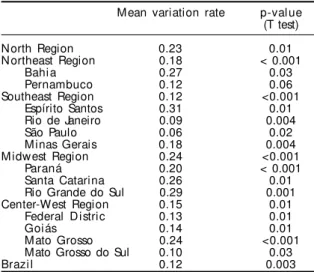
An analysis of time trends in maternal-infant transmis-sion by Region shows that, prior to the introduction of antiretroviral therapy, there was a yearly increase in the number of cases in all Brazilian Regions, with mean annual variation rates ranging from 5.9% to 31%. The states of São Paulo and Rio de Janeiro, both in the Southeast Region, and at the epicenter of the AIDS epidemic in Brazil, showed the smallest increase rates in countrywide (5.9 and 8.9%, respectively). On the other hand, rates in all the States of the South Region were above 20%. The state of Espírito Santo registered
the highest mean annual variation rate among all ana-lyzed states (31%) (Table 2).
The analysis of the time series in regard to the number of observed and expected cases for each of the coun-try’s Regions shows a reduction in the number of AIDS cases notified among children born from 1997 on-wards, with numbers falling progressively every year (Figure 1 and 2).
D ISCU SSIO N
There are still failures in the early detection of HIV among Brazilian pregnant women, as indicated by the Sentinela-Parturiente study.8 Nonetheless, the
results obtained in the present study consistently show a progressive reduction in the number of ex-pected cases of AIDS due to maternal-infant trans-mission among children born from 1997 onwards. This period coincides with the massive and univer-sal introduction of the prophylactic measures
rec-Table 1 - Observed and expected cases of AIDS in children
due to maternal-infant transmission, according to year of birth. Brazil, 1990-2001.
Brazi l O bserved Expected (O bs-Exp/Exp)*100
1990 503 551 -8.7
1991 675 626 7.8
1992 689 712 -3.2
1993 897 808 11.0
1994 906 918 -1.3
1995 1,067 1,043 2.3
1996 1,112 1,185 -6.2
1997 878 1,346 -34.8
1998 764 1,529 -50.0
1999 622 1,737 -64.2
2000 364 1,973 -81.5
2001 226 2,241 -89.9
Total 8,703 14,669
Mean annual variation rate (1990-1996) =0.12; p=0.003
Table 2 - Estimated mean annual variation rates in cases of
maternal-child transmission of AIDS according to Region/ State. Brazil, 1990-1996.
M ean variation rate p-val ue (T test)
North Region 0.23 0.01
N ortheast Region 0.18 < 0.001
Bahi a 0.27 0.03
Pernambuco 0.12 0.06
Southeast Region 0.12 <0.001
Espírito Santos 0.31 0.01
Rio de Janeiro 0.09 0.004
São Paulo 0.06 0.02
M inas Gerais 0.18 0.004
M idw est Region 0.24 <0.001
Paraná 0.20 < 0.001
Santa Catarina 0.26 0.01
Rio Grande do Sul 0.29 0.001
Center-West Region 0.15 0.01
Federal D istric 0.13 0.01
Goi ás 0.14 0.01
Mato Grosso 0.24 <0.001
Mato Grosso do Sul 0.10 0.03
*Sociedade Brasileira de Pediatria. Resultado de Estudo Multicêntrico Brasileiro. Disponível em http://157.86.8.37/docs/ taxa%20de%20transmissao%20vertical.pdf [acesso em 24 abr 2006]
ommended by the PN-DST/AIDS, especially with regard to the administration of antiretroviral drugs to HIV+ pregnant women and to exposed newborns. The number of cases notified for children born in 2001 in the entire country represented only 10.1% of the expected number of cases. In other words, if the trend observed between 1990 and 1996 was maintained, with its 12% mean annual growth rate, a total 2,241 cases of AIDS would be expected in children born in 2001; however, only 226 cases of the disease were recorded.
The reduction in the number of expected cases oc-curred in all Regions. In 2001, for instance, reduc-tions in relation to expected cases ranged from ap-proximately 87% in the North and Northeast Re-gions to over 93.7% in the South Region. These dif-ferences may be partly explained by the findings of a study showing differences in access to antenatal care services between the different Regions.8 In spite
the reductions, the rates of maternal-infant trans-mission of HIV were higher in Regions with more precarious indicators of maternal care, namely the North and Northeast.*
The reduction in the number of children with AIDS after 1997 is due to the increase in the coverage of
measures for the prevention and control of AIDS dur-ing antenatal care and delivery in Brazil, corroborat-ing the results obtained by other authors.7,11
In conclusion, the universal adoption of antiretrovi-ral therapy for pregnant women and children exposed to HIV has prevented around 6,000 new cases of HIV among Brazilian children born between 1997 and 2001. The results obtained by the analysis of the time series of AIDS cases due to maternal-infant transmis-sion, according to year of birth, allowed for the iden-tification of a decreasing trend in the number of pedi-atric AIDS cases, which reflects the impact of the pro-phylactic measures adopted in a global and efficient manner. The greater coverage of these measures, com-bined with greater adequacy of antenatal, delivery, and puerperal care, will surely contribute in a more rapidly effectively to the interruption of avoidable cases of maternal-infant transmission throughout the Brazilian territory.
0 5 10 15 20 25 30 35 40 45
1990 1991 1992 1993 1994 1995 1996 1997 1998 1999 2000 2001 Year
Number of cases
Observed Expected North
0 20 40 60 80 100 120 140
1990 1991 1992 1993 1994 1995 1996 1997 1998 1999 2000 2001 Year
Number of cases
Observed Expected
Northeast
Figure 1 - Trends in observed and expected cases of AIDS in
children due to maternal-infant transmission, according to year of birth; (a) North Region and (b) Northeast Region. Brazil, 1990-2001.
0 100 200 300 400 500 600 700 800 900 1000
1990 1991 1992 1993 1994 1995 1996 1997 1998 1999 2000 2001 Year
Number of cases
Observed Expected Southeast
0 100 200 300 400 500 600
1990 1991 1992 1993 1994 1995 1996 1997 1998 1999 2000 2001 Year
Number of cases
Observed Expected South
0 10 20 30 40 50 60 70 80
1990 1991 1992 1993 1994 1995 1996 1997 1998 1999 2000 2001 Year
Number of cases
Observed Expected Midwest
Figure 2 - Trends in observed and expected cases of AIDS in
REFEREN CES
1. Boletim Epidemiológico - Aids e DST. Ministério da Saúde/Secretaria de Assistência à Saúde. Brasília (DF): 2005;2(1).
2. Brito AM, Castilho EA, Szwarcwald CL. Regional patterns of the temporal evolution of the AIDS epidemic in Brazil following the introduction of antiretroviral therapy. Braz J Infect Dis. 2005;9(1):9-19. 3. Brito AM, Castilho EA, Szwarcwald CL. Aids e infecção
pelo HIV no Brasil: uma epidemia multifacetada. Rev Soc Bras Med Tropical. 2001;34(2):207-17.
4. Centers for Diseases Control and Prevention - CDC. Recommendantions of the U.S. public health service task force on the use of zidovudine to reduce perinatal transmission of human immunodeficiency virus. MMWR. 1994;3:RR-11.
5. Connor EM, Sperling SR, Gelber R, Kiselev P, Scoot G, O´sullivan MJ et al. Reduction of maternal-infant transmission of human immunodeficiency virus type 1 with zidovudine treatment. For the Pediatric AIDS Trials Group Protocol 076 Study Group. N Engl J Med. 1994;331(18):1173-80.
6. Cooper ER, Charurat M, Mofenson L, Hanson IC, Pitt J, Diaz C et al. Combination antiretroviral strategies for the treatment of pregnant HIV-1 – infected woman and prevention of perinatal HIV-1 transmission. J Acquir Immune Defic Syndr. 2002;29:484-94. 7. Ministério da Saúde/Coordenação Nacional de DST/
Aids. Implantação da Vigilância do HIV em Gestantes e Crianças Expostas. Bol Epidemiol Aids. 2000;12(1).
8. Ministério da Saúde. Programa Nacional de DST e Aids. Oportunidades perdidas na detecção precoce do HIV na gestação: Resultados do Estudo Sentinela-Parturiente, Brasil, 2002. Brasília (DF); 2004. 9. Ministério da Saúde. Programa Nacional de DST e
Aids. Recomendações para Profilaxia da Transmissão Vertical do HIV e Terapia Anti-retroviral em Gestan-tes. Brasília (DF); 2004.
10. Mofenson LM, Fowler MG. Interruption of materno-fetal transmission. AIDS. 1999;13:S205-S14. 11. Nogueira SA, Abreu T, Oliveira R, Araujo L, Costa T,
Andrade M et al. Successful prevention of HIV transmission from mother to infant in Brazil using a multidisciplinary team approach. Braz J Infect Dis. 2000;5:78-86.
12. Szwarcwald CL, Barbosa Júnior A, Fonseca MG. Estimativa do número de crianças (0-14 anos) infectadas pelo HIV, Brasil, 2000. Bol Epidemiol Aids. 2001;25(1):49-54.
13. Tess BH, Rodrigues LC, Newell ML, Dunn DT, Lago TD. Breastfeeding, genetic, obstetric and other risk factors associated with mother-to-child transmission of HIV-1 in Sao Paulo State, Brazil. São Paulo
Collaborative Study for Vertical Transmission of HIV-1. AIDS. 1998;26:12(5):513-20.
14. Veloso GL, Vasconcelos AL, Grinsztejn B. Prevenção da transmissão vertical no Brasil. Bol Epidemiol Aids 1999;12(3).