Rev Odontol UNESP. 2017 Mar-Apr; 46(2): 97-103 © 2017 - ISSN 1807-2577
ORIGINAL ARTICLE
Doi: http://dx.doi.org/10.1590/1807-2577.01716
Long-term bond strength of a self-adhesive resin cement to
intraradicular dentin pretreated with chlorhexidine and ethanol
Resistência de união ao longo do tempo de um cimento resinoso autoadesivo à dentina intrarradicular
pré tratadas com clorexidina e etanol
Mariah Carvalho Guimarães dos SANTOS
a, Flávia Lucisano Botelho AMARAL
a,
Cecília Pedroso TURSSI
a, Roberta Tarkany BASTING
a, Fabiana Mantovani Gomes FRANÇA
a*
aFaculdade de Odontologia, Centro de Pesquisas Odontológicas São Leopoldo Mandic, Campinas, SP, Brasil
Resumo
Introdução: Cimentos resinosos autoadesivos não necessitam de tratamento prévio da superfície dental, por esta razão o pré tratamento da dentina pode influenciar a longevidade da resistência adesiva. Objetivo: Avaliar a influência do tratamento dentinário com etanol (ET) 100% e clorexidina (CL) 2% na resistência de união (RU) de um cimento resinoso autoadesivo (CRA) à dentina intrarradicular. Material e método: 80 raízes bovinas restauradas com pino de fibra de vidro e CRA (U200 3M/ESPE) foram distribuídas em 4 grupos, de acordo com o tratamento prévio da dentina intrarradicular: Grupo 1 – nenhum tratamento; Grupo 2 – CL2% por 1 minuto; Grupo 3 – ET100% por 1 minuto; Grupo 4 – CL2% seguido pelo ET100%. As amostras foram seccionadas no sentido radial para obtenção de duas secções de aproximadamente 0,7 mm de espessura em cada terço – cervical, médio e apical. Após 48 horas e 180 dias foi realizado o teste push-out. Resultado: A ANOVA a três critérios para blocos casualizados demostrou que não houve diferença entre os valores de resistência de união nos tempos 48 h e 180 dias, independentemente do tratamento e do terço (p>0,05). A interação tratamento-terço foi significativa (p = 0,041) sendo que o tratamento com CL promoveu menor RU no terço cervical e o tratamento com ET promoveu melhor RU no terço apical. Conclusão: Os tratamentos com CL e ET individualmente ou associados não promoveram diferenças entre os valores de RU do CRA à dentina intrarradicular ao longo do tempo.
Descritores: Etanol; clorexidina; técnica para retentor intrarradicular; cimentos de resina.
Abstract
Introduction: Self-adhesive resin cements do not require prior preparation of the tooth surface, therefore dentin pretreatments may influence long-term bond strength. Objective: To evaluate the influence of 100% ethanol (ET) and 2% chlorhexidine (CL) treatment of intraradicular dentin on the long-term bond strength (BS) of a self-adhesive resin cement (SRC). Material and method: 80 bovine roots were restored with fiber posts and SRC (U200 3M/ESPE) and distributed into 4 groups according to dentin treatment: Group 1 – without treatment; Group 2 – 2% CL for 1 minute; Group 3 – 100% ET for 1 minute; Group 4 – 2% CL, followed by 100% ET. The samples were cross-sectioned to obtain two sections (0.7 mm) thick for each root third: coronal, middle and apical. The immediate push-out test was carried out after 48 hours, and the long-term push-out test, after 180 days. Result: The three-way ANOVA test for randomized blocks showed no difference between the BS values at 48 hours and 80 days, irrespective of the treatment and the third (p>0.05). The interaction of the treatment/third pairing was significant (p = 0.041) since the treatment with CL promoted lower BS in the coronal third, while treatment with ET promoted better BS in the apical third. Conclusion: Treatment with CL and ET, separately or combined, promoted no differences between the BS values of the SRC to root dentin over time.
INTRODUCTION
Extensive tooth loss may require root retention to ensure long-term retention and stability of coronal restorations, which can be achieved using intraradicular iber posts1,2. Traditionally, prefabricated posts are cemented with adhesive systems combined with dual-curing or chemically cured resin cements1. Dual-curing resin cements may act as luting agents with diferent polymerization processes: either a physical process activated by using light from a light-curing unit on photoinitiators (camphorquinone); or by a chemical reaction between benzoyl peroxide and tertiary amines, determining polymerization conditions and conversion of the most suitable monomers, mainly in the most apical portions of root canals, where it is diicult for light to reach3.
Given the the diiculties with bonding to root dentin, and the demand for procedures that optimize clinical time, self-adhesive resin cements have been developed and do not require prior preparation of the tooth surface4-6. he multifunctional organic matrix of these cements is composed of phosphoric acid/ methacrylate. he group of phosphoric acid molecules etches the surface and helps with bonding7.
he bond to dentin may nonetheless degrade over time8 and the use of ethanol as a pre-treatment has been proposed to control dentin moisture and promote a long lasting bond9,10. Accordingly, monomers that have hydrophobic characteristics appear to penetrate into the ethanol-saturated dentin more deeply than dentin saturated with water2. Moreover, this would leave the tissue less hydrophilic, prevent phase separation of the hydrophobic monomer and result in a more stable bond over time11. Despite the encouraging results when used on coronal dentin12, there has been little investigation into this approach to cementation on root dentin9.
Furthermore, the short durability of root bond is linked to hydrolysis of the collagen network within the hybrid layer13. It is known that enzymes such as matrix metalloproteinases (MMP) are involved in connective tissue turnover and are capable of degrading almost all components of the extracellular matrix14. he exposed collagen ibrils, without the protection aforded by minerals, become susceptible to hydrolytic and enzymatic degradation mediated by matrix metalloproteinases (MMPs) that are exposed and activated during acid etching. his phenomenon allows continuous iniltration of a combination of luids, bacterial metabolites and saliva MMPs that will result in degradation of the unprotected collagen ibrils in the lower portions of the hybrid layer. In this scenario, the use of chlorhexidine (CHX) has been proposed to optimize the hybrid layer by inhibiting MMPs15. MMP activity has also been conirmed in root dentin16 and this information encouraged the use of CHX as a dentin pre-treatment prior to cementing iber posts8.
Studies have evaluated the application of ethanol with the purpose of promoting the use of adhesive systems containing hydrophobic monomer units11,17 and chlorhexidine as a MMP inhibitor18. It is still unclear, however, whether the combination of these two substances may act synergistically in the bonding of self-adhesive resin cements, in cases where the application of conventional adhesive systems is contraindicated.
Considering the aforementioned context, the aim of this study was to evaluate the inluence of treating the root canal dentin
with 100% ethanol and 2% chlorhexidine on the bond strength and longevity of a dual-cure self-etching resin cement at diferent root depths.
he null hypothesis tested was that the bonding durability of a dual-cure self-etching resin cement to root dentin in any root third would not be inluenced by pretreatment with chlorhexidine or ethanol, ater 48 hours and at 180 days.
MATERIAL AND METHOD
Experimental Design
Experimental units: root slices obtained from roots restored with iber posts.
Dependent variable: bond strength measured by the push-out test. Failure mode was veriied qualitatively using a scoring system.
Independent variable: Root dentin treatment at 4 levels: no treatment; treatment with 2% chlorhexidine; treatment with 100% ethanol; treatment with both chlorhexidine and ethanol.
Storage time at two levels: 24 hours and 180 days
Root depth at three levels: Coronal, Middle and Apical.
Tooth Selection
his study was approved by the local Animal Research Ethics Committee (#2014/0217). Bovine incisors were kept in 0.1% thymol solution until use. hey were then debrided using periodontal curettes and subsequently sectioned horizontally at the cervical level, close to the cement-enamel junction with a double-faced diamond disk so that all roots measured 17 mm in length.
Preparation of the canals for post cementation
Canal preparation was performed with rotatory burs measuring 2, 3 and 4 mm in diameter. A working length of 9 mm was established by using a rubber stop placed on the bur shat, and burs were replaced ater every 5 preparations. he root canals were aspirated with cannulas connected to a suction tube and excess water was removed with # 80 paper cones (Dentsply, Maillefer, Petrópolis, RJ, Brazil). he roots were positioned in a 21 × 34 mm acrylic mold illed with condensation silicone (Speedex Coltène, Whaledent, Vigodent, Rio de Janeiro, RJ, Brazil) to facilitate handling of the specimens and to allow the curing light to be emitted from the coronal aspect of the root at all times. Table 1 lists the brand names, manufacturers, composition and the steps for applying the materials used in this study.
removed with an absorbent paper point, and inally the dual-cure resin cement was applied (U200 3M/ESPE, St Paul, MN, USA).
Preparation of the iber posts for luting and the luting
procedure
he iberglass posts (Reforpost, Angelus, Londrina, PR, Brazil) were cleaned and disinfected with 70% ethanol for 30 seconds and then air-dried. Subsequently, a layer of silane (Silano, Angelus, Londrina, PR, Brazil) was applied. he posts were then itted into the root canals at 9 mm to match the working length.
he cement was inserted with the aid of a Centrix applicator and a metal tip. he post was then positioned and held in place using inger pressure for 10 seconds, so that the excess cement could be removed with a disposable brush (Microbrush, Vigodent, Rio de Janeiro, RJ, Brazil). he tip of the light-curing equipment was positioned at the cervical end of the root at a 45° angle to its long axis. he resin cement was light-cured for 40 seconds by using a halogen light set to 450 mW/cm2, veriied with a radiometer (Newdent, Ribeirão Preto, SP, Brazil). he roots were then removed from their supporting base and stored in a moist environment in a bacteriological incubator at 37°C for 7 days.
Preparation of the samples for the push-out test
he samples were ixed to acrylic plates with wax so that the long axis of the root remained parallel to the surface of the plate. he plates were then ixed to a metallographic precision cutter (Buehler, Lake Bluf, Illinois, USA) itted with a high-precision diamond disc (Buehler, Lake Bluf, Illinois, USA), and seven parallel cuts were made in the buccal-lingual direction to obtain two slices approximately 0.7 mm thick from each third: coronal, middle and apical. One of the slices was kept in distilled water, which was replaced every other day, until evaluation of bond strength 180 days later.
Push-out test
At time intervals of 48 hours and 180 days, the specimens were positioned on a metal base made of stainless steel, and ixed to the testing machine (DL2000, EMIC, São José dos Pinhais, PR, Brazil) for the push-out test. he metal base had an oriice 3 mm in diameter in the central region and the samples were positioned so that the part corresponding to the post was in the same direction as the oriice. A metal rod with an active 1-mm diameter tip ixed to the load cell (50 KN) was positioned over the center of the post and the push-out test was carried out at 0.5 mm/min. To enable comparison of the thirds, the Kgf value obtained was converted to MPa (MPa = KgF * 9.8/area). he area was calculated considering the diameter of the post and thickness of the section. herefore, area = 2π*r*h, where π = 3.1416; r = radius of the post and h = height of the root section.
Fracture Pattern
At the end of the push-out test, the specimens from each group were observed under an optical microscope, at a 40× magniication, in order to determine the type of failure, classiied as: 1) adhesive failure between resin cement and dentin; 2) adhesive failure between post and resin cement; 3) mixed failure and 4) cohesive failure.
Statistical Analysis
he Shapiro-Wilks normality test and the Levene homogeneity of variance test were applied to the bond strength data. As heterogeneity of variance was observed, the data were transformed using a logarithmic function, which also improved normality. he transformed data were evaluated using three-way analysis of variance for randomized blocks. In order to break down the interactions, the Tukey test was
Table 1. Brand name, manufacturer, composition and steps for applying the materials employed
Brand Name Manufacturer (batch number)
Composition
(main components) Application steps
2% Chlorhexidine solution
(FGM Joinville, SC, Brazil) BATCH:155 2% chlorhexidine digluconate
he 2% chlorhexidine solution was applied with the aid of a disposable syringe and 0.5 × 25 caliber needle in the root canal, remaining there for a period of 60 seconds. he excess
was then removed using absorbent paper cones, while keeping the dentin moist.
Ethanol (Chemco Ltda., Brazil)
BATCH: 24631
100% Ethanol
he root canal was completely illed with ethanol with the aid of a disposable syringe and 0.5 × 25 caliber needle for 1 minute. he excess ethanol was then removed using
absorbent paper cones.
Rely X U200 3M/ESPE (St Paul, MN, USA) BATCH: 1329500658/528731
Silanized glass powder, silica treated with silicon, calcium hydroxide, substituted pyrimidine and sodium
persulfate
Manipulate the pastes in identical quantities using the cement’s own doser and insert it into the canal with the help
of a Centrix insertion syringe.
Reforpost no. 2 (Angelus, Londrina, PR, Brazil)
BATCH: 29393/29846
Fiber glass, Epoxy resin, inorganic load, silane, polymerization catalysts
he post was positioned and pressure applied for 10 seconds, the excess cement being removed with a disposable brush.
Silane
(Angelus, Londrina, PR, Brazil) BATCH: 21845
Silane polysulide, hydrocarbon nucleus, elastomeric composition and
ethanol
used. he level of signiicance adopted was 5%, using SPSS for the statistical calculations.
RESULT
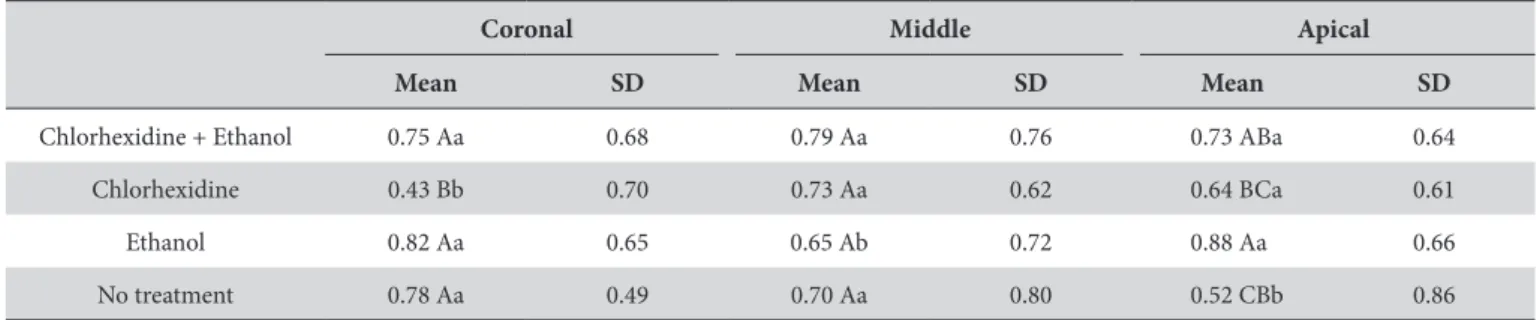
he three-way Analysis of Variance for randomized blocks did not reveal any signiicant triple-interaction efect (p = 0.922), nor did the pairings treatment/time (p = 0.506) or time/root third (p = 0.165). Table 2 shows the means and standard deviations of the groups in relation to root third and storage time. here was no diference between the bond strength values at 48 hours or 180 days, irrespective of treatment or root third. he treatment/third interaction was signiicant (p = 0.041) showing that when chlorhexidine was used, the bond strength in the coronal third was signiicantly lower than the values obtained for the other treatments. In the middle third, no diference in bond strength values was detected when diferent treatments were used. In the apical third, bond strength with ethanol exceeded the values obtained with chlorhexidine or without any treatment (Table 3). With the chlorhexidine + ethanol combination, the result in the apical third was borderline. Where no treatment
was used, bond strength in the apical third was signiicantly lower than the values found in the other thirds, which were identical. With chlorhexidine, bond strength was signiicantly lower in the coronal third, whereas, when ethanol was used the lowest bond strength value was noted in the middle third. When chlorhexidine + ethanol were used, no signiicant diference in bond strength values was observed (Table 3).
Figure 1 illustrates the failure modes for the specimens ater the push-out bond strength test and shows that for all experimental conditions, adhesive failures between the cement and dentin prevailed, equaling a failure rate of between 55 and 90%.
DISCUSSION
Dentin is a complex tissue as regards composition, which translates into a substantial challenge when bonding it to hydrophobic materials19. In order to check the long-term bonding performance of a dual-cure cement to root dentin in the presence of chlorhexidine and ethanol, bovine incisors were selected. his choice was based
Table 2. Means and Standard Deviations of the push-out bond strength considering treatment and root third
Treatments Mean Std. Deviation
Chlorhexidine + Ethanol
48h
Coronal 0.85 0.78
Middle 0.96 0.71
Apical 0.75 0.83
180 d
Coronal 0.65 0.58
Middle 0.61 0.78
Apical 0.71 0.40
Chlorhexidine
48h
Coronal 0.56 0.75
Middle 0.83 0.66
Apical 0.69 0.73
180 d
Coronal 0.29 0.65
Middle 0.63 0.56
Apical 0.58 0.48
Ethanol
48h
Coronal 0.84 0.72
Middle 0.67 0.77
Apical 0.93 0.65
180 d
Coronal 0.80 0.60
Middle 0.63 0.69
Apical 0.82 0.67
No treatment
48h
Coronal 0.81 0.54
Middle 0.88 0.73
Apical 0.47 0.76
180 d
Coronal 0.76 0.44
Middle 0.52 0.84
on the study by Kato et al.16 who concluded that bovine dentin was a reliable substrate for studies involving metalloproteinase activity.
he indings of the present study demonstrated that bond stability was found throughout the studied time intervals of 48 hours to 180 days, not only in groups treated with ethanol and chlorhexidine solutions, but also in the control group, conirming the null hypothesis in relation to length of time. Storing teeth for 6 months may not be suicient time for the hybrid layer to undergo degradation, and consequently reduce bond strength. Instead, storage for 12 months might be more efective for ascertaining the efect of time on root dentin bonding8. Furthermore, this outcome can be explained by the performance of the resin cement used. Self-adhesive resin cements contain multifunctional monomers with phosphoric acid groups, which simultaneously demineralize and iniltrate into enamel and dentin20. he setting reaction may be initiated by exposure to light or chemicals5, resulting in cross-links that form high-molecular-weight polymers. A dash of glass ionomer was added to the composition of the self-adhesive cements to guarantee neutralization of this initially acidic system, resulting in an increase in pH from 1 to 6 by means of reactions between the phosphoric acid and alkaline groups. he phosphoric acid groups also react with the apatite from the tooth structure, and
the water yielded from the neutralization processes contributes to the initial hydrophilicity of the cement, leading to a better it to the tooth structure and tolerance to moisture20. Moreover, water is then reused via a reaction with functional acid groups, and also during the reaction of the cement, resulting in a hydrophobic matrix. he bond obtained relies upon the micro-mechanical retention and chemical interaction between the acid monomer and hydroxyapatite groups4,21.
Chlorhexidine and ethanol, the solutions used for pre-treatment of the root dentin, can afect the adhesion of luting agents, by altering the structure of the dentin or interfering in polymerization of the resin6. In the present study, the self-adhesive resin cement, in combination with ethanol, demonstrated better bond strength values in the apical third, while chlorhexidine reduced the bond strength values in the coronal third.
Ethanol-assisted bonding has been demonstrated to reduce hydrophilicity in the dentin17. he composition of resin materials should preferably be based on hydrophobic monomers, as these are more chemically and mechanically stable, resulting in greater durability of the bond to dentin17. Hydrophobicity is, however, incompatible with dentin moisture. herefore, the use of hydrophobic resin systems demands a reduction in the hydrophilicity of the
Figure 1. Columnar diagram of frequency as a percentage observed in the fracture modes ater the push-out bond strength test according to the type of root treatment, the time elapsed between the bond strength test and test of the root thirds, namely 1) adhesive failure between cement and dentin; 2) adhesive failure between post and cement; 3) mixed failure; and 4) cohesive failure.
Table 3. General means and standard deviations of the breakdown of the hird and Treatment interaction
Coronal Middle Apical Mean SD Mean SD Mean SD
Chlorhexidine + Ethanol 0.75 Aa 0.68 0.79 Aa 0.76 0.73 ABa 0.64
Chlorhexidine 0.43 Bb 0.70 0.73 Aa 0.62 0.64 BCa 0.61
Ethanol 0.82 Aa 0.65 0.65 Ab 0.72 0.88 Aa 0.66
No treatment 0.78 Aa 0.49 0.70 Aa 0.80 0.52 CBb 0.86
naturally moist dentin. In this regard, ethanol has been proposed as a substitute for water in dentin bonding12,17. he concept of replacing water with ethanol infers the possibility that hydrophobic monomers are capable of encapsulating the collagen ibrils in an efective and enduring manner22. Given that the bond strength of the resin cement is highest in the cervical region and lowest in the apical region, probably due to reduced light penetration into the latter scenario, this leads to a strict polymerization of the material6. In the present study, ethanol may have favored bond strength in the apical third by making the substrate less moist, thereby enabling the formation of a more hydrophobic hybrid layer. his outcome corroborated the results of Bitter et al.23 who also found better bond strength in the middle and apical thirds when bonding with dual-cure resin cement in the presence of ethanol.
he use of chlorhexidine as dentin pre-treatment has been suggested, based on inhibiting the degradation of the bond interface over time18,24. Dentin contains MMPs that regulate both the physiological and pathological homeostasis of collagen-based tissues13. In a study conducted by Pashley et al.19, the action of the MMPs was inhibited by using proteinase inhibitors, thus preserving the structural integrity of the collagen ibrils, which could slow down the hybrid layer degradation. It has been shown that chlorhexidine has the desirable property of inhibiting matrix metalloproteinases –2, –8 and –9, even in low concentrations15. When chlorhexidine is applied to exposed collagen ibers and then sealed in by means of a resin bonding agent, it is capable of protecting collagen from collagenolytic attack, thereby retarding one of the degradation pathways24. In addition, chlorhexidine has been proposed as a substitute for sodium hypochlorite as a root canal irrigant during endodontic treatment, based on its bactericidal efects on the root canal8,23. he use of chlorhexidine was, however, not beneicial to the bond in the coronal third. his is not commonplace in the pertinent literature23,25, in which better bonding performance has been found in the coronal (cervical) third when compared with the middle and apical thirds. Di Hipolito et al.26, however, reported that when a resin cement was used, there was incompatibility between self-adhesive systems and chlorhexidine solutions26 due to the formation of precipitates in the form of crystals containing chlorine related to the calcium-chelating properties of chlorhexidine26. According to the authors, Chlorhexidine may react with the remaining apatite crystals during the self-adhesive cement setting, by interfering in polymerization. herefore, it should be stressed that because the
cervical region is close to the external root surface, it was more diicult to dry the coronal third when compared with the middle and apical thirds. As a result, a larger quantity of excess of chlorhexidine may have remained in the coronal third, which could have reacted with the self-adhesive resin cement, thus explaining the negative inluence of chlorhexidine only in the coronal third and not in the middle and apical thirds. Furthermore, Baldea et al.27 also found higher bond strength values in the middle and apical thirds when bonding iberglass posts to root dentin. he authors reinforced that the push out bond strength in root sections has a friction component that depended on the anatomy of the root canal in the region tested. hus, the morphology of the apical and middle thirds was close to the shape, diameter and taper of the posts, thereby improving the bond performance in these regions.
Furthermore, chlorhexidine was found to have no efect on the immediate or long-term bond strength of intraradicular posts23, even when self-adhesive cement was used8. Given these results, the null hypothesis was rejected with regard to the efect of the treatment in the diferent root thirds, as treatment with chlorhexidine and ethanol did inluence the bond strength to the root dentin.
A failure mode analysis revealed that the majority of failures were adhesive between the cement and the dentin, corroborating the results of other studies4,26. he majority of type 2 fractures (adhesive between post and cement) occurred at 180 days, which may also be attributed to the characteristics of the self-adhesive resin cement that favor dentin bonding.
Considering the results obtained in this study, the authors suggest that the bond strength of dual-cure resin cements to root dentin might be favored by treatment with ethanol in the apical third of the root, and the use of chlorhexidine as a dentin pre-treatment still needs to be further investigated, since it reduced the bond strength values in the coronal third.
CONCLUSION
Treatments with chlorhexidine and ethanol, either separately or combined, did not yield a signiicant diference between bond strength values over time. Treatment with chlorhexidine caused lower bond strength in the coronal third, and treatment with ethanol promoted higher bond strength values in the apical third of the root.
REFERENCES
1. Mallmann A, Jacques LB, Valandro LF, Mathias P, Muench A. Microtensile bond strength of light- and self-cured systems to intraradicular dentin using a translucent fiber post. Oper Dent. 2005 Jul-Aug;30(4):500-6. PMid:16130871.
2. Poggio C, Chiesa M, Lombardini M, Dagna A. Influence of ethanol drying on the bond between fiber posts and root canals: SEM analysis. Quintessence Int. 2011 Jan;42(1):e15-21. PMid:21206926.
3. Faria-e-Silva AL, Piva E, Lima GS, Boaro LC, Braga RR, Martins LR. Effect of immediate and delayed light activation on the mechanical properties and degree of conversion in dual-cured resin cements. J Oral Sci. 2012 Sep;54(3):261-6. PMid:23047037. http://dx.doi.org/10.2334/josnusd.54.261.
4. Radovic I, Monticelli F, Goracci C, Vulicevic ZR, Ferrari M. Self-adhesive resin cements: a literature review. J Adhes Dent. 2008 Aug;10(4):251-8. PMid:18792695.
5. Ferracane JL, Stansbury JW, Burke FJ. Self-adhesive resin cements - chemistry, properties and clinical considerations. J Oral Rehabil. 2011 Apr;38(4):295-314. PMid:21133983. http://dx.doi.org/10.1111/j.1365-2842.2010.02148.x.
7. Piwowarczyk A, Lauer HC, Sorensen JA. In vitro shear bond strength of cementing agents to fixed prosthodontic restorative materials. J Prosthet Dent. 2004 Sep;92(3):265-73. PMid:15343162. http://dx.doi.org/10.1016/j.prosdent.2004.06.027.
8. Lindblad RM, Lassila LV, Salo V, Vallittu PK, Tjäderhane L. One year effect of chlorhexidine on bonding of fiber-reinforced composite root canal post to dentine. J Dent. 2012 Sep;40(9):718-22. PMid:22580353. http://dx.doi.org/10.1016/j.jdent.2012.05.002.
9. Carvalho CA, Cantoro A, Mazzoni A, Goracci C, Breschi L, Ferrari M. Effect of ethanol application on post-luting to intraradicular dentine. Int Endod J. 2009 Feb;42(2):129-35. PMid:19134041. http://dx.doi.org/10.1111/j.1365-2591.2008.01491.x.
10. Faria-e-Silva AL, Araújo JE, Rocha GP, Oliveira AS, Moraes RR. Solvent content and dentin bond strengths using water-wet, ethanol-wet and deproteinization bonding techniques. Acta Odontol Scand. 2013 May-Jul;71(3-4):710-5.; published online Aug 20, 2012 PMid:22900709. http:// dx.doi.org/10.3109/00016357.2012.715195.
11. Shin TP, Yao X, Huenergardt R, Walker MP, Wang Y. Morphological and chemical characterization of bonding hydrophobic adhesive to dentin using ethanol wet bonding technique. Dent Mater. 2009 Aug;25(8):1050-7. PMid:19371945. http://dx.doi.org/10.1016/j.dental.2009.03.006. 12. Tay FR, Pashley DH, Kapur RR, Carrilho MR, Hur YB, Garrett LV, et al. Bonding BisGMA to dentin: a proof of concept for hydrophobic dentin
bonding. J Dent Res. 2007 Nov;86(11):1034-9. PMid:17959892. http://dx.doi.org/10.1177/154405910708601103.
13. Tjäderhane L, Nascimento FD, Breschi L, Mazzoni A, Tersariol IL, Geraldeli S, et al. Optimizing dentin bond durability: control of collagen degradation by matrix metalloproteinases and cysteine cathepsins. Dent Mater. 2013 Jan;29(1):116-35. PMid:22901826. http://dx.doi.org/10.1016/j. dental.2012.08.004.
14. Sorsa T, Tjäderhane L, Konttinen YT, Lauhio A, Salo T, Lee HM, et al. Matrix metalloproteinases: contribution to pathogenesis, diagnosis and treatment of periodontal inflammation. Ann Med. 2006;38(5):306-21. PMid:16938801. http://dx.doi.org/10.1080/07853890600800103. 15. Gendron R, Grenier D, Sorsa T, Mayrand D. Inhibition of the activities of matrix metalloproteinases 2, 8 and 9 by chlorhexidine. Clin Diagn Lab
Immunol. 1999 May;6(3):437-9. PMid:10225852.
16. Kato MT, Hannas AR, Leite AL, Bolanho A, Zarella BL, Santos J, et al. Activity of matrix metalloproteinases in bovine versus human dentine. Caries Res. 2011;45(5):429-34. PMid:21860240. http://dx.doi.org/10.1159/000330525.
17. Sadek FT, Pashley DH, Nishitani Y, Carrilho MP, Donnelly A, Ferrari M, et al. Application of hydrophobic resin adhesives to acid-etched dentin with an alternative wet bonding technique. J Biomed Mater Res A. 2008 Jan;84(1):19-29. PMid:17600324. http://dx.doi.org/10.1002/jbm.a.31290.
18. Breschi L, Mazzoni A, Nato F, Carrilho M, Visintini E, Tjaderhane L, et al. Chlorhexidine stabilizes the adhesive interface: a 2-year in vitro study. Dent Mater. 2010 Apr;26(4):320-5. PMid:20045177. http://dx.doi.org/10.1016/j.dental.2009.11.153.
19. Pashley DH, Tay FR, Yiu C, Hashimoto M, Breschi L, Carvalho RM, et al. Collagen degradation by host-derived enzymes during aging. J Dent Res. 2004 Mar;83(3):216-21. PMid:14981122. http://dx.doi.org/10.1177/154405910408300306.
20. Burgess JO, Ghuman T, Cakir D, Swift EJ Jr. Self-adhesive resin cements. J Esthet Restor Dent. 2010 Dec;22(6):412-9. PMid:21171499. http:// dx.doi.org/10.1111/j.1708-8240.2010.00378.x.
21. Sarkis-Onofre R, Skupien JA, Cenci MS, Moraes RR, Pereira-Cenci T. The role of resin cement on bond strength of glass-fiber posts luted into root canals: a systematic review and meta-analysis of in vitro studies. Oper Dent. 2014 Jan-Feb;39(1):E31-44. PMid:23937401. http://dx.doi. org/10.2341/13-070-LIT.
22. Sadek FT, Braga RR, Muench A, Liu Y, Pashley DH, Tay FR. Ethanol wet-bonding challenges current anti-degradation strategy. J Dent Res. 2010 Dec;89(12):1499-504. PMid:20940353. http://dx.doi.org/10.1177/0022034510385240.
23. Bitter K, Aschendorff L, Neumann K, Blunck U, Sterzenbach G. Do chlorhexidine and ethanol improve bond strength and durability of adhesion of fiber posts inside the root canal? Clin Oral Investig. 2014 Apr;18(3):927-34. PMid:23873322. http://dx.doi.org/10.1007/s00784-013-1040-1.
24. Hebling J, Pashley DH, Tjäderhane L, Tay FR. Chlorhexidine arrests subclinical degradation of dentin hybrid layers in vivo. J Dent Res. 2005 Aug;84(8):741-6. PMid:16040733. http://dx.doi.org/10.1177/154405910508400811.
25. Wang L, Pinto TA, Silva LM, Araújo DF, Martins LM, Hannas AR, et al. Effect of 2% chlorrhexidine digluconate on bond strength of a glass fibre post to root dentine. Int Endod J. 2013 Sep;46(9):847-54. PMid:23441932. http://dx.doi.org/10.1111/iej.12070.
26. Di Hipólito V, Rodrigues FP, Piveta FB, Azevedo LC, Alonso RCB, Silikas N, et al. Effectiveness of self-adhesive luting cements in bonding to chlorhexidine-treated dentin. Dent Mater. 2012 May;28(5):495-501. PMid:22204915. http://dx.doi.org/10.1016/j.dental.2011.11.027.
27. Baldea B, Furtos G, Antal M, Nagy K, Popescu D, Nica L. Push-out bond strength and SEM analysis of two self-adhesive resin cements: an in vitro study. J Dent Sci. 2013 Sep;8(3):296-305. http://dx.doi.org/10.1016/j.jds.2013.01.007.
CONFLICTS OF INTERESTS
he authors declare no conlicts of interest.
*CORRESPONDING AUTHOR
Fabiana Mantovani Gomes França, Departamento de Odontologia Restauradora, Faculdade de Odontologia, Instituto de Pesquisas Odontológicas São Leopoldo Mandic, Rua José Rocha Junqueira, 13, Bairro Swit, 13045-755 Campinas - SP, Brasil, e-mail: [email protected]