T
APRS Trends Psychiatry Psychother. 2016;38(4) – 216-220
Activity/rest rhythm of depressed adolescents undergoing
therapy: case studies
Ritmo de atividade e repouso em adolescentes deprimidos durante terapia:
estudos de caso
Maria Eugênia Mesquita,1 Maria Eliza Finazzi,1 Bruno Gonçalves,1 Lee Fu-I,2 Leandro L. Duarte,3
José Ricardo Lopes,3 José Alberto Del-Porto,1 Luiz Menna-Barreto4
Abstract
Introduction: Disorders of circadian rhythms have been
re-ported in studies of both depressed children and of depressed adolescents. The aim of this study was to evaluate whether there is a relationship between the 24-hour spectral power (24h SP) of the activity/rest rhythm and the clinical course of depression in adolescents.
Methods: Six 14 to 17-year-old adolescents were recruited
for the study. They were all sufering from major depressive disorder, according to the Diagnostic and Statistical Manual of Mental Disorders, 4th edition (DSM-IV) criteria, as identi-ied by the Schedule for Afective Disorders and Schizophre-nia for School Aged Children: Present and Lifetime Version (K-SADS-PL). Depressive symptoms were assessed using the Children’s Depression Rating Scale – Revised (CDRS-R) and clinical evaluations. Locomotor activity was monitored over a period of 13 consecutive weeks. Activity was measured for 10-minute periods using wrist-worn activity monitors. All pa-tients were prescribed sertraline from after the irst week up until the end of the study.
Results: We found a relationship between high CDRS values
and low 24-hour spectral power.
Conclusions: The 24h SP of the activity/rest rhythm
corre-lated signiicantly (negatively) with the clinical ratings of de-pression.
Keywords: Circadian rhythms, chronobiology, spectral analy-sis, depression, adolescents.
Resumo
Introdução: Distúrbios do ritmo circadiano têm sido relatados
em estudos com crianças e adolescentes deprimidos. O objetivo deste estudo foi avaliar se existe relação entre a potência es-pectral de 24 horas do ritmo de atividade e repouso e sintomas clínicos de depressão em adolescentes.
Métodos: Seis adolescentes com idade entre 14 e 17 anos foram
recrutados para o estudo. Eles foram diagnosticados com depres-são maior de acordo com os critérios do Manual Diagnóstico e Estatístico de Transtornos Mentais, 4ª edição (DSM-IV), identiica-dos utilizando-se o instrumento Schedule for Afective Disorders and Schizophrenia for School Aged Children: Present and Lifetime Version (K-SADS-PL). Os sintomas depressivos foram avaliados pelo questionário Children’s Depression Rating Scale – Revised (CDRS-R) e por avaliações clínicas. A atividade motora foi moni-torada por um período de 13 semanas consecutivas e registrada a cada 10 minutos utilizando-se monitores de atividades usados no pulso. Todos os pacientes utilizaram o antidepressivo sertralina começando após a primeira semana até o inal do estudo.
Resultados: Foi observada uma relação entre escores altos no
CDRS-R e valores baixos de potência espectral de 24 horas no ritmo de atividade e repouso.
Conclusão: A potência espectral de 24 horas do ritmo de
ativida-de e repouso apresentou uma correlação signiicativa (negativa) com os sintomas clínicos de depressão.
Descritores: Ritmos circadianos, cronobiologia, análise de
po-tência espectral, depressão, adolescentes.
1 Departamento de Psiquiatria, Escola Paulista de Medicina, Universidade Federal de São Paulo (UNIFESP), São Paulo, SP, Brazil. 2 Departamento de Psiquiatria,
Faculdade de Medicina, Universidade de São Paulo (USP), São Paulo, SP, Brazil. 3 Departamento de Fisiologia e Biofísica, USP, São Paulo, SP, Brazil. 4 Escola de
Artes, Ciências e Humanidades, USP, São Paulo, SP, Brazil. Financial support: none.
Submitted Sep 10 2015, accepted for publication Mar 15 2016. No conlicts of interest declared concerning the publication of this article.
Introduction
A depressive state can be the inal psychobiological
response to circadian disturbances.1-3 A regular rhythm
that is synchronized to the 24-hour light-dark cycle is
associated with lower intensity of depressive symptoms.4-8 Depressive subtypes and severity of symptoms have also been linked to circadian disturbances, with a negative
impact on outcome and treatment.9-11
Nowadays, therapies based on chronobiological principles are recognized as important strategies for treatment of mood disorders.12 The principle is to
strengthen temporal cues such as light exposure and manipulate the stability of sleeping and social rhythms
in order to synchronize biological rhythms to the 24-hour
environmental cycle.
Adolescence is a time of life during which intense
biological and psychosocial changes take place due
to the process of maturation.13,14 The later waking-up
and sleeping times observed after puberty have been attributed both to the process of maturation and to psychosocial factors such as late-night social activities, particularly in urban contexts.15,16 However, early school
schedules, which are common during this stage of life,
can conlict with biological time (the evening tendency)
and may disturb circadian entrainment, leading to sleep
deicits and to emotional and cognitive problems. The main chronobiological theory for depression
proposes that circadian rhythms in depression are characterized by a loss of power or stability.17,18 The 24h spectral power (24h SP) of a rhythm is evaluated by the percentage of how well the rhythmic data it to a 24-hour oscillation ascertained by a variance spectral
analysis.19 The 24h SP can be interpreted as a parameter
that relects the degree of circadian entrainment. A higher 24h SP means better synchronization of biological
rhythms to the environmental cycle.
Study of activity/rest rhythms by actigraphy has
been highly recommended. This is a technique for
monitoring locomotor activity using a wrist-worn
device, the actimeter. This technique is accessible, does
not cause patients discomfort and does not disturb the process being examined.20 Additionally, locomotor
activity has both clinical importance and physiological meaning in depression.
Many researchers have described circadian rhythm disturbances of depressed adults. Several studies have reported blunting of the circadian amplitude of circadian
patterns of plasma 3-methoxy-4-hydroxiphenylglycol
(MHPG),9,21 of thyroid stimulating hormone, and of
activity/rest rhythms.22-24 However, there are few studies
of depressed children and adolescents in the literature.
Studies of the 24-hour pattern of plasma cortisol have
found no signiicant diferences between depressed
children and normal children used as controls.25,26
However, higher levels of cortisol were detected at the
onset of sleep in depressive patients. These results were most marked in hospitalized or suicidal patients.27
Cavallo et al. reported a signiicant attenuation in mean 24-hour, nocturnal, and peak melatonin secretion in nine
depressed children and adolescents compared with ten controls.28 Five of the depressed children had mean night
time concentrations of melatonin outside the control range. Although no formal chronobiological analysis
was conducted, this is one study identiied by searching
the literature that demonstrated blunting of circadian amplitude in depressed children.
Teicher et al. reported a reduction in circadian power (or it) in depressed children and adolescents.20
They reported a decreased amplitude of the circadian
activity/rest rhythm and an increased magnitude of semicircadian rhythm. Circadian rhythm accounted
for 49.1±14.0% of variability in the activity proiles of normal controls and 35.5±10.5% of variability in patients with depressive disorders. These results were most marked in adolescents. Semicircadian amplitude diferentiated between depressed patients and controls with 94% speciicity and 84% sensitivity.
Monitoring locomotor activity of people in depressive
states can be helpful to clarify the link between activity/
rest rhythm and depressive symptoms. Circadian activity/rest rhythm studies of depressed adolescents can thus contribute to the pathophysiology, prognostics and therapeutics of adolescent depression.
The objective of this study was to evaluate the correlation between the 24h SP of the activity/rest rhythm and depressive symptoms along a 13-week
course of treatment in adolescents with major depressive
disorder (MDD).
Methods
Six adolescents, two boys and four girls, aged
from 15 to 17, with diagnoses of irst episodes of MDD according to Diagnostic and Statistical Manual of Mental Disorders, 4th edition (DSM-IV) criteria29 were evaluated
along the course of their treatment. The patients were selected from two outpatient services; the Ambulatório de Transtornos Afetivos, Serviço de Psiquiatria Infantil
e da Adolescência, Hospital das Clínicas, Faculdade de Medicina, Universidade de São Paulo (FMUSP) and
the Ambulatório do Programa de Doenças Afetivas, Departamento de Psiquiatria, Escola Paulista de Medicina, Universidade Federal de São Paulo (UNIFESP). Diagnoses
treatment manifest as decrease or remission of symptoms.
The correlation between the CDRS-R scores and 24h SP values was assessed by calculating Spearman’s coeicient (p < 0.05). The CDRS-R scores were used to classify each week as either a week with depression (DP) or a week with no depression (NDP) and the
spectral power values were compared between these
two groups. The Wilcoxon rank sum test was used for
this statistical analysis.
Results
Six subjects (2 males and 4 females) were enrolled on the study. Their ages ranged from 15 to 17. Table
1 lists demographic characteristics, co-morbidities
diagnosed (according DSM-IV criteria) and school and work schedules.
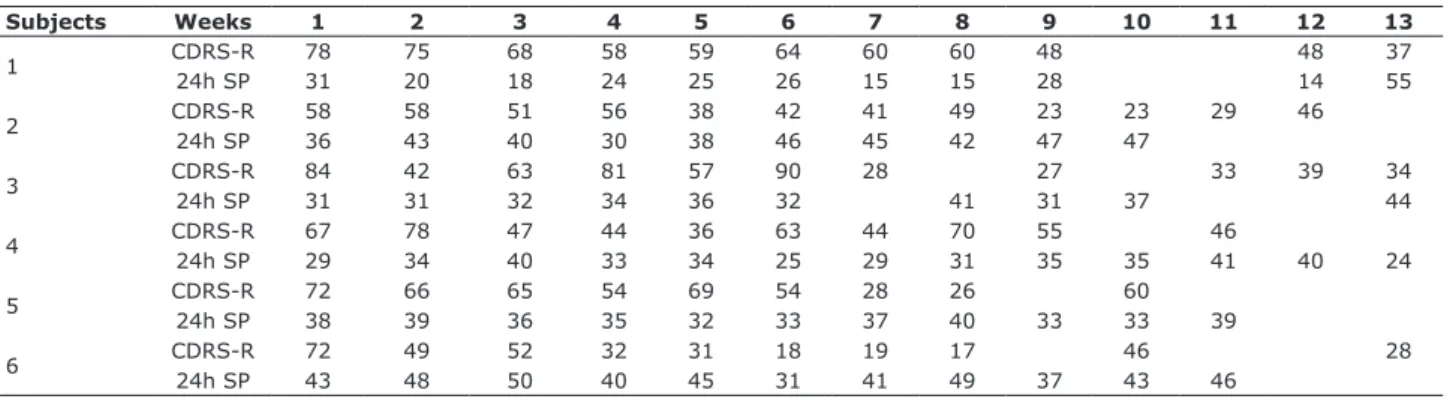
Table 2 lists the 24h SP values for the circadian activity/rest rhythm and CDRS-R scores over the period of 13 consecutive weeks.
Analysis of the correlation between CDRS and 24h SP returned values of r = -0.47 and p < 0.001. Mean 24h SP was higher in weeks in which CDRS was less than 40 in ive of the subjects (Table 3). Subject 6 exhibited a higher mean 24h SP in the weeks he was depressed (CDRS greater than or equal to 40). The overall analysis detected a signiicant diference between weeks with and without depression (p = 0.0032) (Table 3).
Discussion
To our knowledge, this is the irst study of circadian
activity/rest rhythms along the course of treatment of depressed adolescents. Our results demonstrate
a relationship between the 24h SP of the patients’
activity/rest rhythms and their depressive state. Lower
24h SP values were observed during depressive states and higher 24h SP were observed when symptoms were in remission or attenuated. These results support the
theory of loss of circadian power in depressive state.
by two expert psychiatrists. The Brazilian version of the Schedule for Afective Disorders and Schizophrenia for School Aged Children: Present and Lifetime Version
(K-SADS-PL)23 was used to conirm MDD diagnosis and
co-morbidities. The patients had no medical/neurological
diseases and were not given medications that could alter
circadian rhythms during the study. They were evaluated
only after their parents or legal guardians had given written consent for participation and they had provided
verbal consent themselves. The study protocol was
approved by the ethics committees at both UNIFESP and FMUSP.
Motor activity was recorded by actimeters over
a period of 13 consecutive weeks. The actimeter
(MiniMitter Monitoring) is a small accelerometer worn on the non-dominant wrist, with memory for data storage.
This device detects accelerations greater than 0.01G
force (up to 10 counts per second). Actimeter data
were processed individually. Time series with 10 minute intervals (between data points) and weekly intervals starting on Sundays were analyzed. These time intervals were submitted to the Sokolove-Bushell spectral analysis algorithm using El Temps software.30
During the 13-week period, the adolescents also kept activity diaries with their routine activities (school
timetables, transport, start and end of sleep and other
activities) that were based on a work shift diary. Initially
we intended to monitor social activities but diary data were incomplete so we only used these data to evaluate
possible masking factors, such as fever or physical
exercises, and removal of the actimeter.31
Clinical assessments were carried out weekly and the Children’s Depression Rating Scale – Revised (CDRS-R)
was used to assess depressive symptoms. According to
this scale, total scores of 40 or more are strong indicators of the presence of an MDD32 and remission was deined as
when the total score was lower than 40.
All patients received sertraline as an antidepressant treatment, but their doses were individually adjusted to achieve decrease or remission of symptoms. Four patients were on 50 mg/day and two patients were on
100 mg/day from after the irst week until the end of the study. The 13-week period was chosen because it is the mean time taken to achieve a response to
Table 1 - Demographics, DSM-IV co-morbidities diagnosed, school and work schedules and sleep phase delay at weekends
Subjects Sex Age Co-morbidities diagnosed Schedules school/work Sleep phase delay
1 M 17 Dysthymic disorder Not studying No
2 F 17 Dysthymic disorder Morning Present
3 F 15 PTSD Morning Present
4 M 17 Dysthymic disorder Night No
5 F 16 Dysthymic disorder Morning Present
6 F 17 Bulimia Night No
Table 3 - Mean 24h SP weeks with and without depression
Subjects
CDRS 24h SP
DP NDP DP NDP
1 61.8 37 21.6 55
2 50.7 28 40.3 44
3 69.5 30.5 32.7 37.5
4 57.1 36 33 34
5 62.9 27 35.1 38.5
6 54.7 23.4 46 41.2
Total 59.6 27.8 33 41.3
p-value < 0.0001 0.0032
24h SP = 24h spectral power; CDRS = Children’s Depression Rating Scale – Revised; DP = weeks with depression; NDP = weeks without depression.
Table 2 - CDRS-R scores and 24h SP values weekly over 13 weeks
Subjects Weeks 1 2 3 4 5 6 7 8 9 10 11 12 13
1 CDRS-R 78 75 68 58 59 64 60 60 48 48 37
24h SP 31 20 18 24 25 26 15 15 28 14 55
2 CDRS-R 58 58 51 56 38 42 41 49 23 23 29 46
24h SP 36 43 40 30 38 46 45 42 47 47
3 CDRS-R 84 42 63 81 57 90 28 27 33 39 34
24h SP 31 31 32 34 36 32 41 31 37 44
4 CDRS-R 67 78 47 44 36 63 44 70 55 46
24h SP 29 34 40 33 34 25 29 31 35 35 41 40 24
5 CDRS-R 72 66 65 54 69 54 28 26 60
24h SP 38 39 36 35 32 33 37 40 33 33 39
6 CDRS-R 72 49 52 32 31 18 19 17 46 28
24h SP 43 48 50 40 45 31 41 49 37 43 46
24h SP = 24h spectral power; CDRS-R = Children’s Depression Rating Scale – Revised. Blanks correspond to missing data.
Clinical improvement was associated with the
highest 24h SP values in ive patients (numbers 1 to
5). Patient 1 who presented later improvement (only
in the 13th week) had lower mean 24h SP during the depressed phase. Patient 6 had higher mean 24h SP and took less time to recover (four weeks). Teicher et
al. observed that depressed children with adequately
entrained 24h circadian rhythms took less time to recover
from depression without medications then children with circadian disturbances.33 Previous studies have also
shown an increase in gross motor activity in depressed patients following successful treatment.24,29,34
The only discrepant result (patient 6) suggests that
circadian disorders may be present in some but not all depressive states, which is probably related to subtypes of depression23 or to depressive severity.29 One possibility
is that this patient had a well synchronized rhythm (the
irst three weeks with depression had high spectral power values). It would therefore be diicult to increase the spectral power in the following weeks.
It is important to note that monitoring locomotor
activity over the 13 weeks of treatment allowed us to
compare the patient with themselves in terms of their
individual data for depressive state, social schedules and rhythms.
Limitations of this study include the small size of
the sample that is insuicient to allow generalizations, so further replications are needed; and the fact that no
controls not on antidepressant treatment were included.
However, prior studies have reported the 24h patterns of normal controls and shown that the efects of medication
on circadian rhythms were due to their impact on core depressive symptoms.29,34 Additionally, we were unable
to distinguish unipolar from bipolar depression with
certainty, and depression in adolescents can be the irst
episode of bipolar disorder.
The amount of data for each patient assessed in this study was not uniform (see blanks in Table 2) and these diferences were due to missed clinical assessments and
to problems with recording of actimeter data.
These results support the model of circadian
attenuation (loss of circadian power) during depression.17,18
Furthermore, the temporal coincidence between clinical
improvement and increase in 24h SP suggests a possible temporal link between improvement of symptoms and
entrainment of circadian rhythms.
Analysis of circadian dysregulation may contribute to understanding the pathogenesis of depression and
to evaluation of therapeutic eicacy and provides a
potentially useful tool for prognostic assessment and therapeutic management of adolescent depression.
The National Institute of Mental Health has recently released its Research Domain Criteria (RDoC). The RDoC is an initiative to improve classiication of mental health and
open new lines of research based on examining patients’ responses with biological measures.35 The actimeter is
one methodology that is provided for within the RDoC framework as a means of measuring synchronization to the light/dark cycle outside. This study shows the
Acknowledgements
This study was partially supported by Fundação de Amparo à Pesquisa do Estado de São Paulo (FAPESP; grant 01/0435-5). We gratefully acknowledge the help of Mr. José Ricardo Lopes and Dr. Rosa Maria Mesquita.
References
1. Wehr TA, Goodwin FK. Biological rhythms in manic-depressive illness. In: Wehr TA, Goodwin FK, editors. Circadian rhythms in psychiatry. Paciic Grove: Boxwood; 1983. p. 129-84.
2. Akiskal HS. Transtornos do humor: introdução e panorama. In: Kaplan I, Sadock BJ, editores. São Paulo: Artmed; 1999. p. 1175-87.
3. Yanielli PC. Cronobiología de la ansiedad e de la depresión mayor. In: Golombeck D. Cronobiología humana: ritmos y relojes biológicos en la salud y en la enfermedad. Quilmes: Universidad Nacional Quilmes; 2002. p. 171-86.
4. Brown LF, Reynolds CF 3rd, Monk TH, Prigerson HG, Dew MA, Houck PR, et al. Social rhythm stability following late-life
spousal bereavement: associations with depression and sleep
impairment. Psychiatry Res. 1996;62:161-9.
5. Prigerson HG, Reynolds CF 3rd, Frank E, Kupfer DJ, George CJ, Houck PR. Stressful life events, social rhythms, and depressive
symptoms among the elderly: an examination of hypothesized
causal linkages. Psychiatry Res. 1994;51:33-49.
6. Szuba MP, Yager A, Guze BH, Allen EM, Baxter LR Jr. Disruption
of social circadian rhythms in major depression: a preliminary
report. Psychiatry Res. 1992;42:221-30.
7. Luik AI, Zuurbier LA, Direk N, Hofman A, Van Someren EJ, Tiemeier H. 24-hour activity rhythm and sleep disturbances in
depression and anxiety: a population-based study of
middle-aged and older persons. Depress Anxiety. 2015;32:684-92. 8. Wirz-Justice A, Bromundt V, Cajochen C. Circadian disruption
and psychiatric disorders: the importance of entrainment. Sleep
Med Clin. 2009;4:273-84.
9. Souêtre E, Salvati E, Belegou JL, Pringuey D, Candito M, Krebs
B, et al. Circadian rhythms in depression and recovery: evidence for blunted amplitude as the main chronobiological abnormality.
Psychiatry Res. 1989;28:263-78.
10. Ávila Moraes C, Cambras T, Diez-Noguera A, Schimitt R, Dantas G, Levandovski R, et al. A new chronobiological approach to
discriminate between acute and chronic depression using peripheral temperature, rest-activity, and light exposure
parameters. BMC Psychiatry. 2013;13:77.
11. Luik AI, Zuurbier LA, Hofman A, Van Someren EJ, Tiemeier H.
Stability and fragmentation of the activity rhythm across the
sleep-wake cycle: the importance of age, lifestyle, and mental health. Chronobiol Int. 2013;30:1223-30.
12. Hickie IB, Naismith SL, Robillard R, Scott EM, Hermens DF. Manipulating the sleep-wake cycle and circadian rhythms to
improve clinical management of major depression. BMC Med.
2013;11:79.
13. Goodwin FK and Jamison KR. Childhood and adolescence. In: Goodwin FK, Jamison KR, editors. Maniac-depressive illness.
New York: Oxford University; 1990. p. 186-209.
14. McCauley E, Pavlidis K, Kendall K. Developmental precursors of
depression: the child and the social environment. In: Goodyer
IM, editor. The depressed child and adolescent. Cambridge: Cambridge University; 2001. p. 204-32.
15. de Souza CM, Hidalgo MP. Midpoint of sleep on school days is associated with depression among adolescents. Chronobiol Int.
2014;31:199-205.
16. Carissimi A, Dresch F, Martins AC, Levandovski RM, Adan A, Natale V, et al. The inluence of school time on sleep patterns of children and adolescents. Sleep Med. 2016;19:33-9.
17. Siever LJ, Davis KL. Overview: toward a dysregulation hypothesis of depression. Am J Psychiatry. 1985;142:1017-31. 18. Schulz H, Lund R. On the origin of early REM episodes in the
sleep of depressed patients: a comparison of three hypotheses.
Psychiatry Res. 1985;16:65-77.
19. Sokolove PG, Bushell WN. The chi square periodogram: its utility for analysis of circadian rhythms. J Theor Biol. 1978;72:131-60. 20. Teicher MH, Glod CA, Harper D, Magnus E, Brasher C, Wren F,
et al. Locomotor activity in depressed children and adolescents: I. Circadian dysregulation. J Am Acad Child Adolesc Psychiatry.
1993;32:760-9.
21. Gwirtsman HE, Halaris AE, Wolf AW, DeMet E, Piletz JE, Marler M.
Apparent phase advance in diurnal MHPG rhythm in depression.
Am J Psychiatry. 1989;146:1427-33.
22. Kupfer DJ, Weiss BL, Foster G, Detre TP, McPartland R. Psychomotor activity in afective states. Arch Gen Psychiatry. 1974;30:765-8.
23. Benoit O, Royant-Parola S, Borbely AA, Tobler I, Windlocher D.
Circadian aspects of motor activity in depressed patients. Acta
Psychiat Belg. 1985;85:582-92.
24. Raoux N, Benoit O, Dantchev N, Denise P, Franc B, Allilaire JF,
et al. Circadian pattern of motor activity in major depressive patients undergoing antidepressant therapy: relationship between actigraphic measures and clinical course. Psychiatry
Res. 1994;52:85-98.
25. Dahl R, Puig-Antich J, Ryan N, Nelson B, Novacenko H, Twomey
J, et al. Cortisol secretion in adolescents with major depressive
disorder. Acta Psychiatr Scand. 1989;80:18-26.
26. Puig-Antich J. Afective disorders in children and adolescents: diagnostic validity and psychobiology. In: Meltzer HY, editor.
Psychopharmacology the third generations of progress. New
York: Raven Press; 1987. p. 843.
27. Dahl R, Ryan ND, Puig-Antich J, Nguyen NA, al-Shabbout M, Meyer VA, et al. 24-hour cortisol measures in adolescents
with major depression: a controlled study. Biol Psychiatry.
1991;30:25-36.
28. Cavallo A, Holt KG, Jejazi MS, Richards GE, Meyer WJ 3rd.
Melatonin circadian rhythm in childhood depression. J Am Acad
Child Adolesc Psychiatry. 1987;26:395-9.
29. Aronen ET, Teicher MH, Geenens D, Curtin S, Glod CA, Pahlavan
K. Motor activity and severity of depression in hospitalized prepubertal children. J Am Acad Child Adolesc Psychiatry.
1996;35:752-63.
30. El Temps: the chronobiologist’s program [Internet]. 1999 [cited
2015 Jul 9]. el-temps.com/principal.html
31. Fisher FM. Método de avaliação do ritmo de trabalho e repouso
entre condutores de veículos. In: 1º Congresso Brasileiro de Segurança do Tráfego; 1985; São Paulo, Brasil.
32. Poznanski EO, Mokros HB. Children’s Depression Ranting Scale, Revised (CDRS-R). Los Angeles: Western Psychological Services; 1996.
33. Teicher MH, Glod CA, Pahlavan K, Magnus E, Harper D. Circadian
activity dysregulation and antidepressant response in children
and adolescents. In: Scientiic Proceedings of the 37th Meeting of the American Academy of Child and Adolescent Psychiatry; 1990; Chicago, USA. vol. VI, p. 58.
34. Godfrey HP, Knight RG. The validity of actometer and activity
speech measures in the assessment of depressed patients. Br J
Psychiatry. 1984;145:159-63.
35. Insel T, Cuthbert B, Garvey M, Heinssen R, Pine DS, Quinn K, et al. Research domain criteria (RDoC): toward a new classiication framework for research on mental disorders. Am J Psychiatry. 2010;167:748-51.
Correspondence: