Luis Ramon Marques da Rocha GorgotI
Iná SantosI Neiva ValleI
Alicia MatisajevichI
Aluisio J D BarrosI
Elaine AlbernazII
I Programa de Pós-Graduação em Epidemiologia. Universidade Federal de Pelotas (UFPel). Pelotas, RS, Brasil II Programa de Pós-Graduação em Saúde e
Comportamento. Faculdade de Medicina. Universidade Católica de Pelotas. Pelotas, RS, Brasil
Correspondence:
Luis Ramon Marques da Rocha Gorgot Universidade Federal de Pelotas R. General Osório, 1227 Centro 96020-000 Pelotas, RS, Brasil E-mail: [email protected] Received: 2/6/2010
Approved: 10/18/2010
Article available from: www.scielo.br/rsp
Avoidable deaths until months
of age among children from the
2004 Pelotas birth cohort
ABSTRACT
OBJECTIVE: To describe avoidable of children from the 2004 Pelotas Birth Cohort.
METHODS: The death of 92 children between 2004/2008 from Pelotas Birth Cohort were identifi ed and classifi ed according to the Brazilian List of Avoidable Causes of Mortality of Brazilian Unifi ed Healthcare System. The Mortality Information System (SIM) for the State of Rio Grande do Sul (Southern Brazil) and the city of Pelotas were screened to search for deaths that occurred outside the city, as well as causes of deaths after the 1st year. Causes of infant deaths (<1 year of age) were compared between information from a sub-study and SIM. Mortality coeffi cients per 1,000 LB and proportional mortality for avoidable causes, including by type of health facility (traditional or Family Health Strategy) were calculated.
RESULTS: The mortality coeffi cient was 22.2/ 1,000 LB, 82 the deaths occurred in the fi rst year of life (19.4/1,000LB), and these included 37 (45%) in the fi rst week. More than ¾ of the deaths (70/92) were avoidable. In infancy, according to the sub-study, the majority (42/82) could be prevented through adequate care of the woman during pregnancy; according to SIM, the majority could have been prevented through adequate newborn care (32/82). There was no difference in the proportion of avoidable deaths by type of health facility.
CONCLUSIONS: The proportion of avoidable deaths is high. The quality of death certifi cate registries needs improvement so that avoidable deaths can be employed as an indicator to monitor maternal and child health care.
DESCRIPTORS: Infant Mortality. Child Mortality. Cause of Death. Cohort Studies.
INTRODUCTION
Infant mortality includes deaths between birth and the fi rst year of life.22 It is an
important indicator for the level of economic development in a community.24
Preliminary data showed that, between 1994 and 2008, infant mortality in Brazil reduced from 38.2 to 19.0 per thousand live births (LB),a mostly due to the
reduction in postneonatal deaths, which was responsible for the largest propor-tion of infant mortality in the country. Despite the decrease, infant mortality continues to be an important public health problem in Brazil: there were 90 thousand deaths among infants under one year old in 2004, the majority from avoidable causes.b Avoidable deaths are those that could have been prevented
a Ministério da Saúde. Saúde Brasil 2009: uma análise da situação de saúde e da agenda nacional e internacional de prioridades em saúde. Brasília, DF; 2010. [Cited 2010 Dez 21]. Available from: http://portal.saude.gov.br/portal/arquivos/pdf/SAUDE_BRASIL_2009_COLETIVA.pdf
c Estado do Rio Grande do Sul. Secretaria da Saúde. Plano Diretor de Regionalização da Saúde. Porto Alegre; 2002.
d Puffer RR, Serrano CV. Patterns of mortality in childhood: report of the Inter-American Investigation of Mortality in Childhood. Washington, DC: Pan American Health Organization; 1973.
e World Health Organization. International statistical classifi cation of diseases and related health problems: 10. revision. Geneva; 1993. (in totality or in part) with the presence of effective
health services.20
In critique of the various mortality analyses performed among the three Pelotas Birth Cohorts (1982, 1992 and 2004),11,18,22 no study specifi cally analyzed the
percen-tage of deaths classifi ed as avoidable. The identifi cation and quantifi cation of these causes are important for directing health actions, since decisions in regards to investment of human and technological resources depend on understanding the mechanisms that leads to death. This study aimed to describe avoidable deaths among children born in the 2004 Pelotas Cohort.
METHODS
Pelotas is located in the far South of Brazil, close to the border with Uruguay and Argentina and has a population of 340,000 residents. It is a transportation and university center and a reference point in the health sector for the Southern region of Rio Grande do Sul, according to the Regionalization Director Plan.c The
Sistema Único de Saúde (SUS – National Unifi ed Health System) in Pelotas consists of 54 Unidade Básica de Saúde (UBS – Basic Health Units) distributed in urban and rural zones. The 4,231 LB in Pelotas were included in the 2004 Birth Cohort. To identify births, hospitals were visited daily, from January 1 to December 31, by a specially trained team. Mothers that resided in the urban zone of Pelotas and in the Jardim América neighborhood (contiguous to Pelotas and part of the city of Capão do Leão) were interviewed immediately after birth with a pre-coded questionnaire. Children were weighed and measured.3 The cohort of
children were followed-up four times: at three, 12, 24 and 48 months of age. Further details on the metho-dology of the 2004 Cohort are available elsewhere.2
Deaths were identifi ed through follow-up visits and searches of the SIM-RS and SIM-Pelotas database, through 31 December 2008, when all children had completed four years of age. The data was transferred to an electronic worksheet, and the mother’s name and child’s date of birth (date and month) were compared to the available information in the perinatal cohort database. The information available in SIM was trans-cribed, and the primary cause of death from the death certifi cate was assumed to be the actual cause of death.
Deaths during the fi rst year of life were analyzed (between 1 Januray 2004 and 31 December 2005). Deaths were monitored by daily visits to the main hospitals of the city (intensive care units, nurseries, pediatric infi rmaries and emergency rooms). To detect
extra-hospital deaths, bureaucratic registration offi ces, cemeteries and Regional Health Delegacies were visited. Early neonatal deaths (occurring in the fi rst seven days), late neonatal deaths (from the eighth until before the 28th day) and postneonatal deaths (from 28
until 364 days) were included. Information about the primary cause of death were collected by interview of the pediatrician responsible for the newborn’s care at the time of death. In the case of hospitalized children, hospital records were reviewed, and information about the cause of admission, patient history, illness progres-sion, complementary tests, treatment and diagnosis were gathered. Information collected from the perinatal questionnaire of the mother were utilized if necessary.
For children that died between seven and 364 days, a household visit was performed to ask the mother about the clinical history of the illness and its antecedents. For this interview, the questionnaires from the Inter-American Investigation of Mortality in Childhoodd
were adapted to the local reality. These questionnaires comprise several sets of questions, including: iden-tifi cation data, maternal complications, information about type of birth, type of transport for the newborn to the neonatal treatment unit, the newborn’s conditions when admitted into an intensive care unit, pathologies identifi ed, treatment and start and progression of symp-toms. For deaths that occurred outside of the hospital or in other cities, information was collected from death certifi cates, supplemented by household interviews with family members. Two independent pediatricians were responsible for determining the primary cause of death. In case of disagreement, a third pediatrician was invited to discuss the case for a fi nal decision. The decisions were codifi ed according to the International Classifi cation of Diseases.e For those that died after
the fi rst year of life or that were not found in follow-up visits, the cause of death was obtained through an analysis of SIM-RS and SIM-Pelotas databases.
Deaths of children less than fi ve years of age were considered avoidable through primary care actions as proposed by Malta et al.15 The list is divided into three
sections: avoidable deaths, deaths from undefined causes and other causes. The avoidable causes of death were classifi ed in four groups: preventable through immunization; adequate care for women during preg-nancy and birth and newborn care; adequate diagnostic and treatment actions; and adequate health promotion actions connected to adequate health care actions.
during pregnancy (congenital syphilis; diseases caused by HIV; maternal conditions that affect the fetus or newborn, which are transmitted through the placenta or mother’s milk and are not necessarily related to the current pregnancy; maternal pregnancy complications that affect the fetus or newborn, fetal growth or fetal malnutrition; conditions related to short-term gestations and low birth weight); adequate maternal care during birth (other complications of delivery that affect the newborn, conditions related to long gestations and high birth weight, trauma from birth, intrauterine hypoxia and birth asphyxia and neonatal aspiration); and adequate newborn care (congenital pneumonia, newborn respiratory diffi culty, pulmonary hemorrhage originating from the perinatal period, bacterial septi-cemia and omphalitus).
Children under one year old were classifi ed as cases of sudden infant death syndrome (SIDS) when there was a death at home without an apparent cause (the mother found the dead child in the crib, without iden-tifying any previous disease symptom), a death with a determination of “death by milk aspiration” or “death by suffocation” or when there was no autopsy for death and an unknown ICD cause. Although the list by Malta et al15 classifi ed sudden death as “other causes”, we
classifi ed sudden death as reducible through adequate health promotion actions, since putting children to sleep on their back is an effective prevention measure.14
Prematurity was classifi ed as a primary cause as long as there was no associated illness, such as syphilis or congenital malformations.
The perinatal database from the 2004 cohort provided information gathered at birth (name; sex; date of birth; birth weight; gestational age,16 utilizing the date of
last menstruation and newborn exam, according to the method by Dubowitz6) and household address. For
those that died, the date, age and municipality of resi-dence at time of death were obtained from the cohort follow-up registry or from the SIM database.
Between 2004 and 2008, the local health system was characterized according to the following features of the UBS: name, address, geographic area of the enrolled population, type of health facility (traditional of Estratégia de Saúde da Família – ESF; Family Health Strategy). The day of initiation for the ESF team was utilized to classify the health unit as ESF if it functioned for at least six months (before January 2004). The mixed health posts (traditional with ESF team) were classifi ed as ESF, irrespective of the number of teams. The central region of Pelotas, which has one UBS and a large amount of low-income households in its enrollment area that lack basic health services, was analyzed separately.
To calculate the mortality rate, the number of child deaths in the cohort through 2008 was divided by the
total number of LB (4,231) and multiplied by 1,000. The mortality rate from avoidable causes was obtained by dividing number of deaths due to avoidable causes by total LB and multiplying the result by 1,000. Proportionate mortality from avoidable causes was calculated by dividing number of deaths from avoidable causes by total number of deaths and multiplying by 100. These indicators were calculated for total deaths and for infant deaths. Proportionate mortality rate was calculated separately according to the type of health care facility (traditional or ESF) based on the address provided by the mother after birth in order to identify and classify the UBS responsible for the child care.
The research project of the 2004 Pelotas Birth Cohort was approved by the Research Ethics Committee of the Faculdade de Medicina da Universidade Federal de Pelotas (OF 080/09 of 25 March 2009).
RESULTS
There were 94 deaths, 82 before the fi rst full year of life, which corresponds to an infant mortality coeffi -cient of 19.4 deaths per 1,000 LB. The majority of deaths occurred in the early neonatal period (45.1%, n=37), followed by late neonatal deaths (18.3%, n=15) and postneonatal (36.6%, n=30). Twenty-six children weighed less than 1,000 grams at birth, 17 of which weighed less than 800 grams (three of these survived the fi rst week of life). Twelve children died after the fi rst year of life, an overall death rate of 22.2 per 1,000 LB in the 2004 cohort.
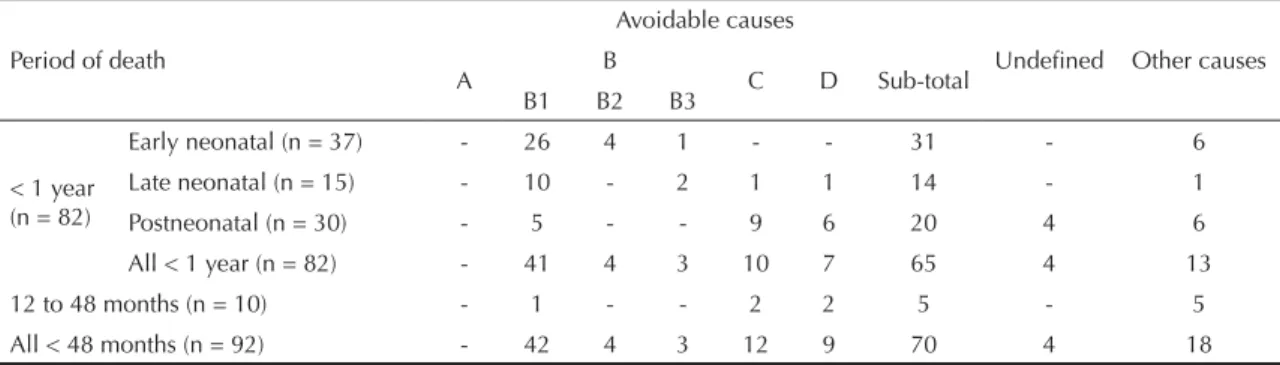
Of the 82 deaths during the fi rst year of life, 65 had avoidable causes (Table 1). The most frequent causes of death in the fi rst year of life were the conditions related to early-term pregnancy and low birth weight (Table 2). The majority of avoidable deaths could be reduced by adequate maternal care (63.1%; 41/65) (Table 1). Early-term pregnancy was present in 47.6% of deaths (39/82) (Table 2), and among these, 28 children had respiratory distress syndrome, a complication of early-term pregnancy. The cause of death was identifi ed as SIDS in four children and congenital syphilis in two.
In two of 12 deaths after one year old, it was not possible to identify cause. They were lost to follow-up, and the deaths probably occurred outside of the state, since the name of the children and their mothers were not identifi ed in SIM-RS. Four of ten deaths were iden-tifi ed as avoidable: two through adequate diagnosis and treatment (bronchopneumonia and acute myocarditis) and two through adequate health promotion actions (both from traffi c accidents) (Tables 1 and 2).
could have been reduced, mainly through adequate maternal care during pregnancy and birth and newborn care (70.0%, 49/70) (Table 1). Adequate maternal care during pregnancy could avoid 60.0% of avoidable deaths (42/70) and 85.7% (42/49) of deaths from this group of causes. No deaths occurred from causes of death avoidable by immunization.
Comparison, of the primary cause of death during the fi rst year of life to causes available in SIM, showed that to both the principal causes of deaths were preventable through adequate maternal care during pregnancy and birth and newborn care. There was a discrepancy between the two sources: while in this study avoidable causes of infant death were mostly reducible with adequate maternal care during pregnancy, according to SIM adequate newborn care was most important (Figure 1).
The majority of births in the 2004 cohort were children whose families resided outside of the city’s central zone. More than half of births occurred in about half of the areas belonging to city’s UBS.
There was no information for mother’s residence in three of the 94 children in the cohort, and it was not possible to link them to any UBS. Ten deaths were in children that lived in the city’s central area. For all other deaths, Table 3 presents number of births in 2004, number of deaths in the fi rst year of life and until 48 months of age and number of avoidable deaths, by type of UBS.
There were 2,523 LB in the enrollment areas of traditional UBS, of which 51 died, corresponding to a mortality rate of 20 per 1,000 LB during the period. Of
these deaths, approximately ¾ (n = 38) were avoidable, and more than half (n = 23) avoidable through adequate maternal care during pregnancy.
There was no statistically signifi cant difference in incidence of avoidable deaths between the type of UBS for place of birth (p = 0.8) (Table 3). There were 1,200 births registered in enrollment areas of the UBS-ESF. Thirty children died, which represents a mortality rate of 25 per 1,000 LB, similar to traditional UBS (p = 0.36). Of these deaths, 80% (n = 4) were avoidable and half (n = 15) were avoidable through adequate care for pregnant women. In total, 1.5% of children born in traditional UBS areas (38/2,523) died from some type of avoidable cause. The corresponding proportion for births in ESF areas was 2.0% (24/1,200), and in the central area it was 1.4% (7/503).
DISCUSSION
Mortality among children less than fi ve years old in the 2004 Pelotas Cohort was concentrated in the fi rst year of life. The majority of deaths could be avoided, mainly through adequate care to pregnant women. This fi nding is consistent with the increase in premature births registered in the city during the last decades.4 In
1982, prevalence of pre-term births was 6.3%, increa-sing to 11.4% in 1993 and 14.7% in 2004.4 During this
period, infant mortality, which in Pelotas decreased between 1982 and 1993 (from 36.4 to 21.1 per 1,000 LB), remained stable between 1993 and 2004 (19.4 per 1,000 LB).23 The increase in pre-maturity was the main
cause of death identifi ed in the perinatal period and the fi rst year of life.17
f Taucher E. Mortalidad infantil en Chile: tendencias, diferenciales y causas. Santiago de Chile: Centro Latinoamericano de Demografi a; 1979. Table 1. Number of deaths until 48 months by age period, according to the list of avoidable deaths. Pelotas, Southern Brazil, 2004-2008. (n = 92)
Period of death
Avoidable causes
Undefi ned Other causes
A B C D Sub-total
B1 B2 B3
< 1 year (n = 82)
Early neonatal (n = 37) - 26 4 1 - - 31 - 6
Late neonatal (n = 15) - 10 - 2 1 1 14 - 1
Postneonatal (n = 30) - 5 - - 9 6 20 4 6
All < 1 year (n = 82) - 41 4 3 10 7 65 4 13
12 to 48 months (n = 10) - 1 - - 2 2 5 - 5
All < 48 months (n = 92) - 42 4 3 12 9 70 4 18
A: Reducible through immunization.
B: Reducible through adequate maternal care during pregnancy and birth and newborn care. B1: Reducible through adequate maternal care during pregnancy.
B2: Reducible through adequate maternal care during birth. B3: Reducible through adequate newborn care.
C: Reducible through adequate diagnosis and treatment.
Studies of prenatal care in Pelotas have identifi ed limitations in quality of care, especially in the public sector which serves the population most susceptible to avoidable causes of infant death,4,10,23 fi ndings that are
supported by our study. More complex and expensive tests, such as obstetric ultrasounds, are performed at the
expense of easier and cheaper tests proven to reduce pre-maturity, such as syphilis serology and searching for urinary infections.1 In addition, the rate of women
that smoke during pregnancy among children born in 2004 was 25.1%, but among the poorest women, the smoking rate was greater (33.6%).21 This shows the Table 2. Causes of child death according to the list of avoidable deaths. Pelotas, Southern Brazil, 2008. (n = 92).
Classifi cation Cause of death < 1 yearDeaths
n
Deaths 12-48 months
n
B1 Congenital syphilis 2 1
Conditions related to short gestation and low birth weight not classifi ed elsewhere 39
-B2 Neonatal aspiration syndrome 4
-B3
Newborn omphalitis with or without light hemorrhage 1
-Other electrolyte and metabolic disturbances in the neonatal period 1
-Congenital pneumonia 1
-C
Acute bronchiolitis 5
-Acute bronchitis 1
-Non-specifi ed acute myocarditis - 1
Other septicemias - 1
Bacterial pneumonia not classifi ed elsewhere 3
-Pneumonia from unspecifi ed microorganism 1
-D
Diarrhea and gastroenteritis presumably from infectious origin 1
-Dog bite or strike 1
-Other choking or accidental strangling 1
-Pedestrian injured in other or unspecifi ed transportation accidents - 2
Sudden infant death syndrome 4
-DC
Metabolic disturbances of sphingolipids and other disturbances of lipid deposits 1
-Encephalocele 2
-Hydrocephalus - 1
Congenital hydrocephalus 2
-Congenital malformations of the cardiac chambers and valves 1
-Congenital malformation of the esophagus 1
-Congenital malformation of the cardiac septum 1
-Myasthenia gravis and other neuromuscular problems - 1
Neoplasm of unknown cause or unknown primary location and from unspecifi ed
locations - 1
Malignant neoplasm of the suprarenal gland - 1
Other chromosomal anomalies, not classifi ed elsewhere 2
-Other congenital heart malformations 2 1
Edwards Syndrome and Pataul Syndrome 1
-MD Other undefi ned and unspecifi ed causes or mortality 4
-Total 82 10
B1: Reducible through adequate maternal care during pregnancy. B2: Reducible through adequate maternal care during birth. B3: Reducible through adequate newborn care.
C: Reducible through adequate diagnosis and treatment.
D: Reducible through adequate health promotion connected to adequate health care. OC: Other causes.
need to invest in quality improvements in prenatal care offered to the poorest women.
Two other studies investigated causes of avoidable death among children under one year in Brazil. Between 1990 and 1992, Gomes et al9 studied 189 deaths in the
city of Presidente Prudente, Southeastern Brazil. They analyzed copies of death certifi cates; live birth certifi -cates; questionnaire data from interviews of mothers, health professionals and medical reports; in addition to registration books from the hospital nurseries. Primary causes of death were reclassifi ed according to criteria used by Taucher.f In the neonatal period, 22.2% of
deaths could have been avoided with adequate birth care, 20.6% through timely diagnosis and treatment and 13.7% through good management of pregnancy. At least 7.9% of neonatal deaths were unavoidable, and over the remainder of the period, 4.2% were unavoidable, with infant mortality reducible by 12.2%.
Caldeira et al5 studied a historical series of mortality in
the fi rst year of life in the metropolitan region of Belo Horizonte, Southeastern, between 1984 and 1998, using data from SIM and the Instituto Brasileiro de Geografi a e Estatística. During the study period, infant mortality decreased from 48.5 to 22.1 deaths per 1,000 LB. Among neonatal deaths, perinatal conditions were the main group of avoidable causes (mostly, perinatal malnutri-tion, prematurity, hypoxia and asphyxia), followed by cardiovascular and respiratory problems. The triad of diarrhea, pneumonia and malnutrition were the main avoidable causes of death during the postneonatal period.
Comparison of the results from these studies to our study is limited by time (one decade or longer) and by geographical distance, as well as by the distinct methodology used to identify cause and classifi cation of avoidable death. Nonetheless, the three studies indicate that avoidable infant deaths have been an important public health problem in Brazil over the
past several decades. Attribution of avoidable causes of death was inconsistent when obtained by a direct method (our study) compared through the SIM, even though the proportion of avoidable deaths does not change substantially between the two sources. We identifi ed the prenatal period as the time when more interventions to reduce avoidable deaths could occur. On the other hand, according to SIM data, interven-tions should focus on newborn care. For a city the size of Pelotas, this divergence has a large impact on the measures managers should adopt in order to reduce infant mortality. According to the results from SIM, manager should better equip neonatal intensive care
Table 3. Number of live births, deaths in under ones, avoidable deaths until 48 months and avoidable deaths by type of BHU. Pelotas, Southern Brazil, 2008. (n = 91)
Location Live births Deaths Óbitos 0 a 48 meses (%) Avoidable deaths
< 1 year B2 B3 C D
(%) Deaths 0 to 48 months 45 (1.8) 51 (2.0) 23 1 2 8 4
(%) 1,200 28 (2.3) 30 (2.5) 15 3 1 2 3
4 - - 2 1
- - - - 1
Total 4,231 82 94 42 4 3 12 9
UBS: Unidade Básica de Saúde (Basic Health Unit). ESF: Estratégia de Saúde da Família (Family Health Strategy). B1: Reducible through adequate maternal care during pregnancy. B2: Reducible through adequate maternal care during birth. B3: Reducible through adequate newborn care.
C: Reducible through adequate diagnosis and treatment.
D: Reducible through adequate health promotion connected to adequate health care.
Figure. Comparison of the proportion of avoidable deaths, by adequate care during pregnancy, birth or to the newborn during the fi rst year of life (n = 48) based on the state Mor-tality Information System (SIM). Pelotas, Southern Brazil, 2008. (n = 45)
85.4%
8.3% 6.3% 11.1% 17.8%
71.1%
Intervention period Avoidable by
adequate maternal care at pregnancy
Avoidable by adequate care
at birth
Avoidable by adequate newborn
care
% of avoidable deaths in the 1st year of life
1. Barros FC, Victora CG, Barros AJ, Santos IS, Albernaz E, Matijasevich A, et al. The challenge of reducing neonatal mortality in middle-income countries: fi ndings from three Brazilian birth cohorts in 1982,
1993, and 2004. Lancet. 2005;365(9462):847-54.
DOI:10.1016/S0140-6736(05)71042-4 2. Barros AJD, Santos IS, Victora CG, Albernaz EP,
Domingues MR, Timm IK, et al. Coorte de nascimentos
de Pelotas, 2004: metodologia e descrição. Rev Saude
Publica. 2006;40(3):403-13. DOI:
10.1590/S0034-89102006000300007
3. Barros AJD, Santos IS, Matijasevich A, Araújo CL, Gigante, DP, Menezes AMB, et al. Métodos utilizados nos estudos das coortes de nascimentos de 1982, 1993 e 2004 de Pelotas, Rio Grande do Sul, Brasil e descrição das condições sócio-econômicas das famílias
de participantes. Cad Saude Publica. 2008;24 (Supl
3):S371-80. DOI:10.1590/S0102-311X2008001500002 4. Barros FC, Victora CG, Matijasevich A, Santos IS,
Horta BL, Silveira MF, et al. Preterm births, low birth weight, and intrauterine growth restriction in three birth cohorts in Southern Brazil:1982, 1993 and
2004. Cad Saude Publica. 2008;24(Suppl 3):S390-8.
DOI:10.1590/S0102-311X2008001500004 5. Caldeira AP, França E, Perpetuo IH, Goulart EMA.
Evolução da mortalidade infantil por causas
evitáveis, Belo Horizonte, 1984-1998. Rev Saude
Publica. 2005;39(1):67-74.
DOI:10.1590/S0034-89102005000100009
6. Dubowitz LM, Dubowitz V, Goldberg C. Clinical
assessment of gestational age in the newborn infant. J
Pediatr. 1970;77(1):1-10.
7. Facchini LA, Piccini RX, Tomasi E, Thumé E, Silveira DS, Siqueira FV, et al. Desempenho do PSF no Sul e no Nordeste do Brasil: avaliação institucional e
epidemiológica da Atenção Básica à Saúde. Cienc
Saude Coletiva. 2006;11(3):669-81. DOI:10.1590/
S1413-81232006000300015
8. Fernandes LCL, Bertoldi AD, Barros AJD. Utilização dos serviços de saúde pela população coberta
pela Estratégia de Saúde da Família. Rev Saude
Publica. 2009;43(4):595-603.
DOI:10.1590/S0034-89102009005000040
units and train and hire professionals for intensive neonatal care. According to our results, the manager should improve quality of prenatal care, irrespective of primary care facility. Therefore, our results demonstrate the need for primary prevention of prematurity, while the results from SIM indicate secondary or even tertiary prevention measures.
There are few available interventions to prevent prematurity, including prevention of maternal tobacco use during pregnancy,13 identifi cation of urinary tract
infections during prenatal care19 and use of progesterone
among pregnant women with a history of previous pre-term birth.12 These can all be performed during
primary care.
The fi ndings from the 2004 Cohort probably refl ect the current situation in other medium-sized Brazilian cities with similar health service characteristics as Pelotas. Monitoring of deaths from avoidable causes would be an appropriate tool to evaluate the quality of maternal and child health care in Brazil. It is necessary, though, that the data source is reliable. Although the objective of the current study was not to measure the validity of information in SIM, the data allow us to anticipate that use of SIM could lead to inaccurate recommendations to managers. SIM is subject to the quality of death certi-fi cates and the competence of the doctor that attended to the death. Therefore, adequate training of doctors to perform death certifi cates is a necessary condition for use of SIM to monitor avoidable deaths.
9. Gomes JO, Santo AH. Mortalidade infantil em município da região Centro-Oeste Paulista, Brasil,
1990 a 1992. Rev Saude Publica. 1997;31(4):330-41.
DOI:10.1590/S0034-89101997000400002
10. Halpern R, Barros FC, Victora CG, Tomasi E.
Atenção pré-natal em Pelotas, RS, 1993. Cad Saude
Publica.1998;14(3):487-92.
DOI:10.1590/S0102-311X1998000300004
11. Horta BL, Gigante DP, Candiota JS, Barros FC, Victora CG. Monitorização da mortalidade na coorte de
nascimentos de 1982 a 2006, Pelotas, RS. Rev Saude
Publica. 2008;42(Supl 2):S108-14. DOI:10.1590/
S0034-89102008000900015
12. Iams JD, Romero R, Culhane JF, Goldenberg RL. Primary, secondary, and tertiary interventions to reduce
the morbidity and mortality of preterm birth. Lancet.
2008;371(9607):164-75. DOI:10.1016/S0140-6736(08)60108-7
13. Lumley J, Oliver SS, Chamberlain C, Oakley L. Interventions for promoting smoking cessation
during pregnancy. Cochrane Database Syst Rev.
2004(4):CD001055. DOI:10.1002/14651858. CD001055.pub2
14. Malloy MH. Trends in postneonatal aspiration deaths and reclassifi cation of sudden Infant death syndrome:
impact of the “Back to Sleep” Program. Pediatrics.
2002;109(4);661-5. DOI:10.15421/peds.109.4.661
15. Malta DC, Duarte EC, Almeida MF, Dias MAS, Morais Neto OL, Moura L, et al. Lista de causas de mortes evitáveis por intervenções do Sistema Único de Saúde
do Brasil. Epidemiol Serv Saude. 2007;16(4):233-44.
16. Martin JA, Hamilton BE, Sutton PD, Ventura SJ, Menacker F, Munson ML. Births: fi nal data for 2003.
Natl Vital Stat Rep. 2005;54(2):1-116.
17. Matijasevich A, Santos IS, Barros AJD, Menezes, AMB, Albernaz EP, Barros FC, et al. Perinatal mortality in three population-based cohorts from Southern
Brazil: trends and differences. Cad Saude Publica.
2008;24(Suppl 3):S399-408. DOI:10.1590/S0102-311X2008001500005
This article is based on data from the 2004 Pelotas Birth Cohort, conducted by the Programa de Pós-Gradução em Epidemiologia da Universidade Federal de Pelotas. The 2004 Birth Cohort is currently fi nanced by the Wellcome Trust Initiative (Major Awards for Latin America on Health Consequences of Population Change).
Previous stages of the study were fi nanced by the World Health organization, the Programa Nacional de Apoio a Centos de Excelência (PRONEX), the Conselho Nacional de Desenvolvimento Científi co e Tecnológico (CNPq), the Brazil Ministry of Health and the Child Pastorial. Fother
Article based on a Master’s dissertation in Evidence-Based Public Health at the Programa de Pós-Gradução em Epidemiologia da Universidade Federal de Pelotas, by Gorgot LRMR, in 2009.
The authors declare that there are no confl icts of interest. 18. Menezes AMB, Victora CG, Barros FC, Albernaz EP,
Menezes FS, Jannke HA, et al. Mortalidade infantil em duas coortes de base populacional no sul do
Brasil: tendências e diferenciais. Cad Saude Publica.
1996;12(Supl 1):S79-86. DOI:10.1590/S0102-311X1996000500012
19. Romero R, Oyarzun E, Mazor M, Sirtori M, Hobbins JC, Bracken M. Meta-analysis of the relationship between asymptomatic bacteriuria and preterm delivery/low
birth weight. Obstet Gynecol. 1989;73(4):576-82.
20. Rutstein DD, Berenberg W, Chalmers TC, Child CG 3rd, Fishman AP, Perrin EB. Measuring the
quality of medical care: a clinical method. N
Engl J Med. 1976;294(11):582–8. DOI:10.1056/
NEJM197603112941104
21. Santos IS, Barros AJD, Matijasevich A, Tomasi E, Medeiros RS, Domingues MR, et al. Mothers and
their pregnancies: a comparison of three
population-based cohorts in Southern Brazil. Cad Saude Publica.
2008;24(Suppl.3):S381-9. DOI:10.1590/S0102-311X2008001500003
22. Santos IS, Menezes AMB, Mota DM, Albernaz EP, Barros AJD, Matijasevich A, et al. Infant mortality in three population-based cohorts in Southern
Brazil: trends and differentials. Cad Saude Publica.
2008;24(Suppl 3):S451-60. DOI:10.1590/S0102-311X2008001500011
23. Silveira DS, Santos IS, Costa JSD. Atenção pré-natal na rede básica: uma avaliação da estrutura e do processo.
Cad Saude Publica. 2001;17(1):131-9. DOI:10.1590/
S0102-311X2001000100013
24. Yu V. Global, regional and national perinatal and
neonatal mortality. JPerinat Med. 2003;31(5):376-9.