Determinants of outpatient expenditure within primary care
in the Brazilian National Health System
Determinantes de gastos ambulatoriais na atenção primária do sistema público de
saúde brasileiro
Bruna Camilo Turi
I, Jamile Sanches Codogno
II, Flávia Mori Sarti
III, Nana Kwame Anokye
IV, Rômulo Araújo Fernandes
I,
Henrique Luiz Monteiro
VUniversidade Estadual Paulista (UNESP), Bauru (SP), Brazil
ABSTRACT
CONTEXT AND OBJECTIVE: One of the big challenges facing governments worldwide is the inancing of healthcare systems. Thus, it is necessary to understand the factors and key components associated with healthcare expenditure. The aim here was to identify demographic, socioeconomic, lifestyle and clinical factors associated with direct healthcare expenditure within primary care, among adults attended through the Brazilian National Health System in the city of Bauru.
DESIGN AND SETTING: Cross-sectional study conducted in ive primary care units in Bauru (SP), Brazil. METHODS: Healthcare expenditure over the last 12 months was assessed through medical records of adults aged 50 years or more. Annual healthcare expenditure was assessed in terms of medication, labora-tory tests, medical consultations and the total. Body mass index, waist circumference, hypertension, age, sex, physical activity and smoking were assessed through face-to-face interviews.
RESULTS: The total healthcare expenditure for 963 participants of this survey was US$ 112,849.74 (46.9% consultations, 35.2% medication and 17.9% laboratory tests). Expenditure on medication was associated with overweight (odds ratio, OR = 1.80; 95% conidence interval, CI: 1.07-3.01), hypertension (OR = 3.04; 95% CI: 1.91-4.82) and moderate physical activity (OR = 0.56; 95% CI: 0.38-0.81). Expenditure on consultations was associated with hypertension (OR = 1.67; 95% CI: 1.12-2.47) and female sex (OR = 1.70; 95% CI: 1.14-2.55).
CONCLUSIONS: Our results showed that overweight, lower levels of physical activity and hypertension were independent risk factors associated with higher healthcare expenditure within primary care.
RESUMO
CONTEXTO E OBJETIVO: Um dos grandes desaios dos governos em todo o mundo é o inanciamento de sistemas de saúde e, por isso, é necessário compreender fatores e componentes-chave associados a despesas em saúde. O objetivo foi identiicar fatores demográicos, socioeconômicos, de estilo de vida e clínicos associados aos gastos diretos com saúde na atenção primária entre adultos do Sistema Único de Saúde da cidade de Bauru.
TIPO DE ESTUDO E LOCAL: Estudo transversal realizado em cinco Unidades Básicas de Saúde em Bauru (SP), Brasil.
MÉTODO: Gastos com saúde nos últimos 12 meses foram avaliados através de prontuários médicos de adultos de 50 anos ou mais. Gastos anuais com saúde foram avaliados com: medicamentos, exames labo-ratoriais, consultas médicas e total. Índice de massa corporal, circunferência da cintura, hipertensão, idade, sexo, atividade física e tabagismo foram avaliados por meio de entrevista face a face.
RESULTADOS: O gasto total com serviços de saúde para os 963 participantes deste inquérito foi de US$ 112.849.74 (46,9% consultas, 35,2% medicamentos e 17,9% exames). Gastos com medicamentos foram associados com sobrepeso (odds ratio, OR = 1,80 [intervalo de coniança, IC 95%: 1,07-3,01]), hi-pertensão (OR = 3,04 [IC 95%: 1,91-4,82]) e atividade física moderada (OR = 0,56 [95% IC: 0,38-0,81]). Gas-tos com consultas foram associados com hipertensão (OR = 1,67 [IC 95%: 1,12-2,47]) e sexo feminino (OR = 1,70 [IC 95%: 1,14-2,55]).
CONCLUSÃO: Nossos resultados mostraram que sobrepeso, menor nível de atividade física e hipertensão são fatores de risco independentes associados com maiores gastos com saúde na atenção primária. IMSc, PhD. Researcher, Postgraduate Program
on Kinesiology, Universidade Estadual Paulista (UNESP), Rio Claro (SP), Brazil.
IIMSc, PhD. Professor, Department of Physical
Education, Universidade Estadual Paulista (UNESP), Presidente Prudente (SP), Brazil.
IIIMSc, PhD. Professor, Department of Food and
Experimental Nutrition, Universidade de São Paulo (USP), São Paulo (SP), Brazil.
IVPhD. Senior Research Fellow. Institute of
Environment, Health and Societies, Brunel University, Uxbridge, London, United Kingdom.
VMSc, PhD. Professor, Department of Physical
Education, Universidade Estadual Paulista (UNESP), Bauru (SP), Brazil.
KEY WORDS:
Health expenditures. Primary health care. Public health. Risk factors. Epidemiology.
PALAVRAS-CHAVE:
INTRODUCTION
One of the big challenges facing governments worldwide is the inancing of healthcare systems. he challenge is more dii-cult in developing nations, not only due to limited budgets, but also because of the increasing prevalence of chronic diseases.1-3
In 2005, cardiovascular diseases and diabetes mellitus were the leading causes of mortality in developing nations, accounting for 30% of deaths.1 However, in 2012, among the 56 million deaths
that occurred, 67.8% were due to chronic diseases, especially car-diovascular and respiratory diseases and cancer.4
In Brazil, treatment of chronic cases relating to overweight/ obesity in the adult population alone cost US$ 2.1 billion in 2008, i.e. around 1% of gross domestic product (GDP).2 he
cumula-tive losses of GDP from 2006 to 2015 due to all chronic diseases were US$ 4.2 billion.1 In terms of economic impact, the burden of
chronic diseases on the Brazilian economy is signiicant because the Brazilian National Health System grants free access to health-care services at all levels of complexity to the entire population. In 2011, the costs relating to maintenance of the Brazilian National Health System accounted for 9% of the national GDP.5
he growing public healthcare expenditure in Brazil has cap-tured the attention of the Brazilian government. he need for development of preventive strategies to address this issue has been highlighted. However, as far as we know, there is a lack of evidence informing the progress of such policies. Previous studies have examined the association between higher healthcare expenditure and speciic determinants, such as physical inactivity, obesity and arterial hypertension.2,6,7 However, the efects of these variables
on healthcare expenditure are usually assessed separately and it is not clear which one is the most relevant as a cause of the rising healthcare expenditure in Brazil. herefore, identiication of cor-relates of higher healthcare expenditure among the adult popula-tion is an important step towards elaborating efective strategies for braking this increasing trend.
To formulate efective policies for addressing the economic burden, not only the drivers of rising costs but also the key com-ponents associated with healthcare expenditure need to be under-stood. hese include medication dispensed, laboratory tests and consultations, given that the dynamics of costs may vary according to the type of service.8 Moreover, even though Brazil is a nation
of continental proportions, with huge metropolises like São Paulo and Rio de Janeiro, the largest proportion of the Brazilian popula-tion lives in small and medium-sized cities. Recent surveys have shown that these adults living in medium-sized Brazilian cities are widely afected by chronic diseases and other health problems.9-11
herefore, in terms of the burden on healthcare costs, small and medium-sized cities are important within the dynamics of health-care costs in Brazil. However, data on healthhealth-care costs and their correlates in this setting are scarce.
OBJECTIVE
he objective of this study was to identify demographic, socioeco-nomic, lifestyle and clinical factors associated with direct health-care expenditure within primary health-care among adults who were attended through the Brazilian National Health System and who were living in Bauru, a medium-sized city in the state of São Paulo.
METHODS
Study design and population
he data were collected through a cross-sectional study carried out in 2010 (August to December 2010) in the city of Bauru, which has around 360,000 inhabitants and is located in the cen-tral region of the state of São Paulo, Brazil. In this study, the min-imum sample size required was 882 individuals. he sample size was estimated based on the percentage of adults attended through the Brazilian National Health System who were clas-siied as “high cost” (25%), error of 3.5%, alpha error of 5% (Z = 1.96) and design efect of 50%. he percentage of 25% was arbitrary and came from previous papers,6,7 in which it had been
used because of the absence of previous data about this issue. Details about the sampling process can be found in previous papers.6,7,12 Briely, the Municipal Health Department was contacted,
the researchers presented the objectives of the research project and asked for permission to access the patients’ medical records. Ater the Research Ethics Board of São Paulo State University, Bauru campus, had assessed the project and approved it (procedural num-ber 1046/46/01/10), the Health Department authorized access to all medical records within the primary healthcare services of the Brazilian National Health System.
he Brazilian National Health System is divided into primary, secondary and tertiary services. Primary services include preventive actions (e.g. vaccination) and treatment of chronic conditions (e.g. medication for patients with chronic diseases) and clinical consul-tations. Such services are provided at primary care facilities called primary healthcare units (PHUs), which provide diferent types of healthcare specialists (e.g. general practitioners, nurses and den-tists) and have the capacity to implement low-complexity health-care procedures for the community. In the city of Bauru, there are 17 PHUs, spread out across all geographical regions of the met-ropolitan area. In this survey, we only included traditional PHUs (without inclusion in the Family Health Strategy). he survey included ive PHUs, i.e. one in each metropolitan area of Bauru (east, west, north, south and downtown). In selecting each PHU, the number of patients served was taken into consideration, i.e. the PHU with the highest number of patients registered was selected in each geographical region.
version 13.0, was used for random sampling. Among the randomly selected medical records, the inclusion criteria were checked. Firstly, all subjects needed to be aged ≥ 50 years, because this age has been correlated with development of chronic diseases in the Brazilian population8,11 and is a cutof point relating to signiicantly
increased healthcare costs among adults.13 Secondly, all subjects
needed to have attended at least one medical consultation during the last six months: this was used as an indicator of current resi-dence in Bauru and usage of the healthcare system.
Patients who fulilled both of these inclusion criteria were con-tacted by phone. hose who agreed to take part in the study were invited to come to the PHU for assessment. At the PHU, the par-ticipants signed a standard written consent form in which they agreed to participate in this study. hey were then interviewed and anthropometric measurements were made.
MEASUREMENTS
Dependent variable
Annual healthcare expenditure
Using participants’ medical records (which were stored at the PHU), only the direct annual healthcare expenditure recorded over the last 12 months prior to the survey date were estimated. hese estimates were based on the major components: medical consultations, medication dispensed and laboratory tests. At the PHU, in a reserved room, two trained researchers extracted data from the medical records. In the event of any doubts, the head nurse of the PHU was consulted. Public healthcare reimburse-ment values provided by the PHU oice (administrated by the Municipal Finance Department) were used to calculate mone-tary values for the medication dispensed, laboratory tests done and consultations performed. For the tests and medical consul-tations, the exact value paid by the municipal administration was calculated using the receipts, while for medicine delivered to the patient, the amount was estimated, because the municipal administration pays for the entire pack of medicine, but in some cases releases less than the entire pack to the patient.
All expenditures were initially calculated in the Brazilian currency (real) and then converted to American dollars (US$) using the mean exchange rate for the period from January 2009 to December 2009. Finally, the monetary values were adjusted according to the annual inlation rate in Brazil observed over the period 2010-2015, so as to express the costs in a manner closer to current values. he inlation index used was IPCA-IBGE (Índice Nacional de Preços ao Consumidor Amplo, from Instituto Brasileiro de Geograia e Estatística).
Four dependent variables indicating diferent types of expen-diture were speciied:
1. medication for regular use (sporadic use of medications, such as anti-inlammatory drugs, was not assessed);
2. medical consultations; 3. laboratory tests; and
4. overall (sum of medications, consultations and laboratory tests).
he numbers of medications and consultations were registered and inserted in the multivariate models as a confounder.
Independent variables
he same two trained researchers who were responsible for data collection from the medical records also conducted face-to-face interviews to assess the independent variables (including appli-cation of questionnaires and making anthropometric measure-ments). he independent variables were selected based on variables that had been shown to be correlated with healthcare expenditure in previous studies.1,2,6,14 Considering that this was the irst study of
its kind in Brazil, we also included other variables.
Anthropometric measurements and health status
Body mass index (BMI) was calculated using measurements of weight (digital scale with maximum capacity of 150 kilo-grams) and height (wall-mounted stadiometer with maximum height of 2 meters).15 Participants with BMI between 25 and
29.9 kg/m2 were considered overweight and obesity was deined
as BMI ≥ 30 kg/m2.16 Waist circumference (WC) was used as a
screening tool for abdominal obesity and the cutof points were deined as 1.02 m for men and 0.88 m for women.17 Hypertension,
diabetes mellitus and dyslipidemia were assessed as present based on diagnoses by physicians that were identiied through the par-ticipants’ medical records.
Demographic and socioeconomic variables
Data on chronological age (categorized as < 65 years or ≥ 65 years because of its association with chronic diseases and higher health-care costs)6,7,11 and sex were obtained from the medical records and
veriied through the interviews. Socioeconomic status was mea-sured using a validated Brazilian family income questionnaire,18
which speciies the following income groups: low (classes C, D and E, i.e. family income of US$ 76.94-966.38 per month) and high (classes A and B, i.e. family income of US$ 1,823.33-2,703.61 per month). his questionnaire estimates income based on data on formal schooling, appliances available in the home and physical characteristics of the home (e.g. number of toilets).
Lifestyle behavior
Information regarding physical activity levels was collected using the questionnaire developed by Baecke et al.19 Individuals’
all speciic domains of physical activity (i.e. occupational, active transportation and sport during leisure time). hese scores were then divided into quartiles and the participants were classiied into three groups: inactive (≤ P25), moderately active (< P25 and > P75) and suiciently active (≥ P75).6,7,14 Smoking status was
obtained through the interviews and was speciied as “yes” (cur-rent smokers regardless of number of cigarettes per day) or “no” (former smokers or never smoked).
Statistical analyses
Binary logistic regression was itted to analyze the relation-ship between annual healthcare expenditure and health, demo-graphic, socioeconomic and lifestyle indicators. In the binary logistic regression, all the models were adjusted using all the independent variables with statistical signiicance (P-value) < 0.05 from the chi-square test, plus the number of consulta-tions, number of medicines and diagnoses of diabetes and dys-lipidemia. he dependent variables were speciied as binary vari-ables, such that one indicated the highest quartile of expenditures (≥ P75), and zero indicated other levels. Regression models were itted separately for each of the four dependent variables.
he magnitude of associations was assessed using odds ratios (OR) and their 95% conidence intervals (95% CI). he Hosmer-Lemeshow goodness-of-it test was used to determine how well the model itted the data (non-signiicant results indicated an adequate it). Bivariate analyses were conducted to identify signiicant asso-ciations between dependent and independent variables. Categorical variables were expressed as rates and were compared using the chi-square test (Yates’s correction was applied in 2 x 2 contingency tables). Due to nonparametric distributions, numerical variables were presented as medians and comparisons were made using the Kruskal-Wallis and Mann-Whitney tests. All statistical analyses were per-formed using BioEstat (release 5.0) and P-value signiicance was set at 0.05.
RESULTS
he sample consisted of 963 participants, who were mainly women (73.4% versus26.6%, P-value = 0.001), with ages ranging from 50 to 96 years. During the data collection, the loss rate was 49.7%, i.e. 1915 calls were made and 952 potential subjects were lost for diferent reasons (did not pick up the phone, incorrect number in the medical records, did not want to participate in the study, or scheduled for interview but did not show up).
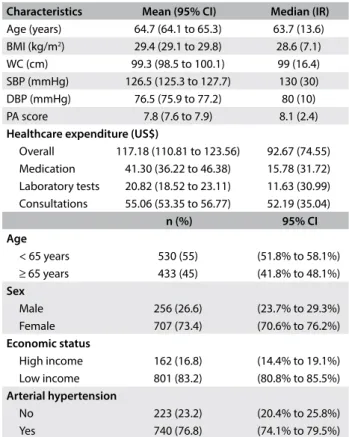
he prevalence of hypertension was 76.8% (95% CI: 74.1 to 79.5), while diabetes mellitus and dyslipidemia were observed in 28.5% and 32.4% of the sample, respectively. We observed that 83.2% (CI: 80.8% to 85.5%) of the individuals had low income.
he total annual healthcare expenditure for the 963 partici-pants of this survey was US$ 112,849.74 and the maximum amount
spent on any patient was U$ 941.78 per year. Consultations with healthcare professionals accounted for the highest proportion of total public healthcare expenditure (46.9%; US$ 53,025.05), fol-lowed by medication dispensed (35.2%; US$ 39,774.90) and then laboratory tests (17.9%; US$ 20,040.79) (Table 1).
he diferent types of expenditure were found to be associ-ated with diferent factors. Bivariate analysis showed that female participants were more likely to generate higher healthcare expen-diture on laboratory tests (P-value = 0.022) and consultations (P-value = 0.005). Participants with hypertension had higher total healthcare expenditure (P-value = 0.001), especially on medication dispensed (P-value = 0.001) and consultations (P-value = 0.006) (Table 2). Smoking was associated with lower healthcare expen-ditures on consultations (P-value = 0.012). Presence of overweight or obesity was associated with higher healthcare expenditure in all the categories considered. Higher levels of physical activity were associated with lower healthcare expenditure on medication dis-pensed (P-value = 0.001) (Table 2).
Ater accounting for potential confounders, expenditure on medication was found to be associated with overweight (OR = 1.80; 95% CI: 1.07 to 3.01), hypertension (OR = 3.04; 95% CI: 1.91 to 4.82)
Characteristics Mean (95% CI) Median (IR) Age (years) 64.7 (64.1 to 65.3) 63.7 (13.6) BMI (kg/m2) 29.4 (29.1 to 29.8) 28.6 (7.1) WC (cm) 99.3 (98.5 to 100.1) 99 (16.4) SBP (mmHg) 126.5 (125.3 to 127.7) 130 (30) DBP (mmHg) 76.5 (75.9 to 77.2) 80 (10)
PA score 7.8 (7.6 to 7.9) 8.1 (2.4)
Healthcare expenditure (US$)
Overall 117.18 (110.81 to 123.56) 92.67 (74.55) Medication 41.30 (36.22 to 46.38) 15.78 (31.72) Laboratory tests 20.82 (18.52 to 23.11) 11.63 (30.99) Consultations 55.06 (53.35 to 56.77) 52.19 (35.04)
n (%) 95% CI
Age
< 65 years 530 (55) (51.8% to 58.1%) ≥ 65 years 433 (45) (41.8% to 48.1%) Sex
Male 256 (26.6) (23.7% to 29.3%)
Female 707 (73.4) (70.6% to 76.2%)
Economic status
High income 162 (16.8) (14.4% to 19.1%) Low income 801 (83.2) (80.8% to 85.5%) Arterial hypertension
No 223 (23.2) (20.4% to 25.8%)
Yes 740 (76.8) (74.1% to 79.5%)
Table 1. Characteristics of the sample in Bauru (SP), Brazil (n = 963)
Variables
Overall (≥ P75 [US$ 135.08])
Medications (≥ P75 [US$ 36.43])
Laboratory tests (≥ P75 [US$ 30.99])
Consultations (≥ P75 [US$ 71.57]) n (%) P-value n (%) P-value n (%) P-value n (%) P-value Age
< 65 years 132 (24.9) > 0.05 127 (24.1) > 0.05 125 (23.6) > 0.05 143 (27.1) > 0.05 ≥ 65 years 109 (25.2) > 0.05 114 (26.3) > 0.05 116 (26.8) > 0.05 99 (22.9) > 0.05 Sex
Male 58 (22.7) > 0.05 67 (26.2) > 0.05 50 (19.5) < 0.05 47 (18.4) < 0.01 Female 183 (25.9) > 0.05 174 (24.6) > 0.05 191 (27.1) > 0.05 195 (27.6) > 0.05 Economic status
High 33 (20.4) > 0.05 32 (19.8) > 0.05 45 (27.8) > 0.05 31 (19.1) > 0.05 Low 208 (26.1) > 0.05 209 (26.1) > 0.05 196 (24.5) > 0.05 211 (26.3) > 0.05 Smoking
No 218 (26.1) > 0.05 217 (26.1) > 0.05 214 (25.6) > 0.05 222 (26.6) < 0.05 Yes 23 (18.1) > 0.05 24 (18.9) > 0.05 27 (21.3) > 0.05 20 (15.7) > 0.05 Body mass index
Normal 27 (14.1) < 0.001 28 (14.5) < 0.001 38 (19.7) < 0.05 34 (17.6) < 0.05 Overweight 92 (24.2) > 0.05 103 (27.1) > 0.05 93 (24.5) > 0.05 99 (26.1) > 0.05 Obese 122 (31.3) > 0.05 110 (28.2) > 0.05 110 (28.2) > 0.05 109 (27.9) > 0.05 Waist circumference
Normal 48 (16.7) < 0.001 55 (19.1) < 0.01 60 (20.8) > 0.05 57 (19.8) < 0.05 Elevated 193 (28.6) > 0.05 186 (27.6) > 0.05 181 (26.8) > 0.05 185 (27.4) > 0.05 Arterial hypertension
No 32 (14.3) < 0.001 25 (11.2) < 0.001 52 (23.3) > 0.05 40 (17.9) < 0.01 Yes 209 (28.2) > 0.05 216 (29.2) > 0.05 189 (25.5) > 0.05 202 (27.3) > 0.05 Physical activity
Inactive 69 (29.1) > 0.05 77 (32.5) < 0.05 56 (23.6) > 0.05 54 (22.8) > 0.05 Moderately active 119 (24.5) > 0.05 106 (21.8) > 0.05 130 (26.7) > 0.05 121 (24.9) > 0.05 Active 53 (22.1) > 0.05 58 (24.2) > 0.05 55 (22.9) > 0.05 67 (27.9) > 0.05 Table 2. Variables associated with high public healthcare expenditure within primary care in Bauru (SP), Brazil (n = 963), from bivariate analysis
Variables
Overall* (≥ P75 [US$ 135.08])
Medications* (≥ P75 [US$ 36.43])
Laboratory tests* (≥ P75 [US$ 30.99])
Consultations* (≥ P75 [US$ 71.57]) OR (95% CI) OR (95% CI) OR (95% CI) OR (95% CI) Age
< 65 years - - -
-≥ 65 years - - -
-Sex
Male - - 1.00 1.00
Female - - 1.41 (0.98-2.04) 1.70 (1.14-2.55)
Economic status
High - - -
-Low - - -
-Smoking
No - - - 1.00
Yes - - - 0.57 (0.34-1.00)
Body mass index
Normal 1.00 1.00 1.00 1.00
Overweight 1.59 (0.93-2.70) 1.80 (1.07-3.01) 1.26 (0.81-1.94) 1.50 (0.91-2.47)
Obese 1.78 (0.98-3.22) 1.53 (0.86-2.74) 1.35 (0.88-2.07) 1.37 (0.78-2.41)
Waist circumference
Normal 1.00 1.00 - 1.00
Elevated 1.17 (0.73-1.86) 1.14 (0.73-1.78) - 0.93 (0.58-1.49)
Arterial hypertension
No 1.00 1.00 - 1.00
Yes 2.17 (1.41-3.35) 3.04 (1.91-4.82) - 1.67 11.12-2.47)
Physical activity
Inactive - 1.00 -
-Moderately active - 0.56 (0.38-0.81) -
-Active - 0.76 (0.49-1.17) -
-Hosmer-Lemeshow test P-value = 0.495 P-value = 0.392 P-value = 0.524 P-value = 0.151
Explanation 75% 75.9% 75% 74.9%
Table 3. Adjusted model for association between high public healthcare expenditure and independent variables in Bauru (SP), Brazil (n = 963)
Figure 1. Healthcare expenditure according to physical activity, obesity and blood pressure among adults in Bauru (SP), Brazil (2010).
Medication Lab. tests Consultations Healthcare expenditure
Healthcare expenditure
Healthcare expenditure
Overall
Physical activity
Inactive
Moderately active
Sufficiently active P-value - 0.001
* * P-value - 0.703
P-value - 0.557
P-value - 0.285 120
80 100
60
40
20
0
Note: * = P-value < 0.05 compared with inactive.
Median values (US$)
Medication Lab. tests Consultations Overall
Overweight / obese
Normal
Overweight
Obese P-value - 0.001
* *
*
* *
P-value - 0.086
P-value - 0.003 P-value - 0.001 120
80 100
60
40
20
0
Notes: * = P-value < 0.05 compared with normal; § = P-value < 0.05 compared with overweight.
Median values (US$)
Medication Lab. tests Consultations Overall
Blood pressure
Non-hypertensive
Hypertensive
P-value - 0.001
P-value - 0.001
P-value - 0.001
P-value - 0.704 120
80 100
60
40
20
0
Median values (US$)
§
* §
and moderate physical activity (OR = 0.56; 95% CI: 0.38 to 0.81). Expenditure on consultations was found to be associated with hypertension (OR = 1.67; 95% CI: 1.12 to 2.47). Overall health-care expenditure was associated with female sex and hypertension (Table 3). All multivariate models were found to show adequate it.
Figure 1 presents healthcare expenditure according to life-style behavior. Participants who were insufficiently active
(Figure 1, Panel A), obese (Figure 1, Panel B) and hyperten-sive (Figure 1, Panel C) had the highest proportions of expendi-ture over a 12-month period.
DISCUSSION
his study involved outpatients attended through the Brazilian National Health System in a medium-sized Brazilian city and investigated the correlates of public expenditure on healthcare services, speciically regarding consultations, laboratory tests and medications. Higher healthcare expenditure was associated with hypertension, overweight, sex and physical inactivity.
he presence of hypertension was associated with higher health-care expenditure in three diferent categories (total expenditure, medication dispensed and consultations), thus denoting that this disease gave rise to a signiicant burden in relation to economic outcomes. his inding corroborates previous evidence that showed that cardiovascular diseases present high economic burdens in developing nations1. his result can at least partly be explained by
the fact that management of hypertension is expensive, involving regular consultations and laboratory tests, as well as use of anti-hypertensive drugs.20
Additionally, overweight showed an association with increased healthcare expenditure relating to medication dispensed. Higher expenditure on medication among obese subjects might result from the link between obesity and a wide variety of cardiovas-cular and metabolic diseases.21 For the period 2008-2010, it has been
estimated that the Brazilian Government’s expenditure on diseases relating to overweight/obesity was US$ 2.1 billion per year, of which US$ 1.4 billion was due to hospitalizations.2 In fact, overweight and
obesity accounted for 6.8% and 9.3% of all hospitalizations among Brazilian men and women, respectively.22 Brazilian expenditure on
bariatric surgery also increased from US$ 9.4 million in 2008 to US$ 17.4 million in 2011.23 A similar pattern has been observed in
developed nations.24,25 Our indings also point out that primary care
services have strategic relevance regarding preventive actions aimed towards controlling obesity and its future complications.
Physical inactivity is a major public health problem of the 21st
century.26 It is noteworthy that physical activity has a role in
reduc-ing the prevalence of obesity and related diseases, such as hyperten-sion.27-29 Physical inactivity and abdominal obesity can act
synergis-tically towards increasing public healthcare expenditure.6 Although
physical inactivity was found in our study to be associated only with healthcare expenditure relating to medication dispensed, it should be emphasized that 1-4% of the total direct cost of healthcare is attributable to diseases relating to physical inactivity.6,30 Moreover,
2. Bahia L, Coutinho ES, Barufaldi LA, et al. The costs of overweight and obesity-related diseases in the Brazilian public health system: cross-sectional study. BMC Public Health. 2012;12:440.
3. Wolfenstetter SB. Future direct and indirect costs of obesity and the inluence of gaining weight: results from the MONICA/KORA cohort studies, 1995-2005. Econ Hum Biol. 2012;10(2):127-38.
4. World Health Organization. WHO methods and data sources for country-level causes of death 2000-2012. Geneva, World Health Organization; 2014. Available from: http://www.who.int/healthinfo/global_burden_ disease/GlobalCOD_method_2000_2012.pdf?ua=1. Accessed in 2016 (Dec 26).
5. Puentes JD, Cahill J. Country report: The health care market in Brazil. PMLiVE. Available from: http://www.pmlive.com/pharma_intelligence/ country_report_the_healthcare_market_in_brazil_409950. Accessed in 2016 (Dec 26).
6. Codogno JS, Turi BC, Kemper HC, et al. Physical inactivity of adults and 1-year health care expenditures in Brazil. Int J Public Health. 2015;60(3):309-16.
7. Turi BC, Codogno JS, Fernandes RA, et al. Accumulation of Domain-Speciic Physical Inactivity and Presence of Hypertension in Brazilian Public Healthcare System. J Phys Act Health. 2015;12(11):1508-12. 8. Kilsztajn S, Silva DF, Camara MB, Ferreira VS. Grau de cobertura
dos planos de saúde e distribuição regional do gasto público em saúde [Level of private health insurance coverage and regional distribution of public health expenditure]. Saúde Soc. 2001;10(2):35-45.
9. Zanuto EAC, Lima MCS, de Araújo RG, et al. Distúrbios do sono em adultos de uma cidade do Estado de São Paulo [Sleep disturbances in adults in a city of Sao Paulo state]. Rev Bras Epidemiol. 2015;18(1):42-53. 10. Zanuto EAC, Codogno JS, Christófaro DGD, et al. Prevalência de dor lombar e fatores associados entre adultos de cidade média brasileira [Prevalence of low back pain and associated factors in adults from a middle-size Brazilian city]. Ciên Saúde Coletiva. 2015;20(5):1575-82.
11. Fernandes RA, Zanesco A. Early sport practice is related to lower prevalence of cardiovascular and metabolic outcomes in adults independently of overweight and current physical activity. Medicina (Kaunas). 2015;51(6):336-42.
12. Schmidt MI, Duncan BB, Hofmann JF, et al. Prevalência de diabetes e hipertensão no Brasil baseada em inquérito de morbidade auto-referida, Brasil, 2006 [Prevalence of diabetes and hypertension based on self-reported morbidity survey, Brazil, 2006]. Rev Saúde Pública. 2009;43(supl 2):74-82.
13. Meerding WJ, Bonneux L, Polder JJ, Koopmanschap MA, van der Maas PJ. Demographic and epidemiological determinants of healthcare costs in Netherlands: cost of illness study. BMJ. 1998;317(7151):111-5. 14. Codogno JS, Fernandes RA, Sarti FM, Freitas Júnior IF, Monteiro HL.
The burden of physical activity on type 2 diabetes public healthcare expenditures among adults: a retrospective study. BMC Public Health. 2011;11:275.
he higher expenditure relating to medical consultation that was observed among women is a pattern that has been found world-wide. Especially ater the menopause, women use healthcare ser-vices more than men do.13,33,34 Regarding the healthcare services
used by women, preventive care and therapeutic treatment are the ones most commonly used,34 and these services were available in
the facilities analyzed in the present survey.
A number of limitations of this study need to be recognized. he cross-sectional design does not support statements of cau-sality between health expenditure and its correlates. Moreover, only direct health care costs were taken into account in this study, while other sources of indirect costs were not considered (e.g. main-tenance of the facilities and the size of healthcare professionals’ paychecks). It is important to recognize that we only included the biggest healthcare units in a single medium-sized city in Brazil. hus, our results may not relect other scenarios and should be extended to other settings only with caution. Other limitations to be considered are that the medical records were usually of poor quality; there was no information about medications obtained from other healthcare units or bought through government subsidy; and no measurements were made regarding adherence to treatments. Although the medical records constitute an important source of information regarding direct costs within primary healthcare, the bias caused through handwritten prescriptions issued by health-care professionals and whether patients are using their medica-tions correctly need to be considered. Additionally, selection of individuals who had had medical consultations during the previ-ous six months may have biased the results from this study, since not all contacts with the healthcare unit are for medical consul-tations, and some patients may have less frequent visits. Physical activity was assessed through questionnaires, while other methods might have better accuracy (e.g. accelerometers and pedometers). Lastly, we did not have any information about alcohol consump-tion, which might have been an important risk factor for consid-eration as a potential confounder.
CONCLUSIONS
Our indings showed that overweight, physical inactivity and arterial hypertension constituted independent risk factors asso-ciated with higher healthcare expenditure in relation to medica-tion use, while arterial hypertension afected not only the over-all expenditure, but also the expenditure attributed to medical consultations. Finally, sex seemed to be an important correlate of healthcare expenditure relating to medical consultations.
REFERENCES
15. Lohman TG, Roche AF, Martorell R. Anthropometric standardization reference manual. Champaign: Human Kinetics Books; 1988. 16. World Health Organization. Obesity: preventing and managing the
Global Epidemic: Report of the WHO Consultation on Obesity. Geneva: World Health Organization: Geneva; 1997. Available from: http://www. who.int/nutrition/publications/obesity_executive_summary.pdf. Accessed in 2016 (Dec 26).
17. Lean ME, Han TS, Morrison CE. Waist circumference as a measure for indicating need for weight management. BMJ. 1995;311(6998):158-61. 18. Associação Brasileira de Empresas de Pesquisa. Critério de Classiicação
Econômica Brasil; 2008. Available from: https://www.google.com.br/ url?sa=t&rct=j&q=&esrc=s&source=web&cd=1&ved= 0ahUKEwjz2P GryOTPAhVDDZAKHXj8B0MQFggeMAA&url=http%3A%2F%2Fwww. abep.org%2FServicos%2FDow nload.aspx%3Fid%3D07&usg=AFQjC NH2G9V5iYOmc kiA4iLqDpCE1EYDsQ&sig2=gC9N3UnxmXEYRw9y9 vHIrg. Accessed in 2016 (Dec 26).
19. Baecke JA, Burema J, Frijters JE. A short questionnaire for the measurement of habitual physical activity in epidemiological studies. Am J Clin Nutr. 1982;36(5):936-42.
20. Brandão AA, Rodrigues CIS, Consolim-Colombo F, et al. VI Diretrizes Brasileiras de Hipertensão. Arq Bras Cardiol. 2010;95(1 supl. 1):1-51. 21. Van Gaal LF, Mertens IL, De Block CE. Mechanisms linking obesity with
cardiovascular disease. Nature. 2006;444(7121):875-80.
22. Sichieri R, Nascimento S, Coutinho W. The burden of hospitalization due to overweight and obesity in Brazil. Cad Saúde Pública. 2007;23(7):1721-7. 23. de Oliveira ML, Santos LM, da Silva EN. Direct healthcare cost of obesity in Brazil: an application of the cost-of-illness method from the perspective of the public health system in 2011. PLoS One. 2015;10(4):e0121160. 24. Atella V, Kopinska J, Medea G, et al. Excess body weight increases the
burden of age-associated chronic diseases and their associated health care expenditures. Aging (Albany NY). 2015;(10): 882-92.
25. Li Q, Blume SW, Huang JC, Hammer M, Ganz ML. Prevalence and healthcare costs of obesity-related comorbidities: evidence from an electronic medical records system in the United States. J Med Econ. 2015;18(12):1020-8.
26. Davis JC, Verhagen E, Bryan S, et al. 2014 consensus statement from the irst Economics of Physical Inactivity Consensus (EPIC) conference (Vancouver). Br J Sports Med. 2014;48(12):947-51.
27. Warburton DE, Nicol CW, Bredin SS. Health beneits of physical activity: the evidence. CMAJ. 2006;174(6):801-9.
28. Sui X, LaMonte MJ, Laditka JN, et al. Cardiorespiratory itness and adiposity as mortality predictors in older adults. JAMA. 2007;298(21):2507-16. 29. Giudice R, Izzo R, Manzi MV, et al. Lifestyle-related risk factors, smoking
status and cardiovascular disease. High Blood Press Cardiovasc Prev. 2012;19(2):85-92.
30. Janssen I. Health care costs of physical inactivity in Canadian adults. Appl Physiol Nutr Metab. 2012;37(4):803-6.
31. Méndez-Hernández P, Dosamantes-Carrasco D, Siani C, et al. Un programa de actividad física en el lugar de trabajo en una universidad
pública de México puede reducir los costos médicos asociados a la diabetes tipo 2 e hipertensión [A workplace physical activity program at a public university in Mexico can reduce medical costs associated with type 2 diabetes and hypertension]. Salud Pública Méx. 2012;54(1):20-7. 32. Codogno JS, Fernandes RA, Monteiro HL. Prática de atividades físicas
e custo do tratamento ambulatorial de diabéticos tipo 2 atendidos em unidade básica de saúde [Physical activity and healthcare cost of type 2 diabetic patients seen at basic units of healthcare]. Arq Bras Endocrinol Metab. 2012;56(1):6-11.
33. Sarker AR, Mahumud RA, Sultana M, et al. The impact of age and sex on healthcare expenditure of households in Bangladesh. Springerplus. 2014;3:435.
34. Owens GM. Gender diferences in health care expenditures, resource utilization, and quality of care. J Manag Care Pharm. 2008;14(3 Suppl):2-6.
Acknowledgements: São Paulo Research Foundation (procedural
number 2015/20458-7) and Coordination Oice for Improvement of Higher-Education Personnel (Coordenação de Aperfeiçoamento de Pessoal de Nível Superior, CAPES)
Sources of funding: None
Conlict of interest: None
Date of irst submission: August 22, 2016
Last received: November 2, 2016
Accepted: November 14, 2016
Address for correspondence: Bruna Camilo Turi
Rua Roberto Simonsen, 305 Presidente Prudente (SP) — Brasil CEP 19060-900