Nonalcoholic fatty liver disease and bariatric surgery:
a comprehensive review
Doença hepática gordurosa não alcoólica e cirurgia bariátrica: uma revisão abrangente
Everton Cazzo
I, José Carlos Pareja
II, Elinton Adami Chaim
IIIUniversidade Estadual de Campinas (UNICAMP), Campinas (SP), Brazil
ABSTRACT
CONTEXT AND OBJECTIVE: Nonalcoholic fatty liver disease (NAFLD) has been increasingly diagnosed worldwide and is now recognized as a source of public health concern. It comprises a wide spectrum of histological features that range from simple steatosis to severe forms of ibrosis, steatohepatitis and even cirrhosis. The impact of bariatric surgery on the course of NAFLD in individuals with obesity has been extensively studied.
DESIGN AND SETTING: Narrative review; public university hospital.
METHODS: A comprehensive review was conducted based on an online search on the electronic databa-ses MEDLINE and LILACS using the MeSH terms “fatty liver” and “bariatric surgery”.
RESULTS: The exact mechanisms that lead to improvement in NAFLD following bariatric surgery are not completely understood. Since Roux-en-Y gastric bypass (RYGB) is the bariatric surgical procedure most performed worldwide, it is also the one from which the efects on NAFLD have been most studied, althou-gh there is also consistent evidence regarding the efects from gastric banding, sleeve gastrectomy and biliopancreatic diversions.
CONCLUSION: According to the currently available evidence, bariatric surgery leads to signiicant impro-vement in NAFLD. Further research, especially by means of randomized controlled trials enrolling larger cohorts of individuals, is needed to determine the optimal procedure for this group of subjects.
RESUMO
CONTEXTO E OBJETIVO: A doença hepática gordurosa não alcoólica (DHGNA) tem sido diagnosticada com maior frequência em todo o mundo na atualidade, sendo agora reconhecida como motivo de pre-ocupação em saúde pública. Abrange um amplo espectro de alterações histológicas que variam desde a simples esteatose até formas graves de ibrose, esteato-hepatite e até cirrose. O impacto da cirurgia bariátrica sobre o curso da DHGNA em indivíduos com obesidade tem sido profundamente estudado. TIPO DE ESTUDO E LOCAL: Revisão narrativa; hospital universitário público.
MÉTODOS: Uma revisão abrangente da literatura foi conduzida baseada na pesquisa on-line nas bases de dados eletrônicas MEDLINE e LILACS por meio dos termos MeSH “fígado gorduroso” e “cirurgia bariátrica”. RESULTADOS: Os mecanismos exatos que levam à melhora da DHGNA após a cirurgia bariátrica não são completamente conhecidos. Como o bypass gástrico em Y de Roux é a cirurgia bariátrica mais realizada em todo o mundo, é também o procedimento cujos efeitos sobre DHGNA foram mais estudados, embora haja também evidências consistentes sobre os efeitos de banda gástrica, gastrectomia vertical e deriva-ções biliopancreáticas.
CONCLUSÃO: De acordo com as evidências atualmente disponíveis, a cirurgia bariátrica leva à melhora signiicativa da DHGNA. Mais estudos, especialmente por meio de ensaios clínicos randomizados e contro-lados, recrutando coortes maiores de indivíduos, são necessários para determinar o melhor procedimento para esse grupo de pacientes.
IMD, MSc, PhD. Assistant Professor, Department
of Surgery, Universidade Estadual de Campinas (UNICAMP), Campinas (SP), Brazil.
IIMD, PhD. Associate Professor, Department of
Surgery, Universidade Estadual de Campinas (UNICAMP), Campinas (SP), Brazil.
IIIMD, MSc, PhD. Full Professor, Department of
Surgery, Universidade Estadual de Campinas (UNICAMP), Campinas, (SP), Brazil.
KEY WORDS:
Fatty liver. Obesity. Bariatric surgery. Metabolic syndrome X. Insulin resistance.
PALAVRAS-CHAVE:
INTRODUCTION
Nonalcoholic fatty liver disease (NAFLD) is deined as accumula-tion of excessive fat in the liver in the absence of excessive drink-ing of alcohol and/or any secondary cause.1-3 Along with obesity
epidemics, it has been increasingly diagnosed over the last few decades and is now recognized as a source of public health con-cern. Today, NAFLD is considered to be the commonest liver dis-ease worldwide. It comprises a wide spectrum of histological fea-tures that range from mild steatosis to severe forms of ibrosis, steatohepatitis and even cirrhosis.3,4
Epidemiology
Today, the most reliable values for the prevalence of NAFLD and nonalcoholic steatohepatitis (NASH) in the general popula-tion in the Western world are 20-30% and 2-3%, respectively.5-7
In Asia, the prevalence of NAFLD has been found to range from 15% to 30% in the general population.8 he reported prevalence
of NAFLD may vary according to the population studied and the diagnostic method used. he results from population-based studies provide more accurate data than do autopsies, hospital series or studies on high-risk groups, since they avoid higher selection bias. Studies that have detected NAFLD by means of liver enzyme levels have observed prevalences of NAFLD in the general population of between 3% and 23%, i.e. generally lower than those reported from analyses that used imaging methods.5-11
Studies based on ultrasound scans appear to be more reliable and have shown prevalences of NAFLD among healthy adults of 25-30% in the United States and Italy and 29% in Japan.5-8
NAFLD is associated with signiicantly higher overall mor-tality, compared with the general population, particularly due to cardiovascular and liver-related complications. he histolog-ical stage is nevertheless crucial for the longer-term prognosis. Among patients with NASH, compared with patients with sim-ple steatosis, the prevalence of cirrhosis development within the irst 15 years of follow-up is signiicantly higher (10.8% versus 0.7%, respectively) and liver-related mortality is also signiicantly higher (7.3% versus 0.9%). he overall and liver-related mortal-ity among patients with NASH is correspondingly higher than would be expected among individuals of the same age and gen-der with simple NAFLD.8-11
Among obese populations with metabolic syndrome (MetS) and type 2 diabetes mellitus (T2DM), the prevalence of NAFLD is much higher, ranging from about 50% to 90%. NAFLD has become a challenging public health concern, given that the prevalences of obesity and overweight have increased to epidemic levels over the last few decades. It constitutes an additional risk factor for this group of patients, especially because of the possibility of evolution to severe forms of liver ibrosis (including end-stage liver disease and cirrhosis) and even liver cancer.5-8,12
Among cases labelled as “cryptogenic cirrhosis”, the preva-lence of NAFLD appears to be very high. Nayak et al.9 carried out
a study in which the clinicopathological features of NAFLD were explored through clinical data and by examining the explanted livers of living-donor liver transplant recipients. Among 103 adult liver transplant recipients with diferent types of chronic liver disease, 30 had a pre-liver transplantation diagnosis of cryptogenic cirrho-sis. Out of these 30 cryptogenic cirrhosis cases, 19 (63.3 %) were inally labeled as NAFLD-related cirrhosis and showed histologi-cal features that difered in several respects from those reported for the early and established phases of NAFLD.
he risk factors for development of NAFLD have been estab-lished. Increasing age presents a direct correlation with the prev-alence of NAFLD. his is possibly related to the increasing insu-lin resistance and incidence of metabolic syndrome that occurs with age.12 NAFLD generally occurs at a higher rate among men
than among premenopausal women. It also difers according to ethnicity, such that it afects 45% of Hispanic people, 33% of Caucasians and 24% of African-Americans in the United States and has been recorded at higher levels among South Asians in the United Kingdom.7-12 Likewise, among children and adolescents,
the prevalence of NAFLD again seems to difer between diferent ethnic groups, with the highest prevalence in Hispanic people.5
Several studies have revealed high rates of NAFLD among obese populations who undergo bariatric surgery.13-17 Reports on morbidly
obese populations have shown that the prevalence of liver ibrosis ranges from 6% to 74.4% and steatohepatitis from 26% to 55%.16,17
Pathophysiology
he underlying mechanisms that are present in the develop-ment of NAFLD are not completely understood, although much progress has been made over recent years. he classical pathoge-netic pathway that leads to NAFLD was described as the “two-hit hypothesis”. his theory stated that damage to the liver tissue begins through triglyceride accumulation (the irst hit), which functions as a sensitizing factor for secondary damage caused by inlammatory mediators (mainly cytokines or adipokines), mitochondrial dysfunction and oxidative stress (the second hits). hese secondary aggressions would lead to steatohepatitis and ibrosis.18,19 Today, it is widely recognized that free fatty acids
(FFAs) also play a direct role in promoting liver injury. One of the consequences of insulin resistance (IR) is greater inlux of FFAs to the liver: these undergo β-oxidation or esteriication with glycerol to form triglycerides. Additionally, FFAs are able to cause toxicity through directly increasing oxidative stress and activating inlam-matory pathways.20,21 Another “hit” that was recently identiied
hepatic progenitor (oval) cells. he size of the oval cell population correlates directly with the degree of ibrosis and it is believed that activation of these cells is involved in hepatic carcinogenesis.18,21-23
In NAFLD, lipid accumulation within the liver (steatosis) may result from several mechanisms: increased fat synthesis, increased fat delivery, decreased fat export and/or decreased fat oxidation.23-28
IR plays an important role in NAFLD development and evo-lution, and NAFLD also contributes towards worsening of IR. In individuals with IR who present excess visceral fat, the inlux of FFAs to the liver is increased, thus leading to both triglyceride accumulation and direct lipotoxicity. On the other hand, several abnormalities intrinsic to NAFLD impair insulin receptor signal-ing, especially FFAs, tumor necrosis factor-alpha (TNF-α), nuclear factor kappa B (NF-κB), ceramide, Jun N-terminal kinase 1 (JNK1), suppressors of cytokine signaling (SOCS) and cytochrome CYP2E1. he cumulative efect generates a vicious cycle of IR and NAFLD worsening each other.18,23,29-31
Steatosis is strongly associated with chronic hepatic inlamma-tion, an efect that is partly mediated by activation of the Iκκ-β/NF-κB signaling pathway. his is associated with elevated hepatic expres-sion of inlammatory cytokines such as TNF-α, interleukin-6 (IL-6) and interleukin 1-beta (IL-1β), and activation of Kupfer cells. Both serum and hepatic levels of TNF-α are elevated in patients with NASH, and these levels are correlated with histological
sever-ity.18,32-35 In addition to the proinlammatory efect, TNF-α
pro-motes IR. Further data suggests that inlammation and NF-κB activation may also promote carcinogenesis and that this chronic inlammatory state may also play a key role in hepatocellular car-cinoma (HCC) development.18,36,37
Increased leptin levels are observed in cases of obesity and NAFLD. hese are usually regarded as states of leptin resistance. It is possible that leptin may have an important role in the pathogen-esis of NAFLD. Conversely, the circulating levels of adiponectin are inversely proportional to body fat content and become reduced in patients with NAFLD.38-41
Oxidative stress and mitochondrial dysfunction play a well-reported role in NASH, with a direct correlation between the degrees of oxidative stress and the severity of liver disease. Structural mito-chondrial abnormalities and impairment of mitomito-chondrial respi-ratory chain activity have been reported in human studies.18,42-46
Endoplasmic reticulum (ER) stress and endotoxemia derived from the gut microbiota are other mechanisms that appear to be implicated in NASH pathogenesis. ER stress is associated with various types of biological stress, such as hyperinsulinemia and hyperlipidemia, and it usually causes IR, inlammation, apoptosis and mitochondrial dysfunction, through several mechanisms. In cases of alcohol-related steatohepatitis, ER stress is a well-estab-lished pathophysiological factor, but further study on the possible role that it plays in the development of NASH is needed.18
he role of gut bacterial overgrowth in the pathogenesis of NASH is now emerging through recent evidence. Bacterial over-growth leads to production of ethanol and release of bacterial lipopolysaccharides, both of which can activate TNF-α produc-tion in Kupfer cells, thereby inducing inlammaproduc-tion in liver tis-sue. Individuals with NASH more frequently present bacterial overgrowth in the small intestine and increased gut permeability than do controls. hese indings also suggest that this is a possible explanation for the rapid onset of NASH and liver ibrosis follow-ing jejunoileal bypass surgery. Furthermore, there is evidence that hepatic inlammation can be reduced by means of changes to the gut microbiota induced by antibiotics and probiotics.47-56
Under high levels of oxidative stress, which is a feature usu-ally observed in the presence of injurious factors such as NASH and viral infection, mature hepatocytes may present impairment of their replication process, thus leading to reduction of their pro-liferative ability. Subsequently, hepatic progenitor cells (HPCs) are recruited; these cells have the capacity to diferentiate into either hepatocytes or cholangiocytes and may be involved in carcino-genesis relating both to hepatocellular carcinoma and to cholan-giocarcinoma. Initial research has observed that there is a strong association between expansion of HPCs and a ductular reaction in liver biopsy specimens in NASH cases. he extent of ductular reactions in turn strongly correlates with the degree of ibrosis, thus suggesting that HPC expansion/ductular reaction may play an important role in stimulating progressive periportal ibrosis.57-60
Histopathology
NAFLD encompasses a wide spectrum of liver histopathological abnormalities that may also have highly variable natural courses. It is grossly divided into two main categories: simple steatosis, in which only hepatocellular steatosis is observed; and NASH, in which necroinlammatory reactions are associated with hepato-cellular steatosis. Simple steatosis usually presents a benign course. NASH, on the other hand, is a progressive disease that can evolve into liver cirrhosis and HCC. Steatohepatitis-associated hepatocel-lular carcinoma (SH-HCC) is a variant of classical HCC in which the onset appears to be strongly linked to NASH.61,62
It is important to emphasize that NAFLD/NASH presents a diferent pattern in pediatric individuals, with lesions that may or may not resemble those observed in adults. It constitutes an area of ongoing investigation within pathology.61,62 Since pediatric
NAFLD is not the focus of this review, it will not be tackled here.
Histopathological features of adult NAFLD
Hepatocellular steatosis is the hallmark of NAFLD; steatosis in more than 5% of the hepatocytes is required for the diagnosis of NAFLD.61,63,64 Steatosis may be macrovesicular or microvesicular;
about 10% of the cases may also present microvesicular steatosis. It usually begins in zone 3 and may evolve to panacinar steatosis in severe cases.61,65,66
Mild intralobular inlammation is present in NASH and con-sists of an iniltrate of mixed inlammatory cell types (lymphocytes, neutrophils, eosinophils and Kupfer cells). Satellitosis may be spo-radically observed in NASH and consists of ballooned hepatocytes surrounded by polymorphs; this feature is more commonly associ-ated with alcoholic hepatitis. Lipogranulomas and lobular micro-granulomas are frequently seen in NASH. Portal inlammation in NASH is usually absent or mild; when there is disproportionately severe portal inlammation, the possibility of other concurrent hepatic diseases needs to be considered.61,67,68
Hepatocellular ballooning is another feature associated with NAFLD and is characterized by the presence of swollen hepato-cytes with rareied cytoplasm, which may contain fat droplets and Mallory-Denk bodies. It usually relects hepatocellular injury.61
Fibrosis in NASH characteristically follows a perisinusoidal/ pericellular pattern and usually begins in zone 3. Typically, an active necroinlammatory reaction is observed, along with ibro-sis. Progression of perisinusoidal/pericellular ibrosis may lead to occurrences of portal/periportal ibrosis, bridging ibrosis and liver cirrhosis.69,70
Other important features of NAFLD/NASH include glycogenated nuclei, acidophil bodies, Mallory-Denk bodies (MDBs), iron deposition and megamitochondria.61,62 Glycogenated
nuclei are vacuolated nuclei that are usually observed in periportal hepatocytes. They are common in NAFLD, but only rarely observed in alcohol-induced liver disease.71 Presence of apoptotic
hepatocytes (acidophil bodies), usually in the sinusoids, is also commonly observed in NASH.72 he eosinophilic irregular-shaped
aggregates that are usually observed in the cytoplasm of ballooned hepatocytes in zone 3 are known as MDBs. hey are not speciic to NASH and may be found in alcohol-induced disease, chronic cholestasis and HCC.73,74 Mild iron deposition within hepatocytes
or in the sinusoidal lining cells of the reticuloendothelial system, or in both of these, is common in NAFLD/NASH; its signiicance is yet to be fully understood.75 Megamitochondria are massively
enlarged round or crystal-shaped eosinophilic structures that are observed in the cytoplasm of hepatocytes, usually with concurrent microvesicular steatosis; they are believed to originate due to lipid peroxidation.76 Ductular reactions and presence of an arterial
branch in zone 3 within perisinusoidal ibrosis are other poorly understood abnormalities observed in NASH.59
Diagnosis
According to the current guidelines of the American Association for the Study of Liver Diseases (AASLD), there are four require-ments for diagnosing NAFLD:
1. presence of hepatic steatosis detected using imaging methods or biopsy;
2. absence of signiicant alcohol consumption;
3. absence of possible competing etiologies for hepatic steatosis; 4. absence of concurrent chronic liver disease.77
here are several noninvasive methods for assessing and diag-nosing NAFLD, although none of them are able to provide the same amount of information that is brought through liver biopsy.78
Ultrasound scanning is a valuable imaging tool, since it is cheap and highly available and may provide overall accuracy of nearly 80% for detecting NAFLD. On the other hand, it presents limita-tions that may compromise interpretation of the results, given that it is examiner-dependent and there may be technical diiculties in performing it on obese individuals because of their anatomical features. hus, although ultrasound provides useful clues towards diagnosing NAFLD, it cannot be taken to be the ultimate method for detecting it. Moreover, it cannot provide nuanced evaluation of the presence of steatohepatitis and the severity of ibrosis.17,79,80
Ultrasonography-based transient elastography (FibroScan) is a promising method that can bring reliable results by means of safe examination. However, its cost and low availability compro-mise its potential impact.17,81 Furthermore, FibroScan has no value
for patients with ascites and presents great limitations relating to examining obese patients, because the probe is calibrated for a speciic distance between the liver and the chest wall and the low-frequency vibration induced by the probe and/or the ultrasound wave may be strongly attenuated by the fatty tissue.82-84
Development of noninvasive scores for assessing liver disease, including NAFLD, is an important ield of study nowadays. he ulti-mate goal in using these scores is to obtain reliable information from noninvasive laboratory and clinical variables that are avail-able in general practice. he NAFLD ibrosis score is the one most used today and can easily be calculated based on six readily avail-able variavail-ables: age, body mass index (BMI), hyperglycemia, plate-let count, albumin and aspartate transaminase/alanine transami-nase (AST/ALT) ratio. A meta-analysis on 13 studies that enrolled 3,064 patients showed that the NAFLD ibrosis score yielded an area under the receiver operating characteristic curve (AUROC) of 0.85 for predicting advanced ibrosis (bridging ibrosis or cirrhosis). Scores ≤ -1.455 had 90% sensitivity and 60% speciicity for ruling out advanced ibrosis, whereas scores > 0.676 had 67% sensitivity and 97% speciicity for identifying the presence of advanced ibro-sis.85 However, this score does not replace liver biopsy and cannot
Despite recent developments in noninvasive methods for assess-ing NAFLD, liver biopsy remains the gold-standard method for diagnosing and characterizing it, since it may provide a nuanced evaluation that no other method is capable of today. On the other hand, it is expensive and highly invasive, and carries signiicant risk of morbidity and even mortality.77 Moreover, the histological
features of NAFLD and NASH are unevenly distributed through-out the entire liver parenchyma, and sampling error might result in substantial misdiagnosis and staging inaccuracies.61,78 he current
guidelines state that use of biopsies should be restricted to indi-viduals who would beneit the most from diagnostic and therapeu-tic guidance, and from prognostherapeu-tic perspectives. Hence, a biopsy should be considered for NAFLD assessment among patients: 1. with NAFLD, who are at increased risk of development of
ibrosis and steatohepatitis;
2. with suspected NAFLD, in whom concurrent etiologies for hepatic steatosis and/or coexisting chronic liver diseases can-not otherwise be ruled out.77
Current clinical treatment
he current treatment strategies for NAFLD are based on the var-ious aspects of its pathophysiology, especially its relationship with obesity and insulin resistance. he current nonsurgical strategies can be divided in non-pharmacological and pharmacological.
he primary goals of the main nonpharmacological strategies are weight loss and lifestyle changes. Interventions based on low-fat and low-calorie diets have been evaluated in several studies in which it was observed that these diets were associated with reductions in liver enzyme levels and liver fat content and improvement in liver histology.87-93 homa et al. reviewed the eicacy of physical exercise
alone versus physical exercise combined with dietary approaches to reduce liver fat content. Energy restriction and weight reduc-tion of 4-14% resulted in signiicant decreases in hepatic steatosis of 35-81%. Decreases in liver fat correlated most strongly with the degree of weight loss. It was seen that regular exercise might mod-estly reduce steatosis even without a change in weight.94 However,
the greatest caveat of interventions that use dietary measures for weight loss is their lack of long-term durability. It remains unclear how weight regain afects the natural history of NAFLD/NASH.94-97
he primary goal of pharmacological interventions aimed towards NAFLD may either be weight loss or consist of a direct efect on liver disease and its pathophysiological features, especially insulin resistance and inlammation. Evidence regarding the efect of weight loss medications on NAFLD is scarce. he results relat-ing to orlistat were inconclusive in several trials.87,98 Pentoxifylline,
albeit not targeted for weight loss, led to a slight weight reduction and improvement in NASH in one trial.99
Regarding insulin resistance, the potential therapeutic efect of insulin sensitizers on NAFLD/NASH has gathered much attention.
Rosiglitazone was shown to improve steatosis and aminotransferase levels in patients with NASH in a randomized controlled trial,100 but
its use is prohibited in Europe and very restricted in the United States because it may increase the risk of ischemic heart disease.101 In
ran-domized controlled trials, pioglitazone induced signiicant improve-ments in serum aminotransferase levels and liver histology (steatosis, inlammation, ballooning and Mallory-Denk bodies) in individuals with NASH.102-104 However, the improvement in the extent of ibrosis
was not signiicant. Use of pioglitazone is also prohibited in Europe, due to the risk of bladder cancer.101 Use of metformin was not shown
to provide any beneits or to have any independent therapeutic role in individuals with NAFLD, in a meta-analysis study. However, there is level III evidence that metformin may have a chemopreventive role in patients with diabetes and chronic liver disease, with reductions in the incidence of HCC and cholangiocarcinoma.105 Liraglutide,
an analogue of glucagon-like peptide 1 (GLP-1), was shown to pro-mote signiicant improvement in liver histology in individuals with biopsy-proven NASH ater 48 hours of therapy. Longer-term research is needed, but the initial results appear promising.106
Use of vitamin E, because of its antioxidant efects, has shown beneits regarding liver histology among non-diabetic individuals with NASH. Nonetheless, it is important to emphasize that the safety of long-term usage of vitamin E is questionable, since high-dosage vitamin E supplements are associated with increased incidence of prostate cancer in healthy men, and with all-cause mortality.101,107-110
he current usage of lipid-lowering drugs targeted towards NAFLD (mainly statins) is so far unsupported by any substantial results from well-conducted studies. hus, this practice is not rec-ommended by American guidelines.77,101 he newer agent
ezeti-mibe, which acts through inhibiting cholesterol absorption, has shown promising efects, especially in association with acarbose, but further results are needed in order to enable its use to be vali-dated as a current recommendation.111-114
here is a lack of conclusive evidence supporting the use of ursodeoxycholic acid, N-3 polyunsaturated fatty acids, angioten-sin receptor blockers, probiotics and synbiotics as validated treat-ment options for NAFLD.77,101
OBJECTIVE
he aim of this study was to conduct a critical analysis on the evi-dence available regarding the efect of bariatric surgery on NAFLD.
METHODS
(screening). Full papers were obtained from journals available through the website of the Commission for Improvement of Higher Education Personnel (Comissão de Aperfeiçoamento de Pessoal de Nível Superior, CAPES) (Ministry of Education, Brazil). Unavailable articles were requested from their authors. Articles presenting potentially relevant studies were read and analyzed to assess their inclusion criteria. We excluded arti-cles that consisted of in vitro or animal studies, articles in which
the participants’ characteristics did not match those mentioned above, poster session abstracts, review articles and other types
of publications (non-standard bariatric surgical techniques; studies without appropriate follow-up; studies without appro-priate NAFLD assessment; or studies with critical method-ological issues). Other papers were used for contextualization and discussion.
RESULTS
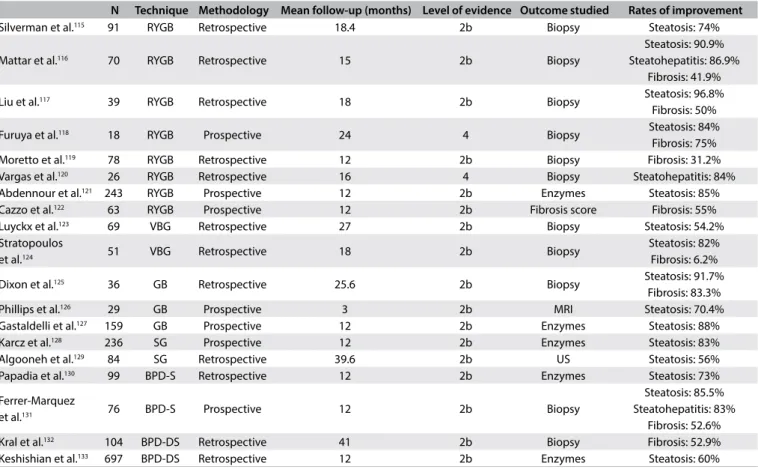
here was signiicant overlap between the databases. Ater care-ful analysis, we selected three systematic reviews, seven prospec-tive cohort studies and twelve retrospecprospec-tive cohort studies. Table 2
Table 1. Database search results for the efects of bariatric surgery among individuals with nonalcoholic fatty liver disease, on November 20, 2016
Electronic databases Search strategies Results
MEDLINE (PubMed) (Fatty liver) AND (Bariatric surgery)
3 systematic reviews 7 prospective cohort studies 12 retrospective cohort studies
LILACS (BVS) ((Fatty liver) OR (Hígado graso) OR (Fígado gorduroso)) AND ((Bariatric surgery) OR (Cirurgia Bariátrica) OR (Cirurgia Bariátrica))
2 systematic reviews 5 prospective cohort studies 9 retrospective cohort studies
Table 2. Main studies on the inluence of bariatric surgery on nonalcoholic fatty liver disease
N Technique Methodology Mean follow-up (months) Level of evidence Outcome studied Rates of improvement
Silverman et al.115 91 RYGB Retrospective 18.4 2b Biopsy Steatosis: 74%
Mattar et al.116 70 RYGB Retrospective 15 2b Biopsy
Steatosis: 90.9% Steatohepatitis: 86.9%
Fibrosis: 41.9%
Liu et al.117 39 RYGB Retrospective 18 2b Biopsy Steatosis: 96.8%
Fibrosis: 50%
Furuya et al.118 18 RYGB Prospective 24 4 Biopsy Steatosis: 84%
Fibrosis: 75%
Moretto et al.119 78 RYGB Retrospective 12 2b Biopsy Fibrosis: 31.2%
Vargas et al.120 26 RYGB Retrospective 16 4 Biopsy Steatohepatitis: 84%
Abdennour et al.121 243 RYGB Prospective 12 2b Enzymes Steatosis: 85%
Cazzo et al.122 63 RYGB Prospective 12 2b Fibrosis score Fibrosis: 55%
Luyckx et al.123 69 VBG Retrospective 27 2b Biopsy Steatosis: 54.2%
Stratopoulos
et al.124 51 VBG Retrospective 18 2b Biopsy
Steatosis: 82% Fibrosis: 6.2%
Dixon et al.125 36 GB Retrospective 25.6 2b Biopsy Steatosis: 91.7%
Fibrosis: 83.3%
Phillips et al.126 29 GB Prospective 3 2b MRI Steatosis: 70.4%
Gastaldelli et al.127 159 GB Prospective 12 2b Enzymes Steatosis: 88%
Karcz et al.128 236 SG Prospective 12 2b Enzymes Steatosis: 83%
Algooneh et al.129 84 SG Retrospective 39.6 2b US Steatosis: 56%
Papadia et al.130 99 BPD-S Retrospective 12 2b Enzymes Steatosis: 73%
Ferrer-Marquez
et al.131 76 BPD-S Prospective 12 2b Biopsy
Steatosis: 85.5% Steatohepatitis: 83%
Fibrosis: 52.6%
Kral et al.132 104 BPD-DS Retrospective 41 2b Biopsy Fibrosis: 52.9%
Keshishian et al.133 697 BPD-DS Retrospective 12 2b Enzymes Steatosis: 60%
summarizes the main articles found and their respective character-istics and reported results.115-133
A schematic representation of the search in the online data-bases and the identiication, exclusion and selection of the articles is presented in Figure 1.
Bariatric surgery and NAFLD
he impact of bariatric surgery on the course of NAFLD in obese individuals has been extensively reported. Surgery plays a signii-cant role in the expected natural history of NAFLD and usually leads to rapid changes in its evolution. Diferent surgical methods act within this context through a variety of mechanisms, which over the long term may be directly associated with the weight loss achieved, but over the short to medium term appear to be more related to acute structural and endocrine changes that are attrib-utable to the procedures. Table 1 summarizes the main studies on the inluence of bariatric surgery on NAFLD.
Roux-en-Y gastric bypass
A pioneering study conducted by Silverman et al.,115 which
enrolled 91 individuals, revealed that ater Roux-en-Y gas-tric bypass (RYGB), 65 patients presented reduced steatosis, 18 patients had no steatosis, 5 patients with minimal steatosis showed no change and 3 patients presented increased steatosis. Pre-gastric bypass biopsies from 13 patients showed perisinusoidal ibrosis (PSF) that was major with bridging in three patients, moderate in one patient and slight in nine patients. Following RYGB, PSF was found to have been eliminated in 10 patients, was reduced in one patient and was the same in two patients. One patient developed PSF ater gastric bypass.
In a study that evaluated 70 individuals who underwent a vari-ety of bariatric procedures by means of intraoperative and postop-erative liver biopsies, Mattar et al.116 observed signiicant
improve-ment in liver steatosis (from 88% to 8%), inlammation (from 23% to 2%) and ibrosis (from 31% to 13%). Inlammation and ibrosis resolved in 37% and 20% of the patients, respectively, correspond-ing to signiicant improvements of 82% in grade and 39% in the stage of liver disease. As expected, purely restrictive procedures produced a signiicantly less dramatic impact on weight loss than did gastric bypass. Improvement in grade in the purely restrictive group (66% showed improvement in grade) was signiicantly less than in the gastric bypass group (93%).
In a case series that enrolled 16 individuals, Clark et al.134
evalu-ated liver histology at the time of RYGB surgery and at the time of elective incisional hernia repair ater weight loss. For all the patients, the initial biopsy showed steatosis, while 94% had inlammation, 88% had ballooning degeneration, 88% had perisinusoidal ibrosis and 81% had portal ibrosis. Steatosis improved in 15 out of the 16 patients, with resolution in 13. Twelve of the 15 patients with
inlammation at the baseline showed improvement, and 12 out of 14 showed less ballooning. Six of the 14 patients with perisinu-soidal ibrosis and 6 of the 13 patients with portal ibrosis showed improvement. No patient presented worsening of steatosis, inlam-mation, ballooning or ibrosis.
In a historical cohort that enrolled 90 individuals who under-went liver biopsies during RYGB and one year aterwards, Mottin et al.135 observed that the prevalence of hepatic steatosis at the
Figure 1. Flow diagram of the narrative review of the literature.
Id
en
ti
fic
a
ti
o
n
Records identified through databases (PubMed and LILACS) search
(n = 1,050)
Records excluded (n = 1,010) Reasons:
- Not pertinent: 582 - Duplicates: 428
Reasons: - Redundant data: 5
- Critical methodological issues: 1 - Non-standard bariatric procedures: 1 Reasons:
- Animal studies: 9
- In vitro studies: 2
Records excluded (n = 11)
Records excluded (n =7) Records screened
(n = 40)
Full-text articles assessed for eligibility (Total n = 29)
Studies included in narrative review (n = 22)
S
cr
een
in
g
E
lig
ib
ili
ty
In
clu
d
time of the surgery was 87.6%. In the second biopsy, 16 patients (17.8%) out of the total had the same degree of steatosis, 25 (27.8%) presented an improved steatosis pattern and 49 (54.4%) had normal hepatic tissue.
In a study on 19 individuals who underwent liver biopsy dur-ing RYGB that conirmed the presence of NASH and were then contacted to undergo a repeat biopsy, Barker et al.136 observed
sig-niicant improvements in steatosis, lobular inlammation, portal and lobular ibrosis. Histopathological criteria for NASH were no longer found in 17/19 patients (89%).
In a study that enrolled 16 individuals who underwent liver biopsy during primary RYGB and a new biopsy during repairs on incisional hernias, Csendes et al.137 observed that 11 out of
15 patients who had had liver abnormalities returned to a nor-mal condition or only had mininor-mal change (73.3%); two patients (13.3%) showed improvements, one patient presented a slight worsening of liver condition and one patient who had presented liver cirrhosis showed no change.
de Almeida et al.138 studied 16 individuals who underwent a
irst biopsy during RYGB and another subsequent to the surgery (23.5 ± 8.4 months aterwards). hey observed complete regression of NAFLD in 15 patients (93.7%); complete regression of necroin-lammatory activity was observed in all patients. Among the four patients presenting ibrosis in the irst biopsy, complete remission was observed in one and improvement in one; two continued to show the same degree of ibrosis without evidence of disease activity.
An exploratory study carried out by Klein et al.139 evaluated
whole-body glucose, fatty acid and lipoprotein kinetics, liver his-tology and hepatic cellular factors involved in inlammation and ibrogenesis in seven severely obese subjects, before and one year ater RYGB. A decrease in hepatic steatosis was observed, without changes in standard histological assessments of inlammation and ibrosis. However, there were marked decreases in hepatic factors involved in regulating ibrogenesis (collagen-alpha 1, transform-ing growth factor-beta 1, alpha-smooth muscle actin and tissue inhibitor of metalloproteinase 1 expression and alpha-smooth muscle actin content) and inlammation (macrophage chemoat-tractant protein 1 and interleukin 8 expression).
In a retrospective analysis on paired needle liver biopsies taken during and following RYGB in 39 patients, Liu et al.117 observed
that the initial prevalences of hepatic pathological conditions were: steatosis (89.7%), hepatocellular ballooning (58.9%) and centrilobu-lar/perisinusoidal ibrosis (50%). hese improved signiicantly ater RYGB: steatosis (2.9%), ballooning (0%) and centrilobular ibrosis (25%); signiicant decreases in the lobular inlammation score and stage of ibrosis were also noted. Nonetheless, no improvements were seen in portal tract inlammation or ibrosis.
A controlled study conducted by Furuya et al.,118 which enrolled
18 individuals who underwent a wedge biopsy during RYGB and
a percutaneous biopsy two years later, showed that, ater a mean excess weight loss of 60%, steatosis disappeared in 84% of the patients, ibrosis in 75% and ballooning in 50%. A slight lobular inlammatory iniltrate remained in 81%, apparently unrelated to fatty degeneration.
Kakizaki et al.140 conducted a prospective study that enrolled
84 participants, to compare the efects of RYGB on NAFLD in Japanese and non-Japanese individuals. hey observed that when the body mass index (BMI) was similar, liver dysfunction among Japanese patients with severe obesity tended to be higher than among non-Japanese patients. Japanese patients with severe obe-sity would therefore need to reduce their body weight to a greater degree than would non-Japanese patients with the same BMI. he laboratory data and BMI were seen to be signiicantly improved, one year ater laparoscopic RYGB, in both groups.
Tai et al.141 conducted a prospective study that enrolled
21 patients with morbid obesity who underwent intraopera-tive liver biopsy and follow-up liver biopsy one year ater laparo-scopic RYGB. hey observed statistically signiicant histological improvements in the patients’ NAFLD activity scores (NAS) and individual components, including steatosis, ballooning degeneration and lobular inlammation. Preoperatively, 4 (19.0%), 11 (52.4%) and 6 (28.6%) patients were found to have NAS ≥ 5, 3 to 4, and ≤ 2, respectively; all patients had NAS ≤ 2 ater surgery. he stage of ibrosis also presented signiicant improvement.
A retrospective study by Moretto et al.119 that evaluated
78 patients with morbid obesity who underwent RYGB and had liver biopsies taken during surgery and ater weight loss, observed that 35 (44.8%) had ibrosis at the time of the irst biopsy and 24 (30.8%) had hepatic ibrosis ater weight loss, including 19 of the 35 patients (54.3%) with ibrosis at the irst biopsy and 5 of the 43 (11.6%) without hepatic ibrosis at the irst biopsy. hese authors concluded that surgical weight loss among patients with morbid obesity was associated with a signiicant reduction in the preva-lence of hepatic ibrosis.
In a study on 26 paired biopsies collected during RYGB and at an average of 16 months aterwards, Vargas et al.120 reported that
there were signiicant improvements in steatosis, lobular and por-tal inlammation and ibrosis in the second biopsy. Twenty-ive of the patients (96.1%) presented NASH in their index biopsy, while only four (15.3%) of the repeat biopsies fulilled the criteria for NASH. Persistence of ibrosis was observed in ive patients at the second biopsy. Steatosis and ibrosis at surgery were predictors of signiicant ibrosis post-surgery.
In a large prospective study that enrolled 1236 participants, Caiazzo et al.142 compared liver biopsy outcomes following RYGB
years, 8.7 versus 14.5; NAS: one year, 0.7 versus 1.1; ive years, 0.7 versus 1.0). In multivariate analysis, the superiority of RYGB was primarily but not completely explained by weight loss.
Abdennour et al.121 conducted a prospective study that enrolled
243 individuals, with the main objective of studying the relation-ship between white adipose tissue evaluation methods and weight loss. hese authors also observed signiicant improvement in liver enzymes one year ater RYGB.
Cazzo et al.122 conducted a prospective study in which they
evaluated changes in NAFLD ibrosis score between the time of surgery and one year ater RYGB. hey observed that the mean score decreased from 1.142 to 0.066, and that surgery led to a resolution rate for advanced ibrosis of 55%. Resolution was sta-tistically associated with female gender, the percentage of excess weight loss, post-surgical BMI, postsurgical platelet count and diabetes resolution.
In an exploratory study that compared 14 RYGB and 9 sleeve gastrectomy (SG) patients, Froylich et al.143 observed that all
mor-phological characteristics of NAS improved signiicantly ater RYGB, whereas only steatosis and total NAS improved ater SG. he state of ibrosis improved in both groups, but to a greater degree ater RYGB. here were no signiicant diferences in the decreases in NAS score ater RYGB and SG procedures. hese exploratory data support the idea that a randomized trial should be conducted to determine the diferential efects of SG and RYGB on NAFLD.
Gastric banding and banded gastroplasty
Luyckx et al.123 conducted a retrospective clinical analysis on
69 individuals who underwent liver biopsy during gastroplasty and a repeat biopsy later on, during the course of a mandatory surgical procedure. hey observed that, ater the drastic weight reduction, 45% of the histological observations were consid-ered normal. Abnormal fattiness signiicantly decreased follow-ing surgery (38% versus 83% before). Furthermore, the sever-ity of steatosis was signiicantly reduced in most cases: mild in 62% versus 21%, moderate in 23% versus 37% and severe in 15% versus 42%, ater and before weight loss, respectively. However, a signiicant increase in hepatitis was observed, in 26% versus 14% before. Nevertheless, 87.5% of the cases were graded as mild and 12.5% as moderate, while no severe hepatitis was observed. he prevalences of ibrosis and cirrhosis remained unchanged.
Busetto et al.144 examined a case series in which they aimed to
evaluate visceral fat content following gastric banding. hey enrolled six premenopausal women with morbid obesity with an ultraso-nographic diagnosis of liver steatosis and observed that there was a statistically signiicant reduction in visceral adipose tissue, of 1.0 ± 0.9 liters over the period from 0 to 8 weeks, but only a non-signiicant further reduction of 0.6 ± 0.7 liters over the period from 8 to 24 weeks. he relative reduction of visceral fat over the
period from 0 to 8 weeks was greater than the relative reduction of total fat. he liver volume also showed a statistically signiicant reduction of 0.24 ± 0.26 liters during the irst phase of weight loss, corresponding to a relative reduction of 12.3 ± 10.6%. Hence, dur-ing the period from 8 to 24 weeks, liver volume was substantially stable. During the phase of rapid weight loss ater gastric surgery, preferential mobilization of visceral fat, compared with total adi-pose tissue, was observed.
Stratopoulos et al.124 conducted a study that enrolled 51
individ-uals who underwent a biopsy during surgery and a second biopsy ater an average time of 18 months, and among whom 16 under-went a third biopsy at an average of 17 months ater the second one. hey reported that, at baseline, steatosis and steatohepatitis (mostly grade 3) were present in 98.0% of the subjects and ibrosis (mostly stage 2) in 94.1%. Ater an excess weight loss of 66%, ste-atosis and steatohepatitis improved signiicantly. Although a signii-cant overall decrease in ibrosis occurred, 21 patients (41.1%) did not present any change, while six patients (11.7%) showed increased ibrosis. None of the patients developed cirrhosis. he third biopsy, performed in 16 of the subjects, showed further signiicant improve-ments in liver histology.
Dixon et al.125 examined a case series of 36 selected obese
patients and evaluated paired liver biopsies: the irst at the time of laparoscopic adjustable gastric band placement and the second ater weight loss. he initial biopsies revealed NASH in 23 patients and steatosis in 12 patients. Follow-up biopsies were taken at 25.6 ± 10 months (range, 9-51 months) ater band placement. here were signiicant major improvements in lobular steatosis, necroinlammatory changes and ibrosis at the second biopsy. Portal abnormalities remained unchanged. Eighteen patients had an initial ibrosis score of 2 or more, while only three patients showed this at the follow-up.
Jaskiewicz et al.145 conducted a study on 10 individuals who
underwent a wedge biopsy during gastroplasty and had a new repeat biopsy eight months later. hey observed signiicant improvements of the degenerative and inlammatory hepatic lesions in the repeat biopsies and liver function readings, eight months ater the surgery. In a prospective study conducted by Phillips et al.,126
pro-ton magnetic resonance spectroscopy and magnetic resonance imaging were used to estimate the quantities of lipids contained within the liver and abdominal subcutaneous and visceral com-partments of 29 obese individuals, before gastric banding and three months aterwards. Signiicant reductions in body weight, abdominal fat and liver fat were observed three months ater sur-gery. Changes in liver fat content were more closely associated with changes in serum gamma-glutamyl transferase than with changes in waist circumference.
Gastaldelli et al.127 conducted a prospective study that
adjustable gastric bypass. hey observed that one year ater gastric bypass, the patients’ glucose tolerance, liver function tests and IR had improved; ferritin had not changed signiicantly but was still correlated with IR. he authors concluded that ferritin might be an additional useful marker for cases of hepatic IR of greater severity. A prospective study by Moschen et al.,146 in which 30
indi-viduals who underwent gastric bypass were enrolled, showed that the surgery improved IR, abnormal liver function tests and liver histology. Pronounced weight loss ater 6 and 12 months was accompanied by signiicant increases in serum adiponectin lev-els, whereas both leptin and visfatin levels decreased. Serum levels of resistin increased ater 6 months but fell below baseline values ater 12 months. hese results suggest that weight loss ater gastric bypass surgery improves the adipocytokine milieu towards a more anti-inlammatory direction, both systemically and in the liver.
In a retrospective study that enrolled 16 individuals, Swierczynski et al.147 observed signiicant improvements in
sev-eral laboratory parameters, including serum phenylalanine, ALT, lipid concentrations and IR. A strong positive correlation between serum phenylalanine and serum ALT concentrations might suggest that the deterioration of liver function observed in obese patients contributes towards decreased phenylalanine metabolism and con-sequently towards increased serum phenylalanine concentration. A prospective study was conducted by Frige et al.148 with the aim
of comparing the efects of gastric bypass and biliointestinal bypass (BIB) on glucose and lipid metabolism in NAFLD. here were 24 individuals in the gastric bypass group and 12 in the BIB group, and a signiicantly greater decrease in liver enzymes (ALT) was observed in the gastric bypass patients than in the BIB group.
Sleeve gastrectomy
In an analysis on prospective data gathered from 236 individuals, Karcz et al.128 observed signiicant improvements in AST, ALT,
triglycerides and high-density lipoprotein (HDL) levels one and three years ater SG. NASH patients showed signiicant losses of body weight and amelioration of NASH status.
A retrospective study was conducted by Algooneh et al.129
on 84 patients diagnosed with NAFLD prior to undergoing SG. he diagnosis of NAFLD was achieved based on ultrasonographic imaging. A total of 47 patients (56%) showed complete resolution of NAFLD postoperatively. Multivariate analysis showed that there was signiicant resolution of NAFLD among the patients who achieved > 50% excess weight loss, ater controlling for age and sex.
A prospective study conducted by Coupaye et al.,149
primar-ily to compare the nutritional efects of SG with those of RYGB, with 30 individuals in each group, also observed that transaminase levels were signiicantly lower ater RYGB than ater SG. his sug-gested that alterations in liver metabolism might afect synthesis or catabolism of some circulating lipids and proteins ater RYGB.
Billeter et al.150 conducted a retrospective matched study on
a prospective database, to compare the efects of RYGB and SG on 34 individuals with morbid obesity. Both procedures signii-cantly lowered ALT and aspartate aminotransferase (AST) ater 12 months, but SG improved both liver function tests signii-cantly better than RYGB did. In contrast to RYGB, SG normal-ized elevated ALT levels completely. In a study comparing 30 individuals who underwent paired liver biopsies during surgery and six months aterwards, Praveen-Raj et al.151 reported that the
individuals who underwent SG presented non-signiicant greater improvement of liver histology than those who underwent RYGB.
Biliopancreatic diversions Scopinaro operation
In a retrospective analysis on 99 consecutive individuals who underwent surgery, Papadia et al.130 noticed that AST levels at
two months were signiicantly higher and then were signii-cantly lower at 12 months. Hepatocellular necrosis in this series peaked at two months and decreased thereater. he weight loss at two months, preoperative body weight, glucose levels and hepatic histology seemed to be of help in identifying patients at increased risk of acute liver damage, thus prompting the need for enhanced surveillance.
Ferrer Márquez et al.131 conducted a prospective study on
76 obese individuals who underwent biopsy during surgery and 12-24 months aterwards. hey observed that there was a signii-cant decrease in overall NAFLD, with decreased inlammation and ibrosis. No cases of liver failure were observed.
Duodenal switch
In an analysis on 104 individuals who underwent the duodenal switch procedure and required further reoperation, Kral et al.132
observed that severe ibrosis (grade 3-5) decreased in 28 whereas mild ibrosis (grade 1-2) appeared in 42. Increased ibrosis was related to low-normal serum albumin, uncontrolled diarrhea, low intake of alcohol and menopausal status. Fibrosis and inlamma-tion signiicantly decreased over time. he 11 patients with cir-rhosis exhibited decreases in ibrosis, from a mean of grade 5 to grade 3, as well as reduced levels of inlammation, Mallory bodies and glycogenated nuclei. Seven patients presented disappearance of nodules and ibrous bridging, while two showed regression.
Keshishian et al.133 conducted a retrospective analysis on 697
improvement in hepatic steatosis were attained three years ater the duodenal switch operation.
In a study on diferent procedures, Weiner152 analyzed 16
indi-viduals who underwent biopsy during duodenal switch and in a later reoperation. Complete recovery from NAFLD was observed, and it was concluded that obesity surgery improved steatosis, necroinlammatory activity and hepatic ibrosis in patients with morbid obesity and NASH.
Johansson et al.153 conducted a prospective cohort study on 10
individuals who underwent duodenal switch and 21 cases of RYGB. Patients with morbid obesity treated by means of RYGB or duo-denal switch showed sustained reductions in liver enzyme levels.
In a retrospective cohort study evaluating the inluence of duodenal switch surgery on liver enzyme levels over a four-year period, among morbidly obese patients with normal aminotrans-ferase and high baseline aminotransaminotrans-ferase levels, Aller et al.154
reported that signiicant decreases in ALT and AST activity levels occurred. he baseline percentages of high aminotransferase lev-els and the percentage of ALT/AST ratios that were < 1 were also found to be signiicantly lower at the one, two, three and four-year follow-ups in both groups.
Systematic reviews and synthesis
A meta-analysis conducted by Mummadi et al.,157 in which the
surgical techniques analyzed were mixed, revealed that steatosis, steatohepatitis and ibrosis appeared to improve or become com-pletely resolved in the majority of patients ater bariatric surgery-induced weight loss. hese authors emphasized the limitations of their study, regarding mainly the vast heterogeneity of the overall designs and expected outcomes of the studies included. Another meta-analysis, conducted by Bower et al.,156 revealed
that bariatric surgery was associated with a signiicant reduction in the weighted incidence of a number of histological features of NAFLD, including steatosis (50.2%), ibrosis (11.9%), hepato-cyte ballooning (67.7%) and lobular inlammation (50.7%); sur-gery was also associated with a reduction in liver enzyme lev-els. hese authors emphasized that there was high heterogeneity among the methodologies and results, a factor that may have lim-ited their analysis of these indings. A Cochrane review157 that
speciically addressed the lack of randomized clinical trials and high heterogeneity of the studies available acknowledged that the improvements regarding steatosis and inlammation seemed to be clear. However, it was concluded that the quality of the data available did not allow the authors to draw any unbiased conclu-sion relating to bariatric surgery for treating NASH. Despite the limitations of these studies, they represent the best level of evi-dence currently available on this topic.
here are some major concerns regarding research on the efects of bariatric surgery for treating NAFLD that need to be
emphasized. Firstly, as is common among surgical studies, there is a lack of randomized controlled studies; in fact, the majority of studies are retrospective and non-controlled, and these aspects may produce data of poor quality. Secondly, and speciically regarding studies on NAFLD, there is no standardized measurement for the outcomes evaluated: some studies have evaluated liver biopsy spec-imens, while others have compared data from imaging studies or noninvasive methods for assessing liver disease. hirdly, optimal evaluation of NAFLD is only possible by means of liver biopsies. hese can easily and safely be carried out at the time of the pri-mary surgery, but this procedure is not widely available later on, given that it is not risk-free and therefore performing it in indi-viduals who do not require surgical interventions constitutes an ethical concern. his leads to great heterogeneity of outcomes that also cannot be ignored.
Despite the lack of controlled and randomized studies, there is a clear trend towards better results with regard to NAFLD out-comes among obese individuals who undergo surgery. It is also clear that the staging of NAFLD at the time of surgery is an important predictor of success, since it is noticeable that the rates of resolu-tion for simple steatosis are much higher than those observed for steatohepatitis and especially for ibrosis.
Mechanisms underlying post-surgical improvements in NAFLD
he exact mechanisms that lead to improvement in NAFLD following bariatric surgery are probably strongly related to the metabolic changes that are involved in amelioration of meta-bolic syndrome (MetS). hese changes occur early ater the pro-cedures, during a phase when no signiicant weight loss has yet been achieved. It is clear that while weight loss plays an important role in controlling metabolic abnormalities, this efect appears to be more signiicant over the long term.158-160 Furthermore, there
is evidence that excess weight is not the main pathophysiological feature relating to NAFLD.158
he causes of early improvement of MetS ater bariatric sur-gery are complex and relate to changes on the entero-insular axis mediated by gastrointestinal hormones called incretins.160-162
he anatomical changes caused by the surgical procedures, par-ticularly duodenal exclusion and overlow of nutrients to the distal small bowel, lead to release of incretins, especially glucagon-like peptide 1 (GLP-1) and gastrointestinal insulinotropic polypep-tide (GIP). hese increase the production and release of insulin, improve peripheral insulin sensitivity and favor an anorexic state. Moreover, it appears that surgery enhances adipokine metabolism, which probably relates to increasing insulin sensitivity and pro-motes an anti-inlammatory efect by means of immunomodula-tion.160 Recent research has indicated that surgery leads to changes
Furthermore, there is a decrease in portal inlux of free fatty acids following surgery, which may be related both to feeding restric-tions and to metabolic changes in visceral insulin sensitivity.161,162
International Federation for the Surgery of Obesity and Metabolic Disorders (IFSO) position statement
In the most recent IFSO consensus statement,163 it is stated that
bariatric surgery leads to reversal or signiicant improvement of NAFLD and NASH. Since the vast majority of the studies that led to this conclusion were non-randomized, non-controlled and observational cohort studies, this postulate constitutes a grade B recommendation, with evidence level 2. he IFSO also con-cluded that, despite the solid evidence available to date, further research, especially in randomized controlled settings, is neces-sary in order to reach ultimate conclusions. he high prevalence of NAFLD among the bariatric population also needs to be con-sidered, as a signiicant factor.17,164,165 Hence, taking into account
the overall impact of bariatric surgery on obesity and obesity-related comorbidities, such as NAFLD, this treatment option should be ofered to the group of individuals who fulill the cur-rent criteria of indications, as a potentially efective therapy.
Bariatric surgery in cirrhotic patients
Despite the increasing prevalence of obesity among the popula-tion with liver cirrhosis, along with the general epidemic of obe-sity, the number of studies on this topic is still limited. he main factors that need to be taken into account whenever a candidate for bariatric surgery is cirrhotic are the presence of portal hyper-tension and abnormalities of hepatocytic function. Regarding obese individuals who are also candidates for liver transplanta-tion, the choice of technique and optimal timing for perform-ing bariatric surgery are also signiicant issues that are not fully addressed in the current literature.
Among individuals with severe cirrhosis, surgical morbidity and mortality are signiicantly higher than what is observed in the general obese population. A retrospective study by Mosko et al.166 that analyzed
a national United States database found signiicantly higher mortality rates among cirrhotic individuals, both in those who were clinically compensated (0.9%) and in those who were not (16.3%), than among non-cirrhotic individuals (0.3%). Moreover, in low-volume centers, mortality reached 41% among non-compensated cirrhotic individu-als. Dallal et al.167 conducted a study that enrolled individuals with
an incidental intraoperative diagnosis of liver cirrhosis, determined during bariatric surgery. hey found that, among compensated cir-rhotic individuals, RYGB presented a mortality rate similar to what was observed in the general population. However, it was also observed that episodes of transient renal failure, longer operation times and greater amounts of intraoperative bleeding and need for transfu-sion were more common within this group than in the general obese
population. In a meta-analysis, Lazzati et al.168 observed a mean excess
weight loss of 66% among morbidly obese cirrhotic individuals over a two-year period, which was comparable to the general population. SG was the surgical procedure most oten performed, and the peri-operative mortality rate was comparable to what was observed in the general population. However, morbidity (especially due to the need for reoperations) and mortality during the irst year following sur-gery were signiicantly higher. he heterogeneity of the studies and the small samples analyzed were considered to be major limitations of their review, thus not allowing further conclusions.
Among candidates for liver transplantation, the choice of tech-nique is of major importance, because of two factors: potential impair-ment of the absorption of immunosuppressive drugs and the pos-sibility of endoscopic access to the biliary tract. Currently, there are no studies analyzing the pharmacokinetics of immunosuppressive drugs in liver-transplanted individuals who underwent bariatric sur-gery, but among kidney transplantation recipients who underwent RYGB, there are reports of the need for higher dosages of tacrolimus, sirolimus, mycophenolate sodium and cyclosporine.169 Regarding
access to the biliary tract, post-transplantation biliary strictures are common, occurring in up to 17% of the cases.170 Taking these
situations into consideration, SG appears to be the most appropri-ate technique for this group of individuals, since it does not afect drug absorption and enables endoscopic access to the biliary tract.
he optimal timing for performing bariatric surgery in individ-uals with cirrhosis who are also candidates for liver transplantation is yet to be determined. his surgery may be performed before, ater or even during the transplantation.171 One signiicant concern is the
potential impact of obesity on the outcomes from liver transplanta-tion. Recently, it was observed that surgical mortality, two-year sur-vival and grat viability were similar in obese and lean individuals. Perioperative morbidity was slightly higher.172,173 Because of the higher
morbidity and mortality observed among non-compensated liver transplantation candidates, the pre-transplantation approach pres-ents clear limitations. Bariatric procedures performed concomitantly with the transplantation have been reported; this approach has the potential to minimize the number of surgical procedures in high-risk individuals. However, it also requires concomitant availability of both surgical teams and generates the risk of combining the complications of both procedures.174 Based on this latter inding, although there is
no consensus yet, the approach that is best accepted is to perform the transplantation irst and the bariatric surgery later on, among non-compensated cirrhotic individuals or among those with moderate to severe portal hypertension. According to the current literature, the morbidity is signiicantly higher, but the mortality is comparable.175,176
Current situation and future perspectives
future. here is enough evidence to suggest that bariatric sur-gery should be considered to be the optimal treatment option for NAFLD by choice, and no longer only by chance.177 It is expected
that NAFLD may become the major reason for living-donor transplantation in the United States by 2030.178
Although bariatric surgery is currently recognized as the stan-dard treatment option for morbid obesity and its related comor-bidities, the number of operations performed is far from sui-cient to meet the need for intervention. In fact, less than 500,000 bariatric surgery procedures are performed worldwide every year today. his number represents less than 0.1% of the entire suppos-edly obese population.179-181 Moreover, there are large numbers of
subjects who do not fulill the current indications for surgery but present harmful abnormalities relating to fat and glucose metabo-lism that can lead to and aggravate liver disease.
Hence, the most practical and efective action that can be implemented in relation to this entire disease chain is preven-tion. Encouragement towards practicing physical activity and fol-lowing healthy low-fat/low-calorie diets needs to be extensively included in educational and community programs as early in life as possible, since obesity has become a pediatric issue too.179,180
Continuing education for healthcare professionals regarding liver disease and the methods for detecting, preventing and treating it should be mandatory. Screening of populations at high risk, in order to provide early diagnosis and staging of NAFLD, may also be carried out by means of simple laboratory tests and ultrasound scans. Early detection of MetS and diabetes and prompt man-agement of these illnesses remain signiicant ways for prevent-ing evolution to liver disease and its ominous severe forms.180,181
Regarding the role of bariatric surgery in relation to the clini-cal course of NAFLD, many questions remain to be answered. Since there is a lack of randomized controlled trials, no ultimate conclusions can yet be provided. It is clear that the overall impact of bariatric surgery on NAFLD is positive, but the optimal surgical technique remains to be determined, as do the longer-term efects and the ways of maintaining the beneits achieved. Since there is also concern regarding the onset of persistent IR or even re-emergence of IR and T2DM182,183 among individuals who initially presented
complete reversal, further research is needed in order to determine the inluence of this event on liver histology. Another longer-term concern is the prevalence of weight regain, which may also have a signiicant efect on NAFLD.
Statement of human and animal rights
All procedures performed in the studies evaluated involving human participants were in accordance with the ethical stan-dards of the institutional and/or national research committee and with the 1964 Helsinki declaration and its later amendments or comparable ethical standards.
CONCLUSION
he currently available evidence shows that bariatric surgery may become the treatment of choice for individuals with NAFLD. It is important to emphasize that further research, especially by means of randomized controlled trials enrolling larger cohorts of individuals, is necessary in order to determine the optimal pro-cedure for this group of subjects, as well as whether only indi-viduals with morbid obesity might beneit from the efects of metabolic surgery, since there are vast numbers of lean and over-weight individuals who also present NAFLD.
REFERENCES
1. Farrell GC, George J. Overview: an introduction to NASH and related fatty
liver disorders. In: Farrell GC, George J, Hall P, McCullough AJ, editors. Fatty
liver disease: NASH and related disorders. Malden: Blackwell; 2005. p. 1-12.
2. Brunt EM. Nonalcoholic steatohepatitis. Semin Liver Dis. 2004;24(1):3-20.
3. Brunt EM. Nonalcoholic steatohepatitis: deinition and pathology.
Semin Liver Dis. 2001;21(1):3-16.
4. Fabbrini E, Sullivan S, Klein S. Obesity and nonalcoholic fatty liver
disease: biochemical, metabolic and clinical implications. Hepatology.
2010;51(2):679-89.
5. Browning JD, Szczepaniak LS, Dobbins R, et al. Prevalence of hepatic
steatosis in an urban population in the United States: impact of ethnicity.
Hepatology. 2004;40(6):1387-95.
6. Bedogni G, Miglioli L, Masutti F, et al. Incidence and natural course of
fatty liver in the general population: the Dionysos study. Hepatology.
2007;46(5):1387-91.
7. Bhala N, Jouness RI, Bugianesi E. Epidemiology and natural history of
patients with NAFLD. Curr Pharm Des. 2013;19(29):5169-76.
8. Duseja A, Chalasani N. Epidemiology and risk factors of nonalcoholic
fatty liver disease (NAFLD). Hepatol Int. 2013;7 Suppl 2:755-64.
9. Nayak NC, Vasdev N, Saigal S, Soin AS. End-stage nonalcoholic fatty liver
disease: evaluation of pathomorphologic features and relationship to
cryptogenic cirrhosis from study of explant livers in a living donor liver
transplant program. Hum Pathol. 2010;41(3):425-30.
10. Angulo P. Long-term mortality in nonalcoholic fatty liver disease: is liver
histology of any prognostic signiicance? Hepatology. 2010;51(2):373-5.
11. Clark JM, Brancati FL, Diehl AM. The prevalence and etiology of elevated
aminotransferase levels in the United States. Am J Gastroenterol.
2003;98(5):960-7.
12. Bugianesi E, McCullough AJ, Marchesini G. Insulin resistance: a metabolic
pathway to chronic liver disease. Hepatology. 2005;42(5):987-1000.
13. Abrams GA, Kunde SS, Lazenby AJ, Clements RH. Portal ibrosis and
hepatic steatosis in morbidly obese subjects: A spectrum of nonalcoholic
fatty liver disease. Hepatology. 2004;40(2):475-83.
14. Guajardo-Salinas GE, Hilmy A. Prevalence of nonalcoholic fatty liver
disease (NAFLD) and utility of FIBROspect II to detect liver ibrosis in
morbidly obese Hispano-American patients undergoing gastric bypass.