Contemporary Analysis of Erectile, Voiding, and Oncologic
Outcomes Following Primary Targeted Cryoablation of the
Prostate for Clinically Localized Prostate Cancer
Christopher J. DiBlasio, Ithaar H. Derweesh, John B. Malcolm, Michael M. Maddox, Michael
A. Aleman, Robert W. Wake
Department of Urology,
University of Tennessee Health Science Center, Memphis, Tennessee, USA
ABSTRACT
P
urpose: To evaluate erectile function (EF) and voiding function following primary targeted cryoablation of the prostate (TCAP) for clinically localized prostate cancer (CaP) in a contemporary cohort.Materials and Methods: We retrospectively reviewed all patients treated between 2/2000-5/2006 with primary TCAP.
Variables included age, Gleason sum, TCAP prostate speciic antigen (PSA), prostate volume, clinical stage, pre-TCAP hormonal ablation, pre-pre-TCAP EF and American Urologic Association Symptom Score (AUASS). EF was recorded as follows: 1 = potent; 2 = suficient for intercourse; 3 = partial/insuficient; 4 = minimal/insuficient; 5 = none. Voiding function was analyzed by comparing pre/post-TCAP AUASS. Statistical analysis utilized SAS software with p < 0.05 considered signiicant.
Results: After exclusions, 78 consecutive patients were analyzed with a mean age of 69.2 years and follow-up 39.8 months.
Thirty-ive (44.9%) men reported pre-TCAP EF level of 1-2. Post-TCAP, 9 of 35 (25.7%) regained EF of level 1-2 while 1 (2.9%) achieved level 3 EF. Median pre-TCAP AUASS was 8.75 versus 7.50 postoperatively (p = 0.39). Six patients (7.7%) experienced post-TCAP urinary incontinence. Lower pre-TCAP PSA (p = 0.008) and higher Gleason sum (p = 0.002) were associated with higher post-TCAP AUASS while prostate volume demonstrated a trend (p = 0.07). Post-TCAP EF and stable AUASS were not associated with increased disease-recurrence (p = 0.24 and p = 0.67, respectively).
Conclusions: Stable voiding function was observed post-TCAP, with an overall incontinence rate of 7.7%. Further, though
erectile dysfunction is common following TCAP, 25.7% of previously potent patients demonstrated erections suitable for
intercourse. While long-term data is requisite, consideration should be made for prospective evaluation of penile rehabili-tation following primary TCAP.
Key words: prostatic neoplasms; cryoablation; erectile dysfunction; voiding dysfunction
Int Braz J Urol. 2008; 34: 443-50
INTRODUCTION
With an expected 218,890 new cases and 27,050 deaths estimated in 2007, prostate cancer (CaP) is the most common malignancy in men in the United States (1).With the ongoing stage migration of contemporary CaP, patients diagnosed with apparent organ-conined tumors are faced with a spectrum of treatment modalities
including surgical, radiation, medical and surveillance. All curative and palliative treatments for CaP are associ-ated with some degree of morbidity, and the effects on quality of life (QOL) can be quite pronounced (2).
salvage therapy following failed deinitive therapy, demonstrating survival and cancer-control at least equivocal to external-beam radiotherapy (3-7). Erec -tile dysfunction (ED) and voiding dysfunction are common following all potentially curative CaP treat-ments. ED is reported to be particularly pronounced following TCAP due to the hypothermic impact of the ice ball on the peri-prostatic nerves. However, since no ligation of the neurovascular bundle occurs during TCAP, the potential for axonal regeneration exists (8). As such, several series have reported varying degrees of erectile function (EF) recovery following TCAP (3,9-13). Additionally, “nerve-sparing” TCAP has shown encouraging results with regards to recovery of EF (14,15).
In addition to effects on EF, conlicting re -ports of the impact TCAP has on voiding function and lower urinary tract symptoms (LUTS) have been documented (3,5,9-12). We investigated our experi -ence with primary TCAP in an attempt to determine EF and voiding function outcomes, as well as predic-tive factors for improved results, in patients treated for clinically localized CaP.
MATERIALS AND METHODS
After obtaining institutional review board approval, we retrospectively reviewed all patients with biopsy-proven CaP treated with TCAP between 2/2000-5/2006 at our institution. Patients receiving salvage TCAP and those with incomplete pre- or post-TCAP EF or voiding function data were excluded. All procedures were performed utilizing the Cryocare prostate cryoablation system (Endocare, Inc., Irvine, CA) with real-time transrectal-ultrasound monitor-ing and a brachytherapy grid for probe/thermosensor placement as has been previously described.(3, 10, 11) All procedures utilized a urethral warmer and employed a six-cryoprobe technique, implementing a double-freeze-thaw cycle.
Clinicopathologic variables included age at TCAP, race, body mass index (BMI), pre-TCAP prostate speciic antigen (PSA), Gleason sum (GS), clinical stage, prostate volume, receipt of neoad-juvant androgen deprivation therapy (NADT), and pre-TCAP EF and American Urological
Associa-tion Symptom Score (AUASS) assessment. NADT was typically employed to downsize glands > 40 cm3. Pre and post-TCAP EF scores and AUASS were recorded at last pre-TCAP follow-up and compared to scores at last post-TCAP follow-up. AUASS were compared as continuous variables, as well as divided categorically according to AUA guidelines: mild (0-7, Category 1), moderate (8-19, Category 2) and severe (20-35, Category 3) (16). Urinary incontinence was deined as any degree of urine leakage, and the number of pads (if any) was recorded. Patients were followed-up with a history/ physical examination, PSA, EF score, and AUASS every 3 months for 2 years, every 6 months for the next 2, and annually thereafter. EF was documented using a 5-point scale as follows: 1 = fully potent, 2 = erections suficient for intercourse, 3 = partial erections insuficient for intercourse, 4 = minimal erections insuficient for intercourse and 5 = no erec -tions. Post-TCAP ED therapy was noted: including phosphodiesterase type-5 inhibitors (PDE5i), pros-taglandin E1 analogues (PGE1), vacuum erection device (VED), and inlatable penile prosthesis (IPP). Notably, it was not our routine practice during the study period to encourage penile rehabilitation post-TCAP. Disease-recurrence/progression was deined as: biochemical (BCR) according to the American Society for Therapeutic and Radiology and Oncol -ogy (ASTRO) criteria (17), biopsy-proven local recurrence (LCR), distant metastasis, by initiation of salvage ADT (SADT) for rising PSA, or by CaP-related death.
Data analysis utilized Student’s-t-test , Chi square and Kruskal-Wallis analysis of variance (where appropriate), as well as univariate/multivariate logistic regression, with all potential explanatory covariates incorporated into models. Independent variables were modeled as continuous and categorical variables as follows: age � 70 vs. < 70 years, Gleason grade sum �� 70 vs. < 70 years, Gleason grade sum � 70 vs. < 70 years, Gleason grade sum �� 7 vs. < 7, PSA � 10 vs. < 10 ng/mL, prostate volume� 10 vs. < 10 ng/mL, prostate volume10 vs. < 10 ng/mL, prostate volume � 30 vs. < 30 cm30 vs. < 30 cm3 and BMI � 30 vs. < 30 �g/m� 30 vs. < 30 �g/m30 vs. < 30 �g/m2. All
RESULTS
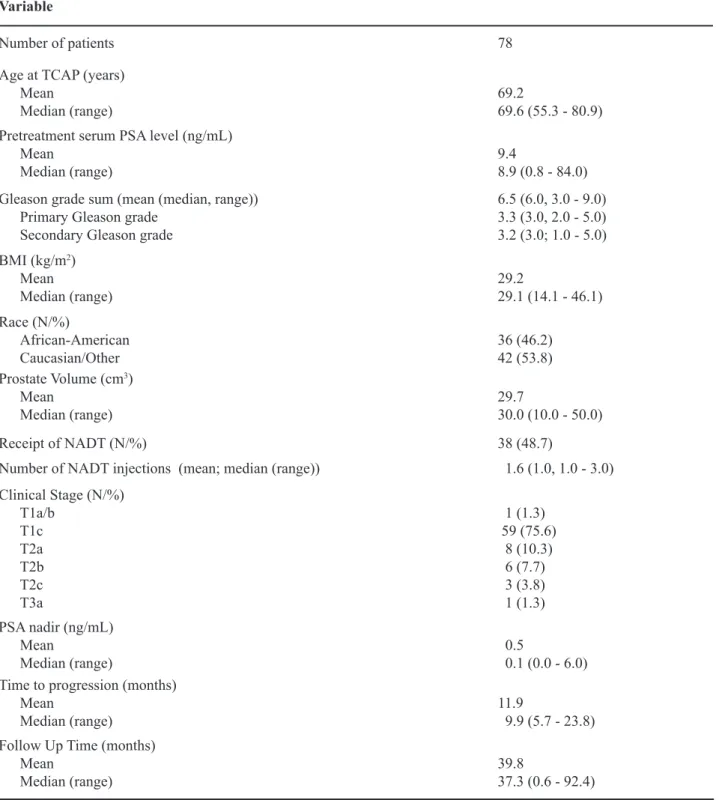
Demographic data and disease characteristics are outlined in Table-1. After exclusions, 78 consecu-tive patients were analyzed with a mean age of 69.2 years (range: 55.3 - 80.9), pre-TCAP PSA of 9.4 ng/mL (range: 0.8 - 84.0), Gleason grade sum of 6.5 (range: 3 - 9), and prostate volume of 29.7 cm3 (range:
10-50).
Erectile Function
Overall, 61 (78.2%) patients reported some degree of pre-TCAP EF with or without the use of erectile aids. However, only 35 (of 61, 57.4%) reported pre-TCAP erections suficient for intercourse (EF levels 1 or 2). Seventeen (21.8%) patients reported pre-TCAP impotence and 2 of these underwent post-TCAP IPP. At a mean follow-up of 39.8 months (range: 0.6-92.4), 10 (16.4%) patients regained EF; 9 (14.8%) achieving level 2 EF with PDE5i only (n = 3), VED only (n = 2), or PDE5i/VED (n = 4) and 1 (1.6%) achieving level 3 EF with PDE5i/VED. Subset analysis of the 35 men who were previously potent (EF level 1-2), however, demonstrated the post-TCAP EF recovery rate to be 25.7%. The mean time to po -tency restoration was 15.2 months (range: 9.7-29.3). Notably, the 2 patients who underwent IPP were not regarded as potent post-TCAP. No signiicant clinical predictors of post-TCAP EF were identiied on either univariate or multivariate analysis (data not shown). Post-TCAP EF was not associated with an increased ris� of disease-recurrence (p = 0.24). EF outcomes are outlined in Table-2.
Voiding Dysfunction
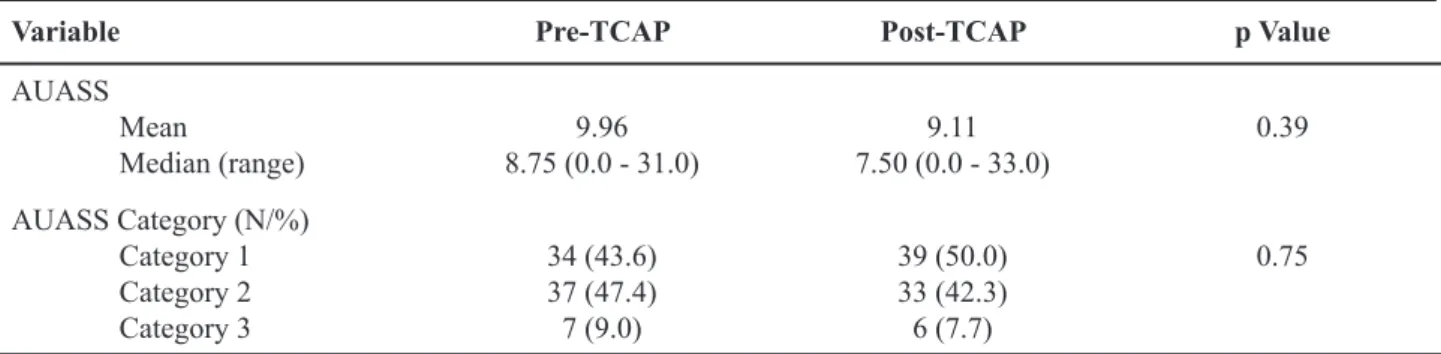
Median pre-TCAP AUASS was 8.75 (range: 0-31.0) vs. 7.50 (range: 0-33.0) postoperatively and did not change with treatment (p = 0.39). When ana -lyzed categorically, 34 (43.6%) men reported Category 1, 37 (47.4%) reported Category 2, and 7 (9.0%) reported Category 3 LUTS. Post-TCAP, 39 (50.0%), 33 (42.3%), and 6 (7.7%) men reported categories 1, 2, and 3 LUTS, respectively. There was no difference between pre and post-TCAP AUASS when compared categorically (p = 0.74). Six patients (7.7%) experi
-enced urinary incontinence at last follow-up: 1 (1.3%) requiring 0-1 pads/day, 1 (1.3%) requiring 1-2 pads/ day, 2 (2.6%) requiring 2-3 pads/day and 1 (1.3%) who developed a bladder neck contracture, which was dilated, resulting in > 3 pads/day incontinence. Overall, 46 patients (59.0%) demonstrated improved or stable AUASS, while 32 (41.0%) reported worsen -ing LUTS. Importantly, the presence of post-TCAP improved/stable AUASS was not associated with an increased risk of cancer recurrence (p = 0.67). Voiding function indings are outlined in Table-3.
On logistic regression (Table-4), lower pre-TCAP PSA (Odds Ratio (OR) 3.06; p = 0.008) and higher Gleason sum (OR 3.80; p = 0.002) were as -sociated with higher post-TCAP AUASS. Larger pre-TCAP prostate volume demonstrated a trend towards worsening LUTS and higher post-TCAP AUASS outcomes (p = 0.07). However, receipt of NADT did not demonstrate a relationship with post-TCAP AUASS (p = 0.67). No patients underwent a pre or post-TCAP transurethral resection/ablation of the prostate for uri-nary retention or LUTS during the study period.
Cancer-Control/Disease-Progression
Thirteen (16.7%) patients demonstrated dis -ease-progression: 10 (76.9%) BCR, 2 (15.4%) LCR, and 1 (7.7%) SADT. No CaP-related deaths were noted during the study period. Mean time-to-recur -rence was 11.9 months (median 9.9; range: 5.7-23.8). On Kaplan-Meier analysis, BCR-free survival was 97.9% at 1 year, 95.7% at 3 years and 82.9% at 5 years. Progression-free survival was 97.9% at 1 year, 95.7% at 3 years, and 71.1% at 5 years. Four (5.1%) patients died of unrelated causes and were censored at the time of death. Overall survival was 95.9% at 1 year, 94.3% at 3 years, and 94.3% at 5 years.
Table 1 – Demographic and clinicopathologic data on 78 men undergoing primarytargeted cryoablation of the prostate (TCAP) for clinically localized prostate cancer.
Variable
Number of patients 78
Age at TCAP (years)
Mean
Median (range) 69.269.6 (55.3 - 80.9)
Pretreatment serum PSA level (ng/mL) Mean
Median (range) 9.48.9 (0.8 - 84.0)
Gleason grade sum (mean (median, range)) Primary Gleason grade
Secondary Gleason grade
6.5 (6.0, 3.0 - 9.0) 3.3 (3.0, 2.0 - 5.0) 3.2 (3.0; 1.0 - 5.0) BMI (�g/m2)
Mean
Median (range) 29.229.1 (14.1 - 46.1)
Race (N/%)
African-American Caucasian/Other
36 (46.2) 42 (53.8)
Prostate Volume (cm3)
Mean
Median (range) 29.730.0 (10.0 - 50.0)
Receipt of NADT (N/%) 38 (48.7)
Number of NADT injections (mean; median (range)) 1.6 (1.0, 1.0 - 3.0)
Clinical Stage (N/%)
T1a/b T1c T2a T2b T2c
T3a
1 (1.3)
59 (75.6)
8 (10.3)
6 (7.7)
3 (3.8) 1 (1.3) PSA nadir (ng/mL)
Mean
Median (range) 0.5 0.1 (0.0 - 6.0)
Time to progression (months)
Mean
Median (range) 11.9 9.9 (5.7 - 23.8)
Follow Up Time (months)
Mean
Median (range) 39.837.3 (0.6 - 92.4)
COMMENTS
TCAP has steadily gained popularity for pri-mary and salvage treatment of clinically localized CaP (3,7). Erectile and voiding dysfunctions are common following all potentially curative CaP therapies. As
these morbidities continue to be elucidated, there is increasing interest in improving QOL outcomes for men undergoing CaP-directed treatments, with par-ticular emphasis on ED and voiding outcomes. How-ever, there remains both a paucity of data focusing on these outcomes, as well as considerable variability following primary TCAP (3,5-7,9,11,13). Particular to EF, the thought that TCAP resulted in irreversible ED secondary to hypothermic injury to the cavernous nerves is being questioned. The potential for axonal regeneration after TCAP-related neuropraxia lends credence to reports of EF recovery following TCAP (8).
Bahn et al. reported 7-year outcomes on these endpoints in 590 men undergoing primary TCAP. Of 373 men potent pre-TCAP, only 19 (5.1%) recovered potency at an average of 16.4 months post-TCAP. Regarding voiding function, of 533 previously conti -nent patients, 448 (84.1%) regained continence at an average of 6.1 months (3). In another series, Han et al.
Table 2 – Distribution of pre- and post- targeted cryo-ablation of the prostate (TCAP) erectile function and dysfunction.
EF Level Pre-TCAP (N/%) Post-TCAP (N/%)
1 9 (11.5) 0 (0)
2 26 (33.4) 9 (11.5)
3 17 (21.8) 1 (1.3)
4 9 (11.5) 0 (0)
5 17 (21.8) 68 (87.2)
Table 3 – Analysis of pre- and post- targeted cryoablation of the prostate (TCAP) American Urologic Association Symptom Score (AUASS).
Variable Pre-TCAP Post-TCAP p Value
AUASS Mean
Median (range) 8.75 (0.0 - 31.0)9.96 7.50 (0.0 - 33.0)9.11 0.39 AUASS Category (N/%)
Category 1 Category 2
Category 3
34 (43.6) 37 (47.4)
7 (9.0)
39 (50.0) 33 (42.3)
6 (7.7)
0.75
Table 4 – Logistic regression analysis for predicting worsening post- targeted cryoablation of the prostate (TCAP) lower urinary tract symptoms (i.e. increased American Urologic Association Symptom Score).
Variable Odds Ratio p Value
Age (years) 1.68 0.112
Pre-TCAP PSA (ng/mL) 3.05 0.008
BMI (�g/m2) 0.66 0.516
Prostate volume (cm3) 1.93 0.070
reported on 106 patients undergoing primary TCAP. They observed impotence rates of 87% for previously potent men, while 3 (3%) required pads for urinary incontinence (5). Similarly, Polasci� et al. reported on 50 men undergoing primary TCAP, documenting a response rate of 50% (3 of 6 previously potent men) with the use of PDE5i therapy after TCAP. Further, they found a 3.7% rate of post-TCAP incontinence, requiring 1-2 pads/day (6). In a questionnaire-based study, Anastasiadis et al. reviewed 131 men undergo -ing primary or salvage TCAP. They found that the most bothersome symptoms following TCAP were sexual, followed by urinary complaints. In particular, ED (90% vs. 86%) and incontinence rates (10% vs. 5.9%) were signiicantly worse in the salvage versus primary TCAP groups, respectively (9).
Our series demonstrated a recovery rate of EF suitable for intercourse of 25.7% in previously potent men (14.8% overall), with responses to VED, PDE5i, or both in combination (Table-2). It is important to
reiterate that it was not our general practice to actively pursue or recommend penile rehabilitation in these patients. Therefore, we infer the potential for further improvement in EF outcomes with implementation of penile rehabilitation protocols post-TCAP. In fact, Ellis et al. reported a recent series of 416 consecutive men undergoing primary TCAP whereby daily VED use was recommended (without constriction ring) beginning 6 weeks post-TCAP for previously potent men along with PDE5i every other day and as needed beginning 6 months post-TCAP (11). They docu-mented progressive EF recovery with this protocol: 29.1% regaining EF at 1 year, 48.5% at 2 years, and 51.3% at 4 years. Similarly, encouraging indings of EF recovery have been documented in other series (13), as well as our own (25.7%), even in the absence of penile rehabilitation. These indings have prompted us to adopt a regimen of aggressive penile rehabilita-tion following TCAP.
Regarding voiding outcomes, we identi-ied urinary incontinence rates comparable to most series, with 7.7% of men reporting some degree of urine lea�age (regardless of pad usage) (3,5,9-12). However, pre-TCAP continence was not recorded consistently in our cohort. Thus, we considered all men to be fully continent prior to TCAP, which may be an overestimation in this regard. Since consider -able variations in incontinence deinitions exist in the literature, we employed a strict deinition of post-TCAP incontinence as any degree of leakage (regardless of pad usage) in order to capture any patient with this complaint.
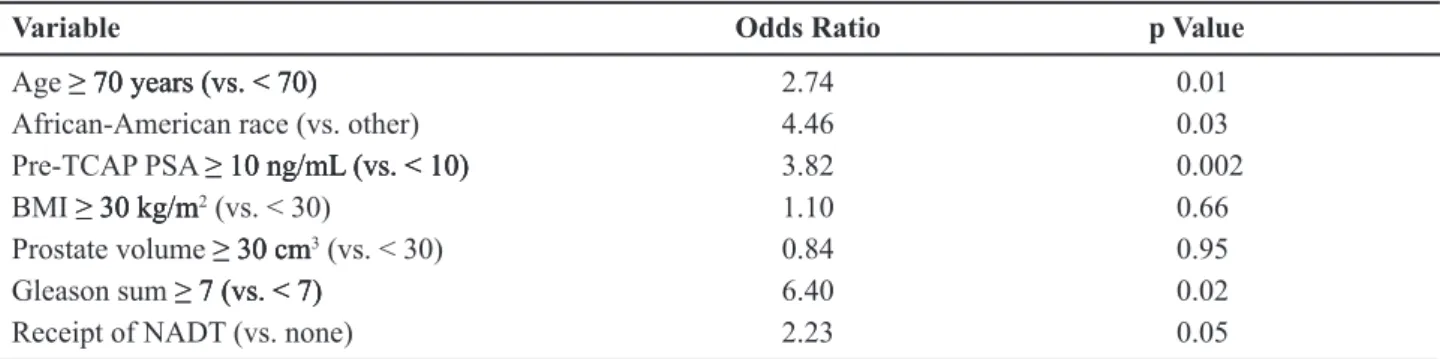
Table 5 – Logistic regression analysis for predicting disease-recurrence utilizing categorical variable modeling.
Variable Odds Ratio p Value
Age � 70 years (vs. < 70)� 70 years (vs. < 70)70 years (vs. < 70) 2.74 0.01
African-American race (vs. other) 4.46 0.03
Pre-TCAP PSA � 10 ng/mL (vs. < 10)� 10 ng/mL (vs. < 10)10 ng/mL (vs. < 10) 3.82 0.002
BMI � 30 �g/m� 30 �g/m30 �g/m2 (vs. < 30) 1.10 0.66 Prostate volume � 30 cm� 30 cm 30 cm3 (vs. < 30) 0.84 0.95
Gleason sum � 7 (vs. < 7)� 7 (vs. < 7) 7 (vs. < 7) 6.40 0.02
Receipt of NADT (vs. none) 2.23 0.05
TCAP = targeted cryoablation of the prostate; NADT = neoadjuvant androgen deprivation therapy.
Table 6 – Logistic regression analysis for predicting dis-ease-recurrence utilizing continuous variable modeling.
Variable Odds Ratio p Value
Age (years) 2.74 0.01
Pre-TCAP PSA (ng/mL) 0.90 0.37
BMI (�g/m2) 0.77 0.45
Prostate volume (cm3) 0.70 0.49
Our series demonstrated oncologic out-comes similar to most contemporary literature (3,5,6,10,11,13). Speciic to our series, it is notewor -thy that improved EF or voiding function demon-strated no association with increased risk for cancer recurrence (p = 0.24 and p = 0.67, respectively). In other words, a suboptimal freeze cannot explain the outcomes seen in our cohort. Another unique inding of our analysis was the increased risk of disease-pro-gression in African-American patients (compared to others) on multivariate analysis (OR 4.46, p = 0.03). While previously reported in radiation and prosta-tectomy series (18,19), to our knowledge, ours is the irst series documenting this association in men undergoing primary TCAP.
An additional novel feature of our series is the use of validated objective assessments of LUTS (AUASS) (16). To our �nowledge, no prior series has utilized this instrument for LUTS comparisons in men undergoing TCAP. Our series demonstrated stable AUASS, whether analyzed as continuous or categori -cal variables. Regression analysis demonstrated wors-ening AUASS to be associated with lower pre-TCAP PSA and higher Gleason sum (Table-4). While the signiicance of this remains unclear, we hypothesize that higher grade cancers that produce less PSA due to glandular de-differentiating may respond differently to the cryobiology of TCAP, potentially contributing to these indings. Notably, larger prostate volumes demonstrated a trend towards worsening post-TCAP LUTS, though this was not statistically signiicant (p = 0.07). However, NADT administration did not demonstrate a significant relationship with post-TCAP AUASS (p = 0.67). We suspect that with larger series and longer follow-up, a relationship between improved LUTS may be realized based on the abil -ity of NADT to reduce the overall prostate volume, potentially offering improved voiding outcomes in this patient population, though we were unable to demonstrate this in our current series.
There are several limitations to this study. Firstly, we report a retrospective review of our ind -ings at a single center and as such, our ind-ings are subject to the inherent biases of this type of analy-sis. Consequently, patients were not evaluated in a prospective fashion using validated EF instruments such as the Sexual Health Inventory for Men or In
-ternational Index of Erectile Function questionnaires to document objective pre- and post-TCAP EF. Ad-ditionally, our cohort remains relatively small (n = 78) with a somewhat short duration of follow-up (39.8 months). Further, selection bias may have occurred as we studied only patients with complete pre- and post-TCAP EF and AUASS data. Thus, these potential biases may limit the ability to demonstrate all potential relationships between variables and the endpoints of the study.
Nonetheless, we feel this data is compelling enough to further investigate the possibility of improving EF outcomes following primary TCAP. Penile rehabilita-tion has proven useful following radical prostatectomy (20), and results appear encouraging following TCAP, though data is limited (11). For these reasons, we have integrated this strategy into our pre-operative and post-TCAP treatment protocol, utilizing validated question-naires to objectively determine our outcomes.
With regards to LUTS, TCAP does not seem to improve nor worsen symptoms to any signiicant degree based on our results. However, a discussion of the potential for urinary incontinence is paramount, as this remains a considerable bother to patients who experience this complaint following TCAP (9).
CONCLUSIONS
Primary TCAP resulted in stable postopera-tive AUASS, while ED remains common. However, 25.7% of previously potent men demonstrated EF suit -able for successful intercourse in the absence of penile rehabilitation. Neither the restoration of EF, nor the presence of stable/improved LUTS were associated with disease-recurrence and therefore, not a result of suboptimal cryoablation. While long-term, prospec-tive data employing validated instruments is requisite, implementation of a proactive penile rehabilitation protocol should be considered in order to maximize sexual outcomes following primary TCAP.
ACKNOWLEDGEMENT
CONFLICT OF INTEREST
None declared.
REFERENCES
1. Jemal A, Siegel R, Ward E, Murray T, Xu J, Thun MJ:
Cancer statistics, 2007. CA Cancer J Clin. 2007; 57:
43-66.
2. Penson DF, Litwin MS: Quality of life after treatment for prostate cancer. Curr Urol Rep. 2003; 4: 185-95. 3. Bahn DK, Lee F, Badalament R, Kumar A, Gres�i J,
Chernic� M: Targeted cryoablation of the prostate:
7-year outcomes in the primary treatment of prostate
cancer. Urology. 2002; 60: 3-11.
4. Chin JL, Ng CK, Touma NJ, Pus NJ, Hardie R, Abdel
-hady M, et al.: Randomized trial comparing cryoablation and external beam radiotherapy for T2C-T3B prostate cancer. Prostate Cancer Prostatic Dis. 2008; 11: 40-5. 5. Han KR, Cohen JK, Miller RJ, Pantuc� AJ, Freitas DG,
Cuevas CA, et al.: Treatment of organ conined prostate
cancer with third generation cryosurgery: preliminary
multicenter experience. J Urol. 2003; 170: 1126-30. 6. Polasci� TJ, Nosni� I, Mayes JM, Mouraviev V:
Short-term cancer control after primary cryosurgical ablation for clinically localized prostate cancer using third-gen-eration cryotechnology. Urology. 2007; 70: 117-21.
7. Wa�e RW, Hollabaugh RS Jr, Bond KH: Cryosurgical
ablation of the prostate for localized adenocarcinoma:
a preliminary experience. J Urol. 1996; 155: 1663-6. 8. Donnelly BJ, Sali�en JC, Ali-Ridha N, Rewcastle JC,
White LJ: Histological indings in the prostate two years
following cryosurgical ablation. Can J Urol. 2001; 8:
1237-9.
9. Anastasiadis AG, Sachdev R, Salomon L, Ghafar MA, Stisser BC, Shabsigh R, et al.: Comparison of
health-related quality of life and prostate-associated symptoms after primary and salvage cryotherapy for
prostate cancer. J Cancer Res Clin Oncol. 2003; 129:
676-82.
10. Ellis DS: Cryosurgery as primary treatment for local -ized prostate cancer: a community hospital experience.
Urology. 2002; 60: 34-9.
11. Ellis DS, Manny TB Jr, Rewcastle JC: Cryoablation as
primary treatment for localized prostate cancer followed
by penile rehabilitation. Urology. 2007; 69: 306-10. 12. Long JP, Bahn D, Lee F, Shinohara K, Chinn DO,
Macaluso JN Jr: Five-year retrospective, multi-institu -tional pooled analysis of cancer-related outcomes after
cryosurgical ablation of the prostate. Urology. 2001; 57:
518-23.
13. Robinson JW, Donnelly BJ, Sali�en JC, Weber BA, Ernst S, Rewcastle JC: Quality of life and sexuality of men with prostate cancer 3 years after cryosurgery.
Urology. 2002; 60: 12-8.
14. Bahn DK, Silverman P, Lee F Sr, Badalament R, Bahn
ED, Rewcastle JC: Focal prostate cryoablation: initial results show cancer control and potency preservation. J Endourol. 2006; 20: 688-92.
15. Lambert EH, Bolte K, Masson P, Katz AE: Focal
cryosurgery: encouraging health outcomes for unifocal prostate cancer. Urology. 2007; 69: 1117-20.
16. Barry MJ, Fowler FJ Jr, O’Leary MP, Brus�ewitz RC, Holtgrewe HL, Mebust WK, et al.: The American
Urological Association symptom index for benign
prostatic hyperplasia. The Measurement Committee
of the American Urological Association. J Urol. 1992;
148: 1549-57; discussion 1564.
17. Horwitz EM, Vicini FA, Ziaja EL, Dmuchows�i CF, Stromberg JS, Martinez AA: The correlation between the ASTRO Consensus Panel deinition of biochemical
failure and clinical outcome for patients with prostate cancer treated with external beam irradiation. American
Society of Therapeutic Radiology and Oncology. Int J Radiat Oncol Biol Phys. 1998; 41: 267-72.
18. Powell IJ, Dey J, Dudley A, Pontes JE, Cher ML, Sa�r
W, et al.: Disease-free survival difference between Af-rican AmeAf-ricans and whites after radical prostatectomy for local prostate cancer: a multivariable analysis. Urol-ogy. 2002; 59: 907-12.
19. Tewari A, Horninger W, Pelzer AE, Demers R, Crawford ED, Gamito EJ, et al.: Factors contributing to the racial differences in prostate cancer mortality. BJU Int. 2005;
96: 1247-52.
20. Mulhall JP, Morgentaler A: Penile rehabilitation should
become the norm for radical prostatectomy patients. J
Sex Med. 2007; 4: 538-43.
Accepted: May 9, 2008
Correspondence address: Dr. Robert W. Wake Department of Urology
University of Tennessee Health Science Center 910 Madison Avenue, Room 409
Memphis, TN, 38163, USA Fax: + 1 901 448-1044