The Length of the Male Urethra
Tobias. S. Kohler, Mitchell Yadven, Ankur Manvar, Nathan Liu, Manoj Monga
Division of Urology (TSK), Southern Illinois University, Springield, IL, Department of Urologic
Surgery (MY, NL, MM), University of Minnesota, Minneapolis, MN, Department of Urologic Surgery
(AM), Northwestern University, Feinberg School of Medicine, Chicago, Illinois, USA
ABSTRACT
Purpose: Catheter-based medical devices are an important component of the urologic armamentarium. To our knowledge, there is no population-based data regarding normal male urethral length. We evaluated the length of the urethra in men with normal genitourinary anatomy undergoing either Foley catheter removal or standard cystoscopy.
Materials and Methods: Male urethral length was obtained in 109 men. After study permission was obtained, the subject’s penis was placed on a gentle stretch and the catheter was marked at the tip of the penis. The catheter was then removed and the distance from the mark to the beginning of the re-inlated balloon was measured. Alternatively, urethral length was measured at the time of cystoscopy, on removal of the cystoscope. Data on age, weight, and height was obtained in patients when possible.
Results: The mean urethral length was 22.3 cm with a standard deviation of 2.4 cm. Urethral length varied between 15 cm and 29 cm. No statistically signiicant correlation was found between urethral length and height, weight, body mass index (BMI), or age.
Conclusions: Literature documenting the length of the normal male adult urethra is scarce. Our data adds to basic anatomic information of the male urethra and may be used to optimize genitourinary device design.
Key words: genitourinary; catheter; urethra Int Braz J Urol. 2008; 34: 451-6
INTRODUCTION
The Egyptians developed the irst use of cath -eters by using an instrument made of reed that was inserted like a plug. The term “katheter” originates from “kathiemai,” meaning ‘to sound’ with a probe. The Greeks further developed this katheter by using a hollow metal tube inserted into the male urethra to empty the bladder.
Modern day catheter use is ubiquitous and catheter-based medical devices are an important component of the urologic armamentarium. Since its development in 1935, use of Frederick Foley’s
urethral catheter has remained pervasive with little
modiication to its design. Current urethral catheters
typically measure 40-45 cm in length. With recent developments of new catheter-based treatments such as microwave therapy of the prostate or cryotherapy, specialized catheters have been developed. One would expect further novel catheter use in the future, and perhaps a departure from the standard Foley design to optimize bladder drainage, minimize cost and improve
patient comfort. In addition, the length of lexible and
rigid endoscopes for transurethral applications would
beneit from standardization based on the expected length of the male urethra. As such, deining the mean
Despite an extensive online literature search and review of anatomic atlases, only one reference to the anatomic length of the male urethra was found. Gray’s Anatomy describes a male urethral length of 17.5 to 20 cm (1). However, an exhaustive review of the aforementioned citation’s reference list sug-gests that supportive evidence is lacking. One prior study utilizing retrograde urethrograms noted that the membranous urethral length ranged from 1 to 1.5 cm (2). A second study reported that the average prostatic urethral length was 2.4 cm (3). Lastly, a more detailed anatomical study reports the urethral length for an infant male to be 5.6 cm (4).
MATERIALS AND METHODS
The study was initiated after IRB consent from all participating institutions was obtained. Pa-tients were recruited from a large Midwest Veteran’s Administration Hospital and from a private urologic practice in Florida. Subjects with a history of pros-tatectomy or urethral surgery were ineligible for the study. To measure urethral length, two methods were employed. The majority of subject data was obtained upon removal of an indwelling Foley catheter. Prior to catheter removal, the subject’s penis was placed on a gentle stretch, the balloon of the catheter was gently “cinched” to the bladder neck, and the catheter was marked at the tip of the penis with tape. The catheter was then removed and the distance from
the mark to the beginning of the re-inlated balloon
was measured in centimeters (n = 79). Alternatively,
urethral length was established at the time of lex -ible cystoscopy upon removal of the cystoscope.
The scope was held ixed at the bladder neck with
the penis on stretch and the cystoscope was simi-larly marked with tape at the end of the penis. The cystoscope was then removed and the distance from the mark to the end of the cystoscope was measured in centimeters (n = 30). Stretched penile length has previously been established as surrogate marker for erect penile length (5). No measurements of separate prostatic, membranous, bulbar or pendulous urethral segments were obtained. After measurement was completed, subject data on age, weight, and height was obtained in most patients. BMI was calculated as kg/meter2. All statistics were performed using
SPSS software.
RESULTS
Data was collected on 109 men. The mean urethral length was 22.3 cm with a standard devia-tion of 2.4 cm. Mean values for age, weight, height, and body mass index (BMI) were 70.7 years, 92 kg, 1.8 meters, and 28.6 kg/m2 (Table-1). Urethral length
varied between 15 cm and 29 cm. The distribution of urethral length is shown in Figure-1. No statistically
signiicant correlation was found between urethral
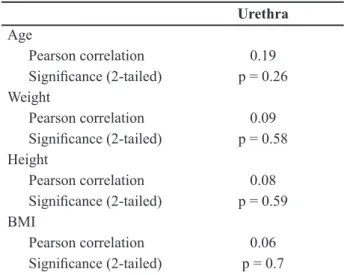
length and weight, height, BMI, or age utilizing Pearson’s correlation 2-tailed test (Table-2).
COMMENTS
Literature documenting the length of the normal male adult urethra is scarce. This study deter-mined the average urethral length to be about 22 cm
Table 1 – Descriptive statistics (n = 109).
Minimum Maximum Mean SD
Age 42.0 89.0 70.7 12.2
Weight (kg) 61.0 141.0 92.0 17.8
Height (m) 1.7 2.0 1.8 0.1
BMI (kg/m(m)) 20.0 44.5 28.6 5.4
Urethra(cm) 15.0 29.0 22.3 2.4
with a standard deviation of 2.4 cm. Our data adds to basic anatomic information of the male urethra and may be used to optimize genitourinary device design.
Current designs have an average length around 40-45 cm, regardless of the lumen size (Table-3). This design is almost double the length of the average male urethral length. Our mean determination or urethral length incorporates differences in penile length and prostatic urethral length, two factors that have a wide variability. Prostatic lengths have been
shown to range from (2.5-4.5cm) inluenced by both
baseline anatomy, and the effect of benign prostatic hyperplasia (6). Our study excluded those with pros-tatic surgery, but allows for the random variation of prostate size attributable to benign prostatic hyperpla-sia of our age population. Any variation on prostate length would be accounted for by the standard devia-tion of our urethral length determinadevia-tion. Similarly, penile lengths are variable in the population. We used stretched penile length in our measurements as it is the only validated surrogate marker for erect length (5). Previous studies have compared both stretched
and laccid penile length to height and found no statistically signiicant correlation (7). Finding of
a positive correlation between urethral length and
Figure 1 – Urethral length (cm) distribution.
Table 2 – Correlations.
Urethra
Age
Pearson correlation 0.19 Signiicance (2-tailed) p = 0.26 Weight
Pearson correlation 0.09 Signiicance (2-tailed) p = 0.58 Height
Pearson correlation 0.08 Signiicance (2-tailed) p = 0.59 BMI
Pearson correlation 0.06 Signiicance (2-tailed) p = 0.7
Table 3 – Catheter lengths for 16F adult catheters.
Catheter Manufacturer Length (inches) Length (cm)
Bard 16 41
Cook 13.4 34
Boston Scientiic 19.7 50
Rochester Medical 15.9 40
Average adult catheter length = 16.2 in or 41 cm.
height has intrinsic appeal, as one could then predict which catheter length would be appropriate (similar to selecting ureteral stents based on height). However,
our indings parallel the penile length data, where no statistically signiicant correlation between height or
BMI and urethral length were found (p = 0.7). By measuring the total male urethral length of our subjects, we are able to obtain a mean length and calculate a standard deviation. Thus, ideal future catheter design seeking to minimize excess catheter material requirements should aim for an intra-ure-thral length of about 22 cm with variations in length 1-2 standard deviations above and below this length. Based on our results, catheter manufacturers could design catheters that would accommodate the majority of male patient’s urethras: 17 to 27 cm. Other authors have determined maximum total penile and urethral extensibility, further justifying the rationale for shorter catheter design (8).
CONCLUSION
Literature documenting the length of the normal male adult urethra is surprisingly scarce. Our study found the average length of the male urethra
was 22.3 cm and there was no statistically signiicant
correlation between urethral length and height. Our data adds to basic anatomic information of the male urethra and may be used to optimize genitourinary device design.
CONFLICT OF INTEREST
None declared.
REFERENCES
1. Gray H: Anatomy of the Human Body. Philadelphia, Lea & Fiberger. 1985, 13th ed.
2. McCallum RW: The adult male urethra: normal anatomy, pathology, and method of urethrography. Radiol Clin North Am. 1979; 17: 227-44.
3. Rolnick HC, Arnheim FK: An anatomic study of the external urethral sphincter in relation to prostatic sur-gery. J Urol. 1949; 61: 591-603.
4. Parker AE: The lymph vessels from the posterior ure-thra, their regional lymph nodes and relationships to the main posterior abdominal lymph channels. J Urol. 1936; 36:538-57.
5. Wessells H, Lue TF, McAninch JW: Penile length in the laccid and erect states: guidelines for penile augmentation. J Urol. 1996; 156: 995-7.
6. Elshaikh MA, Angermeier K, Ulchaker JC, Klein EA, Chidel MA, Mahoney S, et al.: Effect of anatomic, pro-cedural, and dosimetric variables on urinary retention after permanent iodine-125 prostate brachytherapy. Urology. 2003; 61: 152-5.
7. Awwad Z, Abu-Hijleh M, Basri S, Shegam N, Murshidi M, Ajlouni K: Penile measurements in normal adult Jordanians and in patients with erectile dysfunction. Int J Impot Res. 2005; 17: 191-5.
8. Da Silva EA, Sampaio FJ: Urethral extensibility ap-plied to reconstructive surgery. J Urol. 2002; 167: 2042-5.
Accepted after revison: June 10, 2008
Correspondence address:
Dr. Tobias S. Köhler
Southern Illinois University School of Medicine Division of Urology
PO Box 19638
EDITORIAL COMMENT
This study assessed urethral length in 109 men aged 42-89 years at the time of Foley catheter
removal or whilst undergoing lexible cystoscopy.
The authors found a mean urethral length of 22.3 cm
(range 15-29, SD 2.4) and suggest the inding might
lead to revised catheter designs with intra-urethral lengths ranging from 17 to 27 cm. It is proposed that customized catheter lengths would save on excess catheter materials, reduce costs and improve patient comfort. Although the results are interesting, altering
catheter design in relation to the data may not neces-sarily achieve these aims. Optimal patient comfort,
for example, requires suficient extra-urethral catheter
length for ease of appliance attachment and for ten-sion-free catheter immobilization with adhesive tape. In addition, the production of catheters with such a restrictive length would undoubtedly cause problems in the occasional patient with well-above average penile length.
Dr. K. A. Hutton
Department of Pediatric Surgery University Hospital of Wales Heath Park, Cardiff, South Glamorgan Wales, United Kingdom E-mail: [email protected]
EDITORIAL COMMENT
Albert Einstein was quoted to say, “Every-thing should be as simple as it is, but not simpler”, and the study design and methods of this paper could certainly be considered simple. The authors of this study attempt to measure the length of the normal male urethra by either direct cystoscopic measurements (n = 30) or by marking indwelling urethral catheters prior to removal (n = 79). They found that the average stretched male urethral length is 22 cm ± 5 cm. Per their literature review, there has been no previous
at-tempt at a population-based urethral length evaluation. When considering all the times that we as urologists traverse this area blindly (urethral catheter placement, sounds, transurethral microwave thermotherapy, the
new prostate SpannerT), I am astounded to ind that this is the irst study to address this issue. Although no statistically signiicant predictor of urethral length was identiied, I predict that the urethral length conclusion
of this study will (“simply” put) be quoted in anatomy textbooks for years to come.
Dr. Benjamin K. Canales
EDITORIAL COMMENT
The authors measured the urethral length in 109 men, 42 to 89 years old, and found that it varied between 15 and 29 cm (mean 22.3 ± 2.4). They noted that the currently used catheters have an average length of 40 to 45 cm, which is almost double the average male urethral length. Thus, they suggest that future catheter design should aim for an intra-urethral length of 22 ± 2 cm to minimize cost. This may be applied also for the design of catheter-based genito-urinary devices.
The authors are to be congratulated for this interesting and unprecedented idea. However, the cur-rent study is limited by the relatively small number of patients and by missing the group of patients younger than 42 years. The authors are to be encouraged to corroborate on this issue using a larger number of patients and including all age groups. Thus, they might be able to stratify the length of male urethra - and ac-cordingly the appropriate catheter - into 3 categories: short, medium, and long.