Surgical Treatment of Acquired Atresia of the
External Auditory Ear Canal
Valerie Droessaert
1Robby Vanspauwen
1Erwin Offeciers
1Andrzej Zarowski
1Joost van Dinther
1Thomas Somers
11Department of ENT, European Institute for ORL, Wilrijk, Antwerp,
Belgium
Int Arch Otorhinolaryngol 2017;21:343–346.
Address for correspondence Valerie Droessaert, MD, Department of ENT, European Instutue for ORL, Oosterveldlaan 24, Wilrijk, Antwerp 2610, Belgium (e-mail: [email protected]).
Introduction
Acquired atresia of the external auditory canal is a rare con-dition in which the medial part of the ear canal is blocked by a
fibrotic plug.1It is usually caused by recurrent infections or inflammation with formation of granulation tissue. Recurrent inflammation leads to accumulation offibrotic scar tissue and lateral extension of thisfibrotic plug toward the cartilaginous
junction in the external auditory canal (EAC). Other causes include: healing problems,fibrosis after surgery, radiotherapy, trauma, dermatologic conditions, neoplasm, or idiopathic.2–7
Acquired atresia may be combined with EAC cholesteatoma. Major patient complaints include otorrhea and hearing loss.
Paparella et al described the surgical technique to treat acquired atresia as8: removal of the fibrotic plug and the
Keywords
►
ear canal
►
disease management
►
treatment outcome
►
hearing loss
►
adult
Abstract
Introduction
Acquired atresia of the external auditory canal is characterized by the
formation of
fi
brous tissue in the medial part. The causes include chronic otitis externa,
perforated chronic otitis media, postoperative or idiopathic healing problems.
Acquired atresia presents with hearing loss and can be associated with otorrhea.
Objective
We analyzed the results of surgery after six months and two years by
checking (1) pre- and postoperative hearing thresholds; (2) presence of otorrhea; and
(3) whether a dry and patent ear canal is achieved.
Methods
We conducted this retrospective study at a tertiary referral center. In total,
27 ears underwent treatment with resection of the
fi
brotic plug followed by
trans-plantation of a split-thickness skin graft covering the bare bone and tympanic
membrane. When necessary, we combined this with a myringoplasty and a (meato-)
canalplasty.
Results
Otorrhea was present in 59.3% of the patients initially and in 14.8% at six
months and 11% at two years postoperative. A dry and patent ear canal was obtained in
55.6% after six months and in 89% of the patients after two years (
n
¼
27). The pure
tone average before surgery was 39.1 dBHL (SD
¼
20 dBHL), at six months 31.4 dBHL
(SD
¼
16.4 dBHL), and at 24 months postop 30.9 dBHL (SD
¼
17.1 dBHL). We
observed a statistically signi
fi
cant improvement of hearing in 63% of the patients at
six months (
p
¼
0.005) and in 65% after two years (
p
¼
0.022).
Conclusions
Treatment of acquired atresia remains a challenge. Using the
appro-priate surgical technique, including skin-grafting and regular postoperative check-up,
rendered excellent results regarding otorrhea and a moderate improvement of hearing
was achieved in 65% of the patients after two years.
received May 26, 2016 accepted November 6, 2016 published online February 28, 2017
DOIhttps://doi.org/ 10.1055/s-0037-1598604. ISSN 1809-9777.
Copyright © 2017 by Thieme Revinter Publicações Ltda, Rio de Janeiro, Brazil THIEME
diseased skin with a maximal widening of the bony canal and meatus, followed by grafting of the bare areas with a split thickness skin graft.
We analyzed the surgical results 6 and 24 months after surgery in a series of acquired atresia, comparing (1) the hearing before and after surgery, (2) the presence or absence of otorrhea, and (3) the anatomical result. An anatomical success means a dry and patent external ear canal, that is, the absence of otorrhea, myringitis, granulation formation, or tendency to restenosis.
Materials and Methods
Study Population
We performed this study at a tertiary referral center. We retrospectively analyzed patient records of acquired atresia surgery (canalplasty and grafting) performed between 2009 and 2014. We collected the following data: age, sex, cause of atresia, presenting symptoms (otorrhea, hearing loss) and otoscopicfindings such as myringitis,fibrosis, granulation, blunting, stenosis, and atresia. We performed audiometry before and after surgery at 6 months (range: 6–12 months) and at 2 years (range: 18–30 months). We excluded from the study patients in whom we encountered and who underwent operation for preoperatively ossicular chain pathology. In our study population, some patients suffered from middle ear pathology, but did not undergo operation for it at thefirst stage.
In total, we analyzed 27 ears (25 patient records, two patients needing surgery on both ears). Nine were primary cases (33%) and 18 ears were revision cases (66%). The mean age of the patients at the time of surgery was 27 years old (range: 9–61y). The sex ratio was 13 women and 14 men. Demographic data are shown in►Table 1.
Surgical Technique
The surgery is performed via a retro-auricular or endaural incision. An incision lateral to the atresia is made and the
fibrosis is resected, the skin covering the fibrotic plug is preserved and kept attached to the canal skin for later canal coverage. When removing thefibrotic plug at the medial end of the EAC, one pays attention to maintain the parsfibrosa of the tympanic membrane intact and then carefully dissects by blunt dissection. In case of an ear drum perforation, a myringoplasty is performed. In the presence of a narrow
meatus and a narrow bony, a combined meatocanaloplasty is performed. The surgery aims for complete resection of the
fibrosis to reduce the risk of recurrence. The anterior angle is most at risk, certainly in the case of incomplete visualization. Therefore, the surgeon establishes a broad straight external ear canal by widely drilling the canal (canalplasty) and opening the anterior sulcus angle to prevent blunting. Care is taken not to violate the temporomandibular joint ante-riorly and the mastoid cells posteante-riorly. Infeante-riorly a larger amount of bone can be drilled away from the tympanic bone. Thefibrotic plug resection is followed by transplantation of an ultra-thin (0.6mm) split-thickness skin graft (STSG), harvested retro-auricularly using an electrical dermatome (Aesculap, Center Valley, USA). The size of the graft is evaluated using a dummy paper patch and fashioned as in the Jahrsdörfer technique for atretic ears (multiple triangular extensions at one end ensuring total tympanic coverage). Split-thickness is preferred to full-thickness grafts; the thin-ness of the graft ensures that the external canal will not tend to be covered with too thick skin. Attention is paid to a complete coverage of all bare bone and tympanic membrane to avoid a recurrent tendency of granulation tissue,fibrosis, and retraction. In our study, we did not perform middle ear surgery.
Packing of the ear is done using a silicon sheet which is inserted andfilled with sponges embedded in an antibiotic ointment (Terra-Cortril, Zoetis, N. Jersey, USA) for at least 2 weeks. If the ear shows a tendency to restenosis at follow-up otoscopy, a new packing is inserted for another two weeks. Avoidance of water is crucial as long as epithelializa-tion is not fully established. Regular follow-ups are manda-tory to check for appearance of granulating areas which are treated by curetting and ototopical medication (e.g., Terra-Cortril, corticosteroids, Trichloroacetic acid).
Statistics
Pre- and post-operative pure tone averages (PTA), were compared using repeated measure analysis of variance (AN-OVA) and pairwise post hoc comparisons (with Bonferroni correction). We performed the statistical analysis with IBM SPSS Statistics, version 23 (IBM, Armonk, NY, USA). For each analysis, we adopted a significance level of 5%.
Results
In total, 27 ears of 25 patients with acquired atresia were surgically treated in the period between 2009 and 2014. The main pre-operative complaint was hearing loss in 78% of the patients. Otorrhea was reported by 59%. Before surgery, micro-otoscopy revealed granulation in 100%, myringitis in 7.4%, and blunting or webbing in 11% of the ears. The PTA was 39.1 dBHL (SD 20.0 dBHL). The causes of acquired atresia are listed in►Fig. 1, recurrent inflammation (56%) being the most frequent cause, followed by past surgical interventions (37%). We checked the 27 ears at 6 to 12 months and at a later mean follow-up time of 24 months (range: 18–30months) (n¼27). Otorrhea was still present in 14.8% of the patients at 6 months and in 11% of the patients after 24 months. At Table 1 Patient demographics
N¼27
Men vs women 52% versus 48%
Mean Age 27 years (range: 9–61)
Revision surgery 18 (67%)
Follow-up time 6 months (range 6–12 months) and 24 months (18–30 months)
Otorrhea 59%
Hearing loss 74%
International Archives of Otorhinolaryngology Vol. 21 No. 4/2017
6 months, 18.5% suffered from granulation tissue and 11.1% of myringitis. At 24 months, myringitis was present in 4% and granulation tissue in 4% of the patients. In 55.6% and 89%, a dry and stable condition was obtained after 6 and 24 months, respectively. At 24 months, 11% of patients presented web-bing or lateralization of the tympanic membrane in the absence of otorrhea. None of our patients had revision surgery; those with persistent inflammatory areas under-went local treatment in the outpatient clinic with ear drops containing antibiotics and steroids and, if needed, with curetting of the relapsing granulation and application of Trichloroacetic acid or silver nitrate until completion of epithelial healing.
We observed a statistically significant improvement (F (2.44)¼8.5; p¼0.003) of hearing when using repeated ANOVA measures. Post hoc comparisons of PTA revealed a statistically significant difference (p¼0.005) between preop and 6 months postop and between preop and 24 months postop (p¼0.022). The results 2 years after surgery regard-ing presence of otorrhea, granulation, and hearregard-ing thresholds are shown in►Fig. 2.
The mean preop PTA (mean¼39.1 dBHL; standard devia-tion (SD)¼20.0 dBHL) was significantly larger than the PTA measured 6 months postop (p¼0.005) (mean¼31.4 dBHL; SD¼16.4 dBHL) and 24 months postop (p¼0.022) (mean¼ 30.9 dB HL; SD¼17.1 dBHL). There were no statistically
significant differences between the PTA measured at 6 and 24 months postop.
In 65% of the patients we obtained hearing improvement at 24 months postop, with a mean PTA of 14.3dBHL (min. 1.6; max 36.6; SD 10.4).
Discussion
Acquired atresia is a rare condition and a veritable challenge to treat. Literature concerning this pathology remains scarce.1,9–13In this retrospective study, we investigated the
clinical and audiometric results.
Regarding hearing loss, we observed a moderate but statistically significant improvement with postoperative mean PTA of 9 dBHL. Comparison with data from the literature is difficult; terms such as stenosis and atresia are often mixed and patient populations are heterogenic. Atresia is the result of a process with recurrent wet episodes (active granulation) and becomes dry and stable as the cartilaginous junction has been reached. Stenosis is a pathological narrow-ing of the external ear canal in which the tympanic mem-brane might still be seen. Symptoms might differ among these different entities (primarily hearing loss in end-stage atresia versus otorrhea in stenosis). Several authors describe an improvement of hearing in 50–80% of the cases.1,2,9–15In
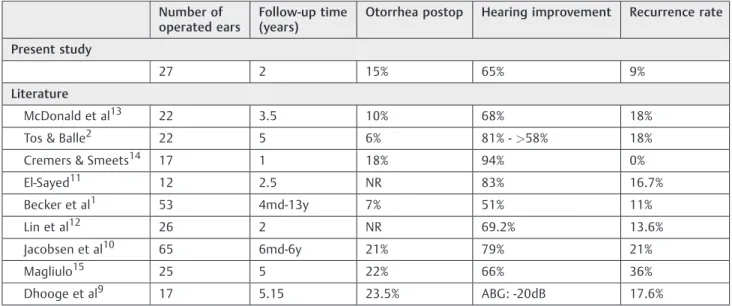
our study, at 24 months postop we saw a hearing improve-ment of 9 dBHL in 65% of our patients, which is in line with current literature (►Table 2).
Incomplete healing with residual myringitis or formation of granulation tissue was present in 8% of the ears after 24 months requiring regular follow-up, suction cleaning, and curetting when needed. None of the cases required revision surgery . Our results are at the better end when compared with other published results1,2,9–12,14,15(
►Table 2). Sixty-seven percent of the ears operated in this series were referred from elsewhere, being potentially at a higher risk for recurrence and postoperative healing problems. Eighty-nine percent of the ears remained stable with no otorrhea, but in 11%, we observed webbing or lateralization of the ear drum. If webbing or lateralisation was present without otorrhoea, nothing was done and, in the absence of complaints from the patients, the situation was left as it was. We saw no statistical difference in results between revision and primary cases.
Our surgical technique is similar to the one described originally by Paparella.8 One may discuss the approach (endaural or retro-auricular) and the type of grafting (split-thickness versus full-thickness, and free graft versus pedicled vascularized graft). All authors agree that the bare areas of bone should be covered with tissues and also lined with skin grafts. Jacobson and Mills reported a 100% recur-rence rate when no skin grafting was performed.10 Thus, removal of thefibrotic plug without skin grafting is doomed to fail. We prefer to use STSG as these are thin and do not tend to narrow the ear canal. A potential disadvantage of STSG could be a tendency to less favorable healing and even potential risk of necrosis,9but the latter was not observed in our series.
Fig. 1 Diagram showing the three etiologic causes of acquired atresia
in the patient population, with inflammation being most frequent (56%), followed by surgery (37%), and 7% unknown cause.
Fig. 2 Comparison of pre- and postoperative data regarding
otor-rhea, granulation and hearing (Pure Tone Average expressed in dBHL).
International Archives of Otorhinolaryngology Vol. 21 No. 4/2017
Conclusion
Acquired atresia remains a therapeutic challenge. Nonethe-less, with the appropriate surgical technique and expertise, it is possible to obtain good anatomical results. In our study, we achieved moderate but statistically significant hearing im-provement of 9 dBHL. Sixteen patients suffered from otor-rhea preoperatively, which disappeared in 80% of these patients. We observed a patent and dry ear canal in 89% of all the ears after two years. In these ears hearing aids were applicable if necessary and water avoidance was not obliga-tory. The authors stress the importance of close follow-up and eventual medical ototopical treatment in the early post-operative stage to prevent recurrence of stenosis.
References
1 Becker BC, Tos M. Postinflammatory acquired atresia of the external auditory canal: treatment and results of surgery over 27 years. Laryngoscope 1998;108(06):903–907
2 Tos M, Balle V. Postinflammatory acquired atresia of the external auditory canal: late results of surgery. Am J Otol 1986;7(05): 365–370
3 Hopsu E, Pitkäranta A. Idiopathic, inflammatory, medial meatal, fibrotising otitis presenting with lichen planus. J Laryngol Otol 2007;121(08):796–799
4 Carls JL, Mendenhall WM, Morris CG, Antonelli PJ. External auditory canal stenosis after radiation therapy. Laryngoscope 2002;112(11):1975–1978
5 DemirbaşD, DağlıM, Göçer C. Bilateral acquired external auditory canal stenosis with squamous papilloma: a case report. Kulak Burun Bogaz Ihtis Derg 2011;21(01):42–45
6 Lau DP, Goddard MJ, Bottrill ID, Moffat DA. Epithelial-myoepithe-lial carcinoma of the parotid gland. An unusual cause of ear canal stenosis. J Laryngol Otol 1996;110(05):493–495
7 McKennan KX, Chole RA. Traumatic external auditory canal atresia. Am J Otol 1992;13(01):80–81
8 Paparella MM. Surgical treatment of intractable external otitis. Laryngoscope 1966;76(06):1136–1147
9 Dhooge I, D’hoop M, Loose D, Acke F. Acquired atresia of the external auditory canal: long-term clinical and audio-metric results after surgery. Otol Neurotol 2014;35(07): 1196–1200
10 Jacobsen N, Mills R. Management of stenosis and acquired atresia of the external auditory meatus. J Laryngol Otol 2006;120(04): 266–271
11 el-Sayed Y. Acquired medial canalfibrosis. J Laryngol Otol 1998; 112(02):145–149
12 Lin VY, Chee GH, David EA, Chen JM. Medial canal fibrosis: surgical technique, results, and a proposed grading system. Otol Neurotol 2005;26(05):825–829
13 McDonald TJ, Facer GW, Clark JL. Surgical treatment of stenosis of the external auditory canal. Laryngoscope 1986;96(08): 830–833
14 Cremers WR, Smeets JH. Acquired atresia of the external auditory canal. Surgical treatment and results. Arch Otolaryngol Head Neck Surg 1993;119(02):162–164
15 Magliulo G. Acquired atresia of the external auditory canal: recurrence and long-term results. Ann Otol Rhinol Laryngol 2009;118(05):345–349
Table 2 Comparison of results regarding otorrhea, hearing improvement and recurrence rate after surgery for acquired atresia/ stenosis in literature
Number of operated ears
Follow-up time (years)
Otorrhea postop Hearing improvement Recurrence rate
Present study
27 2 15% 65% 9%
Literature
McDonald et al13 22 3.5 10% 68% 18%
Tos & Balle2 22 5 6% 81% ->58% 18%
Cremers & Smeets14 17 1 18% 94% 0%
El-Sayed11 12 2.5 NR 83% 16.7%
Becker et al1 53 4md-13y 7% 51% 11%
Lin et al12 26 2 NR 69.2% 13.6%
Jacobsen et al10 65 6md-6y 21% 79% 21%
Magliulo15 25 5 22% 66% 36%
Dhooge et al9 17 5.15 23.5% ABG: -20dB 17.6%
International Archives of Otorhinolaryngology Vol. 21 No. 4/2017